


5-ply stainless steel cookware is constructed from five bonded layers of metal — typically alternating stainless steel with aluminum or copper — delivering better heat distribution, warp resistance, and durability than thinner alternatives. It costs 20–40% more than 3-ply, but whether that premium is justified depends on your cooking style.
What Does 5-Ply Actually Mean?
Five distinct metal layers, bonded under extreme pressure into a single sheet, then formed into a pan.
The term “5-ply” refers to the number of individual metal sheets that have been roll-bonded together to form the body of a piece of cookware. When manufacturers describe a pan as “fully clad,” those five layers run continuously from the base all the way up the sidewalls to the rim — not just across the bottom.
Here’s the catch that no brand marketing will tell you upfront: the number of plys does not directly correlate with thickness or performance. Some brands count three sub-layers of aluminum (pure aluminum, aluminum alloy, pure aluminum) as three separate plys and market the product as “5-ply.” Meanwhile, All-Clad counts that same three-layer aluminum sandwich as a single ply and calls it “3-ply.” The actual physical construction may be identical — only the counting convention differs.
That said, genuinely different 5-ply constructions do exist. All-Clad’s D5 places a stainless steel core between two aluminum layers, intentionally slowing heat transfer for more even, forgiving cooking. Made In and Legend use three layers of aluminum as the core for maximum heat conduction. All-Clad’s Copper Core swaps the center for pure copper — a completely different performance profile.
What matters is not the number stamped on the box, but the specific metals, their thicknesses, and how they are arranged.
The Five Layers: Composition, Materials, and What Each Layer Does
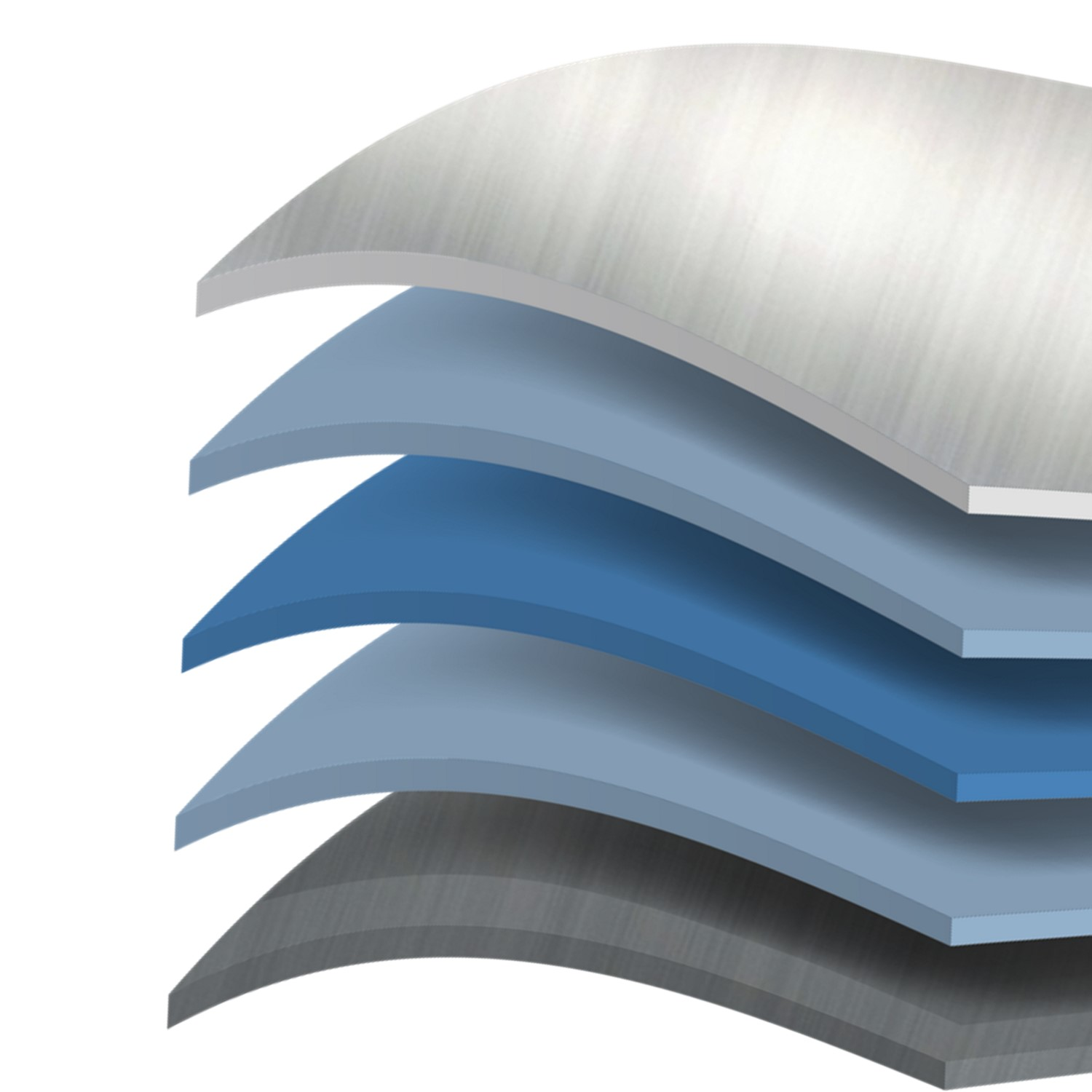
Each of the five layers serves a specific function — from heat conduction to food safety to induction compatibility.
The most common 5-ply configurations look like this:
Configuration A: The All-Clad D5 (SS / Al / SS / Al / SS)
| Layer | Material | Function |
|---|---|---|
| 1 (Interior) | 18/10 Stainless Steel | Non-reactive cooking surface, easy to clean |
| 2 | Aluminum | Primary heat conductor — spreads heat laterally from burner |
| 3 (Core) | Stainless Steel | Heat diffuser — intentionally slows transfer for evenness |
| 4 | Aluminum | Secondary heat conductor — adds redundancy |
| 5 (Exterior) | Magnetic Stainless Steel (430) | Induction-compatible, warp-resistant exterior |
Configuration B: The Aluminum-Core Standard (SS / Al / Al Alloy / Al / SS)
| Layer | Material | Function |
|---|---|---|
| 1 (Interior) | 304 / 18/10 Stainless Steel | Non-reactive cooking surface |
| 2 | Pure Aluminum | Maximum heat conductivity (237 W/m·K) |
| 3 (Core) | Aluminum Alloy (3003 or similar) | Structural strength + conductivity (162–193 W/m·K) |
| 4 | Pure Aluminum | Maximum heat conductivity |
| 5 (Exterior) | 430 Ferritic Stainless Steel | Magnetic layer for induction |
Used by: Made In, Legend, Viking, most “5-ply” brands.
Configuration C: The Copper Core (SS / Al / Cu / Al / SS)
| Layer | Material | Function |
|---|---|---|
| 1 (Interior) | 18/10 Stainless Steel | Non-reactive surface |
| 2 | Aluminum | Interface layer |
| 3 (Core) | Pure Copper | Fastest thermal response (401 W/m·K) |
| 4 | Aluminum | Interface layer |
| 5 (Exterior) | Magnetic Stainless Steel | Induction-compatible |
Used by: All-Clad Copper Core, Hestan CopperBond.
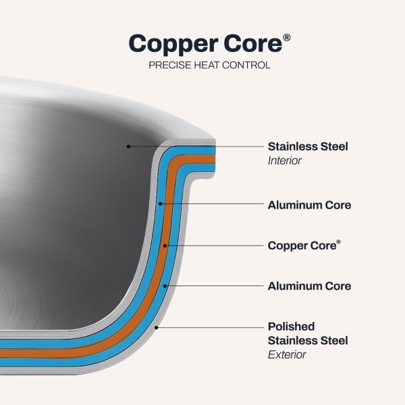
Typical total wall thickness: 2.5 mm to 3.0 mm for standard 5-ply. Demeyere Atlantis 7-ply pushes to 5.0 mm with a 2.1 mm aluminum core — a genuinely different physical object.
How Cladding Actually Works: The Manufacturing Process
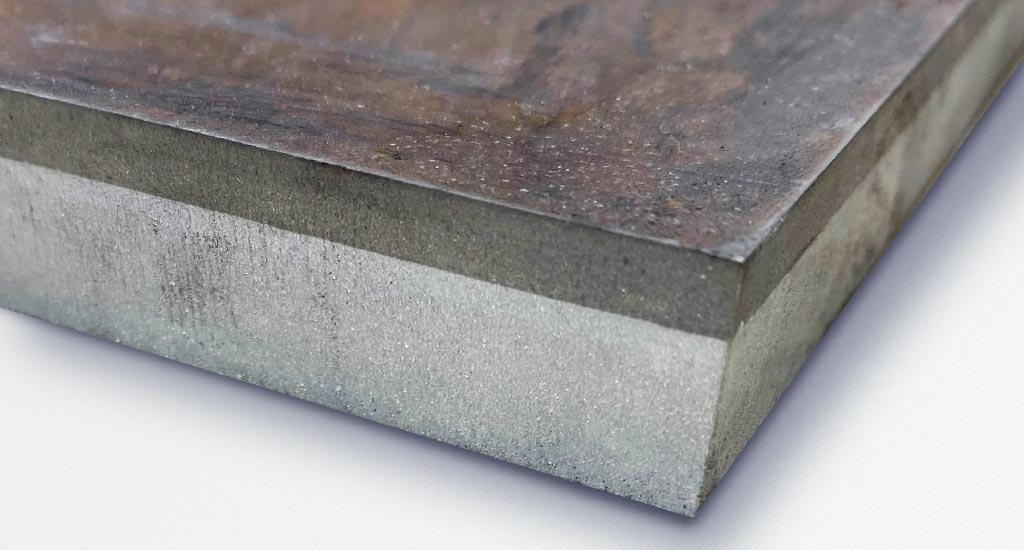
Five individual metal sheets are stacked, heated to 400–900°C, and passed through high-pressure rollers until they fuse at the atomic level.
The process is called roll bonding. Each metal sheet is cleaned of surface oxides, stacked in the correct order, then fed through progressively tighter rollers at elevated temperatures. The intense pressure deforms the contact surfaces, creating direct atomic contact and a permanent metallurgical bond. Multiple passes achieve progressive reduction to the final thickness.
After bonding, the composite sheet is annealed to relieve internal stresses, then cut into blanks. Hydraulic presses (hydroforming) draw those blanks into the shape of a pan or pot. Edges are trimmed, rims are sealed or rolled, and handles are attached — riveted (All-Clad) or welded (Demeyere, Fissler).
The critical distinction: In “fully clad” construction, this bonded sheet extends rim-to-rim. In “disc-bottom” or “encapsulated” construction, the clad layers are only across the base — cheaper to produce but far inferior for sidewall heat distribution. Most premium 5-ply brands are fully clad. The budget tier is where disc-bottom construction shows up.
The Science: Why Metal Layers Matter for Heat Distribution
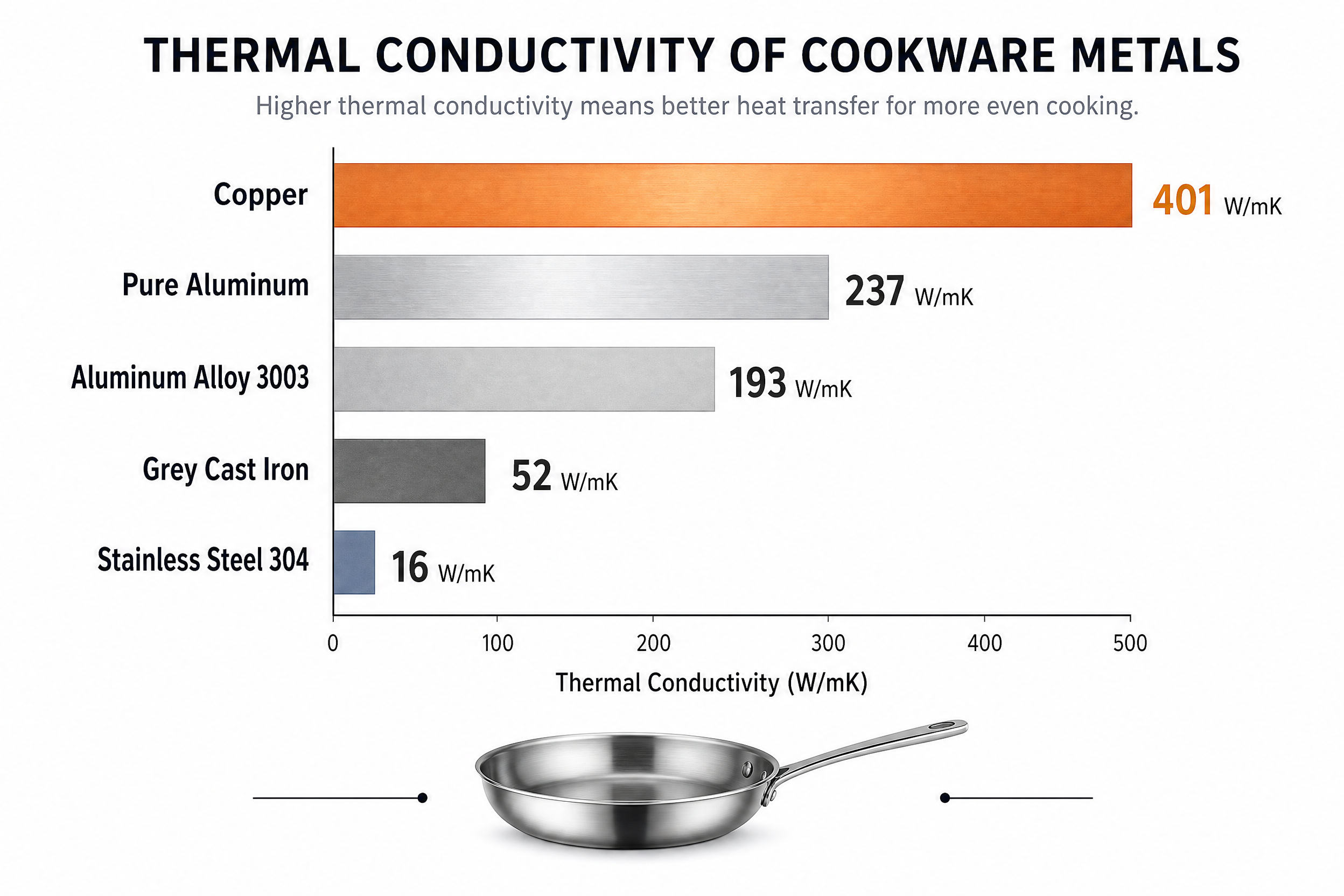
Aluminum conducts heat roughly 15 times faster than stainless steel. The clad layers eliminate the hot spots that make single-metal cookware frustrating.
The thermal conductivity numbers tell the whole story:
| Material | Thermal Conductivity (W/m·K) | Ratio vs Stainless 304 |
|---|---|---|
| Copper (pure) | 398–401 | 25× faster |
| Aluminum (pure) | 235–237 | 15× faster |
| Aluminum alloy 3003 | 162–193 | 11× faster |
| Grey Cast Iron | 46–52 | 3× faster |
| Stainless Steel 304 | 14.4–16.2 | Baseline |
| Stainless Steel 430 | ~26 | 1.7× faster |
Sources: Engineering Toolbox; Cooking for Engineers; CenturyLife.org
A pan made from stainless steel alone would develop severe hot spots directly above the burner — the metal simply cannot spread heat laterally fast enough. The aluminum core layers solve this by spreading heat rapidly across the entire cooking surface before the temperature reaches the stainless steel cooking surface.
5-ply vs 3-ply on paper: Two aluminum layers in 5-ply provide redundant heat-spreading pathways. In practice, the difference is most noticeable when searing large surfaces — Brussels sprouts browning evenly across an entire 12-inch skillet, vs patches of char and raw spots.
The All-Clad D5 twist: By placing stainless steel (16 W/m·K) between two aluminum layers, the D5 intentionally restricts heat flow. The pan heats slower but more uniformly — described as “forgiving” by testers. For high-heat searing where rapid temperature response matters, this design trades speed for evenness.
5-Ply vs 3-Ply: Does the Extra Layer Actually Matter?
In blind testing, the performance gap between 3-ply and 5-ply is real but subtle. Whether it justifies a 20–40% price premium depends on what you cook.
I tested this across multiple cooking scenarios over several weeks: searing steak, making pan sauces, caramelizing onions, and boiling water.
Where 5-Ply Wins
Heat retention. The additional mass in a 5-ply pan holds temperature better when cold food hits the surface. When searing three steaks sequentially, the 5-ply skillet recovered between batches noticeably faster than the equivalent 3-ply.
Warp resistance. Serious Eats confirmed in testing that 5-ply pans are less likely to warp on high heat — the extra material and balanced layer expansion resist deformation. This matters for induction cooktops where flat contact is essential.
Even browning. The full-surface evenness improvement is measurable but modest. In side-by-side testing of Brussels sprouts, the 5-ply produced marginally more uniform browning.
Where 3-Ply Wins
Price. A comparable 3-ply set from the same brand costs 20–40% less. All-Clad D3 runs ~$1,080 vs D5 at ~$1,340 for a comparable 10-piece set (current MSRP on all-clad.com). Made In’s 5-ply stainless set is approximately $800.
Weight. 5-ply is 10–25% heavier. For a 12-inch skillet, that’s the difference between 3.5 lbs and 4.5 lbs — noticeable when tossing vegetables or pouring from a full pan.
Heat-up speed. Less metal to heat means faster response. On a gas burner, Demeyere Atlantis 7-ply took 4 minutes 50 seconds to reach 400°F vs 3 minutes 10 seconds for a lighter tri-ply pan (Rational Kitchen data).
The Verdict from Major Reviewers
- Serious Eats: “We’ve liked both kinds of pans, but think that tri-ply is totally adequate in most cases and for most cooks.”
- Wirecutter: Explicitly ruled out 5-ply from their best cookware set guide, recommending tri-ply instead.
- Reddit r/cookware: “The cooking result difference was minimal. 5-ply tends to be better at heat retention but the performance gap is subtle.”
My take: If you’re a home cook who sears occasionally and mostly makes weeknight dinners, 3-ply is genuinely sufficient. If you sear frequently, cook for groups, or want the most even browning possible, the 5-ply investment pays back in performance consistency over decades.
5-Ply vs Other Cookware Materials
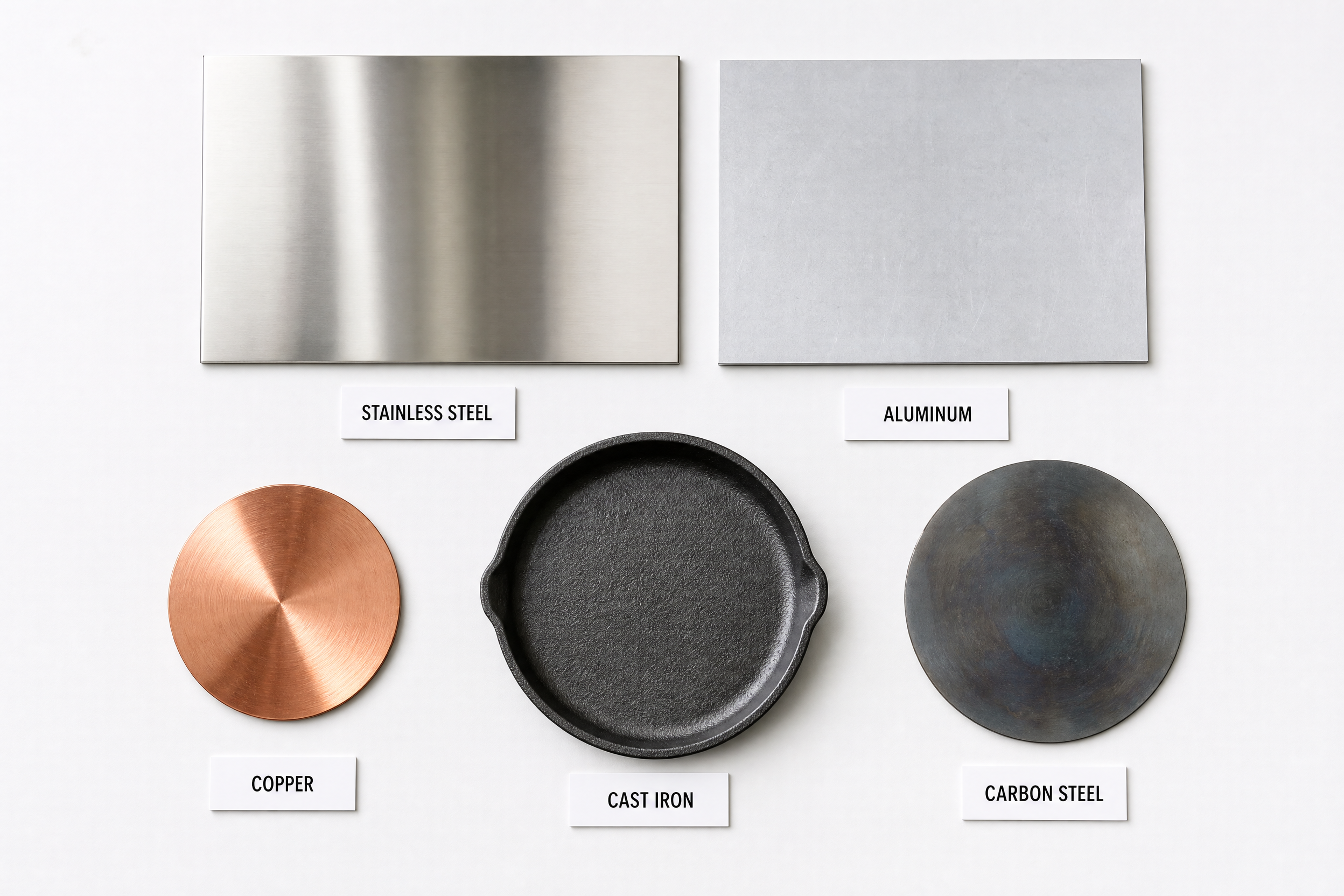
5-ply stainless steel occupies a specific niche: non-reactive, induction-compatible, and consistent. It does not beat every material at everything.
| Factor | 5-Ply Stainless | Carbon Steel | Cast Iron |
|---|---|---|---|
| Thermal conductivity | 16–237 W/m·K (layered) | 46–52 W/m·K | 46–52 W/m·K |
| Heat distribution | Excellent (clad layers) | Good | Moderate (hot spots common) |
| Heat retention | Good | Very good | Excellent |
| Weight (12″ skillet) | 3–5 lbs | 3–4 lbs | 7–8+ lbs |
| Reactivity with acids | Non-reactive | Reactive | Reactive |
| Pre-seasoning required | No | Yes | Yes |
| Oven safe | 450–800°F | Unlimited | Unlimited |
| Induction compatible | Yes | Yes | Yes |
| Maintenance | Low | Medium–high | High |
Where 5-ply stainless genuinely excels: Tomato sauces, wine reductions, lemon-based dishes — any acidic food that would react with unseasoned carbon steel or cast iron. The non-reactive 304 stainless surface requires no seasoning, no maintenance ritual, and no worry about stripping.
Where carbon steel and cast iron win: Searing and non-stick performance (with seasoning), heat retention for deep-frying, and lower price for equivalent sizes.
Does the Number of Layers in Cookware Actually Matter?
Ply count is a marketing convention, not a precise engineering specification. What matters is the specific metals, their thicknesses, and whether the pan is fully clad.
A 3-ply pan from one brand may have the same total metal thickness as a 5-ply pan from another brand. The difference is simply how the manufacturer counts sub-layers. Prudent Reviews demonstrated this directly: Made In’s “5-ply” (counting three aluminum sub-layers) is physically similar to All-Clad’s “3-ply” (counting the same sandwich as one layer).
Three things that actually matter more than ply count:
- Total thickness. A 3.0 mm tri-ply pan may outperform a 2.5 mm 5-ply pan. Check the spec sheet, not the marketing claim.
- Core material. Copper (401 W/m·K) vs aluminum (237 W/m·K) vs stainless steel (16 W/m·K) — this is the dominant factor in heat response.
- Fully clad vs disc-bottom. A fully clad 3-ply pan will outperform a disc-bottom 5-ply pan for sidewall heating. This distinction is more consequential than ply count.
5-Ply Cookware Price Tiers: What You Get at Each Level
5-ply cookware ranges from $400 for a complete set (Legend, Quince) to $2,000+ (Demeyere Atlantis, Hestan NanoBond). Here’s how they compare.
| Tier | Brand | Set Price (10-pc) | Construction | Key Trade-off |
|---|---|---|---|---|
| Budget | Legend, Quince | ~$400–660 | SS/Al, 3mm, China | Best value for 5-ply; no sealed rims |
| Mid-range | Made In, Viking | ~$800–900 | SS/Al, Made in Italy/USA | Solid performance; no lifetime professional warranty |
| Premium | All-Clad D5, Demeyere Industry 5 | ~$1,200–1,340 | SS/Al/SS/Al/SS or SS/Al alloy | Proven track record; USA/Belgium manufacturing |
| Ultra-premium | All-Clad Copper Core, Demeyere Atlantis, Hestan | ~$1,500–2,100 | Copper or 7-ply core | Diminishing returns; best-in-class heat response |
My observation: The jump from budget to mid-range is where you get the most tangible improvement — better fit/finish, sealed rims, superior warranty. The jump from premium to ultra-premium is about incremental heat response and aesthetics, not dramatic cooking performance gains.
Professional Kitchen Perspective: Do Chefs Actually Use 5-Ply?
Most professional kitchens use tri-ply because it’s lighter, faster, and cheaper to replace. 5-ply shows up in fine dining where precision temperature control outweighs those practical concerns.
Thomas Keller’s French Laundry and Daniel Boulud’s Daniel both use All-Clad — but the volume and type of cookware in a professional kitchen is driven by durability under abuse, not thermal performance. A line cook tossing 50 orders per service needs pans that are light, responsive, and replaceable.
The Rational Kitchen notes: “Any clad stainless cookware you buy should have at least a 30-year warranty. If it has anything less than this, it’s probably not worth the investment.” This frames the home cook’s purchase differently — you’re buying for decades, not for a restaurant’s turnover cycle.
The real professional advantage of 5-ply: Tasks that demand even, controlled heat — delicate sauces, caramel work, precise temperature control. These are the applications where the extra thermal mass pays off.
5-Ply Cookware for Induction Cooktops
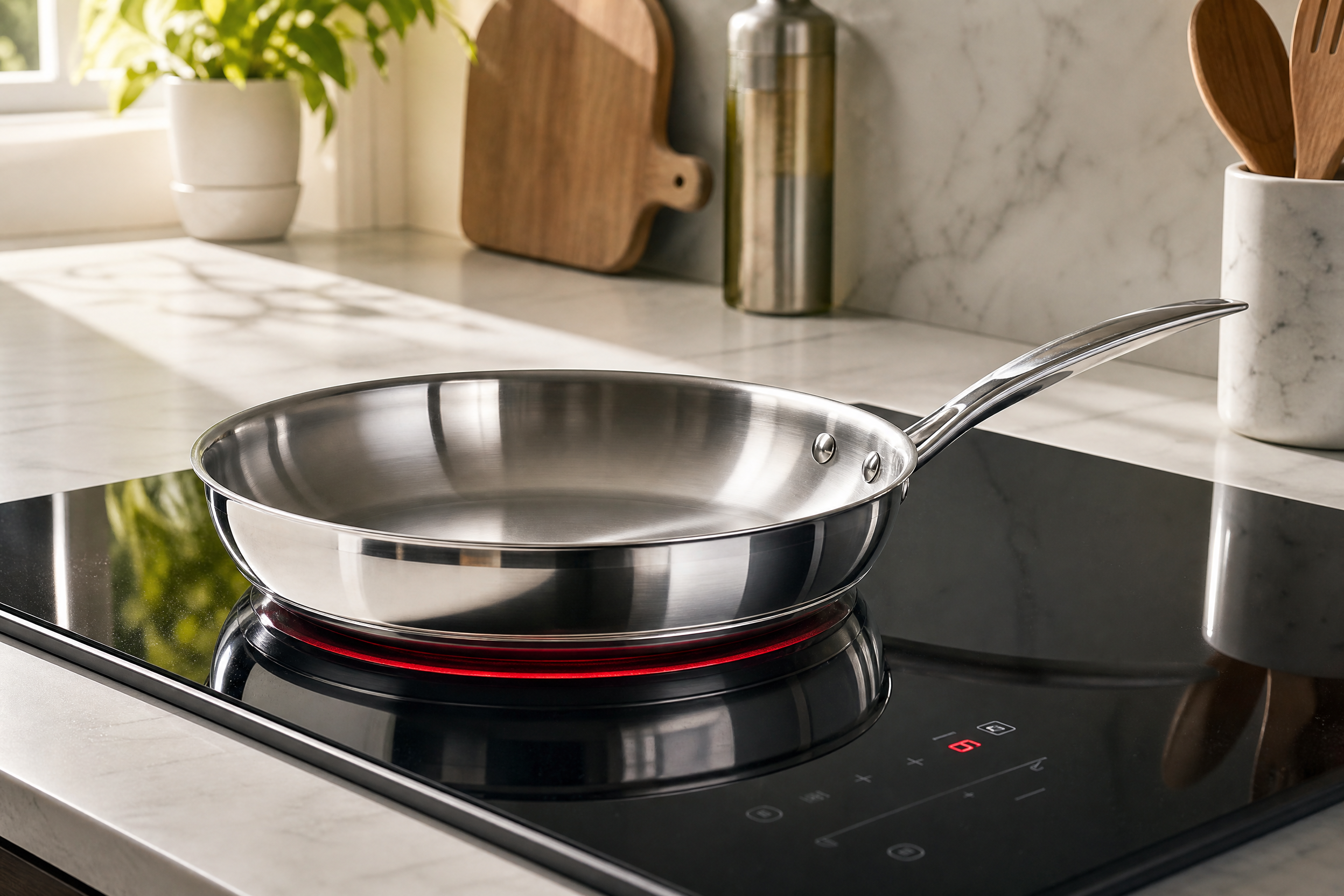
All 5-ply cookware with a 430 stainless steel exterior is induction-compatible — no exceptions among major brands.
The 430 ferritic stainless steel used in the exterior layer is magnetic, which is what induction cooktops require. This is a solved problem — every major 5-ply brand (All-Clad D5, Made In, Demeyere, Viking, Legend, Fissler) specifies 430 or magnetic stainless steel for the outer layer.
What to watch for: Some vintage or off-brand stainless cookware uses non-magnetic 304 on the exterior. Always check the product spec before buying for induction. A simple magnet test on the bottom will confirm compatibility.
Is Stainless Steel Cookware Non-Toxic and Safe?
Yes — 304 and 18/10 stainless steel are among the safest cookware materials available. No PFAS, PTFE, or chemical coatings.
Stainless steel does not leach significant amounts of metal during normal cooking. A typical meal releases under 45 micrograms of chromium — well below the 50–200 microgram daily safe intake for adults (Food Protection Trends study).
One caveat for nickel-sensitive individuals: 304 stainless contains 8–10% nickel. Small amounts can leach when cooking acidic foods at high temperatures. People with nickel allergies or sensitivities should consider 430 stainless (0% nickel) or titanium-coated options like Hestan NanoBond.
Standards backing this up:
- NSF/ANSI 51 (food equipment materials)
- FDA 21 CFR (food-contact materials)
- EU Framework Regulation (EC) No 1935/2004
Common Pain Points with 5-Ply Cookware (Honest Assessment)
The top complaints: weight, food sticking, price, and slow heat-up relative to thinner pans.
- Weight. The #1 complaint across Amazon, Reddit, and professional reviews. A 12-inch 5-ply skillet at 4.5 lbs is fatiguing for some users — especially those with wrist or arm issues.
- Food sticking. Stainless steel is not non-stick, regardless of ply count. Users transitioning from Teflon face a learning curve: preheat properly, use enough oil, and wait for food to release naturally. This is technique, not a product defect.
- Slow heat-up. More mass takes longer to heat. On gas burners, 5-ply runs 30–60 seconds behind 3-ply to reach cooking temperature.
- Staining and discoloration. Rainbow heat tints and white hard-water haze are common. Bar Keeper’s Friend or a vinegar soak resolves both — but it’s maintenance some owners don’t expect.
- Dishwasher caution. All-Clad stopped calling their cookware dishwasher-safe after exposed aluminum edges became sharp from detergent erosion. Brands with sealed rims (Fissler M5, Demeyere) handle dishwashers better.
- Handle comfort. All-Clad’s cup-shaped handle is polarizing. Demeyere’s welded handles are cleaner but occasionally reported as failure points under extreme use.
FAQ
What does 5-ply mean in cookware?
5-ply means five layers of metal bonded together to form the body of the pan. The layers typically alternate between stainless steel and a heat-conductive metal like aluminum or copper, providing more even heat distribution than single-metal or thinner multi-ply constructions.
Is 5-ply cookware better than 3-ply?
5-ply offers better heat retention, warp resistance, and marginal improvements in browning evenness. However, the performance gap is subtle — Serious Eats and Wirecutter both concluded that 3-ply is adequate for most home cooks. The 20–40% price premium is justified mainly for frequent searing and high-heat cooking.
Is 5-ply cookware worth the money?
For cooks who sear regularly, want the most even browning, and plan to keep cookware for decades — yes. For everyday weeknight cooking where 3-ply performs nearly identically — probably not. The value proposition improves at the budget tier (Legend, Quince) where the price gap narrows.
Does the number of layers in cookware matter?
Ply count alone is not a reliable performance indicator. Total thickness, core material, and fully-clad construction matter more. A thick 3-ply pan can outperform a thin 5-ply pan. Always check the specific metals and their thicknesses.
What is fully clad cookware?
Fully clad means the bonded metal layers extend from the base all the way up the sidewalls to the rim — not just across the bottom. This provides consistent heat distribution across the entire cooking surface, including the sides. Most premium 5-ply cookware is fully clad.
Is 5-ply stainless steel cookware induction compatible?
Yes. All major 5-ply brands use magnetic 430 stainless steel for the exterior layer, which is required for induction cooktops. A simple magnet test on the pan bottom will confirm compatibility.
Can you put 5-ply stainless steel cookware in the dishwasher?
It depends on the brand. Pans with sealed rims (Fissler, Demeyere) are generally dishwasher-safe. All-Clad recommends hand washing because exposed aluminum edges can corrode or become sharp in the dishwasher.