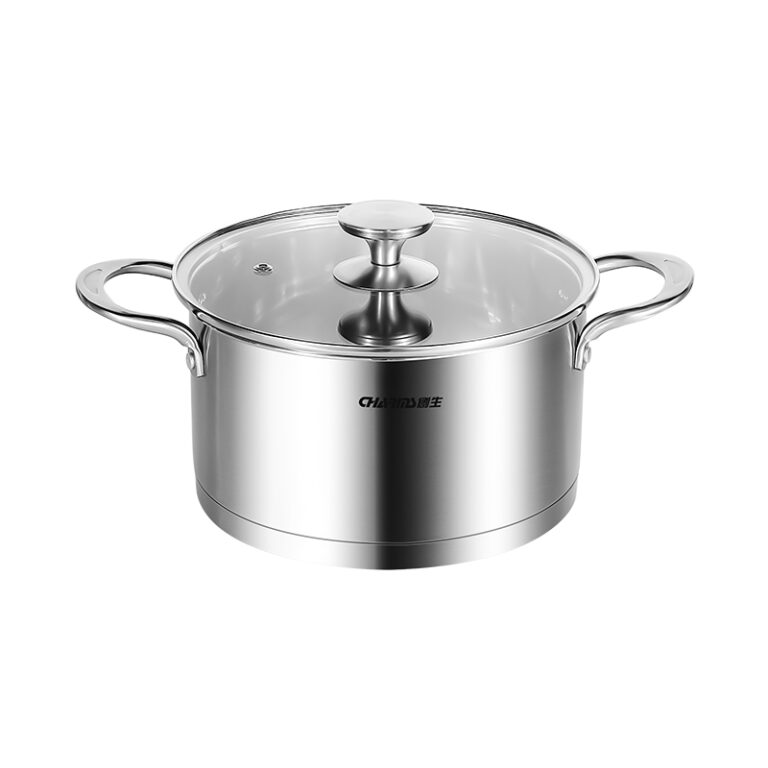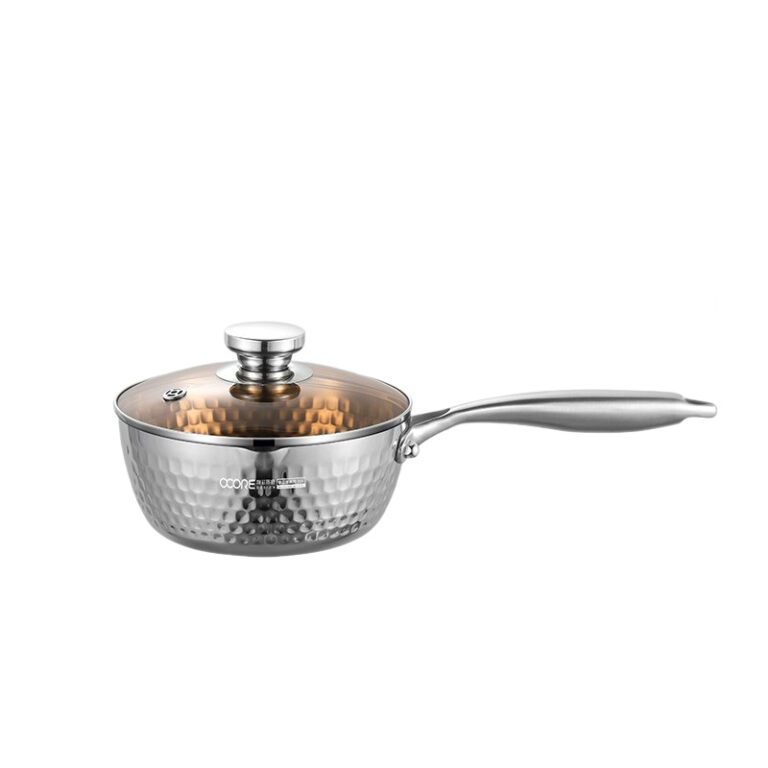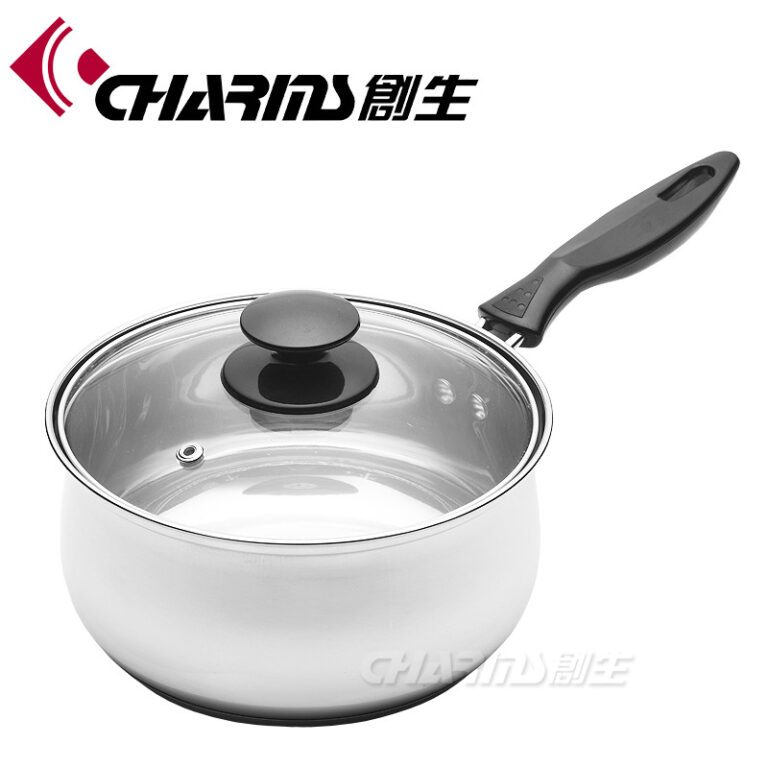

In practical use, the size of your frying pan often affects the taste of the cooked food earlier than its material, brand, or even price. Did you know? When many people are choosing a stainless steel frying pan, they tend to focus on the steel grade, the composite layer structure, or whether it is suitable for induction cookers, seemingly neglecting a more fundamental question: that is, is the size of this frying pan really suitable for your usage scenario?
Based on long-term experience in the manufacturing and application of stainless steel cookware, choosing the wrong size is one of the common reasons for problems such as “poor usability”, “easy sticking to the pot”, and “uneven heating”. It’s not that the pot is not good enough, but rather that there is a mismatch between its working area, heat distribution method, and the actual cooking requirements.
The diameter of the frying pan determines whether the ingredients will be crowded, whether the steam can evaporate smoothly, and whether the oil can be evenly spread, and it also directly affects the coloring effect on the surface of the ingredients and the stability of their texture. This is particularly crucial for those who frequently handle protein-rich ingredients and need a stable output.
In this article, I will start from a practical perspective to understand the four most common sizes of frying pans, and combine the characteristics of stainless steel materials to help you more clearly understand the logic and value behind different sizes. It’s not about “which one is better”, but which one is more suitable for what you are doing.
If you are looking for a frying pan for your project, then I think it’s necessary for you to read this content!
1. Does Frying Pan Size Really Matter?
Yes, and more than many buyers initially expect.
A frying pan’s diameter directly controls three critical factors: heat distribution, cooking capacity, and workflow efficiency. When the size is mismatched to its use, even high-quality stainless steel will not perform at its best.
Heat Distribution and Control
Stainless steel relies heavily on its construction—especially the aluminum or copper core—to spread heat evenly. However, the pan’s diameter determines how effectively that heat is utilized.
- A pan that is too small forces food to crowd.
- Crowding traps steam.
- Steam prevents proper browning.
This is why proteins often turn gray instead of developing a golden crust when cooked in undersized pans. The issue is not heat power. It is surface area.
Cooking Capacity and Yield
From a commercial or bulk-preparation perspective, pan size also affects output per cycle. A slightly larger pan can reduce cooking batches, improve consistency, and save time. Over hundreds of uses, this difference becomes operationally meaningful.
Oil Management and Food Contact
Pan size changes how oil spreads and how food contacts the surface. In stainless steel, proper preheating and oil distribution are essential. A pan that is too large for the food being cooked can cause oil to pool excessively, increasing the risk of uneven cooking or oil degradation.
Storage, Handling, and Ergonomics
Larger pans are heavier. They require stronger handles, better balance, and sufficient storage space. In professional environments, these factors influence safety and speed.
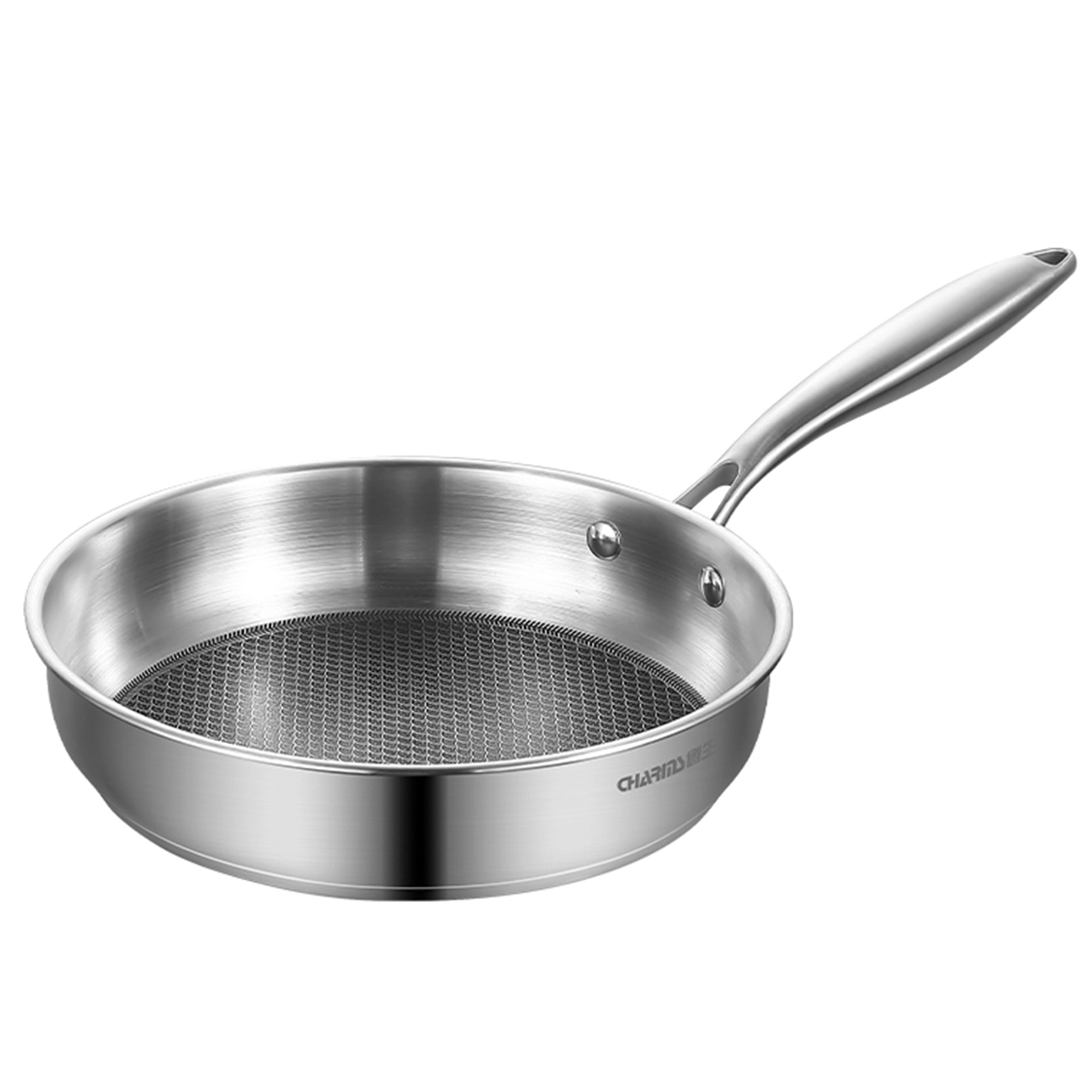
2. The Four Most Common Frying Pan Sizes
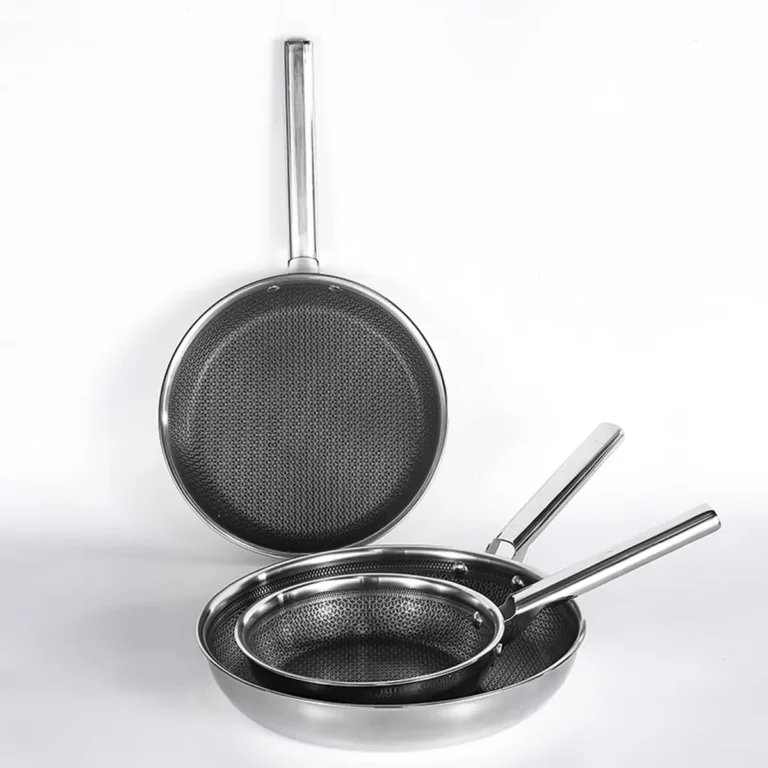
While custom sizes exist, the global cookware market consistently revolves around four core frying pan diameters. Each serves a distinct purpose, and none can fully replace the others.
8-Inch Frying Pan (20 cm)
The 8-inch frying pan is compact, precise, and efficient when used correctly.
Best Use Scenarios
- Single-portion cooking
- Eggs, omelets, pancakes
- Small protein cuts
- Sauce finishing or reheating
Performance Characteristics
This size heats quickly and responds fast to temperature changes. That makes it ideal for delicate tasks where control matters more than volume.
However, its small surface area limits evaporation. Overloading it leads to moisture buildup almost immediately.
Who Should Choose It
This size is best as a supplementary pan, not a primary one. It excels in precision tasks but cannot support volume cooking efficiently.
10-Inch Frying Pan (24–26 cm)
The 10-inch frying pan is often considered the most versatile size, and for good reason.
Best Use Scenarios
- Daily cooking tasks
- Sautéed vegetables
- Chicken breasts, fish fillets
- Two to three portion meals
Performance Characteristics
This size balances surface area with manageability. It allows enough space for browning while remaining easy to lift and maneuver.
Heat retention is stable, especially when paired with a tri-ply or fully clad stainless steel body.
Who Should Choose It
If you had to select only one frying pan size, this would be the most adaptable choice for most cooking environments.
12-Inch Frying Pan (28–30 cm)
The 12-inch frying pan is designed for capacity and performance under load.
Best Use Scenarios
- Family-sized meals
- Multiple protein portions
- High-volume sautéing
- One-pan dishes
Performance Characteristics
This pan offers excellent evaporation space, which improves searing and reduces steaming. It also handles larger food items without overlap.
The trade-off is weight. A well-constructed stainless steel 12-inch pan is heavier, especially when fully clad.
Who Should Choose It
This size is ideal when volume and consistency matter more than speed or light handling. It is often selected as a primary pan in serious cooking environments.
14-Inch Frying Pan (34–36 cm)
The 14-inch frying pan is a specialized tool.
Best Use Scenarios
- Batch cooking
- Large-format dishes
- Professional or semi-professional use
- Shared cooking surfaces
Performance Characteristics
This pan provides maximum surface area. It allows food to cook without crowding, even at high volumes.
However, it requires:
- Strong heat sources
- Careful preheating
- Adequate storage space
Who Should Choose It
This size is best chosen intentionally for specific needs. It is not a replacement for smaller pans but a complement.
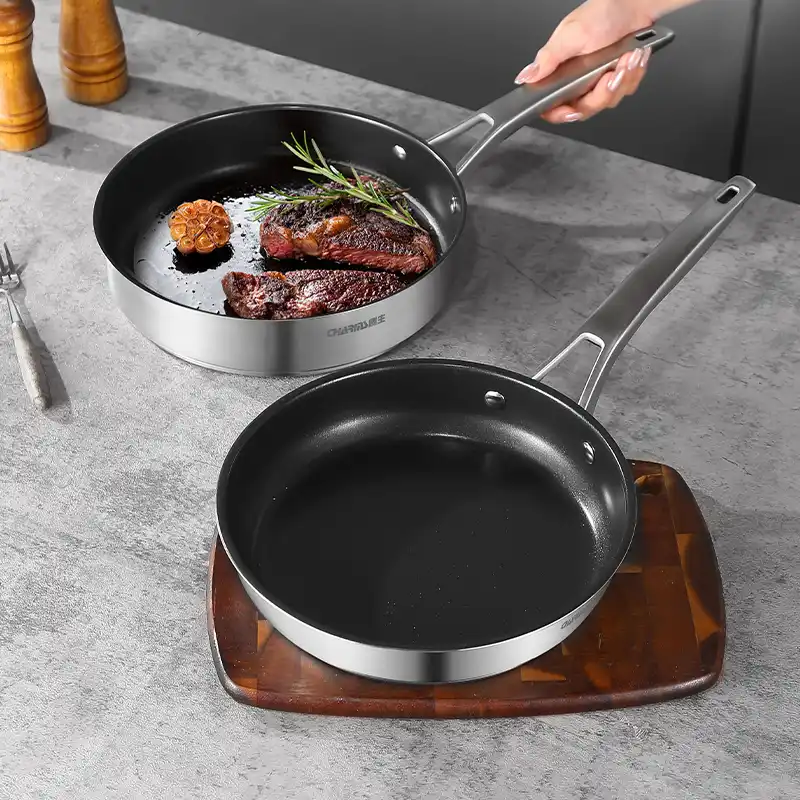
3. What Materials Are Used to Make Frying Pans?
| Primary body material: corrosion-resistant, strong, non-reactive with food | Description | Advantages | Considerations / Notes |
|---|---|---|---|
| Stainless Steel | Primary body material, corrosion-resistant, strong, non-reactive with food | Durable, easy to clean, long-lasting | Poor heat conductivity on its own; requires a conductive core like aluminum or copper for even heating |
| Aluminum Core | Common core material in stainless steel pans | Fast heat transfer, lightweight, cost-effective | Needs to be fully clad or multi-layered to ensure uniform heat distribution |
| Copper Core | Used in high-end or professional pans | Excellent thermal conductivity, very responsive to temperature changes | Expensive, complex manufacturing, requires stainless steel cladding to prevent direct food contact |
| Multi-Ply / Clad Construction | Multiple bonded layers (e.g., tri-ply, five-ply, or hybrid structures) | Even heat distribution, durable, balances weight and performance | Quality of bonding and layer thickness is more important than number of layers |
| Disc-Bottom / Encapsulated Base | Conductive material mainly at the base | Improves heat distribution at the bottom, works well on induction | May not heat large pans evenly; sides can remain cooler |
4. How to Choose the Right Frying Pan Size?
Step 1: Define Primary Cooking Tasks
Ask yourself:
- What foods are cooked most often?
- Are portions single, shared, or batch-based?
- Is browning performance critical?
Protein-heavy cooking benefits from larger surface areas. Sauce-based or reheating tasks do not.
Step 2: Match Heat Source Capacity
Larger pans need stronger, more even heat sources. If heat input is limited, oversized pans underperform.
This is especially relevant for induction compatibility, where coil size matters.
Step 3: Balance Weight and Control
A heavier pan retains heat better but demands stronger handling. Consider who will use it and how often.
Ergonomic handle design becomes more important as the size increases.
Step 4: Plan a Size Combination
Rather than searching for a single “perfect” size, most experienced buyers choose two complementary sizes:
- One medium (10-inch or 12-inch)
- One small or large, depending on needs
This approach improves flexibility without redundancy.
5. Conclusion
The size of a frying pan is very important – it affects the way food is cooked, the transfer of heat and the operational efficiency of the kitchen. The four common sizes – 8 inches, 10 inches, 12 inches, and 14 inches – each have their own advantages. Small frying pans are suitable for fine cooking, medium frying pans have a wide range of uses and are suitable for daily cooking, while large frying pans can cook a large amount of food at one time without feeling crowded.
Charms Cook is located in Caitang, the hometown of stainless steel in China. With nearly 30 years of experience in manufacturing stainless steel cookware, we are dedicated to providing high-quality, durable, and environmentally friendly kitchen solutions.
If you are interested in us, we would be very glad to receive your message!