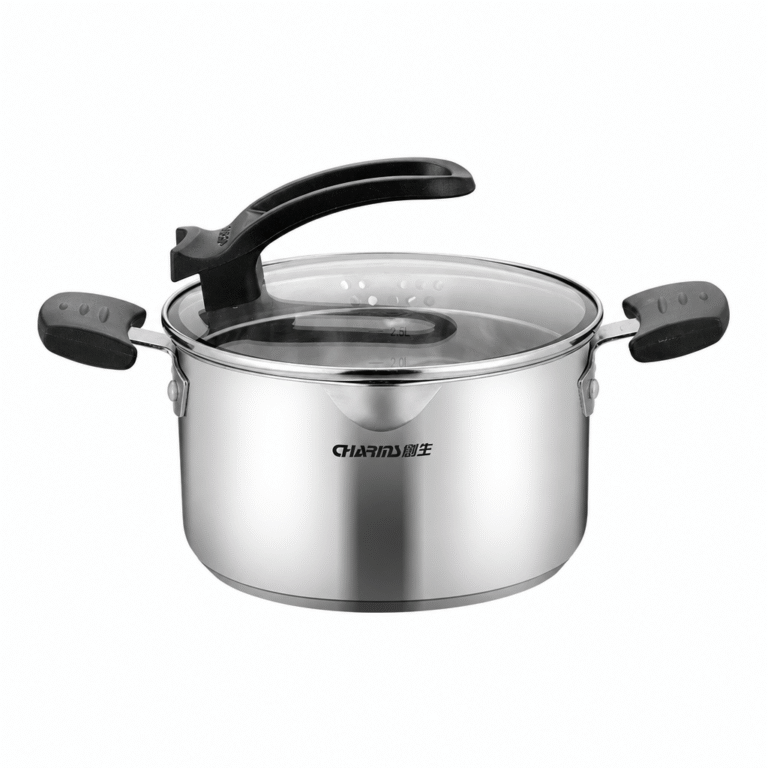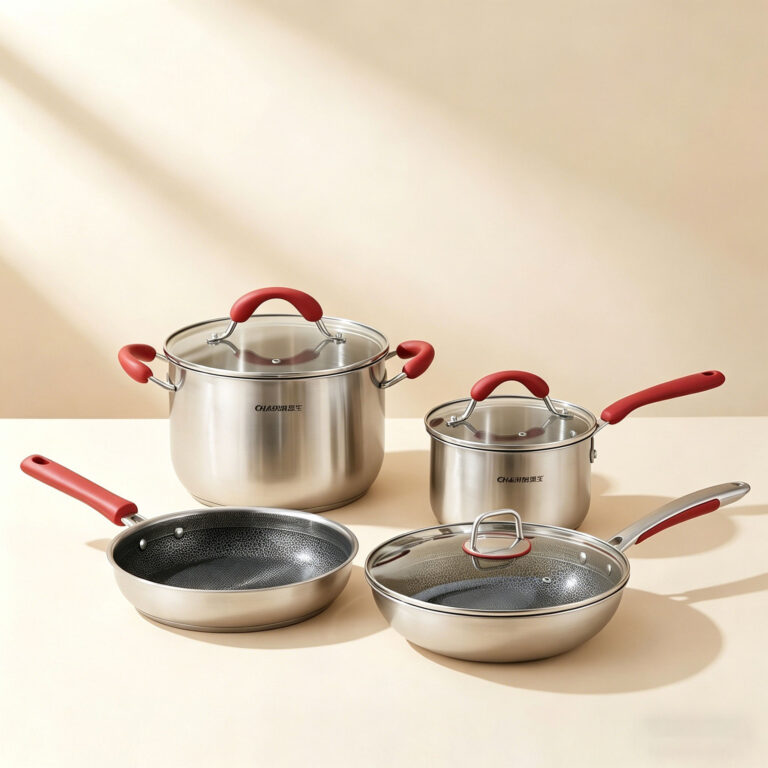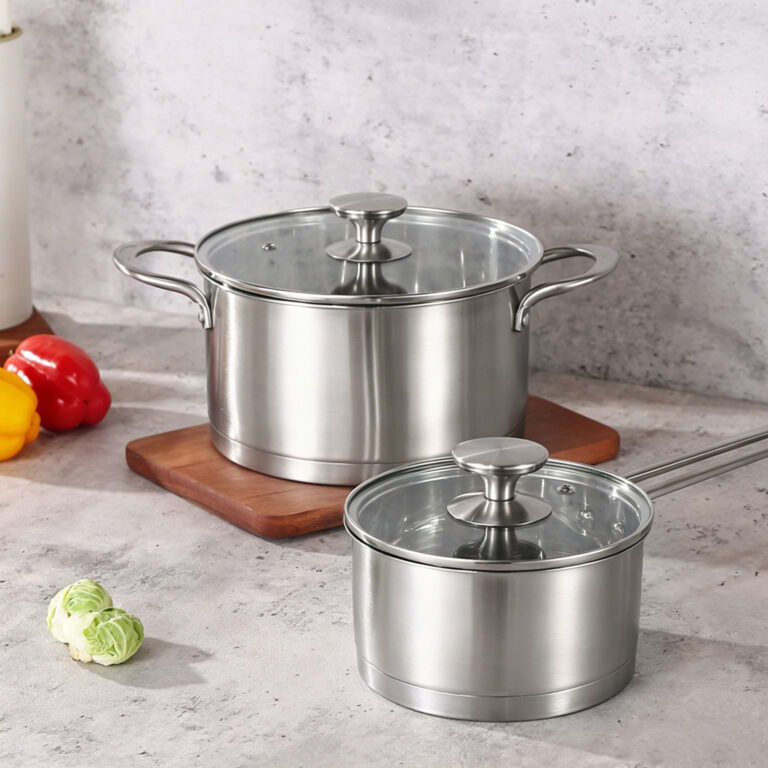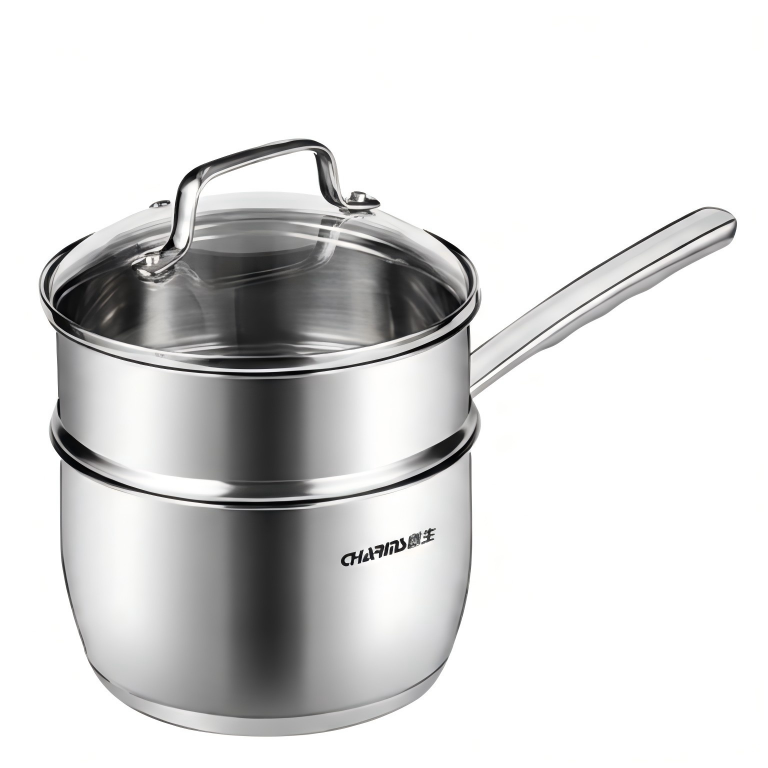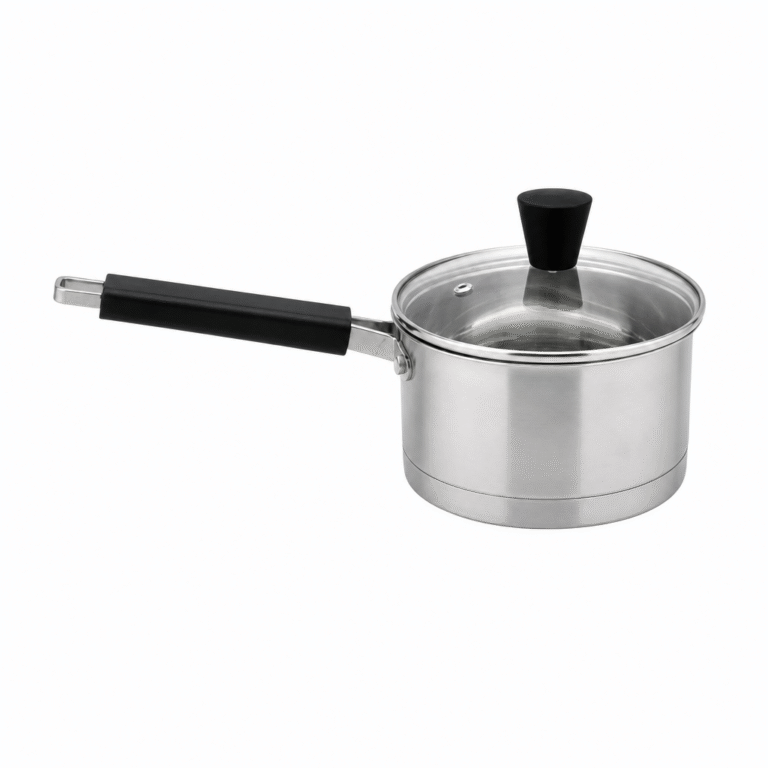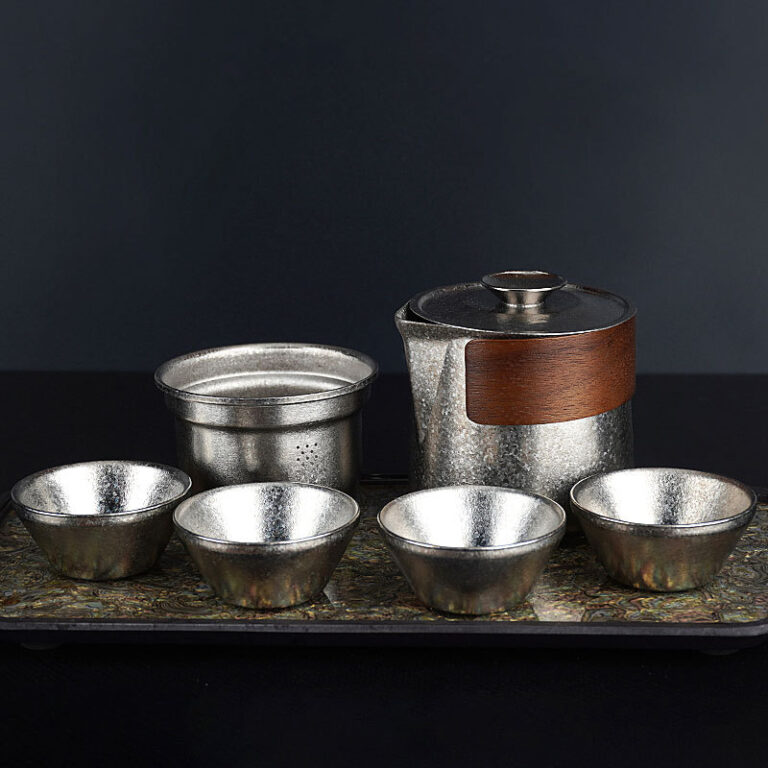


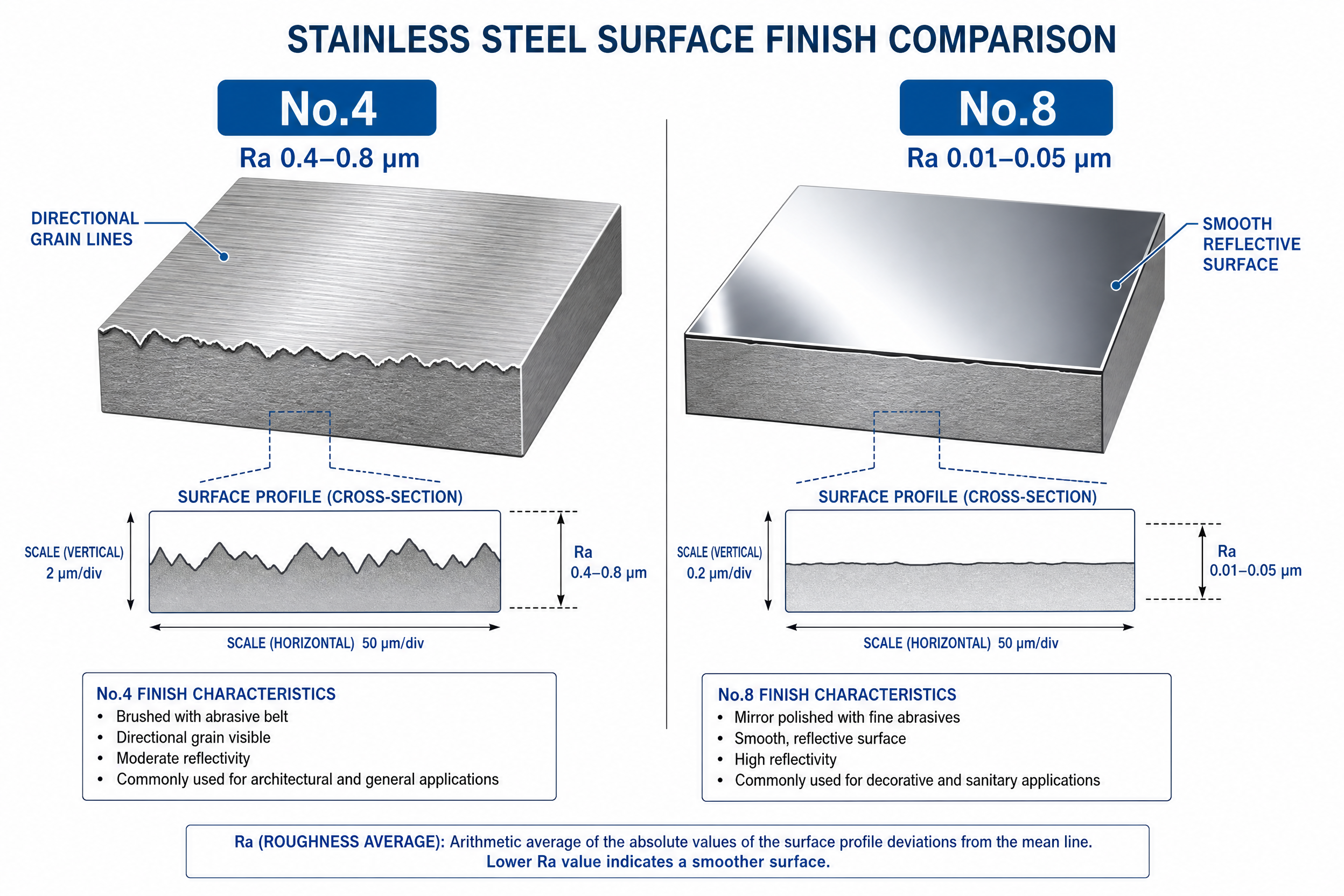
Brushed and mirror polished stainless steel look very different, but for cookware performance the finish rarely matters. What actually changes is maintenance, scratch visibility, and long-term appearance. Brushed finishes (#4, Ra 0.4–0.8 µm) hide fingerprints and wear better. Mirror polish (#8, Ra < 0.05 µm) looks striking but shows every scratch. Both meet the food-grade hygiene threshold (Ra < 0.8 µm). The third option — sandblasted — sits at Ra 1.0–6.0 µm and offers the most texture. Most premium cookware brands use brushed interiors for a reason, and this guide explains exactly what that reason is.
Quick Answer
The short version: brushed and mirror polished stainless steel perform identically in the kitchen. The finish does not change how your pan heats, how food cooks, or how safe the surface is. What changes is how the pan looks after six months of use — and how much time you spend cleaning smudges off the exterior.
If you’re choosing a pan primarily for cooking results, pick whichever finish you’ll maintain more consistently. If appearance matters, brushed holds up better to daily use; mirror polish makes a statement but demands more upkeep.
What These Finishes Actually Are

Every stainless steel pan goes through a finishing process after the steel is formed. That process determines the surface texture — and the key measurement is Ra (roughness average), expressed in micrometers (µm). Lower Ra = smoother surface.
Here’s how the main finishes compare:
| Finish | ASTM Designation | Typical Ra (µm) | Appearance | Common Cookware Use |
|---|---|---|---|---|
| Brushed (#4) | No. 4 | 0.4–0.8 | Satin, directional grain | Interior cooking surfaces |
| Fine Brushed (#6) | No. 6 | 0.3–0.5 | Soft satin, subtle grain | High-end pan interiors |
| Mirror Polish (#8) | No. 8 | 0.01–0.05 | Highly reflective | Decorative exteriors |
| Sandblasted | Process-defined | 1.0–6.0 | Matte, non-directional | Exterior texture panels |
Sources: ASTM A480; IMOA Roughness Measurements PDF; Astro Pak Ra Chart
Brushed finish is produced by grinding the steel surface with abrasive belts (typically 120–240 grit) in one direction, creating the characteristic parallel grain lines. The #4 grade is the most common, used in commercial kitchen equipment and the majority of home cookware.
Mirror polish follows several progressive polishing stages, ending with buffing compounds that bring Ra below 0.05 µm. The result reflects like glass — impressive on a shelf, high-maintenance in actual use.
The fine brushed #6 finish sits between #4 and mirror in both smoothness and appearance. It uses finer Tampico brushing per ASTM A480, and several premium European cookware lines now specify this grade on interior cooking surfaces.
Cooking Performance — The Real Story
The bottom line: surface finish does not meaningfully change cooking results.
The thermal conductivity of 304 stainless steel is approximately 16 W/(m·K) regardless of how the surface looks. Heat distribution is determined by pan construction — ply count, core material (aluminum or copper), and wall thickness. The finish contributes nothing to that equation.
Cooking on a mirror-polished Fissler pan and a brushed All-Clad D3 under identical conditions — same burner, same preheat time, same oil — produces the same Maillard crust, the same fond, the same result. Pan construction determines the outcome; the finish is cosmetic from a cooking standpoint.
A frequently cited discussion in r/AskCulinary puts it plainly: “No difference. Every mirror-finish pan ends up with a patina anyway.” That reflects actual long-term ownership experience, and it lines up with every technical reference available.
One nuance worth mentioning honestly: emissivity. Mirror-polished surfaces have lower emissivity (~0.05–0.1) than brushed surfaces (~0.2–0.4), meaning mirror polish reflects more radiant heat rather than absorbing it. In practice, at stovetop temperatures where direct conduction dominates, this difference is negligible for cooking outcomes. I’m not aware of a controlled test that confirms any practical difference in actual cookware use — and if one exists, I haven’t found it.
Cleaning and Daily Maintenance
This is where the two finishes genuinely diverge — and where the choice has real consequences for your kitchen routine.
Brushed finish: The directional grain pattern visually camouflages light scratches, smudges, and the patina that develops on a well-used pan. Clean along the grain with a soft sponge and dish soap. Bar Keepers Friend (oxalic acid cleaner) restores the look after heavy use without damaging the grain. After years of cooking, a brushed pan looks used in the best sense.
Mirror polish: Shows everything. Every fingerprint, every nick from a metal spatula, every water spot from air-drying. After a few months of regular cooking, the mirror finish around the cooking zone develops visible surface wear. The steel itself is just as functional — this is purely cosmetic — but if the reflective look was the draw, real kitchen use will disappoint you within a season.
A practical point that gets overlooked: most premium cookware brands deliberately use brushed exteriors as well. A scratched mirror exterior on a $250 pan feels like deterioration. A scratched brushed exterior looks like character.
What About Sandblasted Finish?
Sandblasted stainless steel is the third option that rarely gets discussed in cookware comparisons — and it’s worth understanding if you’re evaluating specialty pans or commercial equipment.
The process fires abrasive particles (glass beads or aluminum oxide) at the steel surface, creating a non-directional matte texture. Ra values range widely: 1.0–6.0 µm depending on blast media and dwell time. That’s rougher than brushed and far rougher than mirror polish.
For cookware, sandblasting appears in two main contexts:
- Exterior panels on commercial kitchen equipment, where grip and durability matter over reflectivity
- Post-use restoration — some services sandblast heavily carbon-fouled pans; this works well on bare cast iron and carbon steel, but nonstick-coated and standard SS interiors generally don’t tolerate it
The higher Ra of sandblasted surfaces raises a legitimate food-contact concern: surfaces above Ra 0.8 µm approach the limit of what standard sanitation procedures can reliably clean. Above Ra 1.6 µm, biofilm retention becomes a documented issue in food service contexts. This is why food-grade stainless standards set Ra < 0.8 µm for direct food contact.
Seeing “sandblasted exterior” in a cookware listing is normal. Sandblasted interior on a food-contact surface warrants scrutiny.
Hygiene: Does Rougher Mean Less Clean?
The food industry has a data-backed answer: hygiene is determined by Ra value, not finish name.
The 3-A Sanitary Standards — the benchmark for food-grade surfaces in North America — specify a maximum Ra of 0.8 µm for surfaces in direct food contact. Standard brushed (#4, Ra 0.4–0.8 µm) sits right at this threshold. Mirror polish (#8, Ra < 0.05 µm) is far below it. Both qualify as food-safe and properly cleanable.
The concern that “brushed grooves trap bacteria” doesn’t hold up technically. The grooves in a #4 brushed finish are roughly 0.5–0.8 µm deep — small enough that hot water, dish soap, and mechanical scrubbing remove contamination effectively. Multiple food science studies have confirmed that properly cleaned brushed and mirror-polished stainless surfaces show equivalent bacterial reduction under standard sanitation protocols.
Where Ra does matter is at the extremes: heavily pitted, corroded, or sandblasted surfaces (Ra > 1.6 µm) can harbor biofilm that survives normal cleaning. But that’s well outside the range of any quality cookware surface — brushed or polished.
Why Most Cookware Brands Choose Brushed Interiors
If mirror polish is technically smoother, why do virtually all serious cookware manufacturers use brushed interiors?
All-Clad D3, D5, Copper Core: Brushed interior
Demeyere Atlantis: Brushed interior
Fissler Original-Profi: Brushed interior
Made In Stainless: Brushed interior
Silampos: Brushed interior, mirror exterior
The pattern is consistent across the premium segment. Three reasons drive it:
1. Wear visibility. Brushed surfaces hide the micro-scratches that accumulate from spatulas, whisks, and cleaning. Mirror polish records every one of them. A scratched cooking surface looks damaged even when the steel is structurally fine. Brushed interiors age gracefully; mirror interiors age visibly.
2. Performance parity. Since both finishes cook identically (see above), there’s no engineering reason to use the harder-to-maintain finish on a cooking surface.
3. Consistent food-release behavior. Professional kitchen equipment specialists note that the slight texture of a brushed surface creates more consistent behavior during the Leidenfrost-effect preheating phase — the micro-texture gives the vapor layer a uniform base to form across. This is cited as professional preference in culinary circles; I’m presenting it as industry consensus rather than independently verified data.
The mirror exterior / brushed interior combination — used by Silampos and some All-Clad collections — is the logical outcome: impressive-looking finish where people see it, practical finish where the food goes.
How to Choose: A Practical Guide
| Your situation | Best finish choice | Why |
|---|---|---|
| Daily cooking, want low upkeep | Brushed (#4 or #6) interior | Hides wear, ages well |
| Care about kitchen aesthetics | Mirror exterior + brushed interior | Best of both worlds |
| Commercial / high-volume kitchen | Brushed #4 or #6 | Meets 3-A food-grade standard, survives aggressive cleaning |
| Buying as a gift or for display | Mirror polish | Impressive unboxed, lower-use scenario |
| Very hard water area | Brushed | Water spots far less visible |
| Specialty exterior texture/grip | Sandblasted exterior | Non-directional matte, durable |
| Focused only on cooking results | Either | Finish has no effect on cooking performance |
Frequently Asked Questions
Does stainless steel surface finish affect cooking performance?
No. Thermal conductivity, heat distribution, and food behavior are set by pan construction — ply count, core material, thickness. Both brushed and mirror polished surfaces produce the same cooking results in equivalent pans.
What is the Ra value of brushed stainless steel?
Standard brushed (#4) stainless steel has a typical Ra of 0.4–0.8 µm. The finer #6 satin finish runs 0.3–0.5 µm. These values follow ASTM A480 standard designations.
Is mirror polished stainless steel more hygienic than brushed?
Not meaningfully. Both finishes fall within the 3-A Sanitary Standards food-grade threshold of Ra < 0.8 µm. Normal dishwashing with hot water and soap removes contamination effectively from either surface.
Why do premium cookware brands use brushed interiors instead of mirror polish?
Brushed interiors hide the micro-scratches that accumulate from normal cooking and cleaning. Since both finishes perform identically, brushed is the practical choice — it ages gracefully where mirror polish shows wear.
What is sandblasted stainless steel, and is it safe for cookware?
Sandblasted finish creates a matte, non-directional texture with Ra 1.0–6.0 µm. It is common on exterior surfaces and industrial equipment. For food-contact cooking surfaces, the higher Ra raises cleaning concerns, so sandblasted interiors are unusual in quality cookware.
Which stainless finish is easiest to maintain at home?
Brushed (#4 or #6). The grain pattern camouflages scratches and smudges. Mirror polish demands more careful cleaning to maintain its look, and normal cooking use inevitably dulls the reflection within months.
Summary
The brushed vs mirror polish debate is mostly aesthetic. Both finishes are food-safe, cook identically, and clean up with the same method. What differs is how they age: brushed hides its history; mirror polish keeps a record of every scratch and fingerprint.
The data points to brushed as the more practical choice for a cooking surface — which is exactly why nearly every serious cookware brand uses it on pan interiors. Mirror polish earns its place on exteriors and low-use presentation pieces where appearance matters more than durability.
If anyone tries to sell you a mirror-polished interior as a performance upgrade over brushed, that is a marketing claim, not an engineering one.