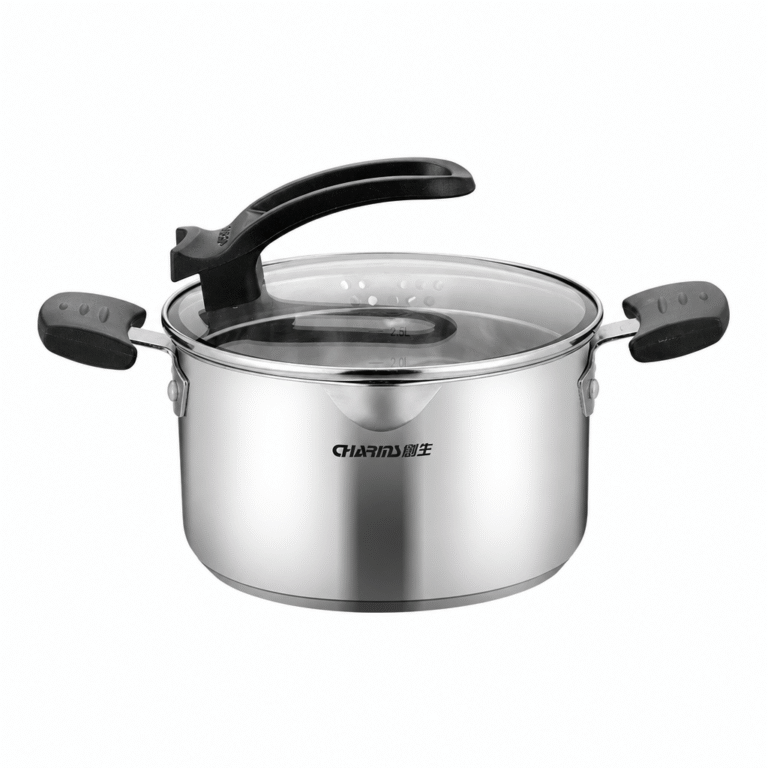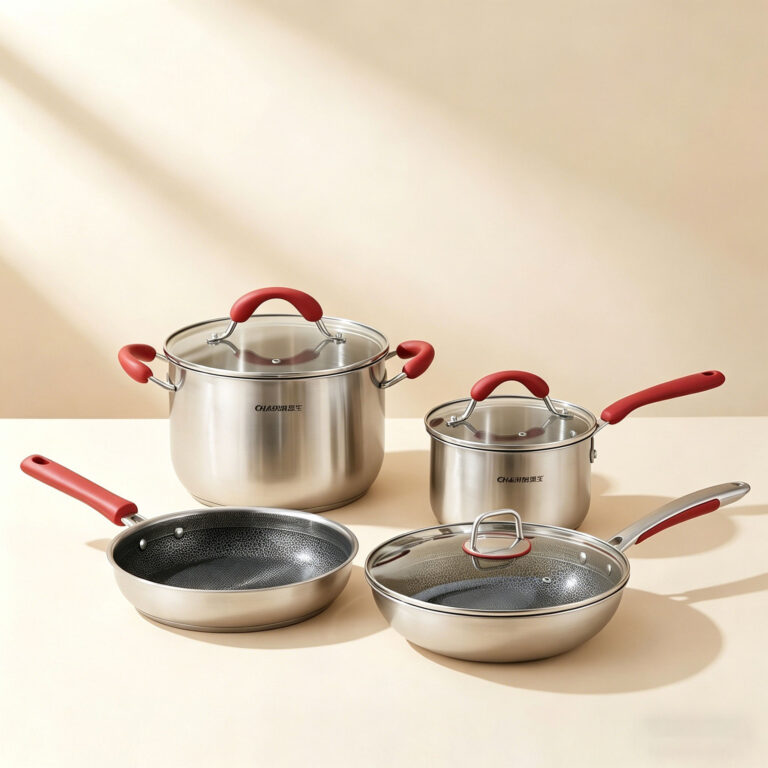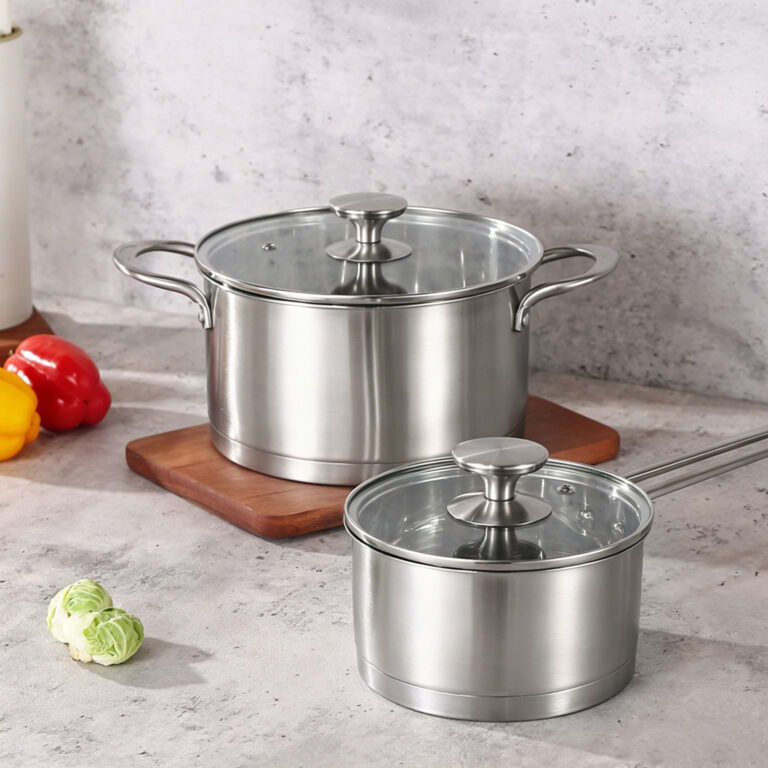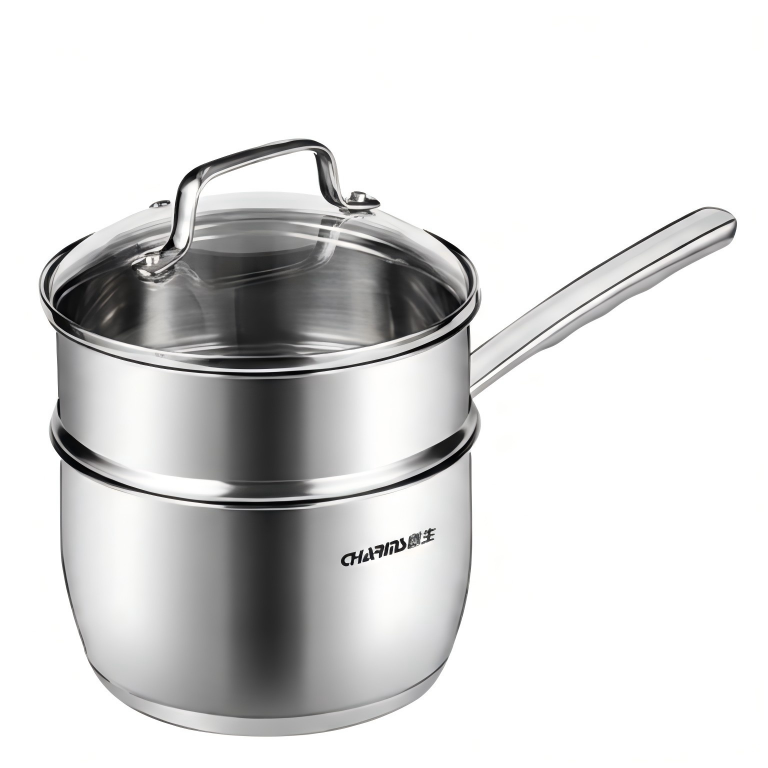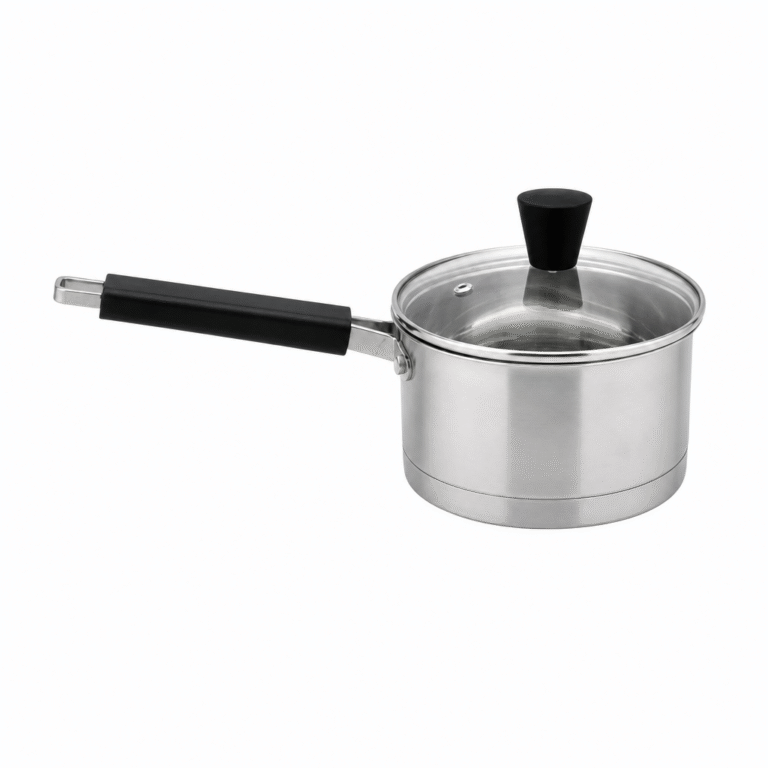


Clad bottom stainless steel cookware refers to any pan where a thermally conductive core — usually aluminum or copper — is permanently bonded to the stainless steel body. The term covers two distinct constructions: disc bottom (encapsulated base), where the bonded disc sits only at the base, and fully clad, where the conductive core runs through the entire body including sidewalls. Both use bonding technologies like roll bonding, impact bonding, or brazing. Fully clad delivers more even heat across the whole cooking surface; disc bottom offers a thicker base at lower cost. Understanding this distinction is critical for B2B buyers specifying OEM cookware, as suppliers frequently use the terms interchangeably despite real performance differences.
What “Clad Bottom” Actually Means — and Why the Terminology Is a Problem

“Clad bottom” is one of the most misused terms in cookware sourcing, and the confusion costs buyers real money.
Ask three different suppliers what “clad bottom stainless steel cookware” means, and you might get three different answers. One might show you a disc-bottom pot with a welded aluminum base. Another will present a fully bonded 3-ply saucepan where the aluminum runs all the way to the rim. A third might hand you a budget pan where a thin aluminum disc is barely attached to the base and call it “encapsulated.”
Here’s the reality: “clad bottom” is an umbrella term, not a precise specification. It describes any cookware where a multi-layer composite structure exists at the base — but it says nothing about whether that bonding extends to the sidewalls or only covers the flat bottom.
The three constructions hiding under this label:
1. Fully Clad (Full-Body Clad)
The conductive core — aluminum, copper, or both — is bonded across the entire body of the pan from base to rim. Typical configurations are 3-ply (SS / Al / SS) and 5-ply (SS / Al / SS / Al / SS or SS / Al / alloy / Al / SS). The bonded composite is formed first as a flat sheet, then pressed into cookware shape. All-Clad pioneered this construction commercially in 1971.
2. Encapsulated Base / Disc Bottom
A single-ply stainless steel body with a separately manufactured multi-layer disc permanently bonded to the exterior bottom. The sidewalls remain single-ply stainless. Also called “impact bonded base,” “sandwich bottom,” or — confusingly — “tri-ply bottom” by some manufacturers even though the tri-ply construction only exists at the base.
3. Single-Ply (No Cladding)
Plain stainless steel throughout. No conductive core. Still sold widely for institutional pots and basic cookware.
How to tell them apart visually: disc-bottom cookware has a visible seam running around the exterior just above the base — that’s where the disc meets the body. Fully clad pans have no such seam; the layered construction runs seamlessly from base to rim.
When writing purchase specifications, never use “clad bottom” alone. Specify either “fully clad body” or “encapsulated/disc base with [X]mm aluminum core.”
Disc Bottom vs Fully Clad: The Technical Breakdown
The core difference is not just where the aluminum sits — it’s how heat moves through the pan during cooking.
Stainless steel 304 (the grade used for cooking surfaces) has a thermal conductivity of approximately 16 W/m·K. That’s roughly 15 times lower than aluminum (237 W/m·K) and 25 times lower than copper (401 W/m·K). When you put a single-ply stainless pan on a burner, heat concentrates directly above the flame and barely spreads laterally — which is why single-ply pans are infamous for scorching.
Bonding a conductive core to the stainless dramatically changes this behavior. The aluminum or copper acts as a heat highway, spreading thermal energy laterally before it reaches the cooking surface.
The critical question is: how far does that highway extend?
| Factor | Disc Bottom (Encapsulated Base) | Fully Clad |
|---|---|---|
| Conductive core location | Base only | Base + full sidewalls |
| Sidewall heat distribution | Single-ply SS (poor conductor) | Bonded aluminum/copper (good conductor) |
| Base aluminum thickness | Can be 6–10 mm+ | Typically 2–4 mm (constrained by forming process) |
| Heat at sidewalls | Limited — food at pan edges exposed to weaker heat | Even — consistent temperature from base to rim |
| Induction compatibility | Requires 430 magnetic SS exterior disc | 430 layer can be integrated throughout or at base |
| Delamination risk | Present under extreme thermal shock | Very low — integrated structure |
| Manufacturing cost | Lower — disc is made and attached separately | Higher — requires cladding mills and heavy-duty presses |
| Price at retail | Budget to mid-range | Mid-range to premium |
| Ideal use case | Boiling, stock pots, deep sauté pans | Searing, sautéing, sauce reduction, skillet work |
The data from this comparison suggests fully clad wins on even heating — and it does, especially for skillet applications where food contacts the sidewalls. But the table also reveals where disc bottom has a structural advantage: base thickness.
Roll bonding the entire body of a fully clad pan imposes forming constraints — the multi-layer sheet has to be deep-drawn without tearing or delaminating, which limits how thick the aluminum core can be. Disc-bottom manufacturers face no such constraint. Companies like Demeyere build disc-bottom pots with 4.8 mm aluminum/copper base cores — thicker than most fully clad skillets’ total wall stack. For deep vessels used primarily for boiling or simmering (where sidewall heating matters less), that extra base mass delivers excellent heat retention and bottom-surface evenness.
How Clad Stainless Steel Cookware Is Made

The bonding technology used in manufacturing is the single biggest determinant of long-term product quality — and the key differentiator to ask suppliers about.
There are three bonding methods used in commercial production. Understanding them helps buyers evaluate supplier claims and factory capability.
Roll Bonding (Used for Fully Clad)
Roll bonding is the foundational process behind fully clad cookware. Metal rolls — stainless steel, aluminum, and sometimes copper — are stacked, heated to precise temperatures, and fed through industrial rolling mills applying thousands of tons of pressure. The combination of heat and pressure creates a metallurgical bond at the molecular level, fusing the layers into a single composite sheet.
This sheet is then blanked (cut into circular “discs”), deep-drawn by hydraulic presses into pan shapes across multiple forming stages, trimmed, polished, and assembled with handles.
Roll bonding requires specialized capital equipment (cladding mills that only a handful of manufacturers globally operate at cookware scale) and tight process tolerances. A poorly controlled roll-bonding run produces uneven layer thickness, which shows up as hot spots in the finished cookware. This is the process All-Clad uses at their Canonsburg, Pennsylvania factory — and the reason their manufacturing transparency matters for product credibility.
Impact Bonding (Used for Disc Bottom)
Impact bonding — also called forge welding or friction bonding — uses extreme pressure and controlled heat to permanently fuse a pre-manufactured composite disc to the base of the stainless steel body. No filler metals, no adhesives.
The process is faster and more scalable than roll bonding. A factory producing encapsulated-base cookware needs the disc stamping and bonding equipment, but not the capital-intensive cladding mills required for full-body cladding. This is why disc-bottom cookware is the dominant construction in mass-market and OEM production globally.
Quality of impact bonding varies significantly between factories. A proper bond shows zero gap between disc and body under destructive separation tests — the aluminum tears before the bond fails. A poor bond creates micro-gaps that act as thermal insulators and trap moisture, leading to eventual delamination.
Brazing (Alternative for Disc Bottom)
High-frequency brazing uses a brazing machine operating at 300–350 kHz to rapidly heat a filler material between the disc layers, creating a molecular bond across the interface. It’s more flexible for smaller production runs and can accommodate more complex layer configurations, but requires careful control to prevent flux contamination at the bond line.
What to ask your supplier: For disc-bottom cookware, request documentation of the bonding method and destructive test results (chisel separation at bond line, thermal cycling test). For fully clad, ask for layer thickness measurements across the body — not just at the base.
Heat Distribution in Practice — What the Thermal Data Shows
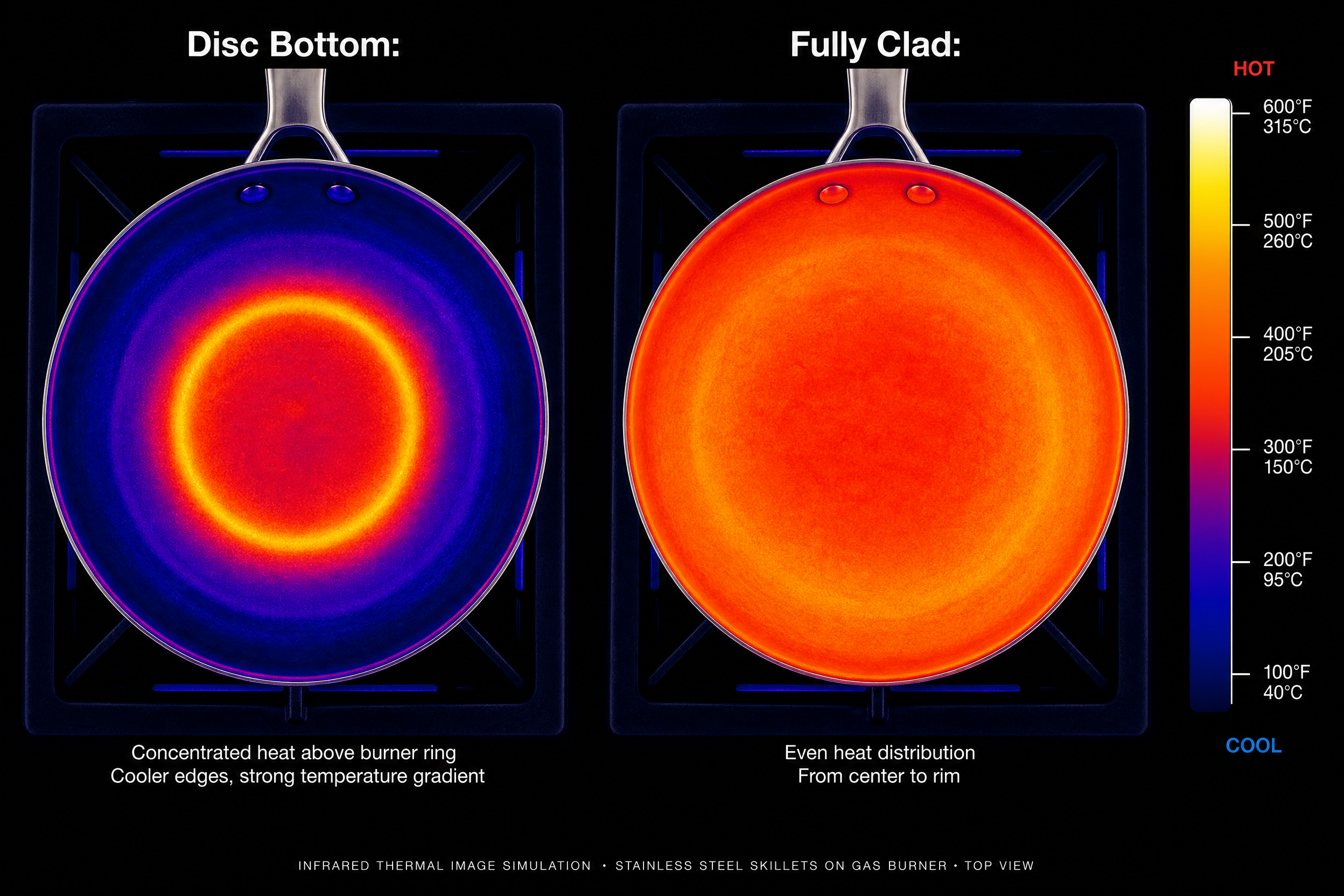
Fully clad pans heat faster at the sidewalls. Disc-bottom pans can match fully clad at the base if the disc is thick enough. Both beat single-ply by a wide margin.
America’s Test Kitchen, in their skillet testing program, documented a consistent pattern: disc-bottom pans develop noticeably hotter zones directly above the burner ring, while fully clad pans show more uniform surface temperatures. In practical cooking terms, this means:
- For a skillet: Food at the center cooks faster than food at the edges with a disc-bottom pan. In a fully clad pan, the temperature gradient from center to edge is much smaller — important for searing proteins evenly.
- For a saucepan: Disc-bottom construction concentrates heat at the base, which works well for boiling and reducing sauces that stay in motion through stirring. The single-ply sidewalls mean liquid above the base heats primarily through convection, not conduction through the walls.
- For a stockpot: Sidewall heating matters very little. A thick-disc-bottom stockpot from a brand like Demeyere or Vollrath performs comparably to fully clad — and the thicker base provides better heat retention for maintaining boil temperatures.
On induction: Both constructions require a magnetic stainless steel (430 grade) layer at the base for induction compatibility. In disc-bottom cookware, this is the outer stainless layer of the composite disc. In fully clad, the magnetic layer is typically the exterior stainless layer. If a supplier offers “304 full body” without specifying how induction compatibility is achieved, push for clarification — 304 stainless is not magnetic.
When Disc Bottom Actually Makes Sense
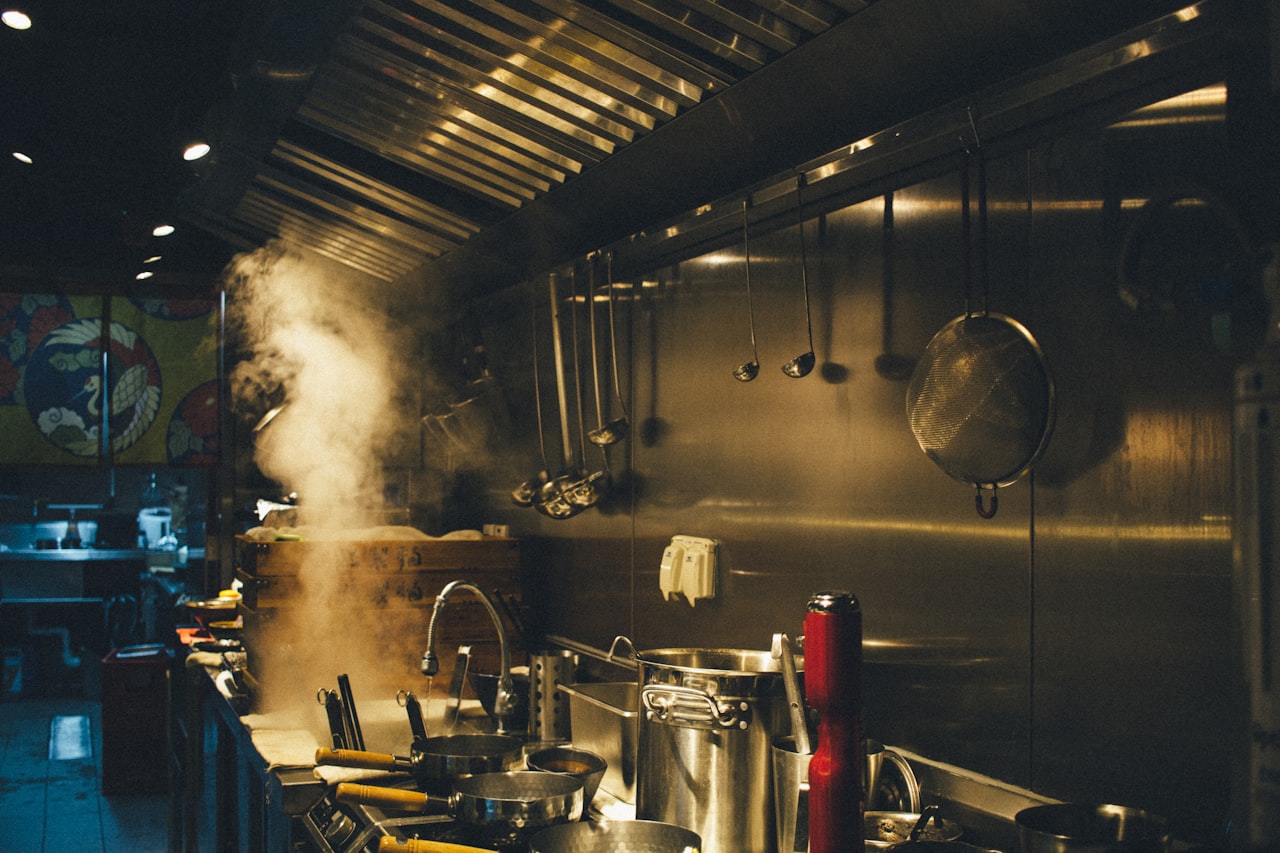
Disc-bottom cookware is not inferior by definition — it’s optimized for a different use case and market position.
The cookware industry narrative often treats fully clad as the obvious upgrade and disc bottom as a compromise. That framing is too simple, and it leads B2B buyers to over-specify (and overpay for) full-body cladding in product lines where it adds cost without adding performance.
Here’s where disc bottom wins:
Deep vessels — stockpots, Dutch ovens, tall saucepans. In a 10-quart stockpot, heat transfer through the sidewalls contributes minimally to cooking performance — the liquid volume is so large that heat input at the base drives everything. A disc-bottom stockpot with a properly bonded 4–6 mm aluminum core will boil water and hold simmer as effectively as a fully clad pot, at 30–40% lower manufacturing cost.
High-volume commercial kitchens. Brands like Demeyere (Atlantis line) and Vollrath build premium disc-bottom cookware specifically for professional kitchens. Their thick composite bases — some approaching 5 mm of aluminum — deliver thermal mass that fully clad pans in the same price category can’t match.
Mid-range private label programs. For a brand targeting the $30–$80 retail price point in cookware sets, disc-bottom construction allows a better-performing product at the cost constraint. Fully clad at that price point means thinner aluminum cores and compromised build quality.
The honest position: For skillets, sauté pans, and anything where food contacts the sidewalls during cooking, fully clad produces better results. For deep vessels, disc bottom is a legitimate choice — provided the bonding quality is verified.
B2B Sourcing Guide: What to Specify When Ordering Clad Cookware
Vague specifications lead to spec disputes and quality inconsistencies. These are the parameters that actually matter.
When placing OEM orders for clad bottom stainless steel cookware, the following specifications should be explicitly documented in your purchase order and supplier agreement:
Construction type:
- Specify “fully clad body” or “encapsulated disc base” explicitly — never just “clad”
- For fully clad: specify ply count (3-ply or 5-ply) and layer material sequence (e.g., “18/10 SS / 1100 aluminum alloy / 430 SS”)
- For disc bottom: specify disc construction and bonding method (“aluminum core disc, impact bonded to base body”)
Core thickness:
- Fully clad: specify minimum aluminum core thickness at the sidewall mid-point (e.g., ≥1.5 mm aluminum core measured at mid-height)
- Disc bottom: specify minimum disc core thickness (e.g., ≥4 mm aluminum core, 430 SS encapsulation ≥0.5 mm each side)
Body material:
- Cooking surface: 304 stainless (18/10 or 18/8) for food safety and corrosion resistance
- Exterior/base magnetic layer: 430 stainless for induction compatibility
Quality acceptance tests to require:
- Disc adhesion test (disc bottom only): Chisel separation test — bond should fail in the aluminum, not at the disc-body interface
- Thermal cycling test: 10 cycles 20°C → 200°C → 20°C, no delamination or visible gap
- Base flatness: ≤0.3 mm deviation across base diameter under room temperature
- XRF composition verification: Confirm 18/10 (18% chromium, 10% nickel) for cooking surface layers
Documentation to request:
- Material certifications (mill test reports for each metal layer)
- Bonding process validation report
- Third-party food safety certification (SGS, Intertek, or equivalent) confirming compliance with FDA 21 CFR, EU Regulation 1935/2004, or other target market standards
Frequently Asked Questions
What is the difference between clad bottom and fully clad stainless steel cookware?
“Clad bottom” (also called encapsulated base or disc bottom) means a multi-layer conductive disc is bonded only to the base of a single-ply stainless body. “Fully clad” means the multi-layer construction — aluminum or copper core between stainless steel layers — runs through the entire body, including sidewalls. Fully clad delivers more even heat up the sides of the pan; disc bottom concentrates heat at the base only.
Is encapsulated base cookware good quality?
It depends on the bonding quality and disc thickness. A properly impact-bonded disc with 4+ mm of aluminum core performs well for boiling, simmering, and deep vessel applications. The failure mode to avoid is poor bonding — a disc that develops micro-gaps or separates from the body after repeated thermal cycling. Always request bonding validation test documentation from suppliers.
How is clad stainless steel cookware made?
Fully clad cookware is made by roll bonding — stacking sheets of stainless steel and aluminum, then running them through industrial rolling mills under heat and pressure to create a permanently bonded composite sheet, which is then deep-drawn into cookware shapes. Disc-bottom cookware is made by separately manufacturing a multi-layer composite disc and permanently attaching it to the base of the stainless body using impact bonding or brazing.
Why does disc bottom cookware sometimes have hot spots?
Hot spots occur when the disc’s conductive layer is too thin to spread heat far enough from the burner contact point, or when the bond between disc and body has micro-gaps that disrupt heat transfer. Fully clad cookware has fewer hot spots because the conductive core extends across the entire base without any bond interface interruption.
What does 3-ply mean in clad cookware?
3-ply means three bonded metal layers: typically 18/10 stainless (cooking surface) / aluminum core / 430 stainless (exterior, magnetic for induction). The “ply” count refers to discrete bonded layers. Some manufacturers label their cookware as “5-ply” when the aluminum core consists of an alloy sheet bonded between two pure aluminum layers — technically five sheets but functionally similar to 3-ply. What matters is the core material and its thickness, not the ply count alone.
Conclusion
The choice between clad bottom and fully clad stainless steel cookware is not a simple better/worse decision — it’s a function of the cooking vessel type, target market, and manufacturing cost constraints. Fully clad is the right specification for skillets and sauté pans where even sidewall heating matters. Disc bottom with a properly bonded, thick aluminum core is a legitimate and often smarter choice for stockpots, saucepans, and mid-range product lines.
What I consistently find when reviewing supplier samples is that the bonding quality — not the construction type — is the primary predictor of long-term performance. A well-bonded disc-bottom pot from a quality factory outperforms a poorly bonded fully clad pan. Before committing to a supplier, validate their bonding process with physical test samples, not just specification sheets.