

Copper core stainless steel cookware uses a full-body multi-layer construction with a copper layer sandwiched between aluminum and stainless steel, running from base to rim. The copper dramatically improves thermal responsiveness — heating fast and adjusting instantly to temperature changes. Unlike copper bottom cookware, which adds copper only to the base disk, a true copper core delivers even heat coverage up the walls of the pan. The premium price is real ($1,500+ for quality sets), but the performance advantage over aluminum-core alternatives is narrower than most marketing suggests. This guide explains the construction, the science, and who should actually buy it.
How Copper Core Construction Actually Works
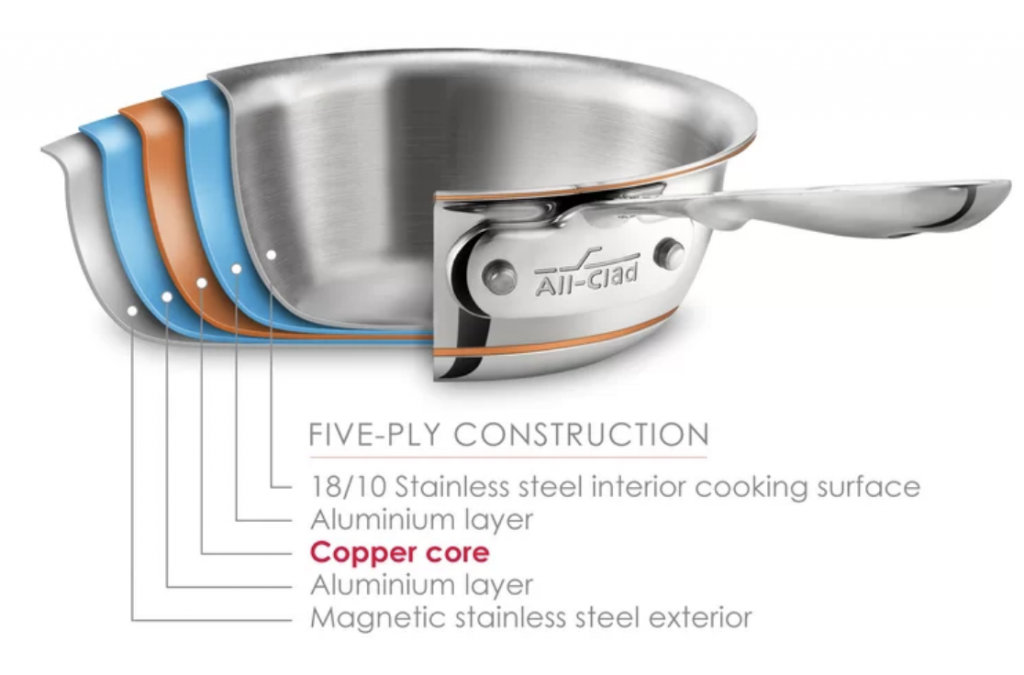
Copper core stainless steel cookware is built from multiple metal layers bonded together — what the industry calls “clad” or “fully clad” construction. The classic architecture is five layers: stainless steel on the outer surface, aluminum, then copper in the center, aluminum again, and stainless steel on the cooking surface.
The copper sits in the middle by design. Copper heats rapidly and responds immediately when you turn the burner up or down, but it’s reactive with acidic food and requires constant maintenance when exposed. Sandwiching it between layers of aluminum (for heat spreading) and stainless steel (for a durable, non-reactive cooking surface) solves all three problems at once.
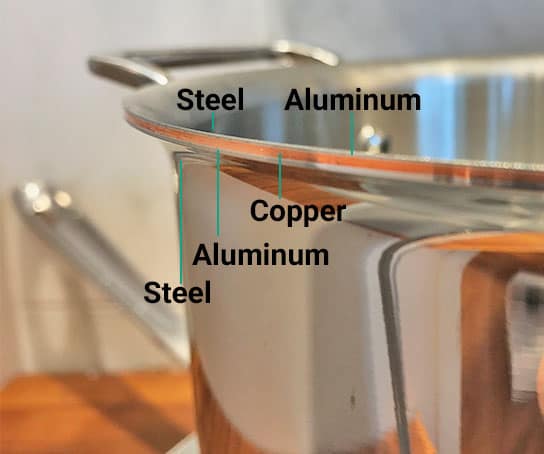
The “fully clad” part is what distinguishes this from lesser constructions. The metal layers run the entire height of the pan — base and sides — not just across the bottom. This means heat is distributed up the walls, not just across the floor of the pan.
The Five-Layer Stack (SS → Al → Cu → Al → SS):
| Layer | Material | Function |
|---|---|---|
| Outer | 18/10 Stainless Steel | Induction compatibility, durability, clean appearance |
| 2nd | Aluminum | Bonds layers; adds heat capacity and spread |
| Core | Copper | Rapid heat conduction, instant temperature responsiveness |
| 4th | Aluminum | Bonds layers; buffers heat transfer |
| Inner | 18/10 Stainless Steel | Non-reactive cooking surface; corrosion resistant |
Copper Core vs. Copper Bottom — Not the Same Thing
These two terms are often used interchangeably online, but they describe very different products.
Copper bottom cookware (also called copper disk base) attaches a copper layer only to the base of the pan. The walls remain bare stainless steel. Heat spreads across the bottom well, but the stainless sides conduct heat slowly — you get an even floor but cold walls. It’s a compromise design and typically found at mid-range prices.
Copper core cookware runs the full multi-layer construction from base to rim. Heat travels uniformly across both the bottom and the walls of the pan. When you’re reducing a sauce in a saucepan, the walls matter as much as the floor — that’s where copper core earns its keep.
A third term worth knowing: copper clad stainless steel generally refers to the broader category of cookware that incorporates any copper layer within stainless steel, whether full-clad or base-only. When you see “copper clad” in a product listing, check whether the construction runs up the sides before assuming it’s a true copper core design.
Simple rule: if the product description says “disk base” or “encapsulated base,” it’s copper bottom, not copper core.
The Thermal Science Behind Better Heat Distribution
Plain stainless steel has a thermal conductivity of roughly 15 W/(m·K). That number is low — it means heat travels slowly and unevenly through the metal, creating hot spots directly over burner elements while the rest of the pan lags behind. You’ve experienced this if you’ve ever burned a center patch of food in a cheap stainless pan.
Copper has a thermal conductivity of approximately 401 W/(m·K). That’s about 26 times higher than stainless steel. More usefully, copper also has much higher thermal diffusivity — the rate at which temperature changes propagate through the metal. Copper’s thermal diffusivity is roughly 111 mm²/s compared to about 4.2 mm²/s for stainless steel 304. That gap is what makes copper so responsive: when you drop the burner, a copper core pan backs off immediately.
Aluminum is the realistic competitor. Cookware-grade aluminum alloy (3003/3004) sits at around 60–70 mm²/s thermal diffusivity — significantly better than stainless steel, but roughly 1.6–1.9 times lower than copper. In raw physics, copper wins. In actual kitchen performance, the difference is more nuanced.
America’s Test Kitchen found in their testing that the stainless steel lining inside copper pans actually helps distribute heat horizontally — copper conducts vertically so fast that without the stainless interior, it could create its own kind of hot spots. The material combination works precisely because each metal compensates for the other’s weakness.
| Material | Thermal Conductivity W/(m·K) | Thermal Diffusivity mm²/s |
|---|---|---|
| Copper (pure) | ~401 | ~111 |
| Aluminum alloy 3003 | ~160–180 | ~60–70 |
| Stainless steel 304 | ~15–16 | ~4.2 |
What Independent Testing Shows
The most honest performance data comes from Bon Appétit’s copper cookware testing, where a writer put multiple copper configurations head-to-head including the All-Clad D3 (aluminum core, 3-ply) as a control.
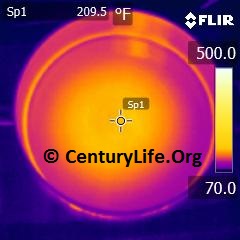
The surprising finding: the All-Clad Copper Core showed marginally faster heating than the D3, but in some measurements displayed greater temperature variation across the cooking surface — not less. The D3, with its simpler aluminum core, produced more consistent results in those tests.
This doesn’t mean copper core is a bad product. It means the advantage is specifically about responsiveness — the speed at which the pan reacts to heat changes — rather than pure heat evenness in every scenario. For a chef reducing a delicate beurre blanc or caramelizing onions precisely, that responsiveness is valuable. For everyday stir-frying or pasta water, an aluminum-core tri-ply performs just as well.
From Serious Eats’ copper cookware testing, pans with thicker copper — particularly traditional copper pans with 2.5mm or more of copper — heated faster and cooled faster than 5-ply copper-core constructions. Counterintuitively, Made In’s copper-lined pan with 1.8mm copper performed sluggishly compared to thinner-but-better-bonded copper layers, suggesting that construction quality and bonding technique matter as much as raw copper thickness.
The real-world verdict: Copper core stainless steel cookware excels at precision cooking that demands fast temperature adjustments — sauces, custards, candy-making, precise searing. If your cooking is primarily utilitarian (boiling, casual sautéing, everyday weeknight dinners), a quality 3-ply aluminum-core pan delivers 85–90% of the performance at 40–50% of the price.
Is Copper Core Cookware Worth the Price?
| Feature | Copper Core 5-ply | Aluminum Core 3-ply |
|---|---|---|
| Typical 10-piece set price | $1,400–$2,000+ | $400–$800 |
| Heat responsiveness | Excellent | Good |
| Heat evenness | Excellent | Very good |
| Weight | ~5–10% heavier than aluminum core | Moderate |
| Induction compatible | Yes (magnetic SS exterior) | Yes |
| Oven safe temperature | Up to 600°F | Up to 500–600°F |
| Maintenance | Handwash recommended | Handwash recommended |
| Dishwasher safe | Not recommended | Not recommended |
The All-Clad Copper Core 10-piece set runs approximately $1,600. The All-Clad D3 10-piece, aluminum core, runs $600–$800. The performance delta does not justify a 2x price difference for most home cooks.
Who should buy copper core: Professional or semi-professional cooks who prepare precision temperature-sensitive dishes regularly (French sauces, confections, delicate proteins). People who cook on gas and appreciate instant response. Enthusiasts for whom owning best-in-class matters as a personal choice.
Who should stick with aluminum core: Home cooks cooking 4–5 nights a week across a range of techniques. Anyone whose budget makes a $1,500 cookware set a stretch. Cooks who prioritize durability and low-maintenance over marginal performance gains.
What to Look For When Buying Copper Clad Stainless Steel Cookware
Layer count and full-clad construction: Look for five-ply construction (SS/Al/Cu/Al/SS) with explicitly stated full-clad build running up the pan sides. Three-ply copper constructions exist but offer less thermal buffering.
Copper layer position: The copper should be an internal core, not an outer decorative layer. Decorative copper bands or bases are aesthetic, not functional in the same way.
Stainless interior grade: 18/10 stainless steel (18% chromium, 10% nickel) offers better corrosion resistance than 18/0. Check the interior grade, not just the exterior.
Induction compatibility: Most copper core designs use a magnetic stainless steel exterior. Confirm compatibility before buying if you cook on induction — not all copper cookware lines are compatible.
Recommended brands: All-Clad Copper Core (USA, industry benchmark), Hestan CopperBond (USA/Italy, five-ply copper core, induction-compatible), Mauviel M’Heritage (France, traditional solid copper alternative for gas cooktops).
FAQ
What does “copper core” mean in cookware?
Copper core means a layer of copper sits at the center of a multi-layer (clad) construction, sandwiched between other metals — typically aluminum and stainless steel. The copper layer runs the full height of the pan, not just the base, improving both heat distribution and temperature responsiveness across the entire cooking surface.
Is copper bottom the same as copper core?
No. Copper bottom cookware has a copper disk attached only to the base of the pan; the walls are single-material stainless steel. Copper core cookware has copper running up the full height of the pan walls as part of a fully bonded multi-layer construction. The performance difference is significant, especially in saucepans and sauté pans where side-wall heat matters.
Is copper core stainless steel cookware induction compatible?
Yes, provided the exterior layer is a magnetic (ferromagnetic) stainless steel grade. All-Clad Copper Core and Hestan CopperBond are both induction compatible. Traditional solid copper cookware is typically not induction compatible without an added steel base. Always verify the specific product listing.
Does copper core cookware require special maintenance?
The stainless steel exterior and interior surfaces are maintained the same way as any quality stainless cookware — handwashing with mild detergent, occasional Bar Keepers Friend for staining. The copper is entirely internal and never exposed to cleaning or food, so it requires no polishing or special treatment.
How does copper core compare to aluminum core in everyday cooking?
For high-precision tasks — reducing sauces, caramelizing, candy-making — copper core offers noticeably faster temperature response. For most everyday cooking, the performance difference between a quality copper core and a quality aluminum core tri-ply pan is marginal. Independent testing has shown aluminum-core pans can match or exceed copper core in heat evenness in some scenarios.
Conclusion
Copper core stainless steel cookware delivers measurable advantages in thermal responsiveness — the speed at which the pan reacts to your burner adjustments — making it the preferred choice for precision cooking techniques. The engineering is sound: copper’s thermal properties are real, and the five-ply construction addresses every limitation of pure copper. But the honest caveat stands: aluminum-core tri-ply cookware closes most of that gap at significantly lower cost. If your cooking style demands precision and you’re investing in cookware for decades, copper core earns its premium. If you want excellent everyday performance without the price, aluminum-core clad cookware is a smarter value.