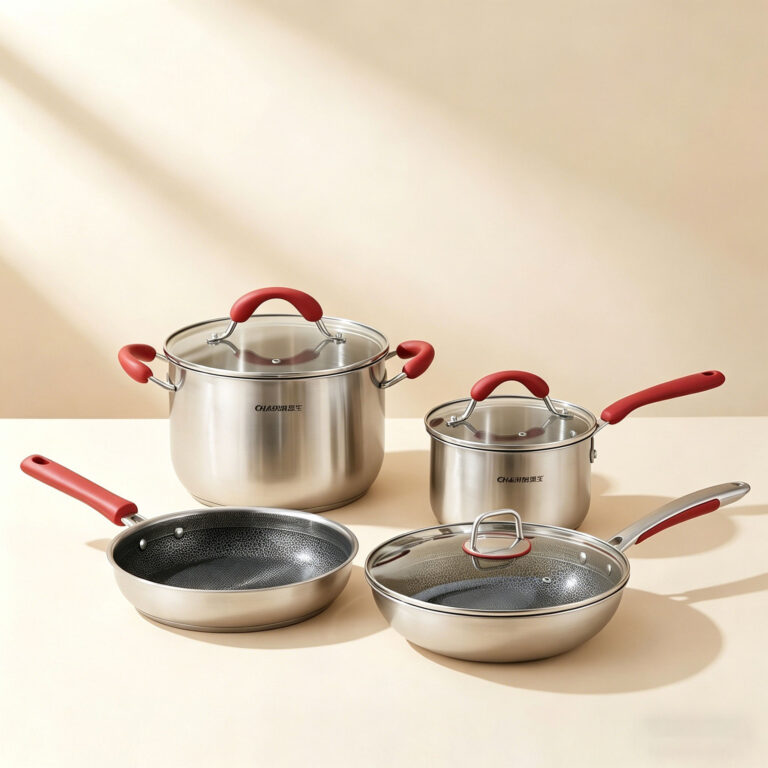


Walk into any well-equipped kitchen — professional or home — and you’ll find both a stock pot and a saucepan somewhere on the rack. They’re both pots. They both hold liquid. And yet, using one in place of the other is one of the most common mistakes that quietly undermines cooking results every single day.
The difference isn’t just about size. It’s about how each piece of cookware is engineered to perform. The depth, the handle placement, the wall thickness, the heat behavior — every design detail serves a specific purpose. Once you understand that, choosing the right pot stops being a guess and becomes a deliberate decision.
This guide breaks down the real distinctions between stock pots and saucepans: their structure, their ideal applications, how they perform under heat, and which material gives you the most long-term value. Whether you’re equipping a restaurant kitchen or sourcing cookware for wholesale, this comparison gives you the clarity to make the right call.
What Is a Stock Pot?
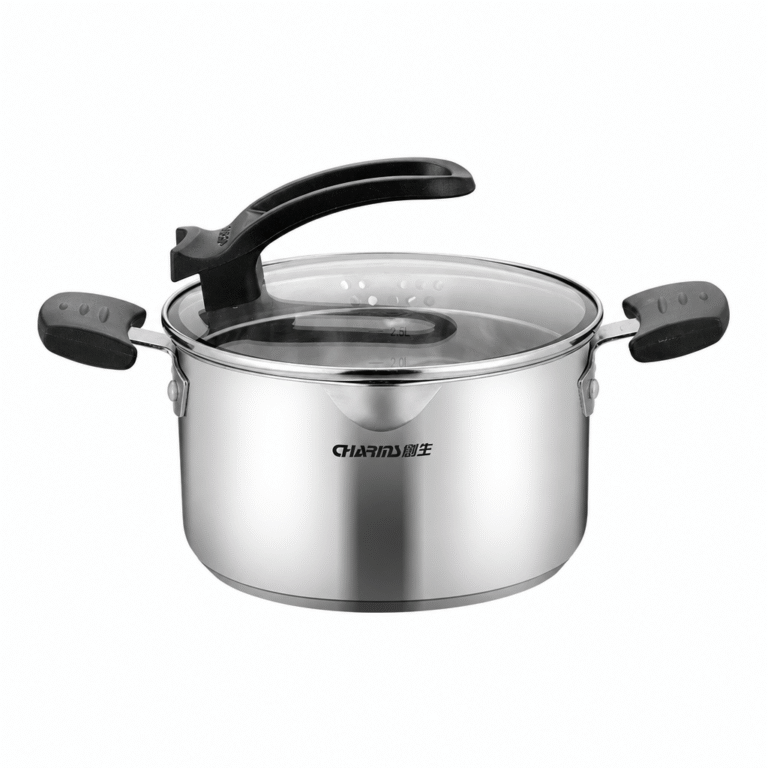
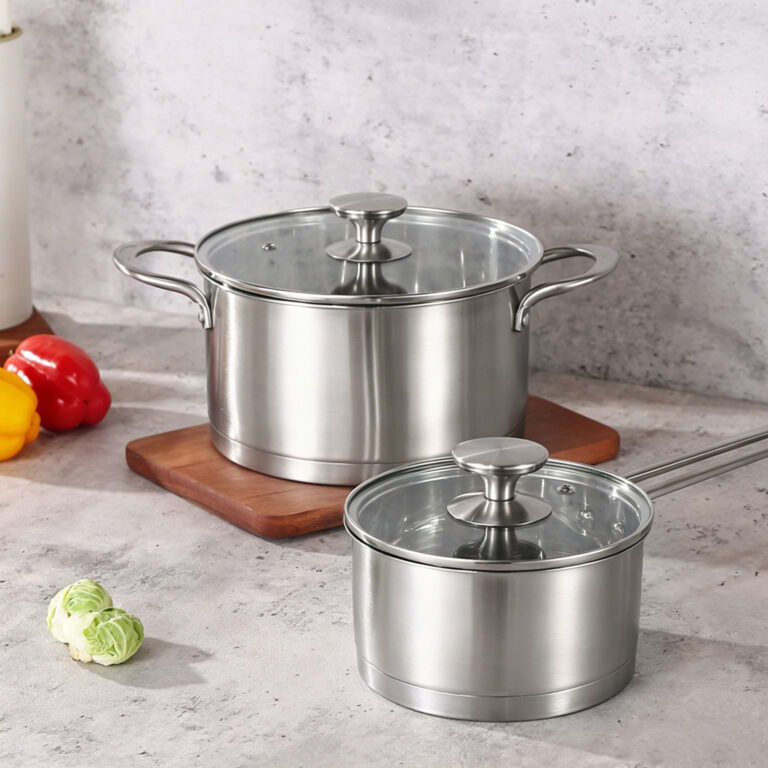
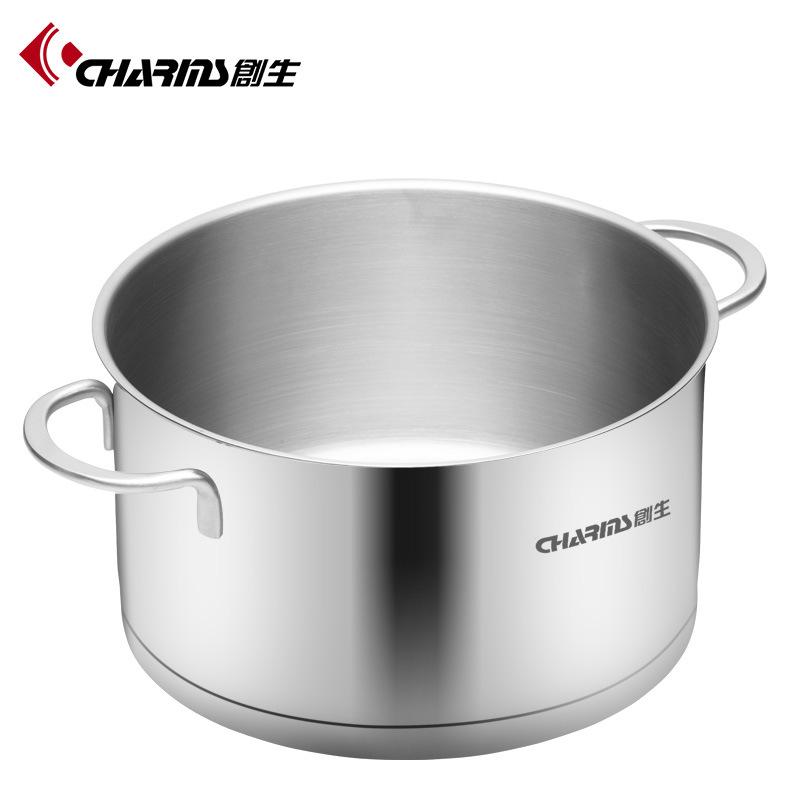
A stock pot is a tall, wide-diameter pot with straight walls, built to hold large volumes of liquid over extended cooking periods. The design is intentional: tall walls minimize evaporation while keeping heat concentrated within the body of the liquid. The base is wide enough to rest stably on a commercial or home burner without tipping.
You’ll recognize a stock pot immediately by its two short side handles — one on each side. This isn’t a stylistic choice. A full stock pot carrying 20 liters of boiling broth is too heavy and too unwieldy for a single long handle. The dual-handle design distributes weight and gives the cook firm, two-handed control during transport.
Main Features of a Stock Pot
The defining structural traits of a stock pot are its height-to-diameter ratio and its capacity. The walls are taller than they are wide — sometimes significantly so — which creates a deep interior that holds liquid efficiently. Most stock pots come with a tight-fitting lid that locks in steam and reduces the time needed to bring large volumes to a boil.
The handles are riveted or welded to the body, not clipped on as afterthoughts. On a high-quality stainless steel stock pot, those handles are engineered to withstand the mechanical stress of repeated heavy loads. The lid typically features a steam vent or a slightly domed profile to allow condensation to drop back into the pot rather than escape.
Common Sizes and Capacities
Stock pots range from 8 quarts on the smaller end — practical for a home kitchen making pasta or a modest batch of soup — up to 60 quarts or more for commercial environments. The most widely used sizes in professional kitchens fall between 20 and 40 quarts. For catering operations or large food service businesses, 40-quart and 60-quart stock pots are standard equipment.
When sourcing for wholesale, the most frequently requested sizes are 20 qt, 30 qt, and 40 qt — these cover the broadest range of commercial applications without requiring specialized storage.
What Is a Stock Pot Used For?
The stock pot earns its name from its primary function: making stock. Bone broth, chicken stock, and vegetable stock — these require hours of low, slow simmering with large quantities of water, bones, and aromatics. A stock pot handles this without complaint.
Beyond stock, the applications are substantial. Pasta in large quantities demands a stock pot; you need enough water volume to keep pasta from sticking and cooking unevenly. Seafood boils — crab, shrimp, lobster with corn and potatoes — are practically impossible without one. Batch cooking for meal prep services, braising large cuts of meat, making soups for 20 or more people: the stock pot is the workhorse that handles all of it.
Benefits of Stainless Steel Stock Pots
Stainless steel is the dominant material choice for stock pots in commercial kitchens, and for good reasons that go beyond durability. 304-grade stainless steel is non-reactive, meaning it won’t interact with acidic ingredients like tomatoes or citrus — a real concern when making tomato-based sauces or broths with vinegar. It also doesn’t absorb odors or flavors between uses, which matters when you’re cycling through different recipes in the same pot.
The surface is easy to clean, resistant to staining, and doesn’t require seasoning or special care. A well-made stainless steel stock pot with an encapsulated aluminum or copper base distributes heat evenly across the bottom, reducing hot spots that can scorch your stock. That base construction — often called a clad or impact-bonded base — is one of the key quality markers to look for when evaluating stock pots for commercial use.
What Is a Saucepan?
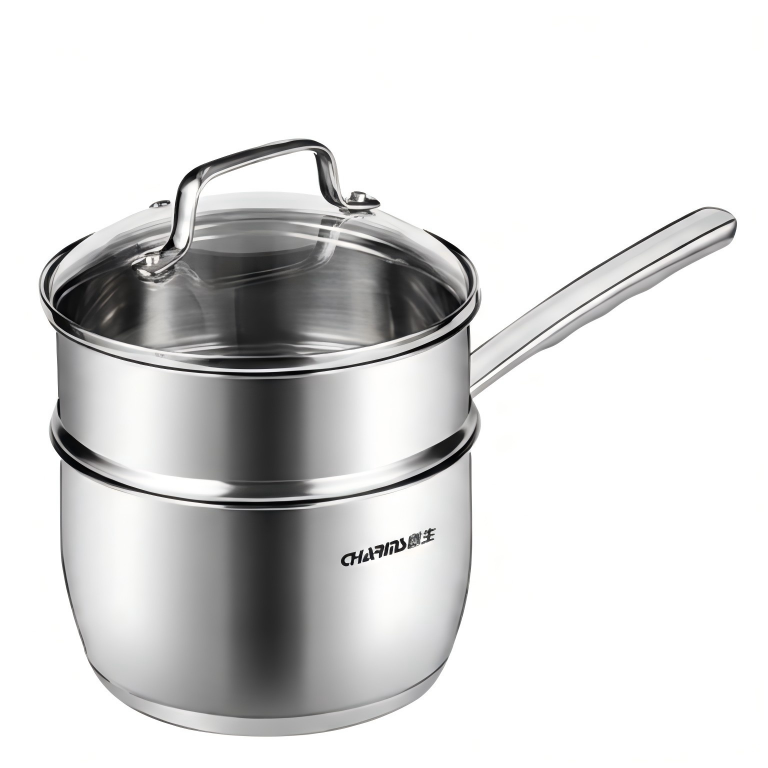
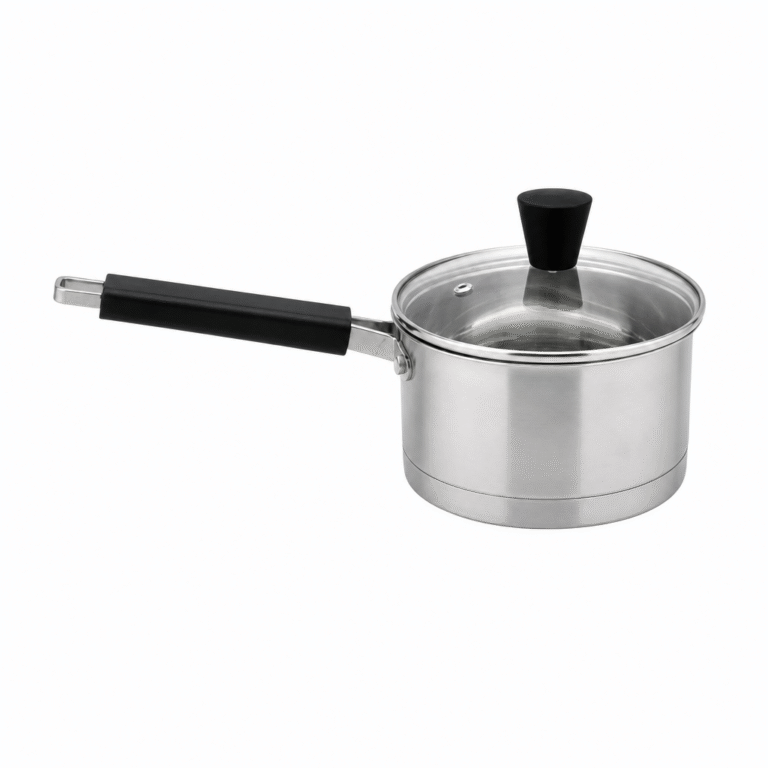
A saucepan is a smaller, shallow-walled pot with a single long handle. It’s designed for precision cooking at smaller volumes — tasks where control matters more than capacity. The long handle keeps your hand away from the heat source, giving you the ability to tilt, swirl, and stir with agility that a two-handled stock pot simply can’t offer.
The form is efficient and immediate. You set it on the burner, it heats up fast, and you work quickly. That’s the point.
Main Features of a Saucepan
The long handle is the saucepan’s most recognizable feature, but the wall depth is equally important. Saucepan walls are tall enough to contain liquid during vigorous stirring but shallow enough that heat reaches the contents quickly and evenly. The smaller surface area at the base means less thermal mass to overcome — the pan responds to temperature changes much faster than a stock pot.
Most saucepans include a lid, though it’s used selectively. Simmering with the lid on retains heat and moisture; leaving it off lets liquids reduce. That flexibility — the ability to manage reduction with precision — is central to what a saucepan does best.
Common Saucepan Sizes
Saucepans typically range from 1 quart to 4 quarts for home use, with commercial kitchens often using 1.5-quart and 2-quart sizes for sauces and reductions. The 2-quart size is the most versatile, handling everything from a single-portion sauce to cooking rice for two or three people.
Larger saucepans — 3 to 4 quarts — bridge the gap between a small saucepan and a Dutch oven, useful for slightly larger batches of soup or for braising smaller cuts of poultry or vegetables.
Best Uses for a Saucepan
The saucepan is purpose-built for tasks where control is the priority. Making a béchamel requires constant stirring and careful heat management — a saucepan’s responsive heating and easy-tilt handle make this straightforward. Hollandaise, caramel, custard, ganache: any sauce where the margin between done and ruined is narrow belongs in a saucepan.
Beyond sauces, the applications are broader than people expect. Heating milk without scorching it. Cooking rice in the absorption method. Soft-boiling or poaching eggs. Warming soups from the refrigerator. Cooking oatmeal in the morning. The saucepan handles all of these efficiently and without the thermal inertia of a larger pot.
Why Saucepans Are Essential in Everyday Cooking
The saucepan works quickly, cleans easily, and doesn’t take up much burner space. In a professional kitchen, multiple saucepans run simultaneously — one holding a reduction, one warming a sauce to order, one gently heating a dairy-based component. They’re not glamorous tools. They just get used constantly, which is exactly what makes them indispensable.
For home cooks, the saucepan often sees more daily use than any other piece of cookware. Its size is proportionate to cooking for one to four people, its weight is manageable, and its versatility covers a wide enough range of tasks that it rarely sits idle.
Stock Pot vs Saucepan: Key Differences
Understanding which pot to reach for requires understanding not just what each one is, but how they differ structurally and functionally. The gap between them is wider than most people realize at first glance.
| Feature | Stock Pot | Saucepan |
|---|---|---|
| Size | Large | Small to Medium |
| Depth | Very Deep | Medium |
| Handle Type | Two Side Handles | One Long Handle |
| Best For | Stocks, Soups, Boiling, Batch Cooking | Sauces, Reheating, Precision Cooking |
| Heat Distribution | Slow & Even | Quick & Responsive |
| Capacity | 8–60+ quarts | 1–4 quarts |
| Weight When Full | Heavy | Light to Moderate |
| Evaporation Control | High (tall walls) | Moderate |
Size and Capacity Comparison
This is the most obvious difference, but the implications run deeper than volume. A stock pot’s large capacity isn’t just convenient for big batches — it changes the cooking physics. More liquid means more thermal mass, which means slower temperature swings. That stability is valuable when you’re simmering a broth for four hours and don’t want temperature spikes to cloud the stock or break down the collagen too aggressively.
A saucepan’s smaller capacity means it responds almost immediately to heat changes. Turn up the flame and the liquid reacts within seconds. Pull it off the heat and it cools quickly. For precision work — reducing a wine sauce to exactly the right consistency, or tempering chocolate — that responsiveness is exactly what you need.
Cooking Performance Differences
Heat behavior differs between these two pots in ways that matter practically. A stock pot, especially with a clad base, heats slowly and holds temperature steadily. It’s built for long cooking times where consistency matters more than speed. Hot spots at the base are the enemy of a clear, well-developed stock, which is why a thick, encapsulated base is worth paying for.
A saucepan heats faster and responds more dynamically. In a restaurant context, that speed is critical — a sauce needs to be ready when the plate is being assembled, not five minutes later. The thinner walls and smaller base area mean you can achieve a rapid simmer or gentle heat almost instantly.
Handle and Lid Design
The handle difference reflects a fundamental difference in how each pot is used. A stock pot sits on the burner for hours — you’re not holding it, you’re letting it work. The two side handles are there for the moments you need to move it: carrying it to the sink to drain pasta, moving it between burners, or transferring it to a different station. They need to be strong and heat-resistant, but they don’t need to be ergonomically refined for constant grip.
A saucepan is in your hand constantly. You’re stirring, swirling, tilting to pour. The long handle needs to be comfortable, well-balanced, and positioned so that the pot feels stable rather than front-heavy. This is where handle design quality becomes genuinely noticeable — a poorly balanced saucepan is tiring to work with over the course of a shift.
Heating Efficiency
Neither pot is more efficient than the other — they’re efficient at different things. A stock pot is efficient for large-volume, long-duration cooking because its geometry minimizes evaporation and heat loss over time. A saucepan is efficient for small-volume, high-control tasks because its geometry maximizes heat responsiveness and reduces the energy wasted heating unused pot volume.
Trying to make a quick pan sauce in a stock pot is inefficient — the large base area and deep walls mean you’re working with too much heat mass relative to the sauce volume. Trying to make stock in a saucepan means constantly topping up liquid and fighting evaporation. Each tool fits its purpose.
When Should You Use a Stock Pot?
The stock pot is the right choice whenever the cooking task involves large volumes, extended cooking times, or both. The design was built around these requirements, and no other common cookware piece handles them as well.
Best Foods to Cook in a Stock Pot
Bone broth and stock are the classic applications. Making a proper beef bone broth requires 12 to 24 hours of simmering — often much more — with large quantities of bones, water, and aromatics. Only a stock pot provides the depth and volume to do this correctly. The tall walls limit evaporation over those long hours, and the capacity means you can produce enough broth to justify the time investment.
Pasta cooked for a crowd demands a stock pot without question. Pasta needs to cook in abundant water — the ratio of water to pasta affects how evenly it cooks and how the starch behaves. Crowding pasta into a small pot leads to clumping, uneven cooking, and sticky results. A 20-quart stock pot can handle several pounds of pasta comfortably.
Seafood boils are almost definitionally stock-pot cooking. The combination of seafood, potatoes, corn, sausage, and seasoned water adds up to a massive volume — and the food needs to cook submerged in that liquid. A stock pot is the only practical vessel.
Stew and large-batch soups benefit from the stock pot’s even heat retention. When you’re cooking a stew for 20 people, you need a pot that maintains a gentle, steady simmer without scorching the bottom or losing temperature every time you add ingredients.
Who Needs a Stock Pot Most?
Restaurants rely on stock pots daily, often running them overnight for stocks that become the base of every sauce and soup on the menu. The quality and volume of stock produced directly affects the flavor quality of a significant portion of the menu.
Catering operations need stock pots to produce food efficiently at scale. Whether it’s a wedding, a corporate event, or a recurring meal service, the ability to cook 10 to 20 gallons of soup or stew in a single vessel saves time and simplifies logistics.
Large families and meal prep services find stock pots invaluable for batch cooking — preparing large quantities of food at the beginning of the week that can be portioned and reheated as needed. It’s a practical and economical approach to cooking that scales naturally with a large stock pot.
Food businesses starting up often discover that a good stock pot is one of the first pieces of serious equipment they actually need. Before a salamander or a tilting skillet, before a combi oven — a stock pot that can handle volume is foundational.
When Is a Saucepan the Better Choice?
The saucepan handles a category of cooking that the stock pot genuinely cannot: precise, small-volume, heat-sensitive work. Any task that requires you to watch the pan closely, adjust heat frequently, and react quickly belongs in a saucepan.
Ideal Foods for a Saucepan
Sauces and reductions are the saucepan’s native territory. A red wine reduction needs to be watched as it thickens, tasted repeatedly, and pulled off heat at exactly the right moment. A beurre blanc needs constant attention and gentle, controlled heat to emulsify properly. The saucepan’s long handle and quick heat response make this kind of work natural rather than stressful.
Milk and dairy scorch easily at high heat and benefit from the saucepan’s quick response to temperature adjustments. Heating milk for a latte, making hot chocolate from scratch, or preparing a cream-based soup base all go smoothly in a saucepan with moderate heat and constant attention.
Rice cooked by the absorption method is a textbook saucepan application. The tight-fitting lid traps steam, the controlled heat maintains a steady simmer, and the relatively small volume means the rice cooks evenly without the temperature swings that a large pot would introduce.
Oatmeal, instant noodles, and single-portion soups are everyday quick tasks where a saucepan is simply the right-sized tool. Using a stock pot for these would be like driving a freight truck to pick up a bag of groceries — functional but completely out of proportion.
Poached and soft-boiled eggs require gentle simmering in a relatively small amount of water. The saucepan handles this precisely, and its size means the water comes to temperature quickly, reducing the total time from start to plate.
Advantages of Using a Saucepan Daily
Speed and convenience are the saucepan’s practical strengths. It heats up fast, it’s easy to handle, and it cleans quickly. In a busy kitchen where the pace is high and every burner counts, a saucepan that’s ready to use in 90 seconds is genuinely valuable.
Its weight is also worth noting. A stock pot full of liquid can weigh 30, 40, or 50 pounds. A saucepan even at full capacity stays manageable. For kitchen staff working a full shift, the ergonomic difference is not trivial — a saucepan you can pour from with one hand and tilt with control is a tool you can use comfortably for eight hours.
Which One Should You Choose for Your Kitchen?
The honest answer is that most professional kitchens — and serious home kitchens — need both. They don’t compete with each other. They serve different functions, and having both means you’re equipped to cook across the full range of what a kitchen is actually called upon to produce.
That said, if you’re making a decision based on current priorities, here’s how to think through it.
Choose a Stock Pot If…
Large-group cooking is a regular part of the workflow, whether for family gatherings, meal prep, or professional food service. Stocks, broths, and bone broth are prepared frequently, often requiring long simmering times and larger batch sizes. Bulk cooking of soups, stews, and pasta dishes also calls for cookware that can handle high volume efficiently. In catering or commercial kitchen environments where output constantly fluctuates, a large-capacity pot that can simmer steadily for hours with minimal supervision becomes an essential tool.
The stock pot pays for itself quickly in any context where volume cooking happens regularly. A high-quality 20- or 30-quart stock pot made from 304 stainless steel with a clad base will last decades with proper care.
Choose a Saucepan If…
Your cooking skews toward sauces, reductions, and precision heat work. Cooking is typically done for one to four people, with little need to prepare large quantities at once. Responsiveness matters more than capacity, making fast-heating pots ideal for quick adjustments while cooking. In busy kitchens with multiple burners in use, compact cookware also helps manage smaller components more efficiently.
A set of two or three saucepans in different sizes — say, a 1.5-quart, a 2-quart, and a 3-quart — covers an enormous range of daily cooking needs without redundancy.
Why Stainless Steel Is the Best Material Option
Across both categories, 304-grade stainless steel consistently outperforms alternatives when durability, hygiene, and performance are evaluated together. It’s non-reactive with acidic ingredients, non-porous so it doesn’t harbor bacteria, and doesn’t degrade over time the way non-stick coatings or seasoned cast iron can.
For stock pots, the critical construction detail is the base. An impact-bonded aluminum or copper base dramatically improves heat distribution compared to a single-layer stainless steel bottom. For saucepans, look for fully-clad construction — stainless steel on both interior and exterior with an aluminum or copper core running the full height of the walls, not just the base. That full-wall cladding gives you even heat from bottom to rim, which matters most precisely when making sauces.
For commercial buyers evaluating stainless steel cookware at scale, the gauge of the steel matters as well. Heavier gauge — typically 18/10 stainless at around 0.8mm to 1.0mm — offers better thermal retention and resistance to warping under repeated high-heat exposure. Lighter gauge pots cost less upfront but deform more readily under commercial use conditions, shortening their effective life considerably.
Custom sizing, branding, and handle design are all considerations worth raising with your manufacturer, particularly when sourcing at volume. The right cookware partner can adapt specifications — whether steel grade, base construction, handle material, or finish — to match the specific demands of your operation.
Conclusion
Stock pots and saucepans solve different problems. A stock pot is built for volume, endurance, and steady, sustained heat — the right tool when the cooking task is large-scale and long-running. A saucepan is built for precision, responsiveness, and control — the right tool when the task is small-volume and heat-sensitive.
Knowing which one to reach for isn’t instinct — it’s knowledge. And that knowledge changes how reliably a kitchen performs, whether that kitchen is a home setup serving a family of six or a commercial operation producing hundreds of covers a night.
If you’re sourcing stainless steel cookware for professional or wholesale use, the specifications that matter most are material grade, base construction, handle engineering, and gauge consistency across the production run. Those details separate cookware that performs well for a year from cookware that performs well for a decade.
The right pot, made from the right material, built to the right specification — that’s what makes the difference in a kitchen that’s expected to produce, every day, at a high standard.Contact Us