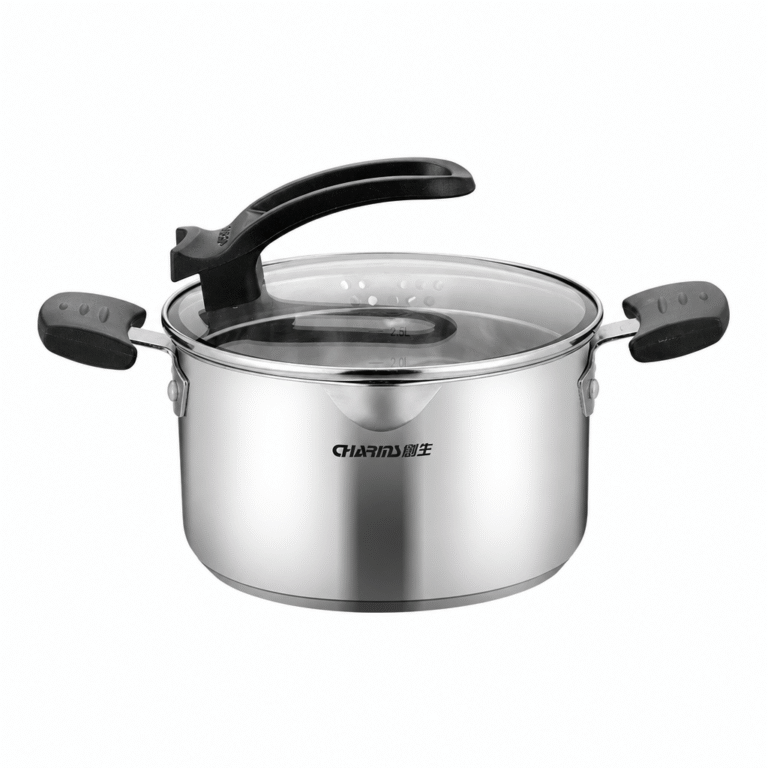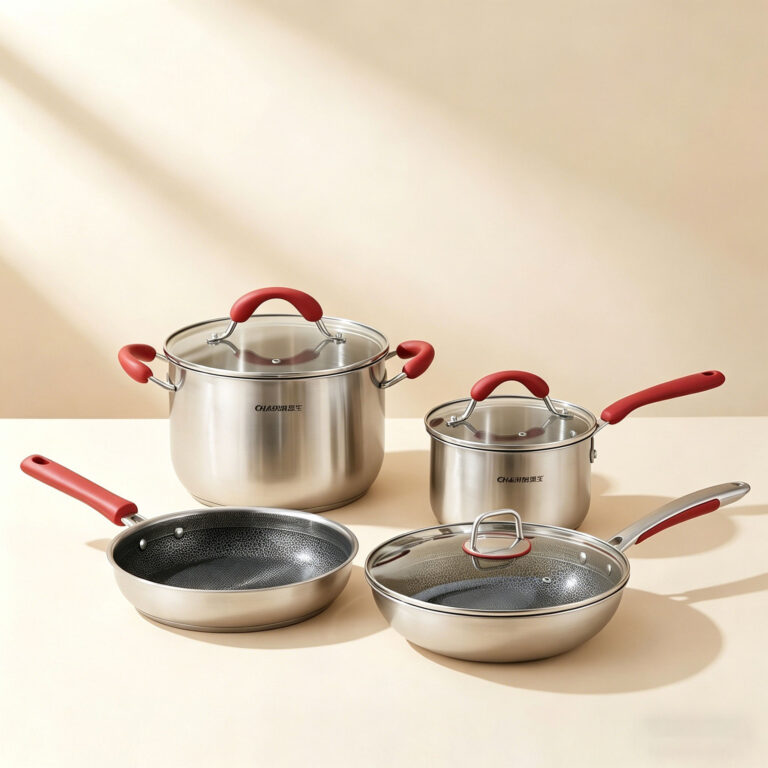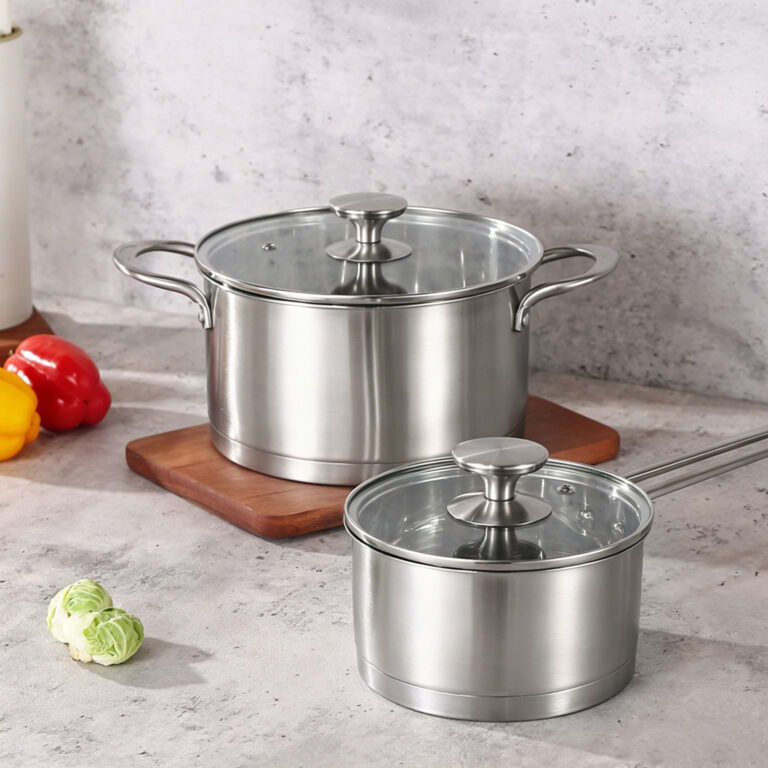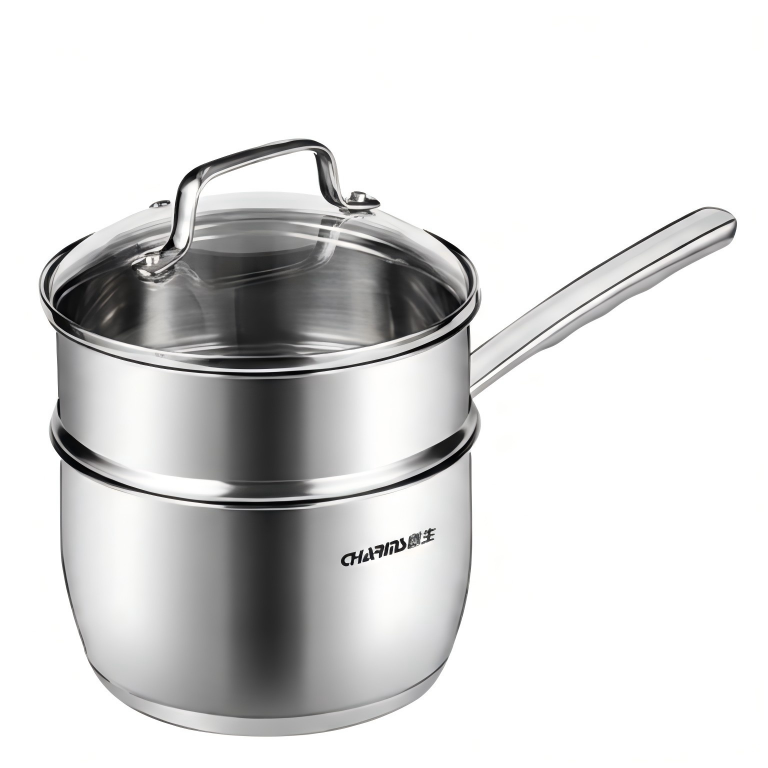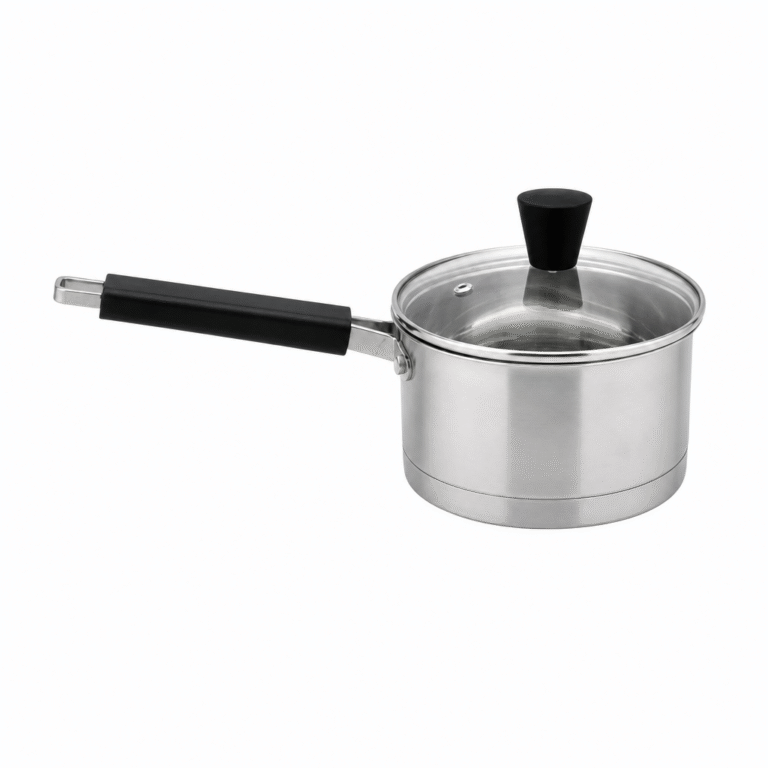


Tri-ply stainless steel cookware bonds three layers — stainless steel, aluminum, and stainless steel — from base to rim for even heating and lasting durability. Fully clad construction is the gold standard over disc-bottom alternatives, while the 3-ply vs 5-ply debate comes down to whether the extra weight and cost of five layers delivers meaningful gains for your cooking style. This guide covers the science, the manufacturing, and the real-world performance differences so you can buy with confidence.
What Is Tri-Ply Stainless Steel Cookware?
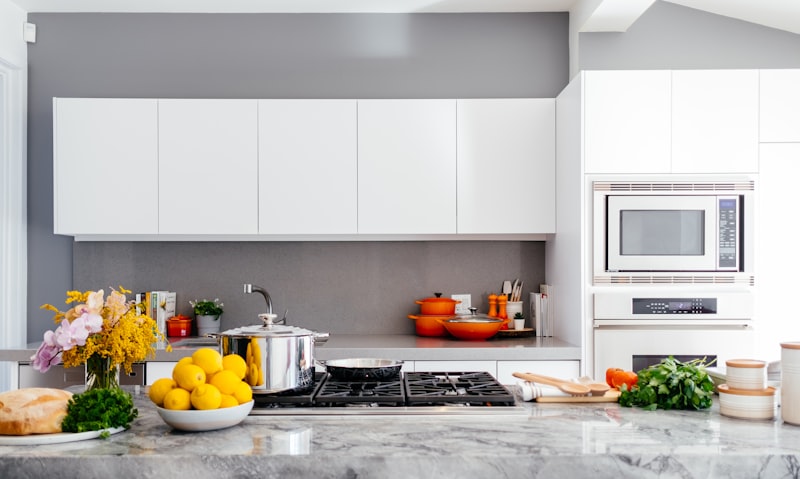
Tri-ply stainless steel cookware is made from three layers of metal bonded together under extreme heat and pressure. The outer layer is stainless steel for strength and corrosion resistance. The middle layer is aluminum for fast, even heat conduction. The inner layer is stainless steel for a non-reactive, food-safe cooking surface.
This construction solves a fundamental problem: stainless steel alone is a poor conductor of heat (about 15 W/m·K compared to aluminum’s 237 W/m·K). Without an aluminum core, a pure stainless steel pan develops severe hot spots directly above the burner. The aluminum core spreads heat laterally across the entire cooking surface, while the stainless steel layers provide the durability and food safety that aluminum alone cannot offer.
The key distinction is “fully clad” versus “encapsulated bottom” (disc-bottom) construction. In fully clad cookware, all three layers extend from the base up through the sidewalls to the rim. In disc-bottom cookware, the aluminum core exists only as a disc attached to the bottom, with thin single-ply stainless steel walls. This difference has a dramatic impact on how evenly your food cooks — especially in saucepans where liquid contacts the sidewalls.
America’s Test Kitchen warns that disc-bottom pans “heat up very slowly and then retain too much heat, so all of a sudden the pan goes from too cold to too hot.” The thick base can even detach from the body over time. Fully clad construction avoids both problems by distributing conductive material across every surface that contacts food.
How Fully Clad Cookware Is Made
Understanding the manufacturing process helps explain why quality fully clad cookware commands a premium price.
The process begins with cladding: rolls of stainless steel and aluminum are stacked, heated to precise temperatures, and fed through rolling mills that apply thousands of tons of pressure. This fuses the metals at a molecular level into a single inseparable sheet. That bonded sheet is then cut into discs (called blanks), pressed into pan shapes through hydraulic forming, trimmed, polished, and fitted with handles via rivets or welding.
All-Clad, which pioneered this process in 1971 in Canonsburg, Pennsylvania, uses this exact method. Their original patents on tri-ply aluminum-core fully clad pans have since expired, which is why brands like Tramontina, Made In, Demeyere, and Cuisinart now produce similar constructions at various price points.
The manufacturing cost difference between fully clad and disc-bottom is significant. Disc-bottom cookware requires bonding metal to only one surface, using less conductive material and simpler equipment. Fully clad requires bonding three layers across the entire pan body — more material, more precision, more expensive rolling mills. This is why a fully clad 10-piece set typically costs 40-100% more than a comparable disc-bottom set.
3-Ply vs 5-Ply Cookware: The Layer Count Question
The terms “3-ply” and “5-ply” refer to the number of metal layers in the pan’s construction. Here’s how they differ:
3-Ply (Tri-Ply) Structure:
- Interior: Stainless steel (18/8 food-grade, equivalent to 304 grade)
- Core: Aluminum alloy (typically 3003 or 3004 series)
- Exterior: Stainless steel (magnetic 430 for induction compatibility)
5-Ply Structure:
- Interior: Stainless steel
- Layer: Aluminum
- Core: Stainless steel (heat-diffusing layer)
- Layer: Aluminum
- Exterior: stainless steel
All-Clad’s D5 line, the most well-known 5-ply construction, uses this alternating stainless-aluminum-stainless-aluminum-stainless pattern. The central stainless steel core acts as a heat diffuser, slowing initial heat-up but distributing temperature more evenly across the surface.
Does More Ply Actually Mean Better Cookware?
The short answer: not necessarily. The total thickness of conductive material matters more than the number of layers.
Consider this: if a 3-ply pan has 1.5mm of aluminum and a 5-ply pan has 1.0mm of aluminum (split across two layers with a stainless steel core), the 3-ply pan actually has more conductive material. The extra stainless steel layer in 5-ply adds weight and warp resistance but doesn’t necessarily improve heat conduction.
CenturyLife.org’s analysis makes this point clearly: “A larger number of layers does not give you more performance if the total thickness does not increase. 1,000,000 microscopically thin plies that total 0.5mm of aluminum won’t really heat any more evenly than a single layer of aluminum 0.5mm thick.”
In fact, many cookware companies count microscopic bonding layers as additional “plies” — which is why some brands market their tri-ply cookware as “5-ply” or even “7-ply” when they’re using the same basic three-layer construction.
3-Ply vs 5-Ply: Head-to-Head Comparison
| Feature | 3-Ply (Tri-Ply) | 5-Ply |
|---|---|---|
| Heat-up speed | Faster — less material to heat | Slower — more thermal mass |
| Heat distribution | Very good to excellent | Excellent — slightly more even |
| Heat retention | Good | Better — holds temperature longer |
| Warp resistance | Good | Better — more structural layers |
| Weight | Lighter (typically 1.8-2.2 lbs for 12″ skillet) | Heavier (typically 2.5-3.2 lbs for 12″ skillet) |
| Responsiveness | More responsive to temperature changes | Slightly less responsive (thermal lag) |
| Price range | $50-$150 per piece | $100-$300+ per piece |
| Best for | Quick searing, sautéing, everyday cooking | Slow braising, sauce-making, precision work |
| Induction compatible | Yes (with magnetic exterior) | Yes |
Serious Eats, after extensive testing, concluded: “We’ve liked both kinds of pans, but think that tri-ply is totally adequate in most cases and for most cooks.” Their D3 (3-ply) review consistently outperformed D5 (5-ply) in value-for-money ratings.
The practical difference most home cooks notice: 5-ply is more forgiving if you accidentally crank the heat too high (it reacts more slowly), while 3-ply gives you more immediate feedback. Neither is “better” — it depends on whether you prefer control speed or forgiveness.
Why Aluminum Core Matters: The Science of Heat Transfer
The thermal conductivity numbers tell the whole story:
| Material | Thermal Conductivity (W/m·K) |
|---|---|
| Copper | ~401 |
| Pure Aluminum | ~237 |
| Aluminum Alloy 3003 | ~162 |
| Cast Iron (gray) | ~50 |
| Carbon Steel | ~50 |
| Stainless Steel 304 | ~14-16 |
Aluminum conducts heat roughly 16 times faster than stainless steel (237 vs 14.4 W/m·K). When you place a stainless steel pan with an aluminum core on a burner, the aluminum pulls heat from the flame or element and spreads it laterally across the pan’s surface. Without this core, the stainless steel directly above the flame gets extremely hot while the edges stay cool — creating hot spots that burn food in some areas while leaving it raw in others.
The specific aluminum alloy matters too. Most quality tri-ply cookware uses 3003 or 3004 aluminum alloy rather than pure aluminum. These alloys offer lower thermal conductivity (162 vs 237 W/m·K) but significantly better corrosion resistance — an important consideration when the aluminum is sandwiched between steel layers that will see thousands of heating cycles.
The total aluminum thickness is the real performance driver. A typical quality 3-ply pan (like All-Clad D3) is about 2.6mm thick, with roughly 1.5-1.75mm of that being aluminum. Thinner pans (under 2.2mm total) often use as little as 1.0-1.25mm of aluminum, which significantly reduces their ability to spread heat evenly. This is one reason cheap tri-ply knockoffs underperform compared to well-made versions.
What “Fully Clad” Actually Means in Practice
The term “fully clad” has become a marketing buzzword, but it has a precise technical meaning that matters for your cooking.
Fully clad = the bonded layers (stainless-aluminum-stainless) extend from the flat bottom of the pan up through the sidewalls, all the way to the rim. When you look at the rim of a fully clad pan, you can visibly see the three distinct layers.
Disc-bottom / encapsulated bottom = the bonded multi-layer disc is attached only to the flat bottom. The sidewalls are single-ply stainless steel — typically less than 1mm thick.
This distinction matters most in:
- Saucepans (where food/liquid climbs the walls)
- Stockpots (where heat needs to travel up the sides for even simmering)
- Sauté pans (where ingredients are tossed against the walls)
In a disc-bottom saucepan, the walls have virtually no aluminum, so heat from the burner doesn’t reach the sides effectively. This causes:
- Food scorches at the liquid line where single-ply walls meet the hot base
- The thick disc base heats slowly, then overshoots your target temperature
- Temperature changes take much longer to propagate
Wirecutter’s testing confirms: “We recommend only fully clad tri-ply sets, which have a layer of aluminum sandwiched between stainless steel and extended all the way to the rims.”
Real-World Performance: What I Noticed Switching to Fully Clad
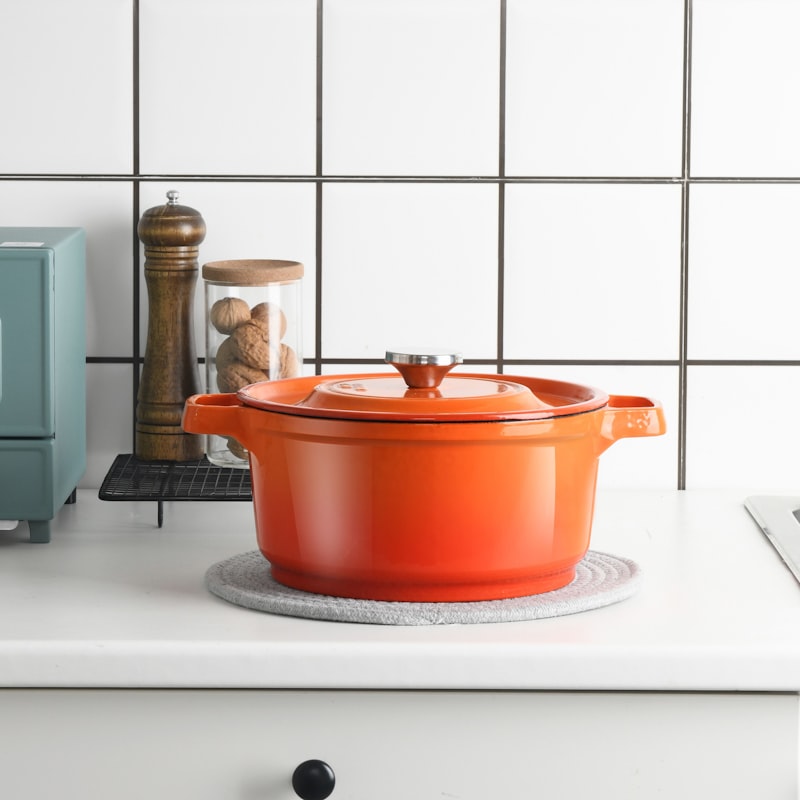
After using disc-bottom stainless steel for years, switching to a fully clad Tramontina tri-ply set (Wirecutter’s top pick) was immediately noticeable. The most obvious difference was in my saucepan: tomato sauce that previously scorch’d at the liquid line cooked evenly from bottom to rim. Caramel that used to develop dark spots in the center now browned uniformly.
For searing steaks, the difference between my old disc-bottom 12-inch skillet and a fully clad All-Clad D3 was subtler but still present. The D3 developed a more consistent Maillard crust across the entire surface, with fewer gray unseared patches near the edges.
The weight difference was noticeable but manageable. The fully clad pans feel solid without being exhausting — my Tramontina 12-inch weighs about 2.0 lbs, while the All-Clad D5 (5-ply) 12-inch comes in at roughly 2.8 lbs. After an hour of cooking, the lighter 3-ply is noticeably easier on the wrist.
Best Tri-Ply Stainless Steel Cookware: Brands Worth Considering
Budget Tier ($50-$150 per piece)
Tramontina Gourmet Tri-Ply Clad — Made in Brazil with fully clad construction from base to rim. 18/10 stainless steel interior. Induction compatible. Wirecutter’s top pick for several years running. A 12-inch skillet runs approximately $55. The best value in fully clad cookware, period.
Mid-Range ($100-$200 per piece)
All-Clad D3 Stainless — The original fully clad cookware, made in Pennsylvania since 1971. 18/10 stainless steel with aluminum core. Oven and broiler safe to 600°F. Limited lifetime warranty. A 12-inch skillet is approximately $150. Serious Eats’ best value pick. If you want buy-it-for-life cookware and can stretch the budget, this is the standard.
Demeyere Alu-Pro / Industry5 — Belgian-made. 5-ply Industry5 is a strong option if you specifically want 5-ply performance. Excellent InductoSeal technology for induction cooking.
Premium ($200-$300+ per piece)
All-Clad D5 Stainless — 5-ply construction with a stainless steel diffusing core between two aluminum layers. Heavier, slower to heat, but more even and forgiving. A 12-inch skillet is approximately $200. Best for precision work like sauces and braises.
All-Clad Copper Core — 5-ply with a copper center layer for the highest conductivity. Beautiful performance but the copper layer is reactive and requires more maintenance.
How to Choose: 3-Ply vs 5-Ply Decision Guide
Choose 3-ply if you:
- Want the best value for everyday cooking
- Prioritize fast heat-up and responsive temperature control
- Do a lot of searing, sautéing, and quick stir-frying
- Have smaller hands or wrist concerns (lighter weight)
- Are building your first quality cookware collection
Choose 5-ply if you:
- Make a lot of sauces, braises, and slow-cooked dishes
- Want maximum heat forgiveness (less overshooting)
- Have a larger budget and don’t mind the extra weight
- Want the most even heating possible across the entire surface
- Plan to use the pans in a professional or high-volume kitchen
Skip disc-bottom cookware entirely unless you’re buying a large stockpot (where sidewall heating matters less) on a tight budget. For skillets, saucepans, and sauté pans, fully clad construction is the minimum standard worth buying.
Frequently Asked Questions
What does “fully clad” mean in stainless steel cookware?
Fully clad means the bonded layers of metal (typically stainless steel and aluminum) extend from the base up through the sidewalls to the rim of the pan. This contrasts with disc-bottom construction, where the conductive layer exists only at the base. Fully clad cookware provides more even heating across the entire cooking surface, including the walls. You can verify fully clad construction by looking at the rim of the pan — you should see three distinct bonded layers.
Is 5-ply stainless steel cookware better than 3-ply?
Not necessarily. The total thickness and quality of the aluminum core matter more than the number of layers. A well-made 3-ply pan with 1.5mm of aluminum can outperform a 5-ply pan with only 1.0mm of aluminum spread across two thin layers. 5-ply pans do offer slightly more even heating and better heat retention, but they’re also heavier and more expensive. For most home cooks, 3-ply is the better value.
Why is aluminum used as the core in stainless steel cookware?
Aluminum conducts heat approximately 16 times faster than stainless steel (237 vs 14.4 W/m·K). Without an aluminum core, stainless steel cookware develops severe hot spots. The aluminum layer pulls heat from the burner and spreads it laterally across the pan’s surface. Aluminum alloys like 3003 are used because they offer good thermal conductivity (162 W/m·K) combined with better corrosion resistance than pure aluminum.
Does more ply mean better cookware?
No. More ply does not automatically mean better performance. The total thickness of conductive material (aluminum or copper) is what determines heat distribution. Some manufacturers count microscopic bonding layers to inflate ply counts — a tri-ply pan with two bonding layers can technically be called “5-ply” even though it performs identically to any other 3-layer construction. Always check total thickness and aluminum core thickness, not just the ply count.
What is the difference between tri-ply and encapsulated bottom cookware?
Tri-ply (fully clad) cookware has bonded layers extending from base to rim, providing even heating across all surfaces. Encapsulated bottom (disc-bottom) cookware has bonded layers only at the base, with single-ply stainless steel walls. Tri-ply is superior for saucepans, skillets, and sauté pans. Disc-bottom may be acceptable for large stockpots where sidewall heating is less critical. Disc-bottom cookware is also more prone to delamination over time.
Is stainless steel cookware safe for cooking?
Yes. 18/10 stainless steel (grade 304) is a food-safe material certified to meet ASTM A240 and ISO 9000 standards. The chromium content (minimum 18%) creates an inert oxide layer that prevents reactions with food. The aluminum core is fully encapsulated between stainless steel layers and never contacts food directly. Some studies show trace nickel can leach at very high temperatures, but amounts are well below safety thresholds for the general population.
Summary
The cookware industry’s “more ply = better” marketing has muddled what should be a straightforward decision. Here’s the reality after years of testing and research: fully clad tri-ply stainless steel with a quality aluminum core is all most home cooks need. The aluminum does the heavy lifting for heat distribution, the stainless steel provides durability and food safety, and the three-layer construction keeps the weight manageable.
5-ply offers marginal improvements in heat evenness and warp resistance that matter mainly for precision sauce work or professional kitchens. It’s not a bad choice — just one that most people won’t notice the benefits of in daily cooking.
The most important distinction isn’t 3-ply vs 5-ply — it’s fully clad vs disc-bottom. That single difference in construction quality makes a far bigger impact on your cooking results than adding two extra layers. Look at the rim: if you see three distinct bonded layers running all the way up, you’ve got fully clad cookware that will serve you well for decades.
For the best combination of performance and value, Tramontina’s Gourmet Tri-Ply Clad line is hard to beat. If budget allows and you want buy-it-for-life quality with American manufacturing, All-Clad D3 remains the gold standard that started it all.