

Food storage containers are one of those things most kitchens can’t afford to get wrong. Choose poorly, and you’re dealing with leaking lids, lingering odors, warped shapes, and ingredients that go bad faster than they should. Choose well, and your kitchen runs smoother, your food stays fresher, and you stop throwing money away on spoiled ingredients.
The problem is not that there are no containers available – there are hundreds of them. The question is which type is the most suitable for your actual needs. There are plastic, glass, stainless steel, and silicone containers – each has its own distinct advantages. Each also has its own limitations. If you purchase containers for a large kitchen, these differences will be magnified rapidly.
This guide breaks down all four types with the depth they deserve: what they’re made of, how they perform over time, where they shine, and where they fall short.
Why Food Storage Containers Matter in Everyday Life
It’s easy to underestimate storage. Cookware gets the attention — pans, pots, knives. Containers sit quietly in the background. But the way food is stored between preparation and consumption has a direct impact on freshness, flavor, safety, and efficiency.
Keeping Food Fresh Longer
Every food product has a window. Proteins, produce, grains, sauces — they all begin breaking down the moment they’re exposed to air, moisture, or temperature fluctuation. The right container controls those variables. A well-sealed container slows oxidation, limits moisture loss, and keeps aromas locked in rather than absorbed into surrounding foods.
What makes the difference between a container that keeps food fresh for two days versus five is rarely magic — it’s the quality of the seal, the material’s reactivity, and the thermal properties of the container itself.
Preventing Spills and Contamination
Cross-contamination is a real operational risk in any kitchen. Containers that don’t seal properly allow odors and moisture to transfer between stored items. In a refrigerator with multiple products stored in proximity, this matters more than people realize. A raw protein stored next to prepared vegetables, in a container with a loose-fitting lid, creates conditions you don’t want.
Beyond contamination, spills are a practical problem — wasted product, wasted time, wasted money. A container that seals reliably isn’t a premium feature. It’s a baseline requirement.
Improving Kitchen Organization
Stackability, uniform sizing, and clear labeling surfaces all contribute to how efficiently a kitchen operates. When containers come in consistent dimensions, shelves fill predictably. When lids are interchangeable across sizes, you spend less time hunting for the right match. These details seem small until you’re running a high-volume kitchen and every second of inefficiency compounds.
Supporting Portion Control and Meal Prep
Portioning is how professional kitchens maintain consistency. When proteins are pre-weighed and stored in dedicated containers, when sauces are pre-measured, when grains are prepped in batches — cooking becomes assembly rather than improvisation. That consistency is nearly impossible to achieve without the right storage infrastructure. The container is the system.
Plastic Food Storage Containers
Plastic containers have dominated kitchen storage for decades, and the reasons are obvious: they’re inexpensive, lightweight, and available in more shapes and sizes than any other material category. A set of plastic containers can handle everything from leftover rice to bulk pantry goods to pre-portioned snacks.
Lightweight and Affordable Option
For operations where volume matters and unit cost is a primary concern, plastic is hard to compete with on price. Containers can be purchased in large sets, replaced cheaply when damaged, and deployed across multiple storage functions without significant investment.
The weight advantage also matters in certain contexts — a plastic container holding a full portion of braised meat is noticeably easier to transport than the equivalent in glass or stainless steel.
Available in Many Shapes and Sizes
No other material offers the geometric variety that plastic does. Rectangular, round, square, deep, shallow, single-serve, family-size — the options are almost unlimited. This flexibility allows for tailored storage solutions: narrow containers for sauces, wide flat containers for baked goods, tall containers for soups.
The ability to fit containers into awkward refrigerator spaces or irregular shelving is a practical advantage that stacks up over time.
Great for Leftovers and Pantry Items
Plastic containers handle ambient storage exceptionally well. Dry pasta, grains, legumes, baking supplies, cereals — all store cleanly in airtight plastic containers without moisture intrusion or pest access. In pantry applications, plastic’s light weight means stacking high without structural concern.
For leftovers in the refrigerator, plastic delivers acceptable performance at a price point that makes replacement a non-issue when containers are stained, scratched, or warped.
BPA-Free Options to Consider
The conversation around plastics and food safety has evolved significantly over the past twenty years. BPA (bisphenol A) — once a common component in hard polycarbonate plastics — has been flagged by regulatory bodies for potential health concerns, particularly around heat exposure. Most reputable manufacturers now produce BPA-free options, typically using TRITAN, polypropylene, or other food-safe alternatives.
When sourcing plastic containers at scale, BPA-free certification matters — not only from a safety standpoint, but from a customer confidence perspective. Verify certifications rather than relying on label claims alone.
It’s worth noting that even BPA-free plastics can degrade over time, particularly when exposed to high temperatures repeatedly. Microwave use, dishwasher cycles, and prolonged sun exposure all accelerate that degradation. Plastic containers have a functional lifespan, and that lifespan should be factored into total cost of ownership calculations.
Glass Food Storage Containers
Glass containers occupy a specific and well-deserved niche in kitchen storage: they perform exceptionally in contexts where heat resistance, non-reactivity, and visual clarity matter. Tempered glass containers have been a professional kitchen staple for good reason.
Durable and Reusable Choice
The durability of tempered glass is often underestimated. While it can break from impact, it resists scratching, staining, and warping under normal conditions with a reliability that plastic simply cannot match. A well-maintained glass container doesn’t degrade over time the way plastic does — the material remains structurally and chemically stable across years of repeated use.
From a total cost of ownership perspective, glass containers that last five to ten years with consistent performance often represent better value than cheaper alternatives replaced multiple times over the same period.
Ideal for Microwave and Oven Use
Glass is oven-safe and microwave-safe in ways that plastic is not. Tempered borosilicate glass containers can handle oven temperatures typically up to 400–450°F (200–230°C), making them useful not just for storage but as part of the cooking process itself. Prepare a dish, move it directly to refrigerator storage, reheat in the oven — all in the same container. That versatility reduces the number of vessels needed and the washing required.
For kitchens where heat transitions are common, this thermal tolerance is a genuine operational advantage.
Stain-Resistant and Odor-Free
Glass is non-porous at the molecular level. It doesn’t absorb food pigments, oils, or odors the way plastic and even some metals can. A glass container used to store tomato-based sauce or strongly spiced food will look and smell clean after washing — the same cannot always be said for plastic alternatives.
This non-porosity also makes glass containers easier to sanitize thoroughly, which matters in any food service context where hygiene standards are non-negotiable.
Best for Meal Prep and Long-Term Freshness
For structured meal preparation where containers will be cycled through refrigerator storage, reheating, and repeated washing, glass holds up with a consistency that earns it genuine loyalty from professional kitchen staff. Meals prepped on Sunday and consumed through Friday don’t degrade the container.
The visual transparency is also a practical feature that gets overlooked. You can assess the contents without opening the lid, which saves time during busy service periods. It also makes inventory management in a walk-in refrigerator more intuitive.
The main limitation is weight. Glass containers are significantly heavier than plastic or stainless steel equivalents, which matters in high-volume transport scenarios or when containers need to be moved frequently. Some glass containers also have less effective lids — particularly older snap-lock designs — so lid quality should be evaluated separately from the container itself when making sourcing decisions.
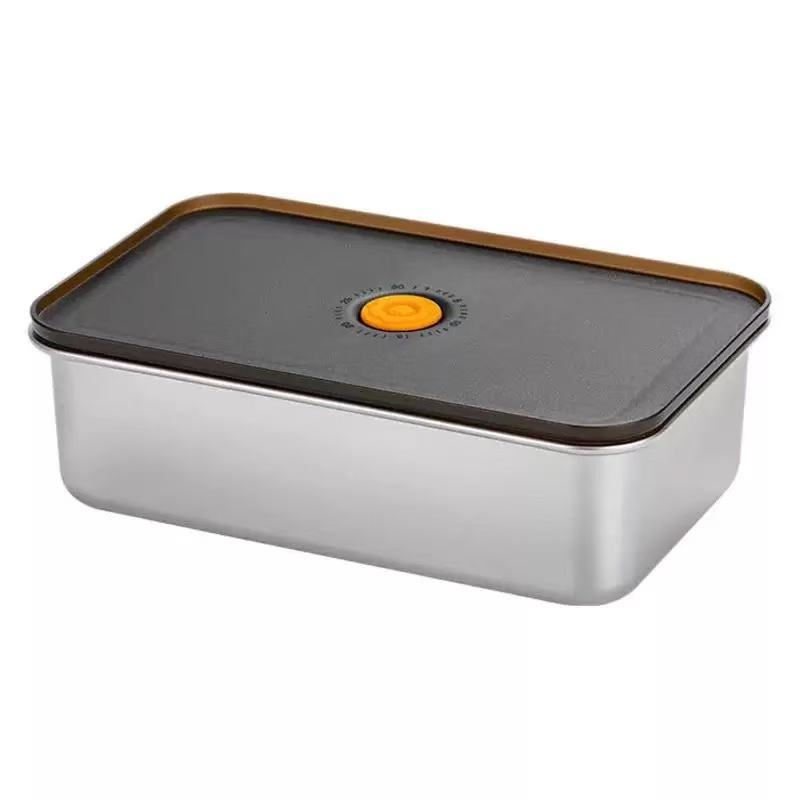
Stainless Steel Food Storage Containers
Stainless steel food storage containers are where durability, safety, and long-term performance converge most convincingly. They’ve been used in professional kitchens and institutional food service for decades, and the reasons go deeper than tradition.
Strong, Rust-Resistant, and Eco-Friendly
Food-grade stainless steel — specifically 304-grade, which contains 18% chromium and 8% nickel — is extraordinarily resistant to corrosion, rust, and chemical reaction. The chromium content forms a passive oxide layer on the surface that continuously self-repairs when scratched or abraded. This is not a coating that wears off. It’s a metallurgical property.
Compared to materials with anti-corrosion coatings that eventually degrade, 304 stainless steel maintains its surface integrity across years of daily commercial use. For operations where containers endure rough handling, industrial dishwasher cycles, and temperature extremes, this durability has direct economic value.
The environmental case for stainless steel is also substantive. A single stainless steel container that lasts fifteen to twenty years avoids the repeated manufacturing, shipping, and disposal cycle of lower-durability alternatives. When sustainability matters to your brand — and increasingly it matters to your customers — stainless steel delivers a credible answer.
Suitable for Lunch Boxes and Dry Food Storage
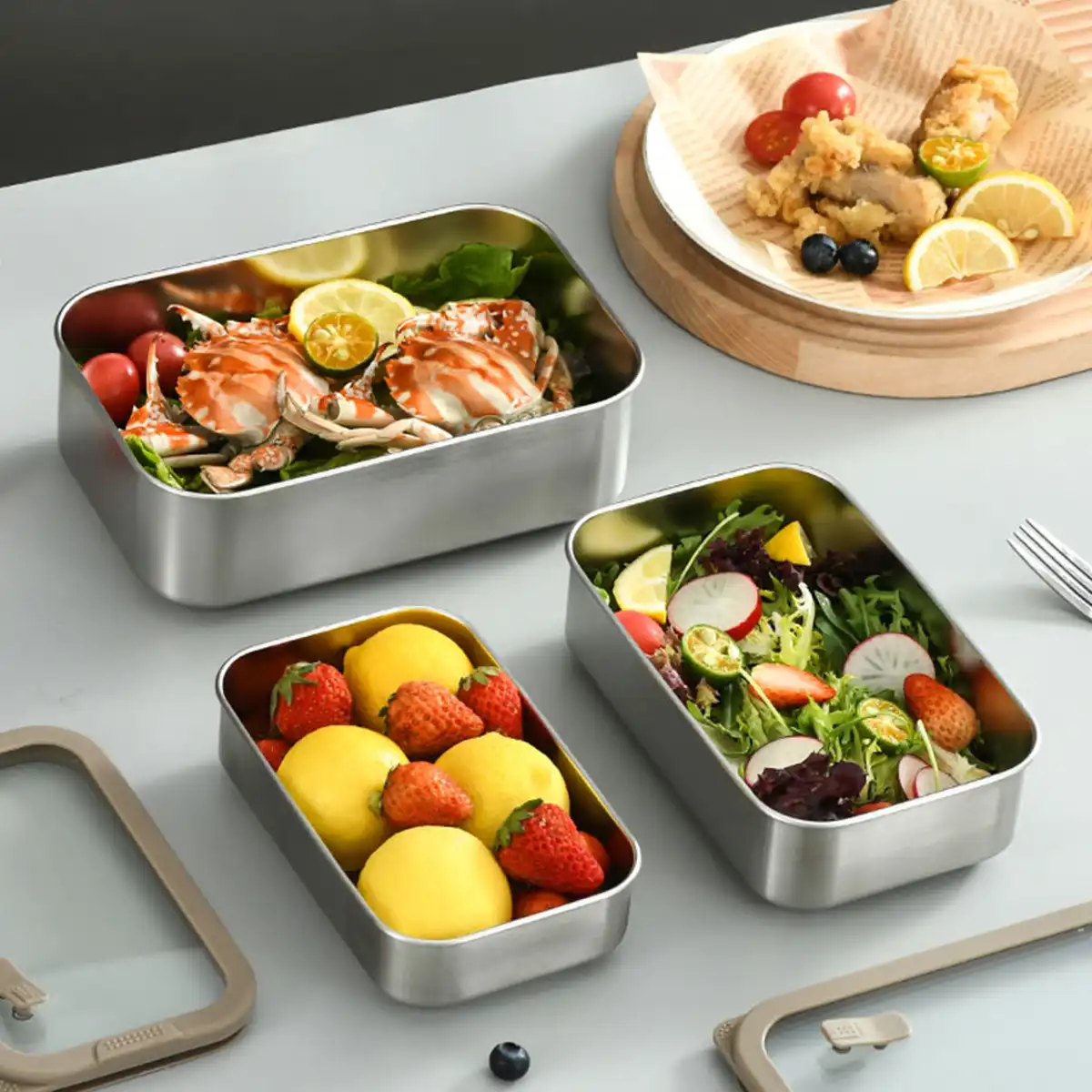
Stainless steel containers excel in applications where the container will be transported, handled outside a controlled environment, or used by end consumers as part of a branded food product. Lunch boxes, bento-style containers, and premium dry food storage all benefit from the material’s strength and aesthetic quality.
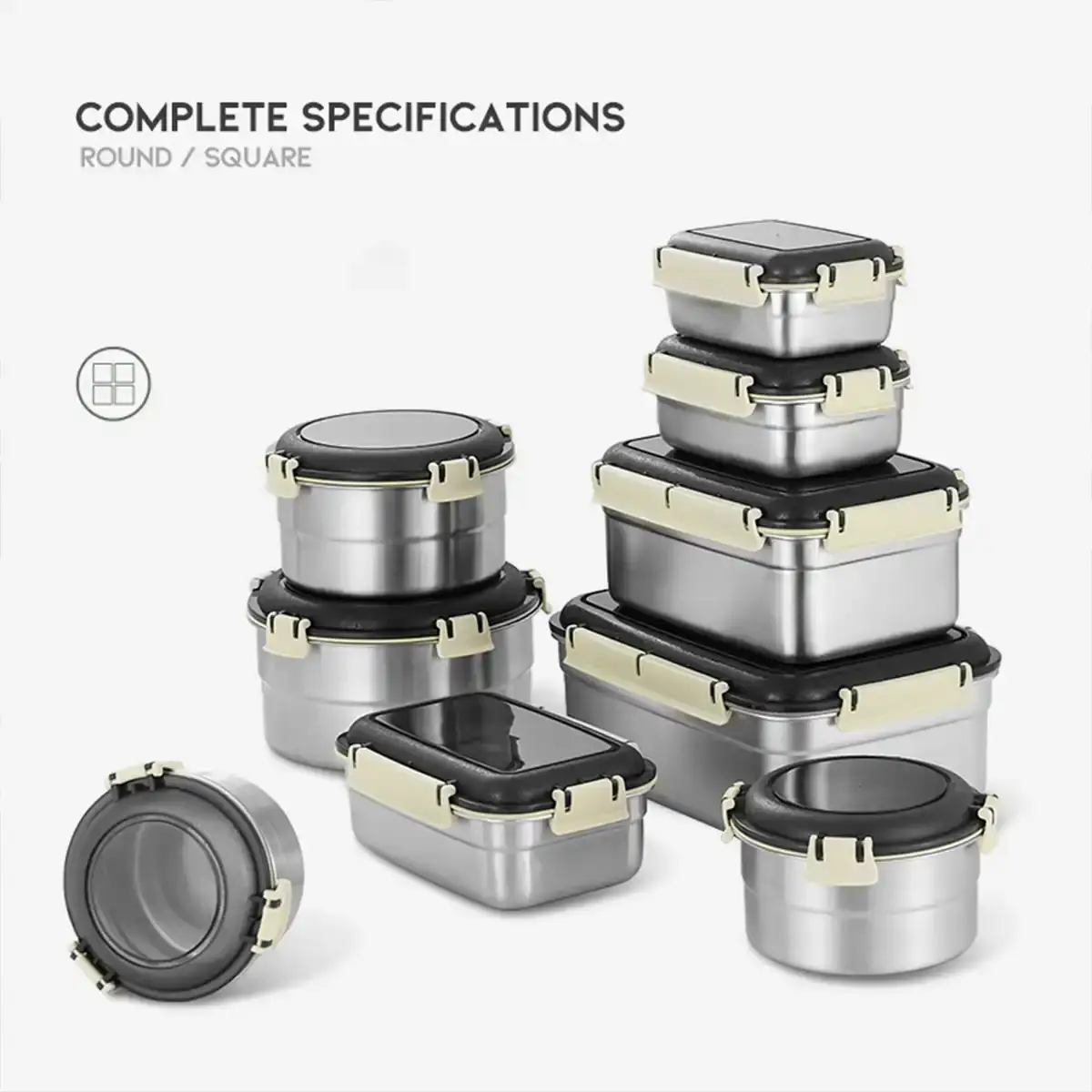
304 stainless steel containers with airtight PP lids — the kind produced by manufacturers with serious quality control behind them — maintain freshness effectively for dry and semi-dry goods. Nuts, seeds, spices, dried fruits, coffee beans — all store well in stainless steel, protected from moisture, light, and air.
The combination of metal body and precision-fit lid is what enables that airtight performance. A lid that doesn’t seat properly defeats the purpose. This is where manufacturing quality becomes visible: the tolerance between lid and container determines whether the seal actually works.
Popular for Commercial Kitchens and Outdoor Use
In commercial food preparation environments, stainless steel storage is often the default because it’s compatible with the same standards as stainless steel prep surfaces and cookware: easy to sanitize, heat-tolerant, chemically inert, and built for volume.
Outdoor use is where stainless steel further distinguishes itself. Camping, hiking, picnics, food market operations — contexts where containers face impact, temperature variation, and rough handling — all favor stainless steel’s robustness. Unlike glass, it doesn’t shatter. Unlike plastic, it doesn’t soften or leach under heat. It handles real conditions without compromise.
Long-Lasting Alternative to Plastic
The comparison between stainless steel and plastic deserves direct treatment because the initial price difference can obscure the actual value calculation. Plastic containers are cheaper to purchase. Stainless steel containers cost more upfront. But the math changes significantly over time.
Plastic containers typically last two to five years under regular commercial use before surface degradation, staining, warping, or lid failure makes replacement necessary. Stainless steel containers — particularly 304-grade with proper manufacturing behind them — routinely last ten to twenty years without meaningful degradation.
When you factor in replacement cycles, disposal costs, and the increasing regulatory and market pressure against single-use or short-lifespan plastics, stainless steel becomes the more economical choice over a multi-year horizon. Kitchens that have made this calculation are moving toward stainless steel not because of marketing, but because the numbers support it.
Silicone and Collapsible Food Containers
Silicone containers represent a category built around a specific problem: storage space. Standard containers occupy the same volume whether they’re full or empty. In kitchens with limited storage, in bags for commuters, in travel scenarios — that fixed volume becomes a real constraint. Collapsible silicone containers solve it directly.
Flexible and Space-Saving Design
Food-grade silicone is a synthetic polymer with properties that make it uniquely suited to collapsible applications. It’s flexible enough to compress completely when empty, yet rigid enough to hold its shape when filled. It doesn’t retain memory of deformation, meaning it returns to its full shape reliably each time.
A set of collapsible silicone containers can compress to a fraction of their full volume for storage, then expand to hold a complete meal portion. For a kitchen that values vertical storage space, or a food prep operation where containers need to be transported to a site and stored compactly on return, this matters.
Great for Travel, Lunch Packing, and Camping
The portability applications for silicone containers are well-established. They’re light, they compress, they don’t shatter, and they handle the temperature variations common in transit — from a hot car to a cold bag to a microwave. For lunch containers sent with employees or clients, for food samples transported to trade shows, for any context where containers travel alongside food, silicone performs consistently.
Camping and outdoor food preparation specifically benefit from silicone’s combination of flexibility, heat resistance, and light weight. Silicone containers can handle boiling water contact and freezer temperatures without material degradation — a thermal range that makes them genuinely versatile.
Leak-Resistant and Freezer Safe
Quality silicone containers seal well. The material’s flexibility actually contributes to the seal: a silicone lid that compresses around a container edge creates consistent contact pressure around the full perimeter rather than at discrete points like snap-lock mechanisms. When properly designed, this makes silicone containers reliably leak-resistant.
Freezer compatibility is another practical advantage. Silicone remains flexible at freezer temperatures — it doesn’t become brittle the way some plastics do, and it doesn’t crack when flexed after extended freezer storage. Containers that move between freezer and room temperature regularly benefit from this material property.
Easy to Store in Small Kitchens
The collapsibility that makes silicone useful in travel contexts applies equally to domestic kitchens with limited cabinet space. A set of silicone containers stacked compressed occupies a drawer slot rather than a shelf. This practical advantage — invisible in a product listing but immediately obvious in daily use — is why silicone containers have earned real market share in compact kitchen environments and among users who travel with food regularly.
The material’s main limitation is rigidity: silicone containers don’t stack as stably as rigid containers when full, and they’re not suitable for oven use at high temperatures. For specific storage needs — travel, freezer, compact kitchens — they deliver excellent performance. As a complete replacement for all storage functions, they work better alongside other container types than as a sole solution.
How to Choose the Right Container Type for Your Needs
The decision isn’t about which material is universally best — it’s about matching material properties to specific use cases.
Plastic handles high-volume, low-cost pantry and leftover storage where replacement cost needs to stay low. Glass handles heat-transition applications and contexts where non-reactivity and visual clarity matter. Stainless steel handles long-term commercial use, transport, and any application where durability and material safety need to be beyond question. Silicone handles travel, freezer storage, and compact kitchen environments where space efficiency is the primary constraint.
Kitchens that understand these distinctions build storage systems with each material in its right role — rather than defaulting to one material for everything and dealing with the friction when it doesn’t fit.
For food service operations, product sourcing companies, and kitchen brands evaluating storage solutions at scale, the quality of manufacturing behind any of these materials is as important as the material choice itself. A 304 stainless steel container is only as good as the precision with which the lid seals, the consistency of the gauge, and the quality of the finishing. A glass container is only as useful as the thermal stability of the specific glass formulation.
Material certification, manufacturing standards, and factory quality control aren’t administrative details — they’re what separates containers that perform consistently from ones that fail under real operating conditions.
When you’re building a product line or sourcing containers that carry your brand’s name, the manufacturing partner behind the product defines the product itself. That’s worth investing time to get right.
If you are looking for wholesale food storage containers, custom kitchen storage solutions, or reliable OEM/ODM manufacturing services, feel free to contact us. We provide high-quality storage container solutions for distributors, retailers, and brands worldwide.