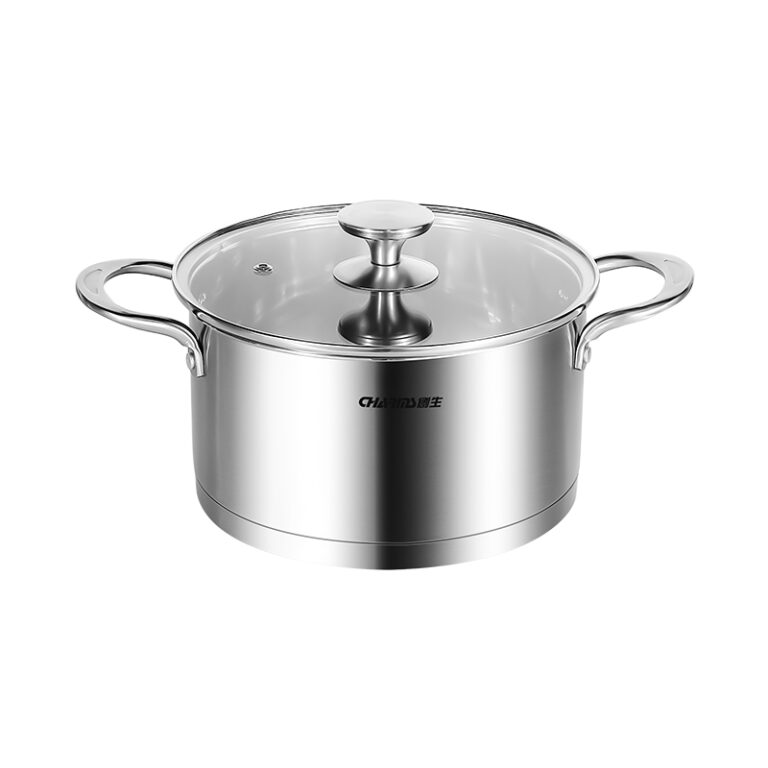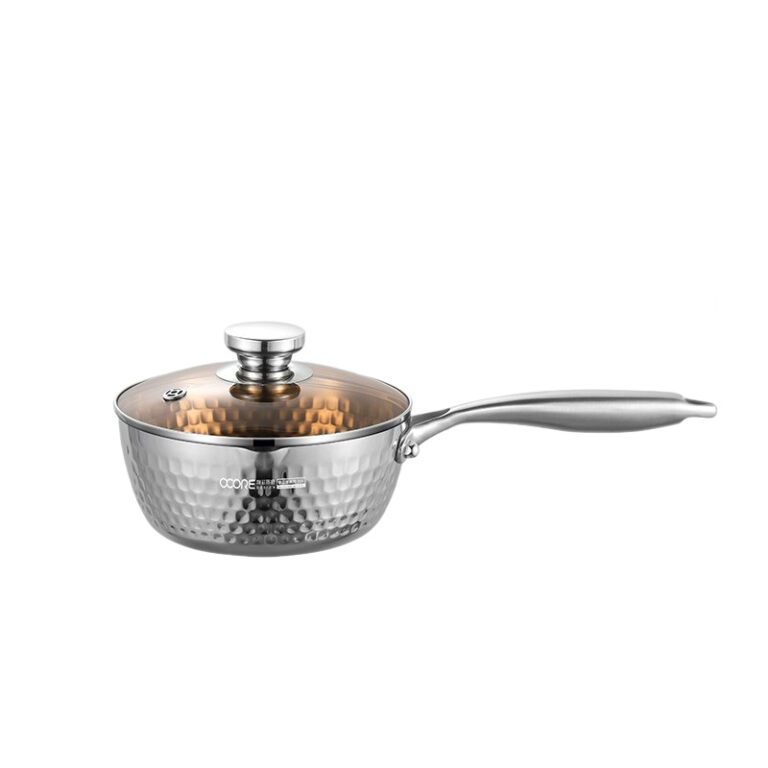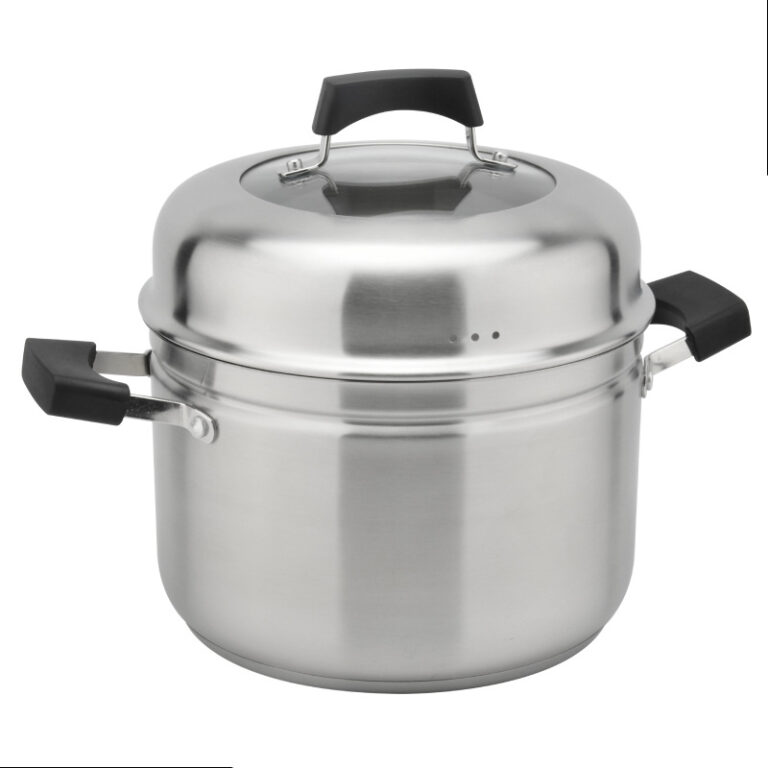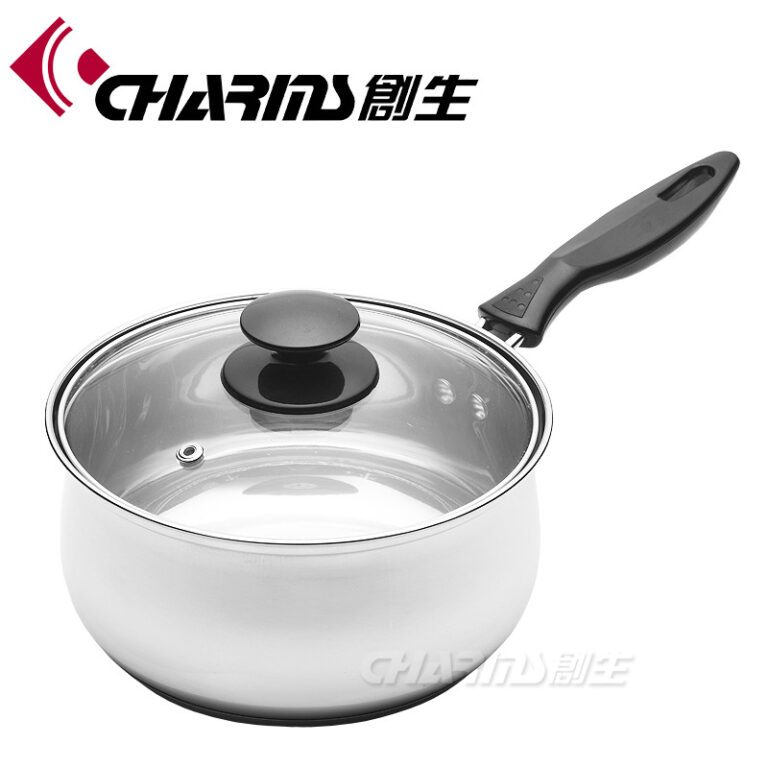

In professional kitchens, food processing environments, and high-frequency usage scenarios, stainless steel cookware has always held a dominant position. This is mainly due to its comprehensive advantages in terms of stability, safety, and long-term controllability.
However, the question “What is the best option among stainless steel cookware sets?” is often oversimplified. A lot of content merely focuses on brand comparisons, price ranges, or superficial parameters, but rarely explains why certain cookware performs more stably over the long term, while others gradually lose control.
In this article, Charms Cook is a custom kitchenware manufacturer based in China with over 30 years of experience. We will introduce to you the advantages, types, maintenance, etc., of the stainless steel cooking sets. Let’s explore them together in the article.
What Is a Stainless Steel Cookware Set?
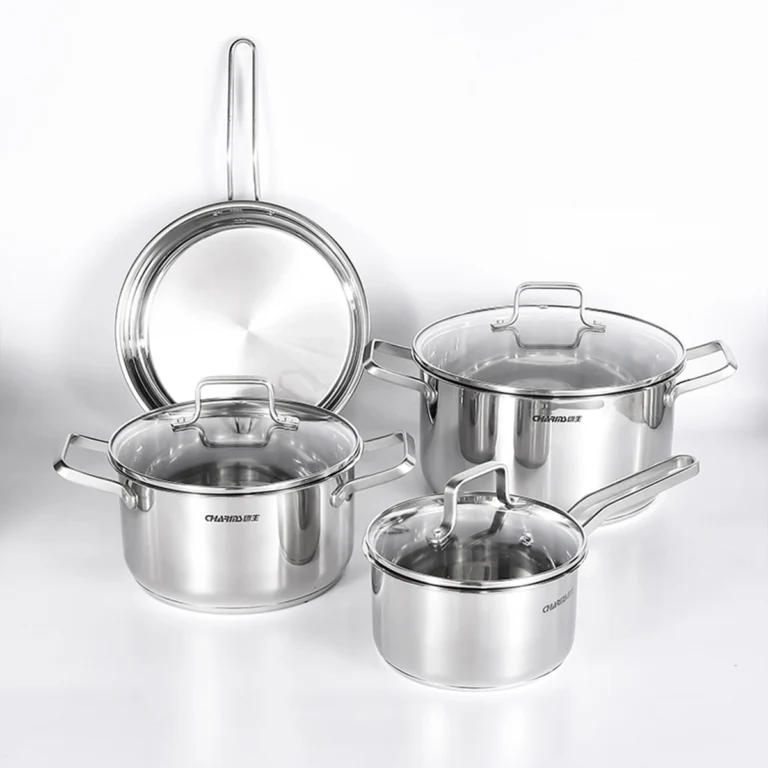
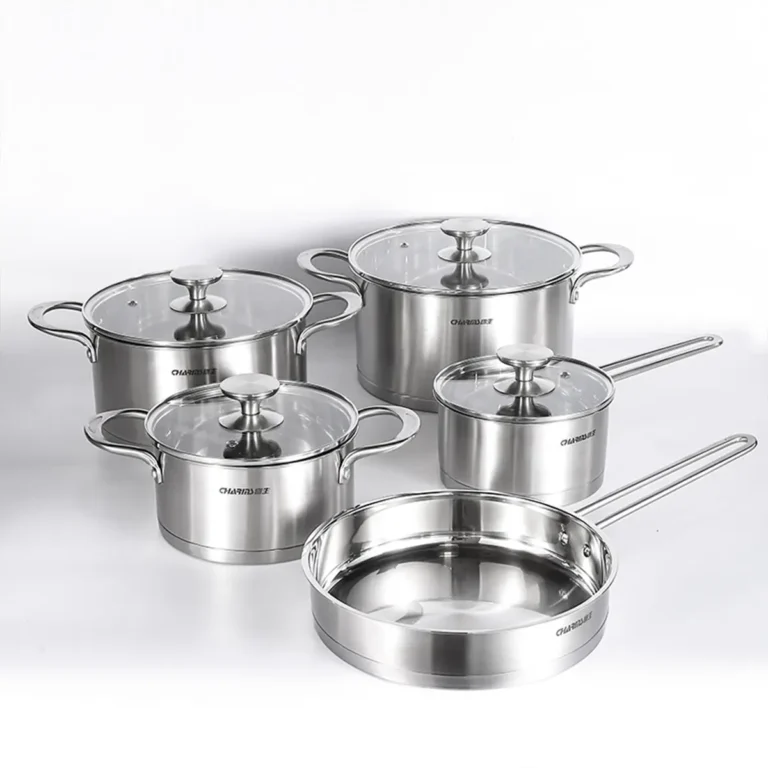
A set of stainless steel cookware is not merely a simple combination of a few stainless steel pots, pans, bowls, and spoons. From a functional perspective, it is more like a complete cooking container system, aiming to enable you to achieve stable and controllable cooking results under different heat sources, different cooking methods, and different usage intensities.
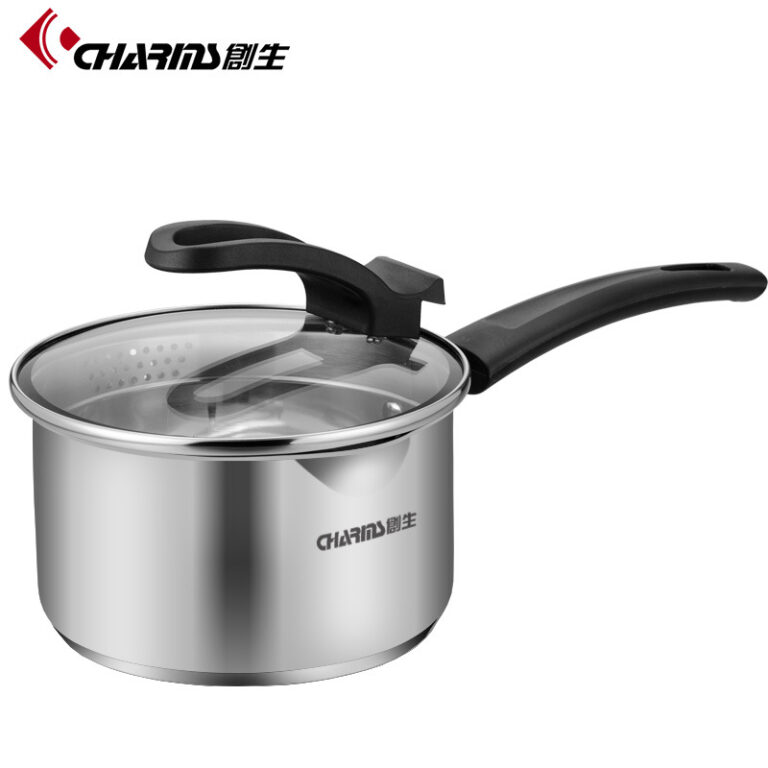
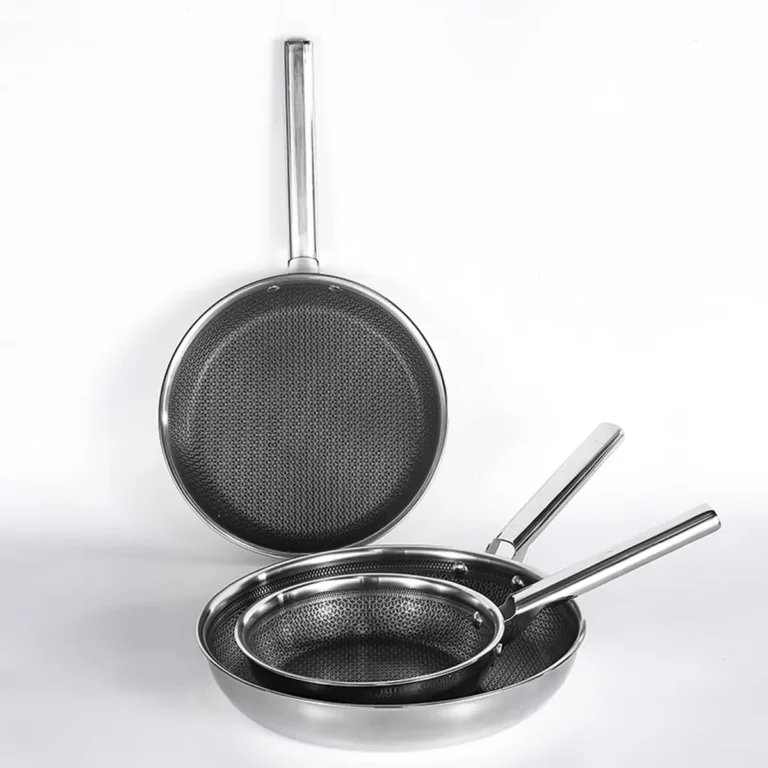
In a complete set of high-quality stainless steel cookware, each piece of utensil – whether it’s a saucepan, a frying pan, a stew pot, or a sauté pan – has a clearly defined role.
However, what truly sets them apart is not just the performance of individual cookware but the consistency of the entire set of cookware in design. These utensils are usually crafted using the same material structure, heat-conducting logic, and durability standards, ensuring that when you use them, you won’t change your judgment on the heat and operation due to the replacement of cookware. It is this consistency that distinguishes a truly comprehensive cookware system from a haphazardly assembled set of cookware.
From a manufacturing perspective, a set of high-quality stainless steel cookware is usually based on several key foundations:
- It will select specific stainless steel grades (such as 304 or 316) to ensure long-term stability and food safety.
- It adopts clearly defined base structures (single layer, three layers, or multiple layers) to balance thermal conductivity and structural strength;
- Through unified wall thickness control and forming processes, it guarantees that each pot maintains consistent performance during heating and cooling.
- It is equipped with compatible pot lids, handles, and fastening systems to enhance overall safety and operational consistency.
- At the same time, surface treatment is not merely for appearance, but for improving durability and the controllability of daily cleaning.
In an environment of frequent use, the true value of a set of cooking utensils can be truly felt not by how shiny they were when first purchased, but by whether they remain reliable after undergoing thousands of heating and cooling cycles, repeated cleaning, and continuous high-intensity usage. A well-designed set of stainless steel cooking utensils can maintain a stable shape, controllable heat conductivity throughout the entire usage period, and always meet safety usage standards.
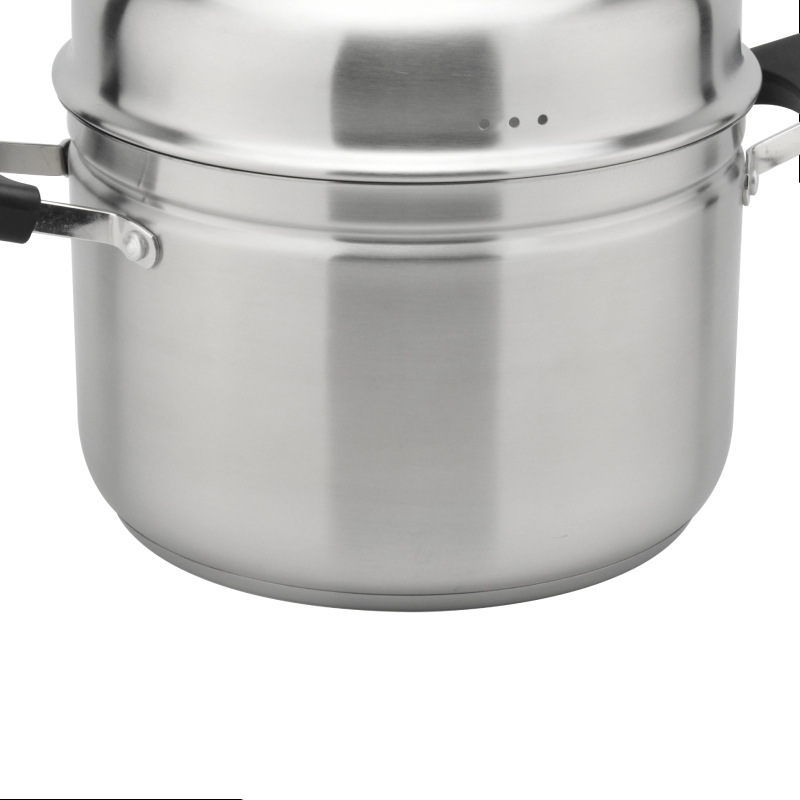
What Makes a Good Stainless Steel Cookware Set?
Not all stainless steel cookware sets perform the same, even when they appear similar on the surface. The real differences emerge over time and under pressure. Below are the key characteristics that define a high-quality stainless steel cookware set.
Material Grade and Stability
The stainless steel grade directly affects corrosion resistance, food safety, and long-term appearance. Grades like 304 stainless steel provide a stable balance of chromium and nickel, ensuring resistance to rust, pitting, and chemical reactions with acidic or alkaline foods.
A good cookware set uses consistent material grades across all pieces, not mixed or downgraded components.
Heat Distribution and Responsiveness
Stainless steel alone is not an efficient heat conductor. That is why high-quality cookware relies on layered construction. Aluminum or copper cores are used to distribute heat evenly, while stainless steel provides durability and safety.
The best cookware sets achieve:
- Even heat spread across the cooking surface
- Predictable temperature changes
- Minimal hot spots that cause uneven cooking
This consistency is essential for repeatable cooking results.
Structural Integrity
Warping is one of the earliest signs of poor cookware engineering. A quality stainless steel cookware set maintains flat bases and stable walls even after repeated high-heat exposure.
This depends on:
- Proper material thickness
- Controlled forming processes
- Reinforced base structures
Once cookware loses its shape, heat transfer efficiency and safety are compromised.
Ergonomic and Secure Handles
Handles are often overlooked, yet they directly affect safety and control. Well-designed handles are:
- Firmly attached through welding or heavy-duty riveting
- Balanced to prevent tipping
- Heat-resistant during normal cooking use
In professional environments, loose or poorly designed handles quickly become liabilities.
Compatibility Across Heat Sources
A good stainless steel cookware set should perform consistently on gas, electric, ceramic, and induction cooktops. This requires precise magnetic base design and flat contact surfaces.
True versatility reduces operational constraints and future-proofs your investment.
Cleanability and Surface Finish
High-quality stainless steel cookware is designed to be cleaned repeatedly without degrading. Smooth interior surfaces, proper polishing, and controlled finishing reduce food adhesion and simplify sanitation.
This matters more over the years than it does on the first day of use.
Common Types of Stainless Steel Cookware Sets
| Cookware Set Type | Typical Components | Primary Use Characteristics | Suitable Environments |
|---|---|---|---|
| Basic Starter Set | Saucepan, Frying Pan, Stockpot | Covers essential cooking tasks with minimal redundancy | Small kitchens, testing facilities |
| Full Cooking Set | Multiple saucepans, sauté pan, frying pans, stockpots | Broad coverage for varied cooking methods | Commercial kitchens, production kitchens |
| Induction-Ready Set | Multi-ply base with magnetic layer | Optimized for induction efficiency | Modern kitchens with induction systems |
| Heavy-Duty Set | Thicker walls, reinforced bases | Designed for high heat and frequent use | Professional kitchens, food processing |
| Modular Set | Interchangeable lids and sizes | Flexible configuration and scalability | Operations with changing production needs |
How to Choose the Right Stainless Steel Cookware Set
Step 1: Define Your Primary Cooking Conditions
Consider how the cookware will actually be used:
- Frequency of use per day
- Typical heat levels
- Types of food prepared
- Cleaning methods and detergents used
Cookware designed for occasional home use will not perform the same under continuous operation.
Step 2: Evaluate Heat Source Compatibility
Confirm which heat sources are involved now and in the future. If induction is part of the equation, base construction becomes non-negotiable.
Flatness, magnetic response, and base thickness directly affect efficiency.
Step 3: Assess Structural Design, Not Just Appearance
Look beyond polish and shape. Ask about:
- Wall thickness
- Base layering structure
- Handle attachment methods
- Tolerance controls during manufacturing
These details determine longevity.
Step 4: Prioritize Consistency Across the Set
Inconsistent cookware leads to inconsistent results. A reliable set behaves the same way across all pieces, allowing cooks to build intuition and repeat results.
Step 5: Consider Long-Term Maintenance
Choose cookware that can withstand repeated cleaning cycles without discoloration, corrosion, or surface degradation. This reduces downtime and replacement costs over time.

Stainless Steel Cookware Set Maintenance and Usage Tips
- Heat gradually rather than using high heat in an empty pan: Stainless steel is better suited for gradual heating. If you start with high heat in an empty pan, especially for multi-layer cookware, it can easily affect the flatness of the bottom and the stability of heat conduction over time.
- Utilizing the heat source properly: You should ensure that the bottom size of the pot matches the size of the stove to avoid localized overheating or uneven heating. This has a direct impact on the control of the fire and energy consumption.
- Gentle cleaning is more beneficial for long-term use: Stainless steel doesn’t require vigorous scrubbing. You only need to use a neutral cleaner and non-abrasive tools. Over time, it will be less likely to stick to the pan.
- Pay attention to the handle and connection parts: During frequent use, you should regularly inspect the handle and the fixed structure, and promptly address any looseness. This can effectively reduce safety risks.
- Pay attention to the storage and handling methods: Randomly stacking can easily cause scratches or deformation. When stacking, adding padding can significantly enhance the stability of the entire set of cookware.
- Treat the cooking utensils as a long-term system: When you view the entire set of cooking utensils as a system that will be used over a long period of time, rather than as disposable items, your judgment of the cooking temperature will be more stable and your operation will be more smooth.
Conclusion
When you select a set of appropriate stainless steel cookware, it’s not about choosing individual pots or surface parameters, but rather determining whether the materials, structure, heat conductivity performance, and long-term stability can form a reliable whole. Only when these elements work together can the cookware consistently provide controllable and stable cooking performance under different heat sources and frequent usage conditions.
Charms Cook is a stainless steel cookware manufacturer with over 30 years of experience, specializing in the overall control from material selection, structural design to long-term performance. For users who desire long-term stable performance rather than short-term usage experience, systematic design and mature manufacturing experience are particularly important.