

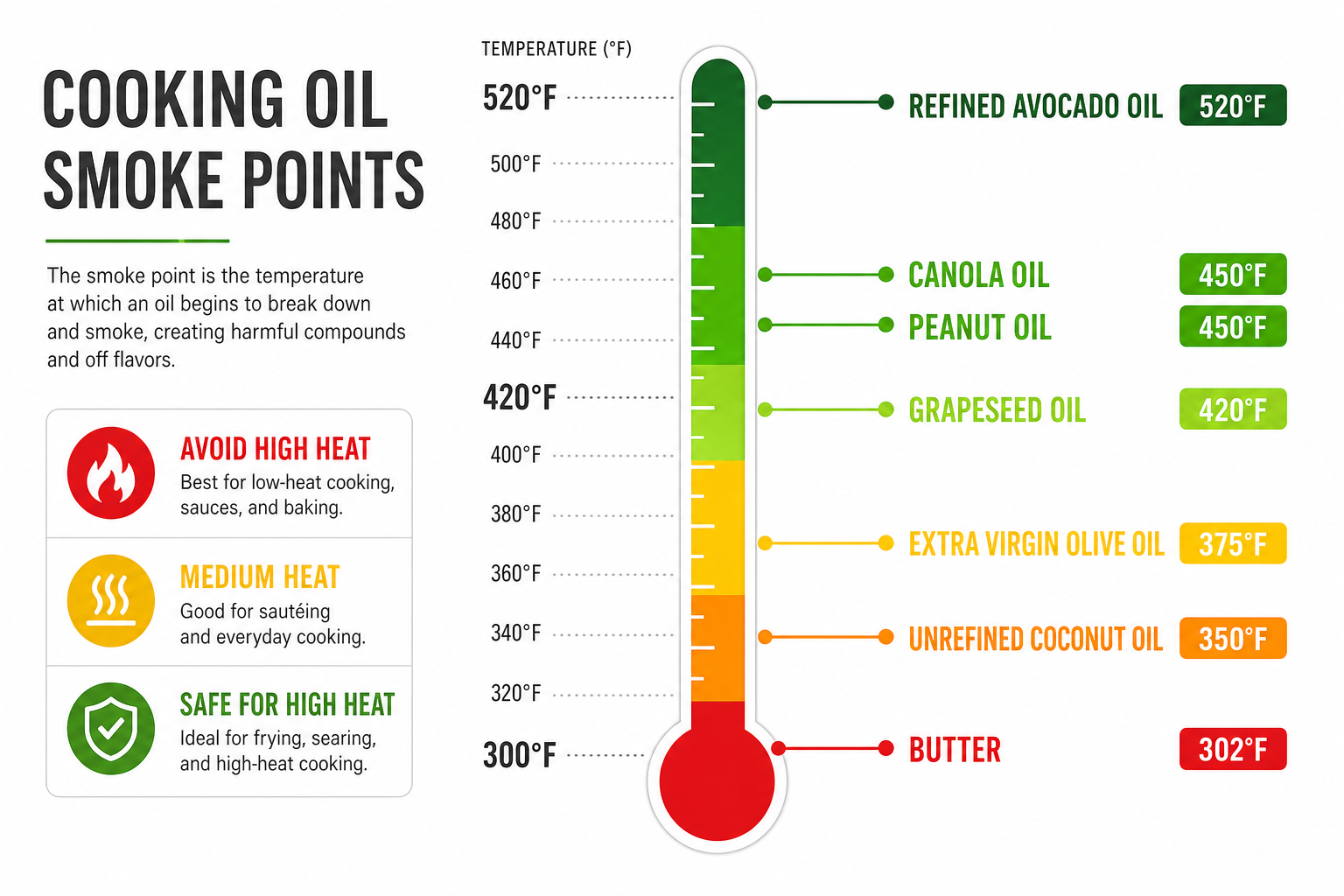
Choosing the right oil for stainless steel cookware comes down to matching smoke point to cooking temperature. For high-heat searing, refined avocado oil (480–520°F smoke point) is the top pick. For everyday cooking, grapeseed oil (420°F) is versatile and neutral. Canola oil (400–475°F) is the budget-friendly workhorse. Extra virgin olive oil, despite being a kitchen staple, smokes at 325–405°F depending on quality — fine for low-heat sautéing but a poor choice for searing. Beyond oil selection, proper pan preheating is equally critical: food sticks and oil smokes when technique is off, not just when the wrong oil is used.
Why Smoke Point Is the First Thing to Get Right
When you cook on stainless steel, the pan surface regularly reaches 400–500°F during a proper sear. At that temperature, most oils don’t just smoke — they break down chemically, releasing acrolein and free radicals that make food taste bitter and fill your kitchen with haze.
Smoke point is the temperature at which an oil begins to visibly smoke. At that point, the oil’s fatty acids are oxidizing and its flavor compounds are burning off. For stainless steel cookware, where high-heat searing is one of the primary advantages over nonstick, this matters more than it would with a ceramic or coated pan you’d never take above 375°F.
Two common misconceptions are worth clearing up before we go further:
- A higher smoke point doesn’t automatically mean a healthier oil. Canola oil has a high smoke point but a poor omega-6 to omega-3 ratio. EVOO has a lower smoke point but outstanding antioxidant content. These are separate conversations.
- Refined vs. unrefined changes everything. Unrefined avocado oil smokes around 375°F. Refined avocado oil smokes at 480–520°F. If your bottle doesn’t say “refined,” assume the lower figure.
Cooking Oil Smoke Point Quick-Reference Table
| Oil | Smoke Point (°F) | Smoke Point (°C) | Best Use with Stainless Steel | Flavor |
|---|---|---|---|---|
| Refined avocado oil | 480–520°F | 248–271°C | Searing, high-heat frying | Neutral |
| Ghee (clarified butter) | ~482°F | ~250°C | Searing, sautéing with flavor | Buttery, nutty |
| Refined peanut oil | ~450°F | ~232°C | Stir-fry, deep frying | Mild, slightly nutty |
| Refined sunflower oil | ~450°F | ~232°C | All-purpose high-heat | Neutral |
| Refined coconut oil | ~400°F | ~204°C | Sautéing, medium-high heat | Mild coconut |
| Canola oil | 400–475°F | 204–246°C | Everyday cooking, pan-frying | Neutral |
| Grapeseed oil | ~420°F | ~216°C | Everyday sautéing, searing | Very neutral |
| Extra light olive oil | ~465°F | ~240°C | Medium-high heat | Light |
| Regular olive oil | 390–470°F | 199–243°C | Medium heat sautéing | Mild olive |
| Sesame oil (refined) | ~410°F | ~210°C | Finishing, stir-fry | Nutty, distinct |
| Extra virgin olive oil | 325–405°F | 163–207°C | Low–medium heat only | Fruity, grassy |
| Unrefined coconut oil | ~350°F | ~177°C | Low–medium heat | Strong coconut |
| Butter | ~302°F | ~150°C | Low heat, finishing only | Rich, dairy |
Note: Smoke points vary by brand, freshness, and refining process. Values above represent typical refined versions unless specified.
The 5 Best Oils for Stainless Steel Cookware
1. Refined Avocado Oil — Best for Searing
Bottom line: The single best all-around oil for stainless steel if you do any high-heat cooking.
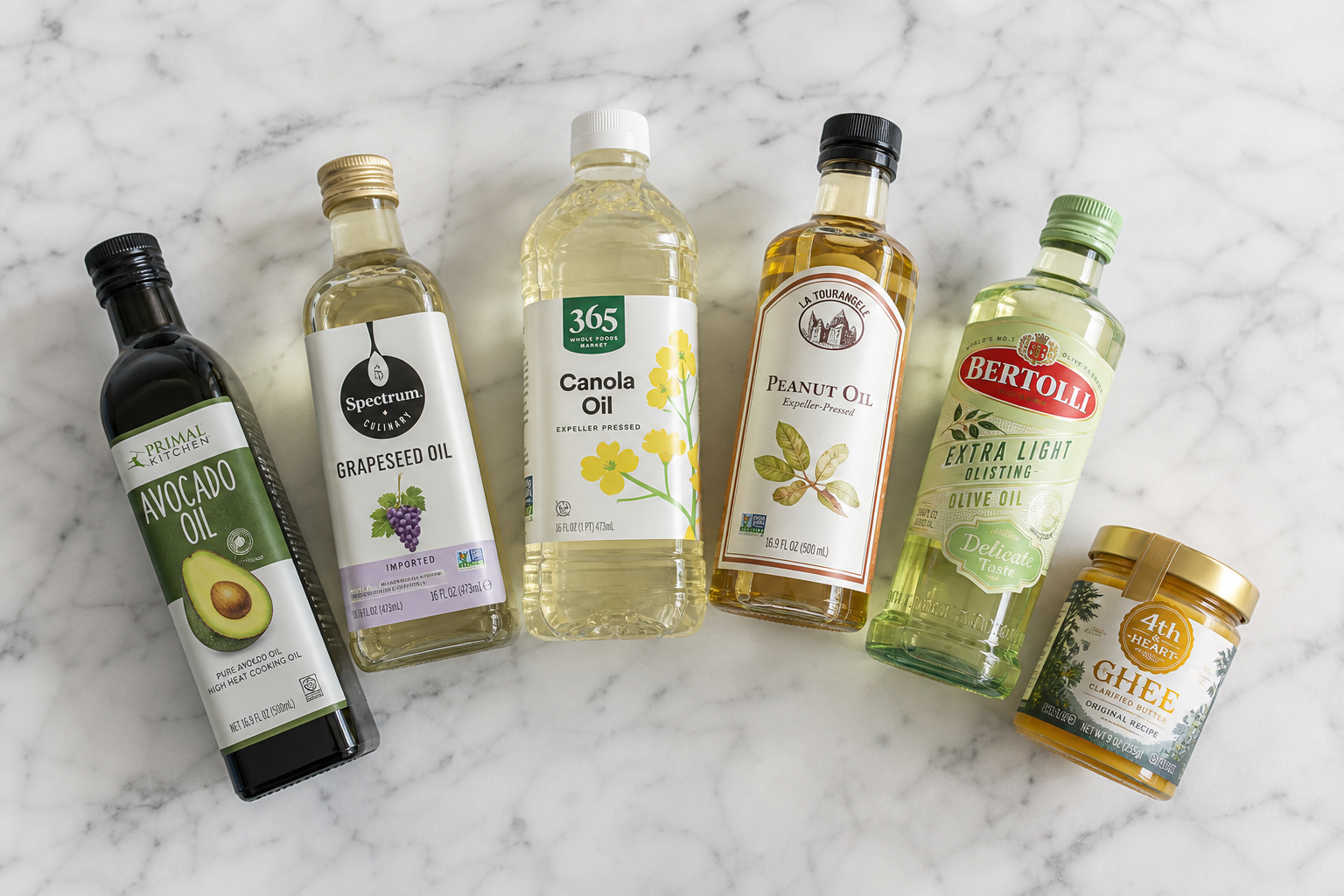
Refined avocado oil’s smoke point of 480–520°F is the highest of any common culinary oil. When you’re searing a ribeye or getting a golden crust on chicken thighs — which requires pan temperatures in the 450–500°F range — avocado oil gives you meaningful headroom. You’re not racing against the smoke point; you’re working comfortably within it.
The flavor is close to neutral, which is important. It doesn’t compete with the food or the fond you’re building in the pan.
One word of caution: check the label for “refined.” Unrefined or “virgin” avocado oil is only rated to roughly 375°F — a significant difference. The bottle should state refined, expeller-pressed, or high-heat. Brands like Chosen Foods and Primal Kitchen consistently specify this.
The main downside is cost. Avocado oil runs about 2–3x the price of canola. For everyday sautéing where you’re not exceeding 375°F, it’s overkill. Save it for searing.
Best for: Searing steak, chicken, pork chops, roasting vegetables at high heat.
2. Grapeseed Oil — Best Everyday Oil
A reliable, affordable neutral oil with enough smoke point for most home cooking tasks.
Grapeseed oil smokes at around 420°F and has a very clean, neutral flavor that doesn’t influence the taste of what you’re cooking. It’s extracted as a byproduct of winemaking, which keeps the price reasonable — usually cheaper than avocado oil but slightly pricier than canola.
Where grapeseed earns its spot is in day-to-day cooking: sautéing onions and garlic, cooking fish fillets, making pan sauces, doing a quick stir-fry. The 420°F smoke point is higher than most medium-heat cooking ever demands.
A note from regular use: grapeseed oil is high in omega-6 fatty acids and low in omega-3s, which matters if you’re cooking with it daily. For health-conscious cooks who want a neutral oil used frequently, avocado oil’s oleic acid content is a better long-term profile. But for occasional high-heat use or when you need a colorless, flavorless base, grapeseed is excellent.
Best for: Fish fillets, sautéed vegetables, pan sauces, eggs, everyday sautéing.
3. Canola Oil — Best Budget Pick
The most practical workhorse for home cooks who don’t want to overthink oil selection.
Canola oil’s smoke point ranges from 400 to 475°F depending on the brand and refining method. It’s inexpensive, available everywhere, and genuinely does the job for most home cooking scenarios.
The health criticism of canola (it’s high-omega-6, often solvent-extracted, and prone to oxidation at very high heat) is worth being aware of if you use it constantly at searing temperatures. But for cooking at 350–400°F — roasting, sautéing, gentle frying — it’s a sensible default.
If you’re equipping a kitchen for the first time and don’t want to spend money on specialty oils, canola handles the majority of stainless steel tasks well. Use avocado or grapeseed when you know you’re going high and hot.
Best for: General sautéing, pan-frying, budget-conscious everyday cooking.
4. Peanut Oil — Best for Stir-Fry
High smoke point with just enough flavor to complement Asian-style dishes.
Refined peanut oil smokes at about 450°F and has a subtly nutty flavor that works well in stir-fries and fried rice. Professional Chinese and Thai cooks use it extensively because it handles wok-level heat (500°F+) without degrading.
For stainless steel, peanut oil shines when you’re doing a quick, very hot cook: vegetables in a hot pan, shrimp stir-fry, fried rice. The light flavor actually adds something without overpowering.
The caveat: nut allergies. Refined peanut oil is generally considered safe for most people with peanut allergies because refining removes most proteins, but this is a meaningful consideration when cooking for others. When in doubt, use grapeseed or avocado instead.
Best for: Stir-fry, fried rice, high-heat Asian-style cooking.
5. Ghee — Best for Medium Heat with Flavor
The most overlooked oil in this conversation, and arguably the best option for eggs and delicate proteins.
Ghee is clarified butter — the milk solids and water have been removed, leaving behind pure butterfat. Because those impurities are what cause butter to burn, ghee’s smoke point jumps to around 482°F, essentially the same as refined avocado oil.
The difference from every other oil on this list: ghee adds flavor. Cooking scrambled eggs in ghee on stainless steel produces a result that’s noticeably richer than grapeseed, with that unmistakable buttery, slightly nutty depth. For sautéing mushrooms, finishing a pan sauce, cooking fish, or making delicate proteins at medium-high heat, ghee outperforms neutral oils on taste.
It’s also one of the more shelf-stable cooking fats — properly prepared ghee doesn’t need refrigeration and has a low moisture content that makes it behave predictably on hot metal.
Best for: Eggs, fish, mushrooms, finishing a pan sauce, any medium-to-high heat cooking where butter flavor is a plus.
Oils That Will Give You Trouble (and One That’s Misunderstood)
Extra Virgin Olive Oil: The Nuanced Answer
Nearly every article on this topic tells you flatly to avoid EVOO with stainless steel. That’s not quite right.
EVOO’s smoke point ranges from 325°F for ordinary grades up to ~405°F for high-quality, low-acidity oils — with most bottles you’d buy at a supermarket landing in the lower half of that range. At those temperatures — a medium-low flame, sautéing garlic, warming a tomato sauce, cooking eggs slowly — EVOO is perfectly fine in a stainless steel pan. It’s not going to smoke, it’s not going to ruin the food, and the flavor contribution is often exactly what you want.
The problem is using EVOO for searing or stir-frying. At 450°F, it smokes immediately, turns bitter, and coats your pan in a gummy residue that’s annoying to clean. That’s the real caution.
Rule of thumb: EVOO works at medium-low to medium heat. Move to grapeseed or avocado once you’re turning the burner above medium.
Unrefined Coconut Oil
Coconut oil’s smoke point varies dramatically by refinement: unrefined (virgin) coconut oil smokes at around 350°F, while refined coconut oil handles up to about 400°F. Most coconut oil sold in health food stores is unrefined virgin, which makes it a poor choice for high-heat stainless steel work.
Refined coconut oil is a viable option for stainless steel, but the flavor is a factor — it still carries a faint coconut note that works in some dishes (Thai curry, certain baking) and not others.
Butter
Butter’s smoke point is about 302°F, which makes it incompatible with anything approaching a proper sear on stainless steel. At those temperatures, butter browns and burns fast. That said, finishing a sauce with a knob of butter after removing the pan from heat is both correct technique and delicious — the fire is off, the task is flavoring, not cooking.
For the actual cooking step, swap to ghee if you want the butter flavor.
The Technique Factor: Why Your Oil Choice Is Only Half the Answer
The most common stainless steel complaint — “food sticks even when I use the right oil” — is almost always a technique problem, not an oil problem.
The correct sequence:
- Preheat the dry pan first. Place the empty stainless steel pan over medium to medium-high heat for 2–3 minutes before adding anything.
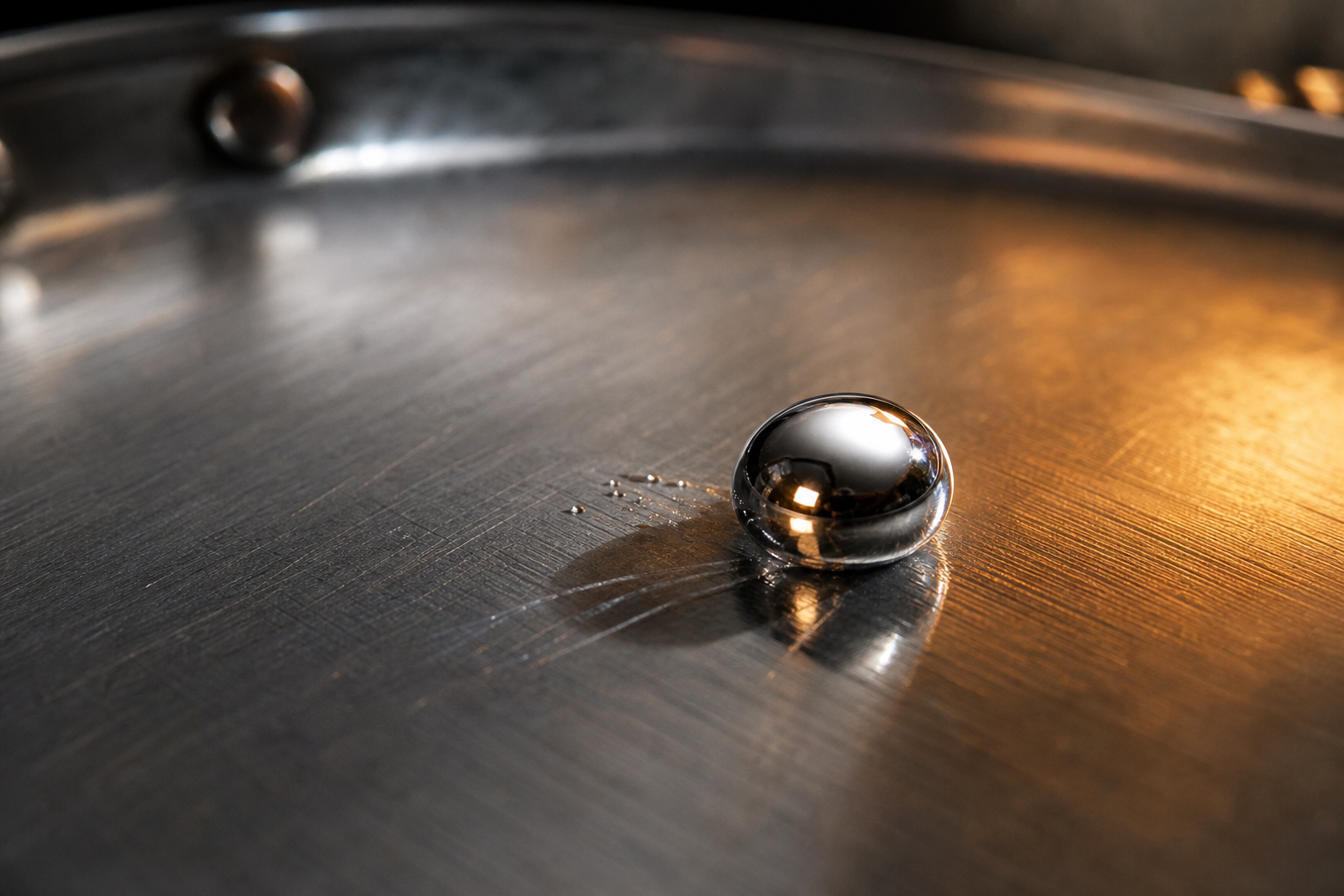
- Do the water bead test (Leidenfrost effect). Flick a few drops of water into the pan. If they sizzle and evaporate immediately, the pan isn’t hot enough. If they bead up into a single mercury-like ball and glide around the surface, the pan has reached the Leidenfrost zone — around 380°F at the water/surface interface, though the pan surface itself is typically 420–430°F by that point. That bead behavior is your cue to add oil.
- Add oil to a hot pan, not a cold one. Pour in enough oil to thinly coat the bottom. Let it heat until it shimmers — 15 to 30 seconds. The shimmer means the oil has reached cooking temperature.
- Add food and don’t move it prematurely. Proteins will release naturally from the pan surface once they’ve developed a sear. If they stick when you try to flip, they’re not ready — wait another 30–60 seconds.
This sequence works regardless of which high-smoke-point oil you use. Skipping the preheat step and adding oil to a cold pan is the single biggest reason home cooks have trouble with stainless steel.
Matching Oil to Cooking Task — Practical Guide
| Task | Temperature Range | Recommended Oil | Why |
|---|---|---|---|
| Searing steak or pork chops | 450–500°F | Refined avocado oil | Highest smoke point, neutral |
| Stir-fry (vegetables, shrimp) | 425–475°F | Peanut oil or refined avocado | Both handle wok-range heat |
| Sautéing fish fillets | 350–400°F | Grapeseed oil or ghee | Neutral or adds flavor without burning |
| Scrambled eggs | 275–325°F | Ghee or butter | Flavor + lower temp = butter-safe range |
| Sautéing garlic/onions | 300–375°F | EVOO or grapeseed | EVOO works fine at this range |
| Pan sauce / deglazing | 300–350°F | Whatever you cooked with | Residual fat is fine for deglazing |
| Fried rice | 400–450°F | Peanut oil | Authentic flavor, high smoke point |
| Roasting vegetables | 400–425°F | Canola or avocado | Adequate smoke point, budget-friendly |
Frequently Asked Questions
What is the best oil for stainless steel cookware overall?
Refined avocado oil is the most versatile pick for anyone who does any high-heat cooking. Its smoke point of 480–520°F gives you headroom for searing and stir-frying. For everyday medium-heat cooking where budget matters, grapeseed or canola oil are practical alternatives.
Can I use olive oil in a stainless steel pan?
Yes, with conditions. Regular (refined/light) olive oil has a smoke point of 390–470°F, which is fine for medium to medium-high sautéing. Extra virgin olive oil ranges from 325°F (standard grade) to ~405°F (high-quality, low-acidity) — safe for low-to-medium heat cooking like sautéing garlic or making a pan sauce, but not for searing. The flat “never use olive oil on stainless steel” advice you see everywhere is an oversimplification.
Why does my oil smoke immediately when I add it to the pan?
Either the pan is too hot (you’ve gone past the Leidenfrost zone into an overheated range) or you’re using an oil with a smoke point that’s too low for the temperature you’ve set. Do the water bead test — if the water beads and glides cleanly, the pan is ready for oil. If the water evaporates the instant it hits the pan, reduce the heat slightly before adding oil.
What’s the healthiest oil to use with stainless steel?
It depends on what you’re cooking. Extra virgin olive oil has the best antioxidant profile (polyphenols, oleocanthal) but only works at low to medium heat. Refined avocado oil is predominantly oleic acid (like EVOO) but with a higher smoke point — a reasonable choice when you need both health properties and high-heat stability. Grapeseed is high in vitamin E but also high in omega-6s, which is a concern if you use it daily.
Can I use butter in a stainless steel pan?
Regular butter starts browning around 250–300°F and burns around 302°F — too low for proper searing. Use ghee instead if you want the butter flavor at high heat; ghee’s smoke point is ~482°F. Butter is fine for low-heat applications like making eggs slowly or finishing a sauce off heat.
Does the type of oil affect how easily food sticks?
Oil type has some effect (thinner, lighter oils spread more evenly), but pan temperature is a much larger factor. If you preheat correctly and use the Leidenfrost test, even canola oil will give you a reasonably non-stick result on stainless steel. Skipping the preheat is the root cause of sticking in most cases.
Summary
After testing several oils across a range of stainless steel pans — from All-Clad tri-ply to basic Cuisinart — the pattern is consistent:
- Refined avocado oil is the go-to for searing and anything above 400°F
- Grapeseed oil handles everyday cooking reliably with minimal flavor interference
- Ghee is the sleeper pick for eggs, fish, and medium-heat tasks where flavor matters
- Canola oil earns its place as a budget workhorse for the majority of home cooking
- EVOO is not banned from stainless steel — just keep it at medium-low heat
The deeper lesson: no oil fixes a cold pan. Preheat first, confirm the Leidenfrost effect, then add oil. Get the technique right, and the choice between grapeseed and avocado becomes a matter of preference rather than the difference between a successful cook and a sticky mess.