

Most China cookware factories quote 30–45 days of production time. The realistic door-to-door timeline for a first-time OEM order is 90–120 days, and for a repeat standard order, 60–80 days. The gap comes from five stages that most factories don’t include in their quote: raw material procurement, sample revision cycles, pre-shipment QC, freight booking, and international transit. This guide breaks down every stage with specific day ranges, explains what actually starts the clock, and shows how order complexity and China’s factory calendar affect the final delivery date.
What “Lead Time” Actually Means — And Where Most Buyers Get It Wrong
When a Chinese cookware factory says “30-day lead time,” they mean 30 days of active manufacturing. They are not counting the time before production starts, the days your sample sits waiting for your feedback, the pre-shipment inspection window, or the 25–40 days a container spends on the water.
In practice, I’ve seen buyers plan a 45-day launch calendar based on a factory’s quoted production time, then watch the actual delivery land 90 days later. The math isn’t mysterious once you map out all seven stages.
The clock doesn’t start when you send the deposit. Most factories confirm the order and then spend 5–15 days procuring raw materials before any production begins. If your order involves new tooling — a custom handle mold, a new lid profile — that tooling typically takes an additional 15–30 days before the first sample even exists.
The four time blocks that don’t appear in a standard lead time quote:
- Order confirmation and raw material procurement: 5–15 days
- Sample revision cycles (if custom): 7–28 additional days per revision round
- Pre-shipment QC inspection: 3–7 days
- Freight booking and export documentation: 5–10 days
None of these are rare exceptions. They happen on almost every order.
The Full 7-Stage Cookware Production Timeline
Here is what a complete order cycle actually looks like, from first inquiry to goods in your warehouse.
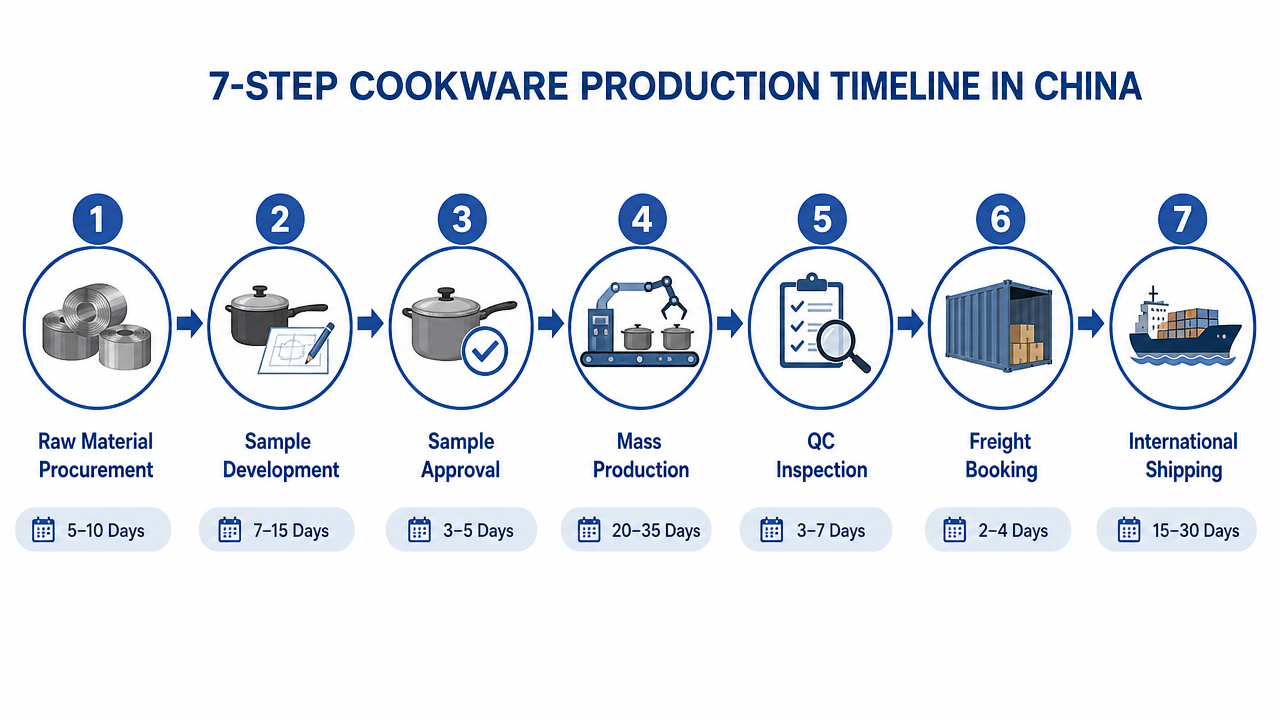
| Stage | What Happens | Typical Duration |
|---|---|---|
| 1. Order confirmation & raw material procurement | Factory confirms specs, PO terms, and sources stainless sheet, aluminum cores, handle components | 5–15 days |
| 2. Sample development | Factory produces first physical sample to your spec | Standard: 7–15 days / Custom: 15–30 days / Complex OEM: 30+ days |
| 3. Buyer sample review & approval | You inspect, request revisions, provide sign-off | 3–21 days (buyer-controlled) |
| 4. Mass production | Factory runs full production batch | 30–60 days (reorders) / 45–60 days (first OEM run) |
| 5. Pre-shipment QC inspection | Factory QC + optional third-party inspection | 3–7 days |
| 6. Freight booking & export documents | Booking container space, preparing commercial invoice, packing list, certificates | 5–10 days |
| 7. International transit | Sea freight to US/EU/AU | 20–45 days |
Total: 73–208 days. The realistic range for a standard reorder without new tooling or certification is 60–80 days. A full OEM launch with custom tooling, packaging, and third-party testing lands closer to 90–130 days before the goods hit your receiving dock.
One thing worth noting: stages 3 and 6 are almost entirely buyer-controlled. A buyer who responds to a sample within 48 hours instead of 14 days can shave 2–3 weeks off the total. Booking freight space before production completes is another week saved.
Standard Reorder vs Custom vs Full OEM: How Complexity Changes the Clock
Not all cookware orders follow the same path. The three order types have meaningfully different timelines, and confusing them is one of the most common planning mistakes I see.
| Order Type | Description | Production Lead Time | New Tooling? | Typical Total (factory to warehouse) |
|---|---|---|---|---|
| Standard reorder | Existing product, existing mold, no new spec | 30–45 days | No | 60–80 days |
| Custom spec on existing structure | New handle, logo, packaging — uses existing mold | 35–55 days | Partial (handle or lid mold) +15–20 days | 75–100 days |
| Full OEM — new product | New shape, new mold, new packaging, third-party testing | 45–60 days | Yes +15–30 days | 90–130 days |
If you’re launching a private-label line for the first time, budget 120 days from the moment you select your factory. If your product requires certifications — California Proposition 65 compliance, EU REACH testing, or LFGB food safety testing for European markets — add another 15–30 days for third-party lab results. Those labs have their own queues, and they don’t accelerate because your launch date is approaching.
A common mistake with new tooling: Buyers often approve the first-article sample without knowing that the first article only confirms the shape looks right. Stable mass production — where every unit in a 2,000-piece run matches the approved sample — takes an additional 10–20 days to validate. That gap between “first article passes” and “production is locked in” is where a lot of schedules silently slip.
What Causes Delays — And by How Many Days
Understanding the common delay sources helps you build realistic buffers rather than hoping for best-case scenarios.
Incomplete or late product specifications: Factories can’t start raw material procurement if they don’t know what thickness, grade of stainless, or surface treatment you need. Every round of clarification adds 3–5 days. Submitting complete 2D drawings, material specs, and surface requirements upfront is one of the highest-leverage things a buyer can do.
Multiple sample revision cycles: Each revision adds 7–15 days for a new physical sample to be produced and shipped to you. A product that goes through three revision rounds before approval adds 3–6 weeks to the schedule before mass production even begins.
Raw material availability spikes: Stainless steel sheet and aluminum core material prices and availability fluctuate. During periods of high demand — particularly heading into Q4 — steel mill lead times to the factory can stretch from 5 days to 15–20 days. Your factory may not tell you this proactively.
Factory capacity queue: A factory’s quoted lead time assumes you have a confirmed slot on their production schedule. If you place the order during a high-demand period without confirming your slot, your order may sit waiting 1–3 weeks before production begins.
Quality issues requiring rework: If the factory’s QC finds defects — polishing inconsistencies, handle torque failures, lid fit issues — production stops for rework. This adds 5–15 days depending on scope.
The China Factory Calendar Every Buyer Should Know
The single most predictable source of cookware delays is failing to account for China’s holiday and seasonal production calendar. Factories don’t slow down evenly across the year — they compress output into windows and shut down for specific events.
| Period | Typical Factory Impact | Buyer Action |
|---|---|---|
| Chinese New Year (Jan–Feb, date varies annually) | Factories close 2–4 weeks; many workers don’t return after CNY — effective disruption is 4–6 weeks | Place orders by early December for pre-CNY delivery; or plan post-CNY orders with a 30–45 day buffer beyond normal lead time |
| Qingming Festival (early April) | 3-day official closure; some factories extend to 5–7 days | Minor — add 5 days to any order due in early April |
| May Day Holiday (May 1–5) | 5-day official closure | Add 5–7 days to any order due in late April / early May |
| Golden Week / National Day (Oct 1–7) | 7-day official closure; production often slows 2 weeks before as factories build buffer stock | Place orders for Q4 by August if sea freight is the transport mode |
| Q3 peak production season (Jul–Sep) | Factories at near-full capacity; factory slot availability shrinks; quoted lead times stretch 10–20% | Confirm factory capacity and lock slot in writing before the season begins |
Chinese New Year is the most disruptive event by far. If your factory closes February 17 (for example), and you haven’t shipped by February 1, your goods may not move until mid-to-late March — even if production was nominally complete before the holiday. Container booking also tightens significantly in the weeks before CNY as everyone rushes to ship.
How to Get an Honest Lead Time Estimate From a Factory
Most factories will quote whatever lead time they think you want to hear during initial negotiations. Getting a reliable estimate requires giving them what they need to produce one.
Before asking for a lead time, send:
- 2D drawings or dimensioned reference photos with key measurements
- Target material specification (e.g., 18/8 stainless 0.6mm body, 1.5mm encapsulated base)
- Surface treatment requirements (brushed, mirror polish, coating type)
- Packaging requirements (retail box, plain export box, custom insert)
- Target quantity and expected order frequency
- Any certifications required for your target market
When you have this information in hand, ask the factory to break their lead time into stages: raw material procurement time, sample lead time, and mass production time. A factory that can answer by stage is a factory that has actually thought through your order. One that responds with a single number — “30 days, no problem” — usually hasn’t.
Locking a factory slot in writing matters. Lead time quotes are meaningless if the factory doesn’t hold a production window for you. When placing an order, include language in the PO that specifies a production start date, a production complete date, and a latest vessel loading date. Factories that agree to milestone-based delivery language tend to treat schedules more seriously.
Air vs Sea: When Freight Mode Overrides the Production Timeline
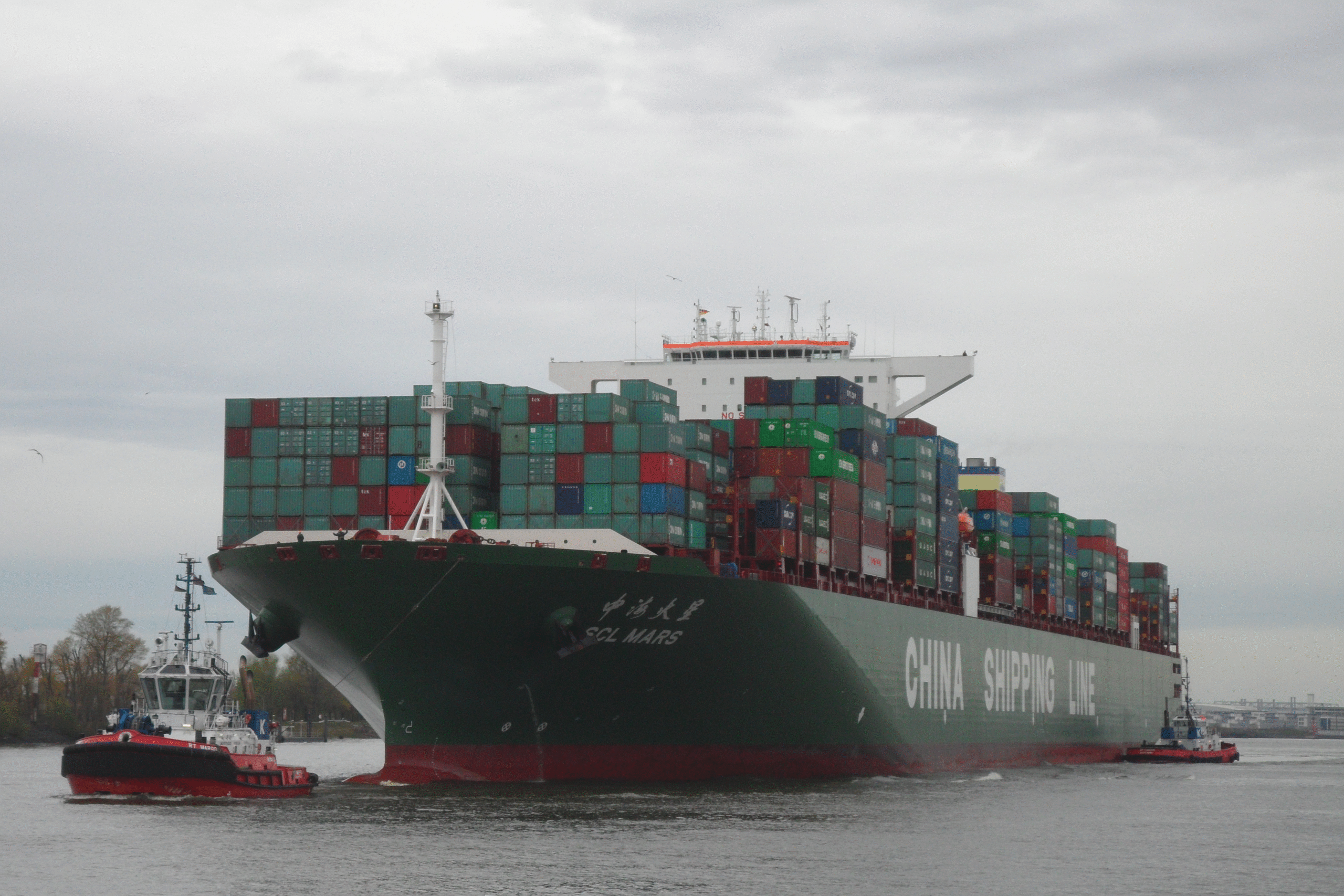
If you’ve burned through your buffer and your goods are ready but sea freight can’t get them to you in time, air freight is the other option. The math is simple but the cost difference is substantial.
| Factor | Sea Freight | Air Freight |
|---|---|---|
| China to US West Coast | 20–30 days | 5–8 days |
| China to US East Coast | 28–40 days | 5–8 days |
| China to UK/EU | 25–40 days | 5–7 days |
| Typical cost (cookware, LCL) | ~$0.20–$0.75/kg (LCL: $100–$150/CBM) | $5–$9/kg |
| Best for | Full container orders, planned replenishment | Launch emergencies, small top-up quantities |
A 1,000-piece stainless cookware order might weigh 800–1,200 kg. At ~$7/kg air freight versus roughly $0.50/kg sea (LCL), the freight cost difference is $5,000–$8,000 per 1,000 units. That’s a real number to factor against the cost of missing a launch date or stocking out ahead of a promotional window.
The decision point most buyers use: if you have 35 or more days before your in-warehouse date, sea freight works. Under 25 days, air is usually necessary. The 25–35 day window is the negotiation zone — sometimes expedited sea freight (express FCL) gets there in time for a cost between the two modes.
Summary
If there’s one thing to take from this guide, it’s that cookware lead time from a China factory is not a single number — it’s a chain of seven stages, each with its own owner and risk profile. The factory controls Stage 4 (mass production). You control Stage 3 (sample approval) and Stage 6 (freight booking lead time). Seasonal events control the gaps in between.
A realistic planning rule: for a standard reorder with approved tooling and no new packaging, budget 70 days from PO to warehouse. For a first OEM run with custom tooling, new packaging, and market certification, budget 120 days. Then add your freight transit separately.
The buyers who hit their launch dates aren’t the ones who push factories hardest. They’re the ones who plan the full chain upfront.
FAQ
How long does cookware production actually take in a China factory?
Active mass production for a standard stainless steel cookware order typically runs 30–60 days after the sample is approved and all production inputs are confirmed. A full OEM run with new tooling runs 45–60 days of production time, not counting sample development, raw material procurement, QC, or freight.
What is the total lead time for importing cookware from China?
Door-to-door, from placing a PO to goods arriving in your warehouse: 60–80 days for a standard reorder, 90–120 days for a first OEM order. Total time can stretch to 130+ days if certifications, multiple sample revisions, or Chinese New Year fall in the window.
Why does my China cookware factory keep pushing the delivery date?
The most common causes are: incomplete product specifications at order time, multiple sample revision rounds each adding 7–15 days, raw material procurement delays, and factory capacity queues during peak season. Solving it starts with sending complete specs before placing the PO and asking the factory to break down their lead time by stage.
How does Chinese New Year affect cookware production?
Factories officially close 7 days, but most shut down 2–4 weeks including worker travel time. Material suppliers close too, so even factories that want to produce can’t get raw materials. Plan on a 30–45 day disruption to any order that falls in the January–February window.
Should I use air or sea freight for cookware from China?
Sea freight is standard for bulk orders: 20–45 days transit at ~$0.20–$0.75/kg equivalent (LCL priced at $100–$150/CBM). Air freight makes sense for launch emergencies or small replenishments: 5–8 days but $5–$9/kg. For heavy cookware, the cost difference per shipment is often $4,000–$8,000 on a mid-size order, so it’s worth building the schedule to avoid it.
How do I lock a production slot at a China cookware factory?
Include milestone language in your purchase order: a confirmed production start date, completion date, and latest loading date. Pay particular attention to Q3 and pre-CNY periods when factory slots fill fast. Factories that agree to milestone PO terms tend to honor them — ones that resist that language are worth noting.
Conclusion
Planning a cookware launch from a China factory works when you treat lead time as a project with seven distinct stages, not a single countdown clock. The production window is predictable. The variable is everything that surrounds it: your specs, your sample approval speed, the time of year, and whether you’ve booked freight before the factory finishes.
Work backward from your in-warehouse date. Allow 70–120 days depending on order type. Add 30–45 days if your window crosses a major Chinese holiday. And ask your factory for a milestone-based schedule, not just a delivery date.