
Minimum order quantity (MOQ) for cookware sourced from China typically ranges from 200 to 2,000 pieces per SKU depending on product type, material, and customization level. Non-stick pans carry the highest MOQs due to coating batch economics; titanium and stainless steel sets run lower. This guide breaks down realistic MOQ expectations by cookware category, explains the factory-side economics that drive these numbers, and outlines proven tactics for negotiating lower quantities—particularly useful for first-time buyers and private-label brands testing new SKUs. Manufacturers like CharmsCook offer structured trial order programs specifically designed for buyers who aren’t ready to commit to full production runs.
What Is MOQ in Cookware Manufacturing?
MOQ—minimum order quantity—is the smallest number of units a factory will produce in a single production run. It exists not because factories want to block small buyers, but because every production run carries fixed costs that don’t scale down proportionally with unit count.
For cookware, this matters more than in most product categories. A single 28cm non-stick frying pan might require:
- A minimum batch of non-stick coating (PTFE or ceramic slurry)
- A full oven load for curing
- A minimum stamping run for the aluminum body
Each of these steps has a floor. You can’t cure 50 pans in an oven calibrated for 800. The factory isn’t being difficult—the physics of manufacturing sets a real lower limit.
MOQ is also different from sample quantity. Most reputable cookware factories will supply 5–20 sample pieces for evaluation before any production order. That’s not MOQ—that’s sampling. MOQ applies to the confirmed production order that follows.
A third term worth separating out: trial order. Some manufacturers, including CharmsCook, offer a formal trial order tier—typically 100–300 pieces per SKU—positioned between sample evaluation and full production. Trial orders often carry a small premium per unit but exist precisely to let buyers test market response before locking into larger volumes.
Typical MOQ by Cookware Category
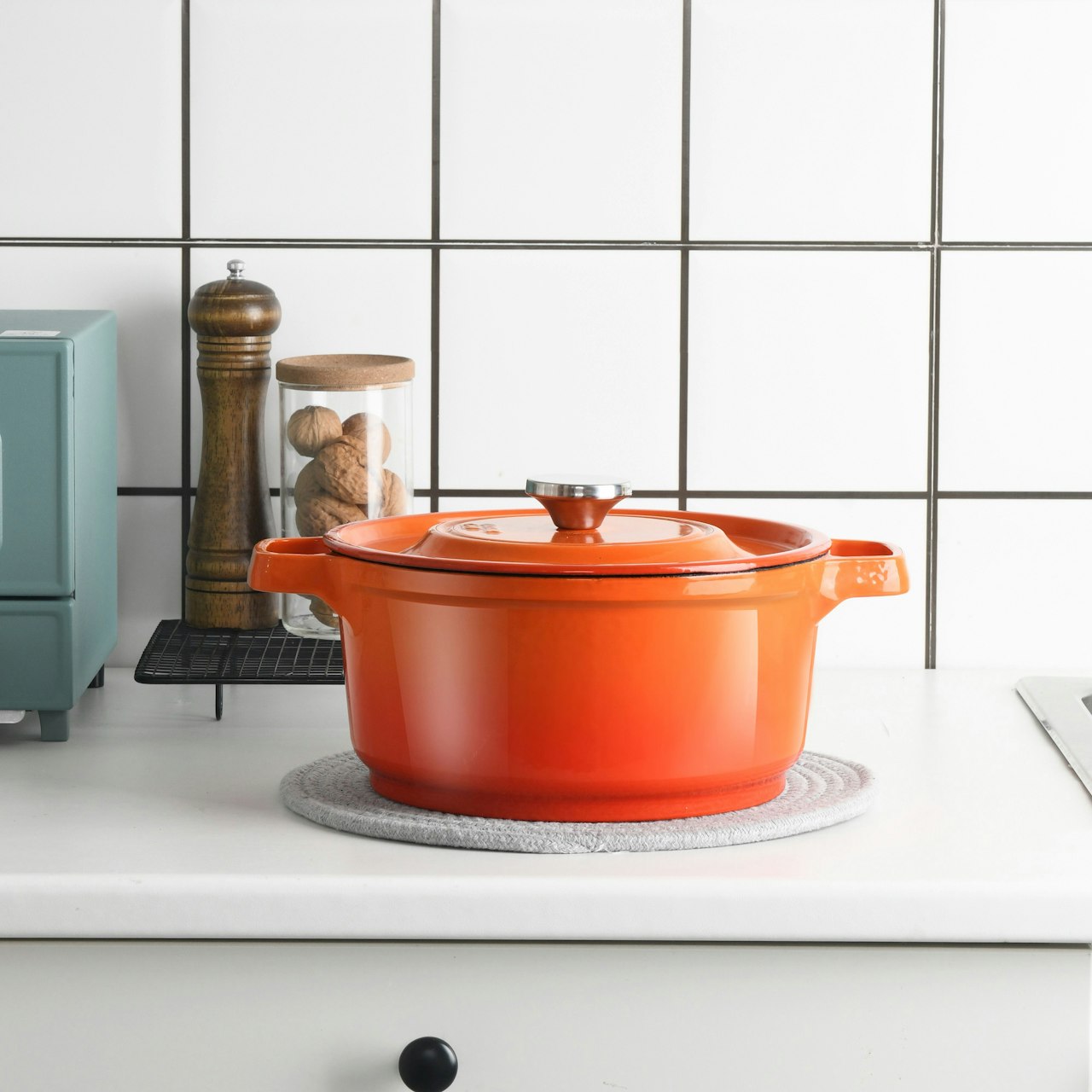
This is the number most buyers actually need before they can plan a budget. Here are realistic MOQ ranges based on standard factory production structures in China’s main cookware manufacturing hubs (Guangdong, Zhejiang, and Jiangsu):
| Cookware Category | Standard MOQ (pcs/SKU) | Notes |
|---|---|---|
| Non-stick frying pans (PTFE coating) | 1,000–2,000 | Coating batch drives floor; PTFE systems require full tank load |
| Non-stick frying pans (ceramic coating) | 500–1,500 | Ceramic slurry batch slightly smaller; water-based system more flexible |
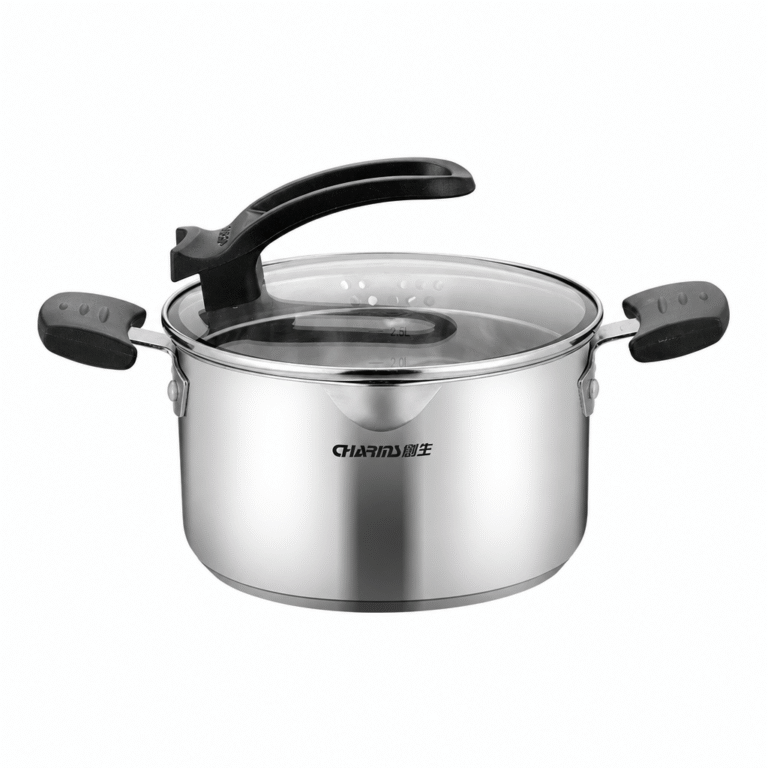
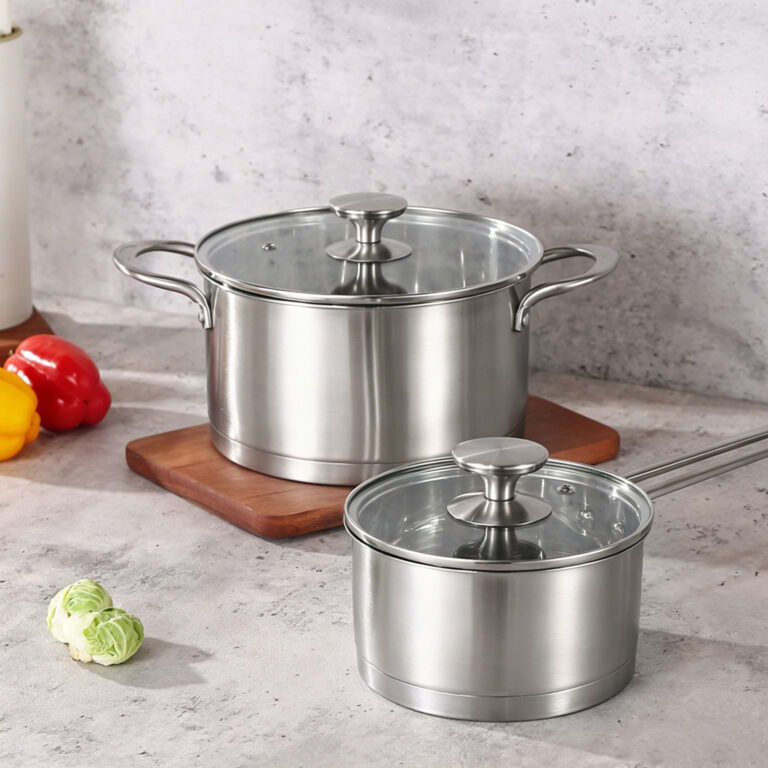
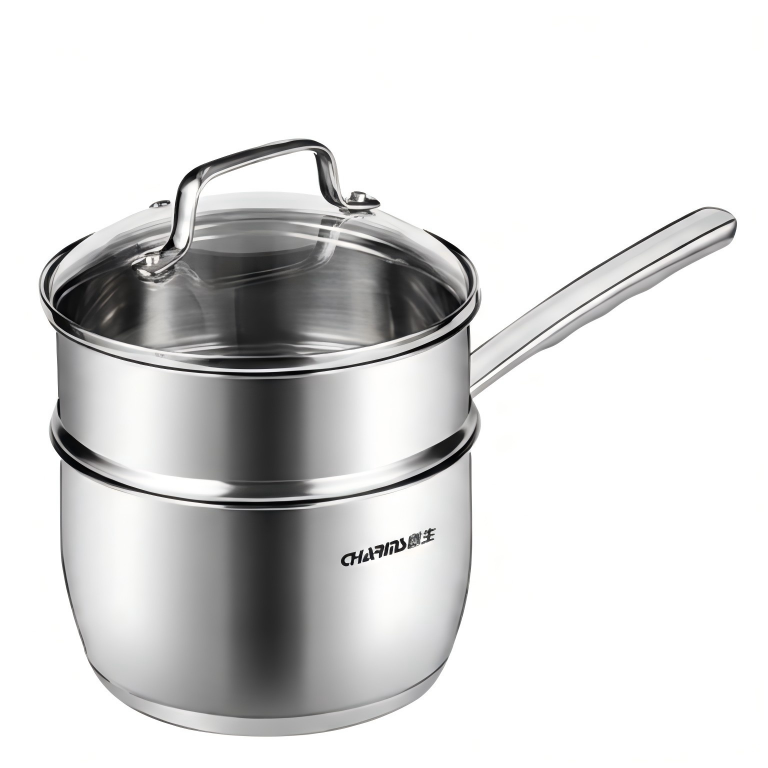
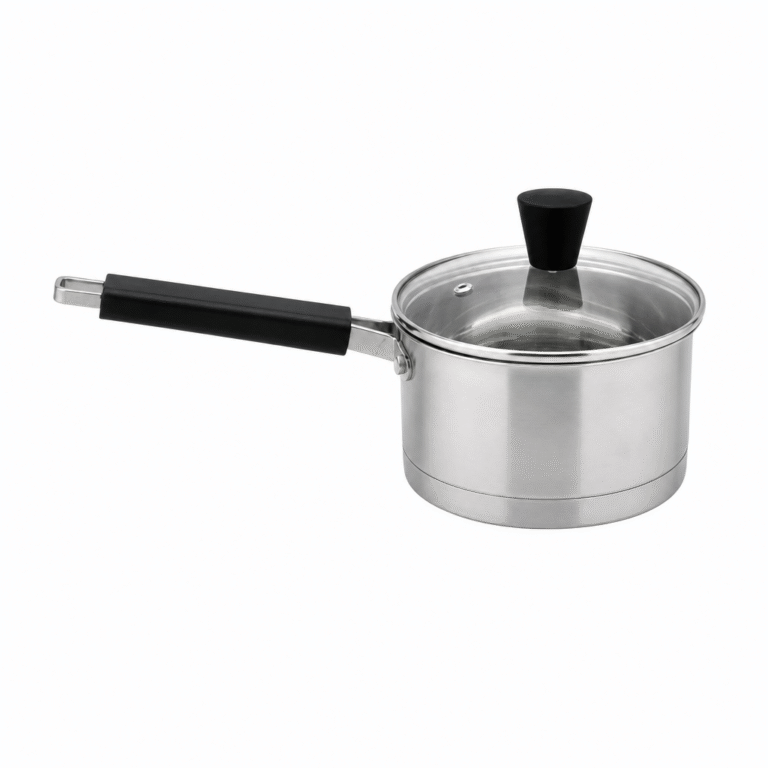
| Stainless steel pots/pans (tri-ply) | 300–800 | No coating batch constraint; rolling/forming setup cost is primary driver |
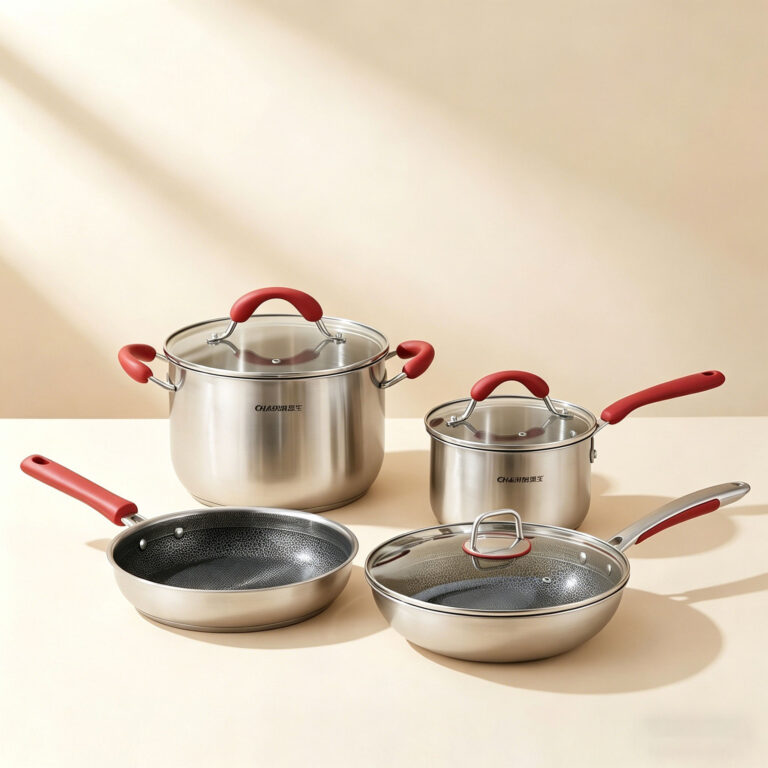
| Stainless steel cookware sets | 200–500 sets | Set bundles reduce per-SKU pressure; often more flexible |
| Cast iron skillets/Dutch ovens | 500–1,500 | Foundry mold amortization; sand or resin mold determines exact floor |
| Enamel-coated cast iron | 800–2,000 | Enamel color batches are expensive to set up; color-specific MOQ applies |
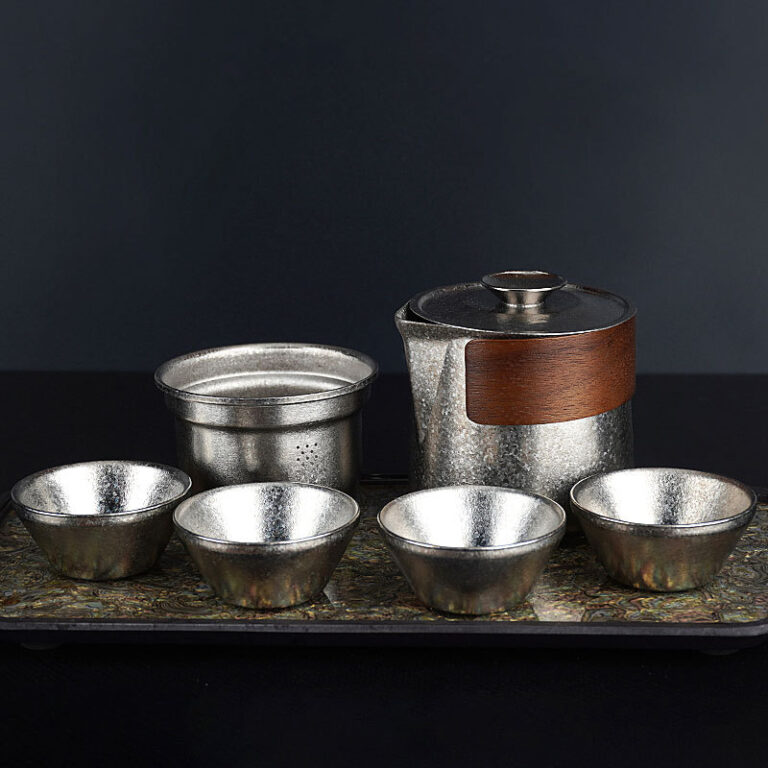
| Titanium cookware | 200–600 | Higher unit value absorbs more setup cost; often more negotiable |
| Aluminum camping/outdoor cookware | 500–1,200 | Anodizing bath determines batch floor |
| Woks (carbon steel) | 500–1,000 | Hand-hammered: lower MOQ; machine-pressed: higher due to press tooling |
These are baseline figures for stock or near-stock items. The moment you add customization—brand logo, custom color, private-label packaging—each element adds its own MOQ layer. More on that in the customization section below.
What Actually Drives MOQ in Chinese Cookware Factories
Understanding the factory’s economics is the most useful thing a buyer can do before negotiating. MOQ isn’t an arbitrary number pulled from the sky.
1. Coating batch minimums
Non-stick coating is the single biggest MOQ driver in cookware. PTFE coating lines require a minimum tank fill to maintain consistent viscosity and temperature. A typical spray-coat line processes 800–1,500 pans per batch. Running 200 pans through a 1,200-pan system wastes coating material, machine time, and energy—so the factory prices the difference into a higher per-unit cost, or simply declines.
Ceramic (sol-gel) coatings work similarly. Water-based systems are somewhat more flexible in batch size, which is one reason ceramic-coated products often have lower MOQs than PTFE equivalents.
2. Raw material procurement
Chinese cookware factories don’t warehouse large quantities of aluminum sheet, stainless coil, or titanium plate speculatively. They order materials per production run. Steel mills and aluminum suppliers have their own minimums—typically 1–5 metric tons per order. A factory producing stainless tri-ply pans needs to order enough raw material to justify the supplier minimum, which then sets a floor on how small a run makes economic sense.
3. Tooling and setup costs
Every time a production line switches from one SKU to another, there’s a changeover cost: tool swaps, calibration, first-piece inspection, scrap pieces during ramp-up. For a factory running 10 SKUs simultaneously, that cost is amortized over the whole order. For a buyer wanting a single SKU in small quantity, the factory absorbs that cost against fewer units.
4. Quality control economics
Reputable factories don’t do a 50-piece QC sample pass the same way they do a 2,000-piece pass. The QC setup—calibrating instruments, preparing test stations, documenting results—has a fixed cost that’s unsustainable below a certain run size.
How CharmsCook Structures MOQ for Different Buyer Types
Not every buyer starts at full production volume, and rigid MOQ policies are a barrier to building long-term supplier relationships. At CharmsCook, we’ve built a three-tier order structure that acknowledges where different buyers actually are in their sourcing journey:
Tier 1 — Sample Evaluation
5–20 pieces per SKU. Covers material, construction, coating performance, and fit-with-packaging evaluation. This is pre-commitment.
Tier 2 — Trial Order
100–300 pieces per SKU. Priced at a modest premium over standard production (typically 8–15% above bulk unit cost). Allows buyers to test market response, verify retail packaging, and confirm quality at small scale before committing to inventory.
Tier 3 — Standard Production Order
500+ pieces per SKU (product-dependent). Full production pricing, full customization availability, standard lead times.
For buyers sourcing multiple SKUs, we also apply blended MOQ logic: if your total order reaches a production-run-viable quantity, we can split that across SKUs even if individual item counts sit below standard minimums. A buyer ordering 300 pcs of a 24cm frying pan + 300 pcs of a 28cm frying pan meets the production floor even though neither SKU alone does.
This approach reflects a reality we’ve seen repeatedly: the buyers who start with a trial order and grow into it become the most consistent long-term accounts.
OEM vs ODM: How the Model Affects Your MOQ
This distinction matters enormously for MOQ calculations, and many buyers conflate the two.
ODM (Original Design Manufacturer): The factory designs and owns the product. You source their existing design, possibly with private-label branding. Because the tooling already exists and the production process is already optimized, MOQ is at its lowest—often 200–500 pcs for an ODM item at CharmsCook.
OEM (Original Equipment Manufacturer, custom design): You provide the design specifications; the factory builds to your spec. This requires new tooling (molds, dies, pressing templates), new QC parameters, and potentially new material sourcing. All of that investment needs to be recovered across the order quantity. OEM MOQ starts higher—typically 1,000–3,000 pcs depending on complexity—and may carry a one-time tooling fee.
The practical implication: If you’re launching a first cookware line and want low MOQ, starting with an ODM base product and adding your logo/branding is significantly more accessible than commissioning a fully custom design. As volume grows, transitioning to OEM with custom specs becomes economically viable.
How Customization Affects MOQ
Every layer of customization adds its own minimum:
| Customization Type | MOQ Impact | Notes |
|---|---|---|
| Logo (laser engraving or stamping) | +0–100 pcs per design | Low incremental impact; setup is quick |
| Custom coating color | +300–500 pcs per color | Color batches are a real constraint |
| Custom handle design | +500–1,000 pcs per mold | New mold required; tooling fee applies |
| Custom packaging (box/insert) | 500–2,000 pcs per SKU | Separate packaging MOQ from the factory or supplier |
| Custom material spec (alloy grade) | +500–1,000 pcs | Material procurement minimums apply |
| Custom certification labeling (FDA, LFGB, CE) | Varies | Testing fee, not MOQ—but budgeting issue |
The hidden MOQ trap: Buyers often negotiate the pan MOQ successfully, then discover that the custom retail box has a 1,000-piece minimum at the packaging factory. Total order economics change completely. Always confirm packaging MOQ at the same time as product MOQ.
Negotiating MOQ: What Actually Works
After sourcing conversations with hundreds of buyers, a few tactics reliably move the needle—and some common approaches don’t.
What works:
1. Offer a rolling commitment. Instead of asking for a lower one-time MOQ, offer a purchase commitment over 3–6 months: “I’ll order 300 now and confirm 700 more within 90 days.” Factories are managing production scheduling, not just single-order economics. A committed pipeline is worth more to them than a higher one-off quantity with no follow-on.
2. Reduce SKU count, increase per-SKU volume. Requesting 3 SKUs at 500 pcs each often hits more resistance than 1 SKU at 1,500 pcs. The factory’s production scheduling prefers fewer changeovers. If you can consolidate SKUs for a first order, you get more flexibility on MOQ.
3. Accept near-stock specs. Asking for a standard coating color and handle from existing tooling—even with your logo—is very different from specifying a custom color that requires a new coating batch. The less customization, the more MOQ flexibility.
4. Time your order with existing production. Experienced sourcing managers ask: “What are you already running in this category this quarter?” Joining an existing production run—sometimes called a consolidated or consolidated-batch order—lets you access lower effective quantities at production-run pricing.
What doesn’t work: Simply asking for a lower MOQ with no offsetting concession. Every experienced factory sales team has heard this request. Without a business reason the factory can act on (pipeline commitment, timeline flexibility, reduced customization), it’s not a negotiation—it’s just a request to absorb cost on your behalf.
Common MOQ Mistakes First-Time Buyers Make
Confusing per-SKU and per-order MOQ. A factory stating “MOQ 500 pcs” usually means 500 pcs per SKU. If you want 5 SKUs, you’re looking at 2,500 pcs total minimum. This surprises more buyers than almost anything else in the sourcing process.
Forgetting packaging MOQ. Product MOQ and packaging MOQ are separate. A 500-piece cookware MOQ with a 1,000-piece box MOQ means you either order 1,000 boxes (and keep 500 for future orders) or find a packaging supplier with a lower minimum.
Treating factory MOQ as fixed. It rarely is, especially for factories that want long-term relationships. The tactics above work. The mistake is not asking, or asking without any value to offer in return.
Underestimating SKU proliferation. New buyers often arrive with a 10-SKU list. Even at 300 pcs per SKU, that’s 3,000 pcs total—more than a 1,000-pc single-SKU order but spread thin across too many items to manage quality effectively. Starting with 2–3 hero SKUs and expanding after the first production run is almost always the right call.
FAQ
What is a typical MOQ for cookware from China?
For standard items, expect 500–1,500 pieces per SKU for non-stick cookware, 300–800 for stainless steel, and 200–600 for titanium. These figures apply to near-stock or lightly customized products. Full custom OEM orders start higher.
Can I order below the minimum order quantity?
Some manufacturers, including CharmsCook, offer formal trial order programs at 100–300 pieces per SKU at a modest per-unit premium. Completely stock, un-customized items sometimes allow even smaller runs. Fully custom OEM products rarely go below their stated MOQ without a pipeline commitment.
How does adding my logo affect the MOQ?
Logo additions via laser engraving or stamping add minimal MOQ impact—typically 0–100 additional pieces. Custom coating colors or handle designs are a different story: each requires a new batch or mold, adding 300–1,000+ pcs to effective minimums.
What’s the difference between OEM and ODM for MOQ purposes?
ODM uses the factory’s existing designs and tooling, so MOQ is lowest—often 200–500 pcs. OEM requires new tooling and custom production setup, pushing MOQ to 1,000–3,000 pcs depending on complexity. For new brands, ODM with custom branding is the most practical entry point.
How do I find a cookware manufacturer in China with low MOQ?
Look for factories that explicitly list trial order programs, or that distinguish between ODM and OEM pricing. Trading companies often offer lower stated MOQs but at higher unit costs than direct factory engagement. Verify that the “low MOQ” applies to your specific product, not just their stock items.
Does CharmsCook work with small brands or first-time importers?
Yes. CharmsCook’s trial order tier (100–300 pcs/SKU) is designed specifically for new buyers who need to validate their market before committing to full production volumes. Blended MOQ logic also applies across multi-SKU orders.
Summary
MOQ in Chinese cookware manufacturing isn’t a gatekeeping mechanism—it’s a reflection of production economics. Coating batch sizes, raw material procurement minimums, tooling amortization, and QC setup costs all set real floors on how small a run can be while remaining economically viable.
The practical takeaway for buyers: Know your product category’s baseline MOQ before approaching suppliers. Build your first order around 1–3 SKUs rather than spreading volume thin. Ask about trial order tiers. And when negotiating, offer something the factory can act on—a pipeline commitment, reduced customization, or timing flexibility—rather than just asking for less.
For brands at the start of their cookware sourcing journey, working with a manufacturer that has a structured approach to MOQ tiers—like CharmsCook’s three-tier sample-to-production pathway—reduces risk significantly and creates a foundation for scaling into larger volumes once your first SKUs are validated.