
When sourcing cookware from a factory, you’ll typically be offered two payment structures: T/T (Telegraphic Transfer, a bank wire) or L/C (Letter of Credit, a bank-issued payment guarantee). T/T is faster and cheaper but puts risk on the buyer. L/C protects both sides but adds cost and complexity. For most cookware orders under $15,000–$20,000, T/T with a structured deposit split and third-party inspection is the practical choice. For large or first-time orders above that threshold, an L/C at sight offers meaningful protection.
T/T Payment: The Most Common Choice for Cookware Orders

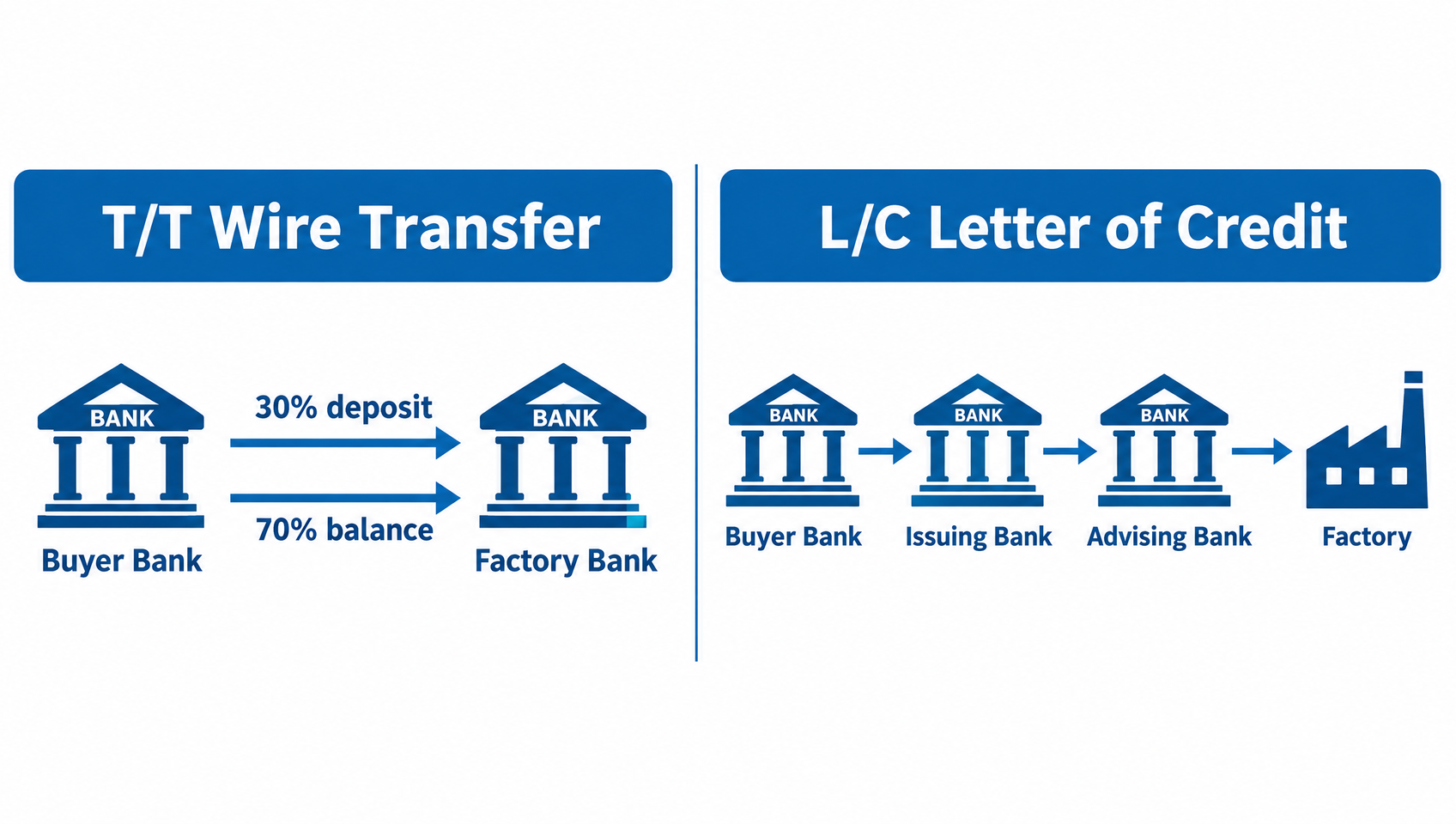
T/T (Telegraphic Transfer) is a direct bank wire from the buyer’s account to the factory’s account. In cookware manufacturing, this is by far the most used payment method — it’s simple, fast (typically 1–3 business days), and involves no document complexity.
The standard structure you’ll see from most cookware factories:
- 30% deposit paid before production starts
- 70% balance paid after goods are ready, before the container is released (against copy of Bill of Lading)
Some factories — especially for new customers — request a 50/50 split: 50% before production, 50% against Bill of Lading. As the buyer-supplier relationship matures, many factories will shift to 30/70 or even 20/80.
The deposit serves as production security. It covers raw materials — stainless steel coil, aluminum discs, PTFE/ceramic coating supplies — which the factory purchases before cutting a single pan. For a 1,000-piece cookware set order, those materials alone can represent a significant portion of the factory’s working capital.
The 70% balance is typically settled against a copy of the B/L (not the original), released by the factory’s freight forwarder once payment clears. This means the factory controls the shipping documents until payment is confirmed — giving them security over the goods. For the buyer, this creates a brief window of exposure: you’ve paid 100%, but the physical goods are still on water.
Where T/T falls short: T/T offers no structural recourse if goods arrive defective. If 500 of your 1,000 frying pans have uneven PTFE coating, your leverage depends on the factory’s goodwill and your purchase contract — not on any banking mechanism. This is why pre-shipment inspection (SGS, Bureau Veritas, or similar) is strongly recommended when paying T/T.
T/T currency: USD dominates cookware trade. Some factories quote in RMB or EUR, but most international T/T transactions are USD-denominated. Lock the currency in the Proforma Invoice to avoid exchange-rate surprises between the deposit date and balance payment date — production runs for custom cookware typically take 30–60 days.
What “against copy of B/L” actually means: The factory’s freight forwarder holds the original Bill of Lading (the document that controls physical ownership of the goods). Once your 70% balance wire clears, the forwarder releases the original B/L to you (or your freight agent). Without the original B/L, you cannot pick up the container at the destination port. This is the factory’s primary collateral on the T/T balance — it’s a clean, practical mechanism that works well in normal transactions.
Recommendation: Use T/T for orders where you’ve done pre-shipment QC inspection and you have an existing relationship with the factory, or where order value is below $30,000.
L/C Payment: When Bank Guarantees Make Sense

An L/C (Letter of Credit) is a bank instrument — your bank (the issuing bank) commits to pay the factory’s bank (the advising/negotiating bank) once the factory presents specific shipping and quality documents. The rules governing L/Cs are standardized under UCP 600 (Uniform Customs and Practice for Documentary Credits, ICC Publication 600, 2007), which is accepted in nearly every country.
For cookware imports, two L/C types are common:
| Type | How It Works | Best For |
|---|---|---|
| L/C at Sight | Factory is paid immediately once compliant documents are presented to the bank | Large first-time orders, high-value cookware sets |
| Usance L/C (Deferred) | Payment made 30, 60, or 90 days after document presentation | Buyers who need payment terms/credit; more common in established relationships |
The L/C document set for cookware typically includes:
- Commercial Invoice
- Full set of original Bills of Lading
- Packing List
- Certificate of Origin
- Quality/Inspection Certificate (if specified in the L/C terms)
- SGS or third-party pre-shipment inspection report (optional but recommended)
The cost reality: Opening an L/C typically costs 0.1%–0.5% of the transaction value in bank charges, plus advising fees, amendment fees (charged every time terms change), and potentially discrepancy fees if the factory’s documents don’t perfectly match L/C terms. For a $10,000 cookware order, L/C fees from both banks combined can easily reach $500–$800. That’s 5–8% of order value — a steep overhead for a small order.
The L/C break-even point: The protection an L/C offers becomes cost-effective roughly above $15,000–$20,000 per shipment, where the bank fees represent a smaller percentage of order value, and where the financial exposure of a bad shipment justifies the documentary control.
At CharmsCook, we work with both T/T and L/C buyers. The reality from the factory side is that L/C transactions require more back-office work — strict document preparation, bank coordination — and factories often price L/C orders slightly higher than T/T to offset that operational cost. If a factory quotes you the same price for L/C and T/T, it’s worth asking directly whether the L/C price includes any documentary handling fee.
T/T vs. L/C: Side-by-Side Comparison
| Factor | T/T | L/C |
|---|---|---|
| Speed | 1–3 banking days | 7–21 days (document processing) |
| Bank fees | $15–$50 per transfer | $300–$1,500+ per transaction |
| Complexity | Low | High (strict document requirements) |
| Buyer protection | Low (pre-shipment inspection recommended) | High (payment tied to document compliance) |
| Seller protection | High (30–50% deposit) | High (bank payment guarantee) |
| Minimum order suitability | Any size | Typically $15,000+ |
| Common cookware split | 30% deposit / 70% balance | Sight or 30–90 day usance |
| Currency risk | Negotiable (USD most common) | Managed in L/C terms |
| Dispute resolution | Contractual / commercial | ICC banking rules (UCP 600) |
| Required documents | Proforma invoice, copy B/L | Full document set per L/C terms |
What Cookware Factories Actually Prefer (and Why It Matters)
Most cookware factories in China, South Korea, and Southeast Asia prefer T/T. The reasons are practical:
- Cash flow: A 30% T/T deposit covers raw material procurement. L/C funds arrive much later in the production cycle, which creates working capital pressure.
- Operational simplicity: L/C document preparation requires experienced export documentation staff. Errors — a single discrepancy between the invoice description and L/C wording — can cause document rejection and payment delays of weeks.
- Amendment costs: Buyers frequently change specifications mid-order (different handle color, extra sets added). Each L/C amendment costs both parties money and time.
That said, cookware factories that export to large retail chains (supermarkets, department stores, buying agents) are comfortable with L/C — those buyers often require it as standard policy.
Negotiation tip: If a factory is reluctant to accept L/C, you can propose a hybrid: T/T deposit (20–30%) at order confirmation, with the balance via L/C or released T/T only after a third-party pre-shipment inspection report confirms goods meet specs. This gives the factory cash flow security and gives you quality verification before full payment.
Cookware-Specific Payment Risks You Won’t Find in Generic Guides
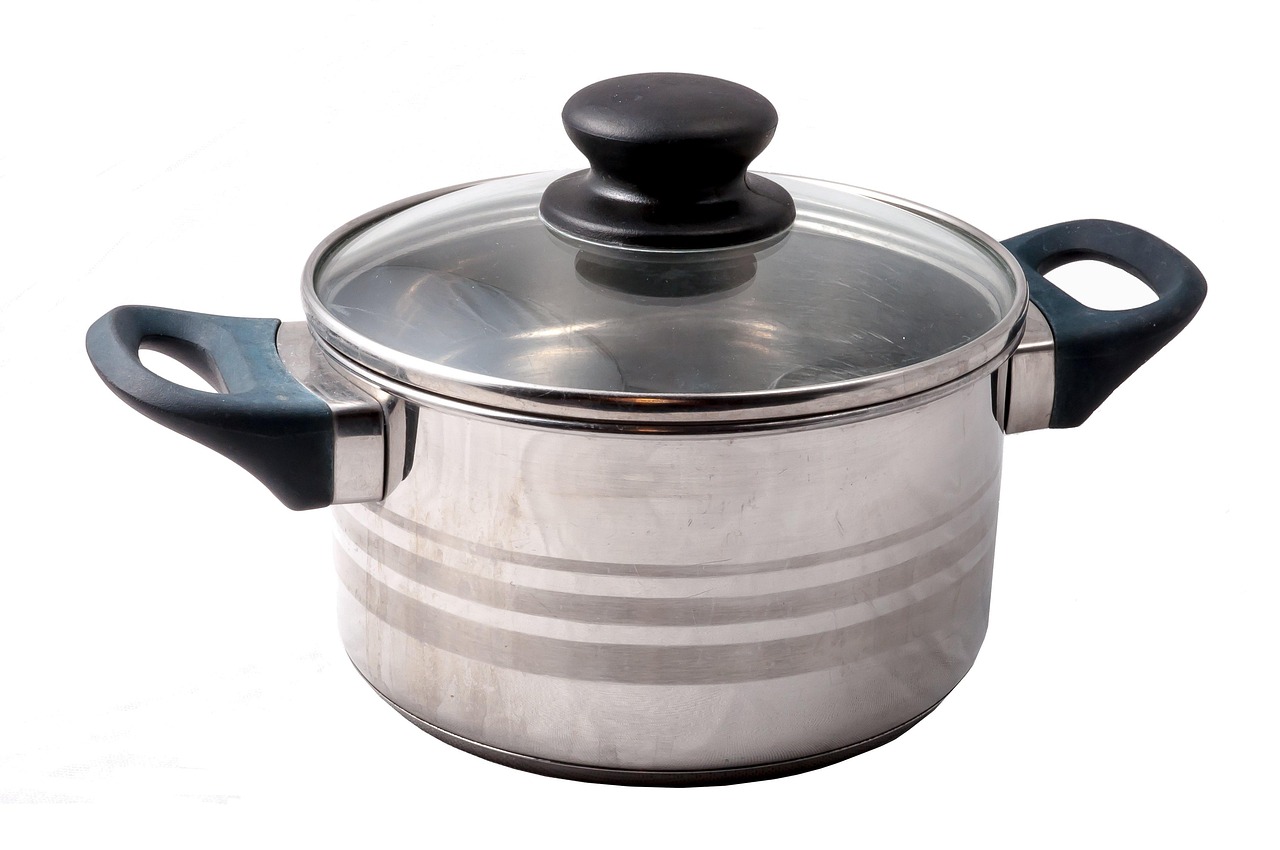
Cookware carries unique quality risks that affect how you should structure payment terms:
Coating integrity: PTFE (non-stick) and ceramic coatings can fail visual inspection on the surface but have micro-pinholes that only show up in use. Pre-shipment inspection should include peel and abrasion testing if coating quality is critical.
Weight tolerance drift: Cookware factories sometimes substitute thinner gauge aluminum or stainless to control costs mid-production run. Your purchase contract should specify minimum metal thickness (e.g., “3-ply stainless steel: 18/8 outer + aluminum core + 18/10 inner, total thickness ≥4.5mm”), which can be verified by inspectors before payment release.
Packaging damage: Cookware is heavy. Damage in transit — dents, scratched coatings — is common. Make sure your insurance and Incoterms are aligned: FOB means you’re liable from port loading; CIF shifts some risk to the seller through the ocean leg.
First-order dynamics: On a first order with a new factory, the risk is highest. Consider using T/T 30% deposit + SGS pre-shipment inspection + T/T balance after inspection pass — this adds one week to the timeline but eliminates the most common quality disputes.
Quick Reference: Which Payment Method by Order Size
| Order Value | Typical Payment Method | Notes |
|---|---|---|
| Under $500 | 100% T/T upfront or PayPal | Sample orders, prototypes |
| $500–$5,000 | 100% T/T upfront or 50/50 T/T | Trial orders, new relationships |
| $5,000–$30,000 | 30/70 T/T | Standard production run |
| $30,000–$100,000 | 30/70 T/T or Sight L/C | Either method viable; L/C fees proportionally manageable |
| Above $100,000 | Sight L/C or Usance L/C | Bank guarantee cost-justified; common for retail chains |
One practical L/C caution: ICC data indicates L/C documents are rejected for discrepancies on first presentation roughly 50–70% of the time. For cookware specifically, complex material specifications (coating type, stainless grade, handle material) and certification requirements (PFOA-free declaration, food-grade coatings) create more document touchpoints than simpler products — meaning a higher chance of needing a costly L/C amendment if specs aren’t locked down before the L/C is drafted.
Alternatives Worth Knowing
Alibaba Trade Assurance: For sourcing through Alibaba.com, Trade Assurance acts as a platform-level escrow. The buyer’s payment is held by Alibaba, and funds are released to the factory after delivery confirmation. This is particularly useful for first-time buyers with orders under $10,000 who don’t have the relationship to negotiate favorable T/T terms. Trade Assurance disputes have a defined resolution process.
Escrow services: Third-party escrow (e.g., Escrow.com) works for smaller custom cookware orders but is less common in manufacturing-scale transactions.
Documentary Collections (D/P, D/A): A middle ground between T/T and L/C. The factory ships goods and presents documents through its bank; the buyer’s bank releases documents upon payment (D/P — Documents against Payment) or acceptance of a bill of exchange (D/A — Documents against Acceptance). Less common in cookware trade but used by some European buyers who find L/C costs prohibitive.
How to Negotiate Payment Terms as a New Buyer
If you’re placing a first order with a cookware factory, here’s a realistic negotiation path:
- Start with the factory’s standard terms — usually 30/70 or 50/50 T/T.
- Propose a third-party inspection clause — offer to pay the inspection fee yourself ($200–$400 for a typical cookware factory visit). Most factories accept this because it reduces post-shipment disputes.
- Commit to a repeat order — factories offer better payment terms to buyers who signal long-term relationship intent. A verbal commitment to a follow-on order often unlocks 30/70 from an initial 50/50.
- Consider a small first order — a $3,000–$5,000 trial order paid 50/50 T/T builds trust before committing to a larger L/C or long-payment-term arrangement.
- Request referees — ask the factory for 2–3 existing buyer contacts (particularly from your region). Established factories are used to this request.
One thing worth understanding from the factory’s side: payment term negotiation is not just about trust — it’s about cash flow timing. A factory running 5–10 production orders simultaneously has working capital deployed across all of them. A 30% T/T deposit on your $20,000 order gives them $6,000 to procure your materials without drawing on a credit line. When you understand their cash flow constraint, you can offer solutions that work for both sides — like a slightly higher deposit in exchange for a faster production slot or a sharper per-unit price.
If you’re sourcing custom cookware (your own brand name, custom handle design, specific coating color), factor in tooling costs separately. Custom mold fees for a new cookware handle design typically run $800–$3,000 and are usually paid 100% T/T upfront before tooling begins, separate from the production deposit. Don’t let a factory fold tooling costs into the production deposit without itemizing them — you want to own the mold, not rent it.
FAQ: Cookware Factory Payment Terms
What is the standard T/T deposit for a cookware order? The most common split is 30% deposit before production and 70% balance before shipment (against copy of Bill of Lading). For new customers, many factories start at 50/50. As the relationship builds, 30/70 or even 20/80 becomes negotiable.
Is L/C safer than T/T for cookware imports? An L/C offers more structural protection — payment is tied to document compliance verified by banks. However, it doesn’t guarantee product quality; it guarantees that the factory presented the correct shipping documents. For quality protection, pre-shipment inspection matters more than payment method.
What L/C type is most common for cookware? L/C at sight (payment upon compliant document presentation) is most common for cookware orders. Usance or deferred L/C (30–90 days) appears in established buyer-seller relationships where the factory extends credit.
What documents are required for a cookware L/C? Typically: Commercial Invoice, full set of original Bills of Lading, Packing List, Certificate of Origin, and any quality certificates specified in the L/C (SGS report, coating test certificate). The exact list is defined in the L/C text itself.
Can I use Alibaba Trade Assurance instead of L/C for cookware? Yes, for orders through Alibaba.com, Trade Assurance provides platform-level payment protection and works well for orders under $10,000–$15,000. For off-platform purchases or large-volume orders, traditional T/T or L/C remains standard.
What is the minimum order value where L/C makes financial sense for cookware? Given combined bank fees from both sides typically range $300–$1,500+, L/C costs start to be proportionally reasonable for orders above $15,000–$20,000. Below that threshold, T/T plus pre-shipment inspection is usually more cost-effective.
Choose the Method That Matches Your Exposure, Not Your Comfort
Payment terms in cookware sourcing are not just financial plumbing — they’re part of your risk management. T/T is faster, cheaper, and widely accepted; the key is pairing it with proper purchase contract terms and pre-shipment QC. L/C makes sense when order values are high enough to absorb bank fees, or when you’re dealing with a new factory where you want documentary discipline enforced at the bank level.
The practical reality: most experienced cookware importers use T/T 30/70 with a third-party inspection for routine orders, and switch to L/C only when a single shipment’s value crosses a threshold where the bank fee cost is worth the documentary protection. Building a relationship with your factory — over 2–3 orders — is the best way to secure favorable terms and reduce the need for costly protective instruments.