

When a factory asks for your “product spec,” most first-time cookware brands send a few bullet points lifted from their marketing copy — material: stainless steel, size: 10-inch, coating: nonstick. The factory nods, begins sampling, and three rounds later you’re arguing over why the pan feels light, the handle wobbles, and the coating doesn’t match what you discussed.
The root cause is almost always the same: there was no real spec sheet.
In apparel sourcing, a tech pack is industry standard — designers know to document every stitch, seam allowance, and hardware spec before the first cut. Cookware has no equivalent tradition. Most brands still communicate through email threads and WhatsApp voice notes. That gap creates expensive sampling failures, compliance surprises at customs, and products that don’t reflect what you designed.
A cookware spec sheet — or tech pack — is the single document that closes that gap. It doesn’t need to be complex to work. It needs to be complete.
What Is a Cookware Tech Pack?
A cookware tech pack is a structured specification document that communicates every measurable and verifiable attribute of a product to your manufacturer — before a single piece of metal is cut.
The term “tech pack” comes from garment manufacturing, where brands use a multi-page technical package to define construction, materials, trims, and tolerances for each style. The same logic applies to cookware: you’re commissioning a manufactured product with specific physical properties, and the factory needs to know what those are in writing, not in approximation.
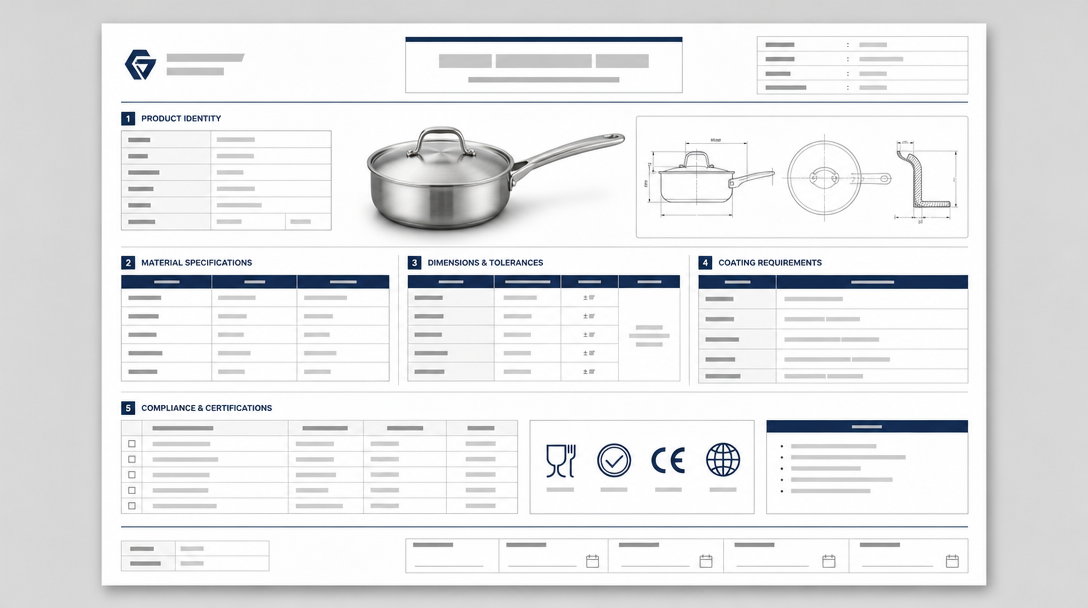
A finished cookware tech pack covers eight core sections:
- Product identity and scope
- Materials and grade specifications
- Construction and dimensions
- Surface treatments and coatings
- Handle and hardware specifications
- Performance tolerances
- Compliance and certification requirements
- Packaging and labeling requirements
Each section serves a different purpose — and omitting any one of them is where sampling rounds go wrong.
The 8 Sections of a Complete Cookware Spec Sheet
1. Product Identity
This section establishes what you’re building and prevents scope confusion across multiple SKUs or factory contacts.
Include:
- Product name and SKU
- Target market (US, EU, or both — this determines which compliance standards apply)
- Intended use category (home consumer, foodservice, induction-compatible, outdoor)
- Product family/series name if part of a set
- Revision number and date
Even a simple field like “target market: EU” changes the compliance requirements for coating migration limits, nickel release, and marking requirements. Factories working with multiple clients in multiple markets need this declared upfront.
2. Materials and Grade Specifications
This is the section where most spec sheets fail — and where the most money is lost.
For stainless steel cookware, specify:
| Parameter | Common Options | Recommended for EU/US Export |
|---|---|---|
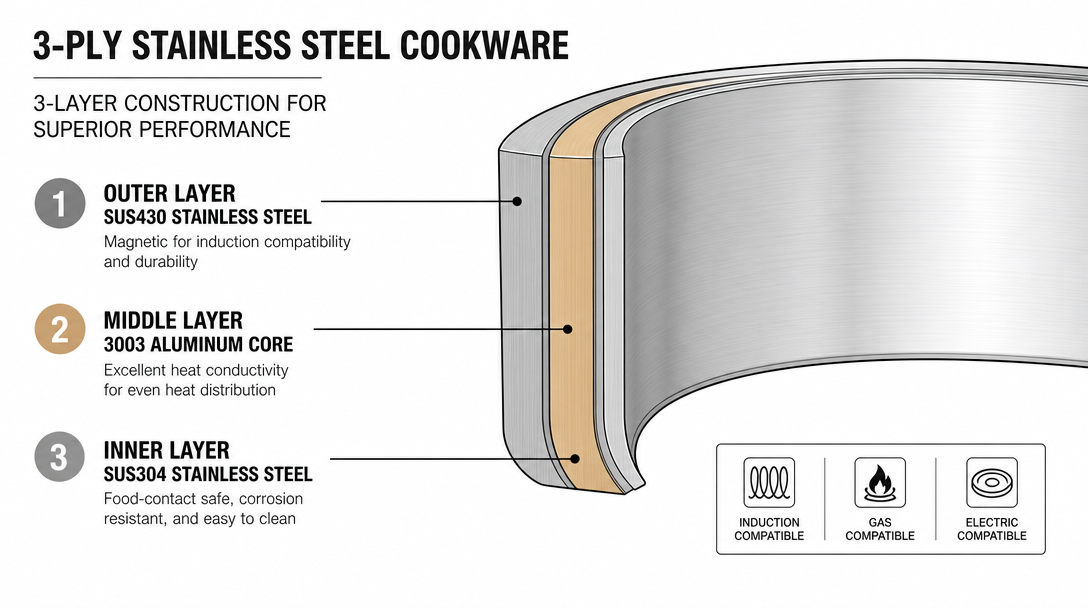
| Exterior grade | 430 (18/0 ferritic) | 430 is standard for induction-compatible bases |
| Interior grade | 304 (18/8) or 316 | 304 is the baseline; 316 for premium salt tolerance |
| Core layer (multi-ply) | 1100 aluminum, 3003 aluminum, 201 SS | 3003 for thermal performance |
| Nickel content declaration | Required for LFGB | ≤0.1 µg/cm²/week nickel migration |
The difference between 18/10 (304 SS with 10% nickel) and 18/8 (304 SS with 8% nickel) is marginal for cooking performance but matters for marketing claims and LFGB nickel migration compliance. If you’re marketing a product as 18/10, the spec sheet must declare it — and the factory must be able to provide mill certificates proving it.
For nonstick coatings, specify:
- PTFE-based, ceramic, or hybrid
- Brand/supplier of coating (e.g., Whitford Xylan, SilverStone, proprietary)
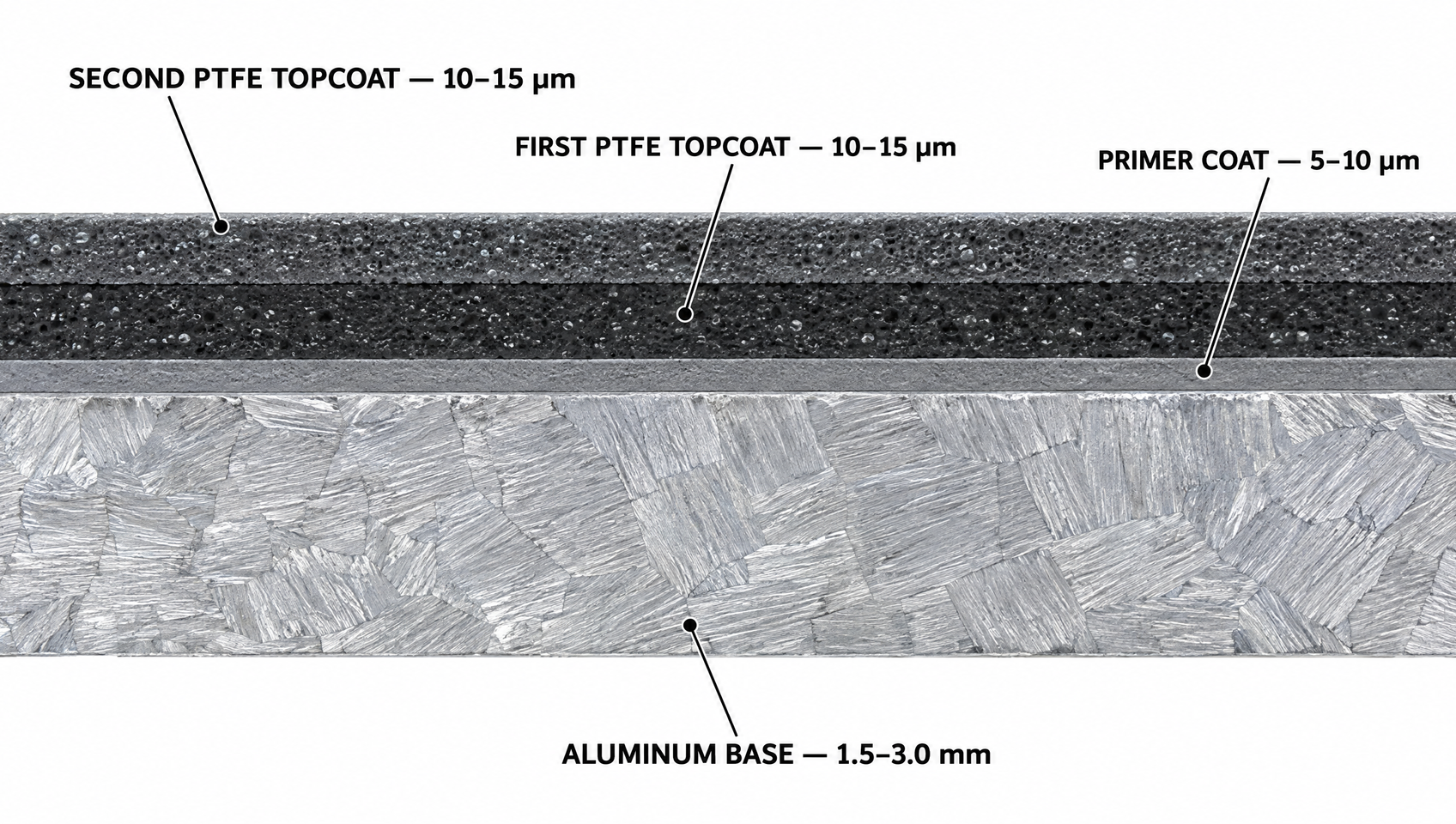
- Number of layers (2-coat vs. 3-coat systems)
- PFAS-free declaration requirement (yes/no) — increasingly required for EU market post-2025 PFAS regulations
- Curing temperature and adhesion test standard
Common buyer mistake: Specifying “nonstick coating” without naming the supplier or layer count. Factories will apply whatever they have in stock, and performance will vary significantly between a 2-coat and 3-coat PTFE system.
3. Construction and Dimensions
This section defines the physical geometry and ply structure of the product. It must include both nominal dimensions and tolerances — a range the factory must stay within.
Key fields:
| Dimension | Example Value | Tolerance |
|---|---|---|
| Outer diameter (top rim) | 260 mm | ±2 mm |
| Base diameter (cooking surface) | 220 mm | ±2 mm |
| Sidewall height | 55 mm | ±1.5 mm |
| Sidewall thickness | 2.0 mm (3-ply) | ±0.15 mm |
| Base thickness | 3.5 mm | ±0.2 mm |
| Ply construction | 3-ply (SUS430 / Al3003 / SUS304) | — |
| Total weight (without lid) | 950 g | ±50 g |
Sidewall thickness is where manufacturers most commonly cut costs. A nominal 2.0mm 3-ply wall claimed in marketing materials might be manufactured at 1.6mm unless the spec explicitly states a minimum. Specify both the nominal value and a minimum floor — “2.0 mm nominal, 1.85 mm minimum” — and require incoming inspection records.
Wonnda’s 2026 manufacturing guide references typical sidewall thickness of 0.6–1.0mm for standard stainless steel cookware after deep drawing. Premium multi-ply construction runs thicker — typically 2.0–3.0mm total for 3-ply or 5-ply sidewalls. Know where your product sits in that range and state it explicitly.
4. Surface Treatments and Coatings
For exterior finishes, this section defines the visual and tactile outcome.
Specify:
- Exterior finish: mirror polish, brushed, sandblasted, PVD color, enamel
- Interior finish (if bare metal): Ra surface roughness value (e.g., Ra ≤ 0.8 µm for food contact stainless)
- Coating adhesion standard: cross-cut adhesion test per ISO 2409 (rating 0 or 1 acceptable)
- Coating thickness: 25–40 µm dry film thickness for standard PTFE systems
- Wear resistance test: DIN 68861-1 (or equivalent) abrasion cycles before failure
For PTFE coatings targeting the EU market, the factory should provide a declaration of compliance with BfR Recommendation XLVI (Germany’s BfR recommendation for fluoropolymers, including PTFE) or the relevant EU framework regulation. For the US market, FDA 21 CFR 175.300 covers resinous and polymeric coatings — request the factory’s FDA compliance letter for their coating supplier.
The August 2025 FDA warning on imported cookware leaching lead is a live enforcement signal: the FDA flagged specific aluminum and brass alloy cookware (marketed under names like “Hindalium” or “Indalium,” primarily from Pakistan) for leaching dangerous lead levels. If your product uses aluminum alloys, brass, or any decorative exterior coating or enamel, require your factory to provide migration test results for lead (Pb) and cadmium (Cd) under FDA leaching protocols.
5. Handle and Hardware Specifications
Handles are the most common point of failure in cookware quality control — and the section most brands leave to the factory’s discretion.
Specify:
- Handle material: bakelite (phenolic), stainless steel, riveted cast SS, silicone-overmolded
- Attachment method: riveted (specify rivet count, rivet material, rivet diameter) or welded
- Ergonomic angle: angle of handle relative to pan base (typically 0°–10° upward tilt)
- Heat resistance rating: handle surface temperature at 100°C pan body temperature (target: ≤60°C at grip zone)
- Torque resistance test: minimum rotational torque before handle failure (EN 12983-1 covers this for European market)
- Oven-safe temperature: if applicable, specify the rated temperature for oven use
Rivet count matters more than brands acknowledge. A pan with two rivets versus three rivets on a heavy 26cm skillet will behave differently over time. Specify it.
For stainless steel handles, also specify the finish (brushed, polished) and whether the handle requires a hollow or solid profile — hollow handles stay cooler on the stovetop but add complexity to tooling.
6. Performance Tolerances and Test Standards
This section defines how the product will be tested before shipment — and what pass/fail thresholds apply.
Core test references:
| Test | Standard | Pass Threshold |
|---|---|---|
| Handle torque resistance | EN 12983-1 | ≥20 Nm without loosening |
| Coating adhesion | ISO 2409 cross-cut | Rating 0–1 |
| Base flatness (warpage) | — | ≤0.3 mm deviation per 100 mm |
| Dimensional compliance | Per spec dimensions | Within stated tolerances |
| Nonstick performance | DIN 68861-1 | X cycles without coating failure |
| Metal migration (EU) | EN 1186 / prEN 13130 | Within LFGB migration limits |
| Lead/cadmium leaching (US) | FDA leaching protocol | Below FDA action levels |
Not all brands will commission lab testing on every item, but naming the standards in your spec sheet signals to the factory that you know what’s verifiable — and that you will check.
For products going to the European market, request your factory’s LFGB test certificates from a recognized third-party lab (Intertek, SGS, TÜV Rheinland). For the US market, nonstick cookware is typically tested under CFIA-equivalent protocols and the Cookware Manufacturers Association (CMA) voluntary standards.
7. Compliance and Certification Requirements
Compliance failures at customs are almost always traceable to a spec sheet that didn’t declare the target market or the required certifications.
For US market export:
- FDA food contact compliance for any coating or interior surface material
- California Prop 65 compliance declaration (lead, cadmium, PFAS if applicable)
- Country of Origin marking (FTC requirement)
- No PFAS-containing nonstick coatings if targeting California post-2025 restrictions
For EU market export:
- LFGB compliance (Germany’s food contact materials law, widely adopted as the de facto European standard beyond the EU Regulation 1935/2004 baseline)
- REACH compliance declaration (for nickel-containing stainless steel, plastics in handles)
- EN 12983-1 handle safety standard compliance
- CE marking is NOT required for cookware — but LFGB is functionally required for retail distribution in Germany, Austria, and Switzerland
Request from your factory:
- Material Safety Data Sheets (MSDS) for all coatings
- Mill certificates for stainless steel grades
- Third-party test reports dated within 12 months
At CharmsCook, every product specification goes through a dual-compliance review — both FDA and LFGB requirements checked against the same spec sheet — because selling a single product line across US and EU markets means building compliance in from the start, not retrofitting it before shipping.
8. Packaging and Labeling Requirements
The spec sheet is incomplete without packaging requirements — especially for private label products where retail presentation is part of the brand experience.
Specify:
- Inner packaging: paper wrap, foam sleeve, polybag — and whether polybag must be perforated for child safety compliance (ASTM F1086 / 16 CFR 1500.51)
- Outer carton: carton dimensions, weight per carton, stacking strength (for warehouse/container storage)
- Labeling: required language(s), country of origin format, care symbols (induction-compatible symbol, dishwasher-safe, oven-safe), maximum temperature marking
- Barcode: UPC/EAN format, placement on packaging
- Drop test: carton drop height standard (ISTA 1A or equivalent)
The Golden Sample: Your Spec Sheet’s Final Gate
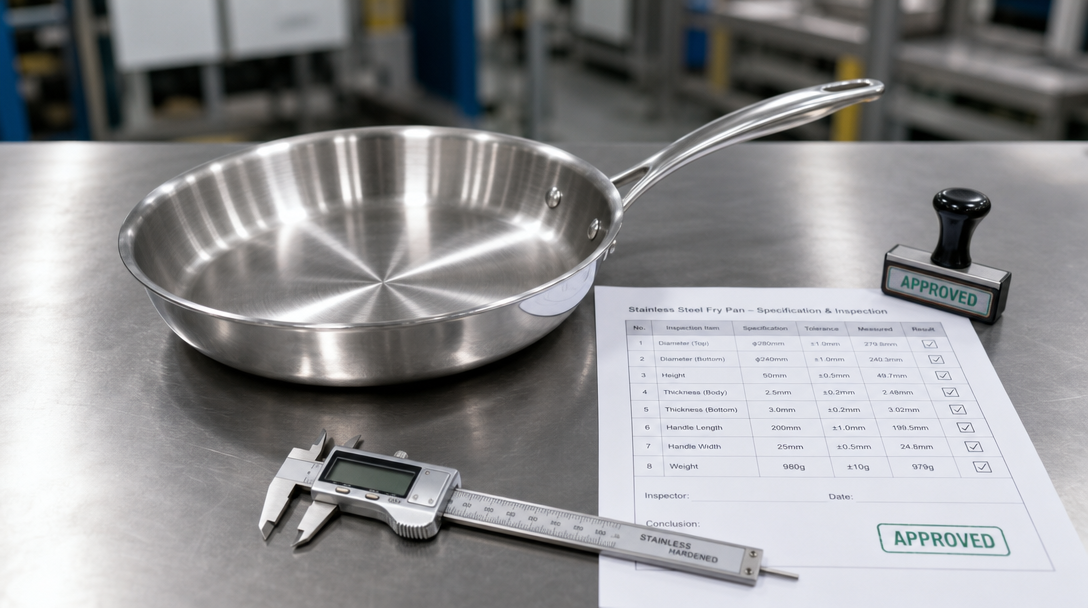
A spec sheet is a written document. A golden sample is a physical object that embodies it.
Once your factory produces a sample that meets every parameter in your spec sheet, that sample becomes the golden standard — the physical reference against which all future production is checked. Treat it as a living document extension: seal the golden sample, photograph every angle, and store a copy at the factory and one with your QC team.
The golden sample process prevents the most common form of spec drift: a factory that nailed the first sample but quietly adjusts materials or construction on the production run because a supplier changed or a shortcut looked harmless. With a golden sample on record, any deviation is measurable — not a matter of opinion.
LFGB vs. FDA: What Your Spec Sheet Must Address for Each Market
The two compliance frameworks you’ll encounter most often when specifying cookware for international markets are LFGB (Germany / EU-oriented) and FDA (United States). They are not interchangeable.
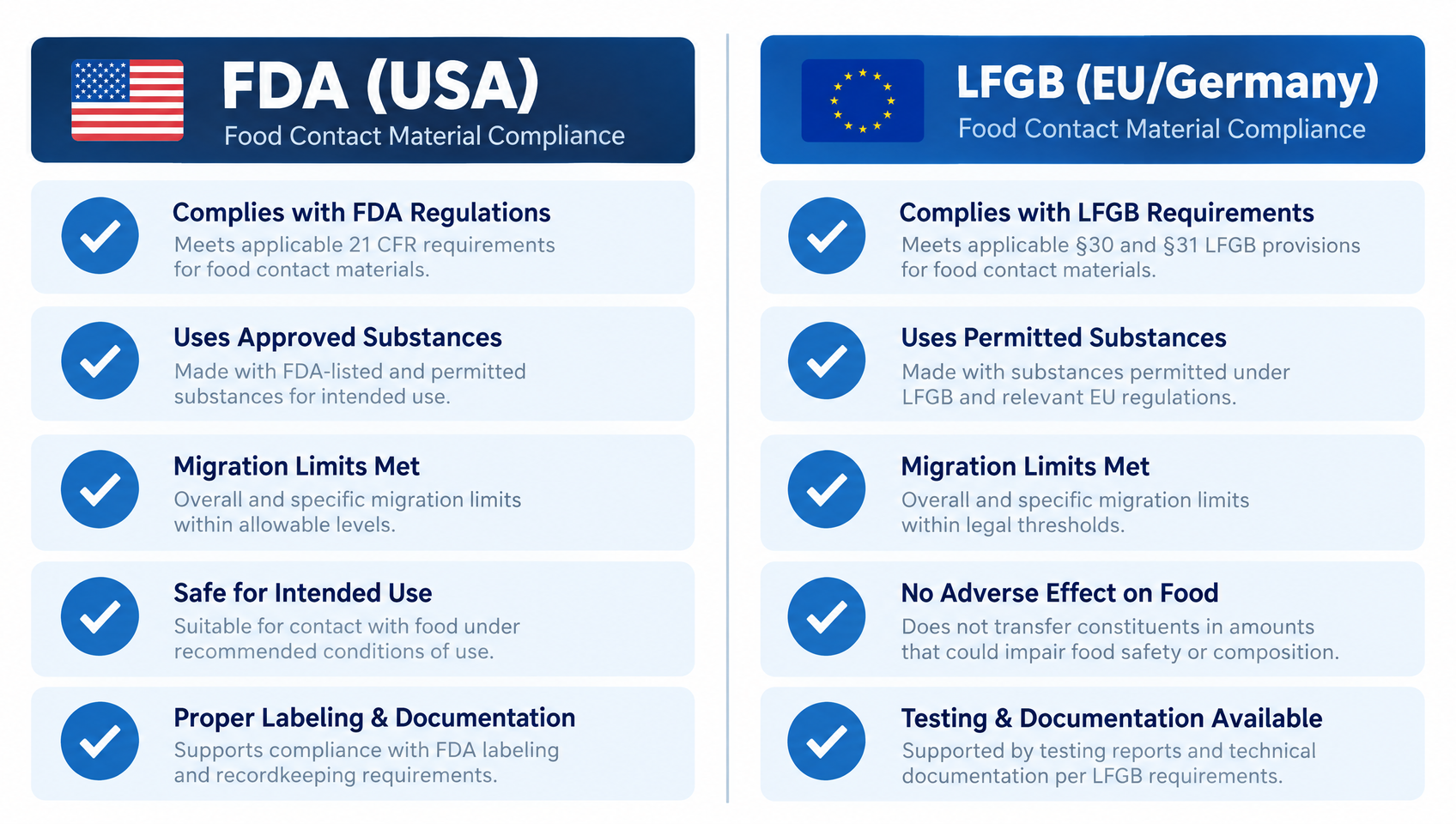
| Requirement | FDA (US) | LFGB (Germany/EU) |
|---|---|---|
| Framework | Federal Food, Drug, and Cosmetic Act | German Food and Feed Code (LFGB) + EU Reg. 1935/2004 |
| Coating compliance | 21 CFR 175.300 (resinous coatings) | BfR Recommendations, positive list system |
| Nickel migration limit | No specific limit | ≤0.1 µg/cm²/week (EN 1811) |
| Lead/cadmium | FDA leaching protocol (active warning Aug 2025) | EN 1186, CEN standards |
| PFAS nonstick | State-level (CA ban in force) | EU PFAS restriction under REACH 2025+ |
| Test report requirement | No mandatory third-party testing | Third-party testing strongly expected by retailers |
If you’re selling in both markets, build to LFGB — it is the stricter standard in most categories, and LFGB-compliant products will satisfy FDA requirements in nearly all cases. The reverse is not always true.
Common Spec Sheet Mistakes (and What They Cost You)
Specifying “stainless steel” without a grade: The factory uses 201 SS (lower nickel, corrosion-prone) instead of 304. You don’t find out until your first round of rust complaints.
Omitting wall thickness tolerances: You spec 2.0mm, the factory delivers 1.6mm. Weight comes in light, heat distribution is uneven. You’ve already paid for tooling.
No coating supplier requirement: Two factories producing the same SKU use different PTFE suppliers. The pans look identical but perform differently. Consumer reviews diverge.
Missing compliance market declaration: Factory ships to the US with LFGB test certs only. US customs requests FDA documentation. Shipment delayed.
No golden sample protocol: Production run deviates from the approved sample. You have no physical reference to support your rejection claim.
Spec Sheet vs. Purchase Order: Know the Difference
A purchase order confirms quantity, price, and delivery terms. A spec sheet defines what you’re ordering.
These are two separate documents, and confusing them is a sourcing error. Your spec sheet should exist before the first factory conversation. It shapes your factory selection (does this supplier have the equipment to meet your wall thickness spec?), your pricing negotiation (3-ply with 3003 aluminum core costs more than 3-ply with 1100 aluminum), and your QC process.
If you’re writing a spec sheet for the first time, start with sections 1–3 and 7. Get the material grade, dimensions, and compliance target right. The remaining sections can be refined through the sampling process — but the foundation must be in place before you begin.
The Spec Sheet Is a Relationship Tool, Not Just a Document
Experienced sourcing teams treat the spec sheet as the beginning of a factory communication protocol, not a one-time deliverable. Every revision gets a version number. Every change is documented. When a factory suggests a material substitution, it goes through a formal spec change process — not a WeChat message.
This discipline pays off most when things go wrong. A factory that produces defective product against a well-documented spec is in a clear contractual position. A factory that produces the same defect against a verbal brief is in a gray area that takes months and significant cost to resolve.
Companies like CharmsCook that work across multiple cookware categories — from titanium to stainless steel to nonstick — maintain spec sheets as living documents, updated with every production round, because the spec sheet is ultimately the memory of the product as it was intended to be built.
The Spec Sheet You Actually Need to Build
A cookware product spec sheet doesn’t have to be a 40-page engineering document. For a single SKU, a well-structured 4–6 page document covering the 8 sections above will do more to protect your product quality than any factory audit.
The key shift is treating the spec sheet as a communication tool designed for a factory floor — not a filing exercise for your own records. Use tables. Use specific numbers with tolerances. Name the standards. Require mill certificates and test reports.
A vague spec produces a vague product. A complete spec sheet gives a factory what it needs to build exactly what you designed — and gives you a clear basis to reject anything that falls short.
Your Spec Sheet Isn’t the End — It’s the Starting Point
Once your golden sample is approved and your spec sheet is locked, you have a foundation. The next step is building a quality control process around it — incoming material inspection, in-process checks, and pre-shipment inspection against the golden sample.
The spec sheet tells the factory what to build. The QC process tells you whether they did.
Build the spec first. Inspect against it. Iterate with version control. That three-step discipline is what separates brands that scale their cookware lines from brands that spend two years and significant capital on sampling rounds that go nowhere.