


When sourcing cookware from a China factory, there are three distinct sample types — counter sample, pre-production sample, and production sample — and confusing them is the single most expensive mistake importers make. This guide explains each type, walks through the pre-production sample process step by step, covers real costs and lead times, and gives you an 8-point evaluation checklist to use before approving any order. CharmsCook, a Zhejiang-based cookware OEM manufacturer, is used throughout as a real-world reference for how a structured sampling process should work.
The Sample Type Problem: Counter Sample vs Pre-Production Sample vs Production Sample
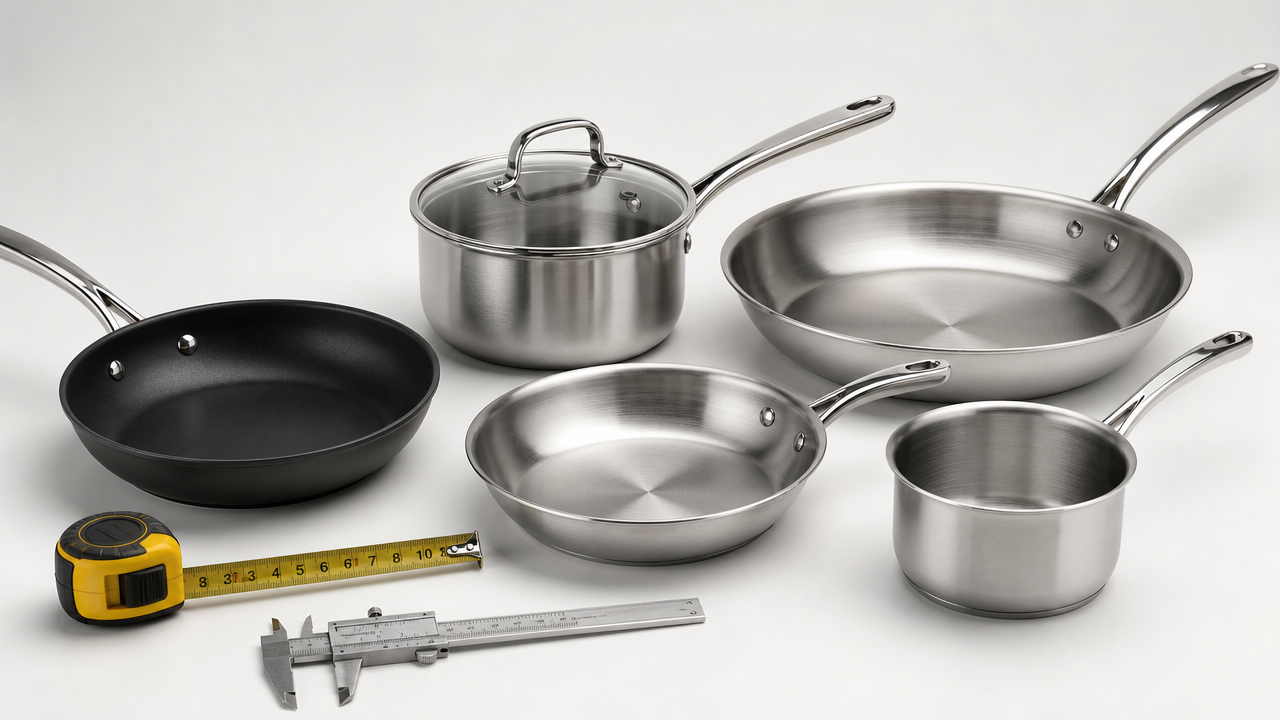
Most sourcing guides treat “factory sample” as one thing. It isn’t.
Understanding the three sample types is the foundation of any successful cookware import. Getting this wrong means you approve something that the factory never actually committed to replicating at scale.
| Sample Type | Who Makes It | What It Proves | When to Use It |
|---|---|---|---|
| Counter Sample | Factory picks from existing stock | Factory can make something in the ballpark | Initial shortlisting; don’t use for production approval |
| Pre-Production Sample (PPS) | Factory makes from your exact spec/tech pack | Factory can hit your specific requirements | Required before any production PO |
| Production Sample (Golden Sample) | Pulled from first production run | Actual production quality | Kept as reference; QC checks all production against it |
A counter sample costs less and arrives faster — typically 5–7 business days — but it’s made from whatever materials and tooling the factory already has. The pre-production sample is made to your specifications: your material grade, your coating type, your handle design, your logo placement. That’s the one that actually matters.
At CharmsCook, we don’t accept a production order without a signed-off pre-production sample. That single policy has eliminated the most common complaint we hear from buyers who switched to us from other suppliers: “The samples were beautiful but the production run looked nothing like them.”
Step-by-Step: The Pre-Production Sample Process at a China Cookware Factory
A pre-production sample goes through 6 distinct stages, each with a decision point.
Here’s what happens from the moment you send your requirements to the moment a box lands on your desk:
Stage 1 — Technical Specification Submission (Day 0)
You provide: dimensions, material (e.g., 3-ply stainless 18/10, hard-anodized aluminum, cast iron), coating spec (PTFE, ceramic, enamel), handle material and attachment method, surface finish, and any branding elements (logo, color, packaging). The more complete this is, the less back-and-forth later.
Stage 2 — Quotation and Sample Confirmation (Days 1–3)
The factory reviews your spec and quotes the sample cost. For a standard non-stick frying pan at CharmsCook, sample pricing typically runs $45–$90 per piece depending on coating complexity and handle design. Cast iron pieces run higher — $80–$150 — because of the weight and finishing labor.
Stage 3 — Material Procurement and Preparation (Days 4–8)
If your spec calls for materials not already in stock (a specific aluminum alloy grade, a particular ceramic coating supplier), this adds time. Most factories work with a fixed roster of coating suppliers; if you require a specific coating that needs third-party sourcing, budget an extra 5–7 days.
Stage 4 — Sample Production (Days 9–18)
The factory’s sample room — which should be separate from the main production floor — makes your pieces by hand or on a limited production line. At this stage, experienced factories will flag any manufacturing challenges before they become your problem. Red flag: a factory that promises samples in under 10 business days for a custom piece with a novel coating or complex handle design. That speed usually means they pulled something close from stock rather than making to spec.
Stage 5 — Internal QC and Documentation (Days 18–22)
A professional factory runs internal checks before shipping: dimensional inspection, coating adhesion test, handle torque test, and heat resistance check. They should provide a basic inspection report with the sample shipment.
Stage 6 — Shipment and Your Evaluation (Days 23–28)
DHL/FedEx express from Yongkang or Guangdong to the US or EU typically adds 3–5 business days. Total timeline from spec submission to sample in hand: 18–28 business days is realistic for a custom pre-production sample. Any factory quoting under 10 days for a genuinely custom piece deserves scrutiny.
What CharmsCook Includes in Every Pre-Production Sample Shipment

A pre-production sample without documentation is just a product. Documentation is what makes it a commitment.
When CharmsCook ships a pre-production sample, the package includes:
- The sample itself — made to the exact specification agreed in writing
- Material certification copies — showing the aluminum or stainless steel grade used
- Coating supplier certificate — confirming the coating meets LFGB (§64 LFGB BfR) or FDA (21 CFR 175.300) requirements, depending on the target market
- Dimensional report — actual measurements vs. spec, signed by QC
- Surface finish reference card — physical swatch showing the approved finish standard
- Signed sample approval form — once you approve, this becomes the binding production reference
The coating certifications deserve special attention. For the EU market, LFGB is the governing standard for food-contact materials. For the US, FDA 21 CFR 175.300 covers resinous and polymeric coatings. California’s Prop 65 adds limits on lead (<0.5 µg/day migration) and cadmium (<4.1 µg/day migration) that go beyond federal FDA requirements. Request these certificates at the sample stage, not after production.
If a factory can’t provide coating documentation at the sample stage, they almost certainly won’t have it at the production stage either.
Costs, Lead Times, and MOQs: What to Actually Expect
The numbers factories quote upfront are rarely the full picture.
Here’s what the market actually looks like, based on industry consensus from sourcing professionals and factory interactions:
| Item | Typical Range | Notes |
|---|---|---|
| Sample cost per piece (standard non-stick pan) | $45–$90 | Increases with multi-layer coatings or custom handles |
| Sample cost per piece (cast iron) | $80–$150 | Higher finishing labor |
| Sample cost per piece (stainless clad) | $60–$120 | Depends on cladding layers |
| Pre-production sample lead time | 18–28 business days | For genuinely custom pieces |
| Counter sample lead time | 5–10 business days | From existing stock/tooling |
| Sample shipping (DHL/FedEx to US/EU) | $35–$80 | Per shipment, not per piece |
| Sample fee refundable? | Sometimes | Factories often credit toward production PO above a threshold |
A note on “sample fees”: many factories advertise free samples. This almost always means a counter sample — something close to what you asked for, not exactly what you asked for. If a factory is genuinely making a custom pre-production sample to your tech pack, there will be a cost. That cost is reasonable and worth paying; it’s far cheaper than discovering a problem after a 5,000-unit production run.
5 Things That Go Wrong With Factory Samples (And How to Catch Them Early)
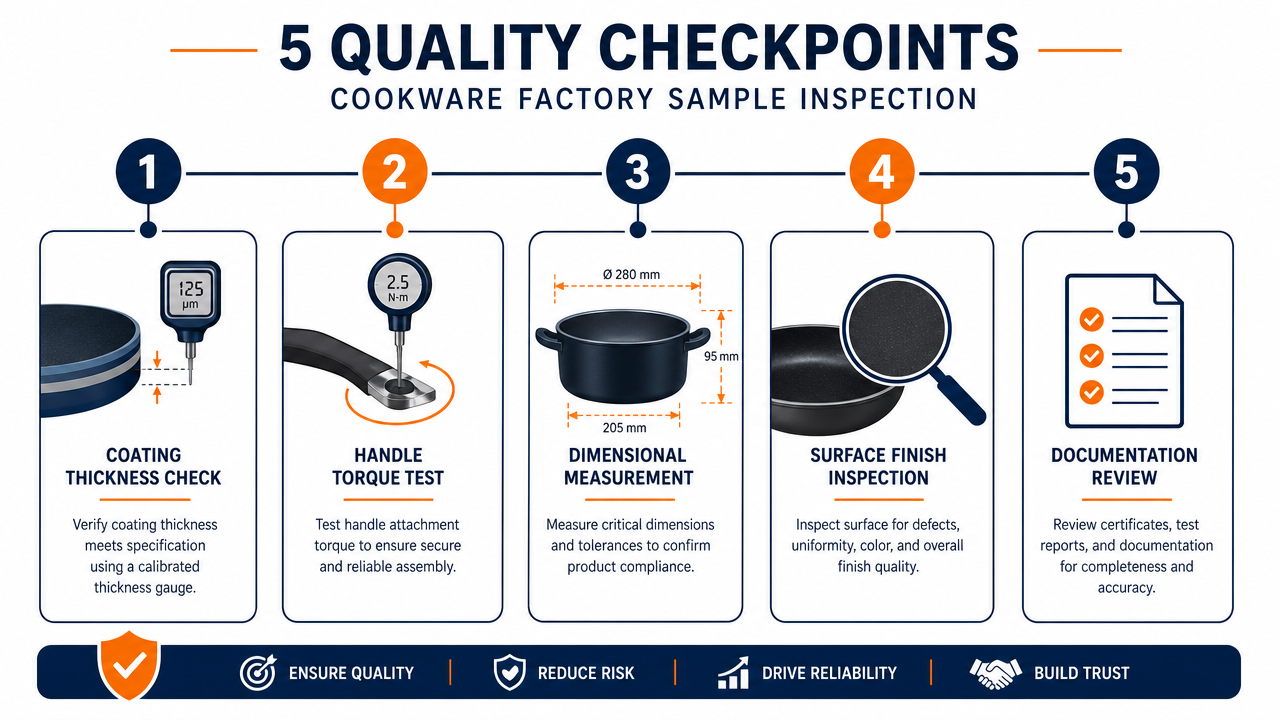
The gap between “sample approved” and “production matches sample” is where importers lose the most money.
After working through CharmsCook’s sample approval process with buyers across North America, Europe, and Australia, these are the five failure points that show up most consistently:
1. Counter sample approved as pre-production sample
The factory sends a beautiful piece that was pulled from existing inventory, tweaked slightly. You approve it. Production arrives with a different handle profile, a thicker gauge, or a slightly different coating finish. Always confirm in writing: “This is a pre-production sample made to my specification, not a counter sample.”
2. Coating supplier substitution mid-production
The coating used on your sample came from Supplier A. During production, the factory switched to a cheaper Supplier B without telling you. Request that the coating supplier name and batch number be documented in the sample paperwork — and include a clause in your PO prohibiting substitution without written approval.
3. Handle attachment not tested under load
Frying pan handles look fine on a sample. Under repeated thermal cycling and use, a handle attached with the wrong screw torque or wrong adhesive will loosen. Test your sample: put it in a 200°C oven for 30 minutes, let it cool, and test handle torque with a wrench. Do this three times. If it loosens, it will loosen in your customer’s kitchen.
4. Coating thickness below spec
Non-stick coating thickness is measured in microns. A spec might call for 25µm total coat thickness (primer + topcoat). Factories under cost pressure sometimes thin coatings. Ask for a coating thickness measurement report with your sample — any serious factory will have a film thickness gauge.
5. No golden sample retained
Once you approve the pre-production sample, both you and the factory should retain a copy as the “golden sample” or “counter sample for production.” This is the physical reference against which production QC is run. Buyers who skip this step have no objective basis to reject production goods that fall below sample quality.
How to Evaluate a Cookware Sample Before Approving Production
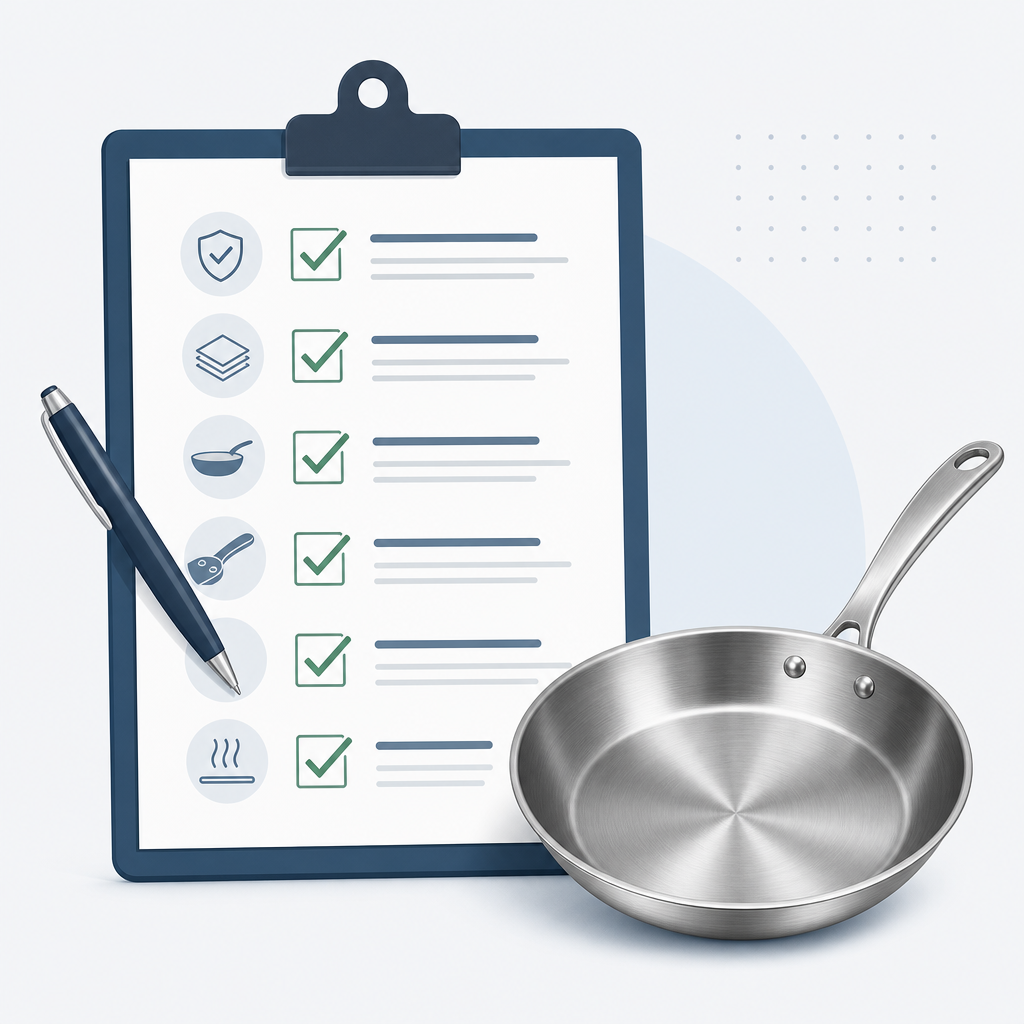
Print this checklist. Use it before you sign any sample approval form.
A thorough evaluation takes about 45 minutes per piece and covers:
- Dimensions: Measure diameter, depth, wall thickness, handle length against your spec. Tolerance should be ±1mm for dimensions under 300mm, ±2mm above
- Weight: Weigh the piece. Weight is an indirect proxy for material gauge — a pan that’s 15% lighter than spec is probably using thinner aluminum or stainless
- Coating uniformity: Hold the piece under strong directional light at 45°. Look for thin spots, pinholes, runs, or uneven texture. Any of these indicate coating application issues
- Handle security: Apply 20Nm of torque to the handle with a torque wrench. Re-test after thermal cycling (200°C × 3 cycles)
- Surface finish: Compare against the reference finish card from the factory. Color and texture should be within the agreed tolerance
- Branding/logo: Check position, color match (Pantone reference), and adhesion on any applied decals or laser marks
- Documentation: Confirm you have coating cert, material cert, dimensional report, and signed approval form in hand
- Functional test: For non-stick — fry two eggs in 5ml butter over medium-high heat. For stainless — heat to searing temperature, add water droplets to test Leidenfrost effect. These are subjective but useful sanity checks
If a sample fails any of the first six checklist points, reject it and request a revised sample. Functional testing alone is not sufficient for production approval.
Frequently Asked Questions
What is the difference between a pre-production sample and a counter sample?
A counter sample is pulled from existing factory inventory or made using whatever materials and tooling the factory already has. It gives you a rough idea of the factory’s capability. A pre-production sample is made specifically to your technical specification — your material grade, coating, dimensions, and branding — and is the only sample type that should be used to approve a production order.
How long does it take to get a pre-production cookware sample from China?
Realistically, 18–28 business days from the date you submit your complete technical specification. Add 3–5 business days for international express shipping. Factories that quote under 10 business days for a genuinely custom piece are almost always sending a counter sample rather than a made-to-spec pre-production sample.
How much does a cookware factory sample cost?
For a standard non-stick frying pan, expect $45–$90 per piece. Cast iron runs $80–$150. Stainless clad pieces fall in the $60–$120 range. These costs are often credited toward your production order if you place an order above the factory’s threshold — worth asking about upfront.
What certifications should I request with a cookware sample?
For the EU market: LFGB certificate for the coating (§64 LFGB BfR). For the US: FDA 21 CFR 175.300 compliance for the coating. For California: Prop 65 migration test results for lead and cadmium. Request these documents with the sample shipment, not after production approval.
Why did my production run look different from the approved sample?
The most common causes: counter sample approved in place of pre-production sample; coating supplier substituted during production; no retained golden sample to QC against; factory used thinner gauge material under cost pressure. A clear written sample approval process — with material certs, supplier documentation, and a retained golden sample — prevents all of these.
How many pre-production samples should I order?
Typically 2–3 pieces per SKU: one for your evaluation, one retained as your golden sample reference, and one for third-party lab testing if you’re doing pre-shipment certification. For complex pieces with multiple components, order 5 to account for destructive testing.
Summary
Getting cookware factory samples right is about asking for the right thing in the right way — and knowing what to do with what you receive.
The pre-production sample is the only document that actually commits a factory to a quality standard. A counter sample is a conversation starter. A production sample is a confirmation. Mixing these up costs importers real money, usually discovered after an entire container has shipped.
At CharmsCook, the sample process is built around documentation: every pre-production sample ships with material certs, coating compliance documents, dimensional reports, and a signed approval form. That paper trail is what turns a factory sample from a hopeful gesture into a binding quality standard.
If you’re sourcing cookware from China and you’re not yet running a structured pre-production sample process, start there. The 3–4 weeks and $100–$300 you spend on proper sampling is the cheapest insurance available for a $20,000+ production order.





