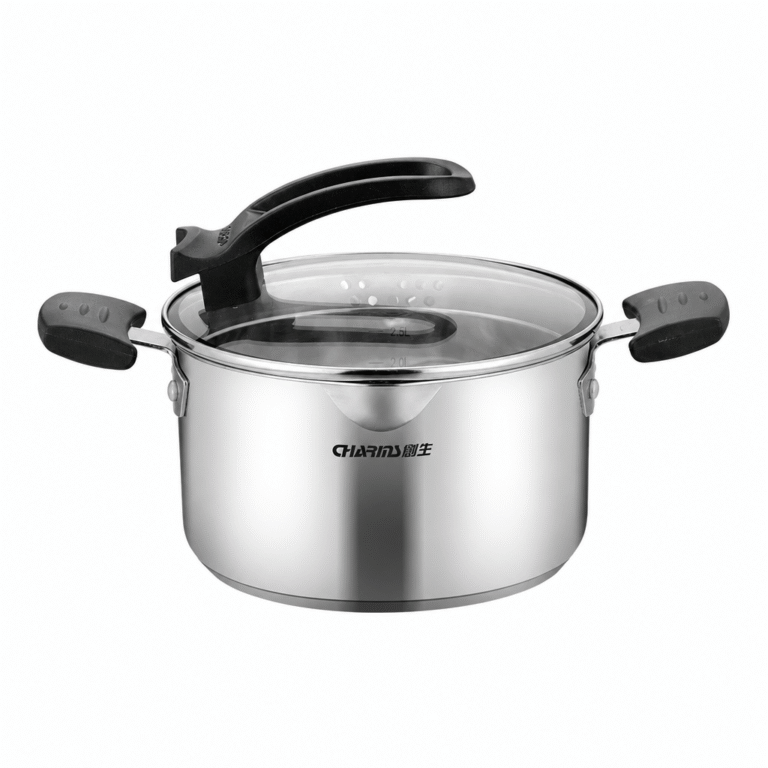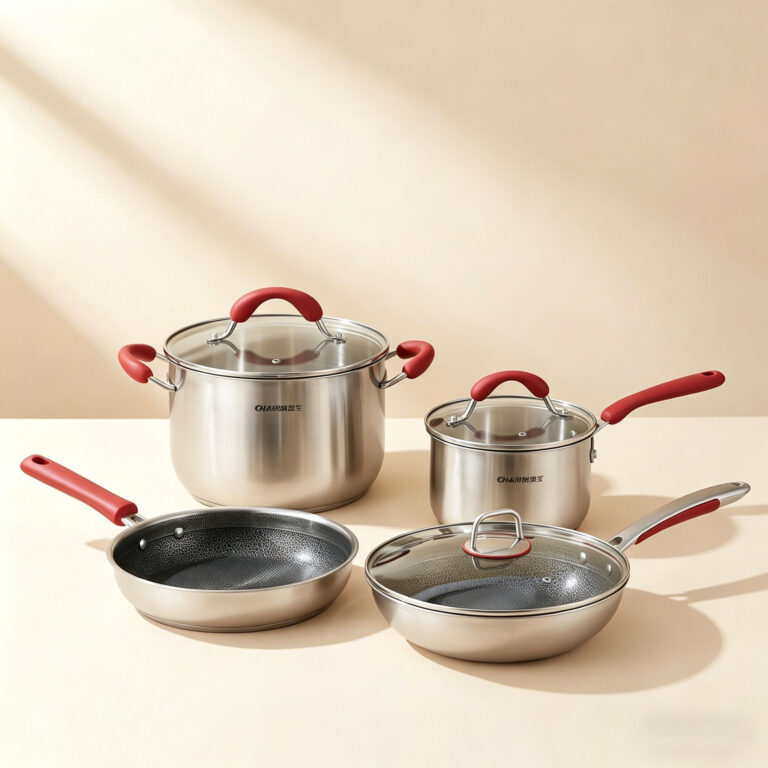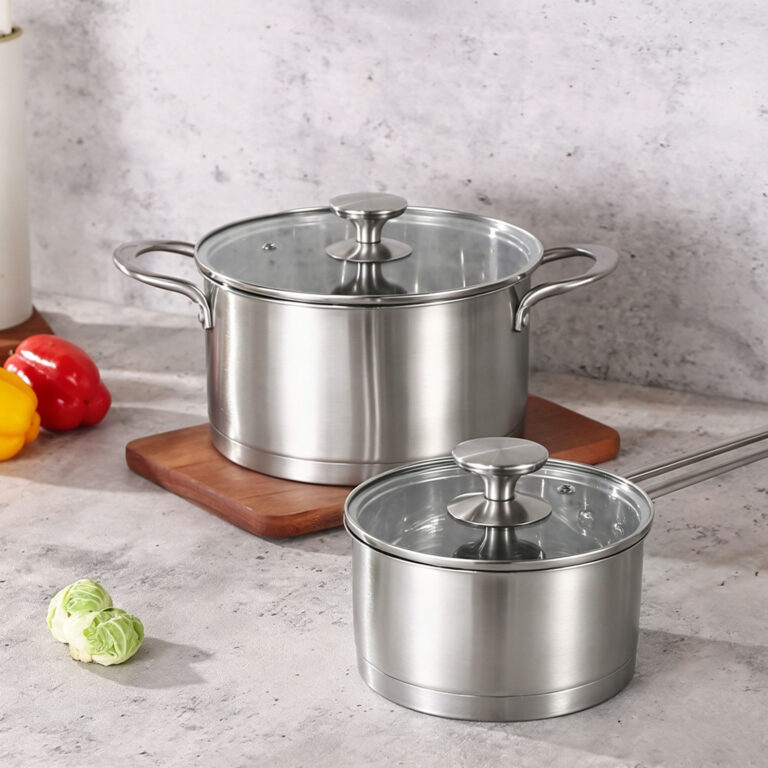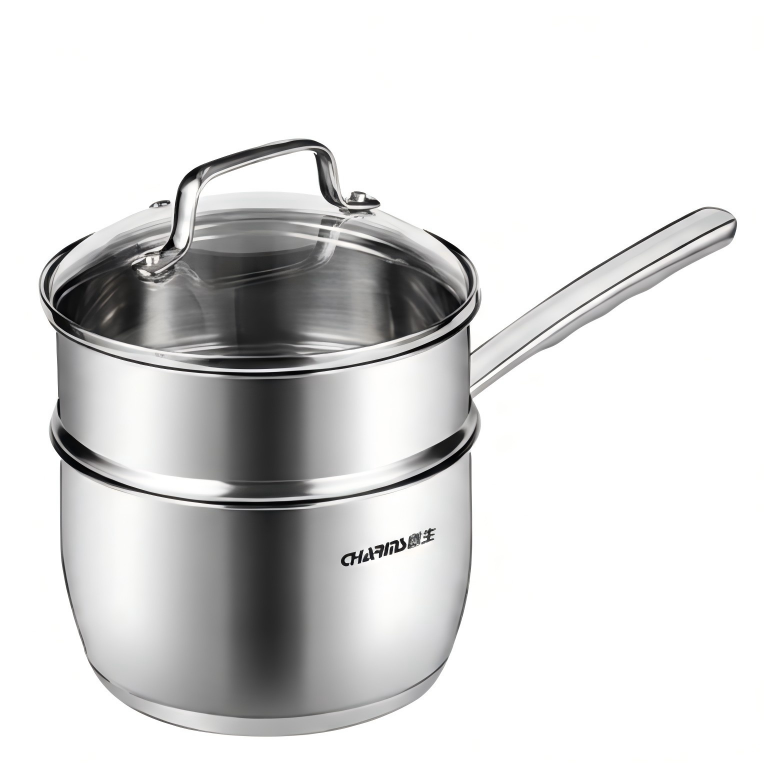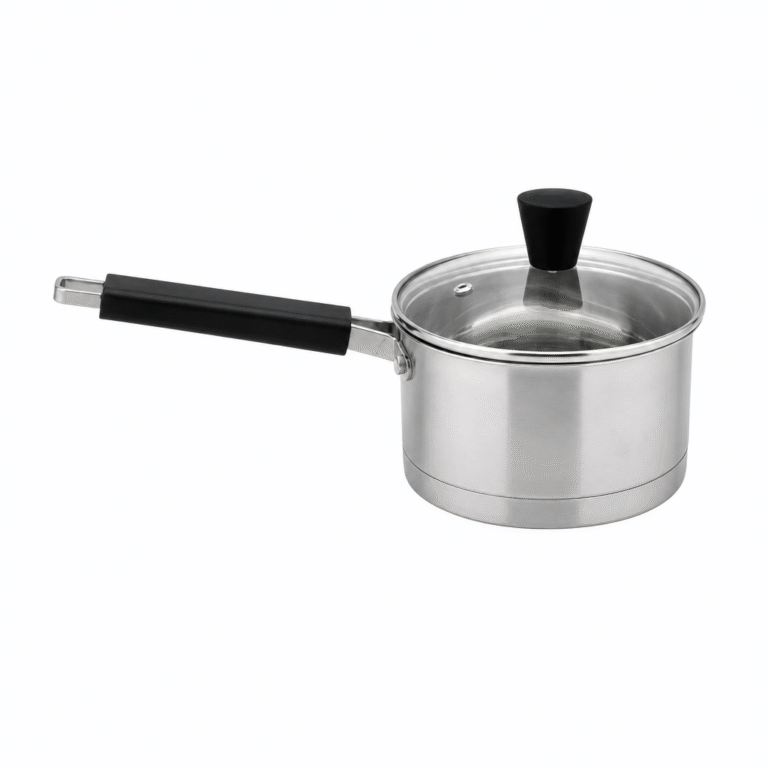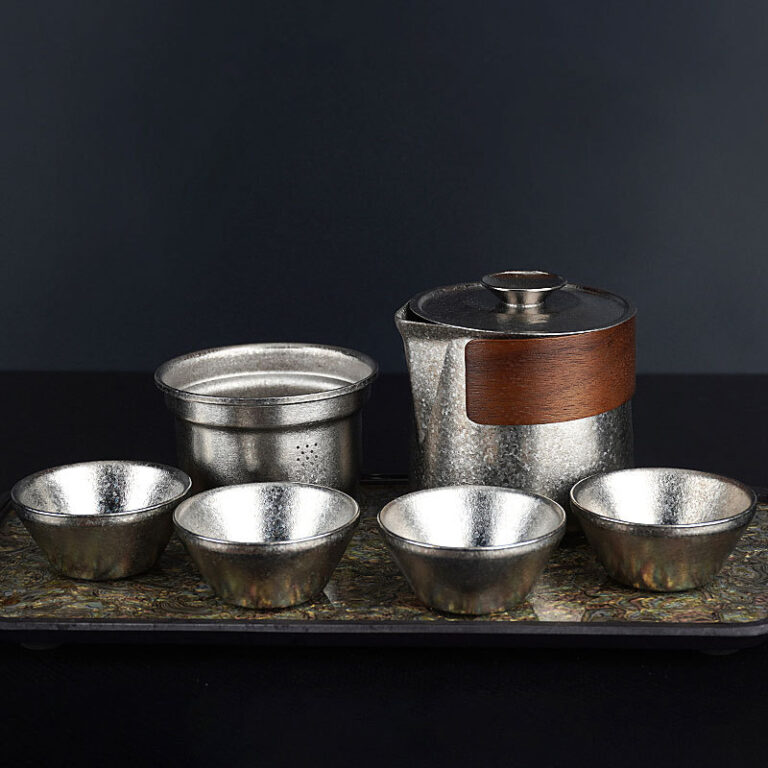


Wholesale cookware from Chinese manufacturers is priced on an FOB basis, typically ranging from $1.50–$5.00/piece for aluminum non-stick and $5.00–$15.00 for stainless steel or cast iron at standard MOQ (500–1,000 pcs). Bulk discounts begin at around 500 pieces and scale to 12–25% off at container-load quantities (3,000+ pcs). This guide breaks down real FOB price ranges by material, explains how MOQ discount tiers work, and shows how to calculate your actual landed cost after sea freight — so you can evaluate supplier quotes before you make contact.
What “FOB Price” Actually Means for Cookware Buyers
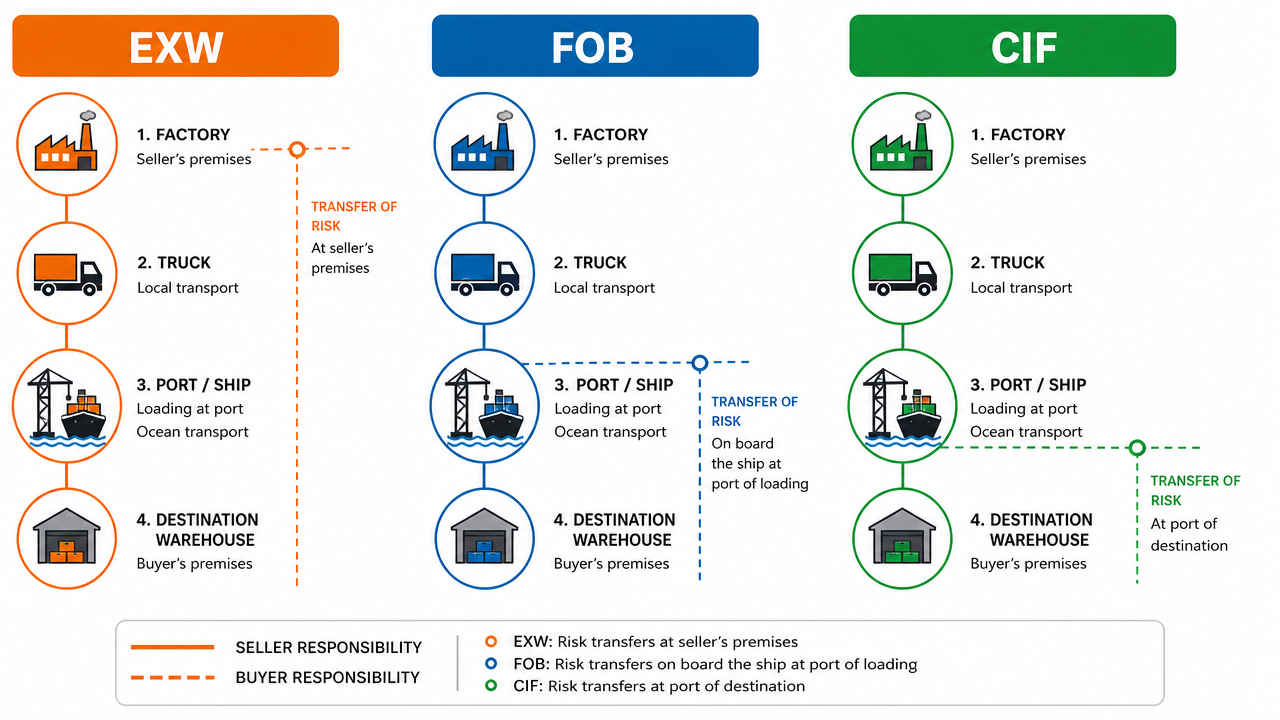
FOB (Free On Board) is the pricing standard used by virtually every Chinese cookware manufacturer. When a supplier quotes you a FOB price, it means the goods are loaded onto your shipping vessel at the Chinese port — after that, freight, insurance, and import duties are your responsibility.
Why this matters: Two suppliers can quote $3.50 and $4.20 for the same pan. If the $4.20 quote is CIF (Cost, Insurance, Freight included) and the $3.50 is EXW (Ex Works, meaning you pay all domestic Chinese logistics too), the actual comparison flips completely once you add $0.60–$1.00 in inland freight to the EXW price.
For most importers sourcing cookware, FOB is the most practical baseline. It gives you control over the freight leg, lets you use your own forwarder, and makes price comparisons across suppliers accurate.
The other common Incoterm you’ll see is CIF. CIF can look attractive on paper, but the supplier chooses the carrier, and margins on the freight leg are often inflated. Unless you’re doing a very small trial order and want simplicity, experienced buyers almost always prefer FOB.
FOB Price Ranges by Cookware Type
The table below is based on active B2B marketplace listings from China manufacturers (October 2025) at standard MOQ (500–1,000 pcs). Prices assume basic OEM (your logo on packaging); add 10–20% for full custom packaging design or unique coating specs.
| Cookware Type | FOB Price Range | Typical MOQ |
|---|---|---|
| Stainless steel 10-piece set (201 grade) | $5.50–$9.60 / set | 1,000 sets |
| Stainless steel 12-piece set (304 grade) | $19.00–$26.90 / set | 800–1,000 sets |
| Stainless steel 3-ply skillet 24cm (316) | $17.36–$18.19 / piece | 500 pcs |
| Non-stick aluminum 8-piece set (standard) | $3.50–$6.90 / set | 1,000 sets |
| Non-stick aluminum 12-piece set (forged/ceramic) | $34.78–$53.67 / set | 1,000 sets |
| Enameled cast iron Dutch oven (3–5.5L) | $15.00–$110.00 / piece | 300–500 pcs |
| Titanium cookware (single piece) | $18.00–$65.00 / piece | 200–500 pcs |
One figure that catches most buyers off guard: the gap between 201-grade and 304-grade stainless steel is 3–4x on a per-set basis. If you’ve been quoting 201SS pricing and expecting to switch to 304SS without adjusting your retail price or margin model, the math won’t work.
Entry-level typically means thinner gauge steel (201SS), basic non-stick coating with 1–2 year durability, minimal QC documentation. Mid-range (304SS, forged aluminum) covers the specs most Western retail buyers expect: PFOA-free coatings, FDA/LFGB-ready documentation. Premium involves triple-ply construction, 316SS or titanium, German-licensed coatings (Whitford, Ecolon), full certification packages.
How China Cookware MOQ and Bulk Discount Tiers Work
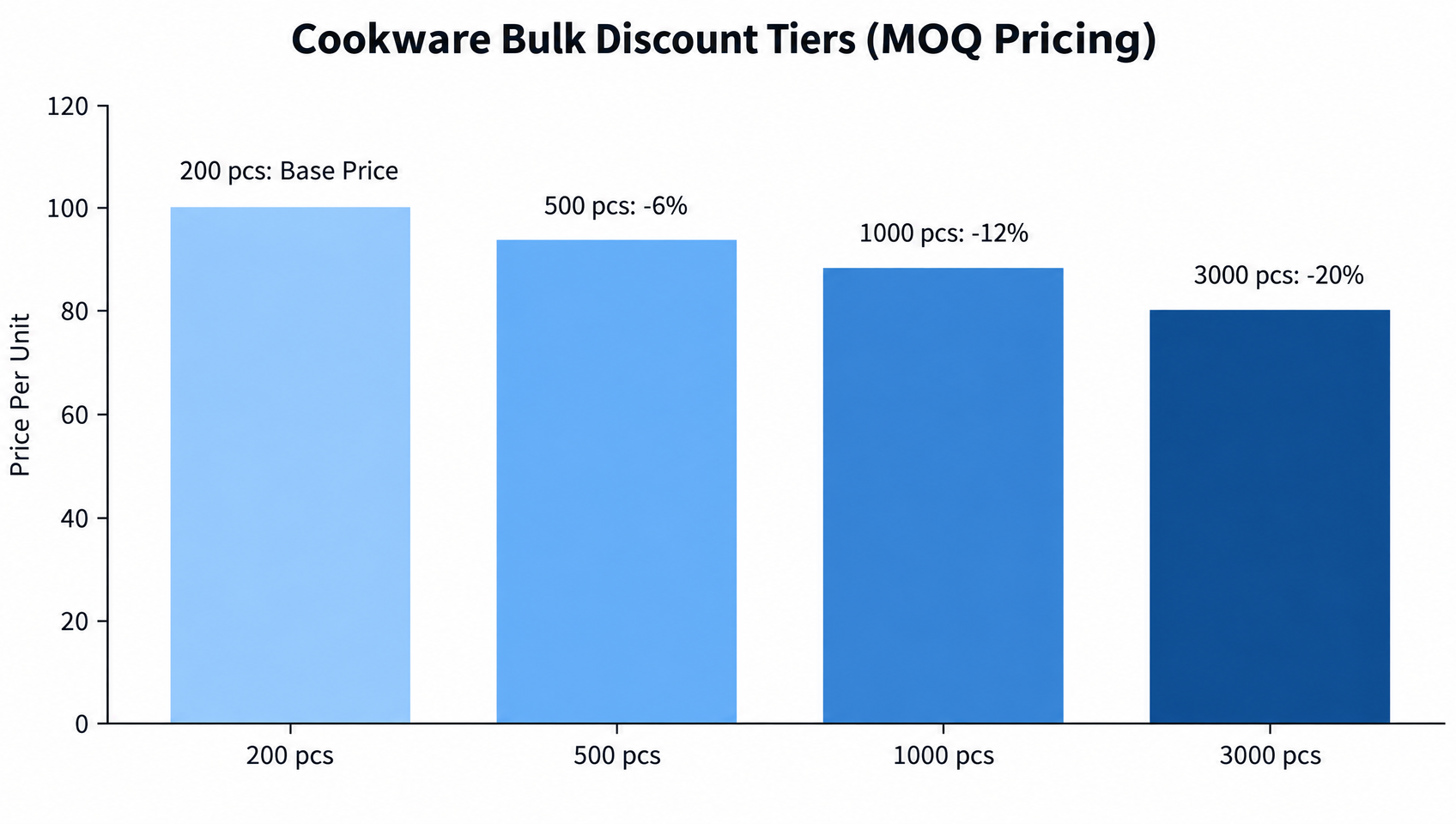
One of the most common misconceptions among first-time importers is treating MOQ (Minimum Order Quantity) as synonymous with the best price. It’s not. MOQ is the floor — the minimum a factory will accept. Discount tiers kick in as you scale above that floor.
Here’s how a typical Guangdong or Zhejiang cookware manufacturer structures pricing:
| Order Quantity | Price vs. Standard FOB | Notes |
|---|---|---|
| 1–10 pcs | +40–80% above wholesale | Sample pricing — often non-negotiable |
| 100–500 pcs/sets | Base wholesale FOB | Standard MOQ bracket — published listing price |
| 500–1,000 sets | Base FOB | Volume starts here for most factories |
| 1,000–3,000 sets | 5–10% off base | First meaningful discount tier |
| 3,000–5,000 sets | 10–18% off base | Mid-volume pricing |
| ~2,000+ sets / 1×40HQ container | Best negotiated rate | May include free tooling or custom packaging |
The container-load threshold is where China sourcing becomes truly competitive. A 20-foot container typically holds 1,500–4,000 pieces of cookware depending on product size and packaging. At that volume, the unit economics shift significantly — and most factories reserve their sharpest pricing for buyers who can commit to FCL (Full Container Load) shipments.
Working with a manufacturer like CharmsCook means you’re dealing with a factory that has transparent tier pricing — you know exactly what you’ll pay at 500, 1,000, or 3,000 pieces before you place the first order.
Where China Cookware Is Made: Manufacturing Regions
Not all “China cookware factories” are equal in what they produce well. Knowing the manufacturing geography prevents costly mismatches between what you need and what the factory actually specializes in.
| Region | City / Cluster | Specialization | Key Advantage |
|---|---|---|---|
| Guangdong | Foshan (Shunde) | Non-stick aluminum, die-cast aluminum | Largest non-stick cluster; most Tier-1 factories |
| Zhejiang | Yongkang | Stainless steel, pressure cookers, OEM/ODM | Strong export infrastructure; mature OEM capability |
| Zhejiang | Wenzhou | Stainless steel pots, industrial components | Competitive on price; more trading companies than factories |
| Fujian | Zhangzhou | Stainless steel, some cast iron | Growing export cluster; competitive 304SS pricing |
| Guangdong | Chaozhou | Ceramics, enamel-finished cookware | Enamel cast iron and ceramic-coated lines |
| Shandong | Zibo | Cast iron, enamel-on-cast-iron | Traditional cast iron; competes on price |
| Jiangsu | Various | Titanium, specialty alloys | Titanium and high-alloy cookware |
For most buyers: Foshan/Shunde for non-stick aluminum, Yongkang for stainless steel, Zibo for cast iron. Each cluster has an ecosystem of coating suppliers, handle manufacturers, and export agents built around its specialty — you pay more when you source a specialty product from the wrong region.
Calculating Your Real Landed Cost
FOB price is not your landed cost. Here’s a worked example that most sourcing guides skip entirely.
Scenario: 1,000 × 26cm non-stick frying pans (mid-range, FOB $4.50/pc)
| Cost Component | Calculation | Amount |
|---|---|---|
| FOB goods value | 1,000 × $4.50 | $4,500 |
| Sea freight (CBM-based) | ~0.8 CBM/100 pcs × 10 = 8 CBM × $120/CBM | $960 |
| Origin charges (THC, doc fee) | Fixed | ~$180 |
| Destination charges (port + customs brokerage) | Fixed | ~$350 |
| Import duty (destination-dependent) | Varies by HTS code and origin rules | ~$165–$1,375+ |
| Total landed | ~$6,155–$7,365+ | |
| Landed cost per piece | ~$6.16–$7.37+ |
Your $4.50 FOB pan costs $6.16+ landed — a 37%+ uplift depending on your import market. US buyers importing from China should factor in applicable Section 301 tariffs (25%+ on many cookware HTS codes on top of base MFN rates), which can push landed costs significantly higher. Always confirm the applicable duty rate for your specific HTS code before building margin models. This is why experienced importers always negotiate FOB price hard: every dollar saved on FOB multiplies into your unit economics at scale.
Sea freight for cookware runs $100–$150 per CBM for standard FCL consolidation (as of 2026). Heavy items like cast iron will have more CBM per piece and push freight costs higher relative to goods value.
Negotiating Better Pricing: What Actually Works
Factories price based on capacity utilization and order certainty. The levers that work:
1. Annual volume commitment. Agreeing to 3–4 shipments per year, even at smaller per-order quantities, signals that you’re a long-term customer. This typically unlocks 3–8% off the standard tier price.
2. Off-season timing. Chinese factories are quietest in January–February (post-Chinese New Year) and July–August. Placing non-urgent orders in these windows gives you more negotiating room — factory managers are actively looking to fill capacity.
3. Simplify your spec. Choosing a standard product from the factory’s existing tooling versus requesting custom dies or unique handle shapes removes tooling amortization costs from your quote.
4. Pay terms. Most factories quote at 30% deposit / 70% before shipment. Offering 50/50 or even higher upfront in exchange for a 2–3% price reduction is often accepted for reliable buyers.
5. Bundle SKUs. Ordering 500 pcs each of three SKUs from the same factory is more attractive than 500 pcs of one SKU — the factory fills more capacity in a single production run.
What Separates a Good Factory Quote from a Bad One
When you receive a FOB quote, these are the signals that distinguish a serious manufacturer from a trading company reselling factory goods at markup:
- Factory audit availability. Legitimate manufacturers welcome third-party audits (SGS, BV, Intertek). Resistance is a red flag.
- Material certs included. 304SS documentation, coating compliance (LFGB, FDA, CE/EU), handle material declarations should be offered, not requested after the fact.
- Specific lead times. Sample lead times of 7–14 days and bulk lead times of 30–35 days are realistic benchmarks. “Flexible” means nothing and hides production scheduling issues.
- Per-piece pricing with tiers. Serious factories have tiered price sheets. If every quote is bespoke with no consistency, you’re likely talking to a trader.
- Named certifications. LFGB (Germany), FDA (US), CIQ (China inspection), EEC (EU) — a factory that has done the work to earn these keeps the documentation. Ask for it before ordering samples.
At CharmsCook, the pricing structure is built for wholesale buyers who need predictability — clear FOB tiers, 7–14 day sample lead times, 30–35 day bulk production, and full certification documentation across stainless steel and titanium product lines.
The Price Is the Floor, Not the Goal
Getting a competitive FOB price from a Chinese cookware manufacturer is the starting point, not the end game. The buyers who build durable import businesses treat the FOB number as one variable in a total cost model — alongside freight, duty, QC, and reorder reliability.
A $3.00 pan from a factory with no QC documentation and irregular lead times will cost you more than a $3.80 pan from a certified manufacturer with a 28-day lead time — once you factor in returns, Amazon FBA fees for defective units, and the cost of stockouts.
Know your price ranges. Know your MOQ tiers. Calculate your landed cost before you negotiate. And source from manufacturers who give you the transparency to do all three.