
Sourcing a custom logo cookware manufacturer involves more than picking a factory with low prices. The logo method you choose — laser engraving, screen printing, embossing, or chemical etching — directly affects product durability, food safety compliance, and minimum order quantities. This guide breaks down the five main branding methods side by side, explains what MOQ tiers actually look like at different order stages, and covers the certifications (FDA, LFGB, SGS) that separate reliable OEM suppliers from risky ones. Whether you are launching a new kitchenware brand or scaling an existing private label line, the decisions you make at the sourcing stage determine how long your logo lasts on the shelf and in the kitchen.
Why Your Logo Method Is a Supply Chain Decision
The logo application method is not an aesthetic choice — it is an operational one that affects tooling cost, lead time, and MOQ from day one.
Most buyers focus on the visual outcome: will the logo look sharp, will the color match the brand guidelines? Those are valid concerns. But the method also determines how much setup cost gets baked into your unit price, what minimum run the factory will accept, and whether the logo survives commercial dishwasher cycles at a hotel or restaurant.
When reviewing factory samples for a private label cookware project, the first thing worth checking is not the logo artwork — it is the surface condition around the mark. A laser-engraved logo on stainless steel that has been properly passivated per ASTM A967 should have no porous scale around the edges. Screen printing that starts lifting at the edges after ten washes is a factory quality issue, not a method limitation.
The method and the execution are both supply chain variables, and they need to be specified in your RFQ.
The 5 Logo Application Methods — Side-by-Side
Each logo method has a different tradeoff profile; there is no universally best option.
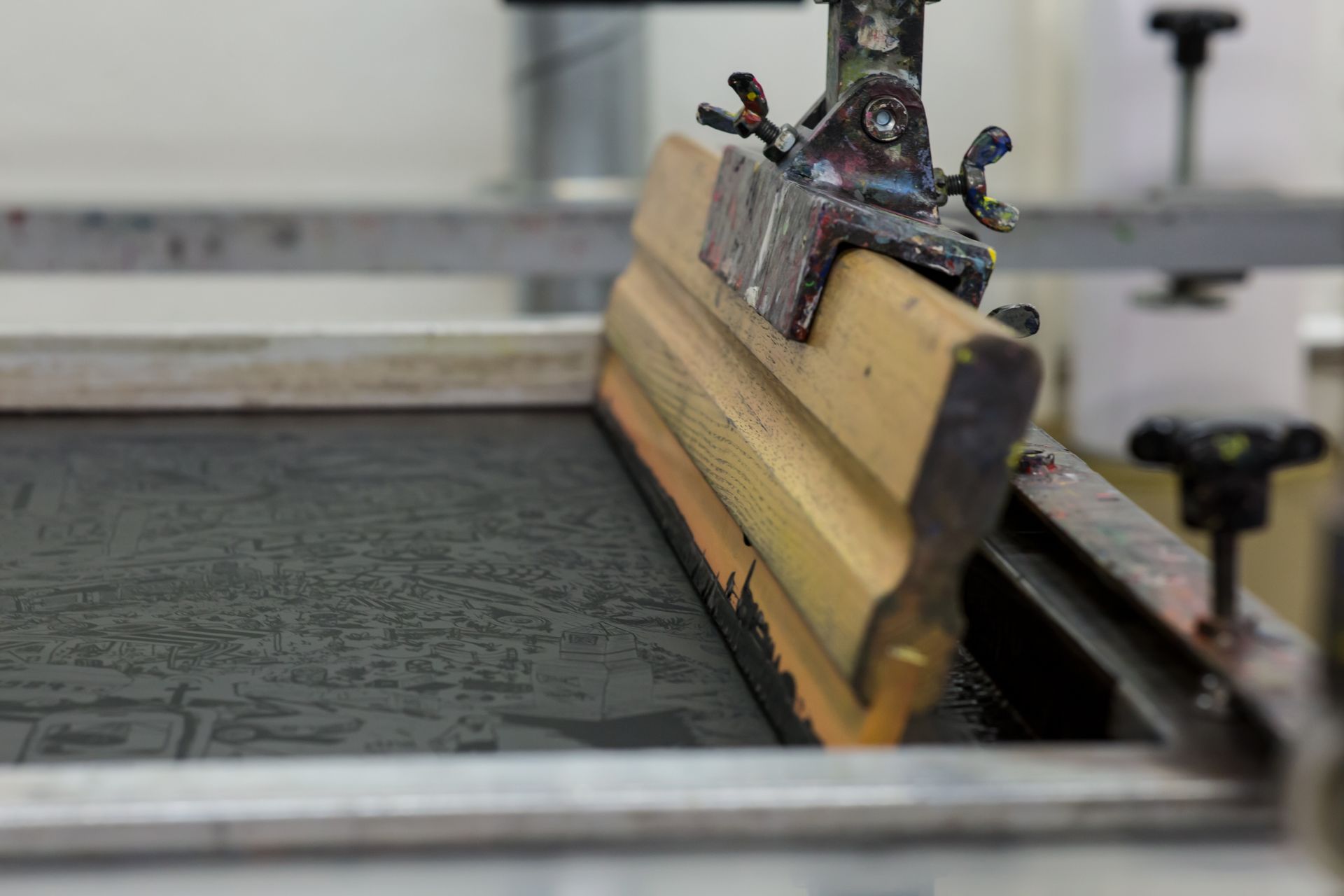
| Method | Durability | Dishwasher-Safe | MOQ Impact | Best For |
|---|---|---|---|---|
| Laser Engraving | Permanent | Yes (100+ cycles) | Low setup, low MOQ | Stainless steel bodies, intricate logos, fine detail |
| Screen Printing | Moderate (fades 30–100 cycles) | Partial | Very low setup | High-volume flat surfaces, color-critical branding |
| Embossing / Debossing | Very High (mechanical) | Yes | High tooling cost, higher MOQ | Handles, lids, exterior branding at scale |
| Chemical / Metal Etching | Very High | Yes | Low-medium | Premium kitchenware, luxury brand positioning |
| Pad Printing | Good | Partial | Low | Curved surfaces, plastic or silicone handles |
Laser engraving is the default recommendation for stainless steel cookware because it requires no consumables after setup, produces a food-safe mark with no ink or chemical residue, and does not require custom tooling — which keeps MOQ lower. Embossing is the right call when a brand wants a tactile, three-dimensional logo at high volume; the tooling cost amortizes well above 3,000 units.
Screen printing remains the most cost-efficient option for brands that need full-color logos on flat exterior surfaces. The caveat is durability under industrial dishwashing: in tests across multiple factory samples, color ink starts showing visible degradation after 30–50 commercial wash cycles if the ink or curing process is substandard.
Laser Engraving vs. Screen Printing: The Real Durability Gap
Laser engraving is permanent by physics; screen printing is permanent by chemistry — and chemistry fails faster in a commercial kitchen.
A fiber laser (1064nm wavelength) works by ablating the surface of the stainless steel to a depth of 50–150 microns for general branding, or 20–50 microns for fine detail marks. The result is a physical indent in the metal. There is no ink to chip, no coating to lift, and no substrate bond to weaken. A properly executed laser-engraved logo on 304 stainless steel will outlast the cookware itself.
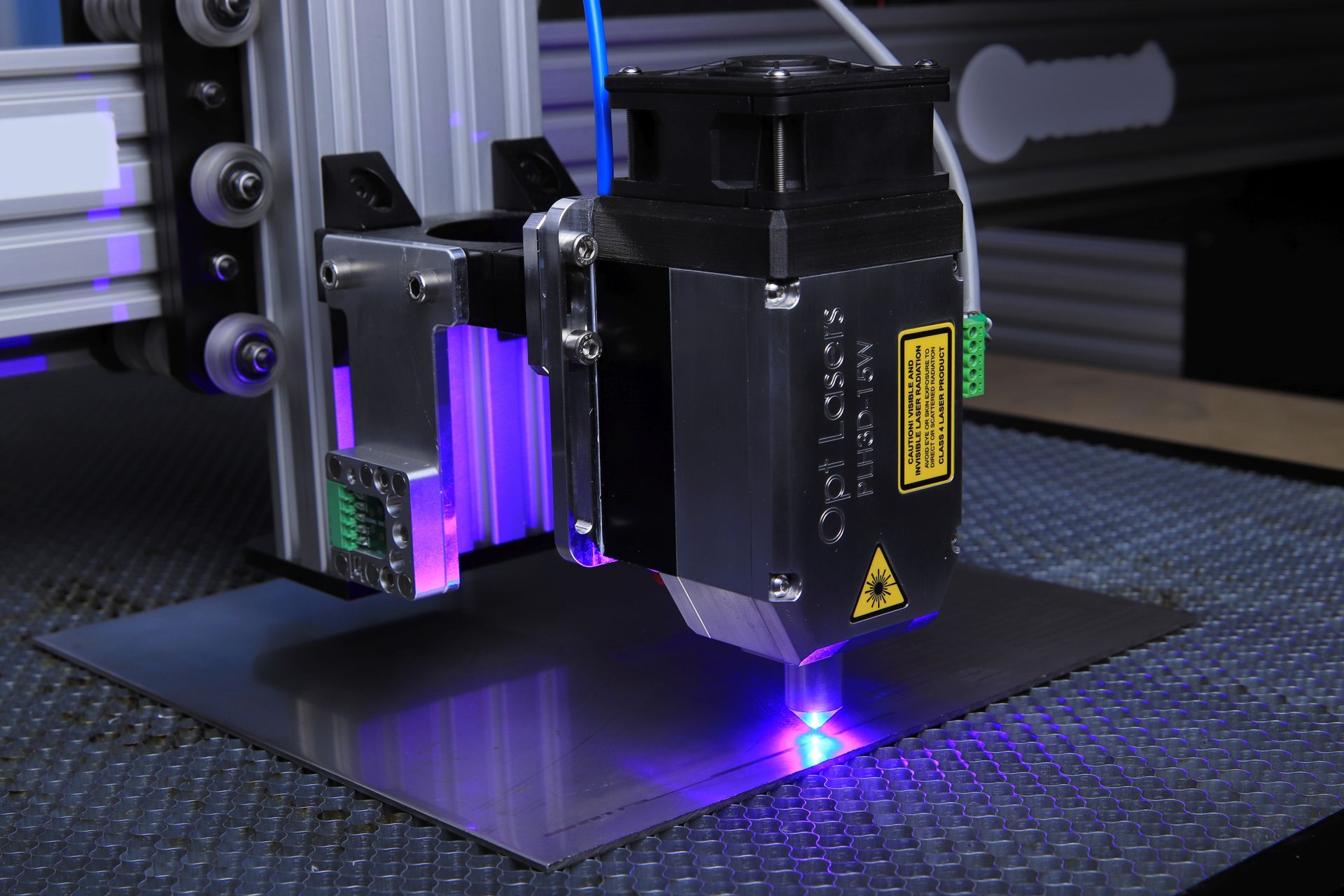
The food-safety requirement is non-trivial: after engraving, the factory must perform ultrasonic cleaning followed by citric passivation per ASTM A967. This step removes oxide scale and brings surface roughness (Ra) below 0.8 µm — the threshold at which microbial biofilm cannot accumulate in the mark. If you are buying cookware destined for a food-service or export market, ask the factory for their post-process protocol in writing.
Screen printing applied at a reputable factory with high-temperature curing can hold up for 80–100 home dishwasher cycles. The failure mode is at the edges, where mechanical abrasion and thermal cycling work together. On commercial dishwashers running at 80°C with high-alkaline detergent, that timeline compresses significantly.
If brand longevity in a commercial environment is the priority, laser engraving is the only method with a performance floor you can specify in a purchase order.
What MOQ Actually Looks Like for Custom Branded Cookware
MOQ scales with customization depth, not just order size — and logo method is one of the levers.
Most buyers come into their first OEM conversation expecting a fixed MOQ number. In practice, MOQ is a function of several variables that interact with each other:
- Logo method: Laser engraving has no custom tooling cost, so factories accept lower runs — sometimes 300–500 units. Embossing requires a custom die, which typically pushes MOQ to 1,000–3,000 units to amortize the tooling.
- Product type: Off-shelf product with logo only: 500–1,000 units. Existing mold with private label branding: 1,000–3,000 units. Fully custom mold and design: 3,000–5,000+ units.
- Packaging: Custom retail boxes carry their own minimums, often 2,000–5,000 units from the box supplier.
Tiered unit pricing at a typical stainless steel cookware factory:
| Volume | Approximate Unit Price |
|---|---|
| 500 units | ~$15/pc |
| 1,000 units | ~$12/pc |
| 3,000+ units | ~$10/pc |
For early-stage brands, the practical entry point is an ODM approach: use an existing factory mold, apply laser-engraved logo, start at 300–500 units, and validate the market before committing to custom tooling. Sample fees run $50–200 per piece (usually refundable against the bulk order), and sample lead time is 7–15 days. Bulk production for a run of 500–1,000 units takes 30–45 days. Plan for a total inquiry-to-delivery timeline of 45–90 days.
Certifications Your OEM Supplier Must Have (FDA, LFGB, SGS)
Certifications are only useful if backed by actual test reports — ask for the lab documents, not just the logo on the letterhead.
In December 2024, the FDA issued a formal advisory warning about imported cookware leaching lead during cooking — primarily aluminum and brass alloy products from certain suppliers in South Asia. The critical point for any US importer: liability sits with the importer, not the overseas manufacturer. If a product you private-label causes harm, your brand name is on the recall.
The practical certification checklist for a stainless steel cookware OEM:
- FDA compliance: Required for US market. No pre-market approval process exists for cookware, but the FDA’s food-contact materials framework governs coatings, metal alloys, and handle materials. 304 and 316 stainless steel are both food-grade under FDA standards.
- LFGB (EU/Germany): Governs migration of harmful substances from food-contact materials. Required for EU distribution.
- SGS / Intertek / TUV: Third-party testing laboratories whose reports are accepted by most major retailers and importers. Certification costs approximately $500–2,000 per product line.
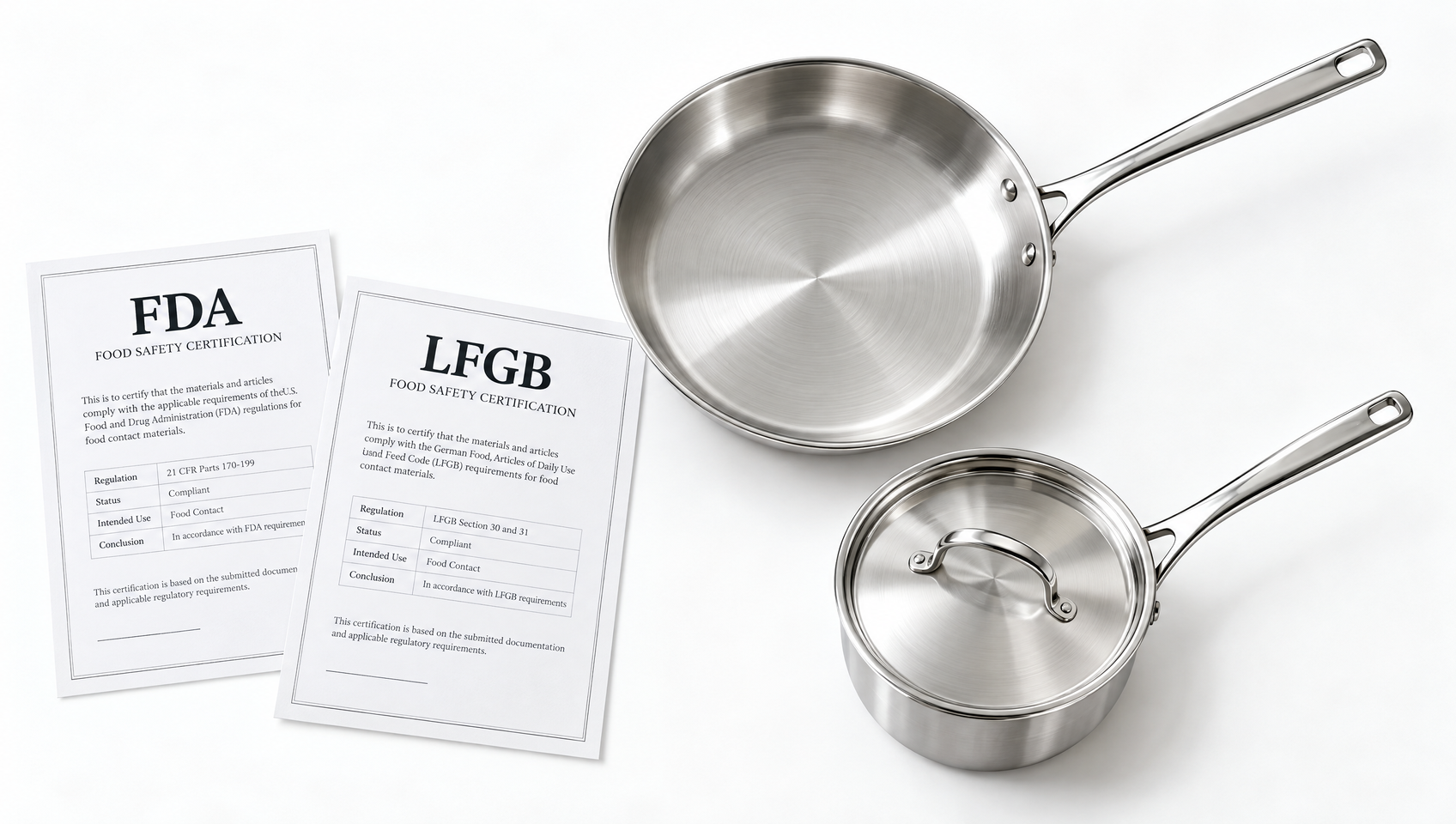
When a supplier provides a certification, request the underlying test report, not just the certificate. The report will list the specific tests performed, the test dates, and the lab reference numbers. A certificate without a traceable report is not verifiable.
How to Brief an OEM Manufacturer on Logo Specs
A clear logo brief eliminates the most common cause of sample rejection: mismatched expectations on logo size, position, and finish.
When sending an RFQ to a custom logo cookware manufacturer, include the following in your logo spec:
- Vector file (AI or EPS): Not a JPG. The factory needs clean vector artwork to program the laser or prepare the screen.
- Preferred method: Laser engraving / screen print / emboss. If open to recommendation, say so explicitly.
- Position and size: Specify in millimeters, with a reference photo or dimensioned drawing of the cookware piece.
- Color reference: For screen printing, provide a Pantone color code. For laser engraving, specify whether you want a natural stainless finish or a darkened (annealed) mark.
- Surface finish: Brushed, mirror-polish, or sandblasted. Logo legibility varies significantly by surface finish.
- Food-contact note: If the logo will be applied to the interior of the piece or near the cooking surface, note this explicitly and request post-process documentation (Ra measurement, passivation protocol).
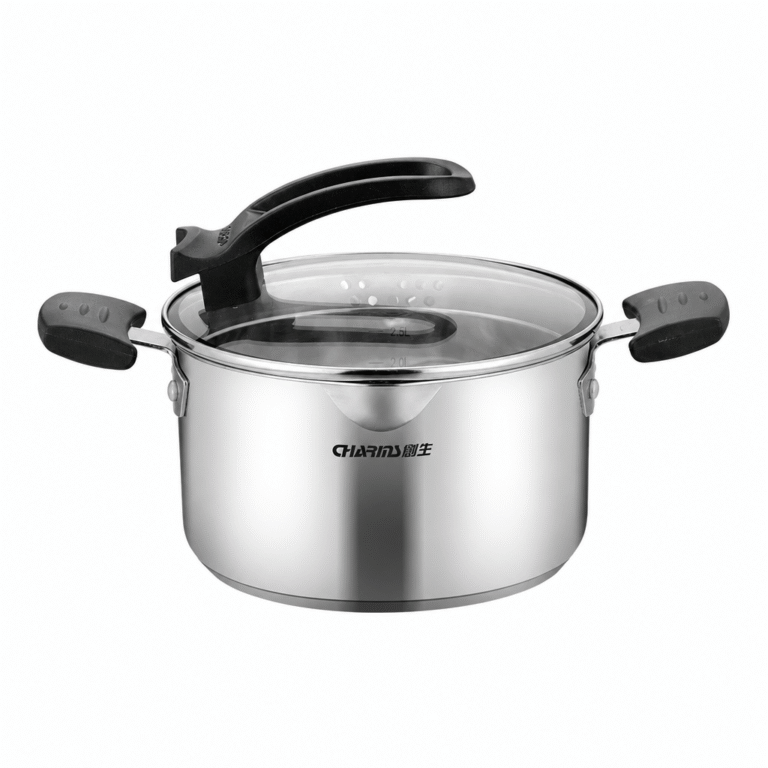
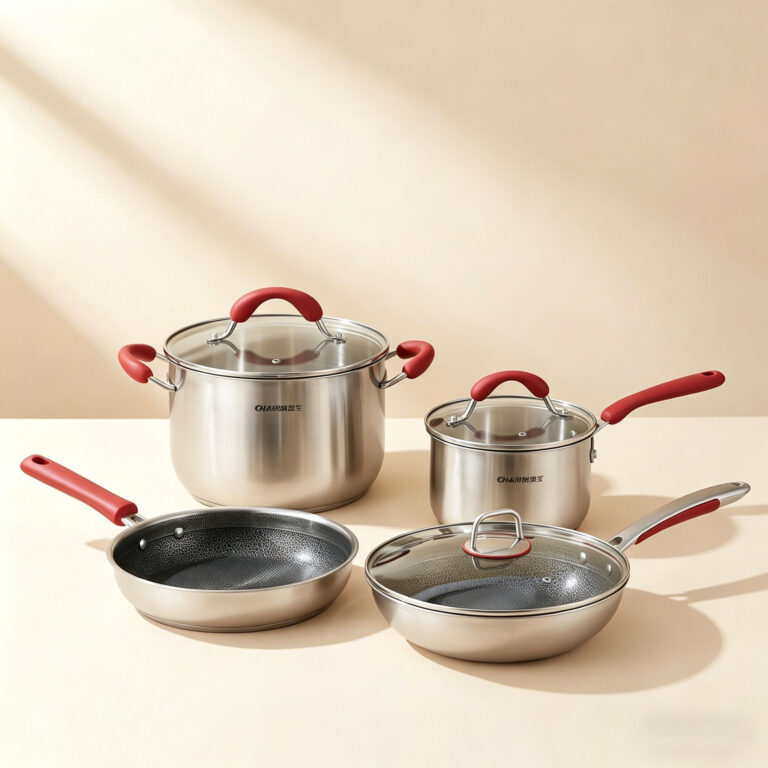
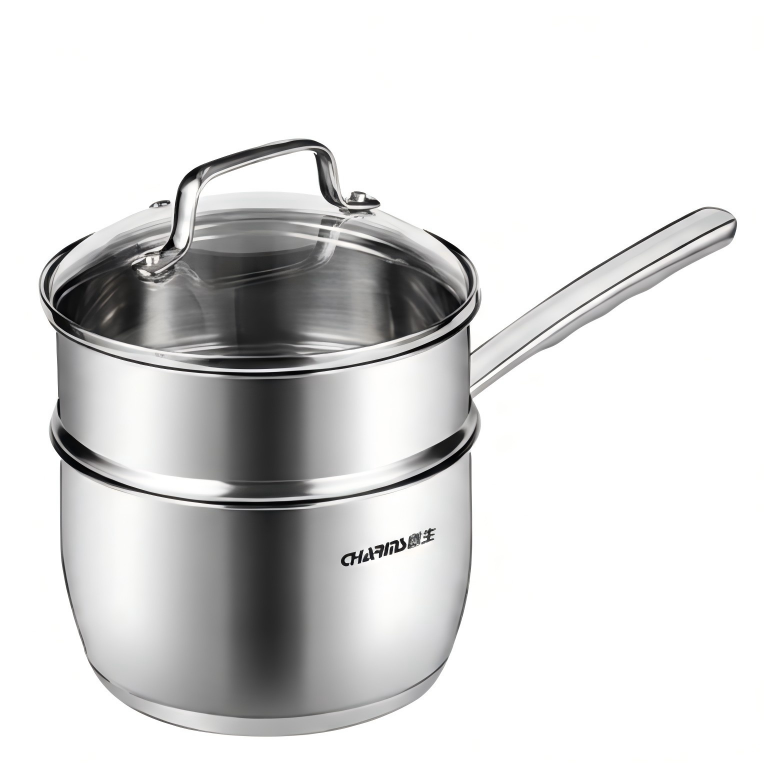
CharmsCook, a factory-direct manufacturer with 30+ years of production experience in Chaozhou, Guangdong, supports laser engraving, stamping, and screen printing across their full stainless steel cookware range. They provide sample approval before bulk runs, which makes the spec alignment process straightforward.
FAQ
What is the most durable logo method for cookware?
Laser engraving is the most durable option for stainless steel. It etches the metal to a depth of 50–150 microns with no ink or coating — there is nothing to fade, chip, or peel. When properly finished to Ra under 0.8 µm per ASTM A967, a laser-engraved logo is also food-safe and dishwasher-rated for 100+ commercial cycles.
What is the minimum order quantity for custom logo cookware?
MOQ depends on the customization level and logo method. Logo-only orders on existing molds typically start at 500–1,000 pieces. Fully custom OEM orders with new mold development start at 3,000–5,000+ pieces. Choosing laser engraving instead of embossing can lower your entry MOQ because there is no custom tooling required.
What certifications should a cookware OEM supplier have? For the US market: FDA food-contact compliance. For Europe: LFGB. For retail distribution: SGS, Intertek, or TUV test reports on coatings and metal alloys. Always request the actual lab test report, not just the certificate document. Certification without traceable test data offers no protection under US import liability rules.
What is the difference between OEM and ODM cookware?
OEM (Original Equipment Manufacturer) means you provide the product design and specifications; the factory produces to your spec. ODM (Original Design Manufacturer) means the factory provides existing product designs that you private-label with your branding. ODM is faster and lower-cost to start; OEM gives you full control over the product design and intellectual property.
How long does the full custom cookware order process take?
Plan for 45–90 days from first inquiry to delivery. Sample production takes 7–15 days. Bulk production for a standard run of 500–1,000 units takes 30–45 days. Add transit time for ocean freight (typically 20–35 days from China to North America or Europe).
The Logo Is the First Thing a Customer Notices — Make Sure It Lasts
Branded cookware is a long-term brand asset. A logo that fades in the first season is not a minor quality issue — it is a visible daily reminder that something went wrong in your supply chain. The decisions that determine logo longevity are made before production starts: which method, which spec, which factory process.
Laser engraving on 304 or 316 stainless steel, with documented passivation per ASTM A967, is the benchmark for permanent, food-safe branding. Screen printing works well at scale when the factory cures correctly and you are not shipping into high-temperature commercial kitchens. Embossing is the premium play at volume, when tooling cost is amortized.
Get the spec right in the RFQ. Ask for the test reports, not just the certificates. Run a sample order with wash cycle testing before committing to bulk. Suppliers like CharmsCook offer sample-before-bulk workflows precisely because experienced buyers know that a verified sample prevents a costly rejection at port.
The brands that win in private label cookware are not the ones with the lowest unit price. They are the ones with a logo still sharp after three years of daily use.