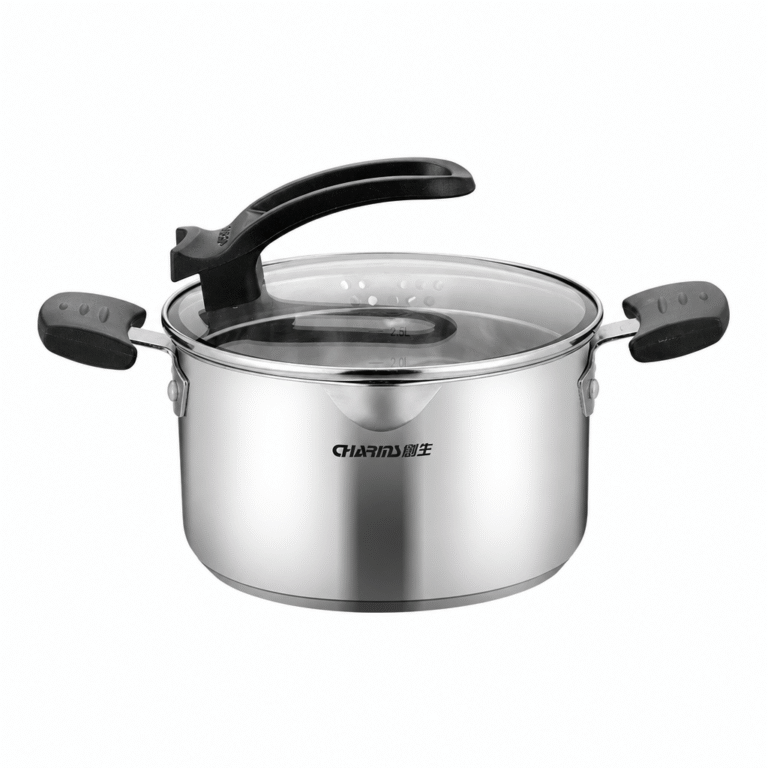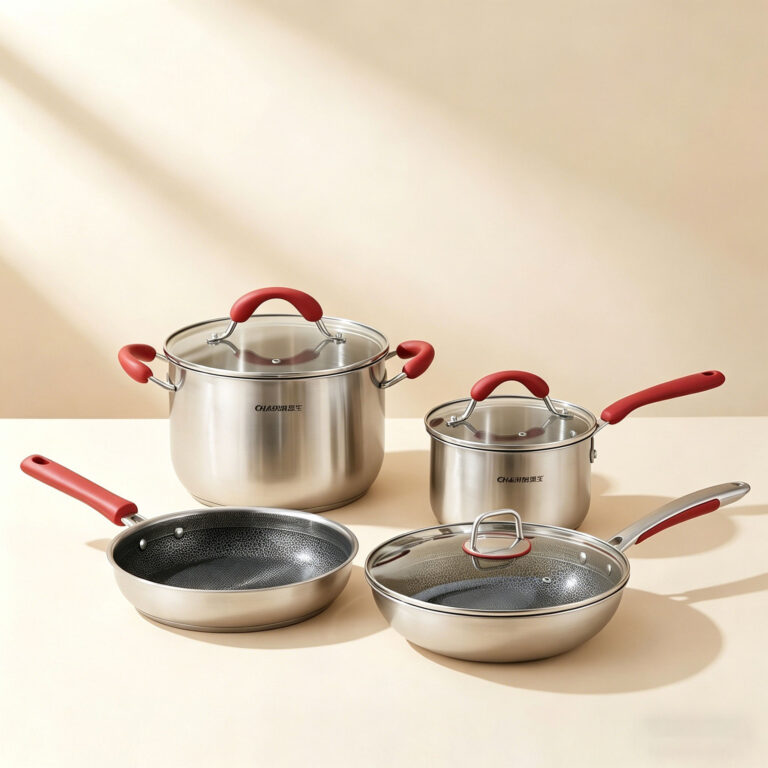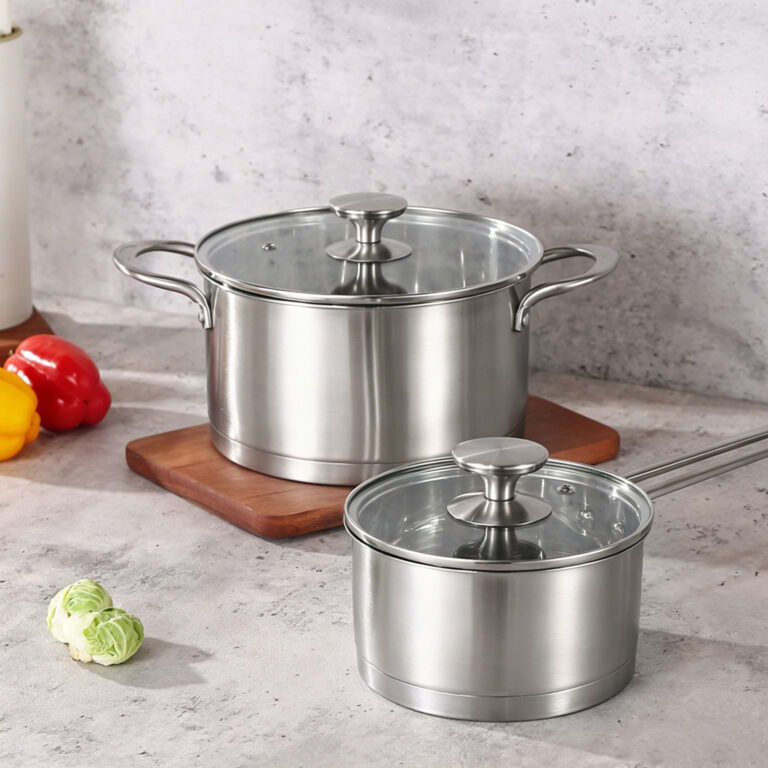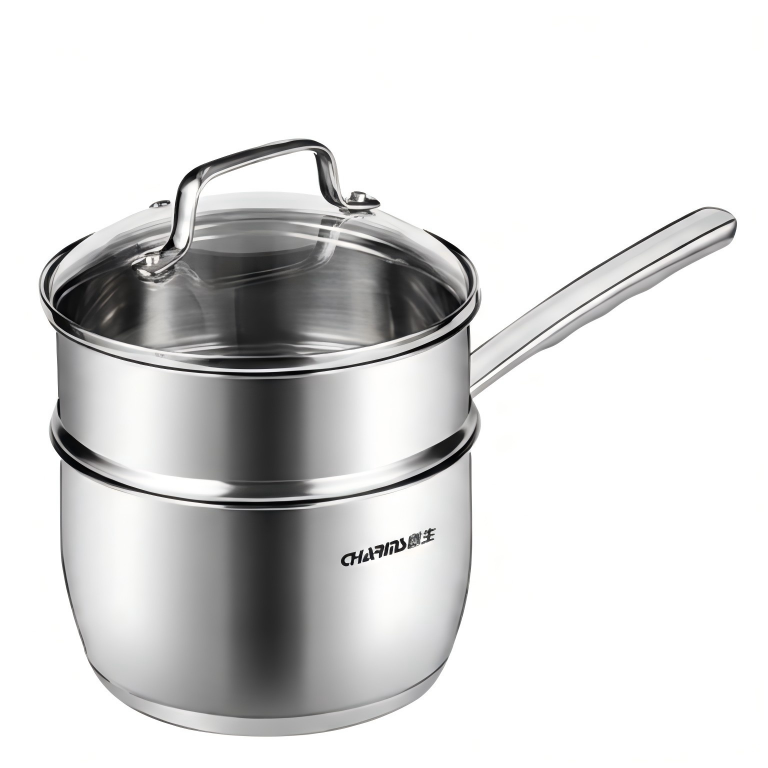


Stainless steel sticks because proteins in food form chemical bonds with the metal surface before a protective crust can form. The fix is a properly preheated pan — hot enough that a drop of water beads up and rolls around (roughly 375–390°F / 190–200°C). At that temperature, food releases cleanly once the Maillard reaction completes the crust. The most common mistake isn’t the pan — it’s pulling food too early.
The Real Reason Food Sticks to Stainless Steel
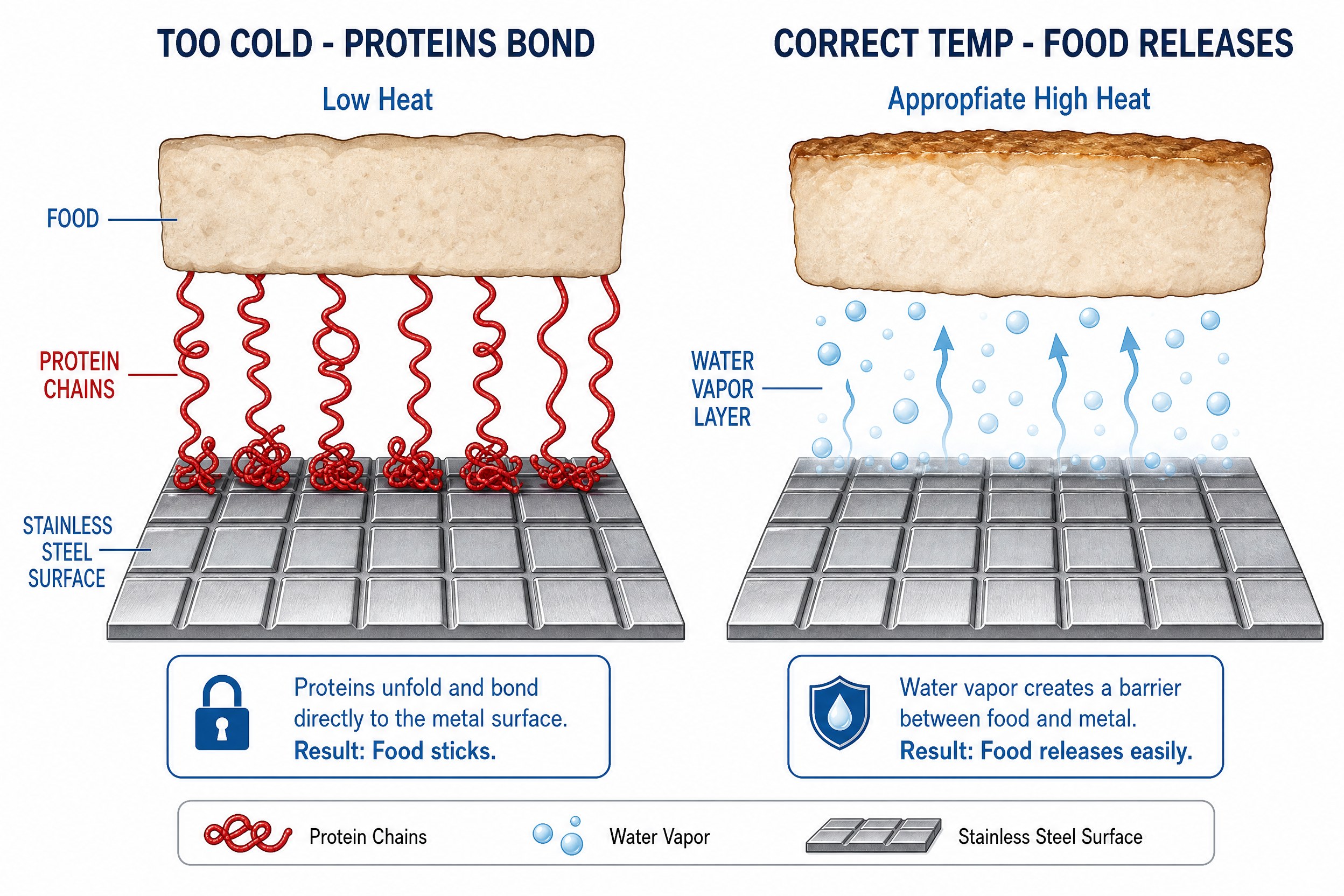
Stainless steel sticks because of protein chemistry, not because of poor cookware quality.
When you place cold or barely-warm food onto a stainless steel surface, the proteins in that food start to denature — they unfold from their coiled structures and expose reactive groups. Those groups, particularly sulfur-containing amino acids, form direct chemical bonds with iron and chromium atoms in the steel’s surface. The result is molecular adhesion: the food is literally bonded to the pan at a microscopic level.
The timing matters more than most people realize. Myosin, the primary structural protein in meat, peaks its denaturation at 54–58°C (129–136°F) — well before the pan looks or smells hot. If you add food to a lukewarm pan, you’re giving proteins the worst possible conditions: enough heat to denature and bond, but not enough to do anything else.
There’s a secondary mechanism working against you: surface texture. At room temperature, stainless steel has microscopic peaks and valleys. Food physically grips those peaks. When the pan reaches proper cooking temperature, metal expansion smooths those irregularities, reducing mechanical grip points. A cold pan is rougher — in every relevant sense.
The same logic applies to oil. Adding oil to a cold pan looks fine, but as the pan heats, that oil flows into open surface pores and polymerizes into a sticky resin. That’s not protective lubrication — it’s adhesive residue. Oil belongs in a hot pan.
The bottom line: stainless sticks when proteins bond to metal before a protective crust can form. The solution is always heat management, not more oil.
The Water Bead Test — How to Know When Your Pan Is Ready
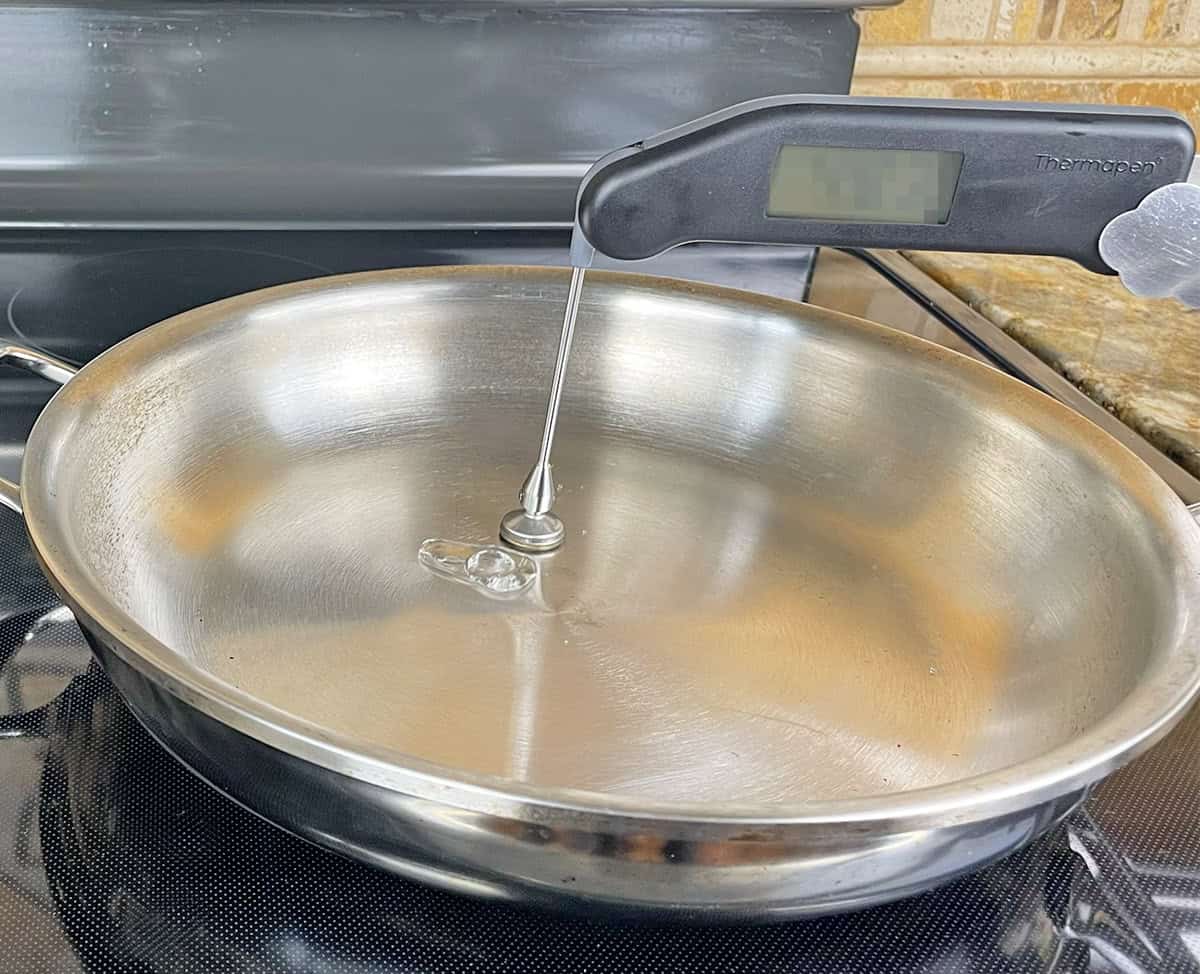
One test tells you everything: drop a small amount of water into the pan and watch what happens.
This is the Leidenfrost effect made practical. At the right temperature — roughly 185–221°C (365–430°F) depending on your stove type — water droplets don’t evaporate on contact. Instead, they form a thin vapor barrier between themselves and the metal. That same vapor barrier is what prevents food from touching the metal surface directly.
Here’s what each result means:
- Drops evaporate immediately → the pan is too cold. The vapor barrier hasn’t formed. Proteins will bond if you add food now. Wait longer.
- Drops form a bead and skitter across the surface → correct zone. Add your oil, swirl to coat, let it shimmer, then add food.
- Drops fragment into many small beads → too hot. You’ve overshot the window. Remove from heat for 30 seconds, test again.
The correct zone is wider than most people think — you have a roughly 40°C (70°F) range to work with once the pan stabilizes. The danger zone is the transition from too cold to hot enough, which happens fast on gas and very fast on induction.
Stove type matters here. Induction heats the pan faster and more evenly than gas, which creates hot spots near the burner ring. On induction, set medium heat and check earlier than you think. On gas, medium-high works but rotate the pan occasionally to even out the heat distribution. Electric coil stoves have thermal lag — preheat on medium-low for 2–3 minutes rather than trying to rush it on high.
Once you’re in the correct zone, add a thin layer of oil with a high smoke point — avocado, grapeseed, or refined sunflower work well. Let it shimmer (not smoke), then add food.
The Maillard Release — Why You Should Stop Trying to Move the Food
If your food is sticking and you’re trying to pry it loose, stop. It’s not done releasing yet.
This is the most counterintuitive and practically important thing about cooking on stainless steel, and it’s missing from almost every guide on the topic.
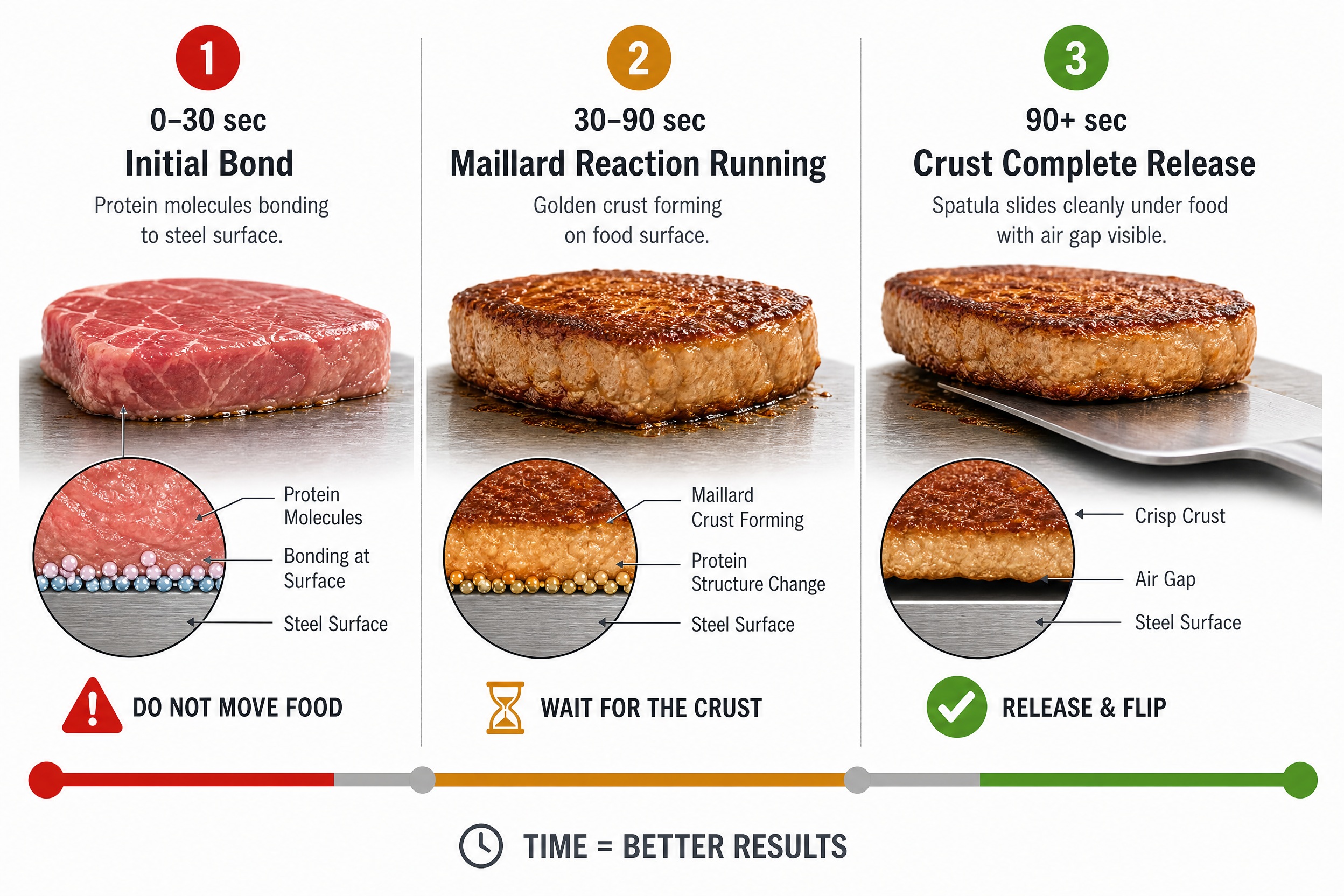
When protein-rich food first contacts a hot pan, it forms an initial bond with the surface. For the first 60–120 seconds, the food will resist if you try to move it. Most people interpret this as “it’s sticking” and reach for a spatula. That’s the wrong move.
What’s actually happening: the Maillard reaction is running. At 140–165°C (285–330°F) at the food surface, amino acids and sugars are reacting to form a structurally cohesive, cross-linked crust. The reactive protein groups that were bonding to the metal are being consumed by this reaction — incorporated into the crust itself. When the reaction completes, the crust is mechanically rigid and no longer chemically attached to the surface.
This is well-established culinary food science: peak resistance occurs mid-cook, then drops sharply as the crust sets. The food releases itself.
The practical rule: if the food resists, wait 30–60 more seconds and try again. A properly formed crust will release from a properly preheated pan without tools. If it still resists after a full minute, either the pan wasn’t hot enough when food went in, or the cut is too thin to form a proper crust.
Eggs are the exception — they have no Maillard reaction to rely on (no sugars in the white), so they depend entirely on proper preheating and a thin layer of butter, not oil, to prevent bonding.
Food-by-Food Guide: What Sticks Most and Why
Different foods stick for different reasons. The fix isn’t always the same.
| Food | Why It Sticks | Key Fix |
|---|---|---|
| Eggs | Egg white proteins begin setting at ~60°C (ovotransferrin) but complete denaturation near 80°C; no Maillard reaction in egg white | Lower heat than meat; use butter, not oil; don’t rush |
| Fish fillets | Delicate collagen structure tears before crust forms; skin is high-moisture | Dry fish thoroughly before cooking; don’t move until skin releases naturally |
| Chicken skin | High fat content melts before Maillard crust sets; fat creates steam | Start skin-side down on medium-low; press flat for first minute |
| Starchy vegetables | Surface starches gelatinize and bond to metal | Higher heat than you’d expect; don’t crowd the pan |
| Ground meat | Large surface area, multiple contact points, often added too cold | Room-temperature meat; don’t break it up immediately |
| Pancakes/crepes | Batter is liquid on contact; no crust formation until nearly done | Fully preheat, use enough butter, wait for visible bubbling before flipping |
The pattern: foods with high protein and low fat (white fish, egg white, lean chicken) are the hardest to cook on stainless without sticking. Foods with higher fat content (chicken thigh with skin, fatty fish) are more forgiving because the rendered fat acts as continuous lubrication.
Stainless Steel vs. Nonstick vs. Cast Iron — Sticking Behavior Compared
Stainless steel is not the worst option for sticking. It just requires more technique than nonstick.
| Property | Stainless Steel | Nonstick (PTFE) | Cast Iron | Carbon Steel |
|---|---|---|---|---|
| Sticking at correct technique | Minimal | Almost none | Minimal | Minimal |
| Sticking if used incorrectly | High | Low | Moderate | Moderate |
| Max safe temperature | 500°C+ | 260°C (500°F) | 500°C+ | 500°C+ |
| PFAS-free | Yes | No (PTFE coatings) | Yes | Yes |
| Durability | Decades | 2–5 years (coating degrades) | Decades | Decades |
| Reactivity with acidic foods | None | None | Moderate | Moderate |
| Technique sensitivity | High | Low | Medium | Medium |
| Best for | Searing, fond-building, versatility | Eggs, delicate fish, low-heat | High-heat searing, cornbread | Restaurant-style searing |
The key tradeoff: nonstick is forgiving but has a shorter lifespan and temperature ceiling. Stainless steel is unforgiving of poor technique but is virtually indestructible, safe for any temperature, and compatible with metal utensils. Once you internalize the water bead test and the Maillard release, stainless steel handles almost everything nonstick can — and handles high-heat searing significantly better.
Does the grade of stainless steel matter for sticking? Marginally. 18/10 stainless (304 grade) has a slightly smoother passive oxide layer than 18/8, which can reduce initial mechanical adhesion. 3-ply and 5-ply construction affect heat distribution — 5-ply heats more evenly, reducing hot spots that cause localized burning — but neither construction changes the fundamental chemistry of protein bonding.
Your Pan Is Stuck Right Now — Here’s What to Do
Don’t panic, and don’t scrape.
If food is stuck to your stainless steel pan mid-cook:
- Leave the heat on. Move the pan off the burner if it’s smoking, but don’t turn off the heat entirely yet. Give the food another 30–60 seconds.
- Try a gentle nudge. Slip a thin spatula under one corner. If it meets significant resistance, wait longer.
- If it won’t release after 2 minutes: add a small amount of liquid — stock, wine, or water — directly to the pan. The steam deglazes the stuck food and lifts it.
- For stubborn burnt-on food: let the pan cool, fill with water to cover the stuck area, bring to a simmer for 5 minutes, and scrape with a wooden or silicone spatula. Don’t use steel wool on brushed stainless — it scratches the grain direction and makes future sticking worse.
- Baking soda paste works for baked-on residue: coat with paste, let sit 15 minutes, scrub with a non-scratch pad.
For next time: the stuck food is almost always a sign the pan wasn’t hot enough when food went in, not that the pan is defective.

FAQ
Does stainless steel cookware always stick?
Not if used correctly. With a properly preheated pan (water bead test), appropriate oil, and patience to let the Maillard reaction complete, stainless steel releases food as cleanly as cast iron. The sticking reputation comes almost entirely from technique errors, not the material.
Why do eggs always stick to stainless steel?
Egg white (albumin) has no Maillard reaction to rely on for release — it denatures and bonds to the surface chemically. Eggs require lower heat than other proteins (medium-low, not medium-high), butter rather than oil (butter’s milk solids act as a barrier), and a pan that’s been brought to temperature slowly.
How do I know when the pan is hot enough?
The water bead test: flick a few drops of water into the pan. If they bead up, merge into a single ball, and roll around the surface, you’re in the correct temperature zone. If they evaporate immediately, the pan is too cold.
Can I season stainless steel like cast iron?
A light seasoning layer can help, but it’s not necessary and doesn’t stick as durably as it does on cast iron or carbon steel. The fundamental difference is surface chemistry — cast iron’s porous surface holds polymerized oil better than stainless steel’s passive oxide layer. For stainless, proper preheating is more reliable than seasoning.
Why does my pan stick even when I use oil?
Most likely because the oil went into a cold or insufficiently hot pan. Oil in a cold pan flows into surface pores and polymerizes into sticky residue. The correct sequence is always: heat the dry pan → water bead test passes → add oil → let oil shimmer → add food.
Does the type of oil matter?
Yes, but primarily for smoke point, not for preventing sticking. Use oils with smoke points above 200°C (392°F): avocado oil (270°C), grapeseed oil (216°C), refined sunflower (232°C). Extra virgin olive oil (190–210°C) is too low for high-heat searing and will smoke and burn before the pan reaches cooking temperature.
Is stainless steel safer than nonstick?
For high-heat cooking, yes. PTFE-coated nonstick pans should not be used above 260°C (500°F) — that is the manufacturer-stated limit where the coating begins to degrade. Stainless steel has no temperature ceiling for normal stovetop use and contains no PFAS compounds. Both materials are considered food-safe when used as directed.
Can cooking spray cause sticking on stainless steel?
Cooking spray (aerosol lecithin-based sprays) can leave a sticky buildup on stainless steel over time because the propellant residue and lecithin polymerize at high temperatures. Stick to liquid oil applied with a paper towel or added directly to the pan.
Summarize
Stainless steel doesn’t stick by default — it sticks when protein chemistry runs faster than crust formation. The entire problem reduces to one variable: temperature at the moment food makes contact with the pan.
Get the pan hot enough to pass the water bead test, add oil after that threshold, and resist the urge to move food until the Maillard crust releases it on its own. That sequence, repeated consistently, is the difference between a pan that frustrates and a pan that lasts a lifetime.
The material itself — 18/10 or 18/8, 3-ply or 5-ply — matters far less than technique. Master the heat, and stainless steel handles nearly everything a nonstick pan can, without the coating, without the temperature limits, and without the 3-year replacement cycle.