


Auditing a cookware factory is not the same as auditing a general manufacturer. Non-stick coatings, enamel firing processes, and food contact material regulations add layers of complexity that generic supplier verification checklists miss entirely. This guide covers what to request before you travel, what to verify on the factory floor, which certifications actually protect you, and the specific red flags — like missing kiln temperature logs and AQL discrepancies — that signal a supplier you shouldn’t trust with your brand.
Why a Standard Supplier Audit Doesn’t Cover Cookware
Most supplier verification frameworks are built around general manufacturing — they check QMS documentation, production capacity, and social compliance. Those checks matter for cookware too. But cookware also involves food contact materials, chemical coatings that degrade under heat, and regulatory frameworks that vary significantly by destination market.
A factory can pass a standard ISO 9001 audit and still ship you non-stick pans with a coating that fails LFGB migration testing, or aluminum pots that leach lead — a documented problem the FDA has been actively pursuing since August 2025, naming over 20 specific imported products from manufacturers in India and Pakistan.
The gap: generic audits verify systems. Cookware audits need to verify chemistry, process records, and market-specific compliance.
The five categories below form a cookware-specific audit framework. Use them to supplement any standard supplier verification template.
Before You Visit: Remote Pre-Qualification Checklist
Before booking a factory trip, request these documents. A supplier’s response (or non-response) tells you a great deal.
Mandatory document requests:
- Business license and export license — verify that both name the same legal entity and physical address as the factory you plan to visit. Trading companies sometimes pass off export licenses from a different entity.
- ISO 9001:2015 certificate — check that it names the specific factory address (not headquarters), has not expired, and was issued by a recognized certification body. The scope statement should cover cookware manufacturing.
- Food contact compliance test reports — specific to your target market:
- US buyers: FDA declaration of conformity referencing the applicable 21 CFR parts (typically Part 175 for coatings, Part 177 for polymers)
- EU buyers: Declaration of Compliance (required for food contact materials covered by specific harmonised EU measures, such as plastics under EU 10/2011), plus LFGB test reports for migration, odor, and taste testing
- German/EU retail: LFGB is a test report from an accredited third-party lab, not a license — if a supplier sends you a “LFGB certificate” with no lab data attached, that is a warning sign
- Coating supplier SDS and compliance documentation — for non-stick cookware, ask for the Safety Data Sheet and FDA/LFGB compliance documentation for the specific coating formulation. A supplier who cannot tell you who makes their PTFE coating and whether it is PFOA-free is a sourcing risk.
- Social compliance report — BSCI, SEDEX/SMETA, or SA8000, dated within 12 months. Ask for the full report, not just the certificate page.
- Prop 65 test reports — if selling into California, request migration testing results for lead, cadmium, and nickel.
If a supplier can deliver all of these within a week, they are set up for B2B export. If they stall on the food contact reports or send documents with mismatched addresses, treat it as a pre-disqualification signal.
On-Site Audit: The 5 Areas That Matter Most
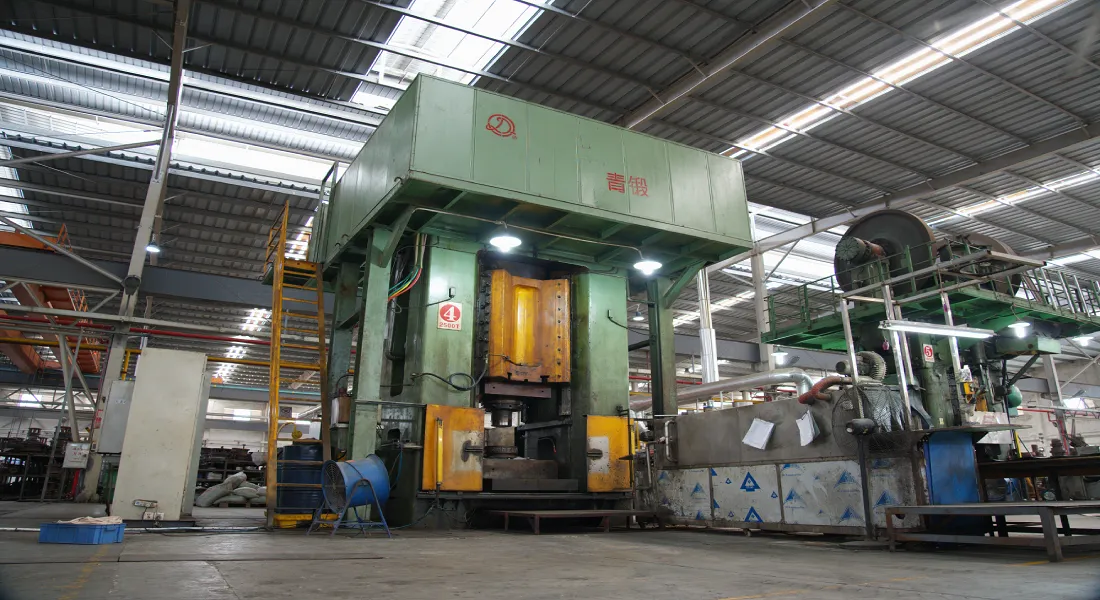
Walk the production line in sequence: raw material storage → casting/forming → surface treatment → QC station → finished goods warehouse. Here is what to verify at each stage.
1. Raw Materials
- Are incoming materials inspected and logged with mill test certificates or CoA (Certificate of Analysis)?
- Is material storage organized by FIFO with visible batch labels and expiration dates?
- For aluminum alloy cookware: confirm the factory does not source scrap metal or industrial-grade aluminum alloy without material certification. FDA’s 2025 lead alert traced directly to cast aluminum cookware made from scrap with elevated lead content. Ask to see the incoming material inspection records for the specific alloy grade.
- For enamel frit: frit should be labeled with supplier name, batch number, and expiration date. Unlabeled enamel frit in unmarked bags is a red flag.
2. Surface Treatment (The Most Cookware-Specific Stage)

This is where most cookware quality failures originate.
For non-stick (PTFE/ceramic) coatings:
- Is there a coating thickness standard posted at the application station? Measure a few pieces with a coating thickness gauge — ask to see the gauge’s calibration certificate.
- Is the coating cure temperature and time logged per batch? The oven/kiln should have printed temperature curve records, not just a temperature dial setting.
- Are adhesion test results recorded? (Standard test: cross-cut adhesion tape test, or pull-off test)
For enamel cookware:
- Kiln temperature curve records are non-negotiable. Enamel blistering and chipping failures trace directly to temperature drift that was never documented. If the factory cannot show printed kiln curves for a representative production batch, this is a major non-conformity.
- Check the kiln’s temperature sensor calibration date.
For nitrided carbon steel:
- Ask about the pre-treatment wash and degreasing process before nitriding. Inadequate oil removal and insufficient pre-treatment stages are a root cause of uneven nitriding, gray patches, and rust resistance failures. Ask to see the pre-treatment SOP and check whether the last process batch had a pre-treatment compliance sign-off.
3. QC Station
- Does the factory run a three-stage inspection: first-piece check, in-process patrol inspection, and final inspection? Ask to see patrol inspection logs from the current week.
- What AQL standard does the factory actually apply at final inspection? AQL 2.5 is standard; AQL 4.0 is significantly more permissive. Some factories quote 2.5 in commercial presentations and run 4.0 in practice.
- Are measuring instruments (micrometers, coating gauges, hardness testers) calibrated and tagged with their next calibration date?
- Ask to see CAPA (Corrective Action and Preventive Action) records from the past 6 months. A factory with zero non-conformance records is not a zero-defect factory — it is a factory that does not document problems.
4. Production Documentation
- Can the factory trace any finished product back to its raw material batch and production shift? Spot-check by picking a finished piece and asking them to pull its production record.
- Are equipment maintenance logs current? Check the most recently serviced machine against the log.
5. Worker Interviews and H&S
- Conduct brief private interviews with 2–3 workers (not staged by management). Inconsistent answers about working hours or wages, compared to what management stated, indicate coached audit preparation.
- Emergency exits: accessible, unblocked, clearly marked.
- Chemical storage: coating materials, solvents, and enamel frit stored in designated areas with proper labeling and ventilation.
Certifications That Are Actually Required (vs. Nice-to-Have)
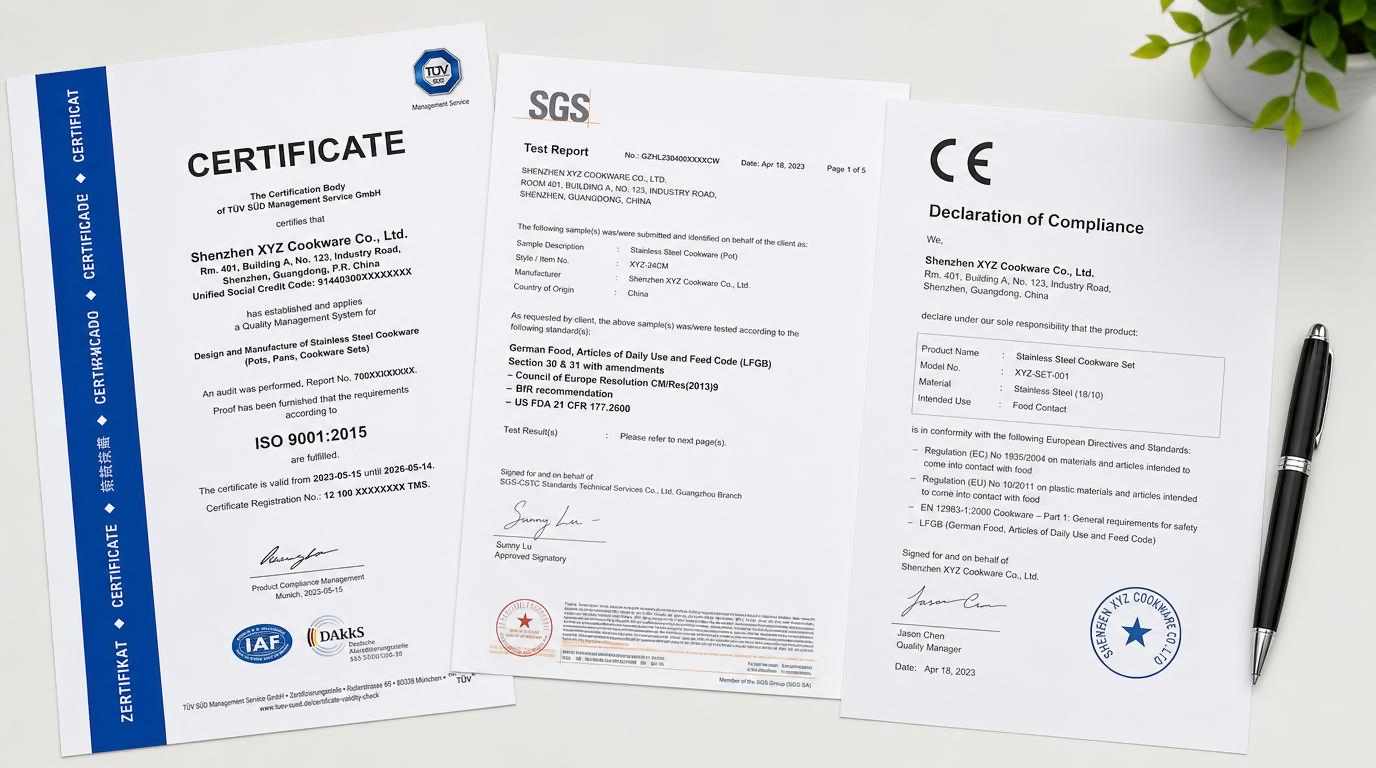
Required, by market:
| Certification / Report | Required For | What It Actually Means |
|---|---|---|
| FDA 21 CFR compliance documentation | US market | Declaration that food contact substances comply with applicable CFR parts. Not an FDA “approval” — FDA does not certify cookware products. |
| LFGB test report | EU / Germany market | Third-party lab test for migration (overall and specific), odor, and taste. It is a test report, not a license. Request the full lab data, not just a summary page. |
| EU Declaration of Compliance (DoC) | EU market (plastics and other harmonised FCMs) | Required for food contact materials covered by specific EU harmonised measures (e.g., plastics under EU 10/2011). The importer bears legal responsibility if the DoC is absent or inaccurate. |
| PFOA-free certification | All markets (standard now) | Verify via coating supplier SDS that PFOA is not used in the coating process. |
| ISO 9001:2015 | Most B2B buyers | Verify the certificate scope covers the factory address where your goods are made. |
Nice-to-have (depending on your retail channel):
- BSCI or SEDEX/SMETA: required by most European retail chains. BSCI operates on a two-year audit cycle. If your customer base includes EU retailers, treat this as mandatory.
- Prop 65 test reports: required if selling into California. Lower-risk for stainless steel; higher-risk for ceramic-coated, colored, or low-cost aluminum alloy products.
- EU BPA compliance: EU Regulation 2024/3190 (effective December 2024) bans BPA in all food contact materials. Any supplier still using BPA-containing materials in food contact applications is non-compliant for EU markets.
Red Flags That Should Stop an Order

These are not hypothetical concerns — each maps to a documented failure pattern.
Immediate disqualifiers:
- Certificates that name a different address or entity than the factory you are auditing (documented fraud pattern, tracked by TradeAiders and BSCI)
- Restricted access to the coating workshop, raw material storage, or waste treatment areas
- Any evidence of undisclosed subcontracting for key process steps (e.g., coating applied off-site)
- No food contact compliance documentation for the specific materials being used
Major non-conformities (require corrective action before ordering):
- No kiln temperature curve records for enamel firing
- No CAPA records for the past 6+ months
- Uncalibrated testing equipment (coating gauges, hardness testers with expired calibration stickers)
- AQL standard applied at final inspection is materially more permissive than what was quoted
- Aluminum alloy cookware sourced from scrap or industrial-grade alloy without incoming material CoA
Watch closely:
- Staff turnover above 25% in the past 6 months, particularly supervisory roles
- Enamel frit or coating materials stored without batch labels or expiration dates
- PTFE/non-stick coating supplier is unknown or undisclosed
After the Audit: What a Corrective Action Request Should Cover
Finding a non-conformity does not automatically mean rejecting a supplier. A supplier who receives a clear Corrective Action Request (CAR) and responds with a credible plan is often a better long-term partner than one who has never been challenged.
A cookware-specific CAR should include:
- Root cause, not just symptom — “enamel blistering on 3% of units” is the symptom. The CAR must identify the root cause: was it kiln temperature drift, enamel frit batch quality, or application inconsistency?
- Specific corrective action — not “we will improve quality,” but “kiln temperature sensors will be recalibrated by [date], and temperature curve records will be reviewed daily by the QC supervisor.”
- Preventive action — what process change prevents recurrence?
- Closure evidence — test results, updated records, or photographs demonstrating the corrective action was implemented.
- Verification timeline — a re-audit or pre-shipment inspection date, agreed in advance.
Give the supplier 2–4 weeks to respond with a CAR. A supplier who acknowledges the finding, explains the root cause clearly, and provides a specific timeline is worth continuing to work with. A supplier who responds with vague commitments or disputes documented observations is not.
Frequently Asked Questions
What is the difference between a factory audit and a pre-shipment inspection?
A factory audit evaluates the supplier’s systems, certifications, and process capability — ideally before you place your first order. A pre-shipment inspection checks a specific production batch against your purchase order requirements, usually when 80% of production is complete. Both are valuable; they cover different risk types.
Does LFGB compliance cover the FDA requirements?
Not directly. LFGB and FDA have different regulatory frameworks and test methods. LFGB is generally considered more stringent (it includes sensory testing that FDA does not), but the specific substances and migration limits differ. A product with an LFGB test report is not automatically FDA-compliant, and vice versa. If you sell into both markets, request separate compliance documentation for each.
How often should we re-audit a supplier?
For new suppliers, conduct a factory audit before the first order. After that, an annual audit is standard for active suppliers. If a supplier has had a quality incident, conduct an unannounced audit within 30–60 days of the incident. For suppliers above USD 100k annual volume, consider adding a mid-year desktop audit (document review without travel).
Can we audit remotely without visiting the factory?
A full factory audit requires a physical visit. However, a remote pre-qualification review — requesting and verifying all mandatory documents before travel — can eliminate 60–70% of unsuitable suppliers before you book a flight. Video walkthroughs can supplement but not replace an on-site visit for surface treatment and QC station verification.
What certifications does a cookware supplier absolutely need?
At minimum: ISO 9001:2015 (with scope covering your factory address), food contact compliance documentation matching your destination market (FDA or LFGB), and a PFOA-free declaration for non-stick products. Social compliance (BSCI or SEDEX) is mandatory if your products will be sold through major EU or UK retail chains.
The Difference Is in the Records, Not the Certificates
A cookware factory can display a wall of certificates and still fail at the process level. The most reliable predictor of product quality is not the ISO plaque on the lobby wall — it is whether the surface treatment team can pull out yesterday’s kiln temperature log and point to where they caught and corrected a deviation.
That is what separates a supplier who produces consistent quality from one who ships well on the first order and poorly on the third. The checklist above is designed to surface that difference before it becomes your problem.





