


Importing cookware into the USA requires navigating FDA food contact material rules under 21 CFR Parts 174–178, CPSC’s General Certificate of Conformity, and CBP entry procedures — not a single “FDA certificate.” In August 2025, FDA issued an active import alert for cookware leaching lead, raising the stakes for every importer. This guide walks through the exact regulatory framework, a material-by-material compliance breakdown, and a five-step import workflow that helps you source confidently from compliant manufacturers like CharmsCook.
The Biggest Misconception: FDA Does Not Certify Cookware
This is where most importers lose time and money. There is no FDA cookware certificate to apply for. FDA does not pre-approve cookware products.
What FDA does is authorize food contact substances — the materials, coatings, and polymers that may come into contact with food. These authorizations live in 21 CFR Parts 174–178. If your cookware is made with authorized substances within their specified conditions of use, it is FDA-compliant. If it contains an unauthorized substance — or an authorized one used outside its permitted conditions — FDA can detain it at the border.
The practical implication: compliance starts at your supplier’s factory floor, not at a government office.
The Regulatory Framework: What Actually Governs Cookware
Two federal agencies share jurisdiction, and understanding the split saves headaches.
FDA (Food and Drug Administration) regulates food contact safety — what can and cannot migrate from cookware into food. Its authority comes from the Federal Food, Drug, and Cosmetic Act (FD&C Act). The relevant CFR parts:
- 21 CFR Part 174 — General indirect food additive rules; includes the Threshold of Regulation (§174.6 / §170.39), which exempts substances migrating at less than 0.5 ppb with no carcinogenic concern
- 21 CFR Part 175 — Adhesives and coatings on food-contact surfaces (relevant for ceramic and enamel coatings)
- 21 CFR Part 177 — Polymers and resins in food contact; the single most important part for cookware, covering PTFE (§177.1550) and other non-stick polymers
- 21 CFR Parts 180–189 — Prior-sanctioned and prohibited substances
CPSC (Consumer Product Safety Commission) regulates physical product safety — structural hazards, handle integrity, burn risks. Importers must issue a General Certificate of Conformity (GCC) under 16 CFR Part 1110. Starting July 8, 2026, GCC filing must be submitted electronically to CBP.
Material-by-Material Compliance Breakdown
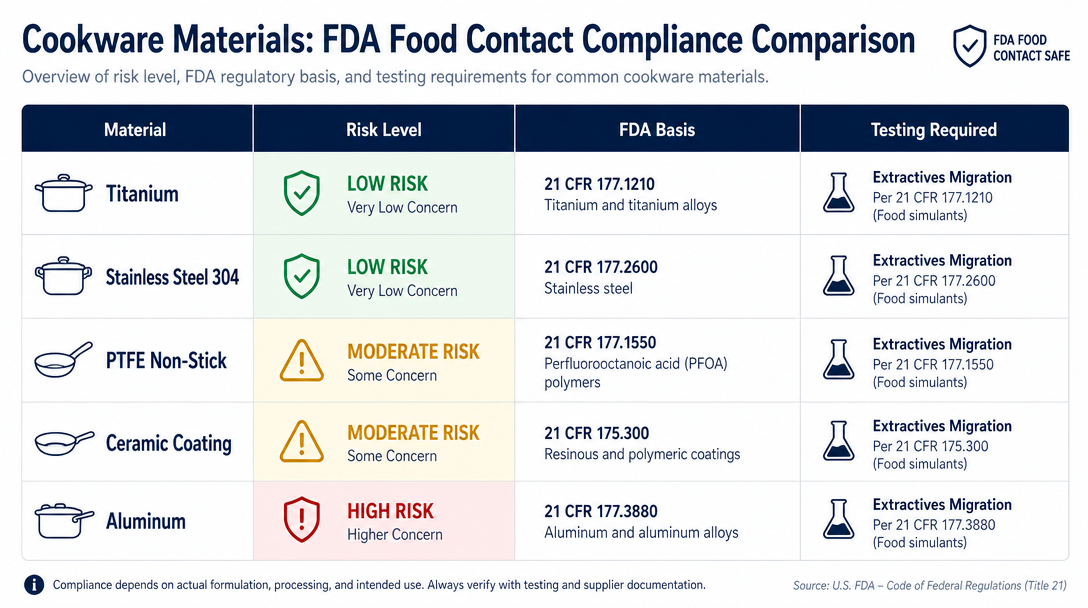
Not all cookware carries the same regulatory risk. Here is how the most common materials stack up:
| Material | FDA Authorization Basis | Key Risk | Testing Required |
|---|---|---|---|
| 304/316 Stainless Steel | GRAS (generally recognized as safe) | Low-grade alloys with elevated nickel or lead | Alloy verification; migration test if using non-standard grade |
| Titanium | GRAS; inert, no known migration concerns | Essentially none | No specific CFR requirement; inertness is the advantage |
| PTFE (Non-stick) | 21 CFR §177.1550 | PFOA was banned; PTFE itself is permitted — but state PFAS bans are growing | Confirm coating is PTFE, not other PFAS variants; check destination state laws |
| Ceramic Coating | 21 CFR Part 175; CPG Sec. 545.450 (lead), 545.400 (cadmium) | Lead and cadmium leaching | Lead ≤1.0 µg/mL (large hollowware); cadmium ≤0.25 µg/mL |
| Aluminum (bare) | Generally accepted; GRAS-adjacent | Hindalium alloys with lead — active 2025 FDA enforcement | Verify alloy composition; lead migration test |
| Enamel-coated Cast Iron | Cast iron GRAS; enamel follows ceramic coating rules | Lead/cadmium in enamel glaze | Same lead/cadmium limits as ceramic |
Titanium deserves a separate mention. It is one of the most chemically inert metals used in cookware. It does not leach heavy metals, contains no coatings, and raises no PFAS concerns. For importers navigating an increasingly scrutinized regulatory environment, titanium cookware from a manufacturer like CharmsCook represents the lowest compliance burden of any cookware category.
The 2025 FDA Lead Enforcement Action: Why This Matters Now
In August 2025, FDA issued an active import alert specifically targeting imported cookware — aluminum alloy pots made with Hindalium (a specific aluminum alloy formulation) that were found to leach lead at levels exceeding safe thresholds. The implicated manufacturer was placed on import alert, meaning every shipment from that source is automatically detained for examination.
What this signals for importers:
- FDA is actively sampling and testing cookware at ports of entry — this is not just a paperwork exercise
- Ceramic-coated and alloy-based cookware face the highest scrutiny right now
- “Our factory says it’s compliant” is not sufficient — third-party lab testing data is essential
The lead action levels under CPG Sec. 545.450 are: 1.0 µg/mL for large hollowware (which covers most standard pots and pans). Cadmium limits under CPG Sec. 545.400: 0.25 µg/mL for the same category.
5-Step Import Workflow for FDA-Compliant Cookware
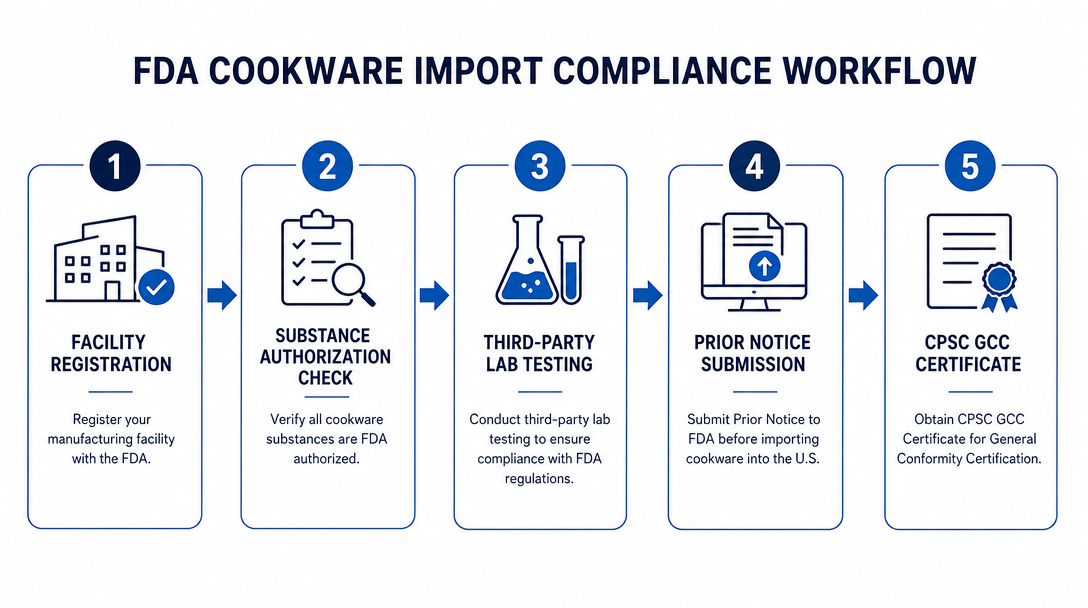
Step 1 — Verify manufacturer FDA facility registration Foreign manufacturers of food contact articles may need to register with FDA under 21 CFR Part 1, Subpart H depending on how the product is classified. Ask your supplier whether they hold an FDA registration number, and consult your customs broker if the requirement is unclear for your specific product category.
Step 2 — Confirm food contact substance authorization For each material and coating in your product, confirm it is either listed in 21 CFR Parts 173–178 under the correct conditions of use, covered by an effective Food Contact Notification (FCN) in FDA’s public database, or GRAS. This is your first-line compliance verification.
Step 3 — Obtain third-party lab testing documentation Commission migration testing from an accredited laboratory (SGS, Intertek, Bureau Veritas are common choices). For ceramic-coated cookware, this means lead and cadmium extraction tests against CPG Sec. 545.450 and 545.400 action levels. For PTFE-coated cookware, confirm coating composition. Testing timelines typically run 2–4 weeks.
Step 4 — Submit Prior Notice via CBP Prior Notice must be submitted electronically through FDA’s PNSI or CBP’s Automated Broker Interface before the shipment arrives: at least 8 hours before ocean arrival, 4 hours for land, 4 hours for air. Failure to submit results in an automatic hold.
Step 5 — Issue CPSC General Certificate of Conformity (GCC) As the importer of record, you must issue a GCC stating your cookware complies with applicable CPSC regulations. From July 2026, file this electronically with CBP. Keep supporting test records on file for at least 5 years.
PFAS and Non-Stick Cookware: The State-Level Complication
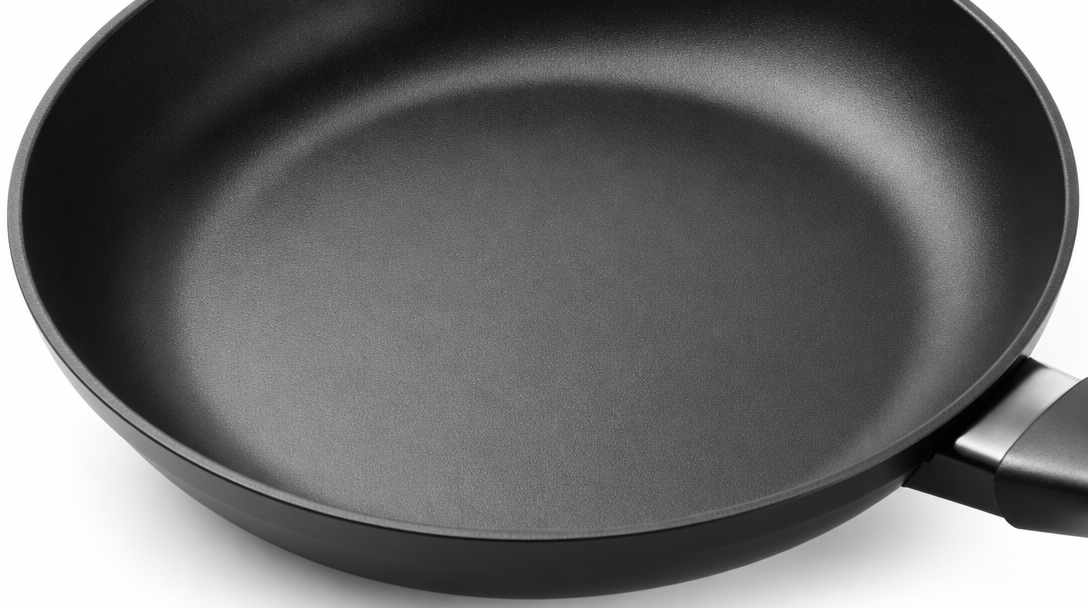
PTFE itself remains authorized under 21 CFR §177.1550 at the federal level. PFOA — a manufacturing byproduct historically associated with PTFE production — was phased out years ago and is no longer an issue in modern PTFE-coated cookware from reputable manufacturers.
However, several U.S. states are moving faster than federal law:
- Minnesota enacted a PFAS-in-cookware ban effective 2025
- California and Colorado have active or pending PFAS cookware legislation
If you are importing non-stick cookware for distribution across multiple states, verify with your supplier that the coating is specifically PTFE (polytetrafluoroethylene) and not another fluoropolymer compound that may fall under broader state PFAS definitions. This is increasingly a compliance risk that federal FDA rules alone don’t resolve.
Why Supplier Selection Is a Compliance Decision
FDA compliance for cookware is not primarily about filing paperwork — it’s about what your supplier puts in the product. The 2025 enforcement actions make this clear: a manufacturer using the wrong aluminum alloy or sourcing ceramic glazes without rigorous quality control creates a detention risk that no amount of paperwork fixes after the fact.
When evaluating cookware suppliers, ask for:
- Third-party lab test reports (not just factory self-certification)
- Material composition certificates (alloy grades, coating chemical composition)
- FDA facility registration number
- Track record of U.S. exports without detention history
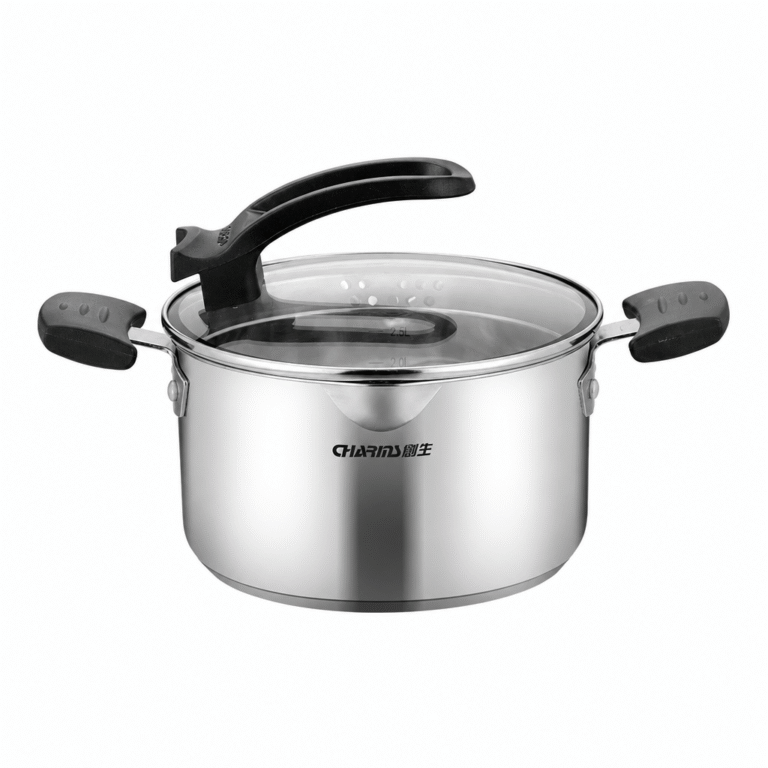
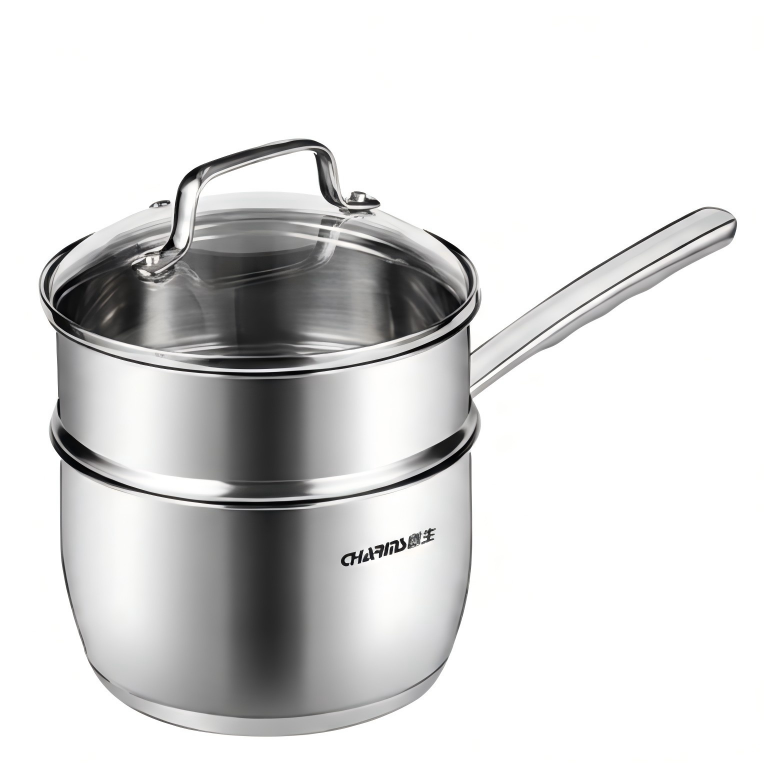
CharmsCook focuses on stainless steel cookware — a material category with the most straightforward FDA compliance profile of the major cookware types. For buyers who want to minimize regulatory complexity while meeting U.S. food contact safety standards, sourcing in materials with established GRAS status is the most practical starting point.
Summary
FDA cookware import compliance is less about getting a certificate and more about understanding the material science behind what you’re importing. The framework is clear: 21 CFR Parts 174–178 govern what can touch food, CPSC’s GCC covers physical safety, and CBP handles the entry logistics. The August 2025 lead enforcement action is a real signal that FDA is actively enforcing — especially on ceramic-coated and aluminum alloy products. Stainless steel and titanium remain the lowest-risk materials for importers who want to stay clear of FDA’s growing scrutiny of coatings and alloys.