

Quick Summary: The brown, black, and rainbow marks on the bottom of your stainless steel pans are not permanent — but the right cleaning method depends entirely on what type of stain you’re dealing with. Burnt food on the cooking surface needs a boiling baking soda soak. Baked-on grease and brown stains on the exterior respond best to Bar Keepers Friend paired with steel wool, which outperformed oven cleaner, powdered cleansers, and baking soda in side-by-side testing. Heat tint (that blue-rainbow shimmer) comes off with a simple white vinegar wipe. This guide covers all three scenarios, with effort ratings so you can pick the approach that fits your patience level.
Identify Your Stain Before You Start
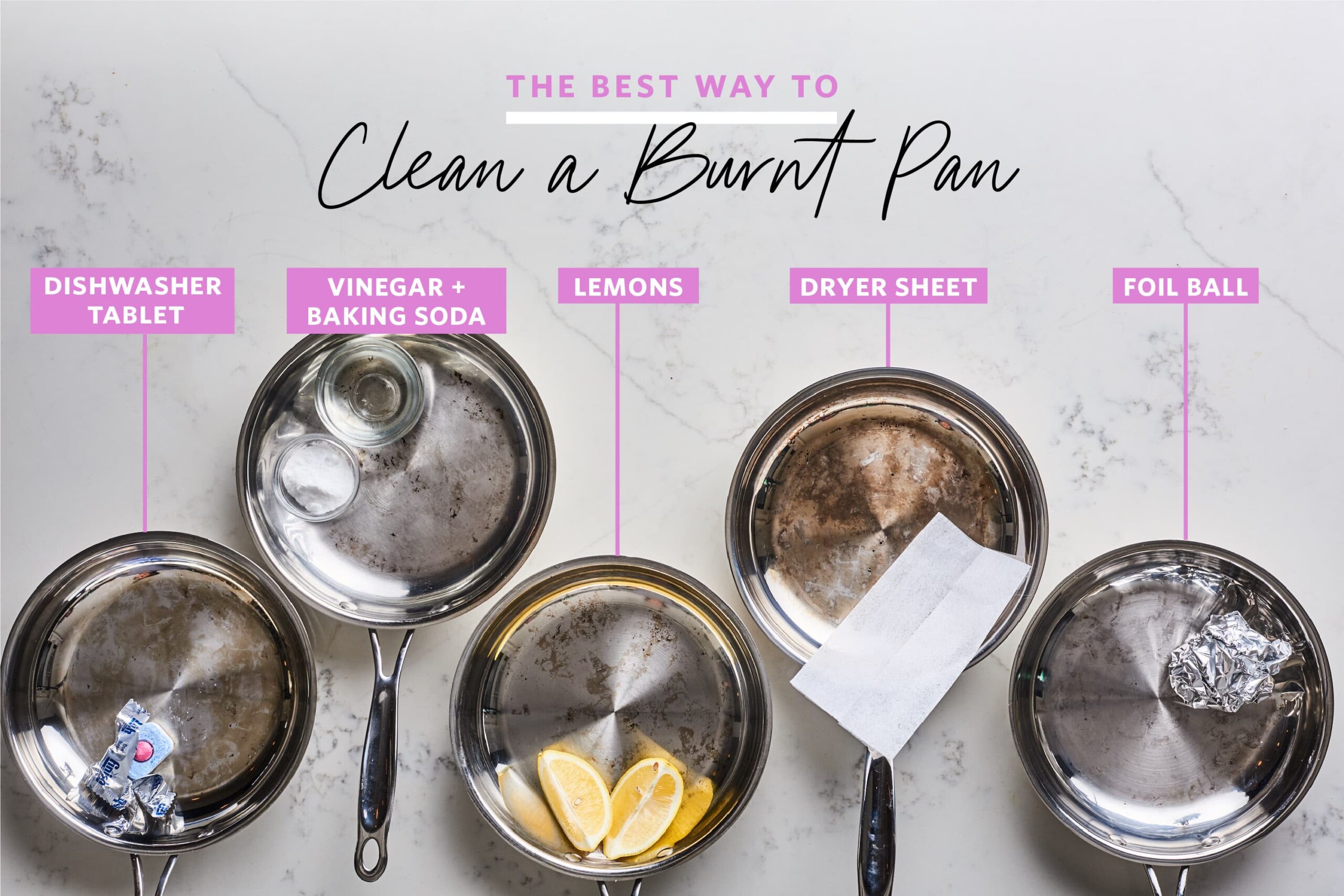
The single most useful thing you can do before grabbing any cleaner is figure out which of these three stain types you have — because each one responds to completely different chemistry.
Most cleaning guides skip this step, which is why so many people end up scrubbing the wrong thing with the wrong product for 20 minutes and getting nowhere.
Type 1 — Burnt food or scorched residue (interior cooking surface)
This is the dark, crusty buildup that happens when food or liquid boils dry and bonds to the pan floor. It looks like a black or dark brown crust and sits on the cooking surface. Alkaline solutions (baking soda) break this down from the inside out.
Type 2 — Polymerized oil and baked-on grease (exterior bottom)
This is the brown-to-black coating that builds up on the outside of the pan over months of stovetop use. Heat and oxygen bond cooking oil into a hard, lacquer-like polymer layer. It’s chemically different from burnt food — it’s essentially the same process used to season cast iron, just unintentional. It requires mechanical abrasion plus an oxalic acid cleaner, or prolonged alkaline soaking.
Type 3 — Heat tint (rainbow/blue discoloration)
That blue, purple, or golden rainbow shimmer on pan bottoms is not a stain at all — it’s a thin chromium oxide layer that forms when stainless steel is exposed to high, dry heat. It comes off with acid (white vinegar), no scrubbing needed.
Diagnosing correctly saves time. If your pan exterior has that hard, dark, baked-on coating that doesn’t respond to dish soap or baking soda wipes, you’re dealing with Type 2 polymerized oil — and you’ll need to jump straight to the Bar Keepers Friend section.
How to Clean the Interior Cooking Surface (Burnt Food)
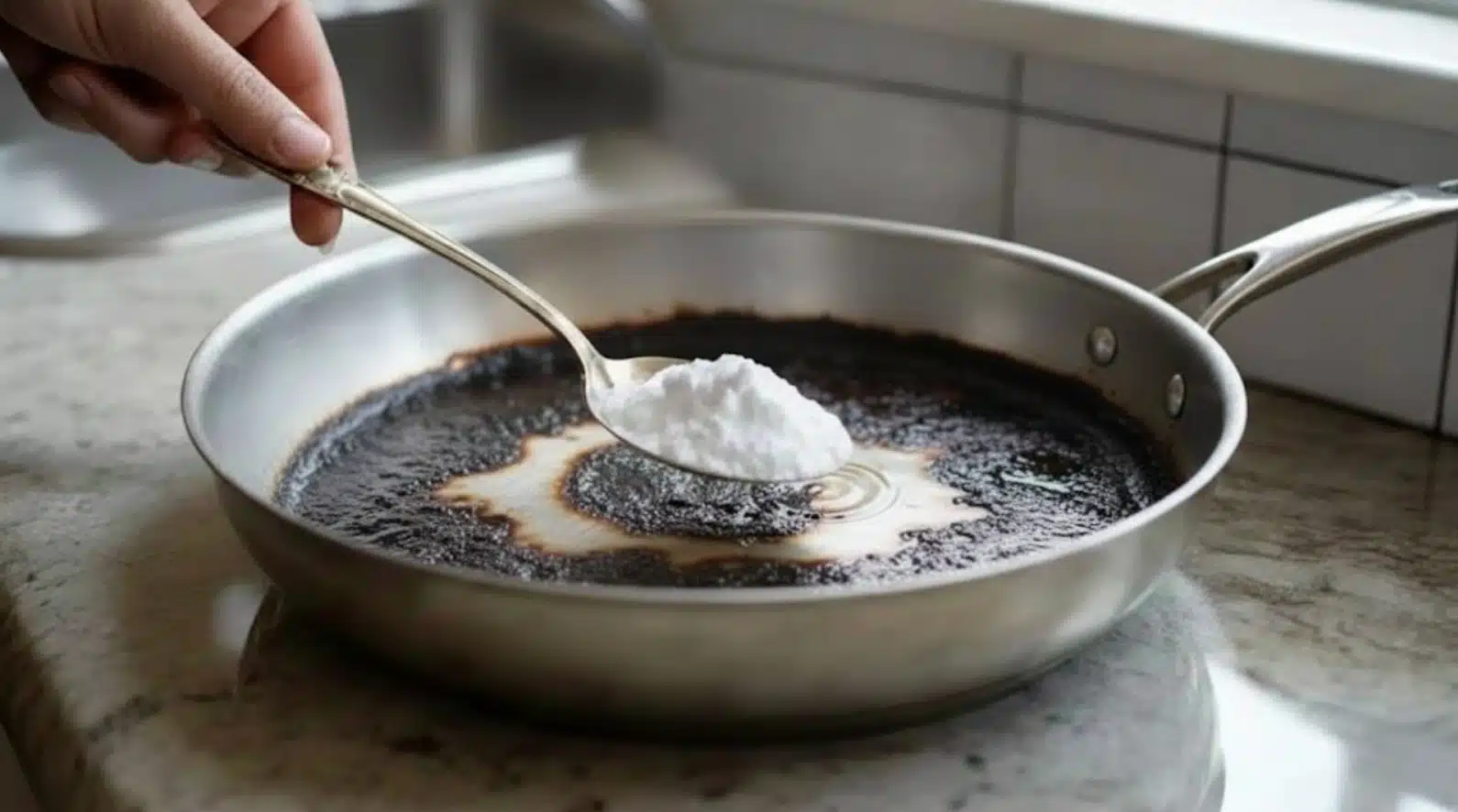
For scorched or burnt-on food inside the pan, the boiling baking soda method is the most reliable and lowest-effort approach — no soaking overnight, no commercial cleaners required.
This method works because baking soda (sodium bicarbonate) is mildly alkaline. When heated, it accelerates the hydrolysis of the carbon-based burnt residue, loosening its bond with the metal surface. The boiling action mechanically lifts it at the same time.
What you need:
- Baking soda (2–3 teaspoons)
- Water (enough to cover the burnt area)
- A wooden spoon or silicone spatula
- A non-scratch sponge or nylon scrubber
Steps:
- Fill the pan with enough water to cover the scorched area.
- Add 2–3 teaspoons of baking soda. For a heavily burnt pot, use 1–2 tablespoons.
- Bring to a boil on the stovetop. Let it boil for 5–10 minutes. You’ll often see the burnt bits start to lift and float.
- Remove from heat. Let it cool to a safe temperature — not cold, just cool enough to handle.
- Use the wooden spoon to scrape gently. Most residue will slide off.
- Wash with dish soap and a sponge. Repeat once if any dark patches remain.
For light discoloration that isn’t crusty, Bar Keepers Friend powder applied with a damp sponge and scrubbed for 30 seconds is faster. In The Kitchn’s side-by-side test, BKF Cookware Cleanser rated 4.5/5 for performance and left the surface noticeably shinier — stains lifted “after just one or two back-and-forth scrubs.”
What to do if the boil method doesn’t fully work: Add a splash of white vinegar to the water before boiling. The combination of mild acid (vinegar) and mild base (baking soda) creates a fizzing reaction that helps lift more stubborn deposits. This is particularly useful when the burnt residue also includes mineral scale from hard water.
How to Clean the Exterior Bottom: Brown Stains and Baked-On Grease
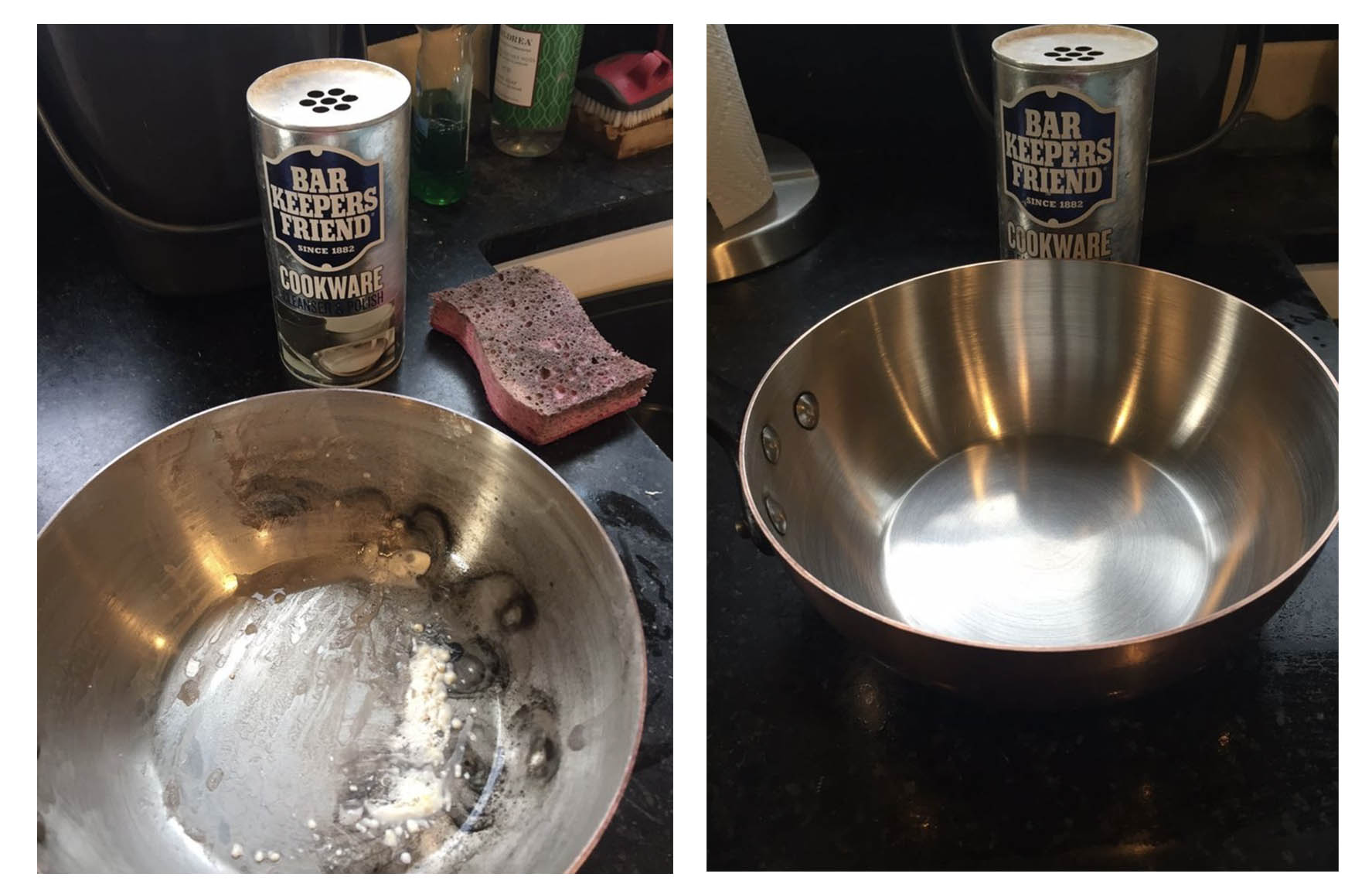
The outside bottom of your pan takes the most abuse — direct flame, dripped oil, and heat-bonded residue — and it needs a more aggressive approach than the interior.
This is the area that most articles gloss over, and it’s also where the biggest frustration lives. That dark brown coating that built up over months or years isn’t coming off with dish soap. Here’s what actually works, ranked by effort and results.
Method 1: Bar Keepers Friend + Steel Wool (Best Results)
This combination is the tested winner. In a head-to-head comparison testing five methods on heavily stained stainless steel cookware, steel wool paired with Bar Keepers Friend Cookware Cleanser was described as making pans look “right out of the box” — even on deeply stained, long-neglected pots.
Why it works: BKF contains oxalic acid, which reacts with iron oxide (rust) and other mineral deposits to form a water-soluble complex that rinses away. It also has a mild abrasive that polishes the surface while cleaning. Steel wool provides the mechanical force to break through polymerized oil layers.
Note on steel wool and stainless steel: Fine steel wool (grade 0000 or “super fine”) leaves minimal visible scratches on stainless steel pan exteriors. One caveat: standard steel wool is made from carbon steel, and tiny fragments can embed in the surface and later rust. If you want to eliminate that risk entirely, use stainless steel wool or a copper scour pad instead. Avoid all steel wool on the interior cooking surface or on any coated, non-stick, or enamel-finished cookware.
Steps:
- Wet the exterior bottom of the pan with water.
- Sprinkle Bar Keepers Friend powder directly onto the surface, or apply BKF Cookware Cleanser & Polish (the liquid version).
- Wet a piece of fine steel wool and begin scrubbing in the direction of the metal grain (usually circular on pan bottoms — work in small circular motions).
- Apply more BKF as needed. The paste will turn brownish as it lifts residue — this is normal.
- Rinse thoroughly and inspect. Repeat on any remaining patches.
- Dry with a soft cloth to prevent water spots.
Method 2: Baking Soda + Lemon (Budget Option, Good Results)
If you don’t have BKF on hand, baking soda with the cut side of a lemon does surprisingly well on light-to-moderate stains. In the same tested comparison, this method rated 3.5/5 for performance and left pans “beautifully shiny” — though it required more scrubbing than BKF and struggled with the heaviest stains.
Steps:
- Wet the pan bottom.
- Sprinkle generously with baking soda.
- Scrub with the cut side of a lemon, using the citric acid + abrasive baking soda combination.
- Switch to a scrubby sponge if needed.
- Rinse and dry.
Cost: about $1.50 worth of ingredients. Good for maintenance cleaning every few weeks before buildup becomes severe.
Method 3: What Doesn’t Work (Save Your Time)
Easy-Off oven cleaner, despite its strong reputation for oven interiors, performed poorly on pan exteriors in testing — rating 2/5 even after soaking for over an hour. The stains barely budged. It’s not worth the chemical exposure or the preparation involved.
Dealing with Severely Polymerized Oil on the Pan Exterior
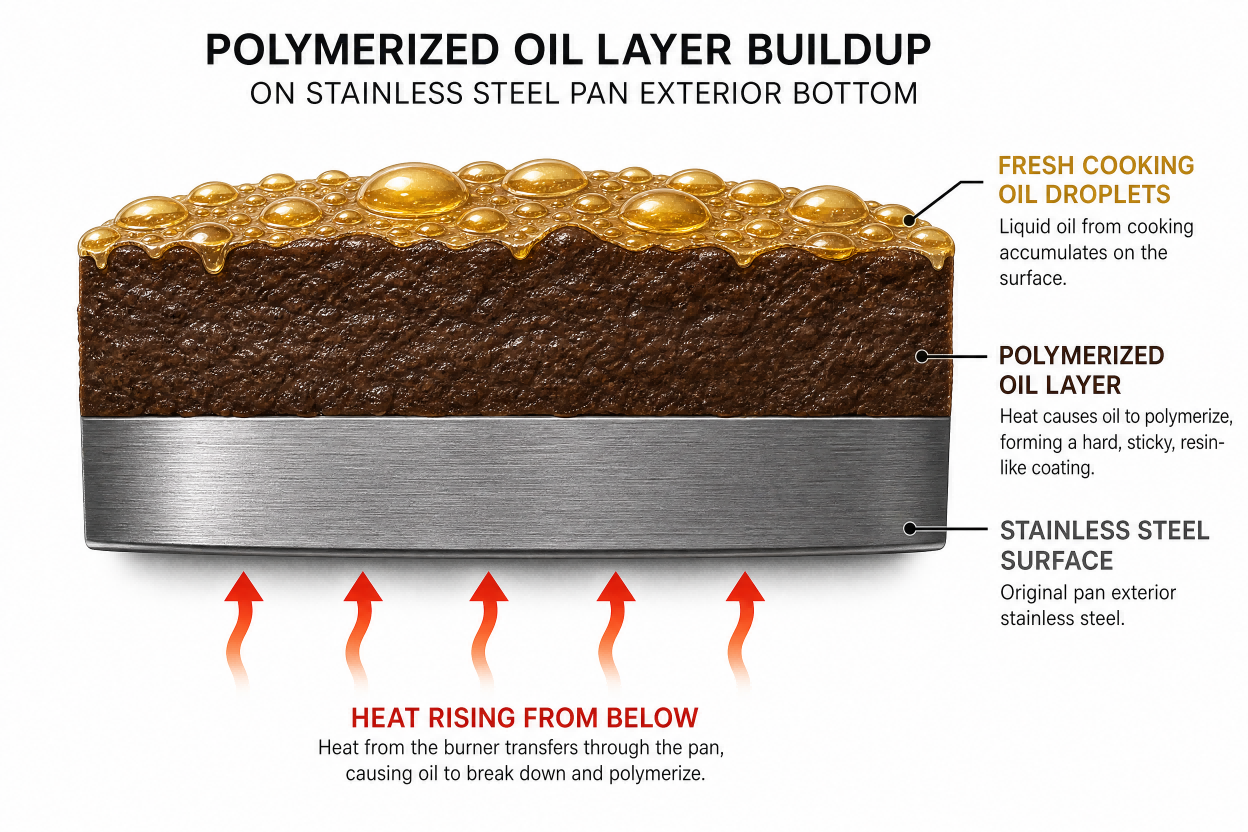
When the exterior bottom has years of hard, lacquer-like buildup that BKF and steel wool alone can’t cut through, you need to attack the polymerized oil chemically before scrubbing.
Polymerized oil is different from a fresh grease stain. It’s cooking oil that has undergone oxidative polymerization under repeated heat — essentially, it has cross-linked into a hard resin. This is the same chemistry behind cast iron seasoning, which is why it’s so stubborn on stainless steel bottoms.
The Boiling Baking Soda Soak (Exterior)
This method works for the outside of pots and deep pans with enough vertical clearance to submerge the exterior bottom in boiling water.
Steps:
- Fill a larger pot (big enough to fit the stained pan) with water.
- Add 3–4 tablespoons of baking soda per liter of water.
- Submerge the stained pan exterior in the solution.
- Bring to a boil and maintain for 15–20 minutes.
- Remove and let cool. The polymerized layer should have softened visibly.
- Scrub with steel wool or a stiff nylon brush while still warm.
- Follow up with BKF if residue remains.
Reddit’s r/Cooking community has widely validated this approach: “Burned on polymerized oil stains on stainless steel pans can be removed by boiling in a baking soda solution.”
BKF Paste + Soak
For flat sheet pans or skillets where submersion isn’t possible:
- Mix BKF powder with just enough water to form a thick paste.
- Apply generously to the entire stained exterior.
- Cover with plastic wrap to prevent drying.
- Let sit for 30–60 minutes.
- Scrub off with steel wool or a stiff brush.
This extended contact time gives the oxalic acid more time to penetrate the polymer layer before scrubbing.
Removing Heat Tint: That Rainbow or Blue Discoloration
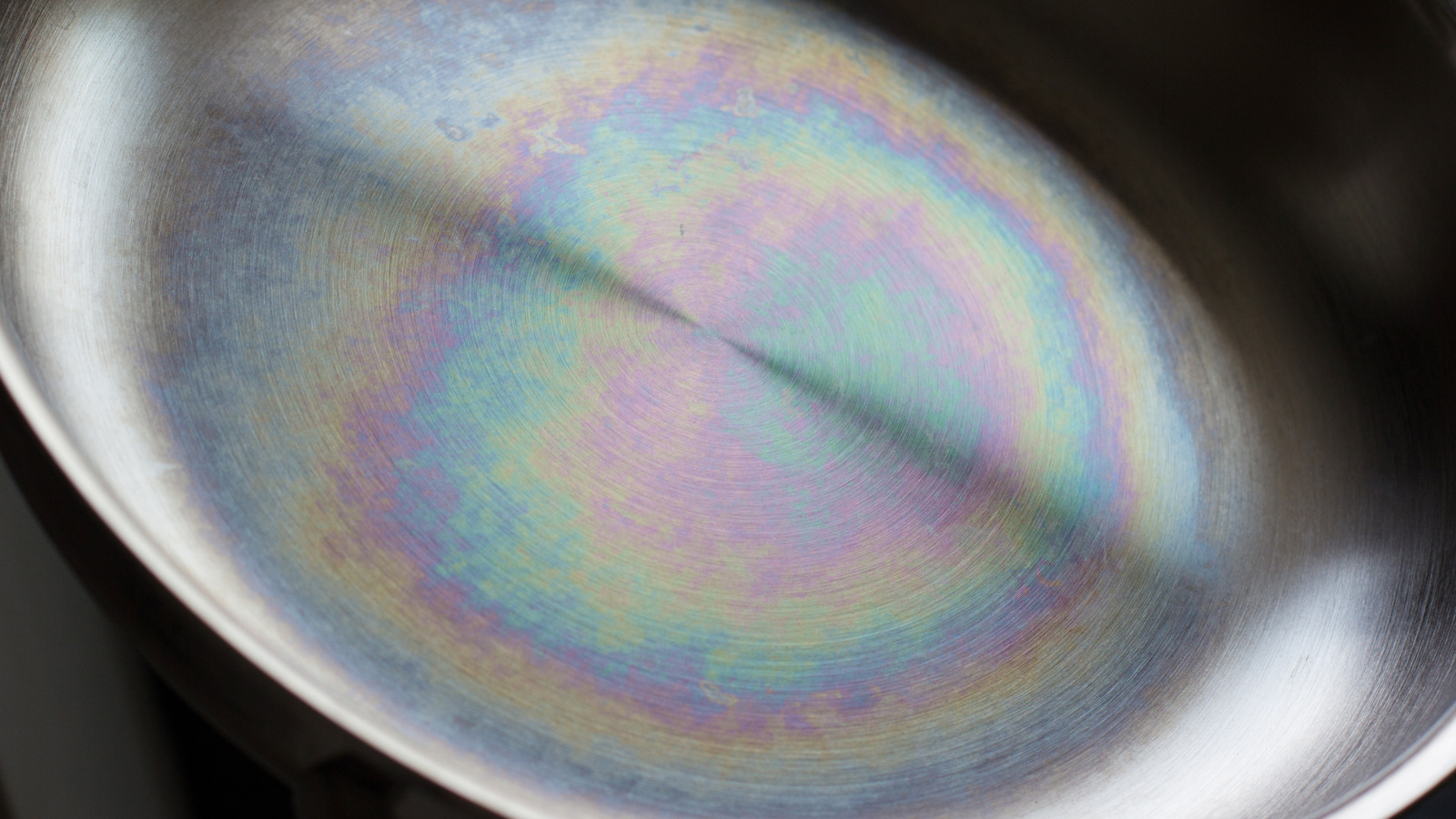
Heat tint on stainless steel is not a stain — it’s a thin interference film caused by chromium oxide forming on the surface when the metal gets too hot or too dry. White vinegar removes it in minutes, no scrubbing needed.
The rainbow, blue, purple, or gold shimmer that appears on pan bottoms after high-heat cooking is a well-understood metallurgical phenomenon. As stainless steel heats past a certain temperature (especially without oil or water present), chromium in the steel reacts with oxygen to form a thicker-than-normal oxide layer. This layer diffracts light, creating the characteristic color bands — similar to the rainbow effect on a soap bubble.
Why vinegar works: White vinegar is a dilute acetic acid (typically 5% concentration). It dissolves the surface oxide layer without attacking the underlying steel, restoring the original metallic appearance.
Steps:
- Pour a small amount of white vinegar onto the discolored area, or dampen a cloth and wipe it over the surface.
- Let it sit for 1–2 minutes.
- Wipe away with a soft cloth. The color will vanish.
- Rinse with water and dry immediately.
That’s it. No BKF, no steel wool, no boiling. If the color doesn’t fully clear on the first wipe, repeat once.
One caveat: Heat tint often co-exists with polymerized oil on the same pan bottom. If the surface still has a brown film after the vinegar removes the rainbow shimmer, you’re dealing with a Type 2 stain underneath — move to the BKF + steel wool method for the remaining residue.
Method Comparison: Effort vs. Results
Choosing the right method comes down to how bad the stain is and how much time you want to spend. This table maps the main approaches against stain type, cost, and effort level.
| Method | Best For | Effort | Cost | Results |
|---|---|---|---|---|
| Boiling baking soda (interior) | Burnt food inside pan | Low | ~$0.50 | 4.5/5 |
| BKF + steel wool (exterior) | Brown exterior stains, moderate-heavy | Medium | ~$8–10 | 5/5 |
| Baking soda + lemon (exterior) | Light exterior staining | Medium-High | ~$1.50 | 3.5/5 |
| BKF paste + soak | Severe polymerized oil buildup | Low prep, medium scrub | ~$8–10 | 4.5/5 |
| Boiling baking soda soak (exterior) | Severe polymerized oil on pot exteriors | Low-Medium | ~$0.50 | 4/5 |
| White vinegar wipe | Rainbow/blue heat tint only | Very Low | ~$0.20 | 5/5 |
| Dish soap + sponge | Routine cleaning, no staining | Low | ~$0.10 | 1/5 on stains |
| Easy-Off oven cleaner | Pan exteriors | High (and toxic) | ~$7 | 2/5 |
Key insight from testing: The combination of Bar Keepers Friend (for chemical lift) and steel wool (for mechanical abrasion) outperforms every DIY and commercial alternative for exterior stain removal on stainless steel. The two work synergistically — the oxalic acid loosens the stain’s bond with the metal while the steel wool removes it physically.
What Not to Use on Stainless Steel Cookware
Several common cleaning agents either damage stainless steel or simply don’t work — knowing what to skip saves your pans and your time.
Chlorine bleach: Never use bleach on stainless steel cookware. Chloride ions attack the passive oxide layer that makes stainless steel “stainless,” causing pitting corrosion and permanent surface damage. This includes chlorine-based cleaning tablets and dishwasher pods with bleach.
Dishwasher (for stained pans): The dishwasher won’t remove polymerized oil or heat stains — it only handles light grease and food residue. Worse, the harsh dishwasher detergents can dull the pan’s finish over time and may void the warranty on premium cookware brands. Hand-washing is always the right call for stainless steel pans.
Harsh scouring pads on the cooking surface: Coarse steel wool or metal scourers are fine on the exterior bottom (where appearance is secondary), but on the interior cooking surface they leave deep scratches that create more spots for food to catch and stick. Use fine steel wool (0000 grade) or stick to nylon scourers for the interior.
Prolonged contact with salty water: Don’t leave salt water or heavily salted food sitting in a stainless steel pan. Salt (sodium chloride) is another source of chloride ions and can cause pitting if left in contact long enough, especially in lower-quality 18/0 stainless steel.
Cooking spray on high heat: This creates the polymerized buildup in the first place — aerosol cooking sprays contain additives (including lecithin) that leave sticky, hard-to-remove buildup on pan surfaces faster than pure oils do. If you’re trying to prevent the brown exterior buildup, switch to wiping a thin layer of high-smoke-point oil rather than spraying.
How to Prevent Buildup on Stainless Steel Pan Bottoms
Cleaning is reactive. These three habits keep exterior buildup from forming in the first place.
1. Wipe the exterior after every use.
Once the pan has cooled, take 30 seconds to wipe the bottom with a damp soapy cloth. Fresh oil and minor drips wipe off instantly. Let them sit through a dozen cooking sessions and they polymerize into the dark coating that needs steel wool to remove.
2. Avoid boil-overs.
Most of the heavy exterior staining comes from liquid boiling over the sides and burning onto the bottom exterior at high heat. Use a larger pot than you think you need, turn the heat down once boiling starts, and place a wooden spoon across the top of the pot to slow foam.
3. Do a monthly BKF wipe.
Even with regular washing, some light staining builds up over time. Spending 2 minutes once a month with BKF powder and a scrubby sponge on the exterior prevents light staining from becoming heavy buildup. It’s significantly less work to maintain than to restore.
Frequently Asked Questions
Can burn marks on stainless steel be fully removed?
In most cases, yes. Brown staining, polymerized oil, and heat tint are surface phenomena — they haven’t penetrated or altered the underlying steel. Bar Keepers Friend with steel wool removes even years-old buildup. The only permanent damage to stainless steel comes from deep pitting corrosion caused by prolonged chloride exposure.
Is it safe to use Bar Keepers Friend on cookware that touches food?
Yes, when used as directed — apply, scrub, and rinse thoroughly. BKF contains oxalic acid, which the Missouri Poison Center notes is safe in cleaning applications: it reacts with rust and mineral deposits to form a water-soluble complex that rinses away completely. Don’t let it sit for extended periods on the cooking surface, and always rinse well.
Why does my stainless steel pan bottom turn brown even when I clean it regularly?
Most likely, cooking oil is dripping or splattering onto the exterior bottom and polymerizing under repeated heat exposure. Even small amounts of oil on the exterior, over dozens of cook sessions, build up into that brown coating. Wiping the exterior after every use prevents this accumulation.
Can I use steel wool on the inside of a stainless steel pan?
Use fine (0000 grade) steel wool sparingly on the interior — it’s safe for removing stubborn burnt-on spots, but will leave light scratches that become visible over time. For the cooking surface, a nylon scour pad or a dedicated stainless steel scrubber is a gentler option. On the exterior bottom, coarser steel wool is fine since appearance there matters less.
How do I clean burnt stainless steel without baking soda?
White vinegar (for heat tint and mineral deposits) and Bar Keepers Friend (for exterior staining and burnt residue) are both effective without baking soda. For interior burnt food, dish soap with a nylon scrubber and some soak time handles light cases. For severe interior burning without baking soda, a commercial stainless steel cleaner like Made In’s Stainless Steel Cleaner or Weiman Cookware Cleaner can substitute.
Why does my stainless steel pan have a rainbow discoloration on the bottom?
The rainbow or blue/gold shimmer is heat tint — a thin chromium oxide film formed when the steel gets very hot, especially without liquid or oil present. It’s harmless and comes off completely with a white vinegar wipe in under two minutes.
The Bottom Line
Most stainless steel cookware that looks permanently stained isn’t — it just needs the right approach matched to the right stain type.
For the interior cooking surface, boiling water with baking soda handles burnt-on food with minimal effort. For exterior brown staining and polymerized oil buildup, Bar Keepers Friend combined with fine steel wool is the tested winner that outperforms every DIY method. For heat tint, white vinegar takes under two minutes. The key is diagnosing which stain you’re dealing with before reaching for any cleaner — that single step is what most guides skip, and it’s why so many cleaning attempts fail.
Keep a can of Bar Keepers Friend under the sink and wipe the exterior after every cook session. With those two habits, your pans will stay in good shape without ever needing a deep-cleaning session.