

Stainless steel sticks when the pan is at the wrong temperature. The fix is proper preheating: heat the dry pan until a drop of water beads up and glides (the Leidenfrost effect), then add oil and your food. At the right temperature, stainless steel becomes nearly non-stick. The mistake most people make is adding food before the pan is ready.
Stainless steel cookware is the workhorse of professional kitchens—and the source of frustration for most home cooks. The first time you crack an egg into a brand-new stainless pan and watch it weld itself to the surface, it’s easy to assume you bought the wrong thing.
You didn’t. You just haven’t learned how to use it yet.
The good news: once you understand what’s actually happening inside the pan, the fix takes about 90 seconds and never fails. This guide covers the full method, the science behind it, and specific techniques for the foods that give people the most trouble—eggs, fish, chicken, and steak.
Does Stainless Steel Always Stick?
Stainless steel sticks under two conditions: when the pan is too cold, or when you flip too early. Neither is a property of the material. Both are fully fixable.
Here’s what’s actually happening: the surface of a stainless steel pan, despite looking smooth, is covered in microscopic pores and ridges. When food hits a cold or warm-but-not-hot-enough pan, the proteins in the food (and the moisture it releases) bond directly to those pores. The food is, effectively, glued at the molecular level.
Two things change when the pan reaches the right temperature. First, the metal expands from heat, physically smoothing out those surface pores. Second, the moisture in food briefly vaporizes on contact, creating a thin steam cushion between the food and the pan surface. That cushion is the Leidenfrost effect—and it’s the key to everything.
As the food continues to cook and the proteins fully set, they pull away from the surface on their own. This is why the single most common mistake is trying to flip food too early: it’s still in the bonding phase, not the release phase. If it resists, it’s not ready.
The Water Drop Test: Finding the Right Temperature

The only reliable way to know your pan is ready is the water drop test. Forget timers. Forget guessing based on smoke. A single drop of water tells you exactly where you are.
Add a few drops of cold water to your pan as it heats. You’ll see one of three things:
Too cold: The water sizzles, spatters, and evaporates in patches. The pan surface is over boiling point but not hot enough—those microscopic pores are still open. Add food now and it sticks.
Just right: The water beads into a single cohesive ball (or a couple of balls that quickly merge) and glides around the pan like a marble. This is the Leidenfrost effect. The surface temperature is between roughly 365°F and 430°F (185–220°C). The metal has expanded, the pores have smoothed out, and food will release cleanly. Add your oil now, wait for it to shimmer, and cook.
Too hot: The water immediately explodes into dozens of tiny droplets that scatter frantically across the surface. Reduce the heat, let it cool for 30 seconds, and test again. At this temperature your oil will smoke the moment it hits the pan.
The first time you see the mercury-ball effect in person, it’s genuinely surprising. The water drop just… glides. Once you’ve seen it, you’ll always recognize it.
One practical note: how long this takes depends on your stove and pan. On a gas burner over medium heat, most tri-ply stainless pans reach the sweet spot in 2–3 minutes. On a traditional electric coil, allow 4–5 minutes. On induction, it’s actually faster than gas—1–2 minutes is often enough. Thicker pans take longer but hold heat more evenly once they’re there.
Step-by-Step: How to Cook with Stainless Steel
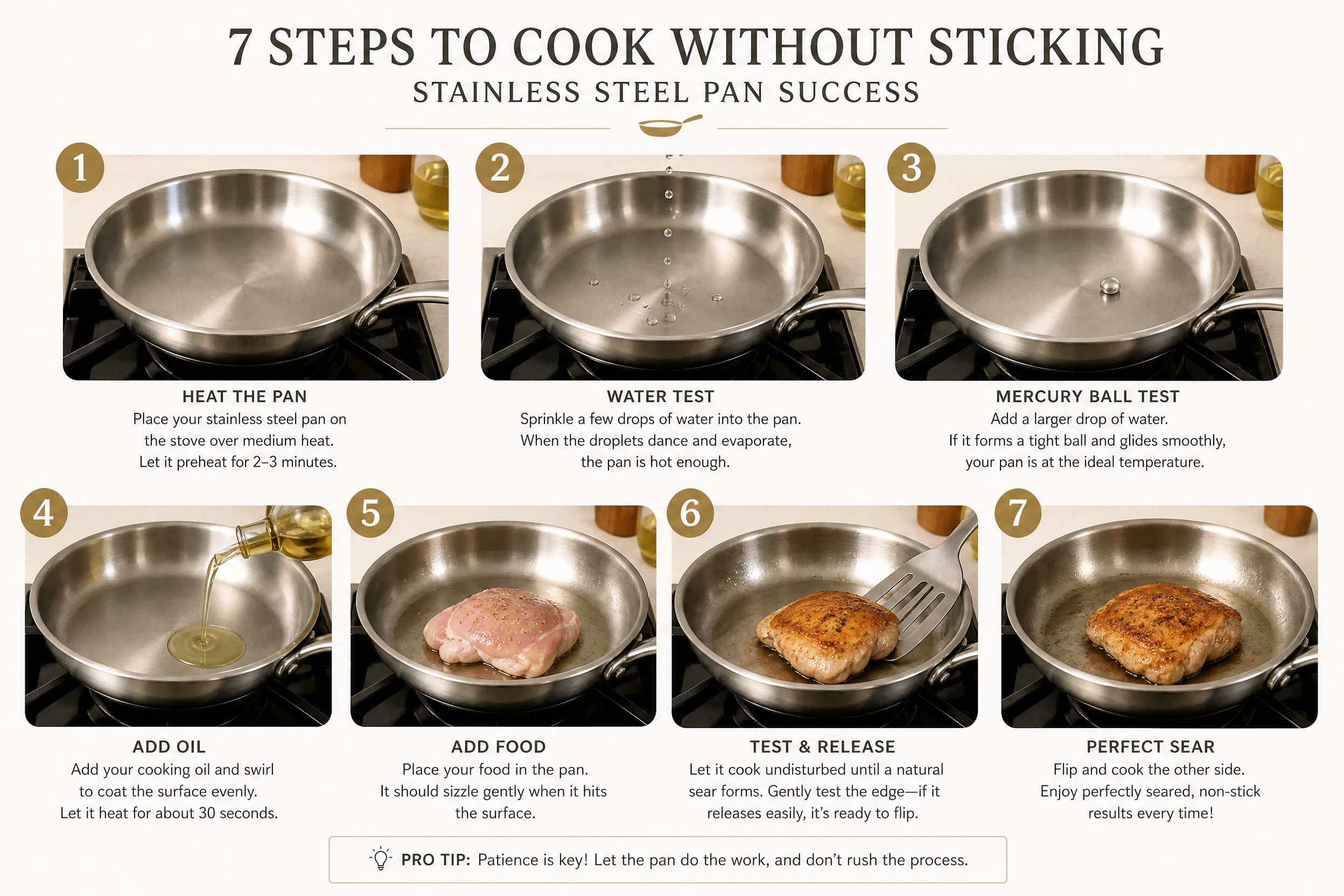
This method works for most foods. Food-specific adjustments are in the next section.
1. Take your food out of the fridge 15–20 minutes before cooking.
Cold food dropped into a hot pan drops the pan temperature, which puts you back in the sticky zone. This matters most for proteins—steak, fish, chicken, eggs. For vegetables, it’s less critical.
2. Place the dry pan on medium heat. No oil yet.
Adding oil to a cold pan and heating them together can cause oil to break down before the pan reaches the right temperature. Start with the bare pan.
3. Do the water drop test.
After 2–3 minutes, add a few drops of water. Wait for the mercury ball. If the water just sizzles, keep going. If it scatters frantically, reduce heat and wait 30 seconds.
4. Add oil or butter immediately after the mercury ball forms.
A thin coat of high-smoke-point oil (avocado, grapeseed, or refined olive oil) is enough for most cooking. For butter, add it after the oil or use it alone at slightly lower heat. The oil should shimmer within 10–15 seconds—not smoke.
5. Add food and leave it alone.
This is the hardest part. Don’t poke, press, or try to move the food. The food will initially stick, then release on its own as the proteins set. For a chicken thigh, that’s 4–5 minutes without touching it. For a fried egg, 2–3 minutes.
6. Test with a spatula before flipping.
Gently try to slide a spatula under the edge of the food. If it slides freely, flip. If it resists, give it another 30–60 seconds and try again. The food will tell you when it’s ready.
7. Finish the cook and deglaze if needed.
If there’s browned residue on the pan surface (fond), add a splash of wine, broth, or water while the pan is still hot. The stuck bits dissolve instantly and form the base of a sauce.
Food-Specific Tips: Eggs, Fish, and Meat
The same core method applies to everything, but three foods trip people up repeatedly.
Eggs
Eggs are the hardest test for stainless steel. The window between “not ready” and “overcooked” is tight, and egg whites bond aggressively to metal surfaces.
The key is more fat than you think you need, lower heat than you expect. After the water drop test, reduce heat slightly before adding butter. Use enough butter to visibly coat the pan surface. Add the egg when the butter is just starting to foam—not brown. Let the white set completely before touching it; it will release cleanly when the edges look fully opaque. For scrambled eggs, use medium-low heat and keep moving them constantly.
Fried eggs on stainless steel are genuinely easier once you’ve done them five or six times. The first two or three will be rough. That’s expected.
Fish (Skin-On Fillets)
Fish skin sticks violently to underseasoned, under-preheated pans. Two rules that change everything:
First, dry the fish skin with paper towels right before cooking. Moisture on the surface causes immediate sticking and steaming instead of searing. Second, press the fillet flat against the pan for the first 30 seconds with a spatula—skin-on fish curls from the heat and only the center of the skin makes contact, leaving stuck edges. Hold it flat until the curl stops. Then leave it alone for 3–4 minutes until the skin is fully crisped and releases cleanly.
Chicken Thighs and Steak
This is where stainless steel shines and non-stick can’t compete. You want the proteins to develop a crust and release on their own—that crust is the whole point.
For a bone-in chicken thigh: put it in the pan skin-side down, press lightly, and walk away for 5–6 minutes. Don’t touch it. When it releases cleanly and the skin is deep golden, flip once. For a steak: room temperature, dry surface, hot pan, minimal oil. Sear undisturbed for 3–4 minutes per side depending on thickness. The crust will be substantially better than anything a non-stick pan produces.
Sometimes the Sticking Is the Point: Fond

After searing a steak or chicken, you’ll see brown, almost caramelized bits stuck to the pan bottom. That’s not a mess—it’s fond, and it’s one of the main reasons professional kitchens use stainless steel instead of non-stick.
Fond is concentrated, browned flavor from the Maillard reaction. It doesn’t come off a non-stick surface because nothing actually stuck. On stainless steel, those bits stay on the surface and become the base for pan sauces.
Deglazing is simple: remove the cooked protein, keep the pan on medium-high heat, and add ½ cup of wine, broth, or even water. The liquid will violently sizzle and all the stuck bits will immediately dissolve into the liquid. Scrape with a wooden spoon, reduce the sauce by half, finish with a tablespoon of cold butter, and pour over the meat.
That sauce takes 3 minutes and is the reason stainless steel is worth learning.
Common Mistakes and Quick Fixes
| Mistake | What happens | Fix |
|---|---|---|
| Adding food to a cold pan | Food bonds to open surface pores, tears when flipped | Always do the water drop test first |
| Skipping the oil after the test | Even at the right temp, fat is the final barrier | Add a thin coat right after the mercury-ball test |
| Pulling food straight from the fridge | Cold food drops pan temperature back to sticky range | Rest food 15–20 minutes at room temperature |
| Trying to flip too early | Food is still in the protein-bonding phase | Wait for clean spatula release — it will release |
| Heat too high | Oil smokes, food surface carbonizes before cooking through | Use medium, not high, heat — stainless holds heat well |
| Pan not clean from previous cook | Old residue creates uneven surfaces | Wash thoroughly after each use; use Bar Keepers Friend monthly |
Cleaning Stainless Steel (It Affects Future Cooking)
A pan that looks clean might not cook clean. Old grease and mineral deposits fill those surface pores back in and create a sticky baseline before you even start cooking.
For routine cleaning: Wait until the pan is warm (not hot) before washing—thermal shock from cold water on a hot pan can warp it over time. Wash with dish soap and a non-scratch pad. For stuck food, add water to the pan, bring it to a simmer on the stove, and the residue loosens in under two minutes.
For discoloration and stubborn buildup: Bar Keepers Friend (the powder or liquid form) removes rainbow-colored heat stains, white mineral deposits from water, and any residue that soap leaves behind. Wet the pan, sprinkle or apply a small amount, scrub gently, rinse. It restores the surface to near-original smoothness, which directly affects how non-stick it performs.
Do not store pans with oil inside. Some people “season” stainless like cast iron. It doesn’t work the same way—the oil goes rancid and creates a gummy residue that’s worse than starting with a bare pan.
Frequently Asked Questions
Can stainless steel be permanently non-stick?
No. Stainless steel cannot be permanently non-stick the way PTFE-coated pans are. But with the water drop test method, it performs like a non-stick surface for most cooking tasks, every time you use it.
Why do my eggs keep sticking even when I preheat the pan?
Most likely the heat is slightly too high and the butter is browning before the egg sets. Try reducing to medium-low after the water test, and use more butter than feels right. Eggs are the highest-difficulty food on stainless steel—lower heat and more fat are almost always the fix.
Is butter or oil better for stainless steel cooking?
Both work. Use high-smoke-point neutral oil (avocado, grapeseed) for high-heat searing. Use butter for eggs and fish at lower temperatures. Combining them—oil first, then a knob of butter—gives you higher smoke tolerance with better flavor.
Can I use stainless steel on induction?
Yes, if the pan has a magnetic steel base (most tri-ply stainless pans do). Check the bottom for an induction symbol, or hold a magnet against the base—if it sticks, it works on induction.
Do I need to season a stainless steel pan?
Not the way cast iron requires. Some cooks do a one-time oil treatment: heat the pan to the Leidenfrost point, add a thin coat of oil, heat until it just starts to smoke, then wipe clean with a paper towel. It can slightly improve initial performance, but it’s optional.
Why does my stainless pan have rainbow-colored stains?
Those are harmless heat tints caused by oxidation at high temperatures. They don’t affect cooking performance. Bar Keepers Friend removes them completely.
What foods should I not cook in stainless steel?
Very delicate fish and eggs require extra attention (see tips above) but are doable. Stainless handles acid well—tomato sauces, citrus—which cast iron can’t. The only foods that are genuinely hard to master on stainless are things you’d cook at very low temperatures with no browning, like omelets. A non-stick is legitimately better there.
Summary
Stainless steel sticks because most people add food before the pan reaches the right temperature. The fix is the water drop test—heat the pan dry until a drop of water forms a single bead and glides across the surface, then add oil and cook. Once you internalize that sequence and learn to wait for natural release instead of forcing a flip, stainless steel stops being frustrating and starts being the most useful pan you own.
The learning curve is about five or six cooks, not dozens. Eggs are the hardest and most satisfying to nail. The fond from a good sear is something non-stick can never give you.