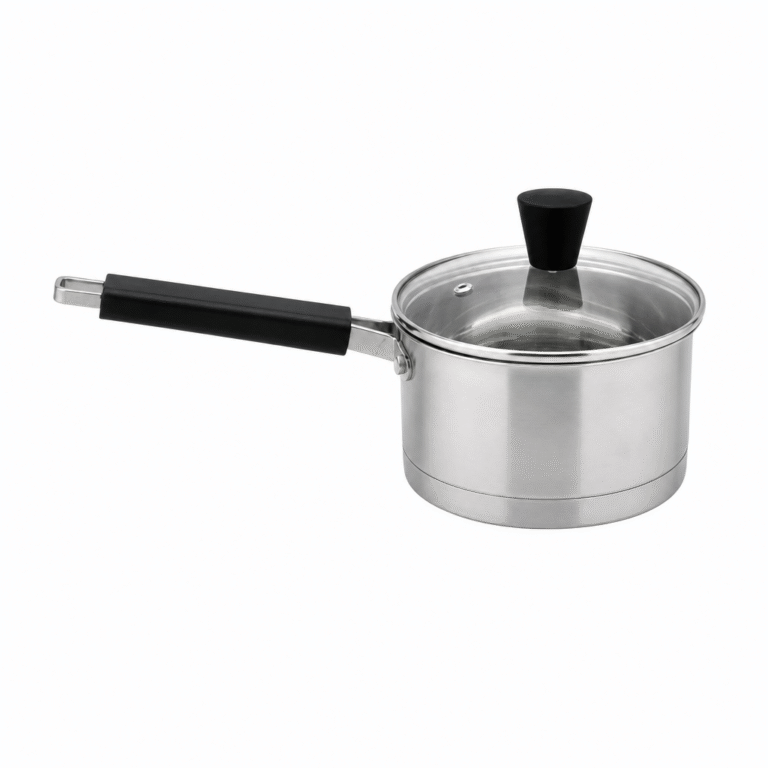


Stainless steel can behave like a non-stick pan—no coating required. The most reliable method is the Leidenfrost hack: heat the pan until water droplets bead up and glide like mercury balls, then add oil and cook. The sweet spot is roughly 370°F–450°F, where the metal’s microscopic surface pores close and food gets a thin vapor cushion instead of bonding to the pan. Two other methods work too: seasoning with oil (good for everyday prep) and the cold-pan cold-oil start (best for fatty proteins like fish). This guide covers all three methods, when to use each, the three mistakes that cause sticking, and food-specific tips.
Why Food Sticks to Stainless Steel in the First Place
Most people assume stainless steel is just “slippery” or “grippy” as a fixed property—like the pan either has non-stick behavior or it doesn’t. That’s not how it works.
Food sticks to stainless steel for two reasons that happen at the same time. First, stainless steel has a microscopically rough surface. Under magnification, it looks like a landscape of tiny ridges and valleys. When food touches a cold or under-heated pan, proteins physically interlock with those surface irregularities. The bond forms in milliseconds.
Second—and this is the part most guides skip—proteins change their shape when they hit a warm but not-hot-enough surface. When proteins from eggs, fish, or meat contact a pan at the wrong temperature, they unfold and bond chemically to the metal. Once bonded, they won’t let go. This is why you can’t just scrape stuck eggs off; part of the protein has actually fused with the surface.
The fix isn’t coating the pan with more oil and hoping. The fix is temperature management. When stainless steel reaches the right temperature range, two things happen:
- The metal expands enough to smooth over those microscopic valleys, leaving less surface area for food to grip.
- The moisture in your food instantly flashes to steam on contact, creating a thin vapor layer between the food and the pan—the Leidenfrost effect. Food floats on that vapor instead of bonding.
Get the temperature right, and stainless steel behaves remarkably like a non-stick pan. Get it wrong—in either direction—and food sticks hard.
Method 1: The Leidenfrost Hack (Water Drop Test)
This is the most reliable method for everyday cooking, especially for eggs and delicate proteins.
The Leidenfrost effect is named after Johann Gottlob Leidenfrost (1715–1794), a German physician and theologian who described what happens when a liquid contacts a surface far hotter than its boiling point: rather than sizzling away, the liquid instantly forms a thin insulating vapor layer and skitters around the surface like a ball of mercury. In practice, this tells you your pan has hit the non-stick temperature zone—roughly 370°F to 450°F (190°C to 232°C).
Here’s how to use it:
Step 1 — Heat the pan dry.
Place your stainless steel pan on medium heat. Let it preheat for 2–3 minutes. Don’t add oil yet. The empty pan heats more evenly without oil masking the temperature reading.
Step 2 — Do the water drop test.
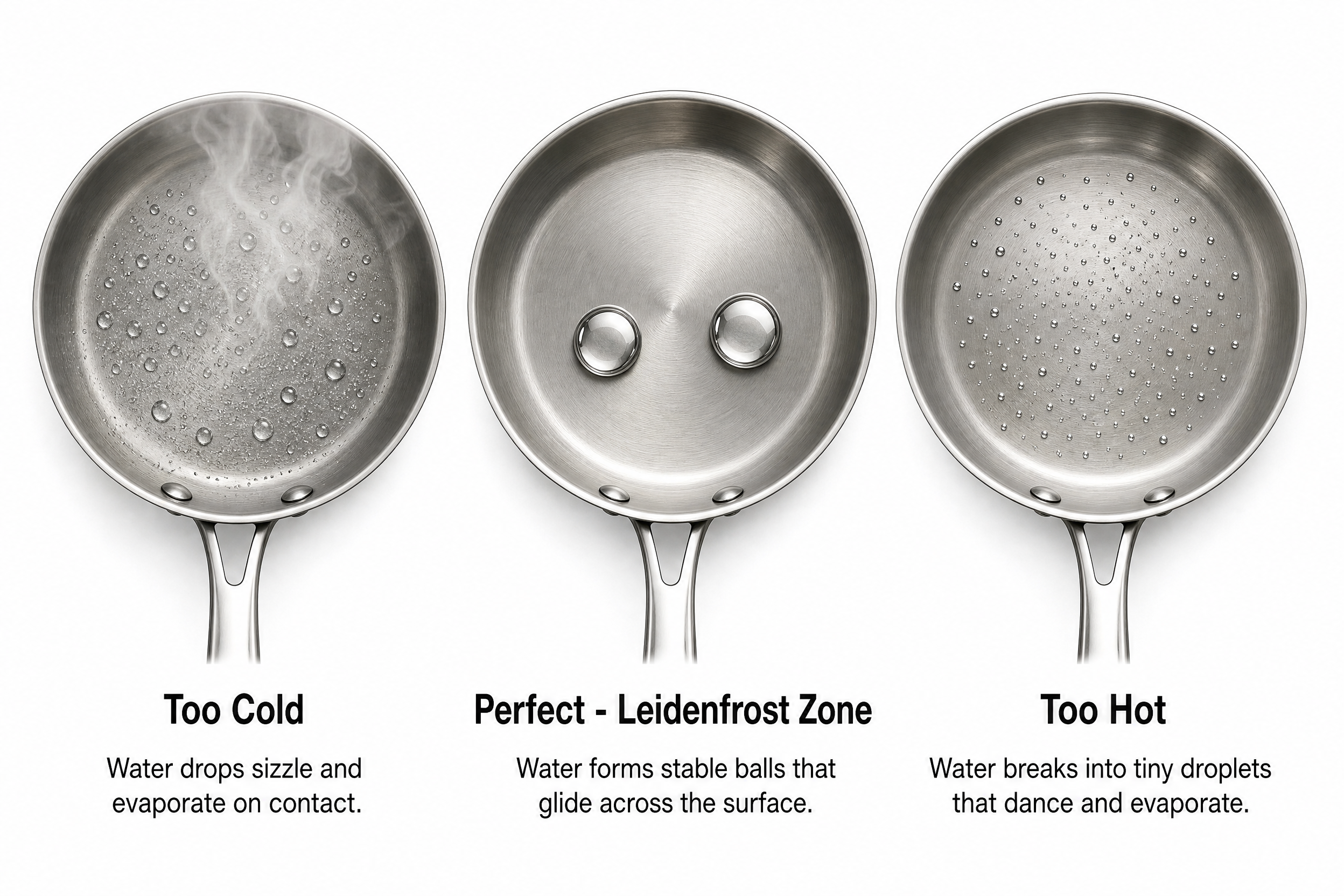
Flick a few small drops of cold water onto the pan’s surface. Three outcomes tell you exactly where you are:
- Water sizzles and evaporates immediately → Pan is warm but not hot enough. Wait another 30–60 seconds and test again.
- Water beads up into one or two smooth, gliding balls that roll around the pan → You’ve hit the Leidenfrost sweet spot. This is the signal to add oil.
- Water immediately breaks into dozens of tiny droplets scattering everywhere → Pan is too hot. Remove from heat for 20–30 seconds, then retest.
Step 3 — Add oil and let it heat briefly.
Once you see the mercury-ball water behavior, wipe out any remaining water drops with a paper towel. Add your oil or butter—just enough to coat the bottom of the pan. The oil will heat almost instantly. After 15–20 seconds, when the oil shimmers (not smokes), add your food.
Step 4 — Don’t move the food immediately.
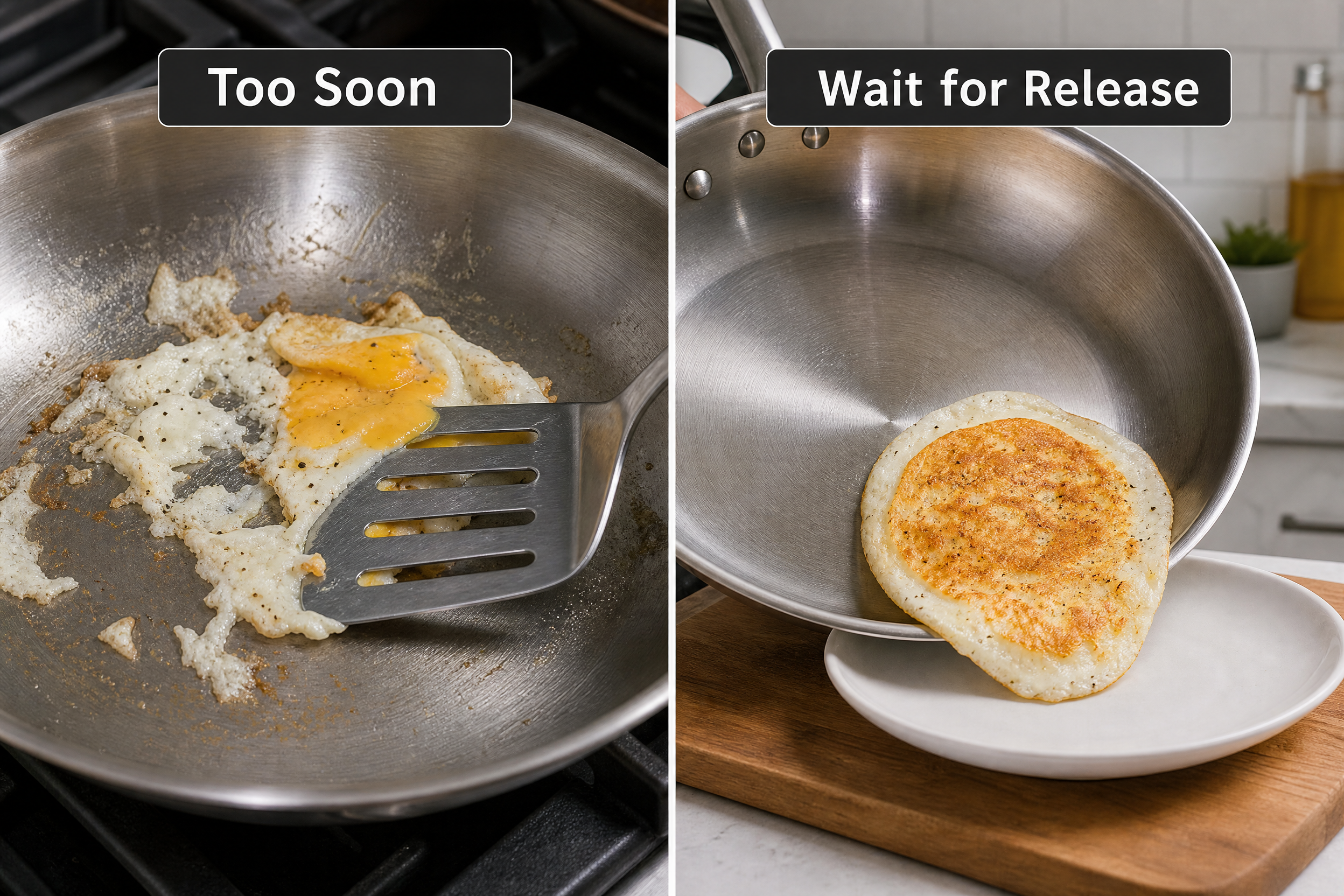
This is where most people undo all their prep work. When meat or eggs first hit the pan, they’ll stick briefly. That’s normal. Leave them alone. Once the protein structure sets and a crust forms—typically 60–90 seconds for eggs, 2–3 minutes for chicken—the food releases cleanly on its own.
Why this works for oil-free cooking too: The ForksOverKnives team tested this for oil-free sautéing. At the Leidenfrost temperature, food’s own surface moisture creates that vapor cushion, so you can sauté vegetables with zero added oil if needed. For proteins, a small amount of oil still helps, but far less than you’d use with a cold pan.
Method 2: Season Your Stainless Steel Pan (Oil Method)
Best for general-purpose cooking prep, not a permanent fix.
Seasoning a stainless steel pan is different from seasoning cast iron. With cast iron, seasoning bakes oil into the metal’s pores and becomes semi-permanent. With stainless steel, seasoning creates a temporary polymerized oil layer on the surface. It reduces sticking for a cooking session, but it doesn’t permanently change the pan.
That said, the seasoning method is worth knowing. It’s the right choice when you’re cooking something that doesn’t need the full Leidenfrost preheating protocol—like making pancakes or doing a longer sauté where you’ll be adding liquid anyway.
How to season a stainless steel pan:
- Start with a clean, dry pan. Any residue from previous cooking will interfere with the oil bonding evenly.
- Heat the pan on medium-high until it just begins to smoke slightly—you want it hot, but not Leidenfrost-level hot.
- Add 1–2 tablespoons of a high smoke-point oil (vegetable, avocado, or canola oil work well; avoid olive oil, which smokes too low).
- Swirl the oil to coat the entire bottom and slightly up the sides.
- Heat until the oil starts to smoke, then remove the pan from heat.
- Let the oil cool, then wipe out any excess with a paper towel. A thin residue of polymerized oil remains.
The seasoned surface will reduce sticking for the cooking session. After washing, the seasoning is largely gone—you’ll need to redo it next time.
When to choose seasoning over the Leidenfrost hack: Use seasoning for lower-heat cooking or long sautés where you can’t maintain the high temp that the Leidenfrost method requires. For high-heat searing or cooking eggs, the water drop test is more reliable.
Method 3: The Cold Pan, Cold Oil Start
Best for fatty proteins like salmon, chicken thighs, and anything where you want a slow-render sear.
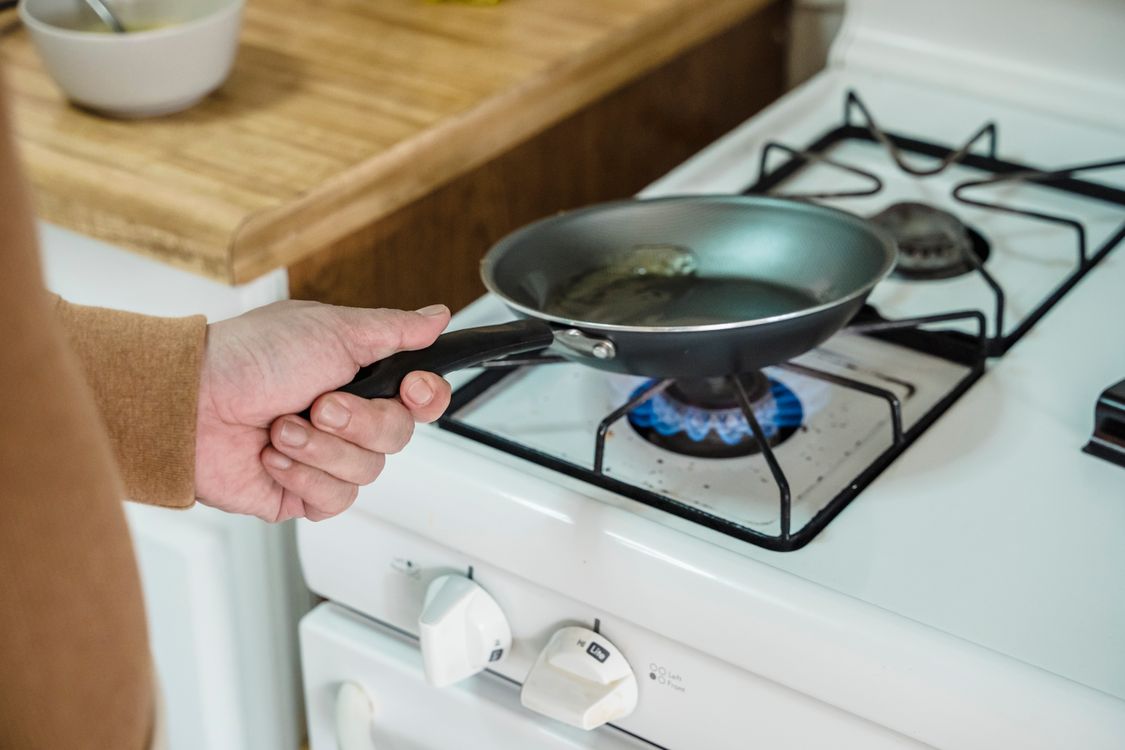
This method is the opposite of everything above, which is why it surprises people. Instead of preheating the pan, you put the food into the cold pan with cold oil, then bring everything up to temperature together.
Here’s the logic: fatty proteins like salmon release their own fat as they heat. If you start them in a hot pan, the surface proteins seize immediately and bond before the fat can create a lubrication layer. Starting cold gives the fat time to render out and coat the surface before anything binds.
How to do it:
- Place your protein in the cold, dry pan, skin-side or fat-side down.
- Add a thin layer of neutral oil around (not over) the food.
- Set heat to medium. Let everything come up together.
- As the fat renders, it will naturally release the food from the surface—you’ll hear the sticking sounds disappear as the pan gets hot.
- Don’t flip until the food releases easily.
Limitations: This method only works for fatty proteins and doesn’t apply to eggs, vegetables, or lean proteins. For those, use Methods 1 or 2.
Which Method to Use: Quick Reference
| Food | Best Method | Why |
|---|---|---|
| Eggs (scrambled, fried, omelet) | Leidenfrost (Method 1) | Precise temp control prevents protein bonding |
| Salmon / skin-on fish | Cold pan, cold oil (Method 3) | Fat renders before proteins bond |
| Chicken thighs | Cold pan, cold oil (Method 3) | Same fat-render principle |
| Chicken breast / lean proteins | Leidenfrost (Method 1) | Needs vapor cushion, not fat render |
| Vegetables / stir-fry | Leidenfrost (Method 1) | High heat, vapor cushion prevents scorching |
| Pancakes / lower-heat cooking | Seasoning (Method 2) | Stable surface for repeated low-heat use |
| Steak | Leidenfrost (Method 1) | Hot pan = Maillard reaction + vapor cushion |
3 Mistakes That Cause Sticking (and How to Fix Each)
Even with the right method, three mistakes undo the work. These come up constantly in r/AskCulinary and r/Cooking threads.
Mistake 1: The pan isn’t hot enough before oil goes in.
This is the most common. People heat the pan for 30 seconds, add oil, add food—and everything sticks. The fix: always do the water drop test before adding oil. If water sizzles and disappears without balling up, the pan isn’t ready. It takes longer than most people expect—2 to 4 minutes on medium heat.
Mistake 2: Overcorrecting by making the pan too hot.
After learning the pan needs to be “really hot,” many cooks crank it to high and blast the pan for 5 minutes. At this point, the water test produces dozens of scattered droplets instead of one gliding ball. The pan has gone past the Leidenfrost zone. Reduce heat, wait 20–30 seconds, test again. A pan at the right Leidenfrost temperature shouldn’t be smoking aggressively—you want shimmer, not smoke.
Mistake 3: Moving the food too soon.
Touching, poking, and lifting food before it has released is the third major cause of sticking. When a protein first hits the pan—even a well-preheated one—it temporarily sticks as the surface proteins set. This phase lasts anywhere from 30 seconds (thin eggs) to 3 minutes (chicken breast). The food will tell you when it’s ready: try to move it, and if it resists, wait. When it’s ready, it releases cleanly with minimal effort.
Food-Specific Tips: What Works for Eggs, Fish, and More
Eggs: The hardest test case.
Scrambled and fried eggs are the ultimate test of non-stick technique in stainless steel. The proteins are delicate and bond easily. Use the Leidenfrost method, and reduce heat to medium-low after the water test passes. Add a small amount of butter (butter’s milk solids create an extra buffer). Don’t touch the egg for at least 45–60 seconds. I’ve cooked scrambled eggs in a stainless steel pan this way with zero sticking and a cleaner result than my old PTFE pan—but only after I stopped rushing the preheat.
Fish (salmon, sea bass, cod):
Fish skin is sticky and delicate. The cold-pan method works best for skin-on fillets. Place the fillet skin-down in a cold pan with a thin film of oil. Medium heat. After 3–4 minutes, the skin will release naturally. Press gently with a spatula only if it hasn’t fully released. Forcing it tears the skin.
Chicken breast and lean proteins:
Use the Leidenfrost method. The key extra step: dry the surface of the protein with paper towels before it goes in the pan. Surface moisture causes the temperature to drop when food hits the pan, which collapses the vapor cushion and causes sticking. Pat dry, add to the properly preheated pan, and don’t move it for 3 minutes.
Vegetables (onions, peppers, mushrooms):
High water content means these will initially steam on contact. That’s fine. Use the Leidenfrost method. Add the vegetables immediately after the water test, reduce heat to medium, and stir every 30–60 seconds. Their own moisture deglazes the pan as they cook.
Pasta and grains:
Avoid cooking pasta directly in a stainless steel pan without adequate liquid and stirring. The starch bonds aggressively to the surface if it runs dry. If it sticks, add a splash of water and scrape with a wooden spoon—the sticking will release quickly.
FAQ
Can you really make stainless steel non-stick?
Yes—but it’s more accurate to say you can make stainless steel behave non-stick through temperature management. You’re not changing the material or coating it. The Leidenfrost effect creates a vapor cushion between food and surface that eliminates sticking when the pan reaches 370°F–450°F. The result is functionally non-stick for most cooking tasks, including eggs.
Do I need to do this every time I cook?
Yes. Unlike cast iron seasoning, there is no permanent non-stick change to stainless steel. Each cooking session requires proper preheating. The good news: once you’ve done the water drop test a dozen times, it becomes automatic and adds less than 3 minutes to your prep.
At what temperature does stainless steel become non-stick?
The Leidenfrost zone for stainless steel is approximately 370°F to 450°F (190°C to 232°C). Below 370°F, water sizzles and evaporates. Above 450°F, water scatters. The mercury-ball behavior—one or two smooth droplets gliding across the surface—is your visual confirmation that you’re in the right range.
Why does food still stick even when I use the water drop test?
Three common causes: (1) you added too much food at once, which dropped the pan temperature below the Leidenfrost threshold; (2) the food had a wet surface and you didn’t pat it dry first; or (3) you moved the food before it had time to release on its own. Surface moisture is the most common culprit—always pat proteins dry.
Does this method work on induction cooktops?
Yes. Induction heats stainless steel pans the same way as gas or electric. The water drop test works identically. Induction does heat faster, so start with medium heat rather than medium-high and test after about 90 seconds instead of 2 minutes.
Is stainless steel actually healthier than PTFE non-stick?
Stainless steel does not release chemicals when heated. PTFE (Teflon) coatings are stable at normal cooking temperatures but can break down above roughly 500°F (260°C). If PFOA concerns drive your choice, stainless steel or cast iron are solid alternatives. Neither material has been linked to health issues at normal cooking temperatures with proper use.
Final Thoughts
Stainless steel gets a bad reputation for sticking because most people start cooking before the pan is ready. The Leidenfrost effect turns stainless steel into a genuinely capable non-stick surface—the science is reliable, the visual cue (mercury-ball water drop) is unambiguous, and once you’ve experienced it, you won’t mistake it.
The short version: dry pan, medium heat, 2–3 minutes, water drop test, add oil when the drop glides, cook. That sequence handles 80% of everything you’ll cook in stainless steel. For fatty proteins like salmon or chicken thighs, the cold-pan cold-oil method is worth learning too.
What you don’t get with stainless steel is the forgiveness of a coated pan. If you rush the preheat, food sticks. If the pan is too hot, oil smokes before it can do anything useful. Stainless steel rewards technique—and the techniques here are worth the 10 minutes it takes to practice them once.