

Polishing stainless steel cookware isn’t one-size-fits-all — the right fix depends on what you’re dealing with. Rainbow discoloration disappears in under 2 minutes with white vinegar. Water spots and mineral haze respond to a warm vinegar soak or Bar Keepers Friend. Burnt-on exterior stains need Bar Keepers Friend Cookware Cleanser combined with steel wool — the approach The Kitchn’s real-world testing rated highest across five methods. Surface dullness polishes back to a mirror shine with circular-free, grain-following strokes and a final buff of olive oil. This guide matches each fix to each problem type, covers both interior and exterior surfaces, and explains what not to use.
Why Your Stainless Steel Loses Its Shine
Stainless steel keeps its shine through a thin, self-repairing chromium oxide layer that forms wherever the steel’s chromium content (at least 10.5% by mass in food-grade alloys) contacts oxygen. This passive layer is only a few nanometers thick — you can’t see it — but it’s what makes the steel “stainless.”
Four things disrupt or build up on that layer:
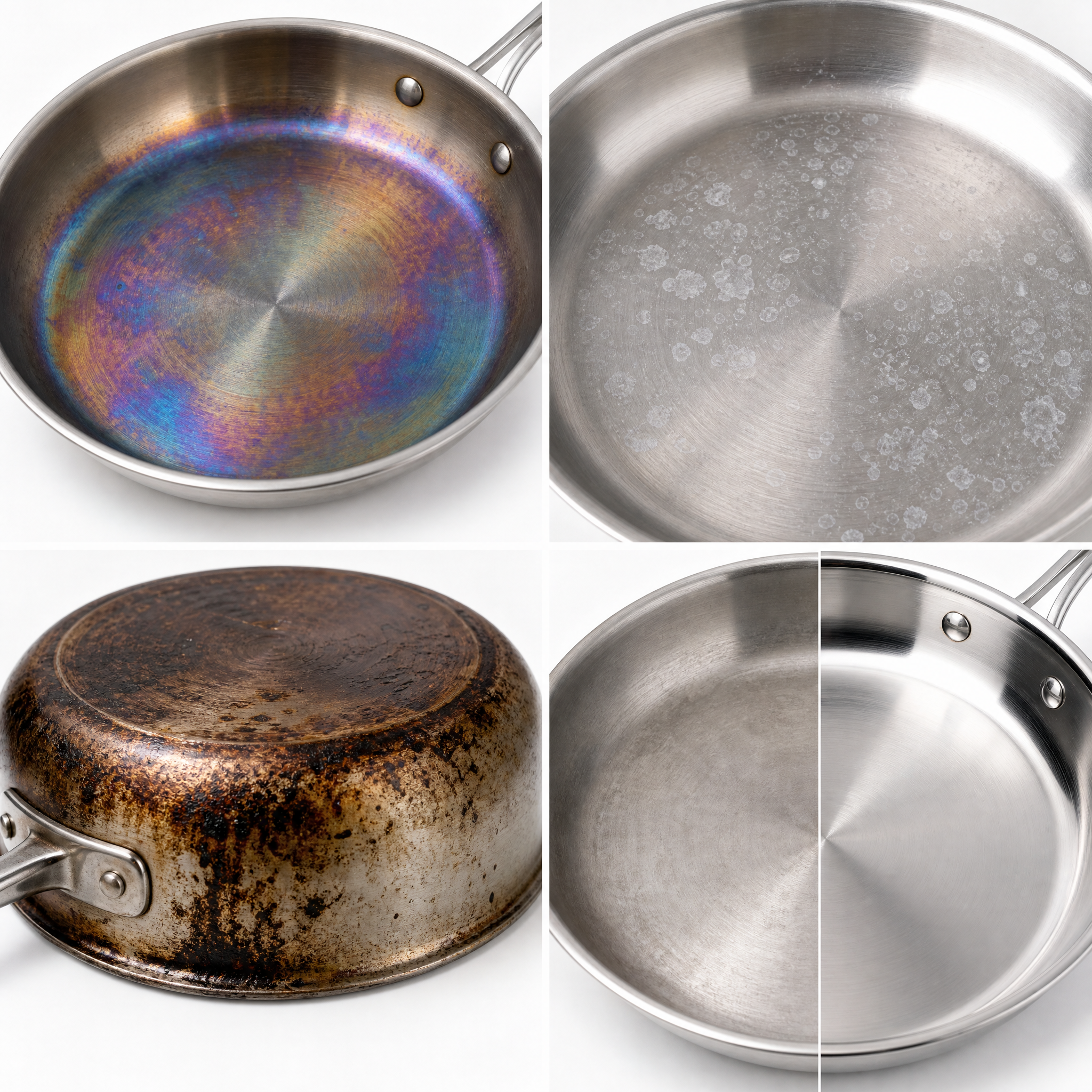
1. Rainbow discoloration (iridescence): Heat causes the passive layer to thicken unevenly, creating light interference patterns — the same physics as an oil slick on water. Appears as blue, purple, or golden streaks inside or around the base of the pan. Completely harmless, easily reversed.
2. Water spots and mineral haze: Calcium and magnesium ions in hard water leave chalky deposits when water evaporates. These look like a cloudy film or scattered white spots and accumulate quickly if you air-dry your cookware instead of toweling it off.
3. Brown and black exterior stains: Grease and food splatter carbonize on the pan’s exterior when exposed to stovetop heat. These bond tenaciously to the metal and need real abrasive action to lift.
4. General dullness: Oxidation and micro-scratches from routine cleaning gradually reduce reflectivity. The pan still works perfectly — it just doesn’t gleam the way it did when new.
Each of these needs a different approach. Trying to fix them all with the same method is why most people get frustrated.
Quick-Reference: Which Fix for Which Stain
| Problem | Best Fix | Time |
|---|---|---|
| Rainbow / iridescent discoloration | White vinegar | Under 2 minutes |
| Water spots / mineral haze (interior) | Vinegar simmer method | 10–15 minutes |
| Water spots / mineral haze (exterior) | White vinegar spray + microfiber | 3–5 minutes |
| Burnt brown / black exterior stains | BKF Cookware Cleanser + steel wool | 10–20 minutes |
| Stuck-on interior food residue | Baking soda paste or simmer | 15–20 minutes |
| General dullness / restore mirror shine | BKF Cookware Cleanser + olive oil buff | 10–15 minutes |
Remove Rainbow Discoloration in Under 2 Minutes
Rainbow stains alarm people when they appear inside a brand-new pan after the first use. They look like something went wrong. Nothing did — they’re a physics side effect of overheating.
When you preheat an empty stainless steel pan on high heat, or leave it on the burner too long, the chromium oxide passive layer thickens unevenly across the surface. Different thicknesses refract visible light at different wavelengths, producing those iridescent blue, purple, and golden rings. The pan is completely safe to cook in. The discoloration exists only at the surface layer and disappears with acid.
How to remove it:
- Pour enough undiluted white vinegar into the pan to cover the stained area. For exterior rainbow marks, apply vinegar with a cloth or paper towel.
- Let it sit for 30–60 seconds. Vinegar is mildly acidic and works fast on this specific type of discoloration — you don’t need long contact time.
- Scrub gently with a soft sponge or microfiber cloth in the direction of the grain (the faint parallel lines running across the steel surface).
- Rinse thoroughly with water and dry immediately with a clean cloth.
The stain should disappear completely in one pass. If a faint shadow remains, repeat once. The acetic acid in vinegar dissolves the thickened chromium oxide layer and reveals fresh steel underneath.
To prevent it coming back: Preheat on medium heat, not high. Stainless steel heats unevenly when empty — local hot spots overheat the passive layer before any oil or food is present to absorb that energy. Medium heat, then increase as needed.
Clear Up Water Spots and Mineral Haze
White chalky spots and cloudy films on the interior are mineral deposits — primarily calcium carbonate left behind when hard water evaporates. They’re cosmetic, not damaging, but they accumulate fast if you air-dry your pans rather than wiping them dry after each wash.
For interior mineral haze — the vinegar simmer method:
- Fill the pan with a 1:1 mix of white vinegar and water — enough to cover the affected area.
- Bring to a gentle simmer over medium heat and hold for 5 minutes.
- Pour out the solution and let the pan cool slightly.
- Wash with dish soap and a soft sponge.
- Dry immediately with a clean cloth.
The mild acidity dissolves calcium carbonate as it heats. This same method handles faint rainbow discoloration you missed earlier.
For exterior water spots:
Spray or wipe undiluted white vinegar onto the affected area. Let it sit 2–3 minutes, then wipe clean with a microfiber cloth following the grain. Rinse and dry.
If the haze is stubborn (heavy hard water area): The liquid version of Bar Keepers Friend Cookware Cleanser tackles persistent mineral deposits more aggressively than vinegar. Apply a small amount to a damp cloth, work in the direction of the grain, and rinse thoroughly within one minute.
The single most effective prevention habit for water spots: dry the pan immediately after every wash. Don’t leave it in the dish rack. A 10-second wipe eliminates the problem before it starts.
Tackle Burnt Stains and Brown Residue
Burnt exterior stains are the hardest to remove and the most common frustration. After months on the stovetop, the bottom and sides of stainless pans accumulate carbonized grease that looks almost welded on — soap does nothing, and most scrubbing barely touches it.
For interior burnt-on food — baking soda method:
Baking soda is the right tool for the inside of the pan. It’s mildly abrasive without scratching polished cooking surfaces, and it chemically loosens carbonized residue.
- Add 2–3 tablespoons of baking soda to the pan.
- Add enough water to cover the burnt area.
- Bring to a simmer and hold for 5 minutes. The residue should loosen visibly.
- Remove from heat and let cool. Scrub with the rough side of a non-scratch sponge.
- For anything remaining: make a paste with baking soda and a few drops of water, apply directly to the spot, wait 10 minutes, then scrub.
For exterior burnt stains — Bar Keepers Friend + steel wool:
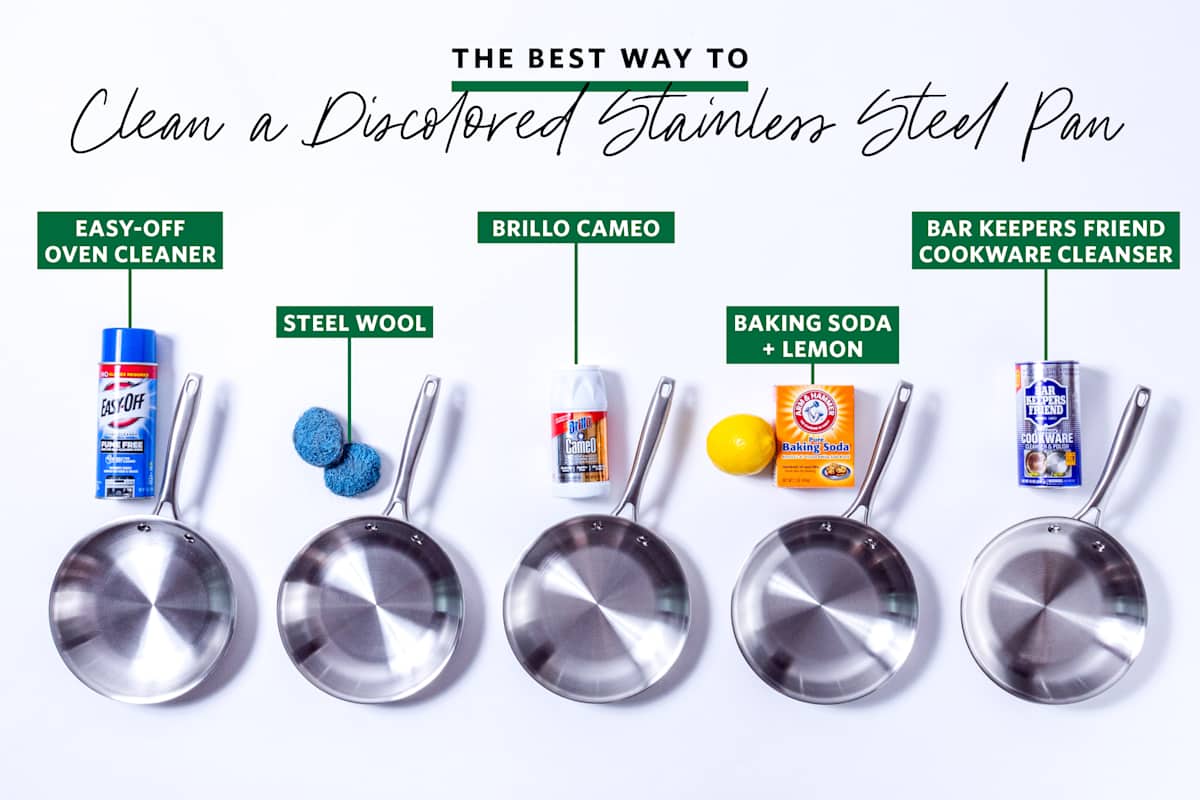
This combination ranked highest in The Kitchn’s tested comparison of five cleaning methods. The oxalic acid in Bar Keepers Friend Cookware Cleanser dissolves iron oxide and loosens carbonized grease, while fine steel wool provides mechanical abrasion that finishes the job.
- Wet the exterior surface with water.
- Apply Bar Keepers Friend Cookware Cleanser (powder or liquid) directly to the stained area.
- Wet a fine steel wool pad with water and begin scrubbing in the direction of the brushed grain — always with the grain, never circular or against it.
- Work in sections. Stains should start lifting within a few back-and-forth strokes.
- Rinse well and inspect. Repeat for deep stains.
- Wash the entire exterior with dish soap to remove all BKF residue. Don’t skip this step.
A note on steel wool: Steel wool scratches soft metals like copper, aluminum, and non-stick coatings. On stainless steel exterior surfaces with a brushed grain finish, fine steel wool follows the existing texture and leaves no visible marks. What it will damage is a polished (mirror-finish) interior cooking surface — so keep it on the outside.
Skip oven cleaner: The Kitchn’s testing gave Easy-Off oven cleaner a 2/5 performance rating on stainless exterior stains — even after an hour of dwell time, stains barely moved. The alkaline sodium hydroxide formula targets oven grime differently than the carbonized grease on stainless. Save it for the oven.
Polish Stainless Steel to a Mirror Shine
Removing stains is one thing. Getting that showroom gleam back — where the pan catches light and looks almost liquid — takes one more step.
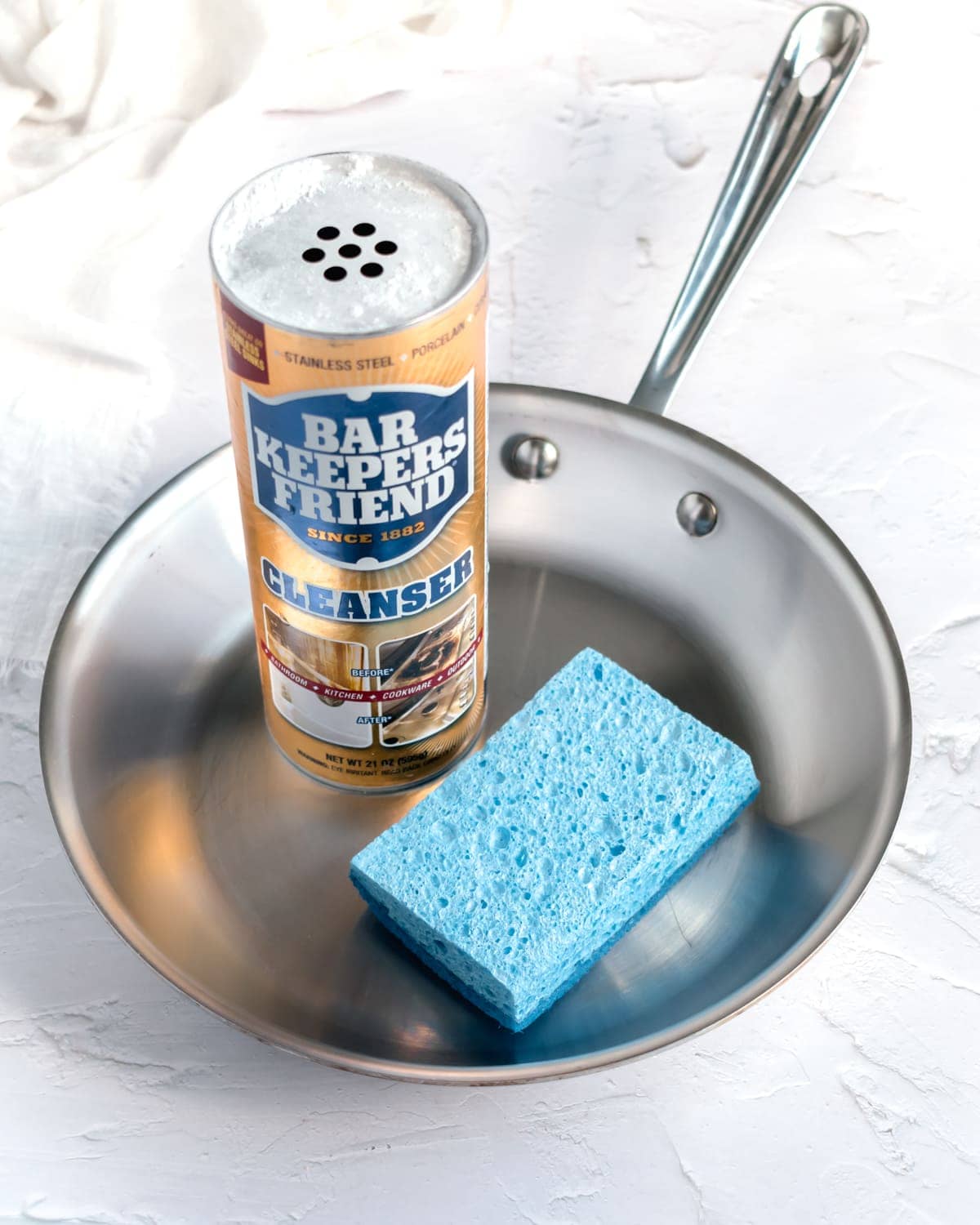
Use Bar Keepers Friend Cookware Cleanser (liquid formula):
The “Cookware Cleanser & Polish” version of BKF is formulated to both clean and polish stainless. The oxalic acid dissolves surface oxidation while fine mineral abrasives smooth micro-scratches that scatter light and cause the pan to look dull rather than reflective.
- Apply a small amount of the liquid formula to a damp microfiber cloth or soft sponge.
- Work in smooth, linear strokes following the grain of the steel. This step is what most people get wrong — circular motions create circular scratch patterns that look hazy in certain light. Always with the grain.
- Continue until the surface looks visually uniform. Rinse thoroughly with warm water.
- Dry immediately.
Final buff — olive oil or mineral oil:
After polishing with BKF, wipe on a very thin coat of olive oil or food-grade mineral oil using a clean cloth. Buff it out until there’s no visible greasy film — just a faint sheen. This fills micro-surface irregularities and changes how the steel catches light, producing that “just unboxed” appearance.
A few drops is enough. More oil leaves a greasy residue that attracts dust and smears under the next touch.
Polishing frequency: Once a month is enough for most home cooks. More often if the cookware sees high-heat daily cooking or sits exposed to dust and humidity between uses.
What NOT to Use on Stainless Steel Cookware
A few things to avoid — either because they damage stainless steel or because they simply don’t work:
Bleach and chlorine-based cleaners: Chloride ions aggressively attack stainless steel’s passive layer, causing pitting corrosion — tiny divots that look like rust spots and can’t be polished out. Never use bleach, chlorine-based sanitizers, or dishwasher detergents with chlorine bleach on stainless cookware. This is why quality manufacturers recommend handwashing, and why your dishwasher is slowly degrading your expensive pans.
Oven cleaner: Tested and rated 2/5. The alkaline sodium hydroxide formula doesn’t work on the carbonized grease that bonds to stainless exteriors. It’s not just ineffective — the prep (gloves, newspaper, ventilation) and extended wait time make it a poor investment of effort.
Steel wool on interior cooking surfaces: Fine steel wool on the interior scratches polished food-contact surfaces, creating micro-grooves that trap food particles and make the pan harder to cook in. On the exterior, it’s fine. On the interior, stick to non-scratch sponges and baking soda paste.
Leaving BKF on longer than one minute: Bar Keepers Friend’s instructions are explicit — maximum one-minute contact time. Extended exposure can lightly etch the steel surface. Apply, scrub actively, rinse. Don’t walk away to answer a text.
Ammonia-based cleaners and harsh household degreasers: These can cause surface etching with prolonged contact and leave residues that are difficult to fully rinse from a cooking surface.
5 Habits That Keep Stainless Steel Looking New
Restoration is effective. Not needing it is better.
1. Dry immediately after every wash. This eliminates the majority of water spot issues. Hard water is unavoidable in most households; letting it air-dry on the surface isn’t. A 10-second wipe with a kitchen towel after washing handles it before it starts.
2. Don’t preheat on high heat. Rainbow discoloration comes from overheating an empty pan. Medium heat is enough for most cooking tasks — stainless steel (especially multi-ply construction) conducts and holds heat well once up to temperature. If you’re searing, preheat on medium-high for 2–3 minutes rather than blasting the pan on maximum from cold.
3. Match pan diameter to burner size. When flames or heating elements extend beyond the base of the pan, they heat the exterior sides unevenly and concentrate carbonized residue exactly where cleaning is most difficult. A matching pan-to-burner fit also improves cooking performance.
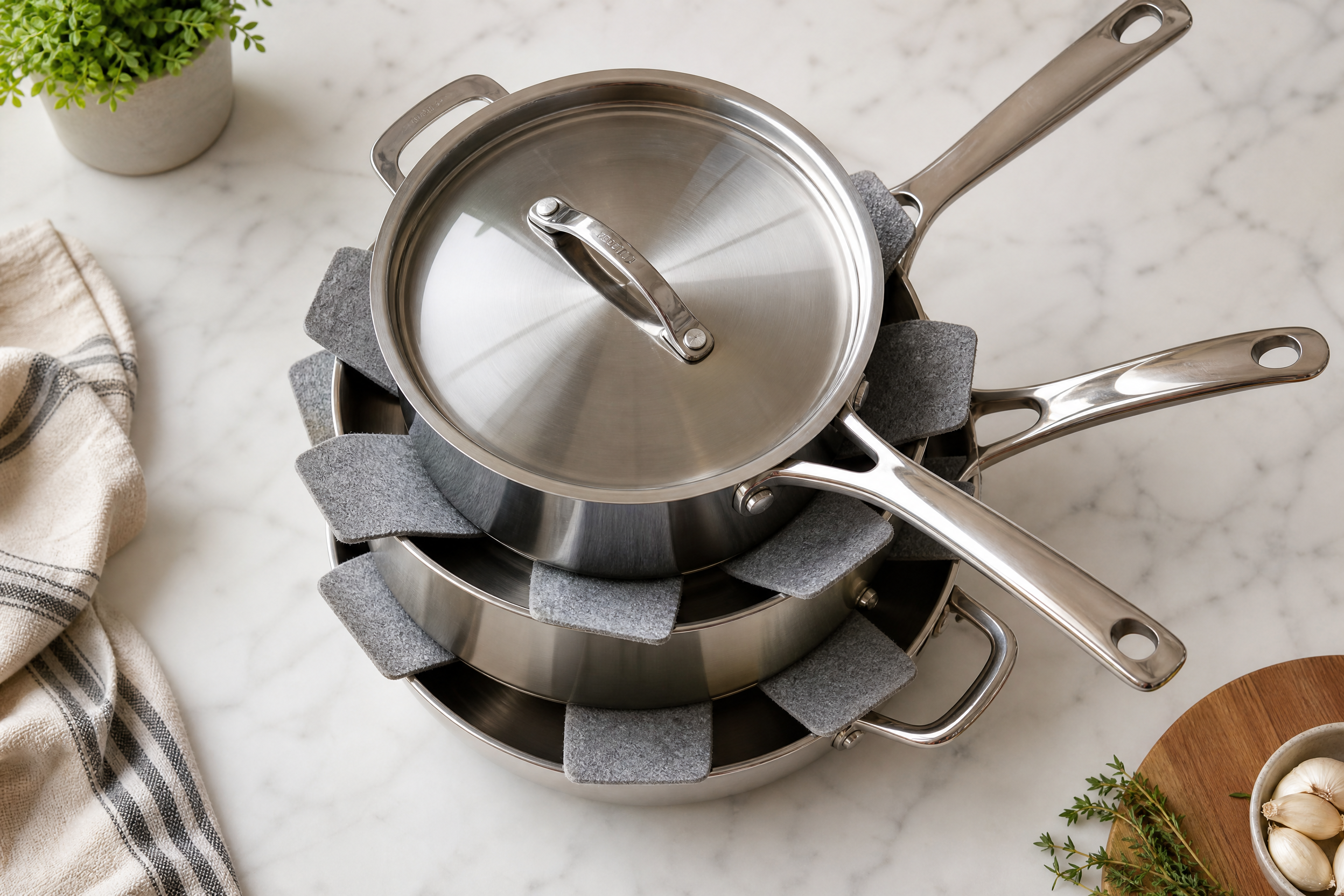
4. Use pan protectors during storage. Stacking stainless steel pans without protectors causes micro-scratches on polished surfaces. Thin felt or foam pan protectors cost a few dollars for a pack and prevent years of surface dulling from stacking.
5. Monthly maintenance polish. A 10-minute pass with BKF Cookware Cleanser once a month maintains surface reflectivity and prevents stain buildup from becoming entrenched. Maintaining shine is far easier than restoring it.
Frequently Asked Questions
Why does my stainless steel pan turn rainbow-colored?
Rainbow discoloration — also called heat tinting — happens when you overheat the pan. The chromium oxide passive layer that gives stainless steel its corrosion resistance thickens unevenly under high heat, causing visible light to refract at different wavelengths across the surface. The result is those iridescent blue, purple, and golden patterns. It’s an optical effect, not a chemical change or defect. White vinegar removes it in under 2 minutes.
Can you make stainless steel pans shiny again?
Yes. Surface dullness from micro-scratches and oxidation responds well to Bar Keepers Friend Cookware Cleanser, applied with a soft cloth in the direction of the grain. The oxalic acid formula removes surface oxidation while fine mineral abrasives restore reflectivity. A final buff with a thin coat of olive oil completes the effect. Most pans can be restored to close to their original appearance with one session.
Is it safe to use steel wool on stainless steel pans?
On the exterior and bottom of stainless steel pans, fine steel wool (not soap-pad varieties) is effective and leaves no visible damage when used with the grain. On the interior cooking surface — especially polished finishes — steel wool leaves scratches. Keep steel wool on the outside. For interior cleaning, use non-scratch sponges or baking soda paste.
How long should I leave Bar Keepers Friend on stainless steel?
No longer than one minute. BKF’s own instructions specify a maximum one-minute contact time. Apply it, scrub actively, then rinse thoroughly with water. Extended contact can lightly etch the steel surface.
Does olive oil really shine stainless steel?
A thin buff of olive oil — applied after cleaning with BKF and fully wiped out with a dry cloth — does improve the appearance of stainless steel cookware by filling surface micro-irregularities. It’s not a protective coating (it evaporates or wipes off), but the optical effect is real. Use a very small amount and buff dry. Too much leaves a greasy film.
Why is my stainless steel pan still cloudy after cleaning?
Post-cleaning cloudiness has two common causes: insufficient rinsing (BKF or soap residue on the surface) or remaining mineral deposits from hard water. Rinse twice with hot water after any cleaner, then dry immediately. If cloudiness persists, the vinegar simmer method (1:1 vinegar and water, brought to a simmer for 5 minutes) should clear it.
Can I put stainless steel cookware in the dishwasher?
Technically yes for most stainless steel — it won’t be immediately ruined. But repeated dishwasher cycles cause gradual surface dulling. Many dishwasher detergents contain chlorine compounds that slowly attack the passive layer. Handwashing preserves the finish longer, especially for multi-ply or high-quality cookware.
The Bottom Line
Stainless steel responds well to targeted treatment. Rainbow stains dissolve in vinegar. Water spots clear with an acid soak. Burnt exterior residue yields to Bar Keepers Friend and steel wool — the combination The Kitchn’s testing found more effective than oven cleaner, Brillo Cameo, or baking soda alone. General dullness polishes out with grain-direction strokes and an olive oil finish.
The pattern across all four problems is the same: use the right tool for the specific stain, always work in the direction of the grain, and dry immediately after every wash. A monthly polish keeps restoration work minimal. Most pans that look “too far gone” come back to near-new appearance with one focused cleaning session.