

Rainbow discoloration (heat tint) on stainless steel cookware is caused by a thickened chromium oxide layer from high heat — it’s cosmetic, not damage. To remove it, pour undiluted white vinegar into the pan, let it sit for 5 minutes, and wipe clean. For brown or yellow mineral deposits, use a baking soda paste. For stubborn stains, Bar Keepers Friend works in under a minute. Never use bleach or steel wool on stainless steel — both damage the protective passivation layer. Prevention comes down to one habit: never heat an empty pan on high.
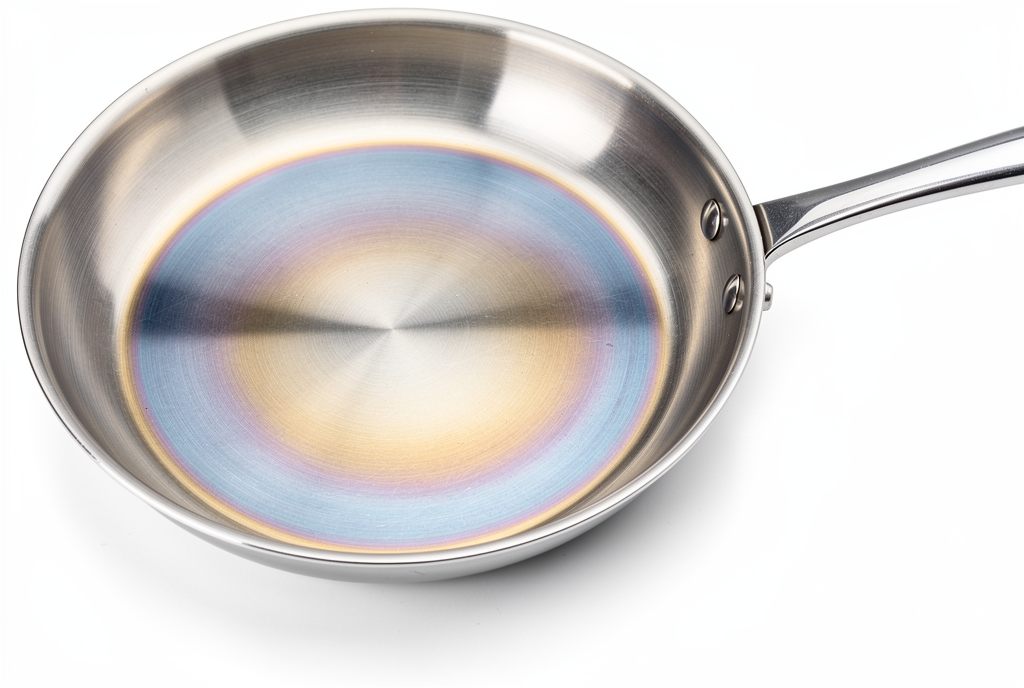
If you’ve pulled a stainless steel pan off the stove and noticed a blueish, gold, or full-spectrum rainbow shimmer on the inside — you’re not alone. That discoloration has a name: heat tint. And the good news is it’s one of the easiest cookware problems to fix, once you know what you’re looking at.
The harder part? There are actually three different types of stains that show up on stainless steel, and each one responds to a different cleaning method. Using vinegar on a mineral deposit won’t do much. Using baking soda on a heat tint takes longer than it needs to. This guide walks through each type, why it happens, and exactly how to remove it — including what to avoid if you don’t want to ruin a $150 pan.
First, Identify Your Stain Type
Before reaching for any cleaning product, look at what you’re actually dealing with. Stainless steel cookware develops three distinct types of discoloration, and the right fix depends on which one you have.
| Stain Type | Appearance | Cause | Fix |
|---|---|---|---|
| Rainbow / Heat Tint | Iridescent blue, purple, gold, or full-spectrum shimmer | High heat oxidizing the chromium layer | White vinegar |
| Brown / Yellow Deposits | Dull brownish or yellowish patches, sometimes white chalky rings | Mineral buildup from hard water, or polymerized cooking oil | Baking soda paste |
| Dark Burn / Scorch | Dark brown or black, often sticky, concentrated in one spot | Overheating or food left to carbonize | Baking soda + dish soap soak, or Bar Keepers Friend |
The quickest test: Run your fingernail across the discoloration. If it’s completely smooth and the color seems to shift as you tilt the pan under light — that’s a heat tint, and vinegar will clear it in minutes. If there’s any texture, buildup, or stickiness, you’re dealing with a deposit or burn, and you need a different approach.
Most stainless steel pans develop a mix of all three over time. Start with the vinegar treatment for the iridescent sections, then address any remaining brown patches with baking soda.
Why Rainbow Stains Form on Stainless Steel
Rainbow discoloration is a physical optics effect, not chemical contamination. Here’s what’s actually happening inside your pan.
Stainless steel gets its corrosion resistance from chromium — cookware-grade alloys (304 and 316 stainless) contain 16–18% chromium by weight (most commonly 18/10, meaning 18% chromium, 10% nickel). When chromium is exposed to air, it spontaneously forms a thin, transparent chromium oxide layer on the steel surface — primarily Cr₂O₃ with traces of chromium hydroxide. This layer is what makes stainless steel “stainless” — it’s a self-healing protective film about 1–3 nanometers thick under normal conditions.
When you heat the pan — especially above 300°C (570°F) or on high heat without any oil or liquid — this oxide layer thickens. As it grows thicker, it causes thin-film optical interference: different wavelengths of light reinforce or cancel each other as they reflect off the two surfaces of the oxide film, creating the same visual effect as a thin film of oil on water: the rainbow spectrum.
The colors you see correspond roughly to the layer’s thickness:
- Gold / straw — thinnest oxidation, lowest heat exposure
- Blue / purple — moderate oxidation
- Full rainbow spectrum — heavier oxidation, typically from extended high heat
This is not rust, corrosion, or damage to the steel itself. The pan’s structural integrity is unaffected. The same phenomenon occurs on titanium welds and is well-documented in metallurgical literature. Your food is completely safe to cook in a rainbow-stained pan.
Is Rainbow Discoloration Safe to Cook With?
Yes — rainbow heat tint on stainless steel is purely cosmetic and poses no food safety concern.
Both Calphalon and Made In Cookware explicitly confirm this in their official care documentation. The thickened chromium oxide layer that causes the rainbow effect is actually the same passivation layer that makes stainless steel food-safe in the first place. It doesn’t leach into food, doesn’t affect flavor, and doesn’t change how heat distributes through the pan.
The only scenario where discoloration signals a real problem is if you see pitting (small holes or craters in the surface) or if the steel has a persistent white chalky film that doesn’t come off with normal cleaning. Pitting can occur from prolonged exposure to chloride-heavy environments (like leaving saltwater in the pan), and it does affect the pan’s integrity. But iridescent rainbow shimmer — even dramatic, full-spectrum discoloration — is never a structural issue.
One thing worth noting: very heavy, sustained overheating can cause the steel’s grain structure to change at a microscopic level, which sometimes shows up as a permanent dull gray cast rather than a rainbow. This is rare with home cooking but more common in commercial kitchens where pans run on high heat for hours. If your pan has that flat gray appearance and won’t clean up even with Bar Keepers Friend, the surface has likely changed permanently — though it’s still safe, just less attractive.
Method 1: White Vinegar (For Rainbow Heat Tint)
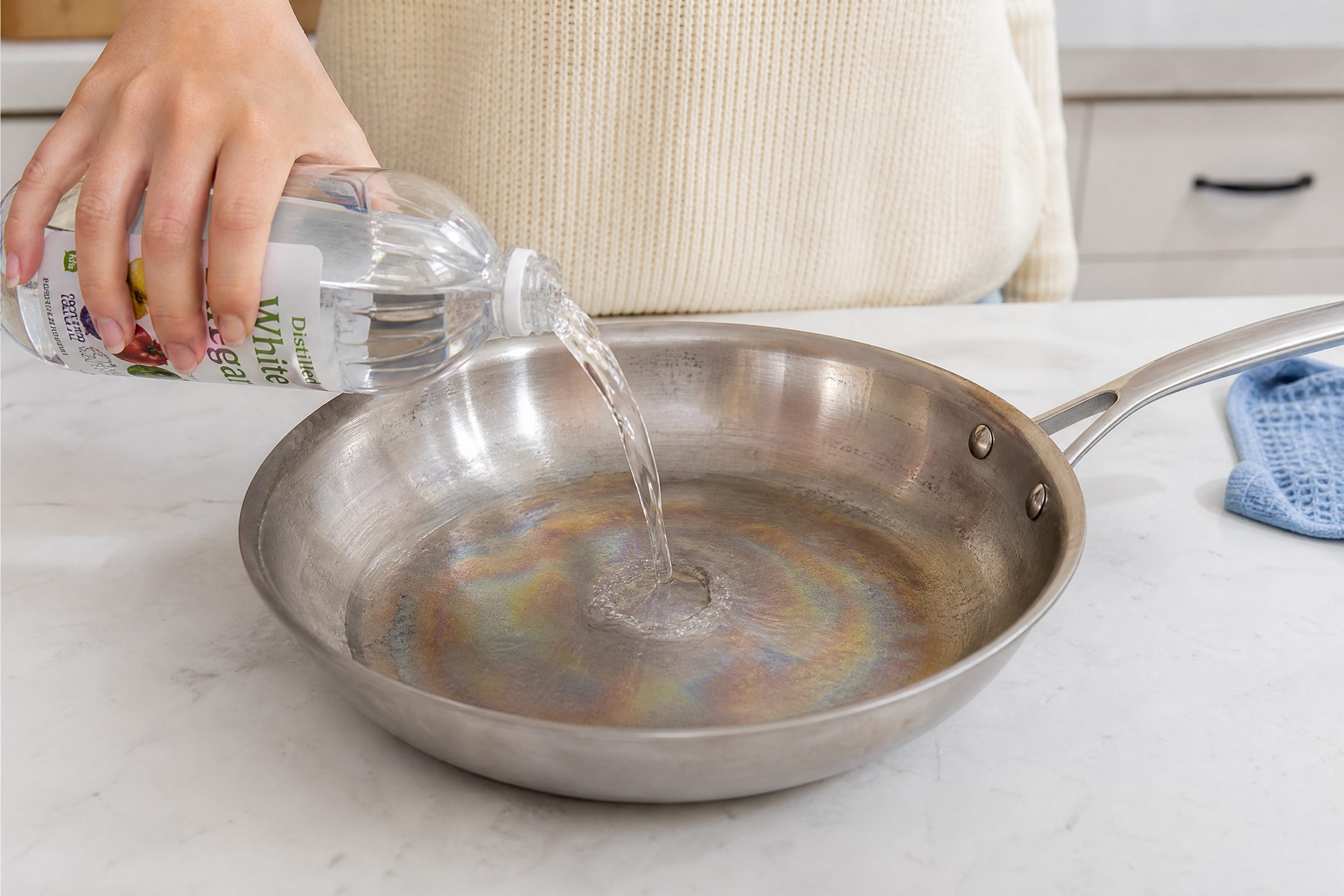
White vinegar removes rainbow heat tint in 2–5 minutes. This is the fastest fix and the one confirmed by multiple cookware brands and hundreds of Reddit users with good reason: it works reliably on fresh and older heat tints alike.
Why vinegar works: The acetic acid in white vinegar (typically 5% concentration) is a mild acid that breaks down the outer chromium hydroxide component of the thickened oxide layer. Once that extra-thick layer is removed, the remaining thinner oxide reforms naturally and no longer produces the rainbow effect. You’re not stripping the steel bare — you’re reducing an overgrown protective layer back to its normal state.
What you need:
- Standard white distilled vinegar (5% acidity — the regular grocery store kind)
- A soft sponge or microfiber cloth
- Water for rinsing
Steps:
- Make sure the pan is cool to the touch before you start.
- Pour enough undiluted white vinegar into the pan to cover the stained area. For a full-pan rainbow, a few tablespoons is usually enough — you just need to be able to swirl it around and coat the surface.
- Let it sit for 2–5 minutes. For fresh heat tints (happened in the last few days), 2 minutes is plenty. For older or more intense discoloration, give it 5 minutes.
- Use a soft sponge to gently wipe the surface in circular motions. You should see the rainbow vanish almost immediately.
- Rinse thoroughly with warm water and dry with a clean towel right away.
If it doesn’t fully clear: Repeat the process, or leave the vinegar in place for up to 10 minutes on a stubborn stain. Don’t scrub harder — the acid needs time to do the work, not mechanical force.
Diluting the vinegar with water will slow the process but still works — just extend the soak time to 10–15 minutes. Lemon juice (also acidic, roughly 5–6% citric acid) is an equally effective substitute if you don’t have vinegar on hand. Calphalon lists it as an official recommendation in their care documentation.
Method 2: Baking Soda Paste (For Brown or Yellow Mineral and Oil Deposits)
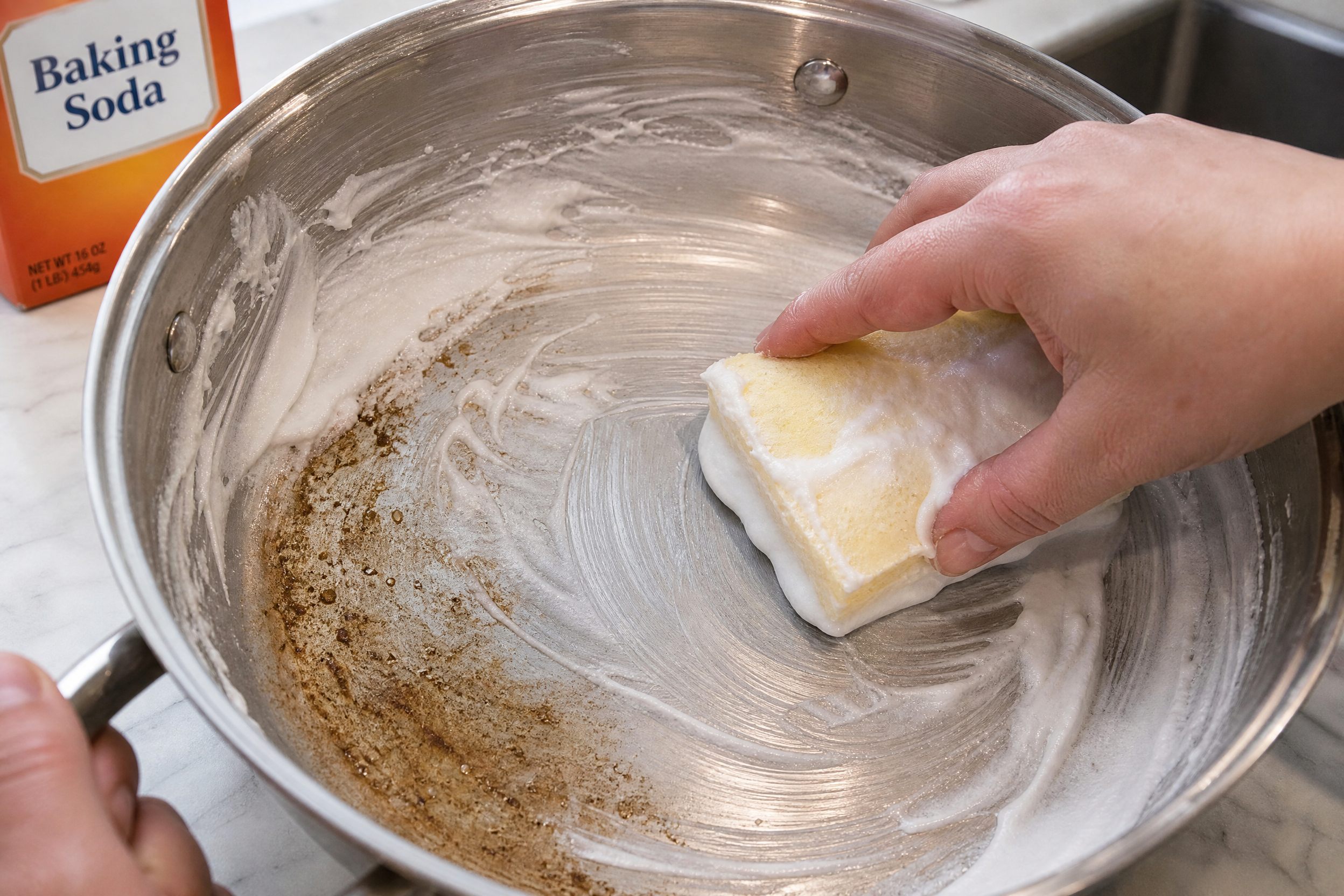
Baking soda paste lifts mineral buildup and polymerized oil residue that vinegar alone won’t touch. If your pan has dull brownish patches, white chalky rings (especially around the waterline), or sticky yellowish areas that persist after normal washing, you’re dealing with deposits — not heat tint.
Why baking soda works here: Baking soda (sodium bicarbonate) is a mild abrasive and a weak base. It physically lifts mineral scale and oil residue through gentle mechanical action, without being aggressive enough to scratch a brushed or polished stainless surface. The slight alkalinity also helps break down fatty acid deposits from cooking oils that have polymerized (essentially baked onto the surface).
What you need:
- Baking soda (standard grocery store sodium bicarbonate)
- Small amount of water or dish soap
- Soft sponge or non-scratch scrubbing pad
- Water for rinsing
Steps:
- Let the pan cool completely.
- Add 2–3 tablespoons of baking soda to the pan, then add just enough water (or a drop of dish soap) to form a thick paste — aim for a consistency like toothpaste.
- Apply the paste to the stained areas and let it sit for 10–15 minutes. For tough mineral scale (the chalky white rings from hard water), you can let it sit up to 30 minutes.
- Scrub in circular motions using a soft sponge or non-scratch pad. With mineral deposits, you’ll feel a gritty texture as the scale lifts.
- Rinse with warm water and dry immediately.
For stubborn oil deposits: Mix the baking soda paste with a few drops of dish soap instead of plain water. The degreasing action of dish soap combined with baking soda’s mild abrasion handles polymerized oil better than either ingredient alone.
Hard water rings specifically: If you regularly see white rings where water has boiled away, the issue is calcium and magnesium carbonate from your tap water. Vinegar actually handles this too — both acid (vinegar) and mild abrasive (baking soda) will dissolve carbonate scale. If you have very hard water, a 5-minute vinegar soak followed by a baking soda scrub clears both the scale and any associated discoloration in one session.
Method 3: Bar Keepers Friend (For Stubborn or Severe Stains)
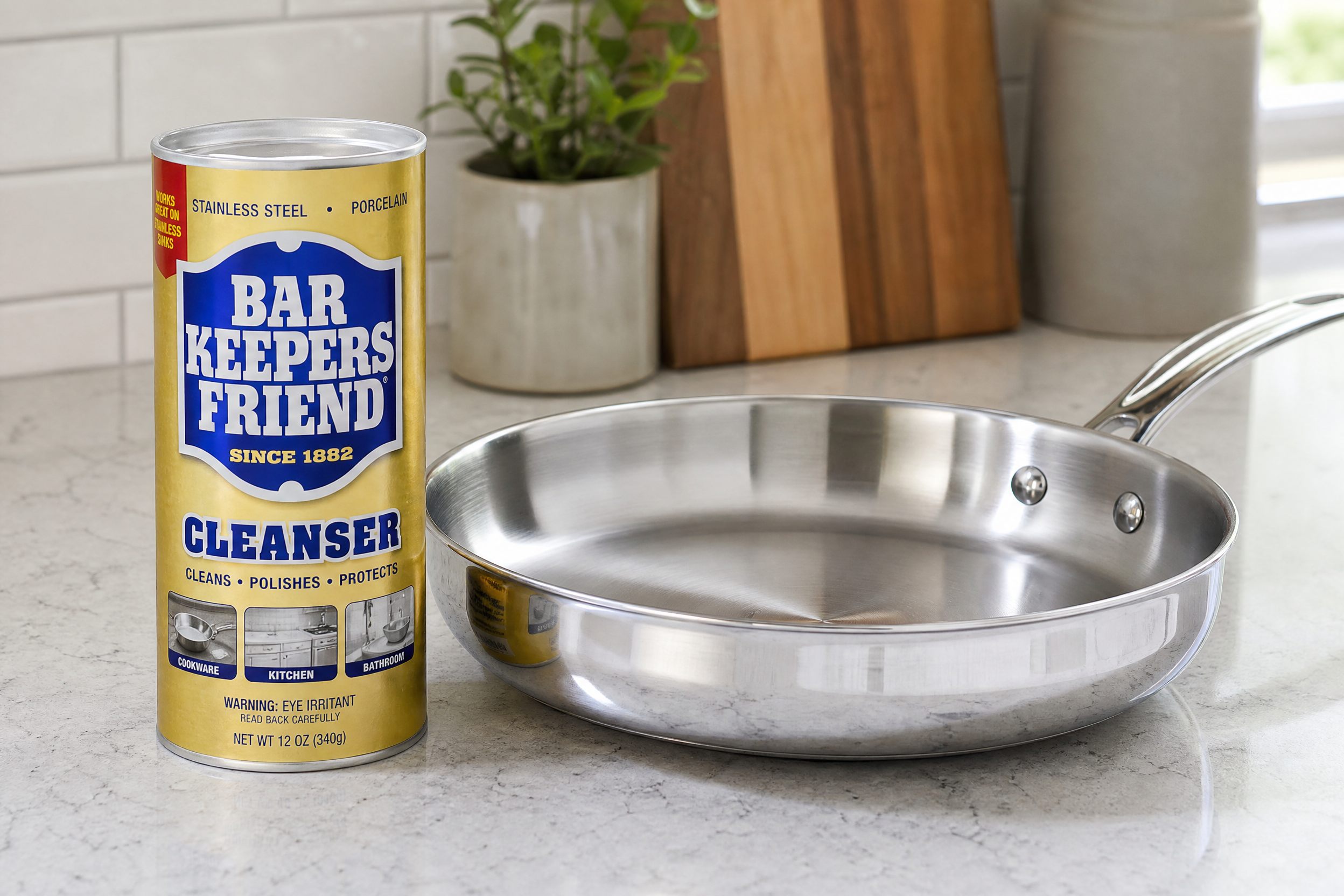
Bar Keepers Friend is the most effective single-product solution for all three stain types, including severe discoloration that vinegar and baking soda can’t fully clear. Both Calphalon and Made In Cookware name it specifically in their official care guides. It handles heat tints, mineral scale, oil deposits, and light burn marks in one treatment.
Why it works: Bar Keepers Friend contains oxalic acid (the active cleaning ingredient) plus a glass oxide abrasive. Oxalic acid is significantly more aggressive than acetic acid (vinegar) at removing metal oxides — it’s both a stronger acid and a chelator that binds to iron compounds — while still being safe for food-contact stainless steel (listed in FDA 21 CFR as acceptable for food-contact applications). The glass oxide particles provide mild mechanical abrasion to help lift the loosened oxidation without scratching the steel base.
What you need:
- Bar Keepers Friend powder or liquid (powder is slightly more effective; liquid is more convenient)
- Soft sponge or non-scratch pad — do not use steel wool or abrasive Scotch-Brite on finished surfaces
- Water
Steps:
- Wet the pan surface lightly with water.
- Sprinkle a small amount of BKF powder onto the wet surface (or apply the liquid version directly). You need less than you think — a teaspoon covers the interior of a 10-inch pan.
- Using a damp soft sponge, work the paste into the stained areas with circular motions. For heat tints, you’ll see the rainbow color fade within 30–60 seconds.
- Don’t let it sit longer than 1 minute on the surface — BKF is more acidic than vinegar and extended contact can affect the finish, especially on mirror-polished pans.
- Rinse thoroughly with warm water, making sure all powder residue is completely washed away. BKF leaves a powdery film if under-rinsed that can be mistaken for a new stain.
- Dry immediately.
Powder vs. liquid BKF: The powder version contains slightly more oxalic acid concentration and the abrasive particles are more evenly distributed. The liquid is easier to control and works well for routine maintenance. Either works for discoloration removal.
One thing I’d add from using both regularly: the powder is better for a pan that’s heavily stained across the whole interior surface, while the liquid is better for spot-treating a specific area without affecting the rest.
What NOT to Use on Stainless Steel
This section matters more than most guides acknowledge. Some cleaning methods that seem logical will actually damage your pan in ways that aren’t immediately visible but degrade performance and appearance over time.
Bleach or chlorine-based cleaners — Chloride ions attack the chromium oxide passivation layer. This is the same chemical mechanism that causes pitting corrosion in marine environments. Using diluted bleach to clean a stainless pan can cause microscopic damage to the surface that shows up later as rust spots or pitting. Chloride damage is also irreversible — once pitting starts, the pan is compromised. This includes dishwasher detergents with chlorine bleach (check the label), which is one reason many cookware brands recommend hand washing.
Steel wool or metal scrubbers — Steel wool leaves iron particles embedded in the stainless surface. Those iron particles rust, and what you see looks like the stainless steel itself is rusting — but it’s actually contamination from the scrubber. Non-scratch Scotch-Brite pads or soft sponges are safe; metal scrubbers are not.
Abrasive powders used too aggressively — Bar Keepers Friend and similar oxalic acid cleaners are safe when used correctly (briefly, with a soft pad, on a wet surface). Using them with heavy scrubbing pressure or abrasive pads on mirror-polished pans will change the surface finish visibly.
Leaving salt water or acidic foods in the pan for extended periods — Salt is a chloride compound. Leaving salted water or highly acidic foods (tomato sauce, citrus juice) sitting in a stainless pan overnight can pit the surface, especially at the waterline. Always transfer food to a different container for storage.
The dishwasher (for high-end pans) — Dishwashers combine high heat, prolonged moisture, and often chlorine-based detergents. Most stainless cookware is technically “dishwasher safe,” but repeated dishwasher cycles accelerate dulling and discoloration. Hand washing takes 90 seconds and keeps the surface looking better for years longer.
How to Prevent Rainbow Discoloration
Rainbow heat tint is almost always preventable with one habit change: never heat stainless steel empty on high heat.
The chromium oxide layer thickens when the steel gets hot without any heat-absorbing medium present (oil, water, or food). Empty pan on high flame = the fastest route to rainbow discoloration. Here’s what actually prevents it:
Preheat correctly. Medium heat is almost always enough for stainless steel cooking. The common test: add a drop of water to the pan before adding oil. If the water forms a bead and rolls around without evaporating immediately, the pan is at the right temperature (the Leidenfrost effect — the water droplet is riding on a layer of steam). At this temperature, oil won’t smoke excessively and the steel won’t overheat. If the water instantly turns to steam, the pan is too hot.
Add oil before the pan is ripping hot. Alternatively: add cold oil to a cold pan, then heat together. The oil acts as a visual indicator — when it starts to shimmer and move slightly (not smoke), the pan is at cooking temperature. Oil in the pan also absorbs heat, which prevents the steel from reaching the temperatures that thicken the oxide layer.
Don’t leave an empty pan on heat unattended. Distractions happen, but even 60–90 seconds on high heat with an empty stainless pan is enough to produce visible discoloration on some alloys.
Dry the pan after washing. Leaving water sitting in stainless steel doesn’t cause rainbow stains, but it does encourage mineral deposits (the white rings and brown patches). Towel drying immediately after washing takes 10 seconds and prevents most mineral buildup.
For commercial kitchens: Stainless steel cookware on a professional line is exposed to much higher sustained heat than home cooking. In that environment, periodic treatment with Bar Keepers Friend — weekly or bi-weekly depending on use intensity — is a standard maintenance practice, not a remediation. The goal shifts from “prevent every rainbow” to “keep the surface in good condition despite constant heat exposure.”
Frequently Asked Questions
Why does my stainless steel pan turn rainbow after cooking?
The rainbow color forms when high heat causes the chromium oxide layer on the steel surface to thicken. That thicker layer causes thin-film optical interference — different wavelengths of light reinforce or cancel each other as they reflect through the oxide film, producing a visible color spectrum. It’s a sign the pan got hot enough to accelerate surface oxidation, not a sign of damage or contamination.
Is the rainbow stain on my stainless steel pan safe?
Yes. Rainbow discoloration is purely cosmetic. The chromium oxide layer that causes the effect is food-safe and is actually the same protective layer that makes stainless steel resistant to corrosion. Multiple cookware manufacturers (including Calphalon and Made In) explicitly confirm this in their official documentation.
How do I remove rainbow stains from stainless steel?
Pour undiluted white vinegar (standard 5% grocery store vinegar) into the pan to cover the stained area. Let it sit for 2–5 minutes, wipe with a soft sponge, then rinse and dry. For a faster result, Bar Keepers Friend powder mixed with a little water clears heat tint in under 60 seconds.
What causes blue stains on stainless steel?
Blue or deep purple staining is a heavier version of heat tint — the same chromium oxide phenomenon, just at a thicker oxide layer which produces the blue-violet end of the visible spectrum. It’s more common after sustained high-heat cooking. White vinegar or Bar Keepers Friend removes it the same way as lighter rainbow discoloration.
What should I never use to clean stainless steel cookware?
Avoid bleach, chlorine-based cleaners, and steel wool. Bleach and chlorine damage the passivation layer and can cause irreversible pitting. Steel wool leaves iron particles that look like rust spots. Abrasive metal scrubbers will also scratch polished surfaces.
Will the rainbow stain come back after cleaning?
It can, if the conditions that caused it recur. If you regularly cook on high heat in an empty pan, heat tint will return. The fix is the same every time — vinegar clears it quickly — but changing the heating habit prevents repeated re-staining.
Can I use apple cider vinegar instead of white vinegar?
Yes. Apple cider vinegar has roughly the same acidity as white distilled vinegar (~5%) and works just as well for removing heat tint. The only downside is that it may leave a slight color or scent if not rinsed thoroughly. White vinegar is recommended simply because it’s inexpensive and leaves no residue.
Final Thoughts
The three-stain framework — heat tint, mineral deposits, burn marks — is what makes this practical rather than confusing. Most guides throw “use vinegar and baking soda” at every type of stain without explaining which does what, and that leads to the experience of “I tried vinegar and it didn’t work” when the stain was actually a mineral deposit.
Vinegar handles the rainbow. Baking soda handles the brown chalky buildup. Bar Keepers Friend handles everything stubborn. None of these are expensive or hard to find, and with the prevention habit of not running an empty pan on high heat, most stainless cookware will stay looking close to new for years.