

Sourcing stainless steel mixing bowl sets for commercial kitchens or wholesale distribution comes down to three variables most buyers overlook: steel grade (304 vs 201), gauge thickness, and NSF compliance. This guide breaks down how to evaluate suppliers, what sizes a professional kitchen actually needs, what MOQ and pricing look like for bulk orders, and how to avoid the most common sourcing mistakes — from receiving substandard steel to failing a health inspection because a bowl lacked proper certification.
Why Steel Grade Is the First Thing to Negotiate

The single most common issue commercial buyers run into when sourcing mixing bowls from overseas manufacturers is receiving 201-grade stainless steel when they ordered 304. Both look identical. Both feel solid. The difference shows up three months later when the bowls pit, discolor, or start rusting along the rim after daily commercial dishwashing.
304 stainless (also labeled 18/8) contains 18% chromium and 8% nickel. It’s the industry-standard material for commercial foodservice equipment, resistant to corrosion from salt, acidic ingredients like citrus and vinegar, and the high-heat alkaline detergents used in commercial dishwashers.
201 stainless is a cheaper manganese-based alloy that substitutes manganese for nickel. It passes a basic shine test but corrodes significantly faster in food-contact applications. A lot of budget wholesale lots — particularly from no-name Alibaba suppliers — ship 201 and label it as “food grade stainless” without ever specifying the grade.
What to do: Request the material test report (MTR) or mill certificate from any supplier. Legitimate 304-grade factories will provide this without pushback. Any supplier who hedges on this document is a red flag.
316 stainless is sometimes specified for marine or highly acidic applications, but it’s overkill for most commercial kitchens and adds typically 20–40% to the unit cost depending on market conditions. 304 is the correct commercial standard.
For reference: Vollrath’s heavy-duty commercial mixing bowls are rated as “300-series” stainless, their shorthand for 304-grade. That’s the benchmark most US foodservice distributors use.
Gauge Thickness: The Spec That Separates Commercial from Consumer Grade

After steel grade, gauge is the next thing to pin down in a purchase order. Commercial mixing bowls are typically 18-gauge (approximately 1.2 mm wall thickness) to 20-gauge (0.9 mm). Consumer-grade sets sold at retail can drop to 22-gauge (~0.75 mm) or thinner.
In a commercial kitchen context, thinner-gauge bowls:
- Dent and warp under heavy mixer use
- Develop stress cracks at the rolled rim after repeated high-temperature washing
- Feel lightweight in the hand, which signals low quality to professional kitchen staff
For catering, hotel kitchens, and restaurant prep: specify a minimum of 20-gauge (0.9 mm). For bakeries using the bowls with stand mixers or for high-volume kneading: 18-gauge (1.2 mm).
When requesting samples from a supplier, bring a simple digital caliper. Measuring the sidewall thickness takes 10 seconds and immediately tells you whether the product matches the spec sheet.
| Gauge | Approx. Wall Thickness | Best Suited For |
|---|---|---|
| 18-gauge | ~1.2 mm | High-volume bakery, stand mixer use, heavy daily prep |
| 20-gauge | ~0.9 mm | Restaurant kitchen prep, catering, hotel F&B |
| 22-gauge | ~0.75 mm | Light-duty use; not recommended for commercial purchase |
NSF Certification vs NSF Listed: A Compliance Distinction That Matters
Most buyers see “NSF” on a product page and assume it means the bowl has been independently tested and certified. That’s not always the case. There’s an important difference:
- NSF Certified: The product has been tested and approved by NSF International (or a licensed certification body) against NSF/ANSI Standard 2 (Food Equipment). There’s a listing in NSF’s public database you can look up by model number.
- NSF Listed: Sometimes used loosely to mean the same thing, but can also refer to a manufacturer self-declaration without third-party testing.
For health inspection purposes and for buyers sourcing for regulated foodservice environments in the US, NSF Certified to NSF/ANSI 2 is the correct requirement. Health inspectors in most US jurisdictions require food-contact equipment to meet NSF standards. A bowl that fails this check can result in a citation or a required equipment replacement.
How to verify: Go to nsf.org and search the product’s model number. If it’s not listed, it’s not NSF certified regardless of what the product page says.
Leading brands like Vollrath carry full NSF listings. When sourcing from a manufacturer directly, ask for the NSF certificate number — a legitimate factory supplying to US foodservice will have it for their export line.
Size Guide: What Your Kitchen Actually Needs
Mixing bowls for commercial kitchens are sold in quart sizes, typically ranging from 1/2 quart to 30+ quarts. Buying the wrong size distribution is one of the most expensive ordering mistakes — you end up with 12-quart bowls sitting unused while constantly competing over the three 5-quart bowls on the prep line.
Here’s how kitchen type maps to size:
| Kitchen Type | Most-Used Sizes | Notes |
|---|---|---|
| Restaurant prep kitchen | 3 qt, 5 qt, 8 qt | Sauce work, protein marinade, vegetable prep |
| Commercial bakery | 12 qt, 20 qt, 30 qt | Dough, batter, large-batch mixing |
| Hotel banquet kitchen | 5 qt, 8 qt, 12 qt | Volume varies by event; a mixed set covers most needs |
| Catering company | 3 qt, 8 qt, 12 qt | Portable prep; lighter 20-gauge at these sizes is acceptable |
| QSR / fast-casual chain | 3 qt, 5 qt | High turnover, smaller portions; emphasize durability over size |
A typical wholesale set for a mid-scale restaurant opening might be: 12× 5 qt, 12× 8 qt, 6× 12 qt, 4× 20 qt. Flat-bottom stackable bowls in graduated sizes let the kitchen store them in a single column without wasted space.
Non-slip base or not? For commercial use, a rolled-bottom non-slip silicone base is helpful for tabletop mixing but can trap moisture if not dried properly, leading to staining. Plain-base 304 stainless is easier to sanitize and is the default in most restaurant supply operations.
Wholesale Pricing and MOQ: What to Expect from a Factory

Pricing for commercial stainless steel mixing bowl sets varies significantly by source, volume, and specification. Here’s a realistic benchmark based on current market data:
US Restaurant Supply Distributors (minimum order 1–12 units):
- Single commercial 5 qt bowl: $8–$18 depending on gauge and brand
- 3-piece set (3 qt / 5 qt / 8 qt): $25–$55
- Vollrath heavy-duty single bowls: $12–$25 per unit
Direct Factory / Wholesale (MOQ 200–500 units per SKU):
- FOB China price: $1.70–$5.50 per bowl depending on size and spec
- Set pricing (3–5 bowl sets): $6–$15 FOB China
- Lead time: 30–45 days for standard spec; 45–60 days for custom/OEM
The math for a distributor: A 500-unit FOB order of 3-piece sets at $8/set lands at roughly $12–$15 per set after freight (sea freight: approximately $100–$150/CBM; a 500-set order fills roughly 2–3 CBM). At US wholesale pricing of $25–$35, the margin works for distribution.
Smaller buyers who need 50–200 sets and can’t meet factory MOQ often use trading companies or consolidated wholesale platforms (WebstaurantStore, TigerChef) where unit pricing is higher but there’s no minimum.
OEM and Private Label: What’s Actually Available
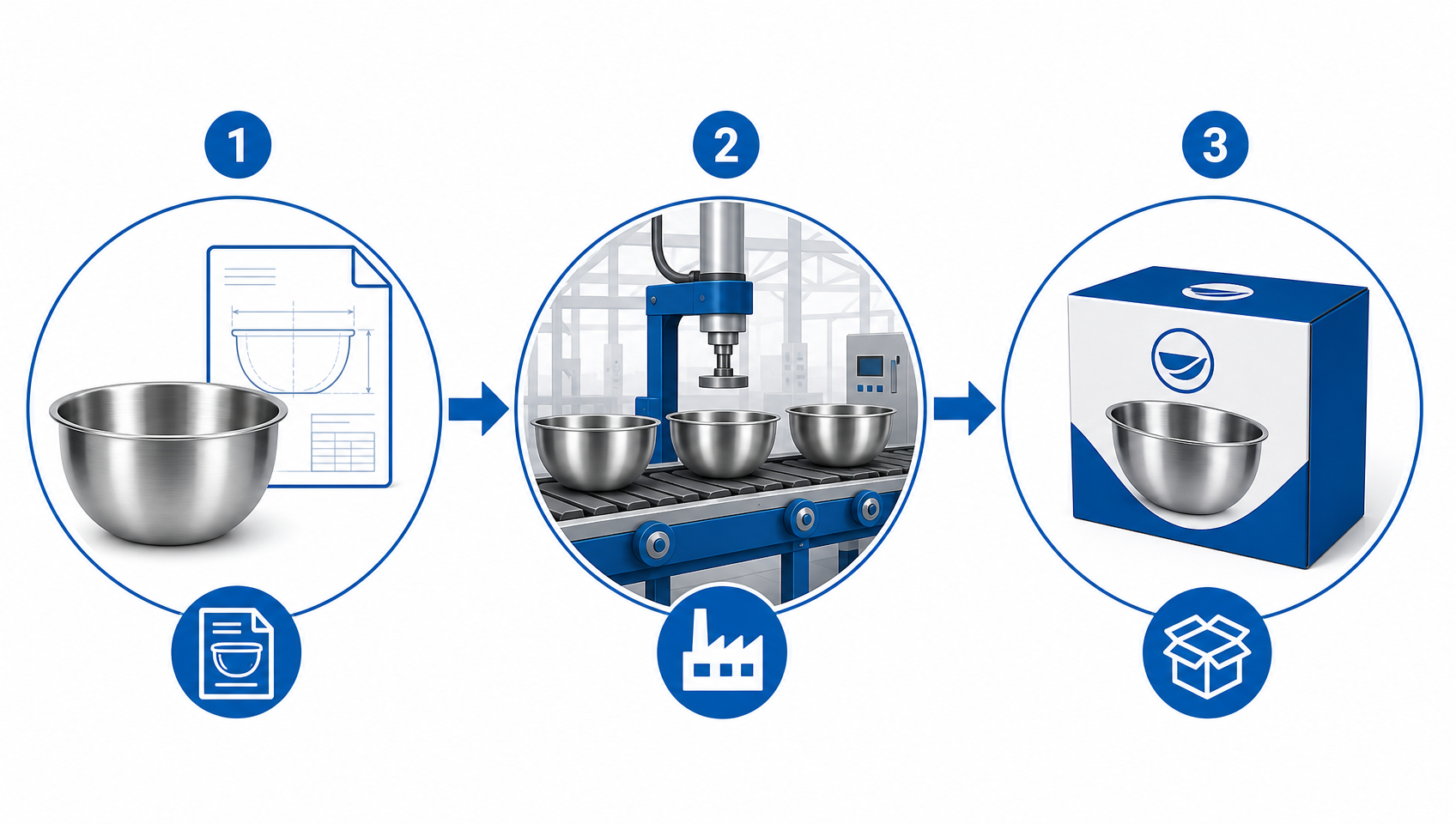
If you’re a kitchenware brand or a foodservice distributor looking to sell under your own label, the private label market for stainless steel mixing bowls is mature and well-structured.
Most Guangdong and Zhejiang kitchenware manufacturers offer:
- Custom embossing or etching of your logo on the bowl exterior (typical MOQ: 300–500 sets)
- Custom packaging (color box, poly bag with your branding)
- Custom handle design or silicone base color (MOQ: 1,000+ units for tooling cost amortization)
- Custom size sets — choosing which 3, 4, or 5 sizes to bundle
OEM lead time with custom tooling: 60–90 days first order. Reorders with established specs: 30–45 days.
Factories with ISO 9001 and BSCI (Business Social Compliance Initiative) audit certification are suitable for buyers supplying major retail chains, which typically require third-party social compliance audits.
Key documents to request from an OEM supplier:
- Material test report (MTR) for each steel batch
- NSF certificate (if applicable to your market)
- ISO 9001 certificate
- Product specification sheet (including gauge, grade, finish type)
- BSCI or equivalent audit report
What to Ask Any Supplier Before You Order
Based on what experienced foodservice buyers look for, here’s the checklist that separates a reliable supplier from one you’ll regret:
Technical:
- What is the steel grade? (Demand 304 / 18-8 in writing)
- What is the gauge thickness of the sidewall?
- Are the bowls NSF certified? What’s the certificate number?
- What finish — mirror polish, satin/brushed, matte? (Mirror is standard for commercial)
Compliance:
- Can you provide the material test report (MTR)?
- Do you have ISO 9001 certification?
- Have you undergone a BSCI or equivalent third-party audit?
Commercial:
- What is the MOQ for each SKU?
- What is the current lead time?
- Do you offer OEM/private label?
- Can you provide 3–5 samples before a bulk order?
Any reputable manufacturer supplying to US or EU foodservice will answer all of these without hesitation. Vague answers to any of these questions are a signal to look elsewhere.
FAQ
What is the minimum steel grade I should specify for commercial mixing bowls? 304 stainless (18/8) is the commercial standard. It resists corrosion from acidic foods, salt, and commercial dishwasher detergents. Avoid 201-grade, which is visually similar but significantly less corrosion-resistant. Always request a material test report to confirm the grade before placing a bulk order.
What gauge stainless steel is best for restaurant mixing bowls? 20-gauge (0.9 mm) is the practical minimum for commercial kitchens. 18-gauge (1.2 mm) is better for bakeries or anywhere bowls are used with stand mixers or under heavy daily load. Consumer-grade bowls sold at retail are often 22-gauge (0.7 mm) and will deform under commercial use.
Do commercial mixing bowls need to be NSF certified? In most US commercial foodservice environments, yes. Health inspectors typically require food-contact equipment to meet NSF/ANSI Standard 2. NSF Certified means the product has been independently tested and listed in NSF’s public database — not just self-declared by the manufacturer.
What is a realistic MOQ for buying mixing bowls direct from a factory? Most Chinese kitchenware manufacturers have an MOQ of 200–500 units per SKU for standard items. For OEM with custom branding or tooling, MOQs typically start at 500–1,000 sets. Trading companies and US wholesale distributors like WebstaurantStore have no minimum quantity requirement but at higher per-unit cost.
What sizes should I order for a restaurant kitchen? For a typical restaurant prep kitchen, 3 qt, 5 qt, and 8 qt bowls handle most prep tasks. Order more units in 5 qt and 8 qt — these are the workhorses. 12 qt and larger are useful for bakeries and banquet kitchens. A standard opening order for a 50-cover restaurant might be: 12× 5 qt, 10× 8 qt, 6× 3 qt, 4× 12 qt.
How do I tell 304 from 201 stainless steel without a test report? A magnet test has limited usefulness — both grades may have slight magnetic properties. The most reliable field test is a ferric chloride spot test (also called a stainless steel test kit, available from welding supply shops). But the professional approach is to require the material test report from the factory. If a supplier can’t or won’t provide it, that tells you everything you need to know.
Buying Smart, Not Just Buying Cheap
Commercial mixing bowls are daily-use equipment that goes through industrial dishwashers, gets stacked under other heavy items, and handles everything from acidic vinaigrettes to salt-heavy brines. The cheapest price at the point of order is rarely the cheapest cost over 12 months.
The purchase decision that matters: nail down the steel grade and gauge in writing before committing to any bulk order. A supplier that agrees to 304/18-8 at 20-gauge minimum, provides an MTR, and holds an NSF certification is worth a higher per-unit price than a mystery-grade bowl that passes a price comparison but fails after one season in a real commercial kitchen.
For buyers sourcing in volume — whether for a restaurant group, a distribution business, or an OEM private-label product — the factories that move serious units to US and EU foodservice accounts are not the cheapest options on Alibaba’s front page. They’re the ones with audit reports, certifications, and five years of verified export history. That documentation is what protects you when a health inspector shows up or when a customer returns a pallet of bowls that don’t match the spec sheet.