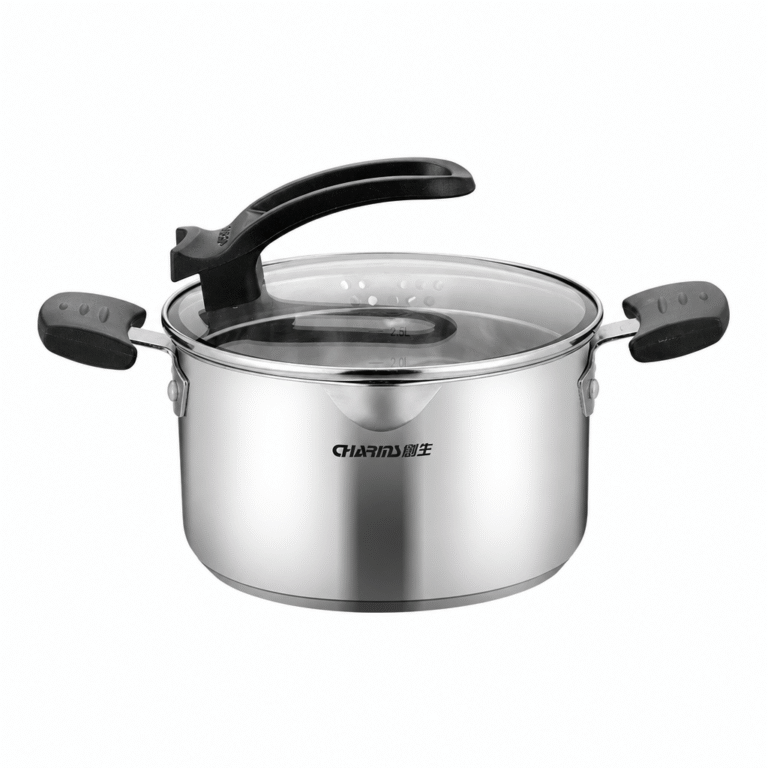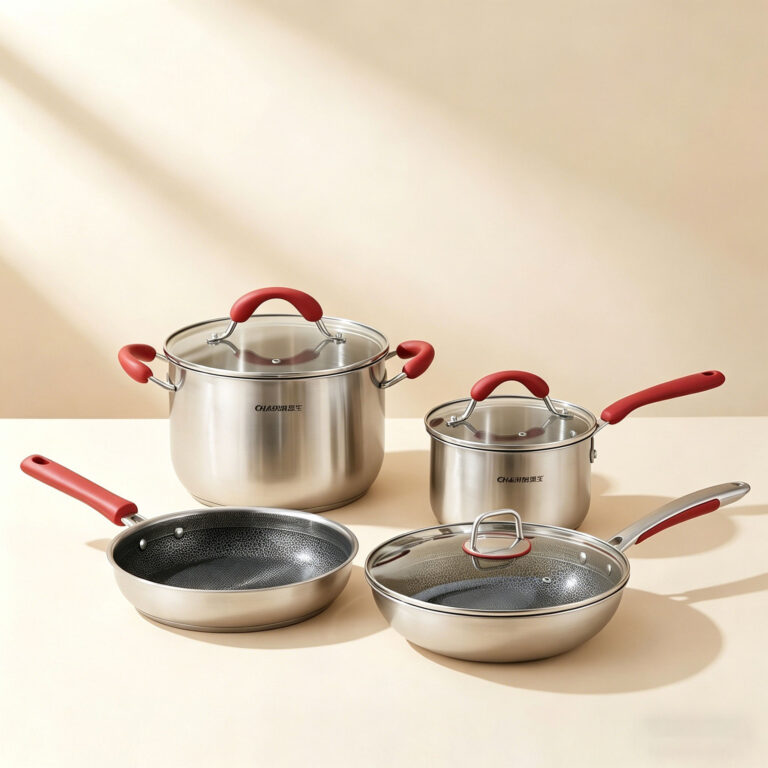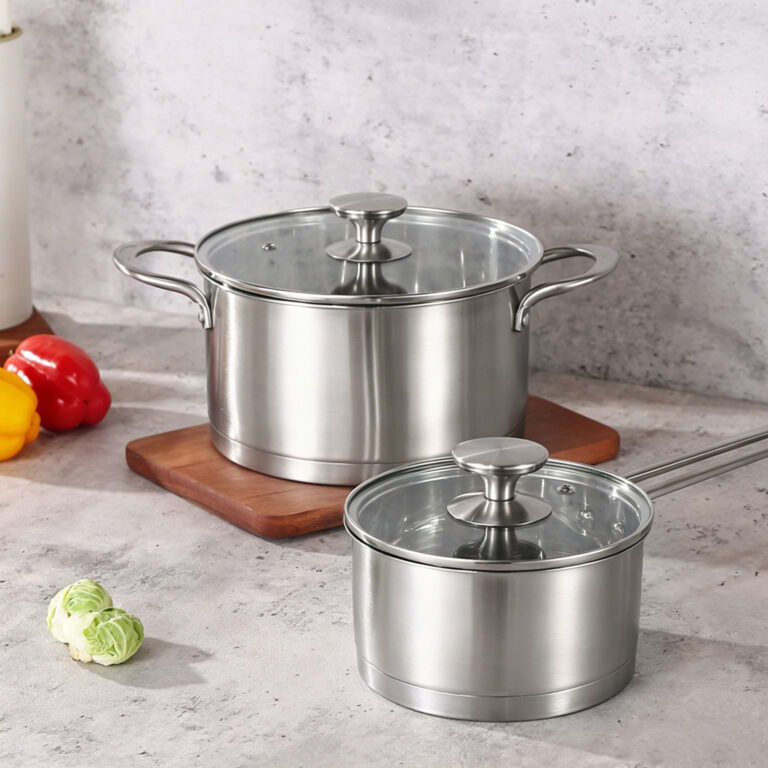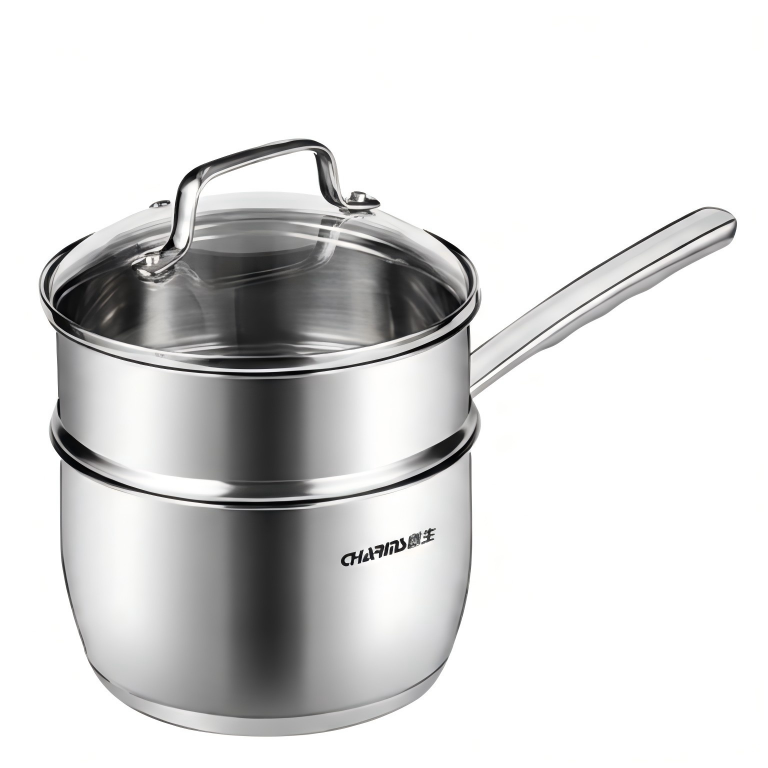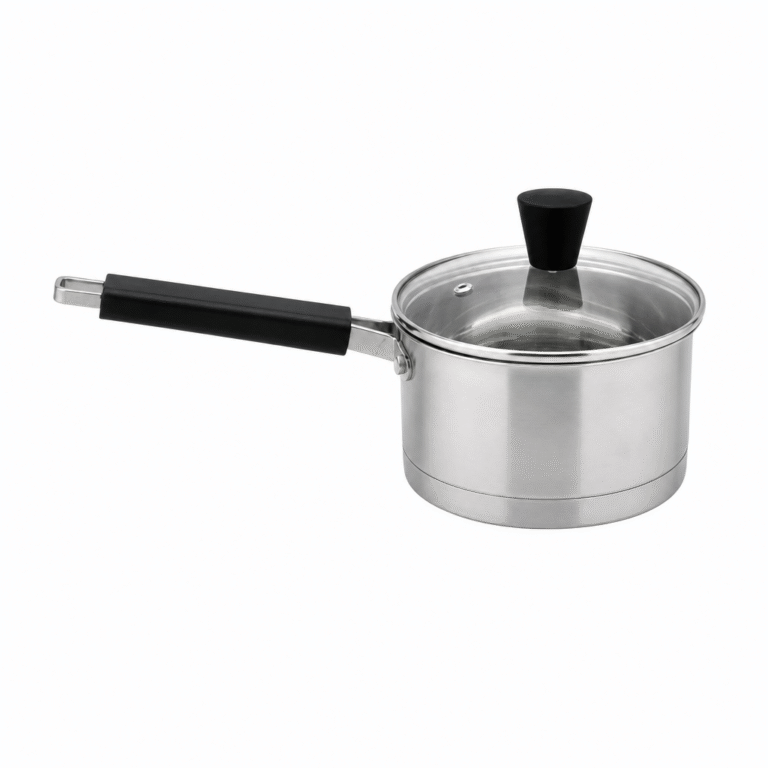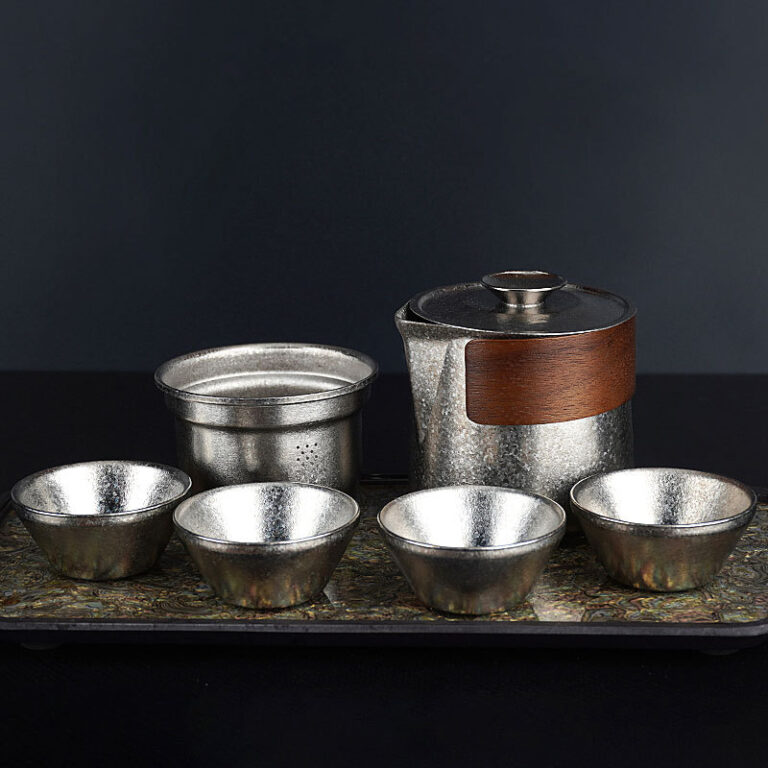

OEM (Original Equipment Manufacturer) means you provide the design and the factory builds to your specs — you own the molds, the IP, and the exclusivity. ODM (Original Design Manufacturer) means the factory already has the design; you add your branding and go to market faster with a lower minimum order. For cookware brands, the choice shapes your MOQ, lead time, tooling cost, and competitive defensibility. This guide covers the real differences, when to use each, realistic costs and timelines, certifications by market, and how to tell a genuine factory from a trading company.
OEM vs ODM Cookware: The Core Difference
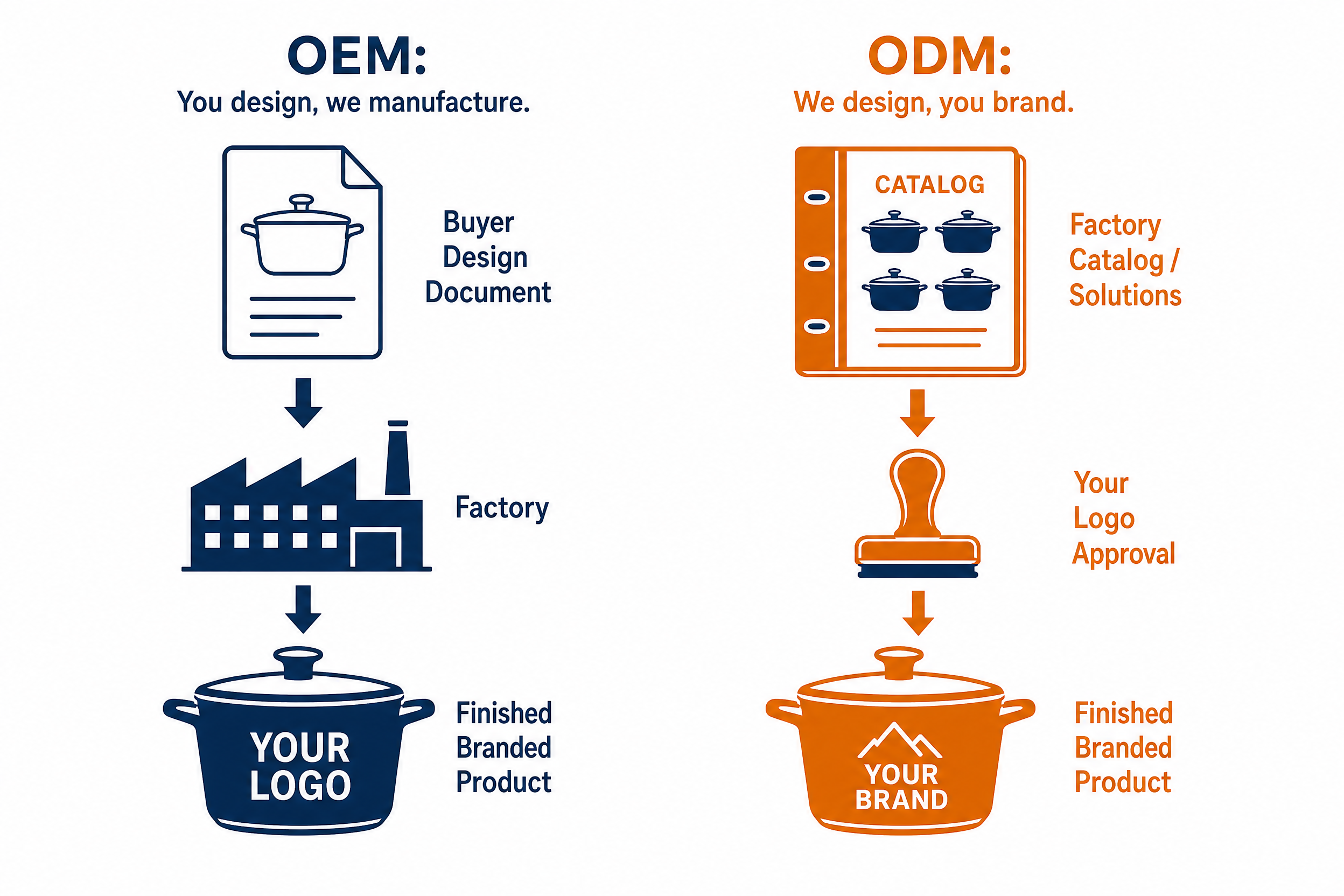
OEM and ODM describe who owns the product design — and that single question determines almost everything else about your sourcing relationship.
In OEM manufacturing, the buyer brings the design. You specify the material grade (304 SS, 316L, hard-anodized aluminum), wall thickness, handle attachment method, surface finish, and lid tolerances. The factory tools up to your drawings, builds the product, and ships it. You own the molds. No other brand can order that exact product from the same factory.
In ODM manufacturing, the factory brings the design. They have a catalog of existing products — pots, pans, steamers, woks — already tooled and in production. You pick what fits your line, specify your logo, color, and packaging, and place your order. The tooling cost is already amortized across many buyers. You go to market faster and at a lower minimum order quantity.
| OEM | ODM | |
|---|---|---|
| Design ownership | Buyer | Factory |
| Customization depth | Full — material, shape, finish, every dimension | Light — logo, color, packaging, minor variants |
| Tooling cost | Buyer pays (typically $800–$3,000/mold) | None or minimal |
| MOQ | Higher — typically 1,000–5,000 pcs/SKU | Lower — typically 300–1,000 pcs/SKU |
| Sampling lead time | 2–4 weeks (+ tooling time if new molds) | 1–2 weeks |
| Bulk production lead time | 35–60 days after sample approval | 30–45 days after sample approval |
| IP protection | Strong — you own the mold, factory cannot sell design to competitors | Weak — factory sells same base design to many brands |
| Speed to market | Slower | Faster |
| Unit cost | Higher (lower volume, custom setup) | Lower (shared tooling, higher runs) |
| Best for | Established brands, proprietary lines, premium positioning | Market testing, fast launch, budget-conscious entry |
One nuance worth understanding: most real orders are a hybrid. A brand might use ODM for their entry-level SKUs while running OEM on their hero product. Factories with both capabilities are common in China’s major cookware clusters.
Which Model Fits Your Business?
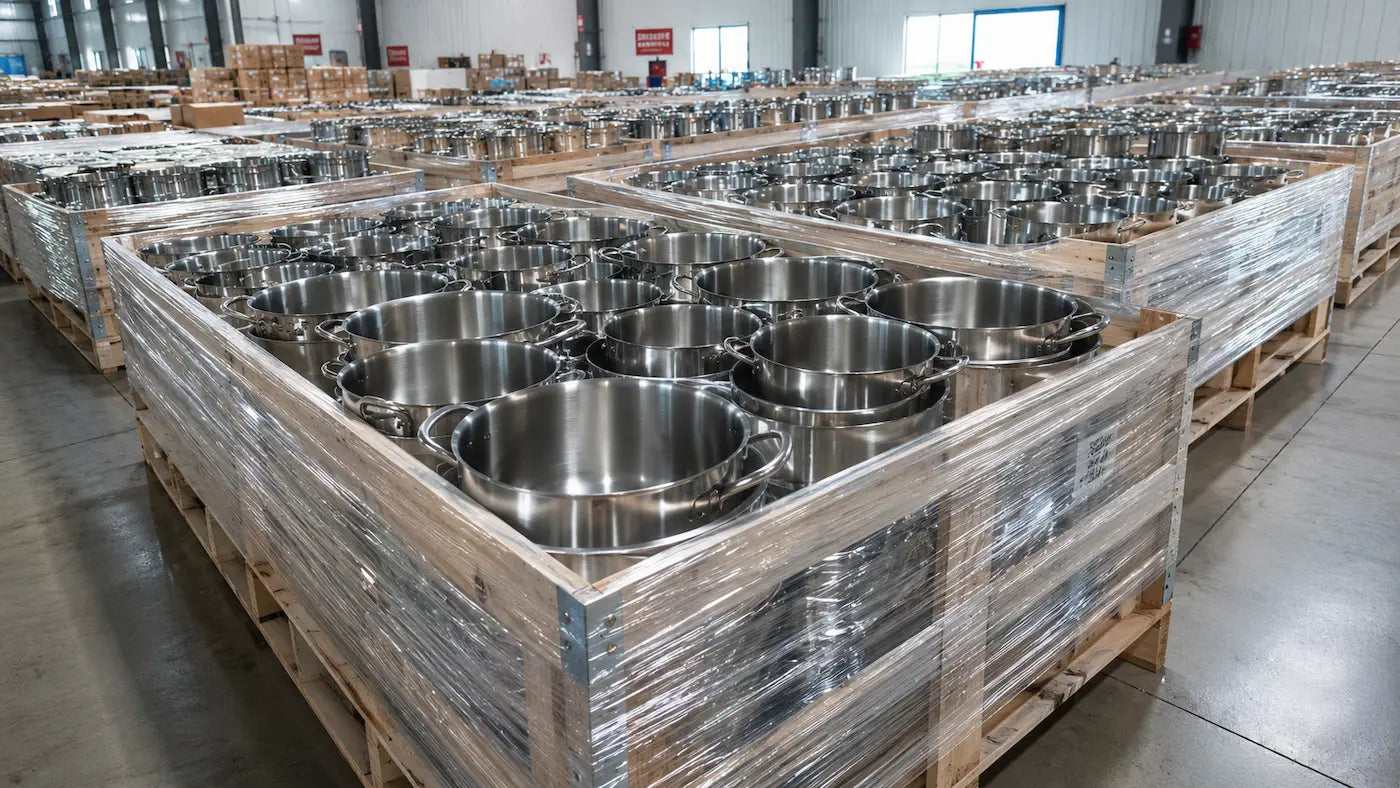
The right choice depends on three variables: how much capital you have, how fast you need to move, and how important product exclusivity is to your competitive strategy.
If you’re launching a new cookware brand and haven’t proven market demand yet, ODM is almost always the right starting point. You’re not committing $3,000 to a mold for a product that might not sell. You’re testing price points, learning what your customers actually want, and building a supplier relationship — all at a fraction of the risk.
If you’re an established brand that’s already selling cookware and you want a product your competitors can’t copy, OEM is worth the investment. A proprietary handle design, a unique composite base configuration, or a custom coating formula becomes a defensible moat. Retailers also respond better to exclusive SKUs — it gives them a reason to stock you over a private-label competitor.
Decision framework:
| Situation | Recommended Model |
|---|---|
| First-time cookware brand, testing the market | ODM |
| Launching with limited capital (<$30,000 initial order) | ODM |
| Need product in market within 3–4 months | ODM |
| Established brand wanting exclusivity | OEM |
| Retail buyer requiring unique SKUs | OEM |
| IP-sensitive design (patentable shape, proprietary coating) | OEM |
| Expanding a proven SKU into new sizes/variants | ODM (if base design works) or OEM (if scaling a custom design) |
One question I find cuts through the noise quickly: “Can I buy this same product with someone else’s logo on it?” If yes, you’re looking at ODM. If no, you’re in OEM territory. Ask that question of any factory you speak to — their answer tells you a lot about how they operate.
What OEM Cookware Manufacturing Actually Looks Like
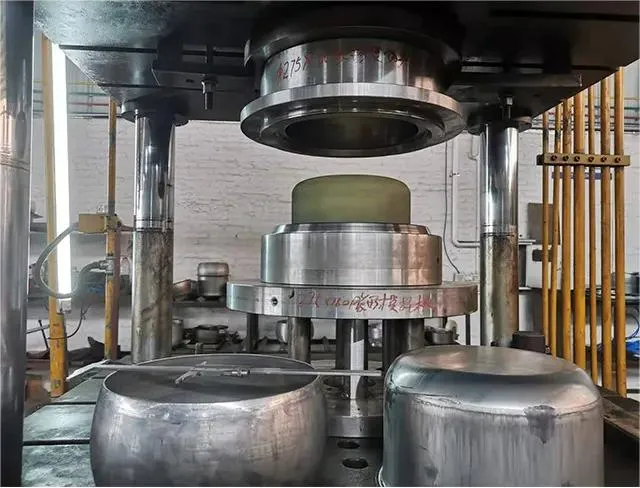
OEM cookware production follows a defined sequence — and understanding each stage helps you set realistic expectations and avoid the most common delays.
Here’s what the process looks like from the moment you contact a factory:
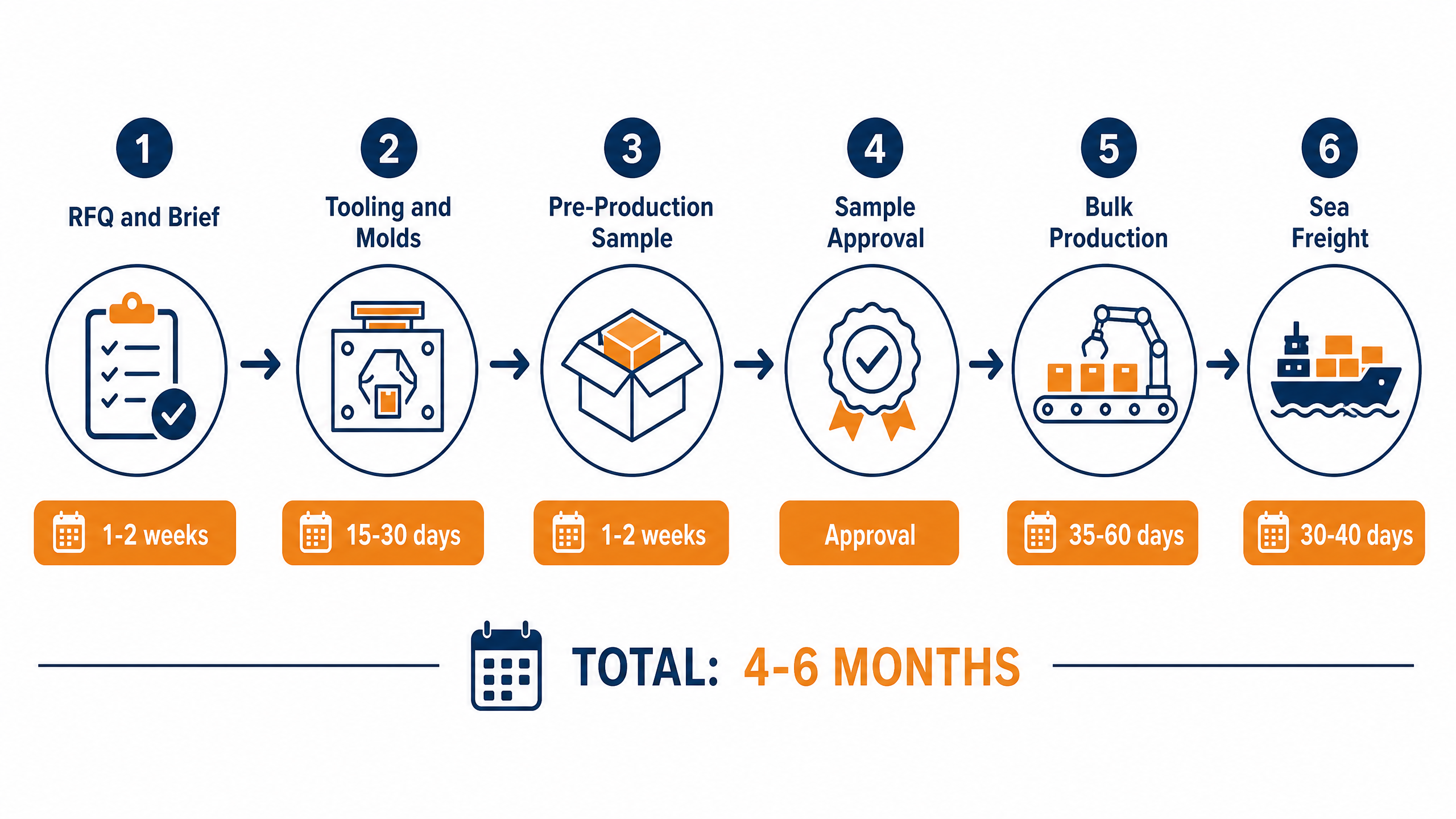
Stage 1: RFQ and Technical Brief (Week 1–2)
You send a request for quotation that includes your material spec (e.g., 304 stainless steel, 0.6mm body, 3.0mm composite base), dimensions, handle type, surface finish, and target unit price. The more specific your brief, the more accurate the quote — vague requests get padded pricing.
Stage 2: Tooling and Mold Development (Weeks 2–6)
If your design requires new molds, the factory’s tooling team builds them before any sample can be produced. A standard stamped pot mold takes 15–25 days. Complex multi-part molds (e.g., with integrated pouring lips or custom handle inserts) can take 30 days. You pay the tooling fee upfront — typically $800–$3,000 per mold depending on complexity. This fee is separate from the unit price.
Stage 3: Pre-Production Sample (Weeks 4–8)
Once tooling is complete, the factory produces 2–5 sample units. You review them against your spec, test fit, finish, weight, and function. Expect at least one revision round. Most experienced buyers allow 2 revision cycles in their timeline.
Stage 4: Sample Approval and Production Confirmation
You sign off on the approved sample. This sample becomes the production reference — deviations from it are your strongest ground for rejecting substandard bulk goods. Get it documented.
Stage 5: Bulk Production (Weeks 8–16 from project start)
The factory enters production scheduling. A standard run of 2,000 stainless steel pots takes 30–45 days. During production, a pre-shipment inspection — conducted by an independent third party (SGS, Intertek, or your own agent) — is strongly recommended. Don’t rely solely on the factory’s own QC report.
Stage 6: Shipping and Delivery
After factory QC clearance, goods are loaded and shipped. Sea freight from China to the US East Coast takes roughly 30–35 days; to Europe, 25–35 days depending on port. Total door-to-door timeline for a new OEM product: approximately 4–6 months from first contact to landed goods.
MOQ, Tooling Costs, and Lead Times: Real Numbers
MOQ in cookware is not arbitrary — it’s driven by tooling amortization economics, and understanding that math gives you leverage to negotiate.
When a factory quotes you a minimum order of 1,000 pcs, they’re not being difficult. They’re telling you the floor below which their per-unit cost to set up the run doesn’t make economic sense. Here’s how the math works: a mold costs $2,000. If you spread that over 300 units, it adds $6.67/unit in tooling cost. Spread it over 2,000 units, it’s $1/unit. The factory needs a viable unit economics model; MOQ is their way of expressing it.
Realistic MOQ ranges by product and model:
| Product type | OEM (new tooling) | OEM (existing tooling) | ODM |
|---|---|---|---|
| Stainless steel pot/pan | 1,000–5,000 pcs | 500–1,000 pcs | 300–800 pcs |
| Non-stick aluminum frying pan | 1,000–3,000 pcs | 500–1,000 pcs | 300–600 pcs |
| Cast iron skillet | 500–2,000 pcs | 300–500 pcs | 200–500 pcs |
| Wok (stamped SS) | 800–2,000 pcs | 500–800 pcs | 300–600 pcs |
| Steamer set | 1,000–3,000 pcs | 500–1,000 pcs | 300–800 pcs |
Tooling cost ranges:
- Simple stamped body mold: $1,000–$2,000
- Handle mold (plastic or SS): $800–$1,500
- Complex lid mold with vent assembly: $1,500–$3,000
- Full set (pot + lid + handle): $3,000–$5,000
Lead times at a glance:
| Stage | OEM (new tooling) | OEM (existing tooling) | ODM |
|---|---|---|---|
| Tooling/mold development | 15–30 days | n/a | n/a |
| Pre-production sample | 7–14 days | 7–10 days | 5–10 days |
| Sample revision rounds | 7–14 days per round | 7–10 days per round | 5–7 days per round |
| Bulk production | 35–60 days | 30–45 days | 30–45 days |
| Sea freight (China → US) | 30–35 days | 30–35 days | 30–35 days |
| Total (first order) | ~4–6 months | ~3–4 months | ~2.5–3.5 months |
The single largest avoidable delay is slow sample approval on the buyer’s side. Factories flag this consistently: a 2-week delay in signing off a sample compresses the entire downstream schedule. If you’re working toward a seasonal launch or retail on-shelf date, build your sample approval deadline into your buyer calendar before you start.
Levers to reduce MOQ legitimately:
- Accept an existing finish instead of a custom one
- Combine SKUs that share the same base mold (e.g., 20cm and 24cm pots from the same tooling family)
- Commit to a reorder schedule — factories often open below their stated MOQ for buyers who show a credible forecast
Certifications Your Cookware Needs
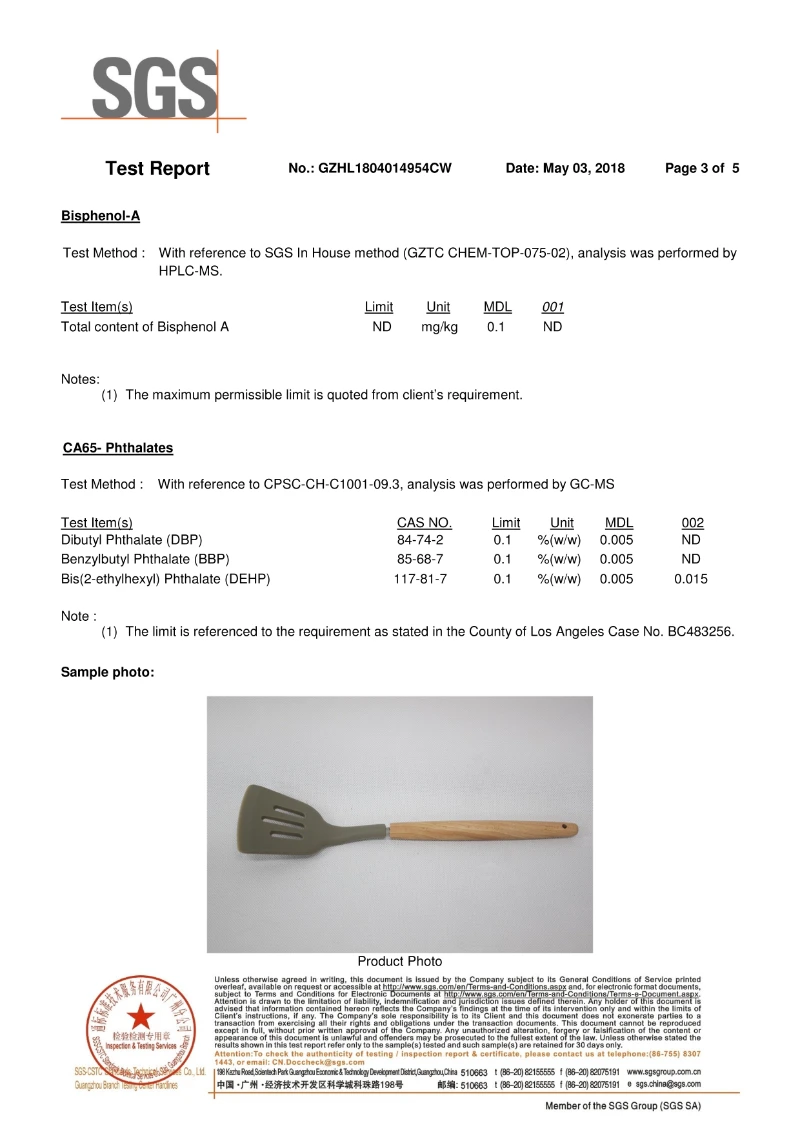
The certification you need depends entirely on where you’re selling — and the two most common requirements, FDA and LFGB, are not interchangeable.
FDA (21 CFR) — United States
FDA compliance for cookware is material-dependent. For non-stick coatings, colorful exterior enamels, and polymer components (handles, knobs), the relevant standard is 21 CFR Part 177 (polymers used in food-contact articles). For stainless steel cookware bodies, no specific FDA numerical migration limit for lead exists — FDA’s position is that properly formulated stainless steel is generally recognized as safe for food contact. FDA compliance is a self-declaration — there is no FDA certificate a factory obtains. What buyers request is a test report from an accredited third-party lab (SGS, Intertek, or Bureau Veritas) confirming the materials meet applicable standards. Coated and enameled cookware requires more rigorous testing than bare stainless steel.
LFGB (§30/31 BfR) — European Union / Germany
LFGB — short for Lebensmittel-, Bedarfsgegenstände- und Futtermittelgesetzbuch — is Germany’s food, consumer goods, and feed code. It sets migration limits for food-contact materials and is broadly considered more stringent than US FDA standards for cookware. LFGB requires third-party migration testing by an accredited lab. Note that FDA and LFGB are independent certification systems for separate regulatory markets — they use different test protocols and pass/fail criteria. A product with LFGB test results still requires separate FDA-specific testing for the US market; the two are not interchangeable.
Other certifications buyers commonly require:
| Certification | Scope | Who Requires It |
|---|---|---|
| ISO 9001 | Factory quality management system | Retail buyers evaluating factory reliability |
| BSCI (Business Social Compliance Initiative) | Factory labor conditions audit | Major European supermarket chains, mass-market retailers |
| CA Proposition 65 | Heavy metals and chemical disclosure | US buyers selling into California |
| REACH (EU) | Chemical substance restrictions | EU importers, especially for coated cookware |
| RoHS | Hazardous substance restriction | EU buyers, relevant for cookware with electronic components |
Practical note: When evaluating a factory, ask for their most recent third-party lab test reports — not just a certificate number. Reports expire (typically valid 1–2 years), and material sources can change between batches. A current, product-specific test report from SGS or Intertek is more meaningful than a general factory certificate.
For brands selling in both US and EU markets, budget for separate FDA and LFGB testing. Factories experienced in export to both markets will have both sets of reports available and can guide you on which tests apply to your specific product materials.
How to Find — and Vet — a Real Cookware Manufacturer
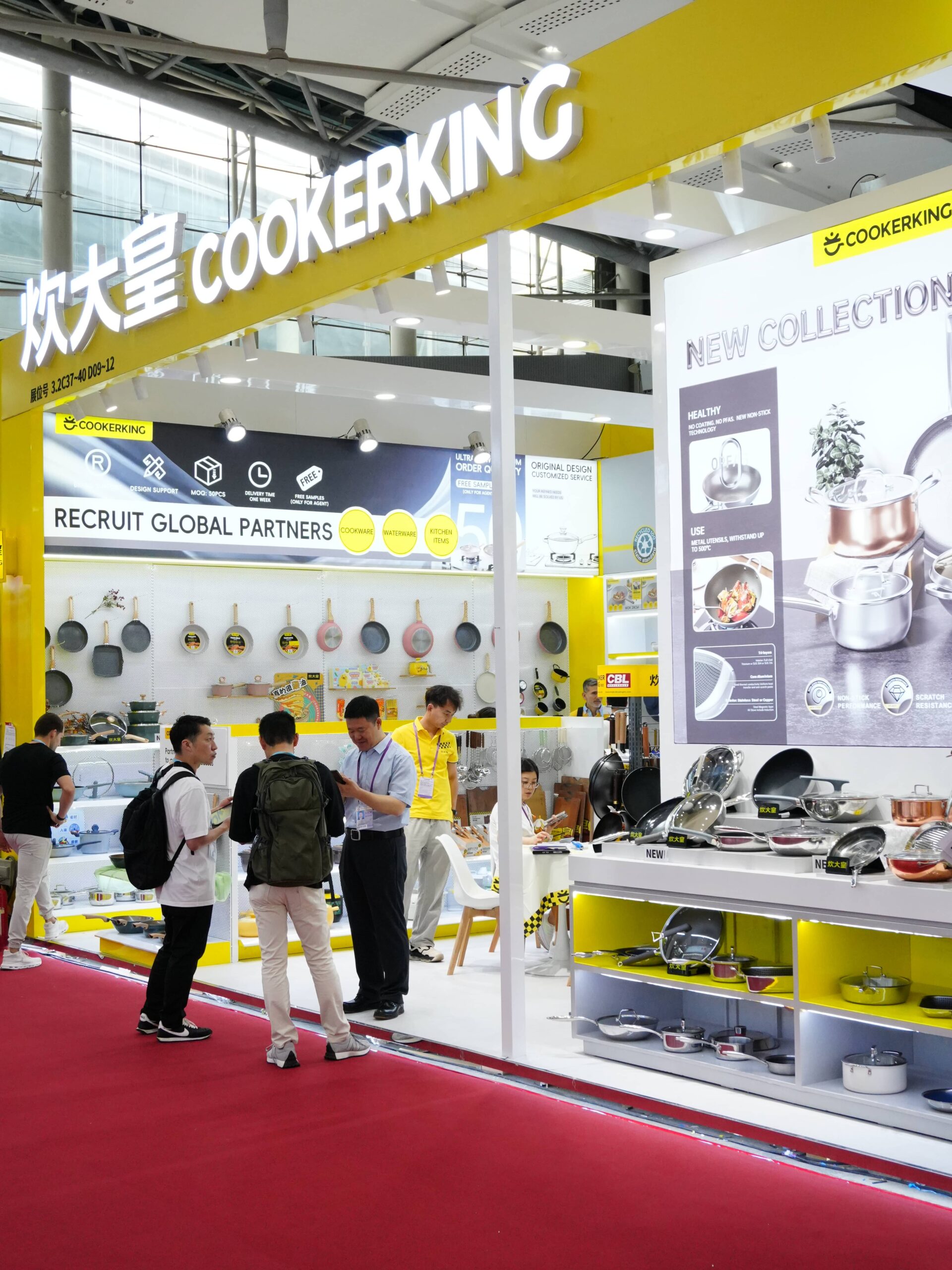
The biggest trap in cookware sourcing is contacting a trading company that presents itself as a factory. Trading companies add margin, can’t give you factory-floor QC access, and have less control over production quality.
Here’s how to tell the difference — and what to do once you’ve found a genuine manufacturer.
Identifying a real factory vs a trading company:
- Ask for the factory address and request a video call from the production floor. A real factory can show you their stamping machines, polishing lines, and assembly area on demand. A trading company will hesitate, offer a showroom visit instead, or send you photos that don’t match any verifiable location.
- Check the business license. Chinese factories registered as manufacturers (生产型企业) have a different business license category than trading companies (贸易公司). Ask for their business registration certificate (营业执照) — the business type is listed. Legitimate factories share this without issue.
- Look for tooling ownership clarity. Ask: “If I develop a custom mold here and switch factories in 18 months, can I take the mold with me?” A factory will give you a direct answer about their tooling policy. A trader often doesn’t know the answer because the actual tooling sits at a third-party factory.
Where to find cookware manufacturers:
- Alibaba (Gold Supplier + Verified Manufacturer badge) — useful starting point, but verification is still your responsibility. Cross-reference with their factory video and business license.
- Made-in-China.com — similar to Alibaba, with a large base of Chaozhou and Foshan cookware factories.
- Canton Fair (Guangzhou Import and Export Fair) — the world’s largest trade fair; held in April and October. Meeting factories in person and seeing samples live is the most efficient way to evaluate new suppliers.
- Industry clusters directly — sourcing agents based in Chaozhou or Foshan can introduce you to factory contacts that never appear on B2B platforms. If you’re placing orders above $50,000/year, this approach pays for itself quickly.
- Factory referrals from non-competing brands — if you know another brand sourcing cookware for a different market segment, a direct referral is the most reliable source.
Vetting checklist before placing a first order:
- Video call from the production floor (not a showroom)
- Business license copy confirming manufacturer registration
- Current third-party lab test report (SGS/Intertek, less than 2 years old)
- ISO 9001 or BSCI certificate if required for your retail channel
- Signed sample confirmation with production spec attached
- Payment terms with a deposit structure (30% deposit, 70% balance before shipment is standard)
- Written contract specifying tooling ownership if OEM
China’s Cookware Manufacturing Clusters: Which Region Makes What
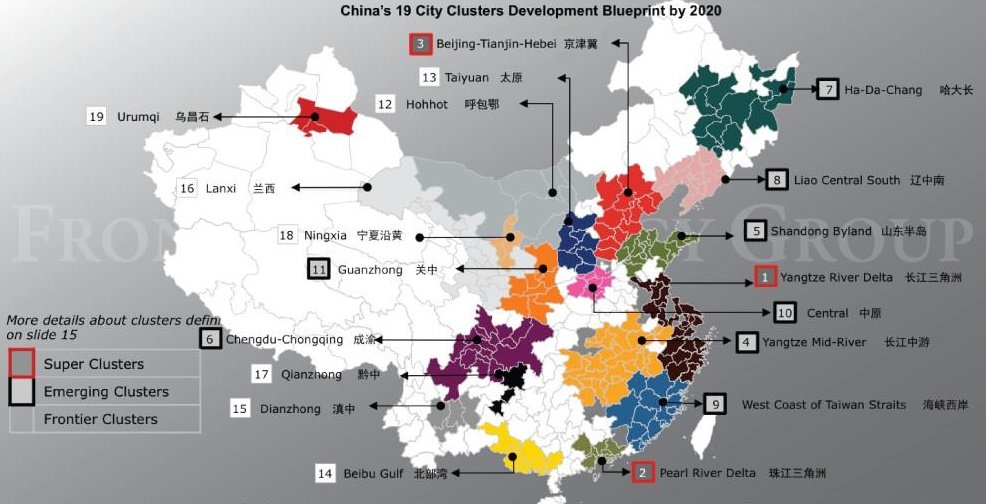
China produces roughly 75% of the world’s exported cookware, but the industry is not evenly distributed — different regions specialize in different product types, and sourcing from the right cluster affects quality, price, and logistics.
Chaozhou (Caitang Town), Guangdong Province — Stainless Steel Cookware Capital
Caitang Town in Chao’an District, Chaozhou, is known informally as “China’s Steelware Capital.” More than 300 kitchenware factories operate within a few kilometers of each other, creating a fully integrated supply chain: raw steel coil, stamping, polishing, composite base manufacturing, electroplating, and packaging are all local. This cluster dominates stainless steel pot and pan production for export.
If you’re sourcing stainless steel cookware — sauce pots, stock pots, steamers, frying pans with SS bodies — Chaozhou is the primary target. The density of factories here creates genuine price competition, and the supply chain is mature enough that even smaller orders move efficiently. Established manufacturers like CharmsCook (est. 1989) and Zhenneng (est. 1987) are based here.
Foshan / Shunde, Guangdong Province — Small Kitchen Appliances
Foshan’s Shunde district is the primary hub for small electric kitchen appliances — rice cookers, induction cookers, electric pressure cookers, and air fryers. It is not the center for aluminum or non-stick cookware pans. If your product line includes electric cooking equipment or appliances alongside cookware, Foshan is the right sourcing destination for the appliance components.
Yongkang, Jinhua, Zhejiang Province — Hardware, Tools, and Aluminum Cookware
Yongkang — officially recognized as “China’s Hardware Capital” — produces kitchen hand tools, baking accessories, vacuum flasks, and also has a significant cluster of aluminum and non-stick cookware manufacturers. If your product line includes non-stick frying pans, die-cast aluminum cookware, or kitchen utensils, Yongkang and the broader Zhejiang cluster are strong sourcing targets alongside Chaozhou.
Cixi, Ningbo, Zhejiang Province — Export-Focused Cookware
Cixi has a cluster of export-oriented stainless steel and aluminum cookware factories with strong logistics access via Ningbo port (one of the world’s busiest container ports). Factories here tend to be more experienced with Western retail requirements and often have existing relationships with European and US buyers.
Which cluster for which order:
| Product type | Primary cluster | Secondary cluster |
|---|---|---|
| Stainless steel pots, pans, steamers | Chaozhou, Guangdong | Cixi, Zhejiang |
| Non-stick frying pans, aluminum cookware | Yongkang, Zhejiang | — |
| Kitchen utensils, baking tools | Yongkang, Zhejiang | — |
| Mixed cookware + utensil line | Chaozhou + Yongkang | — |
| Commercial kitchen equipment | Shandong coastal cluster | — |
Common Mistakes and How to Avoid Them
Most sourcing failures in cookware come from the same handful of mistakes — and nearly all of them are avoidable with the right questions asked at the right stage.
Mistake 1: Choosing on price alone
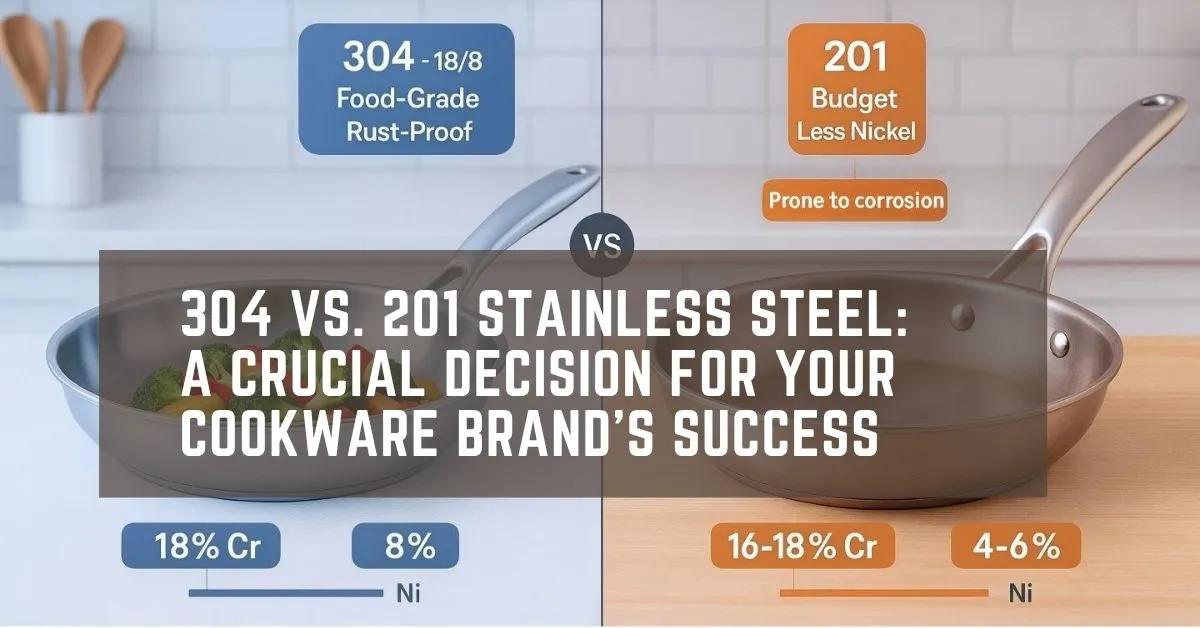
A low unit price quote almost always means something was cut: the material gauge was reduced, 304 SS was swapped for 201 (which rusts in dishwashers), the handle attachment switched from riveted to welded, or certification testing was skipped. When comparing quotes, ask each factory to quote against an identical spec sheet — not against their interpretation of your general request. Price comparison only makes sense when you’re comparing the same thing.
201 vs 304 stainless steel is the most common material substitution. Both look identical. 201 SS contains less nickel (3.5–5.5% vs 8–10.5% in 304), which makes it cheaper and more rust-prone. Specify 304 grade explicitly in your purchase order and require a material test certificate (often called an SGS steel grade report) with your shipment.
Mistake 2: Vague specifications
“Good quality stainless steel pot, 24cm, medium thickness” produces a quote with maximum ambiguity padding — the factory will interpret every unclear dimension in their economic favor. A proper spec sheet for a 24cm stainless steel pot should specify: body material grade (304 SS), body thickness (e.g., 0.6mm), base construction (single-layer vs triply vs composite), base thickness (e.g., 3.0mm composite), handle material and attachment method, surface finish (mirror polish / satin / brushed), lid type, and tolerance ranges for key dimensions.
Mistake 3: Skipping independent pre-shipment inspection
Factory self-inspection is not neutral. An independent third-party inspection — where an SGS, Intertek, or QIMA inspector physically visits the factory before goods are loaded — is the most cost-effective quality control step available. Inspections typically cost $150–$300 per inspection day. That’s trivial against a $30,000 order and very expensive if skipped and the container arrives with defects.
Mistake 4: No written contract on tooling ownership
In OEM manufacturing, the mold is often worth more than the first production run. If you invest $3,000–$5,000 in tooling and the factory holds the molds, you have no leverage to switch suppliers later without losing that investment — or worse, seeing your design sold to a competitor. Specify mold ownership in writing, in the purchase contract, before production starts.
Mistake 5: Treating the first sample as final
The pre-production sample is the negotiation stage, not the approval stage. Use it to identify issues — surface finish inconsistencies, handle torque, lid fit, weight deviations from spec. Two revision rounds is normal and expected. Factories that push back on revision requests are worth reconsidering.
Frequently Asked Questions
What is the difference between OEM and ODM cookware manufacturing?
OEM (Original Equipment Manufacturer) means you own the product design — you provide specs and the factory builds to them. ODM (Original Design Manufacturer) means the factory owns the design — you choose from their catalog and apply your branding. OEM offers full customization and IP protection but requires higher MOQs and longer lead times. ODM is faster and lower risk, but offers no design exclusivity.
What is the minimum order quantity for OEM cookware?
For stainless steel cookware requiring new tooling, typical OEM MOQs run 1,000–5,000 pcs per SKU. If you’re using an existing base mold (i.e., the factory already has tooling for a similar shape), 500–1,000 pcs is more common. ODM private-label orders typically start at 300–800 pcs per SKU.
How long does OEM cookware manufacturing take from start to delivery?
From first contact to landed goods, a new OEM cookware product requiring custom tooling typically takes 4–6 months: tooling development (15–30 days), pre-production sampling (7–14 days), sample revision and approval (7–21 days), bulk production (35–60 days), and sea freight (30–40 days). ODM or repeat OEM using existing tooling runs closer to 3–4 months. The biggest variable is how quickly you approve the sample.
What certifications does cookware need for the US and EU markets?
For the US: FDA compliance is required. For non-stick coatings and polymer components, the relevant standard is 21 CFR Part 177. For stainless steel bodies, FDA has no specific numerical migration limit — properly formulated stainless steel is generally recognized as safe. In practice, buyers request a third-party lab test report (SGS or Intertek) confirming material safety. For the EU: LFGB certification from an accredited lab is the standard, requiring third-party migration testing. FDA and LFGB are independent systems for separate markets — a product passing LFGB still needs separate FDA-specific testing for US market entry.
How do I tell if a supplier is a real factory or a trading company?
Ask for a video call from the production floor — not a showroom. Request a copy of their business registration certificate (营业执照) and check that the business type reads as a manufacturer (生产型企业) rather than a trading company (贸易公司). Ask who owns the tooling if you develop a custom mold, and ask for references from current customers in your market. Real factories answer these questions directly; trading companies often deflect.
Who owns the tooling in OEM manufacturing?
Tooling ownership must be specified in your purchase contract. The default assumption — that the tooling stays with the factory — is not always correct, but without a written agreement you have no recourse. In most OEM arrangements, the buyer pays the tooling fee and the contract should specify that the buyer owns the molds and has the right to request their transfer to another factory with sufficient notice.
Is it possible to do OEM with a low budget?
It depends on the product and the factory. A simple stamped stainless steel item with existing molds can be produced on an OEM basis at 500 pcs, which at $8–$15/unit translates to $4,000–$7,500 — accessible for many small brands. Complex products requiring new multi-part tooling at 2,000 pcs minimum are a different equation. ODM is almost always the right starting point for brands under $20,000 in initial order budget.
Summary
OEM gives you a product your competitors can’t copy, at the cost of higher upfront investment, longer lead times, and more planning discipline. ODM gets you to market faster with less capital at risk, but leaves you with a product anyone else can brand. Most successful cookware brands use both — ODM to test the market, OEM to build the defensible part of the line once they know what sells.
The variables that matter most are: who owns the design, what certifications your market requires, how much tooling investment makes sense at your volume, and whether you’ve verified you’re dealing with an actual factory. Get those four right and the rest of the sourcing process is manageable.