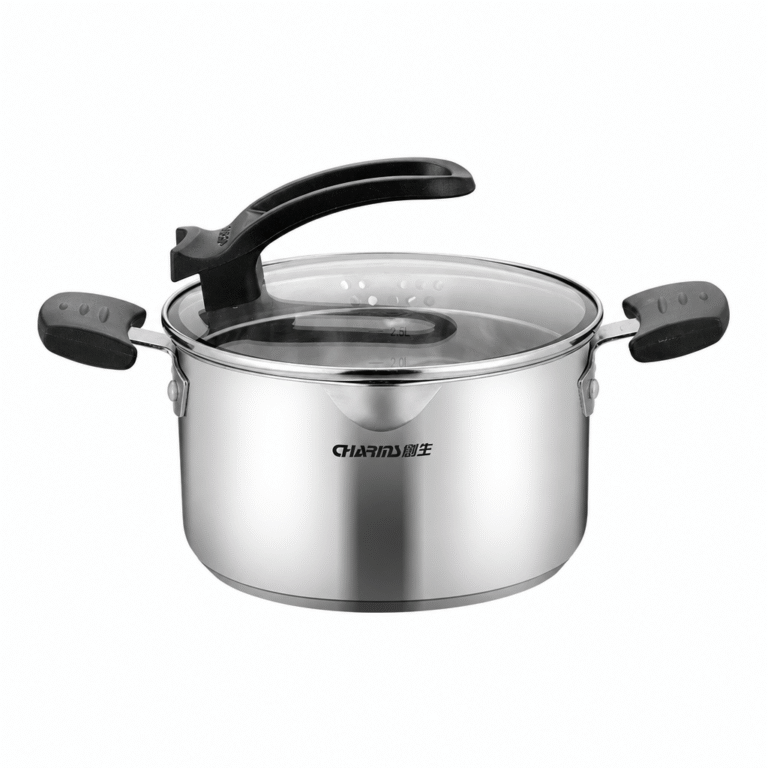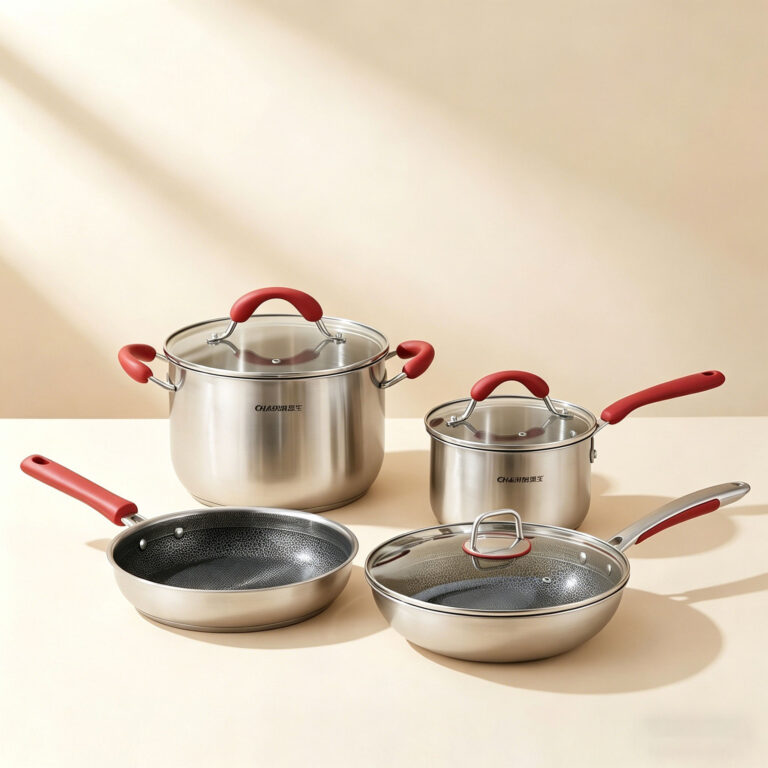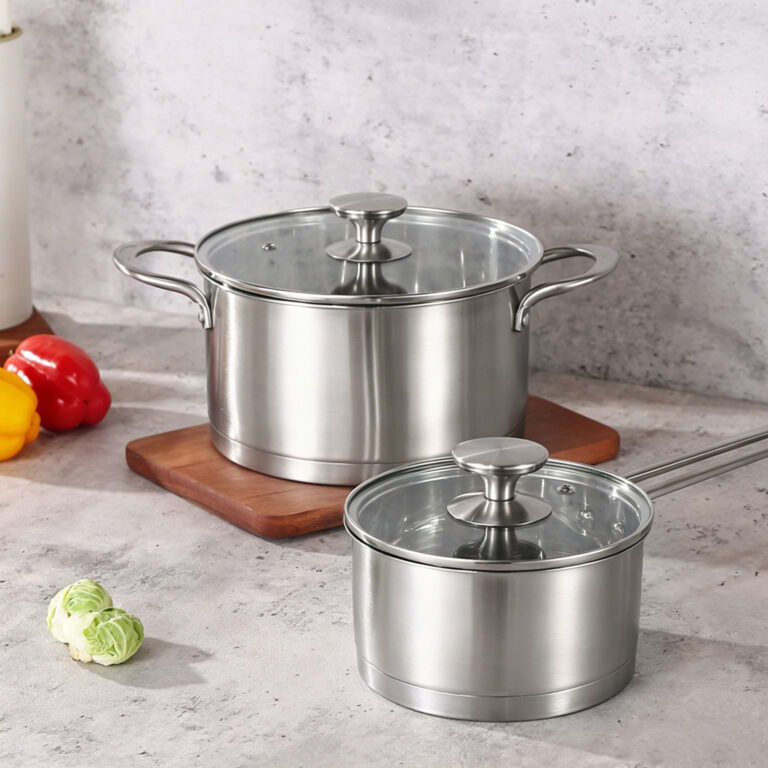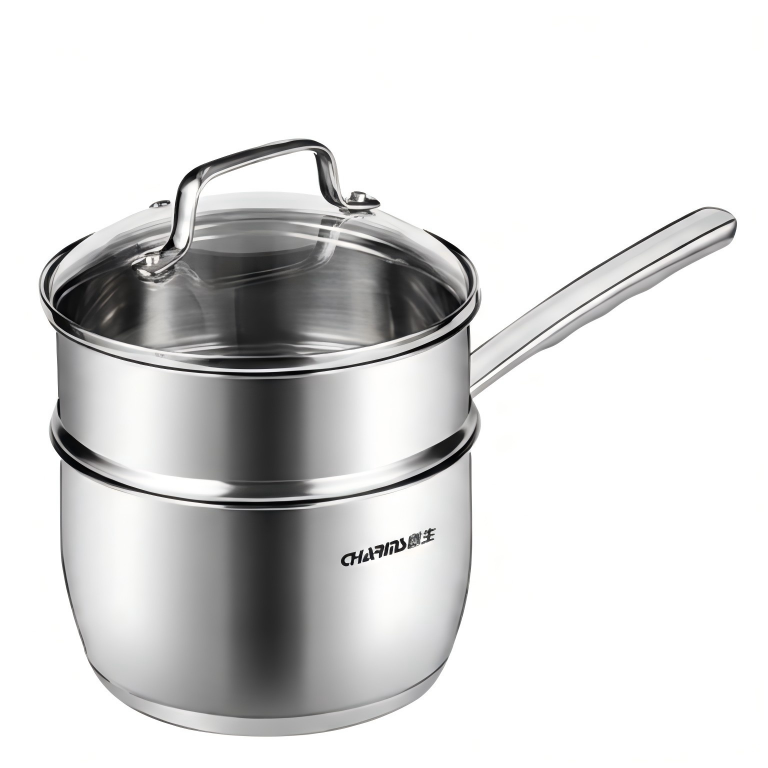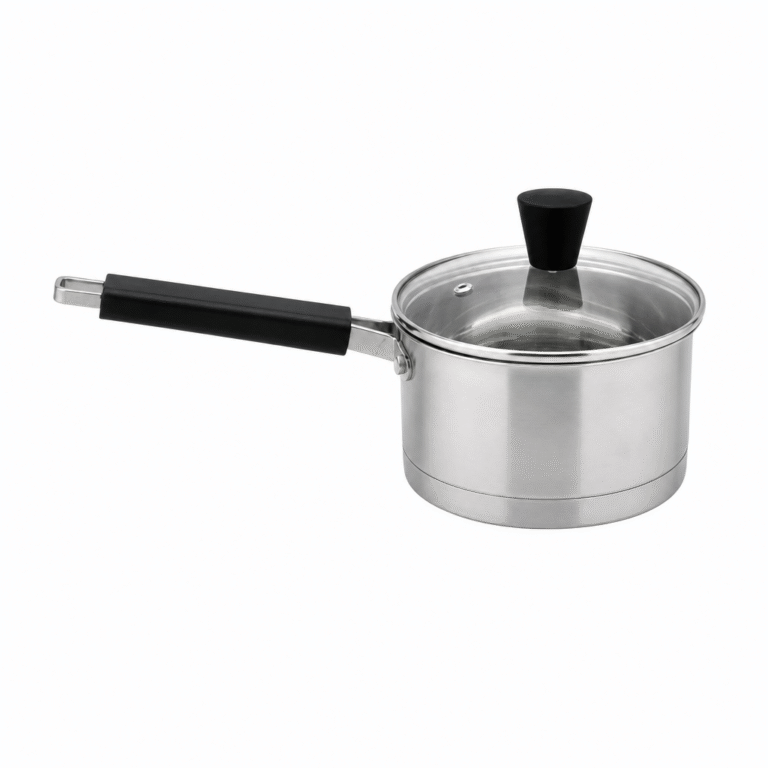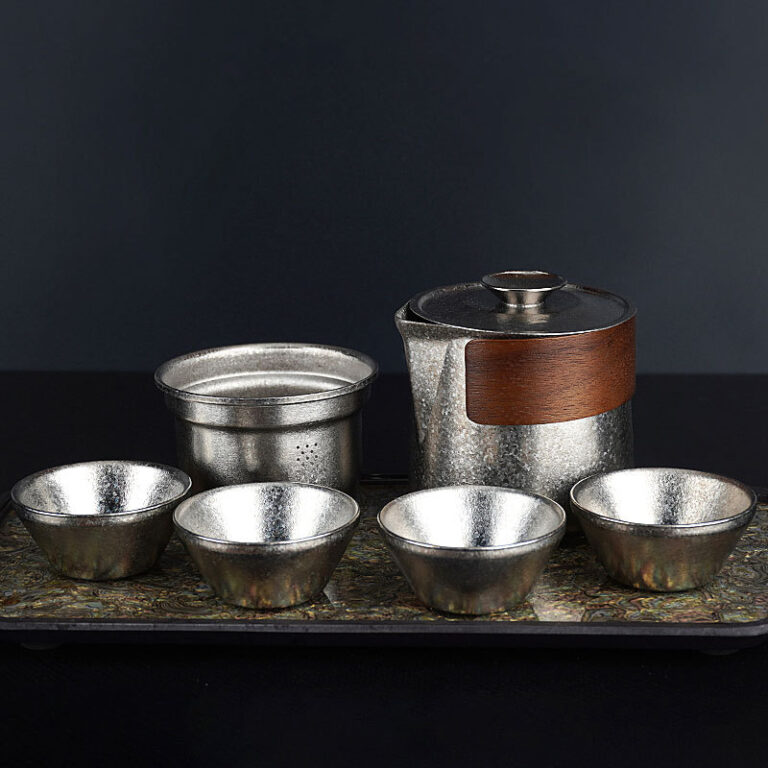

Private label cookware means a third-party factory manufactures the product and you sell it under your own brand name. It’s the most practical way for entrepreneurs, Amazon FBA sellers, and retailers to launch a branded cookware line without building a factory. This guide covers the full process — niche definition, product selection, manufacturer vetting, customization, compliance, and costs — with specific numbers on MOQs, timelines, and working capital requirements that most manufacturers won’t publish.
What Is Private Label Cookware — And How Does It Differ from OEM?
Private label cookware is manufactured by a third party and sold under your brand. The factory makes the product; you own the brand, set the price, and control the customer relationship.
This is distinct from two related models that buyers often confuse:
| Model | What You Control | Customization Depth | Time to Market | Investment Level |
|---|---|---|---|---|
| White Label | Logo / packaging only | Minimal | 4–8 weeks | Low |
| Private Label | Color, handle, logo, packaging | Moderate | 3–5 months | Medium |
| Full OEM | Product design, specs, materials | High | 6–12 months | High |
White label is faster but provides no product differentiation — any competitor can order the identical item. Full OEM is the most differentiated but requires deep capital commitment and tooling lead time. Private label sits in the practical middle: you work with proven, manufacturable product formats and invest your energy in brand identity, packaging, and customer experience rather than product engineering.
Most successful cookware brands start with private label and selectively introduce OEM modifications — a custom handle design, a proprietary coating formulation — once their volumes justify tooling investment.
CharmsCook, a stainless steel cookware manufacturer based in Chaozhou, Guangdong (established 1989), works with brands at all three levels. In practice, about 70% of international brand inquiries we receive start as private label programs, with OEM elements introduced in subsequent production runs.
Why Launch a Private Label Cookware Brand in 2026?
Three structural factors make the current window favorable:
The market is fragmenting. Consumers are moving away from legacy mass-market brands toward products with a clear identity — health-conscious, aesthetically specific, sustainably positioned, culturally grounded. The center of the market is hollowing out, and private label brands are filling the gaps that legacy brands aren’t designed to address.
E-commerce removes the distribution barrier. A decade ago, launching a cookware brand meant fighting for retail shelf space against entrenched incumbents. DTC e-commerce and Amazon give a new brand immediate distribution reach. Private label gross margins of 25–40% (compared to 8–15% for reselling established brands) mean you don’t need massive volume to build a viable business.
Manufacturing capabilities have improved. The best private label cookware factories in China — particularly in Guangdong, Zhejiang, and Shandong provinces — now offer in-house R&D, compliant materials (FDA, LFGB-certified), custom packaging design, and lower MOQs than were standard five years ago. The operational barrier to entry has compressed significantly.
The risk isn’t market opportunity — it’s execution. Brand clarity, manufacturer selection, and compliance readiness are the real differentiators.
How to Start a Private Label Cookware Brand: Step by Step
Step 1 — Define Your Brand Niche
Get clear on your positioning before contacting a single manufacturer. The cookware market has well-defined segments — pick one and go deep rather than wide:
- Health-first — ceramic coating, PFOA-free, PTFE-free, non-toxic materials messaging
- Professional/performance — stainless steel, tri-ply, induction-compatible, chef-grade positioning
- Aesthetic-led — signature colorways, lifestyle photography, social-commerce native
- Outdoor/adventure — lightweight, campfire-compatible, minimalist design
- Cultural/regional — woks, tagines, paella pans, Korean ttukbaegi, Japanese yukihira
“Premium quality at an affordable price” is not a niche — it’s every product’s claim, which makes it no product’s claim. Specificity converts buyers; generality competes on price alone, which is a race to the bottom.
Step 2 — Choose Your Core Product
Starting focused reduces MOQ exposure, sharpens your marketing message, and generates clean feedback before you expand the range. Most successful first launches are built around one of:
- A frying pan or skillet — highest search volume, strong gifting appeal, clear use case
- A 5–8 piece cookware set — higher average order value, efficient for retail and bundles
- A single niche product — e.g., a carbon steel wok for a culinary-focused brand
Material selection drives your positioning:
| Material | Positioning | Typical FOB Price* | Buyer Profile |
|---|---|---|---|
| Aluminum non-stick | Budget to mid | $8–25 / set | Mass market, Amazon |
| Stainless steel 18/8 (304) | Premium, professional | $15–60 / set | DTC, specialty retail |
| Carbon steel | Enthusiast, artisan | $12–35 / unit | Kitchen stores, DTC |
| Cast iron | Heritage, gifting | $10–40 / unit | Specialty, wholesale |
| Hard-anodized aluminum | Health-conscious | $18–45 / set | DTC, health brands |
*FOB estimates based on standard spec, 500–1,000 unit quantities. Pricing varies with specifications and order volume.
A note on stainless steel grades: For premium-positioned products, specify 18/8 (304 grade) — the canonical industry designation for 304 stainless steel (18% chromium, 8% nickel). 18/10 labeling is common in consumer marketing but refers to a nickel content at the higher end of the 304 spec range, not a separate grade. Avoid 201 stainless — its lower nickel content (3.5–5.5% vs. 8–10.5% in 304) reduces corrosion resistance, and products made from it carry a higher risk of failing LFGB nickel migration limits. Always request mill certificates confirming the steel grade for every production run.
Step 3 — Find a Private Label Cookware Manufacturer
Your manufacturer is the most consequential supplier relationship in the business. Here’s what to evaluate before committing:
Specialization — Do they primarily manufacture cookware, or is it one product line among hundreds? Cookware specialists have deeper tooling libraries, process-specific quality teams, and more relevant compliance documentation.
Certifications — For the US market: FDA 21 CFR compliance for food-contact materials. For EU/UK: LFGB (Germany’s food contact standard, the operative benchmark across Europe). For retail distribution: BSCI or SMETA social compliance audit. Request current certificate copies — not just verbal claims.
MOQ and sampling policy — Standard private label MOQs for existing tooling run 500–2,000 units per SKU. Custom molds push this to 3,000–10,000+. Confirm whether MOQ applies per colorway or per product line — it matters for how you plan your initial SKU range.
In-house capabilities — Manufacturers with in-house coating lines, handle fabrication, and packaging printing have more control over quality and timeline. Factories that outsource surface finishing introduce additional variables.
Communication response time — A 24-hour quotation response to a first inquiry is a reasonable proxy for how the relationship functions at scale. Slow initial response typically indicates a disorganized operation or low interest in the account size.
CharmsCook’s private label program covers 304 and 316L stainless steel, FDA and LFGB-certified materials, and MOQs from 500 units per SKU on standard product lines. Sample production runs 7–10 business days from spec confirmation.
Step 4 — Customize Your Brand Identity Through the Product
Private label is more than a logo on a box. Customization levers, roughly in order of brand impact:
- Exterior color / coating — A signature colorway (matte sage, deep teal, warm copper, slate gray) differentiates your product immediately at point of sale and in product photography. This is where the visual identity lives.
- Handle design and material — Silicone grip inserts, riveted versus welded attachment, handle angle — these affect both appearance and the tactile quality perception during unboxing and use.
- Logo placement — Embossed into the handle, laser-engraved on the base, or printed on the exterior coating. Each signals a different premium level.
- Packaging — The box is the first physical touchpoint. Full-color custom printing, magnetic closures, recycled kraft finishes, and brand story inserts turn unboxing into a brand moment that drives social sharing.
- Accessories and inserts — Recipe cards, care guides, branded silicone trivets — these reinforce premium positioning and encourage repeat engagement with the brand.
Lock the exterior colorway and handle design before sampling — these drive the longest tooling lead times if changes are required post-sample.
Step 5 — Navigate Compliance
This is where new brands most consistently underestimate complexity.
US market: Food-contact cookware materials must comply with FDA 21 CFR regulations (Parts 175–178 cover adhesives, polymers, and coatings for food contact). Stainless steel in 304 and 316L grades is broadly accepted. For coated cookware: PTFE-based coatings must be PFOA-free and applied per coating manufacturer specifications. Your factory should provide documentation confirming this.
EU/UK market: LFGB (Lebensmittel- und Futtermittelgesetzbuch) is the operative standard. EU Regulation 1935/2004 governs food contact materials broadly. LFGB-tested cookware carries a stylized fork-and-knife symbol and is the de facto requirement for most EU retail buyers.
Retail marketplace requirements: Amazon, Walmart, and Target each maintain vendor compliance programs. Some require third-party test reports issued by CPSC-accepted labs (SGS, Intertek, Bureau Veritas) in addition to factory certifications.
Working with a certified manufacturer covers most of this — but the brand owner remains responsible for product safety in their market. For retail partnerships, plan to supply your own third-party test documentation, not just the factory’s.
Step 6 — Build Your Go-to-Market Strategy
Direct-to-consumer (DTC) via Shopify or WooCommerce: full margin (typically 45–65% gross), full customer data. Requires SEO content investment, paid media, and strong photography. Plan 6–12 months before the channel becomes self-sustaining.
Amazon FBA: immediate access to buying intent. Private label cookware with genuine differentiation outperforms generic listings. Budget for early PPC — typically $1–3 per unit sold in launch phase — until organic ranking builds. Amazon FBA fees for cookware typically run $5–$10 per unit (most pots and pans weigh 2–5+ lbs).
Wholesale / retail: higher inventory commitment and longer sales cycles, but can scale revenue faster than DTC at early stage. Specialty kitchen stores, gift boutiques, and regional grocers are more accessible than national chains for emerging brands.
Social commerce (TikTok Shop, Instagram Shopping): increasingly drives cookware discovery for visually-led brands, especially those with a strong color story or founder narrative.
Most successful new cookware brands run Amazon FBA + DTC simultaneously — Amazon for volume and discovery, DTC for margin and brand equity building.
What to Look for in a Private Label Cookware Manufacturer
The right manufacturing partner does more than make products — they protect your brand’s reputation and your customers’ safety.
After working with international buyers across North America, Europe, and Southeast Asia, the factors that separate reliable manufacturing partners from problematic ones cluster into four areas:
Factory audit transparency — Legitimate manufacturers welcome third-party audit requests (BSCI, SMETA, SA8000). Reluctance to provide audit documentation or allow factory visits before an order is placed is a significant red flag. An audit result from the past 12 months is a reasonable minimum requirement.
Sample-to-bulk consistency — This is where most quality issues originate. Request two sample rounds: initial (confirming design direction) and pre-production (confirming final spec before bulk production runs). The pre-production sample should match bulk shipment exactly. Any deviation between pre-production sample and delivered goods is a contract violation — make this explicit in your purchase order.
Documentation standards — Every production run should ship with: material mill certificates (confirming steel grade), coating supplier certification (confirming PFOA-free status for non-stick products), packing list with weight and dimensions, and relevant customs documentation. Manufacturers who resist providing mill certificates are often substituting a lower-grade steel than specified.
Production capacity and buffer — A manufacturer consistently running at 100% capacity with no schedule flexibility is a risk. Ask about current lead time, whether they can accommodate rush production on standard SKUs, and their policy for production delays. Capacity transparency matters more than capacity size.
CharmsCook maintains a monthly production capacity exceeding 500,000 units across cookware categories. Standard lead time for private label orders runs 35–45 days from sample approval, with expedited options available for standard product lines.
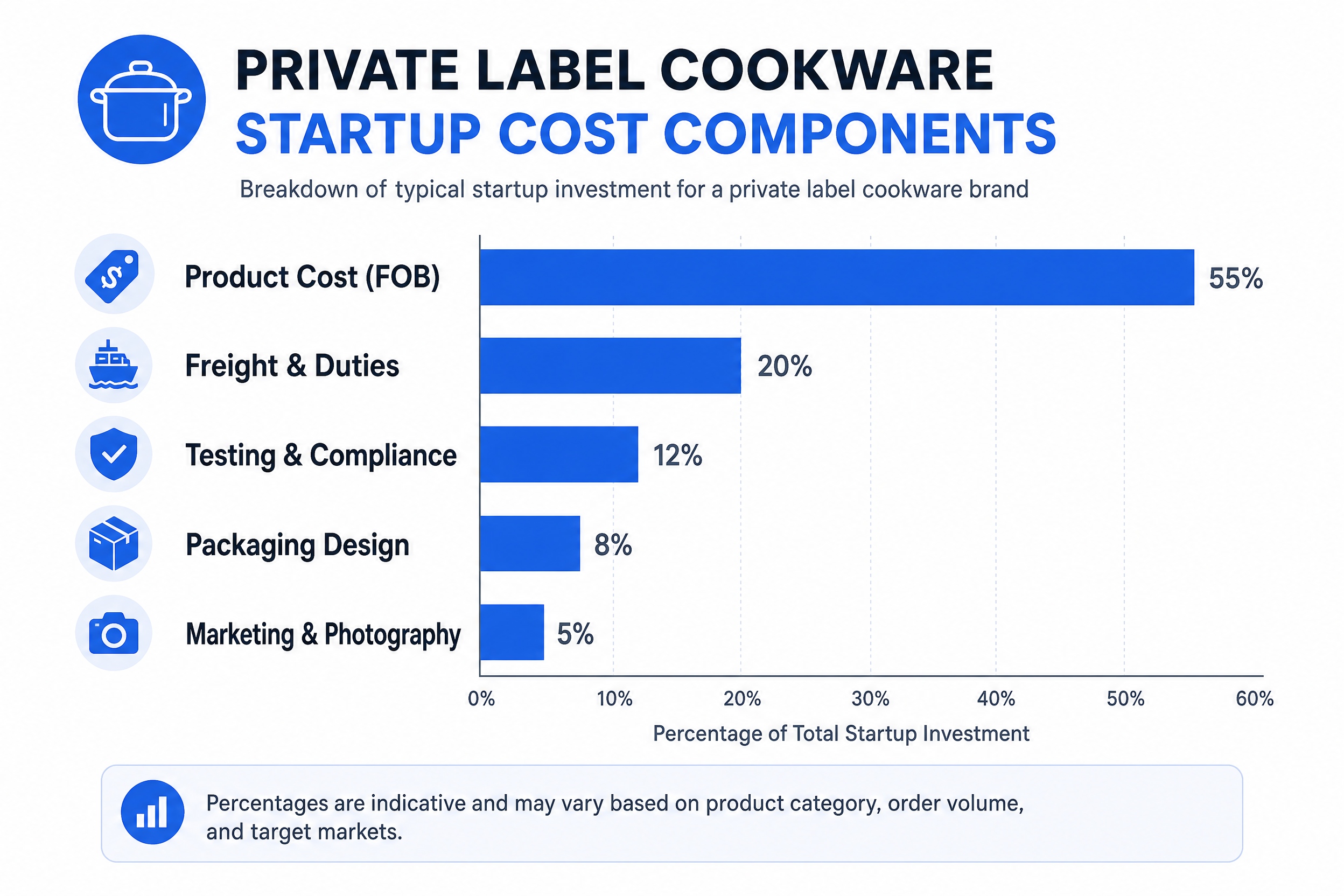
Real Cost Breakdown: What Does Private Label Cookware Actually Cost?
Most manufacturers won’t publish cost data — here’s what to expect.
Transparency on pricing is rare in this category. The following ranges are based on stainless steel cookware as a reference point, reflecting realistic 2025–2026 factory pricing for international buyers:
| Cost Component | Typical Range | Notes |
|---|---|---|
| FOB unit cost (5-pc set, 18/8 304 SS) | $18–$45 | Varies with material spec, coating, quantity |
| Initial sampling | $50–$200 / sample | Usually credited against first production order |
| Packaging design (one-time) | $500–$2,000 | If sourced from factory design service |
| Custom tooling (if required) | $1,500–$8,000+ | Required for unique handle shapes, mold changes |
| Third-party test report (per SKU) | $200–$600 | FDA/LFGB from accredited lab (SGS, Intertek) |
| Ocean freight (per 40’ HQ container) | $2,000–$5,000 | Varies by route, season, and current rates |
| Amazon FBA fees (per unit sold) | $5–$10 | Cookware typically 2–5 lbs; heavier items at upper end |
| Import duty (US) | 0–25% on FOB | Subject to applicable trade classification |
Working capital estimate for a focused first launch (1 SKU, 1,000 units, stainless steel set):
| Item | Low | High |
|---|---|---|
| Product cost (FOB) | $25,000 | $40,000 |
| Freight + duties | $3,000 | $7,000 |
| Testing + compliance | $800 | $2,000 |
| Packaging design | $500 | $1,500 |
| Photography + launch marketing | $2,000 | $5,000 |
| Total | ~$31,300 | ~$55,500 |
This is not a low-capital venture — but the margin profile makes the return viable. Private label gross margins of 25–40% (compared to 8–15% for reselling established brands) mean a $40,000 launch investment can recover within 12–18 months at realistic e-commerce volumes.
The largest cost variable is tooling: if you can work with a manufacturer’s existing tooling library (standard handles, lids, and body shapes), you avoid a $1,500–$8,000 upfront charge. Starting with existing tooling and using color and packaging for differentiation is the most capital-efficient entry path.
Private Label vs. OEM vs. White Label: Which Path Fits Your Stage?
Choose your manufacturing model based on where you are, not where you want to be.
| White Label | Private Label | Full OEM | |
|---|---|---|---|
| Product uniqueness | None — identical to other buyers | Moderate — color, logo, packaging | High — custom-engineered |
| Brand protection | None | Moderate | Strong |
| Minimum investment | Very low | Medium | High |
| MOQ | 100–500 units | 500–2,000 units | 2,000–10,000+ units |
| Time to market | 4–8 weeks | 3–5 months | 6–12 months |
| Suitable stage | Concept testing | Building a brand | Scaling a brand |
| Manufacturer dependency | High | Medium | Low |
Most brands follow a natural progression: white label to validate category demand, private label to build brand equity, selective OEM customizations to deepen product differentiation as volumes justify tooling investment.
The mistake is trying to launch at the OEM level before the market has validated the concept. A unique product with no buyers is an expensive lesson. A private label product with strong branding and proven demand gives you the leverage to invest in deeper customization confidently.
CharmsCook supports all three models. A buyer can start with a private label SKU from the existing catalog and transition specific product lines to OEM customization in later production runs — without changing manufacturing partners or re-qualifying the factory.
FAQ
What is the minimum order quantity for private label cookware?
For private label programs using a manufacturer’s existing tooling, standard MOQs run 500–2,000 units per SKU. Custom molds and handle tooling push this higher — typically 3,000 units minimum for new tooling to be financially viable. Some manufacturers, including CharmsCook, offer first-order accommodations at lower quantities for buyers running initial market tests. Always confirm whether the MOQ applies per colorway or per product line — this affects how you plan your initial SKU range.
How long does it take to launch a private label cookware brand?
From first manufacturer contact to receiving your first shipment: plan for 3–5 months. That breaks down as: 2–4 weeks for product selection and customization sign-off, 2–4 weeks for sample production and approval, 35–60 days for bulk production, and 3–6 weeks for ocean freight. Air freight can compress the import timeline significantly but increases landed cost by 4–8x.
Is private label cookware profitable?
Yes — with the right positioning. Private label gross margins typically run 25–40% on DTC e-commerce, and 15–25% on Amazon after fees and PPC spend. Reselling established brands typically yields 8–15%. The profit differential compounds as brand equity builds and you reduce paid acquisition dependency over time. The critical variable is differentiation: undifferentiated private label products compete on price and compress back toward commodity margins.
What certifications do I need to sell cookware in the US?
At minimum: FDA-compliant materials (your manufacturer should provide this documentation). For coated cookware sold through retail channels: a third-party test report from a CPSC-accepted lab (SGS, Intertek, Bureau Veritas). For Amazon: review current ASIN-level compliance requirements for your category. Some retail partners additionally require BSCI or SMETA social audit documentation from the factory.
What is the difference between private label and OEM cookware?
Private label means branding an existing manufacturer product with your logo, packaging, and color choices — the product format is proven, the tooling already exists. OEM (Original Equipment Manufacturer) means the product is designed and engineered to your specifications, often from the ground up. Full OEM requires more capital (tooling, R&D) and longer timelines but results in a product that competitors can’t easily replicate. In practice, most manufacturers offer a spectrum between the two.
What stainless steel grade should I specify for premium private label cookware?
Specify 18/8 (304 grade) for cooking surfaces and interiors. The 18/8 designation refers to 18% chromium and 8% nickel — the canonical composition of 304 stainless steel. Avoid 201 stainless — its lower nickel content (3.5–5.5% vs. 8–10.5% in 304) reduces corrosion resistance, and products made from it carry a higher risk of failing LFGB nickel migration limits. Request material mill certificates from the factory for every production run confirming the actual grade.
Can CharmsCook handle private label and OEM in the same order?
Yes. A single production run can include private label SKUs (standard product lines with custom branding) and OEM SKUs (design-modified products). Minimum quantities apply per SKU type. Contact CharmsCook’s B2B team with your product brief — responses within 48 hours.
The Bottom Line
Private label cookware is one of the more viable product categories for building a differentiated consumer brand. The market is fragmenting, manufacturing capabilities have improved substantially, and the e-commerce infrastructure to reach buyers at scale already exists.
The real competitive advantage is no longer access to a factory — it’s brand clarity, product focus, and manufacturing partnership quality. The brands that are building durable businesses in this category share three characteristics: a specific positioning that resonates with a defined audience, a manufacturing partner with documented compliance and consistent quality, and the discipline to start focused before expanding.
CharmsCook has partnered with cookware brands across North America, Europe, and Southeast Asia since 1989. Our private label program is designed for brands that take product quality and compliance seriously — not brands looking for the cheapest FOB price. If you’re planning a launch or evaluating manufacturing options, contact our team with your product specifications. We’ll respond with a detailed quote within 48 hours.