


Sourcing stainless steel bowls wholesale means navigating grade confusion (201 vs 304 vs 316), undisclosed gauge thickness, and MOQ tiers that change once you add a logo. This guide cuts through those issues with a direct comparison of steel grades, a realistic pricing table, and a checklist of certifications your supplier should actually be able to produce — so you can place an order with confidence, not guesswork.
201 vs 304 vs 316: The Grade Decision You Can’t Skip
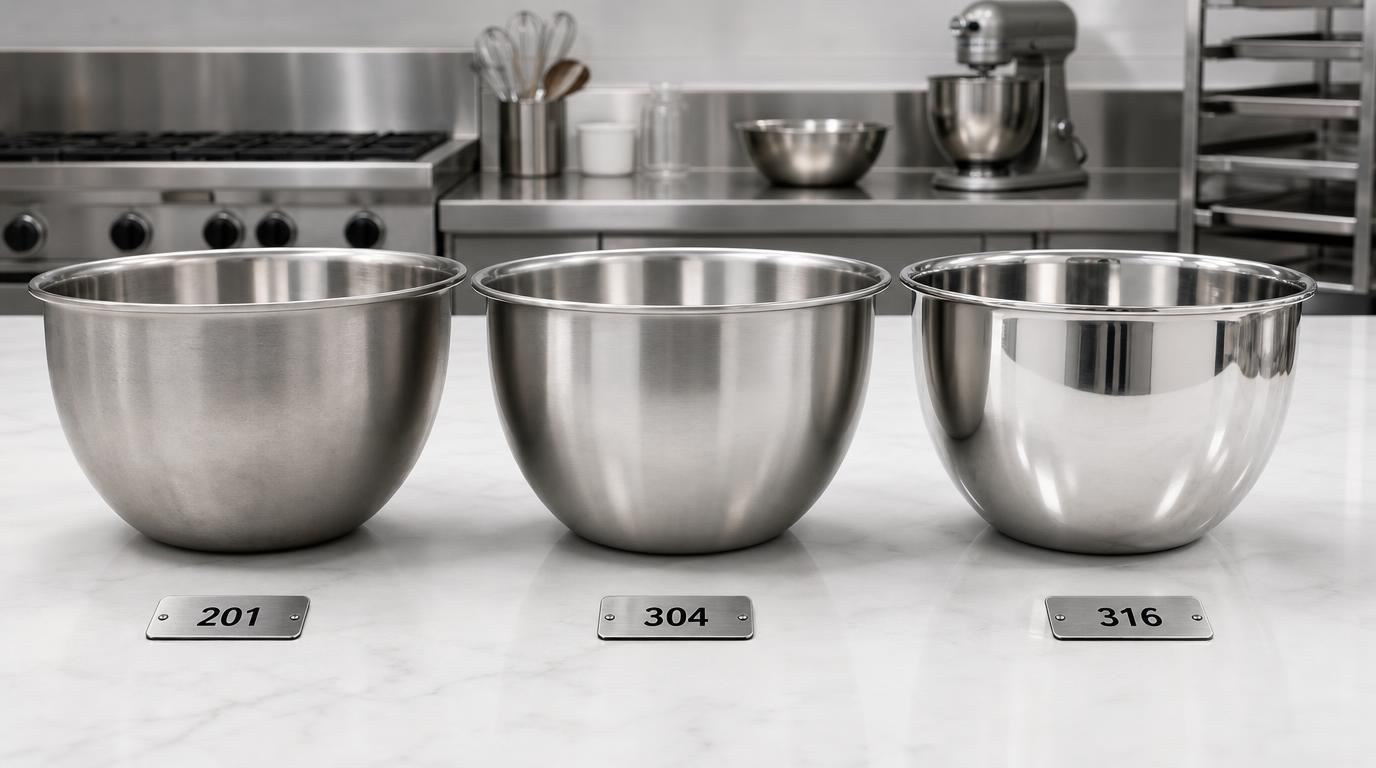
The steel grade determines food safety, corrosion resistance, and long-term durability — and most supplier listings don’t tell you which one you’re getting.
Stainless steel bowls sold at wholesale fall into three grades. Here’s what separates them:
| Grade | Chromium | Nickel | Manganese | Food Safe | Corrosion Resistance | Typical Use |
|---|---|---|---|---|---|---|
| 201 | 16–18% | 3.5–5.5% | 5.5–7.5% | Debated | Low | Budget consumer goods |
| 304 | 18–20% | 8–10.5% | ≤2% | Yes (FDA compliant) | High | Commercial kitchens, food service |
| 316 | 16–18% | 10–14% | ≤2% | Yes + molybdenum | Very high | Marine, high-salt environments |
For restaurant and food service wholesale, 304 is the industry standard. It meets FDA and NSF requirements, resists acidic foods (vinegar-based dressings, citrus marinades), and holds up to commercial dishwasher cycles. Grade 201 is cheaper — roughly 20–30% lower unit cost — but its higher manganese content and lower nickel make it susceptible to pitting when exposed to acidic or salty environments repeatedly.
When I’ve reviewed supplier quotes, the ones listing “stainless steel” without a grade callout are almost always shipping 201. Ask before you order.
Gauge Thickness: The Spec Most Buyers Ignore
Commercial kitchen use demands at least 0.8mm wall thickness. Consumer-grade bowls often measure 0.35mm.
Gauge (wall thickness) affects how a bowl performs after 200 dishwasher cycles, not on day one. Thin-wall bowls dent when stacked under weight, warp at high temperatures, and develop stress cracks at the rim faster than heavy-gauge alternatives.
Here’s a practical reference:
| Thickness | Application | Expected Service Life |
|---|---|---|
| 0.35–0.5mm | Consumer/retail (gift sets, light home use) | 1–3 years with normal use |
| 0.6–0.8mm | Entry-level foodservice, catering events | 3–5 years |
| 0.8–1.2mm | Commercial restaurant, institutional kitchen | 5–10+ years |
| 1.2mm+ | Industrial mixing, heavy prep work | 10+ years |
When requesting quotes, specify thickness in millimeters. Suppliers understand gauge by weight per piece — a 22cm (≈8.5″) 304 bowl at 0.8mm should weigh approximately 180–220g. If a supplier quotes you 95g for a 17cm bowl (as Purecook lists for their 201 product), you’re looking at 0.35mm consumer material.
Wholesale Pricing Tiers: What to Expect at Different Volumes
Pricing varies by grade, size, volume, and whether you’re adding custom branding — and each of those variables compounds.
This table reflects realistic factory-to-importer pricing for 304 stainless, standard polish, no custom logo (FOB China):
| Bowl Size | 200–300 pcs (sample run) | 500–1,000 pcs | 3,000–5,000 pcs |
|---|---|---|---|
| 17cm / 1.5qt | $1.20–$2.00 | $0.80–$1.30 | $0.50–$0.80 |
| 22cm / 3–4qt | $2.00–$3.50 | $1.40–$2.20 | $0.90–$1.40 |
| 30cm / 8qt | $4.00–$6.50 | $2.80–$4.50 | $1.80–$2.80 |
| 36cm / 20qt | $8.00–$12.00 | $5.50–$8.00 | $3.50–$5.50 |
Custom logo (laser engraving or silkscreen) adds $0.15–$0.40/unit and typically requires a 1,000-piece minimum, regardless of the supplier’s stated MOQ for plain stock. Custom packaging (individual color boxes) adds another $0.30–$0.80/unit.
US-based distributors (WebstaurantStore, restaurantsupply.com) sell at $7–$44/unit depending on size — appropriate for restaurants buying a dozen at a time, not for importers placing container orders.
Certifications That Actually Matter (and How to Verify Them)
“Food grade” is a marketing phrase. NSF, FDA, and LFGB are verifiable certifications with specific testing criteria.
| Certification | Issuing Body | What It Tests | How to Verify |
|---|---|---|---|
| NSF/ANSI 2 | NSF International (US) | Cleanability, material safety, no crevices that trap bacteria | nsf.org product search by brand/model |
| FDA Compliance | U.S. Food & Drug Administration | Materials do not leach harmful substances under intended use conditions | Supplier provides Declaration of Conformity (DoC) |
| LFGB | German Institute for Standardization | Migration testing for EU food contact materials | Test report from accredited lab (SGS, TÜV) |
| ISO 9001 | ISO | Quality management system — not a food safety cert | Certificate from accredited registrar |
| BSCI | amfori | Labor standards audit — not a food safety cert | amfori.org audit database |
For US foodservice buyers, NSF listing is the most meaningful signal. An NSF listing means a specific model was tested — not just “the factory is NSF approved.” Ask your supplier for the NSF listing number and verify it at nsf.org.
FDA compliance is typically provided as a DoC from the supplier, not a searchable database entry. It’s still worth requesting — a supplier who won’t provide one is a yellow flag.
Sizes and Capacities: A Practical Mapping
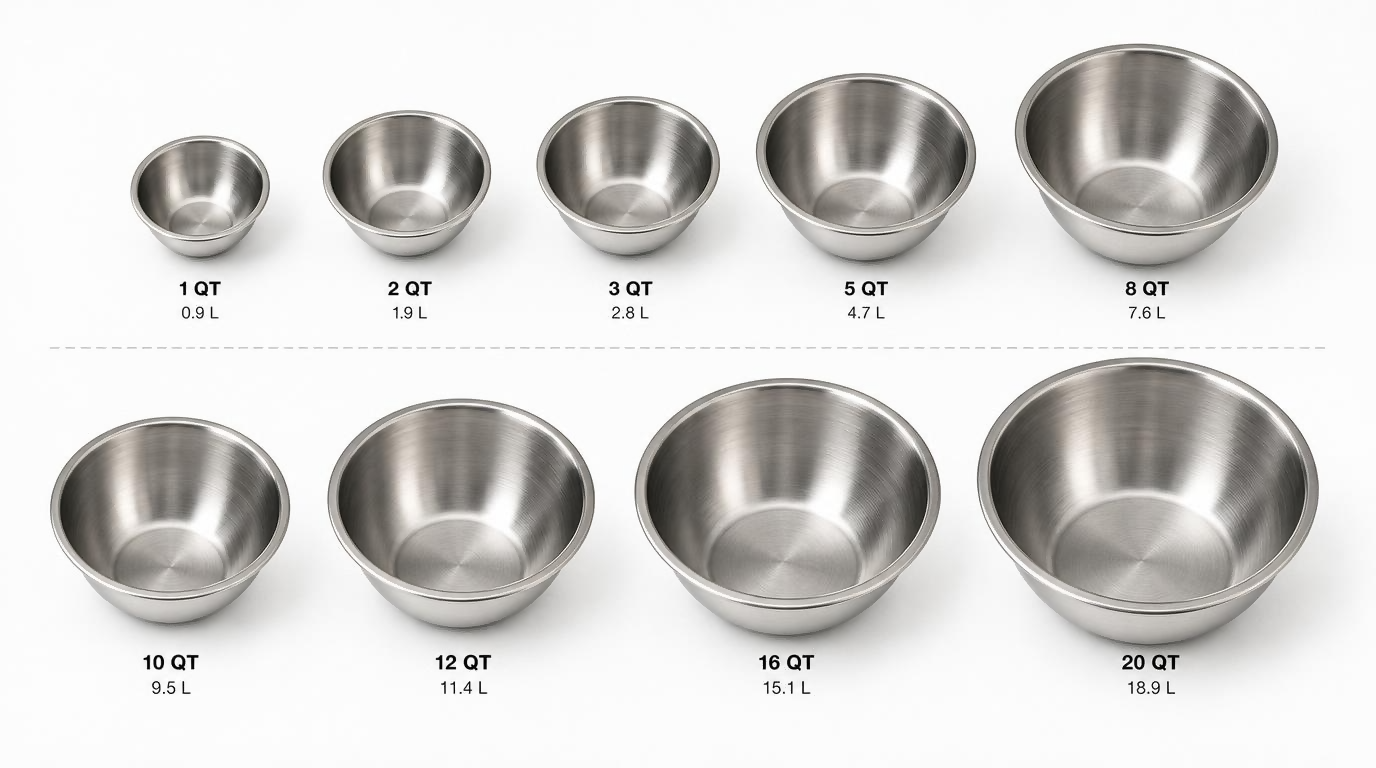
Restaurants and catering operations typically stock three core sizes:
- 3–5 quart (≈20–24cm): Sauce prep, salad tossing, mise en place
- 8–12 quart (≈28–32cm): Batter mixing, marinating, bulk salads
- 20–30 quart (≈38–42cm): High-volume prep, dough, large batch cooking
For wholesale sourcing, buying a nested set (3–5 sizes that stack inside each other) reduces storage footprint and shipping costs. A standard restaurant set covers 3qt, 5qt, 8qt, and 20qt.
Lead Times: What First-Time Importers Miss
From purchase order to warehouse delivery: budget 45–75 days for a standard production run.
- Factory production: 15–25 days (standard order; 25–40 days with custom logo/packaging)
- Quality inspection (third-party): 3–5 days if you schedule one
- Sea freight (China to US West Coast): 18–25 days
- Customs clearance: 3–7 days
Air freight cuts transit to 5–7 days but costs roughly 6–8x more per kg. For mixing bowls (dense, heavy), sea freight is almost always the right call unless you’re covering a stockout emergency.
What to Ask Your Supplier Before You Place an Order
A shortlist of questions that separate serious manufacturers from resellers:
- “What grade of stainless steel is this — 201, 304, or 316?” (Get it in writing on the spec sheet)
- “What is the wall thickness in millimeters?” (Ask for the spec, not the verbal assurance)
- “Can you provide an NSF listing number or FDA Declaration of Conformity?”
- “What is the MOQ for plain stock vs. custom logo vs. custom packaging?” (These are often three different minimums)
- “Do you accept third-party inspection (SGS, Bureau Veritas) before shipment?”
- “What is your current production lead time?” (Changes by season; CNY holiday adds 2–4 weeks)
The Grade You Specify Is the Bowl You Actually Get
Every wholesale bowl order starts with a spec decision, not a price decision. 304-grade at 0.8mm+ with an NSF listing is the baseline for commercial kitchens that wash and reuse equipment daily. Anything below that isn’t “cheaper” — it’s shorter-lived, and the replacement cycle will cost more over 3 years than the premium grade would have upfront.
The market has plenty of 201-grade, 0.35mm bowls priced to look attractive at small MOQs. They’re not wrong products — they’re just wrong for commercial food service. Know which one you’re buying.
FAQ
What steel grade is best for restaurant mixing bowls wholesale?
304-grade stainless steel is the commercial kitchen standard. It’s FDA-compliant, corrosion-resistant to acidic foods, and rated for repeated high-temperature dishwasher cycles. Grade 201 is cheaper but uses higher manganese content and less nickel, making it prone to pitting in food service environments.
What is a typical MOQ for stainless steel bowl wholesale orders?
Plain stock (no customization) typically starts at 200–500 pieces per SKU. Custom logo adds a minimum of 1,000 pieces. Custom packaging (individual boxes) often requires 1,000–2,000 pieces minimum. These MOQs are independent — a supplier might accept 300 plain units but require 1,000 for any branding work.
How do I verify NSF certification for wholesale mixing bowls?
Visit nsf.org and use the product/company search. NSF-certified mixing bowls have a specific listing by brand and model number. A supplier claiming NSF compliance should be able to provide the listing number — “NSF-certified factory” without a specific product listing is not meaningful for food contact compliance.
What gauge thickness should I specify for commercial kitchen mixing bowls?
Specify 0.8mm minimum wall thickness for active commercial kitchen use. Bowls measuring 0.35–0.5mm are consumer-grade and will dent, warp, or crack faster under stacking weight and repeated thermal cycling in a commercial environment.
What’s the price difference between 201 and 304 stainless steel mixing bowls wholesale?
At factory pricing (FOB China), 304-grade bowls typically cost 20–35% more per unit than comparable 201-grade bowls of the same size and finish. The premium is worth it for food service buyers: 304 grade lasts significantly longer in daily commercial use and meets NSF and FDA compliance requirements that 201 may not satisfy.





