


A stainless steel braiser pan is a wide, shallow cooking vessel with straight sides and a tight-fitting lid, designed for searing then slow-cooking in liquid. For B2B buyers, the critical decisions are construction type (triply vs disc-bottom), stainless grade (18/10 vs 18/8), and certification compliance (FDA, LFGB, CA65). This guide covers every spec that matters at the wholesale level — with pricing benchmarks, size guidance, and an OEM sourcing checklist.
What Is a Stainless Steel Braiser Pan? (And Why It’s Not a Dutch Oven)
A braiser pan sits between a skillet and a Dutch oven in both form and function. The defining features: a wide, flat cooking base (typically 10–14 inches / 25–35 cm in diameter), straight sides that rise 2.5–4 inches (6–10 cm), and a domed lid that returns condensation to the food. That wide base is the key — it creates a large Maillard-reaction surface for searing before the lid goes on and braising begins.
The confusion with Dutch ovens is common. A Dutch oven has taller, more vertical walls and is optimized for long braises and soups. A braiser’s wide, shallow profile maximizes browning surface and keeps protein portions in a single layer — critical in commercial kitchen settings where searing dozens of portions sequentially determines service speed.
For wholesale buyers: the braiser occupies a distinct, defensible SKU position. It doesn’t replace a rondeau (which is essentially the same shape but typically unlidded and larger, used for sautéing) and doesn’t compete directly with the Dutch oven. Importers who carry all three cover different use-case budgets without cannibalizing.
Stainless Steel Grade: 18/10 vs 18/8 — What Actually Matters for Wholesale
The numbers refer to chromium and nickel content by percentage. 18/10 stainless (also called AISI 304) contains 18% chromium and 10% nickel. 18/8 contains 18% chromium and 8% nickel. The chromium provides corrosion resistance; the nickel adds luster and additional protection against acidic foods.
For braising applications — where wine, tomatoes, and citrus are common braising liquids — that 2% nickel difference is relevant. In a 2-hour braise with red wine, 18/8 surfaces can show very slight surface discoloration after 50–100 wash cycles, while 18/10 holds its mirror finish longer. Whether this matters to your end customer depends entirely on your market: restaurant supply buyers expect heavy use and accept some patina; premium retail customers expect the pan to look new after three years.
Practical wholesale guidance: Specify 18/10 for premium retail and HoReCa lines. 18/8 is acceptable for value-tier wholesale where price point is the primary driver. Verify with your factory by requesting the material test certificate (MTC) — not just a verbal confirmation.
One grade that occasionally appears in supplier catalogs is 430 stainless (ferritic, not austenitic). It is magnetic, induction-compatible, but significantly less corrosion-resistant than 304. Some factories use 430 for the base of disc-bottom pans and 304 for the body — a legitimate approach if disclosed, but one to verify explicitly.
Construction Types: Triply vs Disc-Bottom — The Performance and Cost Split
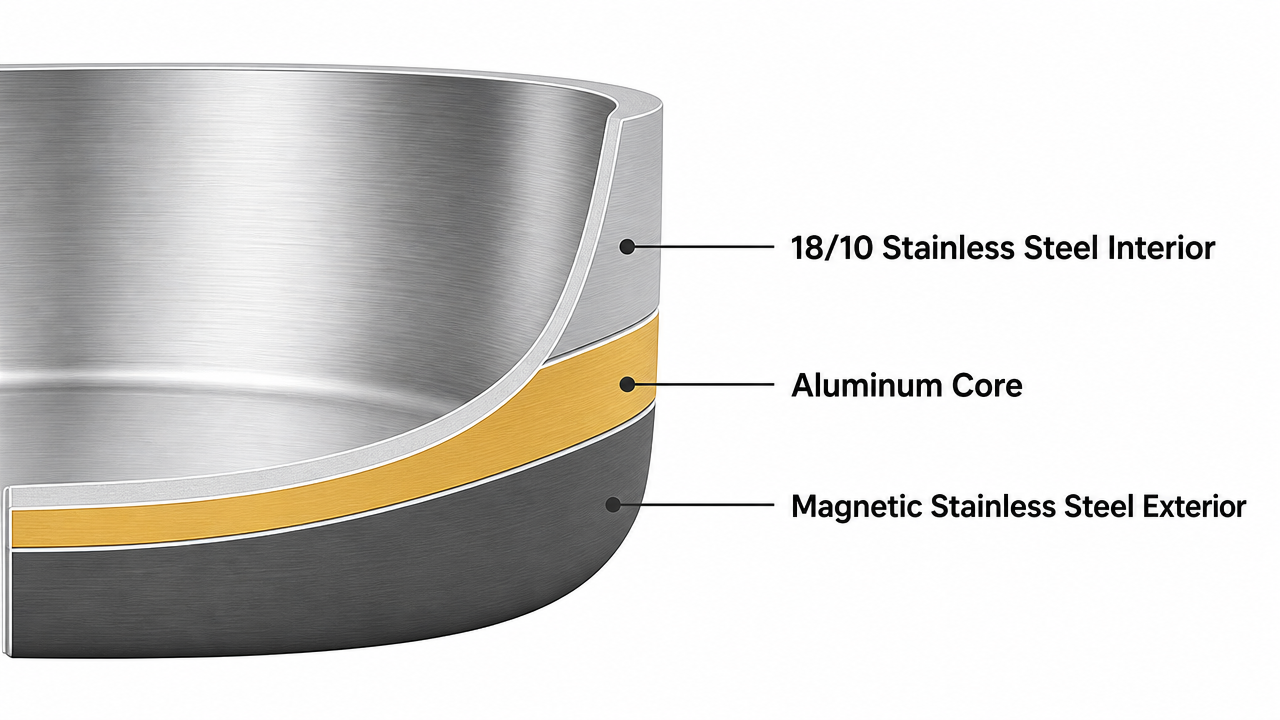
This is the decision that most affects unit economics and end-user experience.
| Construction | Heat Distribution | Oven-Safe Temp | Factory Cost (relative) | Best For |
|---|---|---|---|---|
| Full triply (3-ply clad) | Even, edge-to-edge | 260°C / 500°F typical | Higher (+40–60%) | Premium retail, HoReCa, private label |
| 5-ply clad | Excellent, ultra-even | 260°C+ | Highest | Premium restaurant lines |
| Disc-bottom (encapsulated base) | Good at center, less at edges | 200–230°C typical | Lower | Value retail, foodservice supply |
| Single-ply 304 | Poor, hot spots | Varies | Lowest | Institutional budget supply |
In a triply braiser, aluminum or copper is sandwiched between two layers of stainless steel across the entire pan body — base and walls. Heat travels laterally and reaches the sides of the pan. This matters when braising: the liquid in contact with the walls also receives heat, keeping it at a steady simmer without requiring a higher burner setting.
A disc-bottom braiser bonds the conductive layer only to the base. The walls are single-ply stainless. This works for boiling and stock reduction but creates a temperature gradient in a braise — the bottom runs hotter than the sides. For restaurant volume braising, that gradient means either over-reducing the bottom or under-cooking the protein against the wall.
I’ve reviewed construction cross-sections from three factories (two Guangdong-based, one Zhejiang-based) — the gap in wall thickness and clad bonding quality between a $15 and a $28 factory price is not cosmetic. At $15, you’re typically getting disc-bottom with 0.3–0.4mm walls. At $28, you’re getting full triply with 0.5–0.6mm wall thickness and a proper cold-roll bond.
For buyers targeting the $60–120 retail price range, full triply is the minimum defensible construction. Below $50 retail, disc-bottom is standard and expected.
Wide and Shallow: Why the Geometry Matters in Commercial Kitchens

The wide, shallow form factor is not just aesthetic. For braising specifically, three things depend on base diameter:
Searing capacity per batch. A 28cm (11-inch) base fits 4–5 chicken thighs in a single layer. A 24cm base fits 3. In a 40-cover restaurant service, that’s the difference between 2 searing rounds and 3 rounds per mise en place — roughly 8 minutes of cook time per batch.
Evaporation rate during reduction. Because the lid returns moisture to the pan, a wider surface area concentrates flavor reduction more efficiently. The wide base accelerates sauce concentration in the final uncovered stage.
Oven rack compatibility. Standard commercial combi oven GN 1/1 trays are 53cm × 32.5cm. A 32cm (12.5-inch) braiser with handles fits a GN 1/1 rack without angling. Many importers don’t spec this until a hotel client returns an order — measure handle-to-handle before quoting HoReCa accounts.
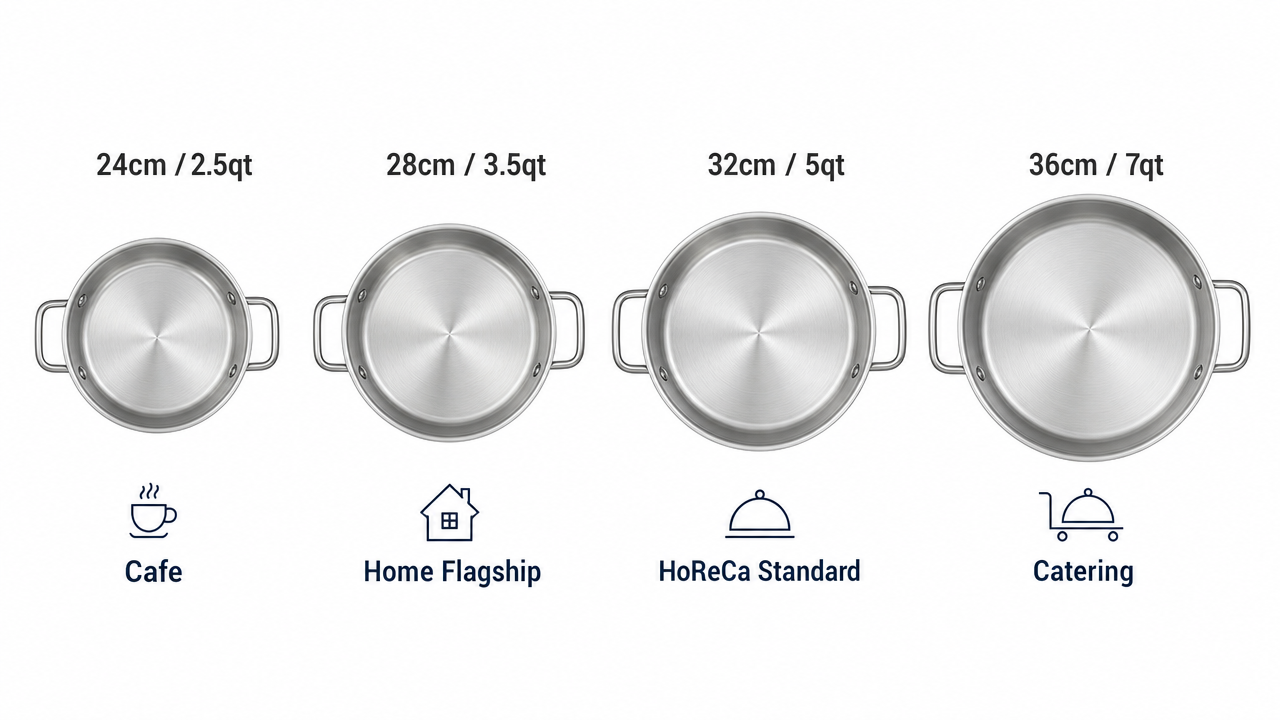
For wholesale sizing guidance, the most common SKU range for B2B braiser orders is:
| Size | Capacity | Application |
|---|---|---|
| 24 cm / 9.5 in | ~2.5 qt / 2.4 L | 2–3 portion residential, café |
| 28 cm / 11 in | ~3.5 qt / 3.3 L | Home cook flagship, small restaurant |
| 32 cm / 12.5 in | ~5 qt / 4.7 L | HoReCa standard, hotel banquet |
| 36 cm / 14 in | ~7 qt / 6.6 L | Large batch restaurant, catering |
Stocking the 28cm and 32cm as your core SKUs covers 80% of order requirements across segments. The 24cm moves in retail gift sets; the 36cm is a HoReCa specialty order.
Certifications: What Importers Need Before Clearing Customs
Skipping certification documentation is the most common sourcing mistake I see among first-time cookware importers. The pan itself might be perfect, but the paperwork gap delays containers and triggers FDA holds.
For the US market:
- FDA compliance under 21 CFR (food contact materials) — most 304 stainless pans comply by material, but you need a signed factory declaration
- California Proposition 65 — requires testing/documentation if selling in CA
- Major retail buyers (Amazon, Target, Walmart) increasingly require independent third-party material and performance testing reports
For EU/UK markets:
- LFGB certification (German standard, widely accepted across EU) — specifically Article 31 migration testing for stainless steel
- EU Regulation 1935/2004 (food contact materials framework)
- REACH compliance for any surface coatings or handle materials
For Australia/NZ:
- FSANZ food contact material guidelines
Request these documents before the factory ships sample orders. A factory that cannot produce MTC and LFGB test reports is a compliance risk regardless of sample quality.
What Real Buyers Find in Production Runs (And How to Spec Against It)
Three quality issues come up repeatedly in HoReCa procurement reviews of stainless steel braisers:
Lid fit tolerance. A loose-fitting lid loses steam during braising, extending cook time and drying out protein. Specify a maximum lid-to-rim gap of 0.5mm in your purchase order. Factory QC teams can measure this with feeler gauges; if yours can’t, find a different factory.
Handle rivet vs welded. Riveted handles are traditional but create a hygiene risk in commercial kitchens — food and liquid accumulate around the rivet head. Welded handles are harder to manufacture cleanly but pass health inspections more reliably. For HoReCa buyers, specify fully welded handles with external welds only (no interior weld bead that traps residue).
Base flatness after heat cycling. Single-ply pans warp when heated empty on induction. A flat base spec of ±0.3mm deviation after 10 heat cycles (empty, to 200°C) should be a standard QC checkpoint in your specification. Ask factories for their heat cycling test protocol — most established manufacturers have one.
Sourcing Checklist for OEM and Private Label Orders
If you’re placing OEM or private label braiser orders, cover these points in your initial RFQ:
- Material grade: 18/10 (AISI 304) or 18/8 — request MTC
- Construction: full triply, disc-bottom, or 5-ply — confirm clad bonding method (cold roll vs explosion welding)
- Wall thickness: minimum 0.5mm for triply body; specify base thickness (typically 3–5mm for disc-bottom, 2.5–3mm for triply)
- Handle type: riveted or welded; handle material (cast SS, silicone, bakelite); oven-safe temp rating
- Lid: dome or flat; knob material; steam vent (yes/no)
- Induction compatibility: confirmed via base material (430 or triply with magnetic outer layer)
- Certifications required: FDA declaration, LFGB, CA65, REACH (specify by destination market)
- Surface finish: mirror polish, brushed, or matte — specify Ra value if critical
- Logo/branding: laser engraving, embossing, or label — confirm min order for each
- MOQ: typical triply braiser MOQ from established factories is 500–1000 pcs per SKU
- Sample lead time: 10–15 working days standard; 5–7 days for rush (with surcharge)
- Production lead time: 45–60 days post-sample approval for first order; 30–45 days for reorders
How to Evaluate a Factory Price Quote
A triply stainless steel braiser (28cm, 18/10, welded handle, with lid) from an established Guangdong or Zhejiang factory typically quotes in the $20–30 range FOB (per unit, 500+ MOQ, including FDA declaration) depending on finish and branding complexity. Below $18 for a claimed triply pan with certifications is a red flag — request the cross-section and material certificate before proceeding.
Disc-bottom 28cm braisers quote at $8–14 FOB. Single-ply at $5–8 FOB.
Price spikes above $35 for standard triply typically reflect heavy-gauge 5-ply construction, premium finishes (hammered exterior, colored enamel-effect exterior), or small MOQ premiums.
When comparing quotes across factories, normalize to the same spec: same diameter, same material grade, same construction, same certification package. A $22 quote with LFGB and FDA documentation may be more cost-effective than a $17 quote that requires you to commission certification testing independently ($800–2,500 per SKU depending on test scope).
Summary
The stainless steel braiser pan is one of the most versatile SKUs in a cookware line — it covers searing, braising, roasting, and shallow frying in a single piece, justifying its price point to both retail and HoReCa buyers. For wholesale procurement, the decisions that matter most are construction type (invest in triply if your margin supports it), material grade (spec 18/10 for markets where longevity is a selling point), and certification documentation (get it from the factory before samples ship, not after).
The wide, shallow form factor isn’t a style preference — it’s a functional spec with direct implications for searing throughput and oven compatibility. Buyers who understand that geometry sell it more effectively to chefs and buyers who don’t just describe it as “a lid pan.”
Frequently Asked Questions
What is the difference between a braiser pan and a Dutch oven?
A braiser has a wider, shallower profile (more surface area, less depth) optimized for searing proteins before adding liquid. A Dutch oven has taller walls, more volume, and suits soups, stews, and long braises. For commercial kitchens, both are standard; for a single SKU purchase, a braiser is more versatile across quick weeknight proteins.
Can you braise in a stainless steel pan?
Yes — stainless steel is excellent for braising. Unlike non-stick, it tolerates high-heat searing and acidic braising liquids (wine, tomatoes, citrus) without coating degradation. Full triply stainless maintains even temperature across the base and walls, critical for consistent liquid temperature in a long braise. Single-ply stainless develops hot spots and is less reliable for this application.
What stainless steel grade is best for a braiser pan?
18/10 (AISI 304) is the industry standard for quality braiser pans. It offers superior corrosion resistance to acidic braising liquids and maintains a clean surface appearance over years of commercial use. 18/8 (AISI 304 variant) is acceptable but shows slightly earlier surface wear in high-acid applications. Avoid 430 stainless for the pan body; it is induction-compatible but significantly less corrosion-resistant.
What MOQ should I expect for private label stainless steel braisers?
Established Chinese cookware factories typically set a minimum of 500–1,000 pieces per SKU for triply construction with custom branding. Disc-bottom braisers may be available at lower MOQs (200–500 pcs) due to simpler construction. Some factories offer lower MOQs for a first order with a higher unit price, then step down at 500+ pcs.
What certifications does a stainless steel braiser need for US import?
At minimum: an FDA 21 CFR food contact compliance declaration from the factory. If selling in California, a Proposition 65 documentation package. Major retail buyers (Amazon, Target, Walmart) increasingly require ASTM testing reports. For EU markets, LFGB is the primary certification; for the UK post-Brexit, you need UKCA-equivalent food contact documentation.





