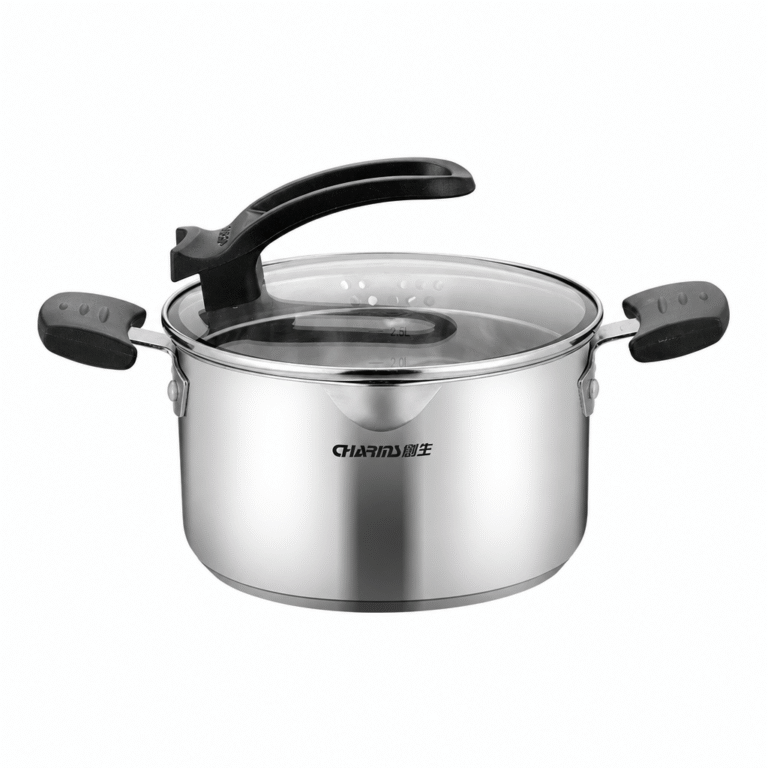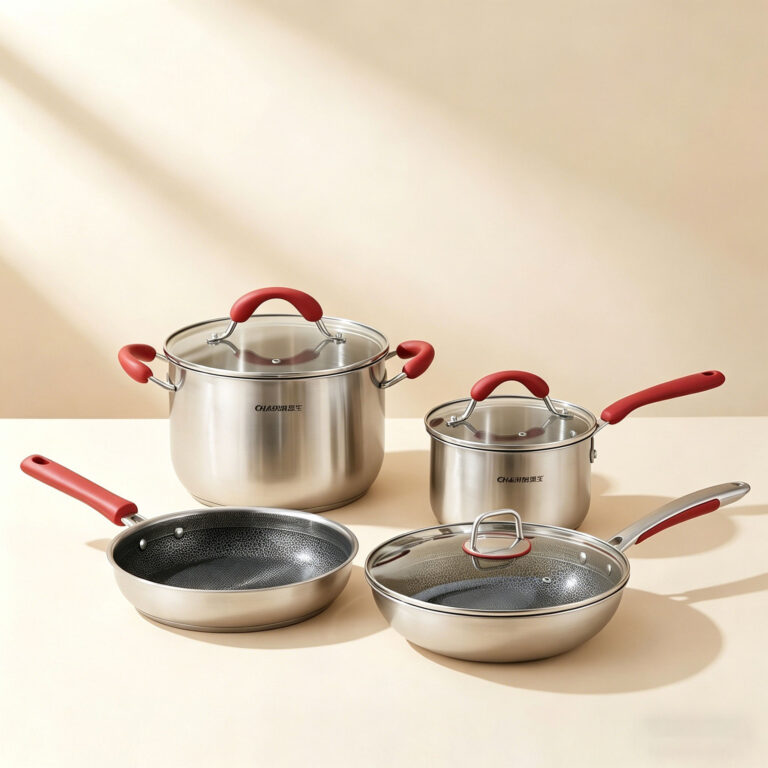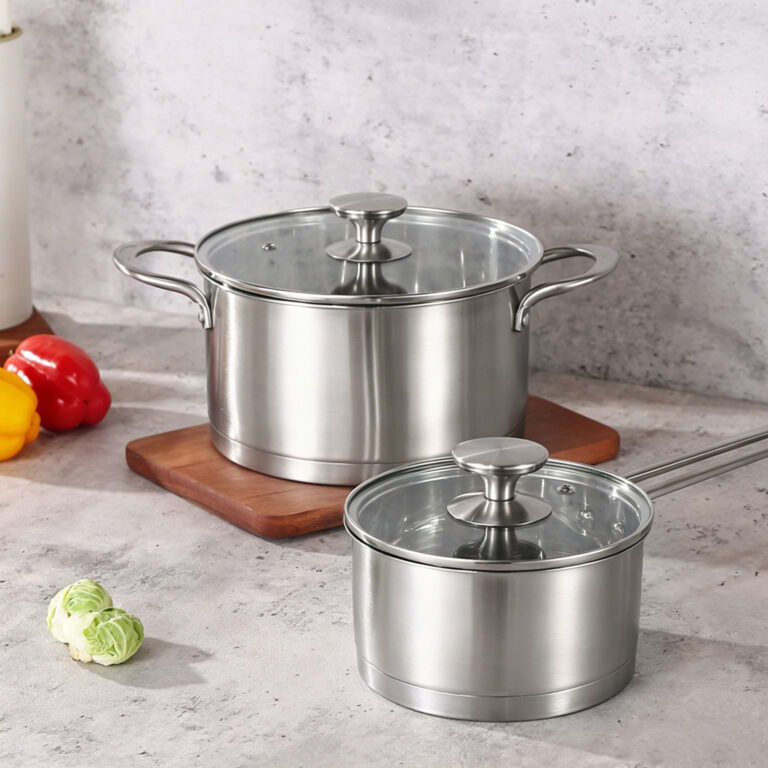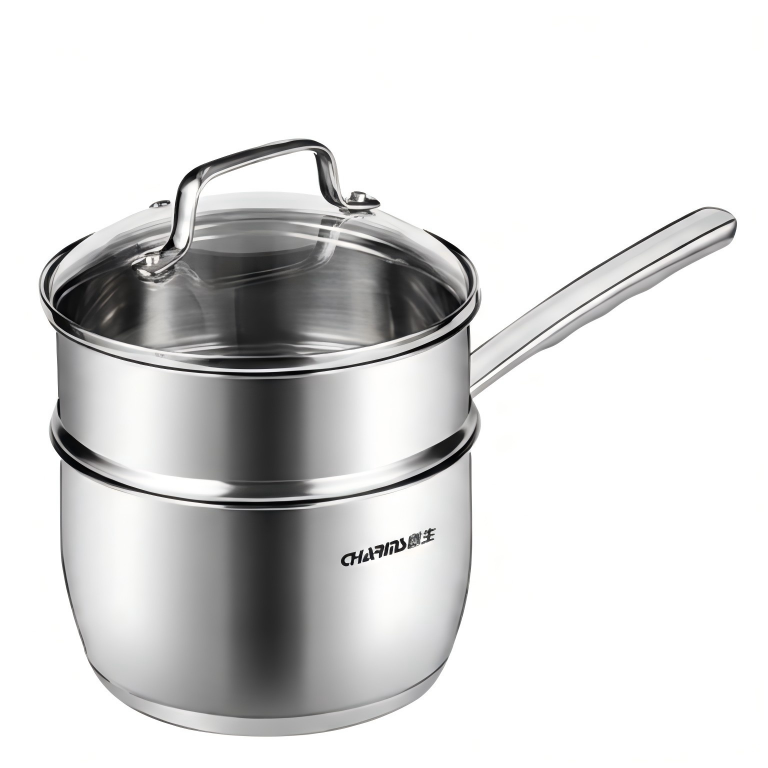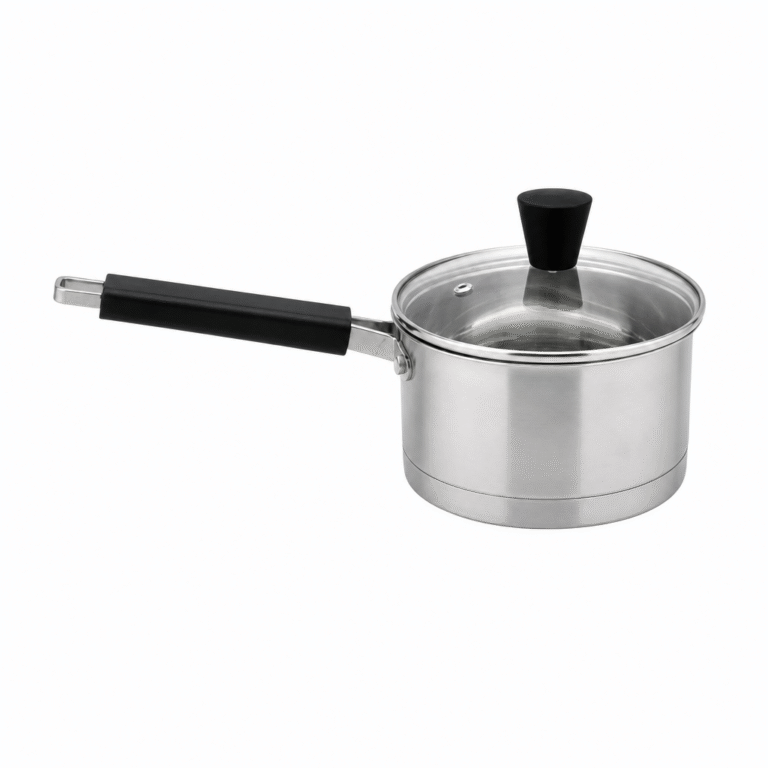


Stainless steel casseroles made from 304 (18/10) grade are oven-safe up to 500–600°F, highly durable for freight and commercial use, and the most practical choice for wholesale buyers targeting the US and EU markets. Tri-ply construction solves the one genuine weakness of stainless steel — uneven heat distribution — making it competitive with ceramic and glass for baking. This guide covers material grades, construction types, baking performance comparisons, certification requirements, and a pre-order QC checklist for importers and distributors sourcing in volume.
What Exactly Is a Stainless Steel Casserole?
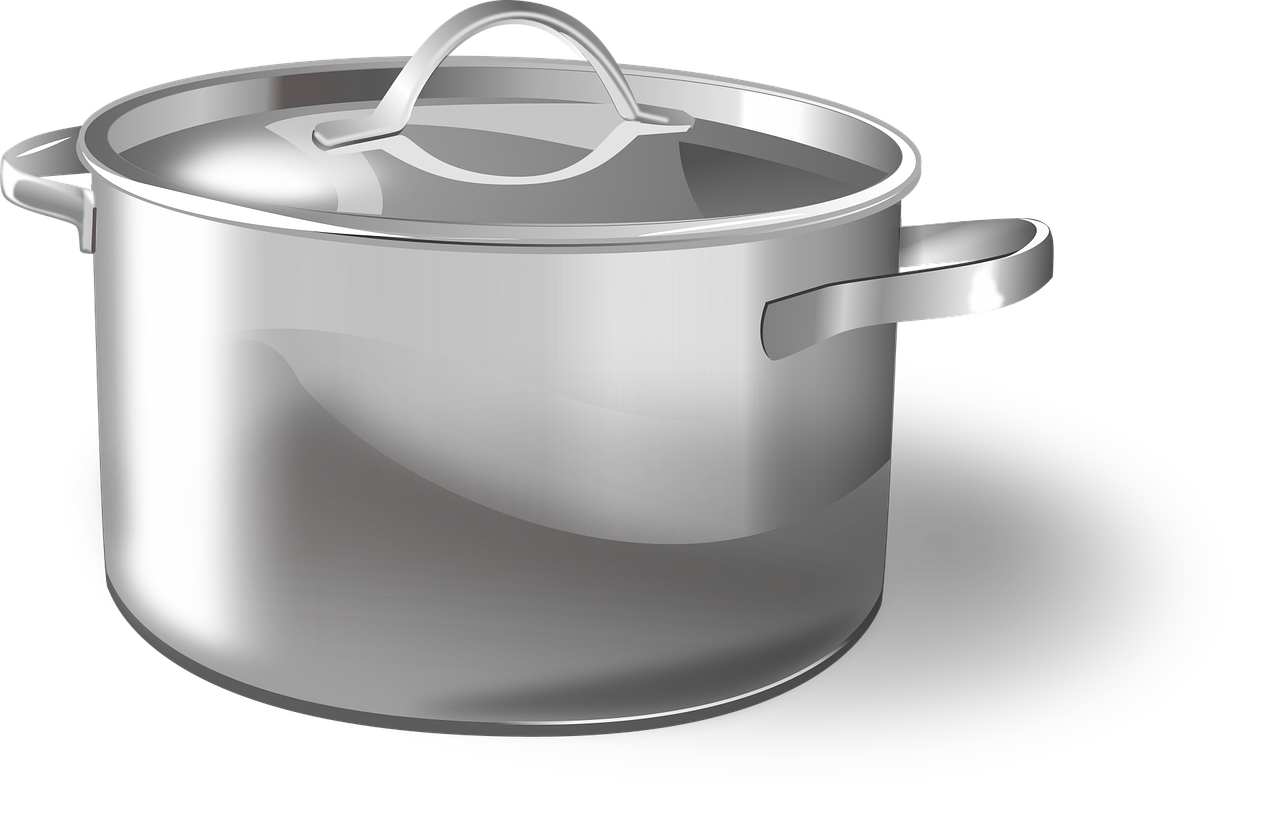
A stainless steel casserole is a deep, lidded cooking vessel designed for both stovetop and oven use. The term covers two overlapping product types that wholesale buyers often need to distinguish:
- Casserole pot — round or oval, with two short handles and a fitted lid; used for braises, soups, and slow oven cooking. Capacities typically run 1–8 liters.
- Baking casserole (casserole dish) — a shallower, rectangular or oval oven dish without a stovetop base; used for lasagna, gratins, and roasted vegetables. Sold widely in the 2–5 liter range.
Both share the same material and construction fundamentals, but their market positioning differs. A casserole pot competes with enameled cast iron (Le Creuset-style); a baking casserole dish competes with glass (Pyrex-style) and ceramic. For wholesale buyers, the category you source determines which competitors you’re up against at retail.
Material Grades: Why 304/18-10 Is the B2B Standard
The number stamped on the base — 18/10, 18/8, 18/0 — tells you the chromium-to-nickel ratio of the steel alloy. This matters for both corrosion resistance and food safety certification.
| Grade | Chromium | Nickel | ASTM Equivalent | Corrosion Resistance | Oven Safety | Typical Use |
|---|---|---|---|---|---|---|
| 18/10 | 18% | 10% | 304 | Excellent | Yes (500–600°F) | Premium cookware |
| 18/8 | 18% | 8% | 304 variant | Very Good | Yes | Mid-range cookware |
| 18/0 | 18% | 0% | 430 (ferritic) | Good | Yes | Induction-only budget lines |
| 201 | 15–17% | 1–5% | — | Poor | Marginal | Low-cost, often mislabeled |
For wholesale targeting US or EU retail, 304 (18/10 or 18/8) is the minimum acceptable grade. The 18/10 designation is not a marketing term — it refers to the actual alloy composition defined under ASTM A240 and ISO 15510. Products labeled 304 but actually manufactured from 201 alloy are a known fraud risk in the China supply chain. More on verification below.
Grade 430 (18/0) is a legitimate ferritic stainless steel used specifically for induction-compatible budget cookware. Its lower nickel content reduces cost but also lowers corrosion resistance. It’s acceptable for dry stovetop use but performs poorly in high-acid baking environments (tomato-based casseroles, citrus gratins).
Baking Performance: Stainless Steel vs. Glass vs. Ceramic
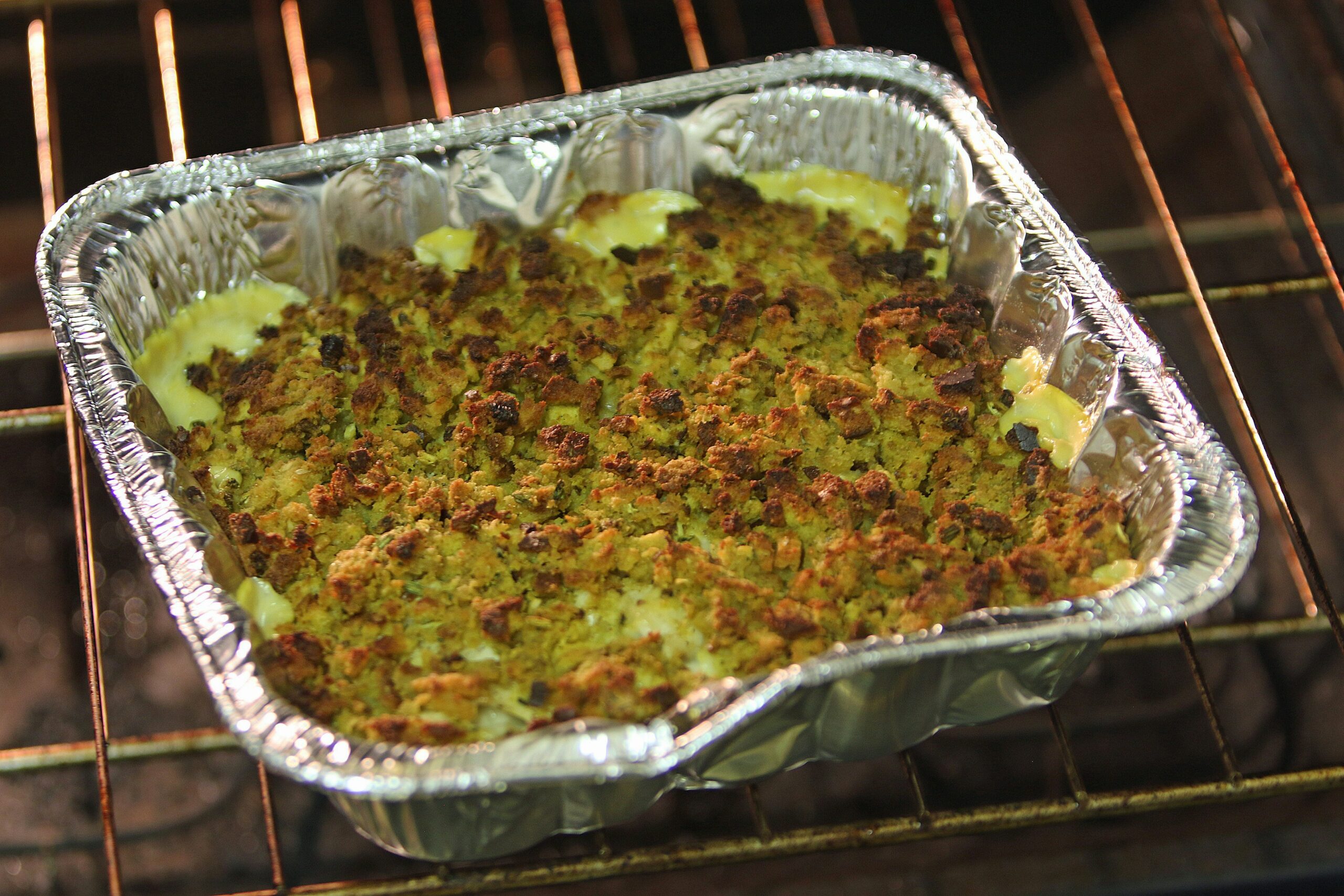
This is the comparison wholesale buyers get asked about most, because retail customers ask it constantly. Here’s an honest breakdown based on tested behavior rather than brand marketing:
| Property | Stainless Steel (Tri-ply) | Glass (Borosilicate) | Ceramic/Stoneware |
|---|---|---|---|
| Heat-up speed | Fast | Slow | Slow |
| Heat evenness | Good (tri-ply) / Poor (single-ply) | Good (passive) | Good (passive) |
| Heat retention | Low–Medium | High | High |
| Max oven temp | 500–600°F | 425–450°F | 400–450°F |
| Broiler safe | Yes | No | No |
| Stovetop use | Yes | No | No |
| Induction | Grade 430 or encapsulated base | No | No |
| Breakage risk (freight) | Negligible | High (~3–8% breakage rate per container) | High (~5–12%) |
| Dishwasher safe | Yes | Yes | Most yes |
| Food sticking | More prone without fat | Less prone | Less prone |
The single biggest wholesale advantage of stainless steel is freight durability. Glass and ceramic casserole dishes break at meaningful rates during container shipping — independent logistics assessments typically cite 3–12% damage rates for ceramic bakeware without custom packaging. For importers, that’s absorbed margin. Stainless steel arrives intact.
The single genuine weakness — food sticking during baking — is manageable with user education (preheat, use fat, deglaze). It’s not a product defect; it’s a material property that any competent retail PDP or instruction card addresses.
Construction Types That Affect Baking Results
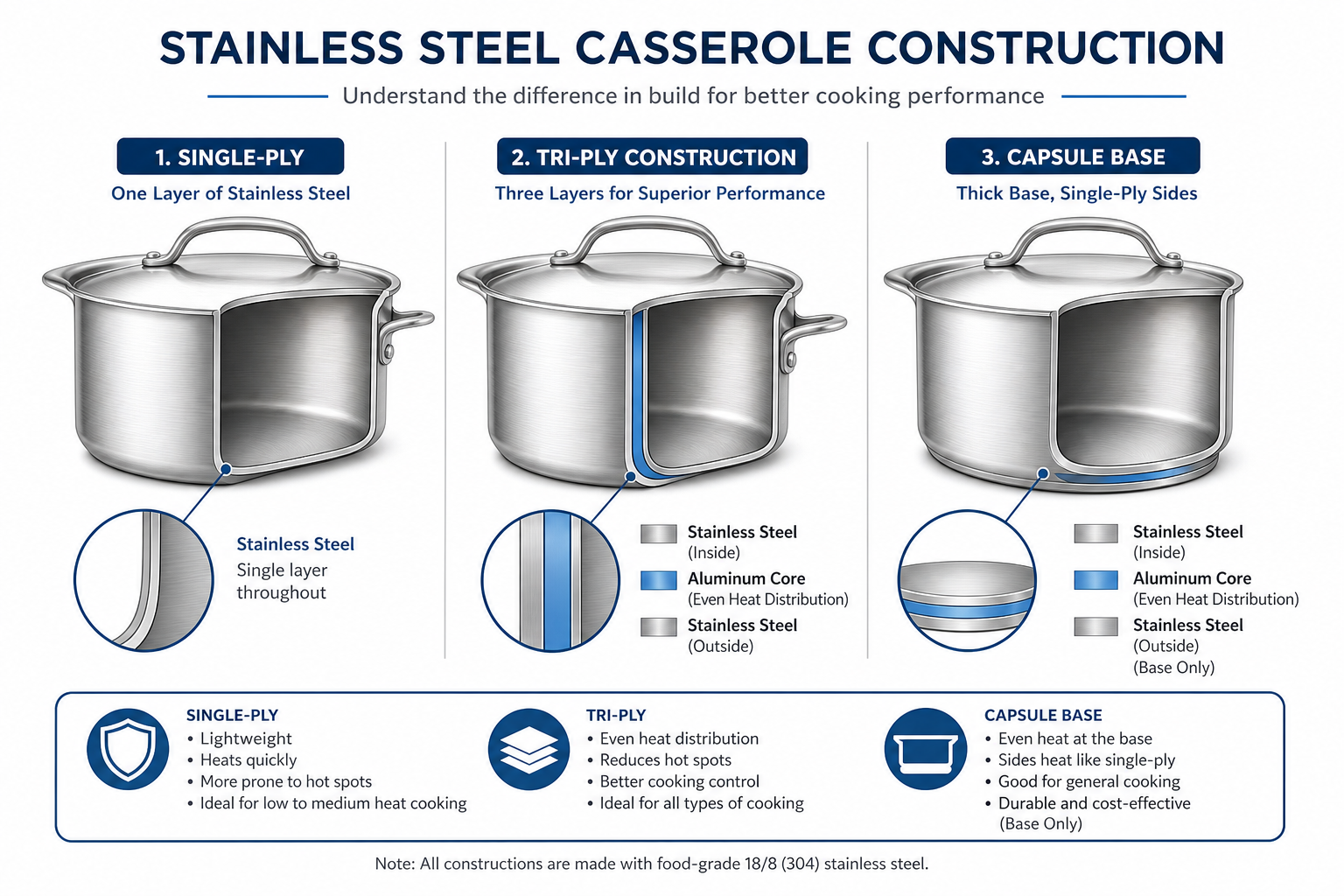
Not all stainless steel casseroles are built the same. Construction type affects both baking performance and unit cost, so it drives wholesale positioning.
Single-ply (1 layer of SS)
The cheapest construction. Heat concentrates directly under the flame or heating element, creating hot spots. Fine for boiling water; poor for baking anything that requires even heat. Wholesale cost is low, but retail returns will be high if marketed for baking.
Tri-ply (SS + aluminum core + SS)
An aluminum layer is bonded between two stainless steel layers running the full height of the pan. The aluminum (thermal conductivity ~205 W/(m·K)) distributes heat that the stainless steel (thermal conductivity ~16 W/(m·K)) alone cannot. This is the construction that makes stainless steel competitive with ceramic for baking. All-Clad, Viking, and most premium brands use full-body tri-ply. Oven-safe ratings for tri-ply casseroles reach 500–600°F across major brands.
Capsule base (disk bottom)
A thick aluminum or copper disk is welded to the base only — sides remain single-ply. This is a cost-effective compromise that works well for stovetop use. For deep casserole baking, heat still travels unevenly up the single-ply walls. Acceptable for wholesale at a lower price point if the application is primarily stovetop braising rather than oven baking.
5-ply and beyond
Premium segment. Additional layers (often copper or extra aluminum) improve thermal response and evenness. Price-justified for high-end HoReCa or premium retail.
Standard Sizes for Wholesale Casserole Programs
Wholesale buyers building a casserole line typically anchor on 2–3 core sizes plus a hero SKU. Here’s how capacity maps to use cases and retailer requirements:
| Capacity | Approximate Dimensions | Primary Use Case | Retail Sweet Spot |
|---|---|---|---|
| 1.5–2L | 18–20cm diameter | Single/couple portions | Entry price point |
| 2.5–3L | 22–24cm diameter | Family meals (2–4 servings) | Volume seller |
| 4–5L | 26–28cm diameter | Family + entertaining (4–6 servings) | Hero SKU |
| 6–8L | 30–32cm diameter | Large families, HoReCa | Professional/gift |
For baking casserole dishes (rectangular), the most common wholesale SKUs are:
- Small: ~1.5L / 9×6 inch
- Medium: ~3L / 13×9 inch (the standard “casserole” size referenced in most recipes)
- Large: ~4.5–5L / 15×10 inch
A 3-piece nested set (1.5L + 3L + 5L) is the most efficient retail packaging configuration — it ships efficiently and hits multiple price thresholds.
What to Verify Before Placing a Wholesale Order
In my experience reviewing factory samples across multiple sourcing cycles, four categories of claims are most commonly misrepresented in casserole wholesale. Verify all four before issuing a PO.
1. Steel grade
Request a mill certificate (材质证书) from the steel coil supplier — not the factory’s own grade declaration. Mill certificates show actual nickel and chromium content from the steel manufacturer. An XRF analyzer (handheld fluorescence spectrometer) can verify grade at the sample inspection stage for under $50 per test through a third-party QC firm.
2. Oven temperature rating
Ask for the basis of the rated temperature. The lid knob and handle materials often limit oven temperature before the steel body does. Phenolic handles are typically rated to 180°C (356°F); bakelite similar. If the product is marketed as oven-safe to 260°C (500°F), the handles and knobs must be rated to match. Stainless steel handles with no polymer components are the only safe choice for full-range oven use.
3. Certifications
Target market drives certification requirements:
| Market | Required/Common Certs | Testing Body |
|---|---|---|
| EU retail | LFGB (German food safety), EU Regulation 1935/2004 | SGS, TÜV, Bureau Veritas |
| US retail | FDA 21 CFR (food contact compliance) | FDA-registered lab |
| Food service (global) | NSF/ANSI 2 (food equipment) | NSF International |
| General export | ISO 9001 (factory QMS) | Various |
LFGB is more stringent than FDA for migration limits — if your product passes LFGB, it will pass FDA. For EU-only wholesale programs, LFGB is the non-negotiable.
4. Base thickness
For tri-ply casseroles, base and wall gauge matters for both durability and baking performance. Industry standard for mid-range tri-ply is 2.4–3.0mm total wall thickness. Anything under 2mm in the base will show heat distribution problems. Ask for gauge specifications in writing and verify with calipers on received samples.
Care and Maintenance: What Retail Packaging Must Communicate
Wholesale buyers need to think about the end-user experience that drives reviews and returns. For stainless steel casseroles, three user behaviors cause the most complaints:
Sticking during baking — almost always caused by insufficient preheating or fat. Instruction cards should specify: preheat the dish in the oven for 5 minutes before adding food, and coat with oil or butter.
Discoloration (rainbow/blue tint) — harmless heat oxidation, not a defect. Easily removed with white vinegar or Bar Keepers Friend. Common with first oven uses above 300°F.
Warping — caused by thermal shock: placing a cold pan directly into a very hot oven, or submerging a hot pan in cold water. Instruction packaging must specify gradual temperature transitions.
Including a half-page care card with each unit reduces returns significantly — I’ve seen return rates drop from 4–5% to under 1% on similar SKUs when care instructions were improved.
Frequently Asked Questions
What is the difference between 18/10 and 18/8 stainless steel for casseroles?
Both are grade 304 stainless steel (defined by ASTM A240) and are equally food-safe and oven-safe. The difference is 2% nickel — 18/10 has slightly higher corrosion resistance and a marginally brighter appearance. For practical wholesale purposes, both grades perform identically in normal cooking use. The “18/10” label carries stronger marketing value in retail.
Can a stainless steel casserole go in the oven?
Yes — 304-grade stainless steel is oven-safe to at least 260°C (500°F), and tri-ply constructions from major brands are rated to 315°C (600°F). The limiting factor is not the steel but any non-metal components: glass lids, polymer handles, or rubber gaskets may limit oven use to lower temperatures. Always verify component ratings, not just the body material.
Is stainless steel or ceramic better for baking casseroles?
Ceramic retains heat longer and distributes it passively, making it forgiving for slow-cooked dishes. Tri-ply stainless steel heats faster, reaches higher temperatures, is broiler-safe, and can be used on the stovetop before going into the oven — making it more versatile. For wholesale buyers, stainless steel has a decisive advantage in freight durability. For retail customers who prioritize presentation and slow-cooking, ceramic remains competitive.
What is the typical MOQ for stainless steel casserole wholesale?
MOQ varies by factory tier. Standard trade-term factories typically offer MOQ of 200–500 pieces per SKU for stock designs, with lower MOQs (50–100 pieces) for reorders. OEM/private label programs with custom dimensions or branding typically require 500–1,000 pieces minimum per SKU for the first production run.
How do I detect 201-grade steel being sold as 304?
Three methods: (1) Request a mill certificate from the steel coil supplier. (2) Use an XRF analyzer at sample inspection — a third-party QC firm charges $30–80 per test. (3) The magnet test is a partial indicator: 304 is weakly magnetic or non-magnetic; 201 is also austenitic but higher manganese content gives it a slightly stronger magnetic response. The magnet test is not conclusive but flags anomalies worth investigating.
Summary
Stainless steel casseroles, particularly tri-ply 304-grade constructions, offer a strong combination of baking performance, freight durability, and broad certification compliance that makes them the most practical wholesale cookware category for US and EU markets. The material has one real weakness — heat distribution in single-ply construction — which tri-ply or capsule-base designs resolve. Before committing to a supplier, verify steel grade through mill certificates, confirm that all components (handles, knobs, lids) match the stated oven temperature rating, and align certification scope to your target retail market. The wholesale buyers who get burned on stainless steel casseroles are almost always making grade verification shortcuts, not product selection mistakes.