

Not all stainless steel works on induction cooktops. The difference comes down to one variable: whether the base layer contains a ferromagnetic grade of steel. Austenitic grades like 304 (18/10) are non-magnetic and will not heat on induction. Ferritic grades like 430 (18/0) are magnetic and will. Most quality cookware resolves this with clad construction – a food-safe 18/10 interior bonded to a magnetic 430 exterior, with an aluminum core for even heat distribution. For B2B buyers, vague supplier claims like magnetic stainless are not enough. You need the ASTM grade on record, a mill certificate, and a receiving inspection protocol that catches grade substitution before the cargo clears your warehouse. This guide covers the material science, the magnet test, performance differences, and the specification language that protects your procurement.
The global induction cooktops market reached .7 billion in 2024 and is growing at a 6.2% CAGR through 2030, with Europe holding roughly one-third of global demand. That growth is pulling demand for induction-compatible cookware – and stainless steel, which holds approximately 33.9% of the cookware market by material, sits at the center of it.
The problem: induction compatibility in stainless steel is not obvious from the outside. Two pans can look identical and carry the same price tag. One works on induction. One does not. Understanding why requires about 90 seconds of material science.
Why Most Stainless Steel Does Not Work on Induction
Induction cooktops generate heat by creating a rapidly alternating magnetic field through a copper coil beneath the glass surface. Place a ferromagnetic pan on top and the field induces eddy currents inside the pan base – those currents generate heat through electrical resistance, directly inside the metal.
The requirement is clear: the pan base must be ferromagnetic.
This is where most stainless steel fails. Stainless steel is a family of alloys, not a single material. The grades most commonly used for cookware interiors – 304 and 316 – are austenitic: their face-centered cubic crystal structure is largely non-magnetic, regardless of how thick or expensive the pan is. The nickel content (8-14% in these grades) stabilizes this non-magnetic structure.
Place a magnet on a 304 pan. It will not hold. Put that pan on an induction burner and nothing happens.
Ferritic stainless steels work differently. With little to no nickel and a body-centered cubic structure, grades like 430 are ferromagnetic. The induction field couples with the base, eddy currents flow, and the pan heats.
The Grade Decoder: What 18/10, 18/8, and 18/0 Actually Mean
Cookware is commonly labeled with fraction-style designations – 18/10, 18/8, 18/0 – referring to chromium-to-nickel ratios by percentage. These map to ASTM grade designations:
| Cookware Label | ASTM Grade | Chromium % | Nickel % | Magnetic? | Induction Compatible? |
|---|---|---|---|---|---|
| 18/10 | 316 | ~18% | 10-14% | No | No (as sole layer) |
| 18/8 | 304 | ~18% | 8-10% | No | No (as sole layer) |
| 18/0 | 430 | ~17-18% | <1% | Yes | Yes |
| – | 432 | ~17-18% | <1% + Ti | Yes | Yes |
The nickel content determines magnetic behavior. Nickel stabilizes the austenitic (non-magnetic) phase. Remove it, and the steel reverts to a ferritic (magnetic) structure. This is why 18/0 (Grade 430) is the baseline for induction-compatible stainless cookware.
One grade deserves a red-flag warning: Grade 201 (16% chromium, 3.5-5.5% nickel, with manganese substitution) is sometimes weakly magnetic and turns up in budget cookware marketed as magnetic stainless. It may trigger an induction burner at low power but performs poorly and corrodes faster than either 304 or 430. More critically for B2B buyers: 201 is frequently substituted when suppliers cut costs – misrepresented as 304 on the interior layer. Specify explicitly in your purchase orders and require mill certificates.
Grade 304 (18/8) is the minimum specification for food-contact cookware surfaces. Any supplier offering interior surfaces in 201 is below acceptable quality threshold.
Multi-Ply (Clad) Construction: How 18/10 Pans Can Still Pass the Induction Test
The real engineering solution is multi-ply construction – bonding multiple metal layers together, each chosen for a specific property.
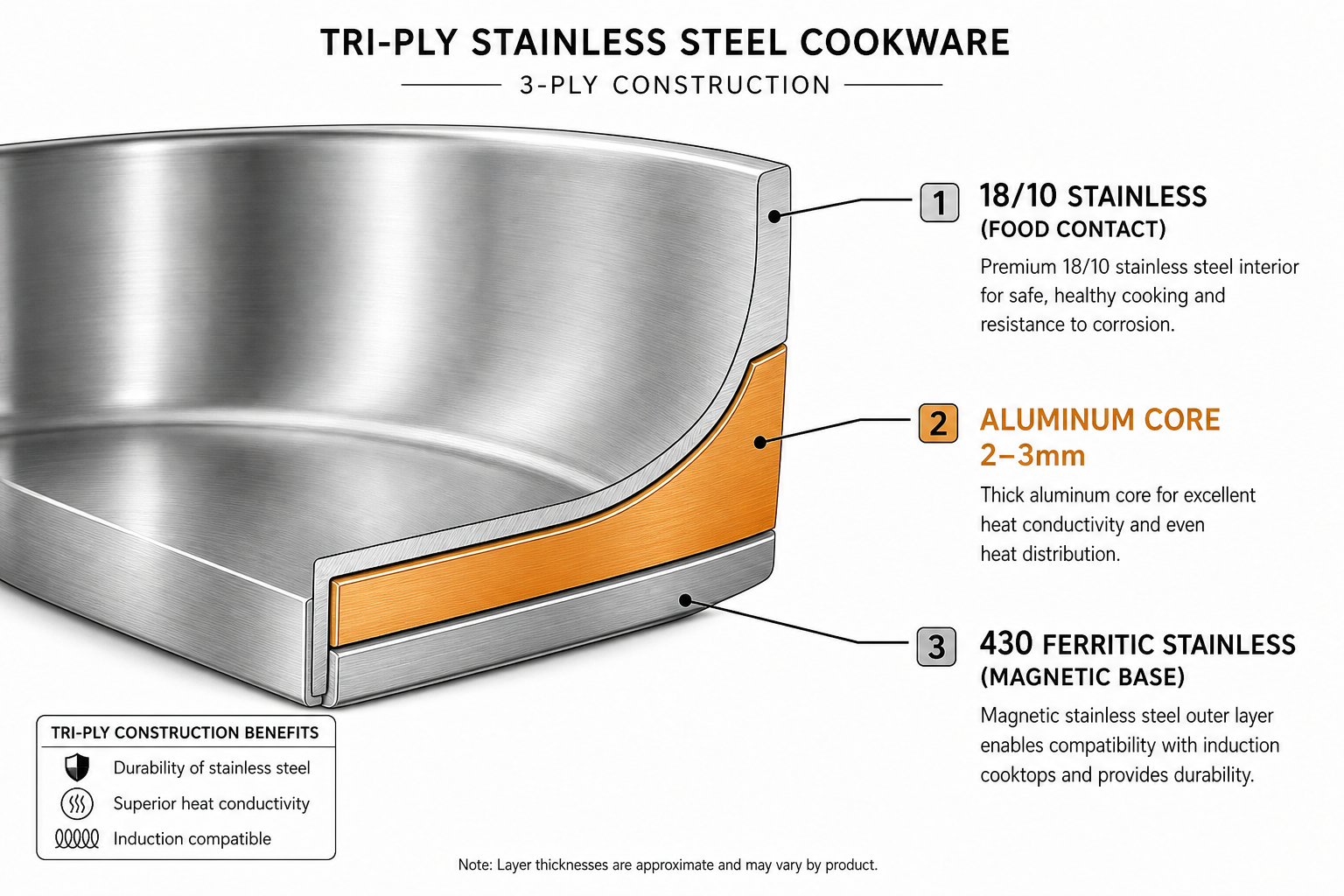
Tri-ply (3-layer) is the most common configuration:
- The 18/10 interior remains food-safe, non-reactive, and easy to clean
- The aluminum core (typically 2-3mm) provides dramatically better heat distribution – aluminum thermal conductivity (~205 W/m·K) far exceeds austenitic stainless steel (~15-17 W/m·K)
- The 430 exterior enables induction compatibility
Five-ply adds two additional layers, further reducing hot spots. The difference matters most on induction, where heating concentrates under the coil rather than spreading from a flame. Testing tri-ply vs five-ply on an induction surface shows measurably more even temperature distribution with five-ply – relevant for restaurant supply, less critical for home use.
The critical sourcing variable: the exterior base layer grade determines induction compatibility, but base layer thickness determines how well it works. A 430 base thinner than 0.5mm provides weak magnetic coupling – slow and uneven heating despite technically being induction compatible. Specify minimum base layer thickness in your RFQ.
Grade 432 adds ~0.6-0.75% titanium to a 430 base, improving resistance to thermal cycling and reducing warping. Made In Cookware specifically references ferritic stainless steel in their induction-compatible lines. For B2B sourcing, 432 commands a slight premium over 430 but offers better flatness retention under sustained induction use.
The 60-Second Magnet Test
Before reviewing any technical documentation, the magnet test is the fastest field qualification available:
- Place a standard refrigerator magnet against the bottom exterior of the pan
- Strong, secure grip – induction compatible
- Weak attraction that slides off – unreliable; may trigger some cooktops at low power but will not perform consistently
- No attraction – not induction compatible
The physics: induction efficiency scales directly with magnetic permeability. A pan that barely attracts a magnet provides weak magnetic coupling with the cooktop’s field – translating to slow, uneven heating at higher power settings.
For B2B warehouse receiving, this should be standard incoming inspection. Grade substitution in the base layer is one of the most common quality failures in budget stainless cookware. Test a random sample from each production lot, not just the supplier’s display piece.
Supplementary tests:
- Acid spot test: A few drops of dilute hydrochloric acid on the interior surface. Grade 201 reacts (bubbles, discoloration) faster than Grade 304 – detects interior layer substitution the magnet test will not catch
- Thickness gauge: Measure base layer thickness on minimum 5% of units per lot
Real-World Performance: Pure 430 vs Clad Construction on Induction
Two pans can both pass the magnet test and deliver very different cooking results.
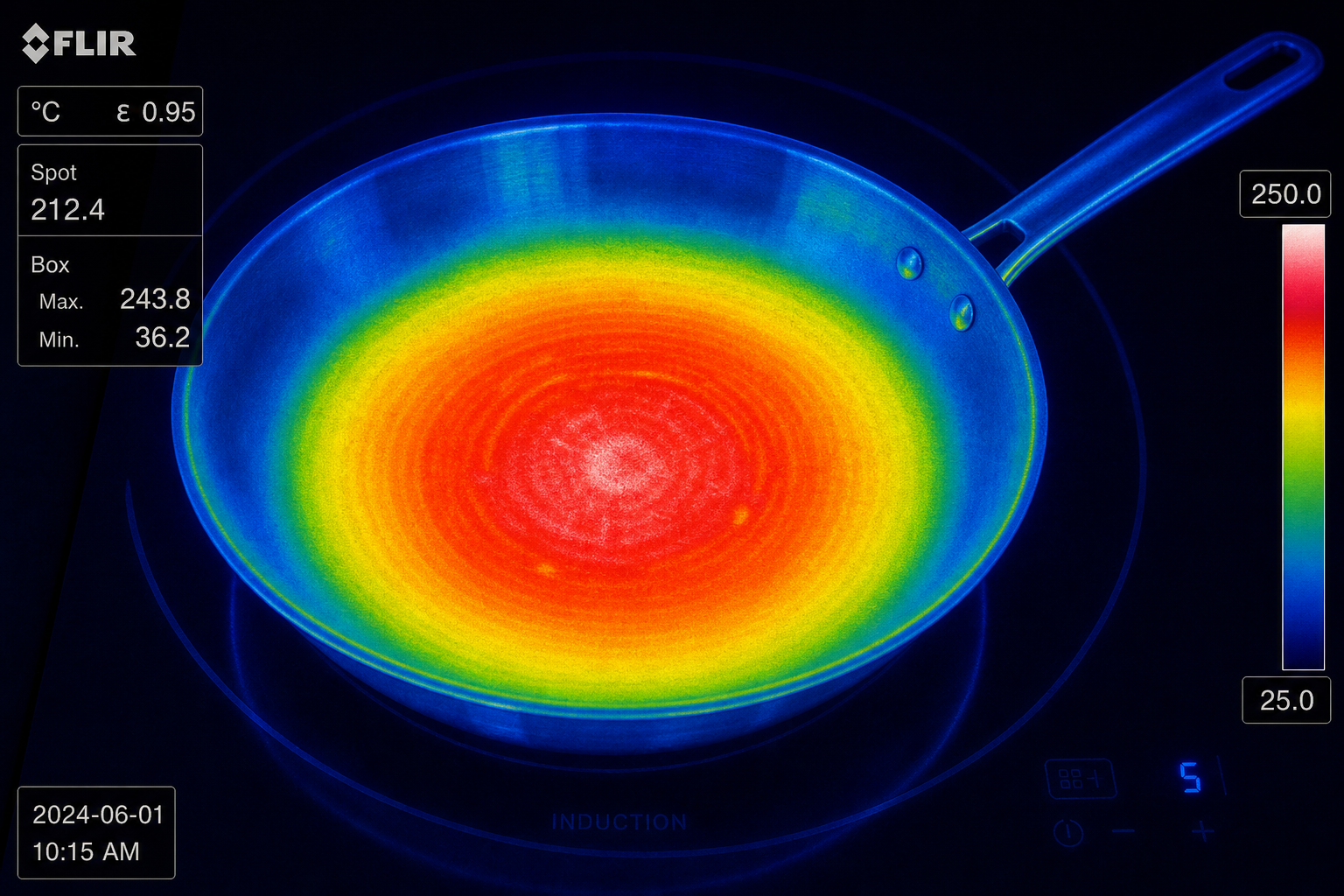
Pure 18/0 (430) construction – common in budget cookware:
- Heats quickly but creates significant hot spots – the induction coil contact zone reaches temperature faster than the edges
- Proteins scorch at the center while outside areas lag
- More prone to warping under thermal shock due to lack of supporting layers
Clad multi-ply with aluminum core – the standard in mid-range and professional cookware:
- Aluminum core spreads heat laterally before it reaches the cooking surface, evening temperature distribution
- More consistent results at medium power settings – fewer hot spots during searing
- Less prone to warping (bonded layers mutually constrain thermal expansion)
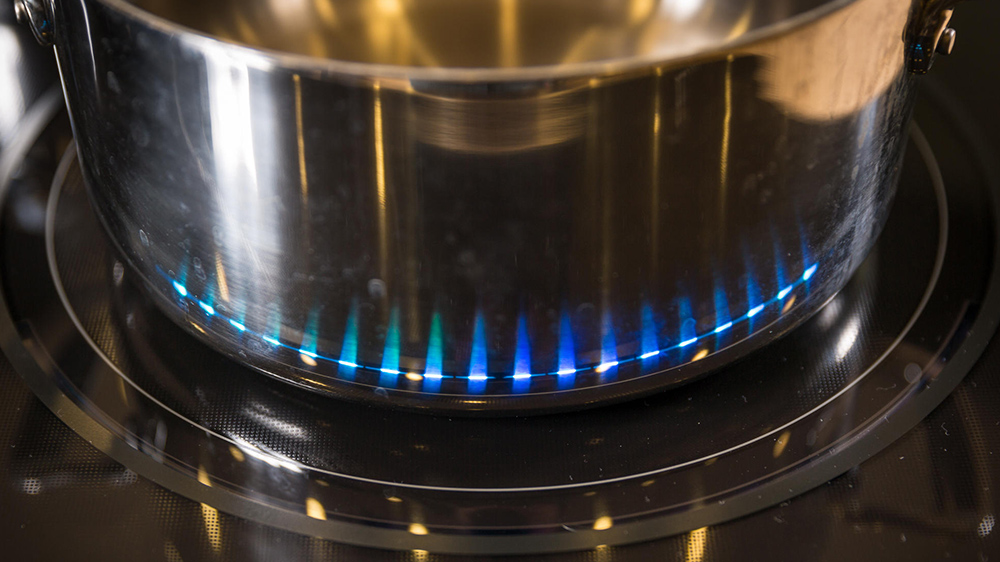
The gap is larger on induction than on gas. A gas burner distributes heat across a broader area; an induction coil focuses energy at a specific annular zone. Clad construction bridges that localized heat input into even surface temperature; pure 430 does not.
For B2B context: restaurant supply and professional kitchens should specify clad construction with a minimum 2mm aluminum core. Pure 430 is cost-effective for budget retail lines – market it accurately.
B2B Sourcing Specifications for Induction-Compatible Stainless Cookware
Vague language in purchase orders invites substitution. These are the specific terms for RFQs and supplier contracts.
Interior Layer
- Specify: Grade 304 (18/8) or Grade 316 (18/10) – explicitly exclude Grade 201
- Require: Material Test Report (MTR/mill certificate) with Cr%, Ni%, Mn%, C%
- Red flag: Supplier reluctance to provide MTR documents, or certificates missing nickel content data
Exterior / Base Layer
- Specify: Grade 430 ferritic stainless steel (or Grade 432 for premium lines), minimum base layer thickness 0.5mm
- Require: Third-party magnetic permeability confirmation
- Red flag: Magnetic response on the interior cooking surface – indicates 430 used throughout
Core Layer (Clad Construction)
- Specify: Food-grade aluminum alloy (Series 1050 or 3003), minimum thickness 2mm for tri-ply
- Require: Alloy series documentation
Base Flatness
- Specify: Maximum base flatness deviation of 0.3mm across the full base diameter
- Why it matters: Induction efficiency requires close contact with the cooktop glass. Even 1-2mm warp reduces magnetic coupling and creates uneven heating
Certification Checklist
| Market | Required Certification |
|---|---|
| Global baseline | ISO 9001 |
| US market | FDA food contact materials compliance |
| EU / Germany | LFGB food contact certification |
| EU chemicals | REACH compliance declaration |
| US heavy metals | California Prop 65 compliance |
| Social compliance | BSCI, SMETA, or equivalent |
Incoming QC Protocol
- Magnet test: 100% base inspection on every unit received
- Acid spot test: 5% random sample on interior surface (Grade 201 detection)
- Thickness gauge: Base layer measured on minimum 5% of units per lot
- Flatness check: 3% random sample per lot
- Cross-section inspection: Destructive sample from every 5th production lot
Frequently Asked Questions
Why doesn’t my 18/10 stainless steel pan work on induction?
Because 18/10 (Grade 316) is austenitic. The 10-14% nickel content stabilizes a face-centered cubic crystal structure with very low magnetic permeability – the induction field has nothing to couple with. To work on induction, a pan needs either 18/0 (Grade 430) throughout, or a clad design with a magnetic base layer. Check with a magnet: if it does not hold firmly to the base, the pan will not perform well on induction.
Is Grade 430 stainless steel food-safe for cooking?
Yes – Grade 430 meets FDA food contact standards. The tradeoff versus 304/316 is lower corrosion resistance: it stains more easily with acidic foods and is more susceptible to surface rusting if left wet. In clad construction, the 430 layer is only on the exterior – the food-contact surface remains 18/10. For pure 430 pans, dry thoroughly after washing and avoid long exposure to acidic ingredients.
What is the difference between “induction-compatible” and “induction-ready” on packaging?
These labels are used interchangeably, but some manufacturers draw a distinction. “Induction-compatible” may mean the cookware technically works on induction but was not specifically engineered for it. “Induction-ready” may indicate a base designed from the start for optimal magnetic coupling – thicker base, tighter flatness tolerance. For B2B sourcing, request the specific base layer grade designation and thickness rather than relying on either label.
Can a warped pan damage an induction cooktop?
Primarily it heats unevenly – a warped base reduces magnetic coupling area, causing inconsistent heating and potential surface marking on the glass. Severe warping can scratch the cooktop glass over time. Warping is most often caused by thermal shock or a base layer too thin to resist concentrated thermal expansion at the coil contact zone. Specifying 0.3mm flatness tolerance and minimum 0.5mm base thickness in your RFQ significantly reduces this risk.
Why would a supplier use Grade 201 instead of 304?
Cost. Grade 201 replaces nickel with cheaper manganese. The savings on a high-volume production run are significant from a supplier’s perspective. The problem is that 201 has meaningfully lower corrosion resistance – it will rust and stain faster under normal kitchen conditions – and it is a misrepresentation of product specification. Always request MTR documentation, and treat supplier reluctance to provide it as a disqualifying signal.
Summary
Induction compatibility in stainless steel cookware comes down to one material decision: is there a ferromagnetic (18/0 / Grade 430) layer in the base? If yes, the pan works. If the base is 18/10 or 18/8 throughout, it does not – regardless of price, brand, or how convincingly premium the packaging looks.
Quality cookware solves this with clad construction: a food-safe 18/10 interior, an aluminum core for even heat distribution, and a 430 magnetic exterior. The result is a pan that is non-reactive on the cooking surface, efficient on induction, and does not create the hot spots that pure 430 construction does.
For sourcing teams: the risks are specific and manageable – grade substitution (201 for 304), base layer thickness underspecification, and flatness tolerance drift. A three-point incoming QC protocol (magnet test, acid spot test, thickness gauge) catches most failures before they reach your end customer.
The induction market is growing. Getting the material specification right once is worth the effort.