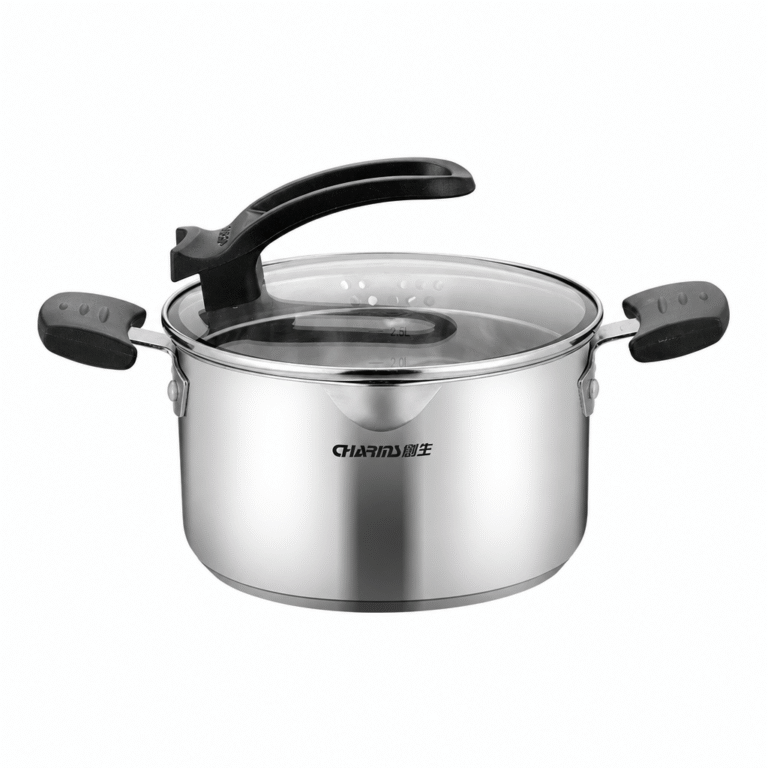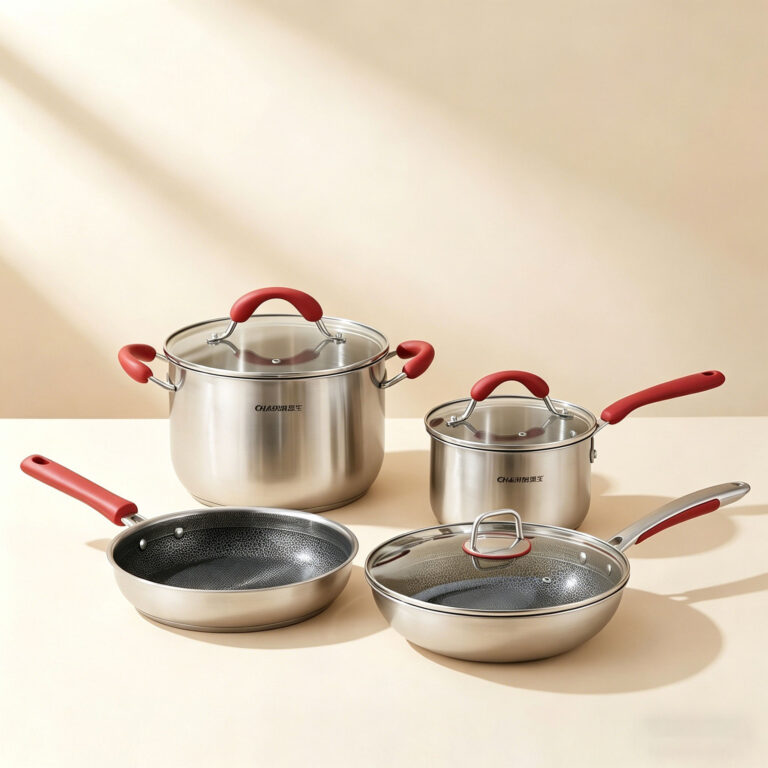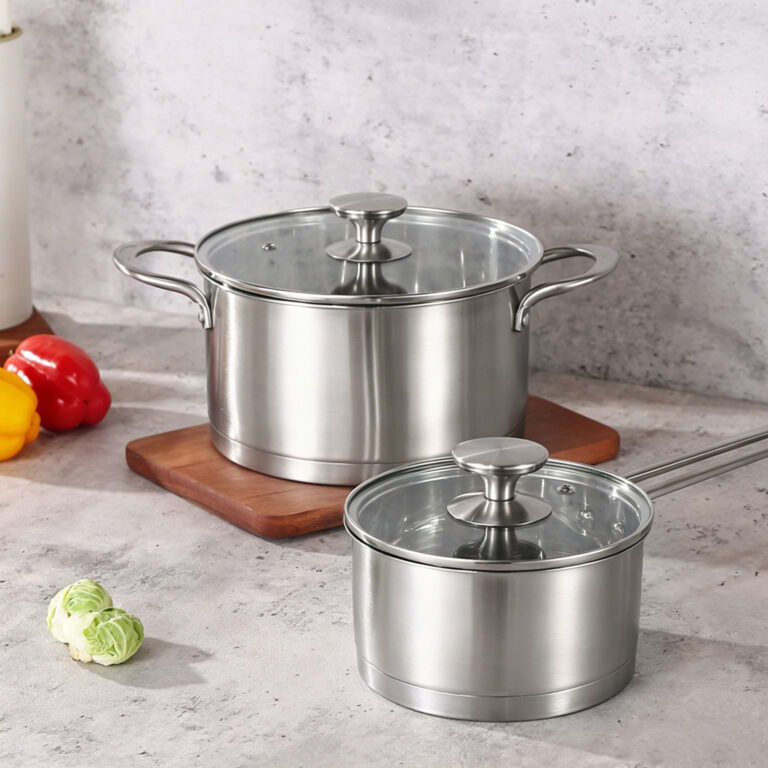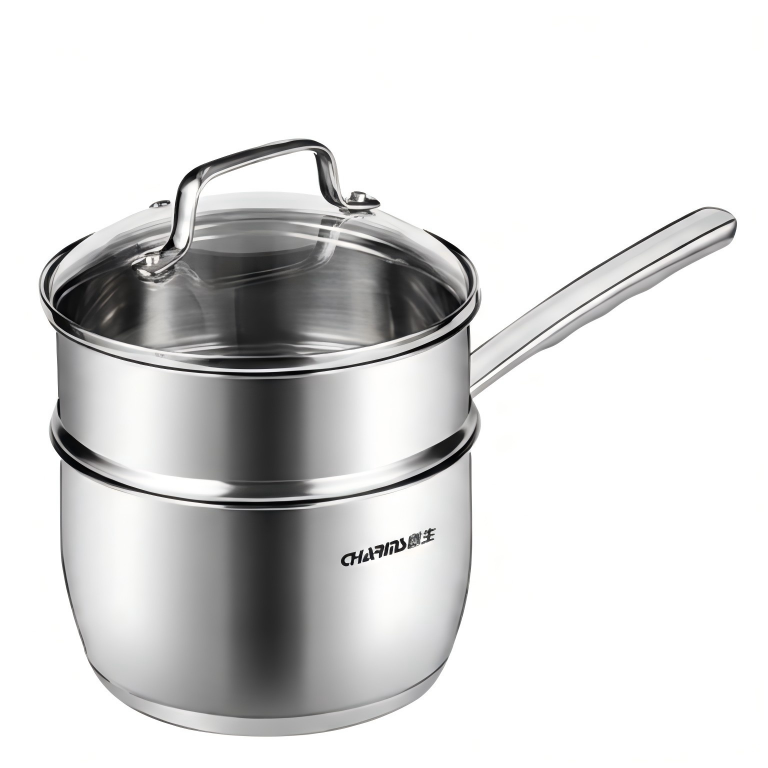

China is the world’s dominant stainless steel cookware manufacturer, exporting approximately 1.1 billion units of stainless steel household articles in 2024 at a value of $6.7 billion. But 25% of factories audited by QIMA in 2023 received a “Red” ranking — meaning serious compliance gaps. This guide walks through a five-stage vetting framework for sourcing stainless steel cookware from China: document screening, material verification, certification auditing, sample testing, and factory audits. It covers the 304 vs 201 grade substitution risk, how to verify LFGB and FDA certifications without relying on factory-provided documents, and what realistic MOQs and lead times look like in 2026. Manufacturers like CharmsCook (est. 1989, Chaozhou) show what a properly documented, multi-certified factory looks like in practice.
Why China Produces Most of the World’s Stainless Steel Cookware
China’s position in global cookware manufacturing is structural, not coincidental. The country is the world’s dominant cookware producer, with manufacturing concentrated in three main regions: Chaozhou and Jiangmen in Guangdong province (stainless steel specialists), Yongkang in Zhejiang province (aluminum and die-cast cookware), and parts of Jiangsu and Shanghai for higher-end export-oriented facilities.
The Chaozhou cluster alone — specifically the Chao’an district — has built a dense ecosystem over four decades: coil suppliers, stamping and pressing operations, polishing houses, handle fabricators, and packaging converters within a 30-kilometer radius. This concentration is what makes Chinese factories genuinely competitive on price without sacrificing engineering depth, because supply chain fragmentation costs and tooling lead times are far lower than in any other country.
For buyers, that infrastructure cuts both ways. The same cluster depth that enables a legitimate factory like CharmsCook to go from design brief to finished sample in two to three weeks also allows lower-tier operators to undercut on material grade without buyers noticing until products fail in the field.
The grade spectrum in Chinese stainless cookware runs from food-safe to problematic:
| Grade | Nickel Content | Food-Safe? | Typical Use |
|---|---|---|---|
| 316L | 10–14% Ni, 2–3% Mo | Yes — premium | Medical-grade, high-acid cooking environments |
| 304 (18/8) | 8–10.5% Ni | Yes — standard | Most cookware, tableware, storage |
| 430 | 0% Ni (ferritic) | Yes — limited | Induction discs, budget outer layers |
| 201 | 3.5–5.5% Ni | Debated — substandard for cookware | Cut-cost substitution; leaches Mn at low pH |
The critical risk isn’t that Chinese factories can’t produce food-safe 304 — most legitimate ones do so reliably. The risk is grade substitution: a factory quoting 304 but supplying 201, which has lower nickel content and elevated manganese, and which costs roughly 20–40% less per kilogram of coil depending on prevailing nickel prices. In 2026, with nickel prices volatile, the substitution incentive is higher than ever.
That’s where a structured vetting process earns its keep.
The 5-Stage Vetting Framework
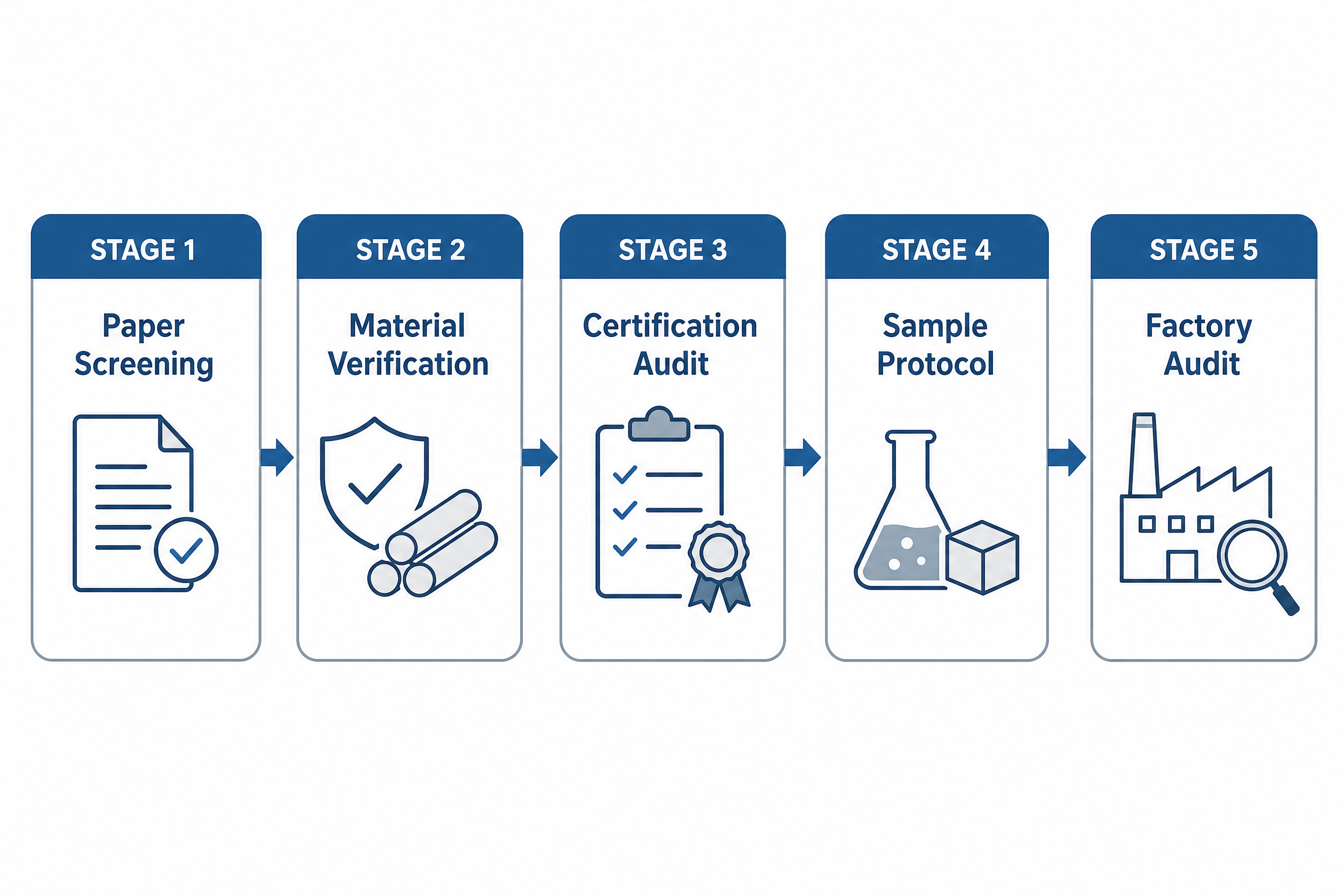
Most sourcing failures happen because buyers compress this process — they get a good sample, like the price, and jump to a bulk order. The five stages below are sequential for a reason: each one screens out a different category of problem supplier, and skipping any stage shifts the risk from the factory to you.
Stage 1: Paper Screening
Before requesting samples or getting on a call, verify the supplier’s legal identity.
Business license check: Any legitimate Chinese manufacturer registered with the State Administration for Market Regulation (SAMR) will have a Unified Social Credit Code (18-digit alphanumeric). Request it, then verify it at the SAMR National Enterprise Credit Information Publicity System (gsxt.samr.gov.cn). This takes under five minutes and immediately separates registered entities from ghost operations.
Export license scope: Check that the business scope on the license explicitly covers manufacturing and export of kitchenware or stainless steel products. A trading company registered as an import/export agent will have a different scope description. This matters because trading companies add a margin layer and have no production control.
Online footprint cross-check: Search the company’s registered name (not just the English trade name) on Alibaba, Made-in-China, and Global Sources simultaneously. Factories that appear on multiple platforms with consistent factory photos, employee counts, and founding dates are more credible than those with a single listing and stock-image galleries.
Stage 2: Material Verification
This is where grade substitution risk surfaces. Two tools matter here:
Mill certificates (Material Test Reports, or MTRs): A real mill certificate from a steel coil supplier shows the heat number, chemical composition, mechanical properties, and the supplier’s stamp. Request it with the RFQ, not after order placement. A factory that can’t or won’t provide mill certificates for their incoming coil stock is a significant warning sign.
Specifically look for: Cr content (18–20% for 304), Ni content (8–10.5% for 304), Mn content (should be ≤2% for 304; 201 often shows 5.5–7.5%). If the document shows manganese above 3%, you’re likely looking at 201 or a transitional grade.
XRF testing: For orders where the specification is critical, request pre-shipment XRF (X-ray fluorescence) testing through a third-party inspection company like SGS, Bureau Veritas, or Intertek. XRF testing gives a non-destructive elemental composition reading in minutes. This is the only reliable way to confirm steel grade on a finished product without a lab. Cost is typically $150–400 per batch depending on sample size and provider.
Stage 3: Certification Audit
Do not accept certification documents at face value — verify each one directly with the issuing body.
- LFGB (German food contact standard): Certificates issued by DAkkS-accredited labs in Germany. The certification number is searchable on the issuing lab’s public registry. If the factory can’t provide a certificate number you can look up, treat the document as unverified.
- FDA food contact compliance: FDA doesn’t issue a “certificate” for stainless steel cookware. The relevant framework is 21 CFR Parts 174–189 (indirect food additives), which covers food contact materials and surfaces. For uncoated stainless steel, compliance hinges on the alloy composition meeting food-contact material requirements under this framework. If a factory claims an “FDA certificate,” ask what specifically was tested and by which accredited lab. Genuine FDA-compliant documentation comes from third-party labs like NSF, SGS, or Intertek, not from FDA itself.
- ISO 9001: Verify the certificate expiry date and the accredited registrar’s name. ISO certificates can be downgraded or revoked after surveillance audits. Check directly on the registrar’s site.
- BSCI: Social compliance audit with a rating scale of A through E. A and B allow a standard two-year re-audit cycle and indicate the factory passed without major outstanding findings. A C rating (“acceptable”) triggers a mandatory follow-up audit — it is not a clean pass. D and E indicate significant non-compliance. Verify the factory’s current score via the amfori BSCI database (amfori.org).
Stage 4: Sample Protocol
Once documentation passes, request production samples — not showroom samples. Specify that you want samples pulled from the same coil and process that will be used for your production run.
Test the samples yourself before approving: check base thickness with calipers, test handle torque resistance, run the magnet test (a strong magnet should attract 430-grade discs on the base, but pull away from 304 food-contact surfaces with minimal attraction — though note this test is not definitive for 201 vs 304 without XRF). If samples pass visual and functional inspection, approve them in writing and retain them as your quality benchmark.
Build the sample approval document into your PI (Proforma Invoice) as a reference standard. “Bulk production must match approved sample [reference number]” is enforceable; “good quality” is not.
Stage 5: Factory Audit
For orders above roughly 3,000 units, or for any OEM/private-label program, a factory audit is worth the cost.
You have two options: in-person (feasible if you’re in the region, or during trade fair season when you’re visiting Guangzhou) or third-party remote audit. QIMA, SGS, and Bureau Veritas all offer cookware-specific factory audits. QIMA’s ethical factory audit program rated 25% of inspected factories as “Red” (urgent remediation required) in 2023 — down from 27% in 2022, but still one in four. An audit report gives you negotiating leverage, not just risk data.
Key areas an audit should cover: raw material storage and traceability, process control documentation (pressing tolerances, annealing parameters), QC sampling plan (AQL 2.5 is the standard for cookware), and worker certification for welding and polishing operations.
Stainless Steel Grades: What You’re Actually Buying
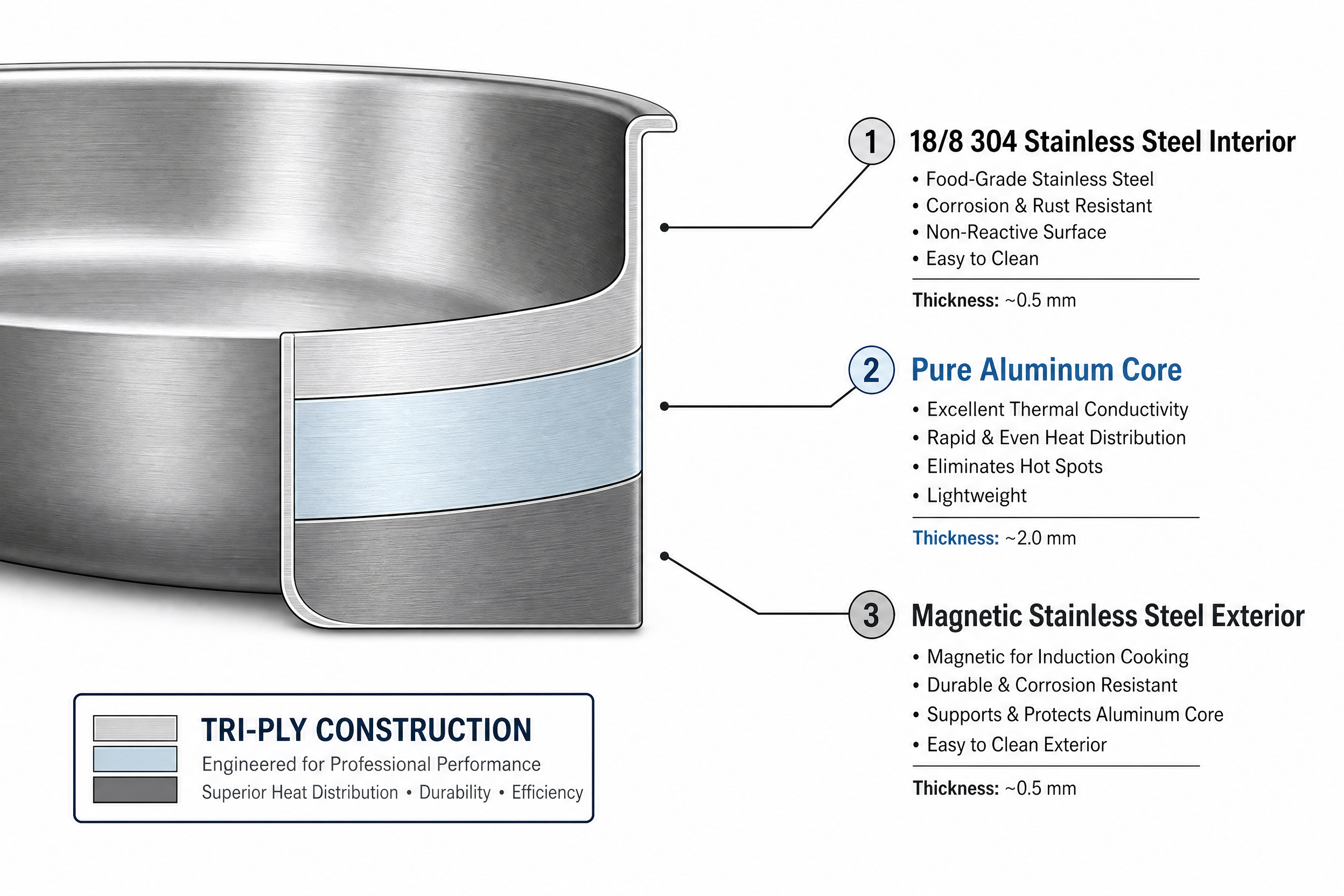
The grade specification is the single most important line in any cookware purchase order, and it’s the one most frequently treated as boilerplate.
Grade 304 (18/8 austenitic) is the industry standard for food-contact stainless cookware. The “18/8” designation means 18% chromium and 8% nickel by composition. These ratios determine corrosion resistance, food safety, and the characteristic non-reactive quality that makes stainless preferable to reactive metals for acidic foods. The nickel content is what drives the price — and what makes 304 a target for substitution.
Grade 316L adds 2–3% molybdenum to the 304 formula, which significantly improves resistance to pitting corrosion in chloride-rich environments. It’s standard in marine equipment and pharmaceutical applications. For cookware, it’s relevant for high-end lines marketed to professional kitchens that regularly cook with salt-heavy brines, and for buyers sourcing for Middle Eastern or coastal hospitality markets. The “L” designation means low-carbon, which improves weldability. Expect a 15–25% cost premium over 304 at the factory level.
Grade 201 is where the substitution problem lives. On paper, it’s still an austenitic stainless — it passes the magnet test similarly to 304. But 201 achieves its austenite structure through manganese (5.5–7.5%) rather than nickel (3.5–5.5%), making it cheaper to produce. The trade-off: higher manganese content is associated with accelerated leaching into food, particularly in acidic environments, and corrosion resistance is meaningfully lower. Germany’s LFGB migration limits flag manganese as a monitored element. A factory that quotes “18/10 food-grade stainless” and delivers 201 is substituting the most critical material in the product without disclosure.
How to Detect Grade Substitution
- Magnet test (preliminary only): Both 304 and 201 are weakly magnetic in austenitic form, but 201 with higher manganese is sometimes slightly more magnetic than 304. This test is a rough screen, not a confirmation.
- Mill certificate inspection: The Ni content column tells you what you need to know. 304 will show Ni at 8.00–10.50%. 201 will show 3.50–5.50%. Request this document before order placement and check the heat number against the lot you’re ordering.
- XRF testing on finished goods: Third-party pre-shipment inspection with XRF gives you elemental composition data on the actual finished product within a few hours of testing. For any order where the steel grade is material to your product claim or target market compliance, this is non-negotiable. Budget $200–350 for a standalone XRF test as part of a pre-shipment inspection.
- Ask directly about coil sourcing: Legitimate factories source coil from traceable mills — in China, TISCO (Taiyuan Iron and Steel Group), Baosteel, Lisco, and Zhangpu are among the major producers. Ask the factory which mill supplies their 304 coil and cross-reference the mill certificate. A factory that can’t name their steel supplier is running an opaque supply chain.
Multi-Ply Construction: Why It Matters Beyond Grade
Grade is one dimension; construction is another. Tri-ply (three-layer) construction — food-contact 304 inner layer, aluminum core for heat distribution, magnetic 430 or 304 outer layer — is the standard for quality cookware sold in North American and European markets. The aluminum core provides thermal conductivity that pure stainless can’t match; stainless steel conducts heat at roughly 14–16 W/(m·K) versus aluminum at 200–250 W/(m·K).
Impact-bonded bases (an aluminum disc bonded only to the base, not the walls) are lower cost and adequate for saucepans and stockpots. Fully-clad construction, where the multi-layer runs up the entire wall, is required for frying and sauté pans where wall heating matters.
CharmsCook produces both impact-bonded and fully-clad lines, which is relevant context: a factory that can execute both constructions has the process knowledge to do either correctly. A factory that only does impact-bonded bases has limited multi-ply engineering experience.
Certifications That Gate Your Target Markets
Certifications are not optional decoration — they determine whether your product can legally enter target markets, whether retailers will accept it, and whether your liability exposure is manageable if a complaint surfaces.
LFGB (Germany / EU)
LFGB (Lebensmittel-, Bedarfsgegenstände- und Futtermittelgesetzbuch) is Germany’s food safety statute, and LFGB testing is widely regarded as the strictest food-contact standard in the world. A product that passes LFGB testing complies with EU Regulation (EC) No. 1935/2004 on food contact materials and passes the German-specific migration limits that go beyond the EU floor.
For stainless steel cookware, LFGB testing evaluates migration of metals (nickel, chromium, manganese) into food simulants under defined temperature and time conditions. A factory holding valid LFGB certificates from a DAkkS-accredited lab is demonstrating that its actual production material — not just a claimed grade — passes migration limits. This is why LFGB is a meaningful vetting signal even if your primary market isn’t Germany.
Verification: Ask for the complete test report, not just the certificate page. The report should show the tested item description, the specific migration values, and the accreditation number of the testing lab. Cross-reference the lab’s accreditation on the DAkkS database (dakks.de).
FDA Food Contact (United States)
The FDA’s framework for stainless steel cookware is material-composition based rather than product-certified. Under 21 CFR Parts 174–189 (indirect food additives), food contact materials must meet composition requirements that ensure safety. Grade 304 and 316 fall comfortably within accepted ranges; 201 is in a gray zone that increasing numbers of import compliance teams are flagging.
When a Chinese factory says their cookware is “FDA certified,” the accurate statement is that their material meets FDA food contact composition requirements, typically confirmed via third-party lab testing (SGS, Intertek, or equivalent). If you’re selling in the US through retail channels or Amazon, request the actual lab test report showing 21 CFR compliance testing, not just a certificate claiming “FDA approved” (FDA doesn’t approve cookware products).
For California sales, also verify Proposition 65 compliance — nickel is a Prop 65 listed substance, and while food-contact stainless at normal use conditions is generally compliant, products marketed to California should have a Prop 65 assessment on file.
ISO 9001 and BSCI
ISO 9001 is a quality management system standard — it tells you the factory has documented processes, not that those processes produce good products. It’s a baseline signal of organizational maturity, not a quality guarantee. Verify that the certificate is current (check expiry date) and issued by an IAF-recognized registrar. Common registrars in China: Bureau Veritas, SGS, TÜV Rheinland, DNV.
BSCI (amfori Business Social Compliance Initiative) covers social accountability — labor conditions, worker welfare, environmental practices. For European retail buyers especially, BSCI is often a vendor onboarding requirement. The rating scale runs A through E: A and B allow a standard two-year re-audit cycle and indicate no major outstanding findings; C is “acceptable” but triggers a mandatory follow-up audit; D and E indicate significant non-compliance. Verify via the amfori BSCI database (amfori.org).
Certifications That Are Frequently Misrepresented
- “CE certified cookware”: CE marking does not apply to plain stainless steel cookware. If a factory claims CE certification for a standard pot or pan, they’re either confused about CE scope or misrepresenting. CE is relevant for products with electrical components or specific safety-regulated categories.
- “National Food Safety Standard” certificates: Some factories reference GB 9684 (China’s food-contact stainless standard). This is a real standard, but it’s the domestic Chinese standard, not equivalent to LFGB or FDA. Useful as a baseline, not as evidence of export-market compliance.
- Expired certificates presented as current: Always check the validity date on every certificate. Certificates can lapse after surveillance audits. A 2022 certificate presented in 2026 is not current.
5 Red Flags That Signal a Problem Supplier
These flags aren’t theoretical — they surface in sourcing due diligence regularly.
Red Flag 1: Unable or unwilling to provide mill certificates
A factory that makes 304 stainless cookware receives coil stock with a mill certificate every time they take delivery. If they can’t produce one on request, they either don’t have traceability into their supply chain or they’re buying from brokers with no documentation trail. Neither scenario is compatible with a verifiable grade claim.
Red Flag 2: Certification documents with no verifiable certificate number
Genuine LFGB, BSCI, and ISO certificates include a certificate number or registration ID that can be looked up in the issuing body’s database. A certificate with a logo but no traceable number is likely a stock image or a copy of an expired document. Ask for the certificate number and verify it yourself before accepting.
Red Flag 3: Price significantly below market for the stated specification
304 stainless steel coil trades on commodity markets. A price for a tri-ply 28cm frying pan that’s 35–40% below what other verified factories are quoting for the same specification usually means one thing: the specification isn’t what’s being supplied. Either the grade is 201, the base construction is simpler than quoted, or the wall thickness is below spec. Get the sample and XRF test before assuming the price is a bargain.
Red Flag 4: Factory photos that don’t match production scale claims
If a supplier claims annual capacity of 500,000 units but their factory photos show a single production line and what appears to be 15–20 employees, the numbers don’t add up. Request a virtual factory tour or use Google Street View on their registered address. Factories that can’t show stamping presses, polishing lines, and annealing ovens appropriate to their claimed scale are either trading companies or severely overstating capacity.
Red Flag 5: “Trading company” framing with “factory price” claims
Trading companies play a legitimate role in Chinese export — they aggregate orders across multiple factories and handle export documentation. The issue isn’t that they exist; it’s when they claim to be factories or claim “factory-direct pricing” while adding a 15–25% margin. Identify trading companies by: no manufacturing scope on their business license, inability to answer specific process questions (annealing temperature windows, base thickness tolerance), and unwillingness to arrange a factory visit. If you’re building an OEM program, working directly with a factory almost always gives you better specification control.
CharmsCook: What a Properly Documented Chaozhou Factory Looks Like
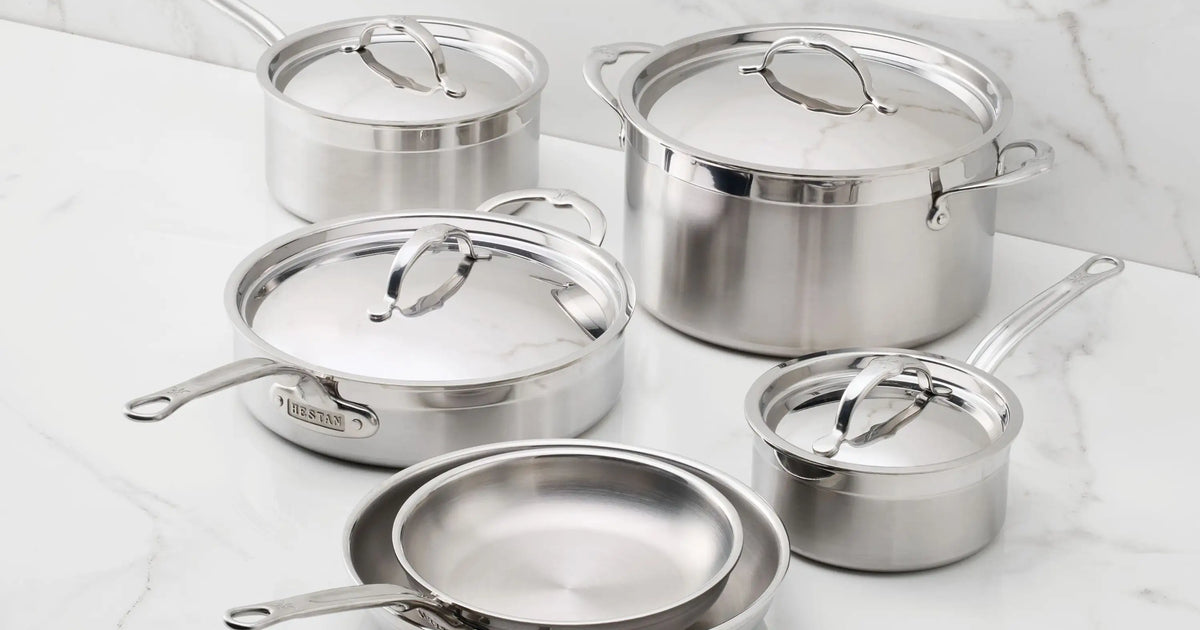
CharmsCook (charmscook.com) is a useful reference point here not as an advertisement, but as a concrete illustration of what a well-documented Chaozhou stainless steel factory looks like when you run it through the vetting framework above.
Founded: 1989, which means 35+ years of continuous stainless steel manufacturing. Founding year is verifiable on the business license and traceable through Alibaba or Made-in-China export history. Multi-decade factories have survived multiple economic cycles, which typically means stable ownership, mature process documentation, and accumulated tooling investment.
Location: Chaozhou, Guangdong — the same manufacturing cluster described in the opening section. Being embedded in this cluster means access to the same coil suppliers, polishing contractors, and handle manufacturers that the cluster’s best factories use.
Certifications: FDA and LFGB. For a North American or European buyer, these two certifications together cover the two strictest food-contact regulatory frameworks. Both are verifiable via the routes described earlier.
Product scope: Cookware, Storage, Tableware, Utensils, Drinkware, and Outdoor. The breadth matters for buyers building multi-category lines — a factory that runs stainless across multiple product types has diverse tooling and process experience. The Outdoor category specifically suggests experience with brushed finishes and lighter-gauge stainless for portable items, which is different process knowledge from heavyweight stockpot production.
Construction capability: Both impact-bonded and multi-ply (fully clad). In practice, multi-ply capability requires an aluminum-core bonding line, which is a significant capital investment. Not every factory in Chaozhou has one; the ones that do are generally at a higher process maturity level.
What to ask CharmsCook specifically (or any similar factory):
- Which steel mill supplies your 304 coil? Can you provide the mill certificate for your current inventory?
- What’s your base thickness tolerance for a 20cm saucepan — and how do you control it in production?
- What’s the lead time for a first OEM order with new tooling versus a repeat order on existing tooling?
- Can you share your most recent LFGB test report certificate number so we can verify it on the issuing lab’s registry?
A factory that can answer all four questions specifically and quickly is organized. One that needs weeks to retrieve basic production documentation is not.
MOQ, Lead Times, and Payment Terms: Real Numbers for 2026
Minimum Order Quantities
MOQ in Chinese stainless cookware is product-type and tooling-dependent:
| Scenario | Typical MOQ Range |
|---|---|
| Standard SKU from existing tooling (stock mold) | 300–1,000 pcs |
| OEM order on existing mold with custom logo/packaging | 500–2,000 pcs |
| ODM with new die/mold for custom shape | 1,000–5,000 pcs |
| Mixed-SKU consolidated order (multiple items) | 2,000–5,000 pcs total |
For buyers testing a new factory relationship, starting with a stock mold SKU at the lower end of the range limits capital exposure while generating a real production sample from a full production run — which is more informative than a pre-production sample.
Lead Times
After sample approval and production order:
- Standard production on existing tooling: 30–45 days
- New tooling (first OEM run): 45–60 days (tooling fabrication 15–20 days + production)
- Peak season (typically August–November pre-holiday): Add 10–20 days buffer
Ocean freight from Guangdong ports (port-to-port, 2026):
- US West Coast: 14–22 days
- US East Coast: 28–45 days
- North Europe: 30–45 days
Add 7–14 days for origin/destination handling and inland transit to get door-to-door figures.
Total timeline from order placement to warehouse receipt: Typically 50–75 days for US West Coast, 65–95 days for US East Coast and Europe. Build this into your inventory planning — buyers who don’t account for ocean freight transit end up air-freighting at 6–10x the cost.
Payment Terms
The industry standard for initial buyer-factory relationships:
- 30% deposit at order placement (secures production slot and material procurement)
- 70% balance before shipment, after pre-shipment inspection
For established relationships (after 3+ successful orders):
- T/T 30 days after BL (Bill of Lading) becomes negotiable with some factories
- LC (Letter of Credit) is available through most export-ready factories and reduces payment risk for large orders
Never pay 100% upfront to an unvetted factory. Never pay via Western Union or personal account — these payment methods have zero buyer protection. Wire to the company’s registered business account only; the company name on the receiving account should match the business license exactly.
Trial Order Strategy
For first-time buyers, the most effective approach is a two-phase trial:
- Phase 1 (validation): Order 300–500 units of one SKU on stock tooling. Have a third-party inspection before shipment. This order is primarily about relationship and process validation, not margin optimization.
- Phase 2 (scale): If Phase 1 passes, negotiate the OEM program. Now you have a production track record and the factory has evidence you’re a serious buyer — leverage both.
Factories that are unwilling to accept a small first order are either oversubscribed (a positive signal of demand, worth the wait) or uninterested in buyers who require validation (a negative signal).
Frequently Asked Questions
Is stainless steel cookware from China safe to use?
Yes, when sourced from a verified manufacturer using food-grade 304 or 316L stainless steel with current certifications (LFGB, FDA food contact). The risk isn’t China as an origin — it’s unverified grade substitution. A factory with current LFGB test reports from an accredited lab has demonstrated that the actual material passes food-contact migration limits. Ask for those reports, verify the certificate number, and you’ve addressed the core safety question.
How do I tell if a Chinese supplier is a real factory or a trading company?
Request their SAMR Unified Social Credit Code and check it on gsxt.samr.gov.cn. The business scope on their license should explicitly include manufacturing (生产). Ask specific process questions: what’s the wall thickness tolerance on their 20cm saucepan? What annealing temperature do they use after pressing? What mill supplies their 304 coil? Trading companies can’t answer these from production experience. Real factories answer in minutes.
What’s the difference between 304, 316, and 201 stainless steel for cookware?
304 (18/8) is the food-contact standard: 18% chromium, 8–10.5% nickel, corrosion resistant and non-reactive with acidic foods. 316L adds molybdenum for better chloride resistance — useful for professional kitchens. 201 replaces nickel with manganese to cut cost, resulting in lower corrosion resistance and elevated manganese migration in acidic environments. Always verify grade via mill certificate or pre-shipment XRF testing.
What certifications should I require for cookware sold in the EU?
At minimum: LFGB testing from a DAkkS-accredited lab (this also satisfies EU Reg 1935/2004 food contact requirements) and ISO 9001 from an IAF-recognized registrar. For social compliance, BSCI is required by most major European retail chains. Request the actual test reports with certificate numbers, not just certificate images.
What is a realistic MOQ for a first order from a Chinese cookware factory?
For a standard SKU on existing tooling: 300–1,000 units. For OEM with existing molds (custom branding): 500–2,000 units. For fully custom tooling: 1,000–5,000 units. Starting with an existing-tooling SKU at the lower MOQ minimizes risk on a first order while giving you a real production run to evaluate.
How long does it take to receive an order from a Chinese cookware manufacturer?
30–45 days production plus 14–45 days ocean freight depending on destination (US West Coast shortest, Europe longest), for a total of approximately 50–95 days from order placement to warehouse arrival. Add 15–20 days for new tooling, and buffer 10–20 days during peak production season (August–November).
Summary
Vetting a stainless steel cookware manufacturer in China isn’t complicated, but it does require working through the stages in order. The biggest mistakes — accepting certifications without verification, skipping XRF on the steel grade, treating a trading company as a factory — are all avoidable with a few hours of due diligence per supplier.
The market reality in 2026 is that China’s best stainless cookware factories are genuinely capable of producing to the same standard as any cookware sold under premium European brands, at a fraction of the cost. The gap between a CharmsCook (35 years in Chaozhou, LFGB and FDA certified, multi-ply capable) and a borderline operator is real — and visible, if you know what to look for.
Run the five stages. Verify the certifications. Test the steel grade. Start with a trial order. The factories worth working with expect this level of diligence; the ones that don’t are telling you something important.