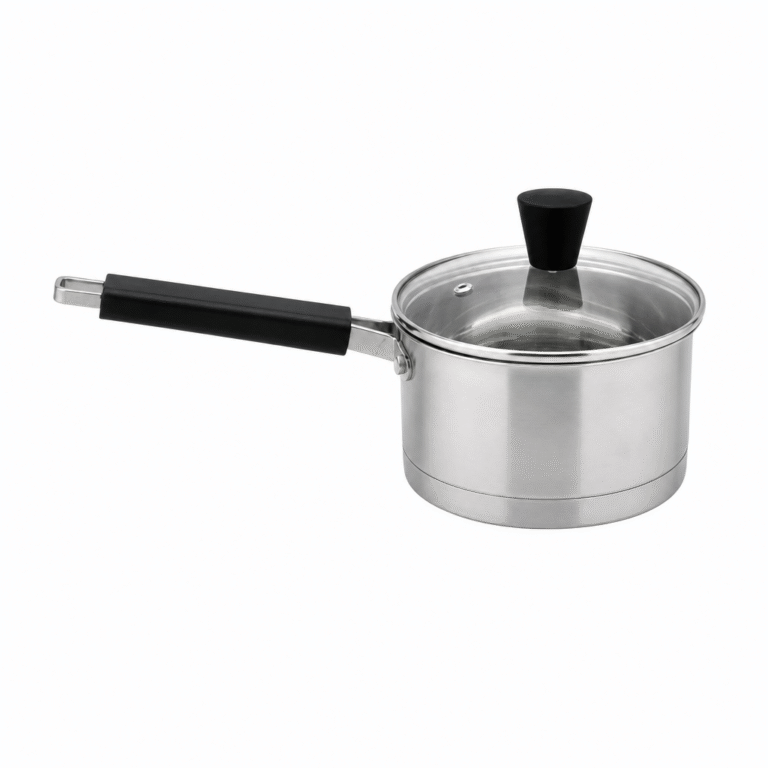


Most stainless steel cookware is oven-safe between 350°F and 600°F, depending on construction and handle material — not the steel itself. Premium all-metal pans like All-Clad (600°F) and Made In (800°F) outlast budget pans (350–375°F) because the steel handle is the only limiting factor. On the stovetop, stainless steel can safely reach 400–600°F in normal use; the Leidenfrost point (when water beads and rolls) occurs around 370–450°F (188–230°C). Rainbow discoloration is a cosmetic side effect of high heat, not a safety signal. This guide covers stovetop limits, oven-safe ranges, brand specs, and what actually happens when you push stainless steel too far.
The Steel Itself Can Handle Far More Heat Than You’ll Ever Cook At
Before diving into practical limits, the context matters. Grade 304 stainless steel — the 18/10 alloy in the vast majority of cookware on the market — has a melting point of 1,400–1,455°C (2,550–2,650°F) according to ASM International material data. Its oxidation resistance holds to roughly 870°C (1,600°F) before the surface begins to scale in any meaningful way.
No kitchen stove, oven, or broiler comes close to those numbers. A home gas burner at maximum output produces flame temperatures around 1,000°F (540°C), but the cooking surface of your pan during a hard sear reaches 400–600°F (200–315°C). A standard oven broiler tops out at roughly 500–550°F. In other words, the stainless steel body of your pan is not the weak link — everything attached to it is.
This is the single most important thing most cookware articles miss: the temperature limit printed on your pan’s packaging has almost nothing to do with the steel’s heat resistance. It’s about the handle, the lid knob, the bonding adhesives, and in some cases the rivets.
What Actually Limits Your Pan’s Temperature: Handle Materials
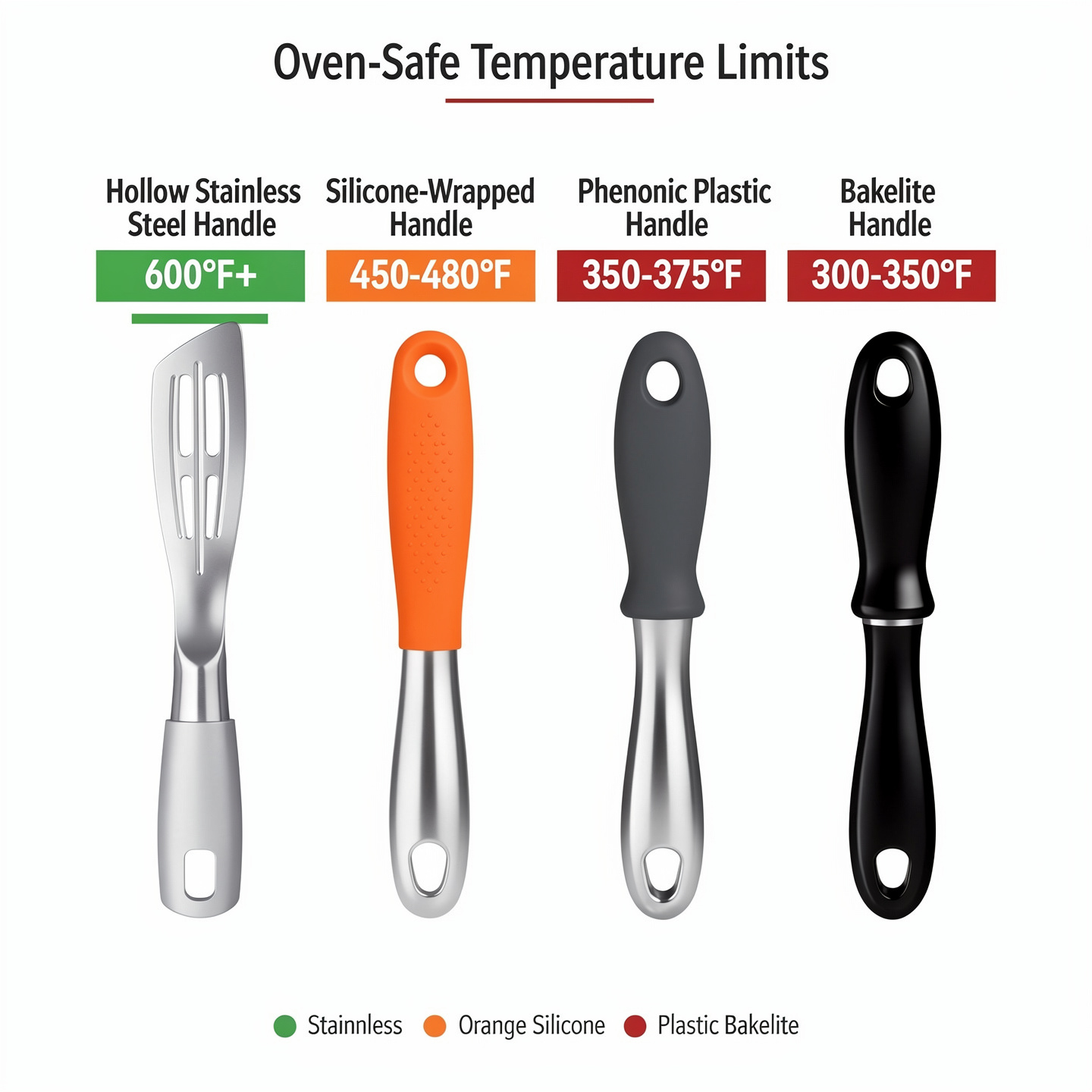
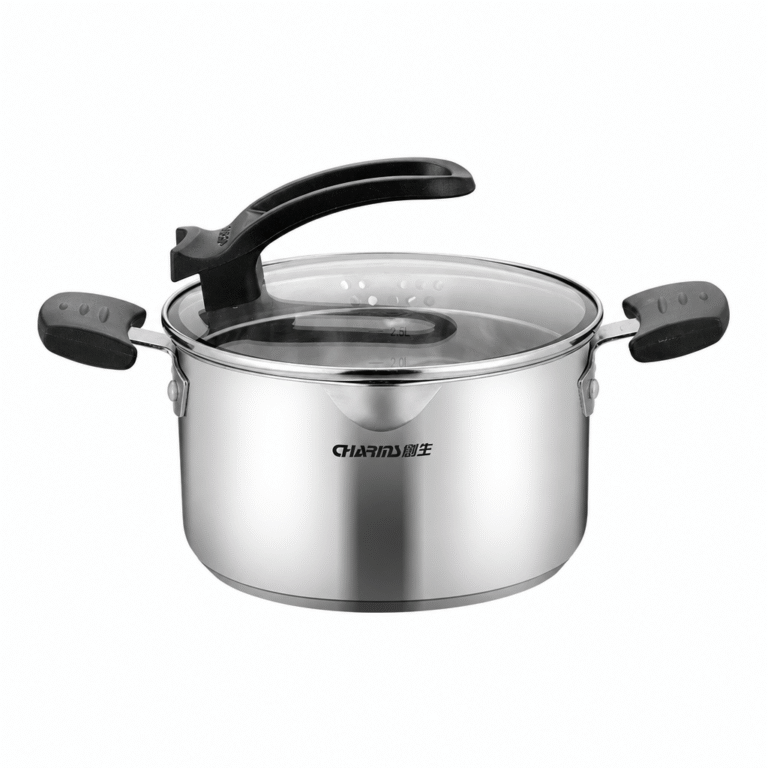
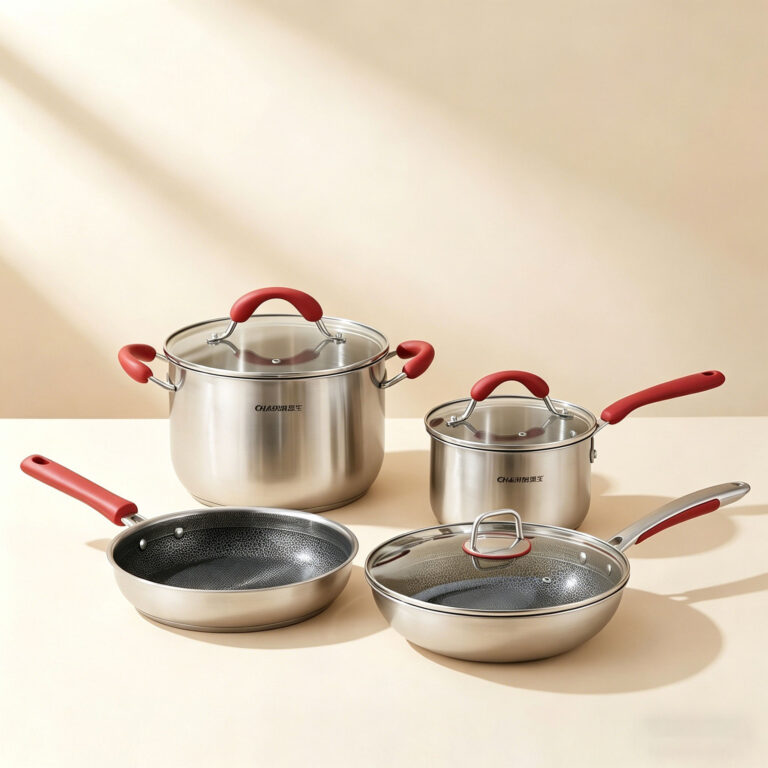
The handle material determines the oven-safe rating for almost every stainless steel pan sold today. Here’s the practical breakdown, based on data from cookware engineering sources:
| Handle Material | Oven-Safe Limit | Common On |
|---|---|---|
| Stainless steel (hollow) | Pan body is the only limit (≥600°F) | All-Clad, Made In, Demeyere |
| Silicone-wrapped steel | 450–480°F (230–250°C) | Mid-range brands, some Cuisinart |
| Phenolic (hard plastic) | 350–375°F (175–190°C) | Budget sets, older designs |
| Bakelite | ~300–350°F | Older or imported budget cookware |
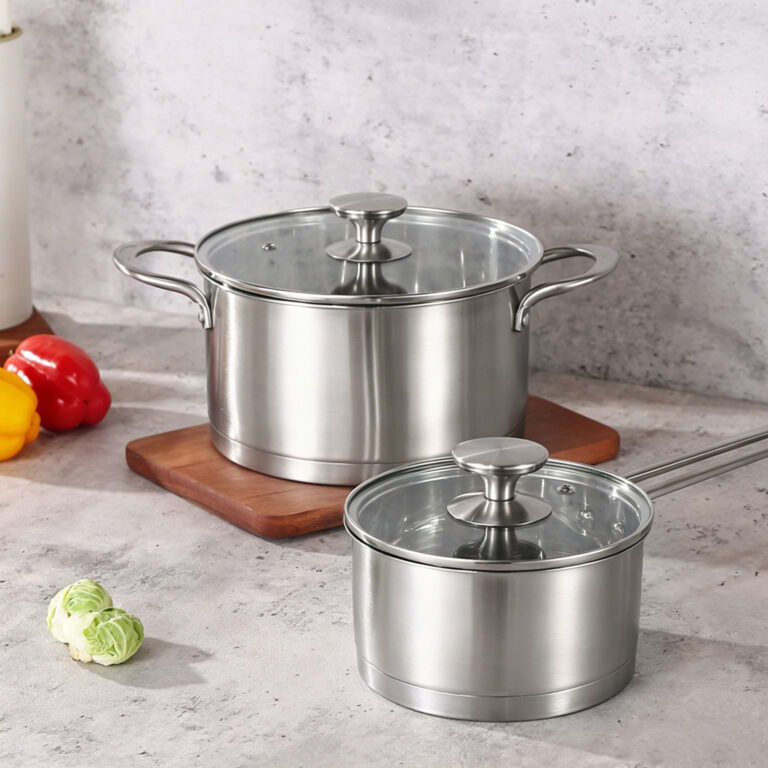
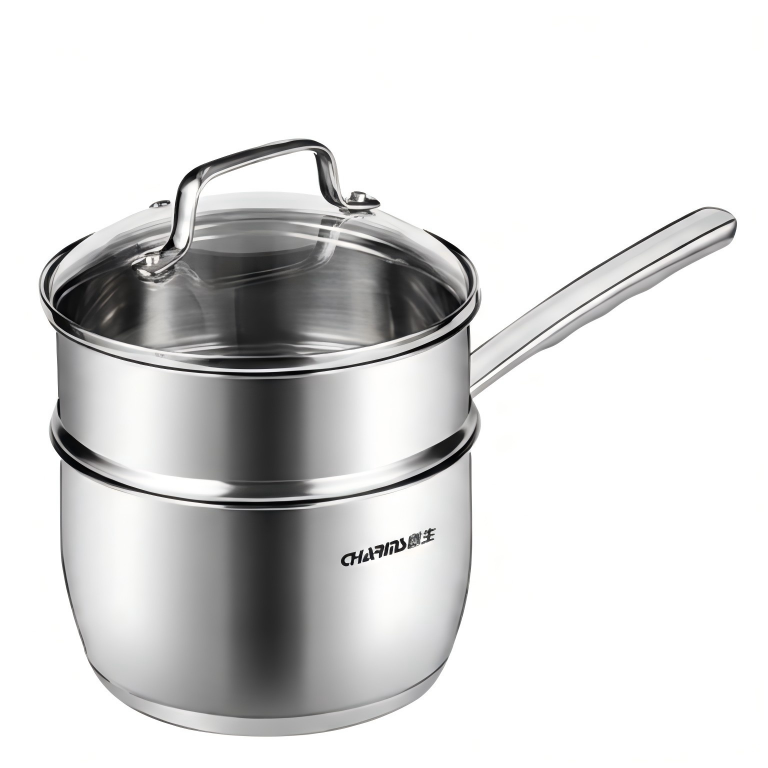
A pan with a solid stainless steel handle — no rubber grip, no silicone sleeve — has no meaningful oven-safe ceiling for home cooking purposes. All-Clad’s D3 and D5 lines carry a 600°F (315°C) rating. Made In and Misen claim 800°F (425°C) for their all-steel pans. The reason your budget Costco or department store set is rated to 400°F is almost certainly the phenolic or silicone grip on the handle, not any weakness in the steel pan body.
Practical rule: Check the handle before assuming an oven limit. If it’s all-metal, the manufacturer’s stated limit is conservative safety spec, not a hard physical ceiling for the steel.
Brand-by-Brand Oven-Safe Temperature Comparison
Here’s a verified comparison of major brands, based on published manufacturer specifications:
| Brand / Line | Oven-Safe Temp | Broiler Safe? | Lid Limit |
|---|---|---|---|
| All-Clad D3, D5, Copper Core | 600°F (315°C) | Yes | Glass lid: 350°F |
| Demeyere 5-Plus, Atlantis | 500°F (260°C) | Yes | SS lid: 500°F |
| Made In Stainless Clad | 800°F (425°C) | Yes | — |
| Misen 5-Ply | 800°F (425°C) | Yes | SS lid: 800°F |
| Cuisinart MCP/FC Series | 500°F (260°C) | Yes | Lid: ~370°F |
| Tramontina Tri-Ply Clad | 500°F (260°C) | Yes | SS lid: 500°F; glass lid: 350°F |
| Budget / entry-level SS | 350–400°F | Check label | Varies |
A few things worth noting from this table:
- Lids are always the limiting factor for oven use. Even on a pan rated to 600°F, the tempered glass lid maxes out at 350°F. Remove glass lids before finishing in a hot oven or sending anything under the broiler.
- The 800°F claims deserve scrutiny. Reddit’s r/carbonsteel and r/cookware communities have noted discrepancies in Misen’s specs — their FAQ previously stated 800°F but product testing referenced 500°F. The steel can handle 800°F; the question is whether the rivets and bonding materials can sustain it repeatedly. For practical home cooking, the distinction doesn’t matter — you won’t hit either number in a standard oven.
- “Broiler safe” is different from “oven safe at 600°F.” Broiling involves direct radiant heat from an element above, which heats the pan surface faster and less evenly than convection. All-Clad and most premium all-steel pans are broiler safe by design.
Stovetop Heat: What’s Actually Happening at the Pan Surface
Stovetop cooking is where stainless steel handles its most extreme real-world heat. But the temperatures involved are often misunderstood.
Gas vs electric vs induction — surface temperatures vary:
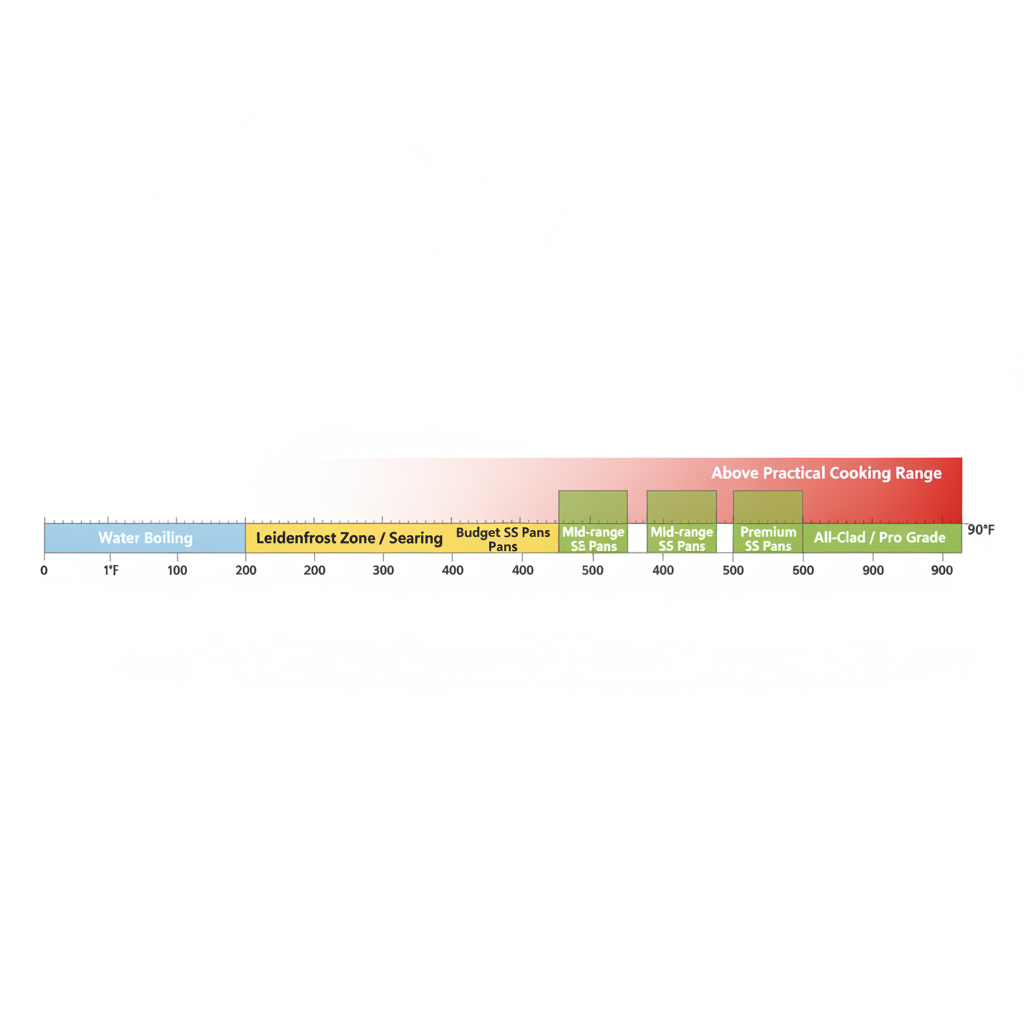
- Gas burner on high: flame is ~1,000°F but the pan surface during cooking stabilizes at 400–600°F (200–315°C) depending on pan gauge and whether food is in the pan
- Electric coil: similar surface result, slightly more consistent
- Induction: heats the ferromagnetic base layer directly; can ramp up faster than gas, potentially creating localized hot spots at lower pan base thickness
For stainless steel specifically, the poor thermal conductivity of the steel itself (16.2 W/m·K compared to aluminum at ~200 W/m·K) means single-ply stainless pans develop significant hot spots — the area directly over the burner can be 200°F hotter than the edges. This is why every quality stainless pan uses a clad or encapsulated construction with an aluminum or copper core: those metals conduct heat rapidly across the entire cooking surface.
The Leidenfrost window — your stovetop temperature signal:
The Leidenfrost effect is the phenomenon that makes stainless steel effectively non-stick when properly preheated. When a water droplet hits a surface significantly hotter than water’s boiling point, the droplet briefly floats on a vapor cushion and skates across the surface rather than immediately evaporating. For water, the Leidenfrost point is approximately 193°C (379°F) per physics literature; in practice on a stainless pan, the mercury-ball effect becomes reliable at roughly 370–450°F (188–230°C) pan surface temperature.
The practical test: add a few drops of water to a preheating pan. If the water immediately sizzles and evaporates — pan too cold. If it forms a bead that rolls around like a marble — you’re in the Leidenfrost zone and ready to cook. Add oil, let it heat for 20–30 seconds, then add food.
This temperature range — roughly 370–450°F — is also the effective preheat window before adding food. Searing a steak requires the pan surface at approximately 450–500°F (230–260°C); sautéing vegetables works well at 350–375°F.
What Happens When You Overheat Stainless Steel
Overheating a stainless steel pan in a home kitchen context means one of three things:
1. Rainbow Discoloration (Heat Tint)
The most common result. When stainless steel is exposed to high temperatures, the chromium in the alloy oxidizes and forms a thicker chromium oxide layer on the surface. Because this layer is thin and transparent, it refracts light — producing the iridescent blue-gold-rainbow effect you see after an aggressive empty preheat or a cooking session with very little oil.
This is entirely cosmetic. The discoloration does not compromise food safety, structural integrity, or cooking performance. It’s the same passivation layer that gives stainless steel its corrosion resistance — just thicker. It comes off easily with a splash of white vinegar or Bar Keepers Friend on a soft cloth.
2. Warping
Warping happens when a thin or low-quality pan is heated too quickly, too unevenly, or subjected to thermal shock — placing a screaming-hot pan under cold water immediately after cooking. The metal expands and contracts faster than the structure can absorb, and the base buckles.
Higher-quality clad construction with thicker gauge steel resists warping significantly better than budget single-ply pans. If your pan rocks on a flat surface after a high-heat session, warping has occurred. Mild warping in thicker pans sometimes resolves on its own with normal heating cycles; significant warping affects heat distribution and is a functional problem.
The thermal shock rule: Let your stainless pan cool on the stovetop or trivet for at least 5–10 minutes before rinsing with water. Never plunge a hot pan directly into cold water.
3. Damage to Clad Layers
This is less common but worth noting, especially for B2B buyers evaluating commercial durability. Multi-ply clad cookware bonds stainless steel to aluminum or copper through explosive bonding or roll bonding at high pressure. Under extreme repeated overheating cycles well above rated temperatures, the differential thermal expansion of the layers can stress the bonding interface. Signs of delamination — bubbling, raised areas on the base, uneven spots that don’t cook evenly — are the warning signals.
In normal home or professional cooking use, this isn’t a realistic concern. Commercial kitchens running pans at high heat daily for years report far longer lifespans than any manufacturer warranty covers.
The Sensitization Zone: An Engineering Footnote for B2B Readers
There’s a metallurgical phenomenon called sensitization that’s worth understanding if you’re procuring stainless cookware at scale, even though it has no practical relevance to cooking.
When austenitic stainless steel (grades 304 and 316, the standard cookware grades) is held at temperatures between 425–870°C (800–1,600°F) for extended periods, chromium carbides precipitate at the grain boundaries. This depletes chromium from the surrounding matrix — reducing the material’s corrosion resistance near those boundaries, a condition called sensitization.
In cookware terms: this temperature band sits above any temperature achievable in a home or restaurant oven. Your broiler running at 550°F (290°C) is still below the 800°F (425°C) lower threshold. Sensitization only becomes a concern in industrial heat treatment, welding, or furnace applications.
If you’re specifying stainless cookware for industrial food processing equipment that operates near these temperatures, specify 316L (low-carbon 316) or 321 stainless — grades stabilized against sensitization with titanium or low carbon content.
Heat Resistance Across Stainless Steel Grades: Does It Matter for Cookware?
Most cookware uses grade 304 (18/10) stainless steel for cooking surfaces and grade 430 or 444 for the magnetic induction base layer. Some premium or medical-use cookware uses grade 316.
For heat resistance in the cooking context, the difference is minimal:
| Grade | Common Name | Max Oxidation Resistance | Food Contact Use |
|---|---|---|---|
| 304 | 18/10 | ~870°C (1,600°F) | Industry standard |
| 316 | Marine grade / 18/10/2 | ~870°C (1,600°F) | Medical, high-acid foods |
| 430 | 18/0 (ferritic) | ~870°C | Induction base layers |
The real difference between 304 and 316 is corrosion resistance — 316 contains molybdenum, which improves resistance to salt and acid. For cooking performance and heat resistance at any temperature you’ll actually use, 304 and 316 are equivalent.
The “18/10” and “18/8” designations refer to chromium (18%) and nickel content (10% or 8%) — higher nickel content improves corrosion resistance and gives the pan a brighter polish, but doesn’t meaningfully change heat resistance.
A Note on Safety: Nickel and Chromium at High Temperatures
Some readers ask whether overheating stainless steel makes it unsafe due to nickel or chromium leaching. This deserves an honest answer.
A peer-reviewed 2013 study (Kamerud et al., JAMA/PubMed) confirmed that stainless steel cookware does leach trace amounts of nickel and chromium into food, particularly when:
- Cooking acidic foods (tomato sauce, vinegar-based dishes)
- Cooking for extended periods
- Using newer pans (leaching decreases with use as the passive layer matures)
- Operating at higher temperatures
The amounts involved are small and well within WHO and EU daily tolerable intake limits for healthy adults. The Nickel Institute notes this in their food contact material fact sheets. For most people, stainless steel remains one of the safest, most inert cooking surfaces available.
The exception: people with diagnosed nickel allergies may experience sensitivity to even trace dietary nickel. If that applies to you, grade 316 stainless (lower nickel leaching than 304 for the same conditions) or ceramic/cast iron cookware is a reasonable alternative.
Practical Guidelines: Getting the Most from Your Stainless Steel
Stovetop:
- Preheat on medium heat for 2–3 minutes before adding oil; test with the water bead method
- High heat is fine for searing (450–500°F pan surface) but avoid sustained empty pans on high for more than 3–4 minutes
- Never leave an empty pan on a lit burner and walk away
Oven:
- Check your pan’s handle material before putting it in the oven
- All-metal handles: follow the manufacturer’s stated limit (typically 500–600°F, sometimes 800°F)
- Silicone or plastic handles: limit to 350–400°F; remove or cover with a folded oven mitt for short high-temp runs if necessary
- Always remove glass lids before temperatures above 350°F
Broiler:
- Only use pans explicitly rated as broiler-safe — the direct radiant heat element is more intense than convection oven heat
- Keep pan at least 4–5 inches below the broiler element
- Never broil with a glass lid on the pan
After cooking:
- Let the pan cool 5–10 minutes before washing
- Rainbow discoloration? White vinegar + soft cloth, 30 seconds
- Never use the dishwasher for high-end clad stainless — the harsh detergents and heat cycling accelerate surface dulling
Frequently Asked Questions
What is the maximum temperature a stainless steel pan can handle in the oven?
For pans with all-metal stainless steel handles, the practical oven maximum is 600–800°F depending on the brand — but the real-world ceiling for home cooking is the broiler at ~500–550°F. If your pan has silicone or phenolic handles, assume 350–400°F max.
Can a stainless steel pan go in a 500°F oven?
Yes, for any pan with all-metal handles. Most mid-to-high-end stainless pans (All-Clad, Demeyere, Cuisinart MCP) are rated to at least 500°F. Remove glass or plastic lids before putting the pan in the oven at that temperature.
Why did my stainless steel pan turn rainbow?
That’s heat tint — chromium oxide forming a thicker layer on the surface due to high heat exposure. It’s cosmetic, not a safety issue, and fully reversible with white vinegar or Bar Keepers Friend.
Can I put a stainless steel pan directly under the broiler?
Yes, if it’s explicitly rated as broiler-safe. All-Clad, Demeyere, Made In, and most premium all-metal-handle stainless pans are broiler-safe. Avoid broiling with any glass lid or silicone handle grip in place.
Does high heat make stainless steel toxic?
At normal cooking temperatures, no. Trace nickel and chromium leaching occurs at elevated temperatures, particularly with acidic foods, but the amounts are well within safe dietary limits established by the WHO and EU for healthy adults. Those with nickel allergies should use 316-grade cookware or non-stainless alternatives.
How hot does a stainless steel pan get on a gas stove?
The cooking surface of a stainless pan on high gas heat typically reaches 400–600°F (200–315°C) in normal use. The burner flame itself is around 1,000°F (540°C), but the pan surface temperature depends on pan thickness, presence of food, and time.
Summary
Stainless steel — specifically grade 304 (18/10) — is an exceptionally heat-resistant material with a melting point above 2,550°F and oxidation resistance to 1,600°F. None of that is relevant to the practical question because the handle determines the limit, not the steel body.
All-metal stainless handle pans (All-Clad at 600°F, Made In and Misen claiming 800°F) outperform budget pans with plastic or silicone grips (rated 350–400°F) for a straightforward engineering reason. Rainbow discoloration is cosmetic. Warping is a quality and thermal shock issue, not a heat limit issue. And for nearly all healthy adults, the trace metal leaching at cooking temperatures falls well within established safety thresholds.
If you’re buying: look for all-metal handles and tri-ply or 5-ply construction. If you’re cooking: use the Leidenfrost test to nail the right preheat temperature, let pans cool before washing, and keep glass lids out of the oven above 350°F.