



A stainless steel crepe pan designed for wholesale uses a tri-ply construction — SS304 (18/10) food-contact interior, aluminum thermal core, SS430 induction-compatible exterior — with a low-profile sidewall typically between 1.9 cm and 2.5 cm. The thin, flat cooking surface is what separates a true crepe pan from a standard frying pan. For B2B buyers, key sourcing criteria include body gauge (2.0–2.5 mm total wall), aluminum core thickness (1.5–1.8 mm optimal), surface pattern (smooth or honeycomb-etched), diameter range (20–30 cm), compliance certifications (FDA, LFGB), and MOQ flexibility (commonly 500 pcs for standard programs). The same pan geometry supports dual-catalog positioning as both a crepe pan and a shallow pizza pan.
Why Stainless Steel is the Right Call for Wholesale Crepe Pans
Most articles comparing crepe pan materials focus on home cooks. If you’re sourcing for a private label line, a retail chain, or a HoReCa supply contract, the calculus is different.
Carbon steel and cast iron require seasoning and will generate return complaints in markets where end users aren’t familiar with bare-metal care. Nonstick aluminum pans are cost-effective but face growing PFAS-free pressure in EU and North American retail channels. Stainless steel — specifically tri-ply — solves both problems at once.
Here’s what that actually means for a wholesale buyer:
- No coating failure warranty claims. The surface is the material. Nothing to flake.
- Dishwasher safe. Critical for HoReCa and retail credibility.
- Compatible with all cooktops when the exterior layer is SS430 (magnetic). No customer complaint about “doesn’t work on my induction hob.”
- Long service life. A properly constructed tri-ply stainless crepe pan can outlast a nonstick pan by 5–10× in commercial settings.
- Cleaner story for EU/US retail. 18/10 stainless is PFAS-free, BPA-free, and straightforward to certify under LFGB or FDA standards.
The trade-off is real: stainless steel requires more technique to prevent sticking. The response to that objection in your product marketing — whether that’s a QR code linking to a how-to video or a bundled spreader tool — is a sourcing and packaging decision, not a material flaw.
What “Thin Stainless” Actually Means for This Pan
The phrase “thin stainless steel crepe pan” comes up in wholesale searches, but nobody in the SERP defines it precisely. Here’s what it means in practice.
“Thin” refers to the sidewall and body profile, not a quality shortcut. A crepe pan is defined by its low sidewall height (typically 1.9 cm or 2.5 cm, versus 4–5 cm on a standard frying pan) and its flat, wide cooking base. These two geometric features — not thin material — are what allow a batter spreader to work properly and what give the cook enough angle to flip a thin crepe cleanly.
Body wall thickness is a separate spec, and it should not be “thin” in the sense of flimsy:
| Total Wall Thickness | Classification | Buyer Use Case |
|---|---|---|
| 1.8 mm or less | Underspec | Risk of warping; avoid for commercial or premium retail |
| 2.0–2.2 mm | Standard home use | Suitable for mid-market retail programs |
| 2.5 mm | Professional / premium grade | HoReCa, specialty retail, premium private label |
| 3.0 mm+ | Ultra-heavy | Too heavy for crepe pans; increases shipping cost without benefit |
When a supplier quotes a “thin stainless crepe pan,” ask them to confirm the total wall gauge in mm using a digital caliper measurement. A well-specified tri-ply body at 2.0–2.2 mm will feel light because the aluminum core is doing thermal work — it is not thin because the material was reduced.
Tri-Ply Construction: The Three Layers That Matter
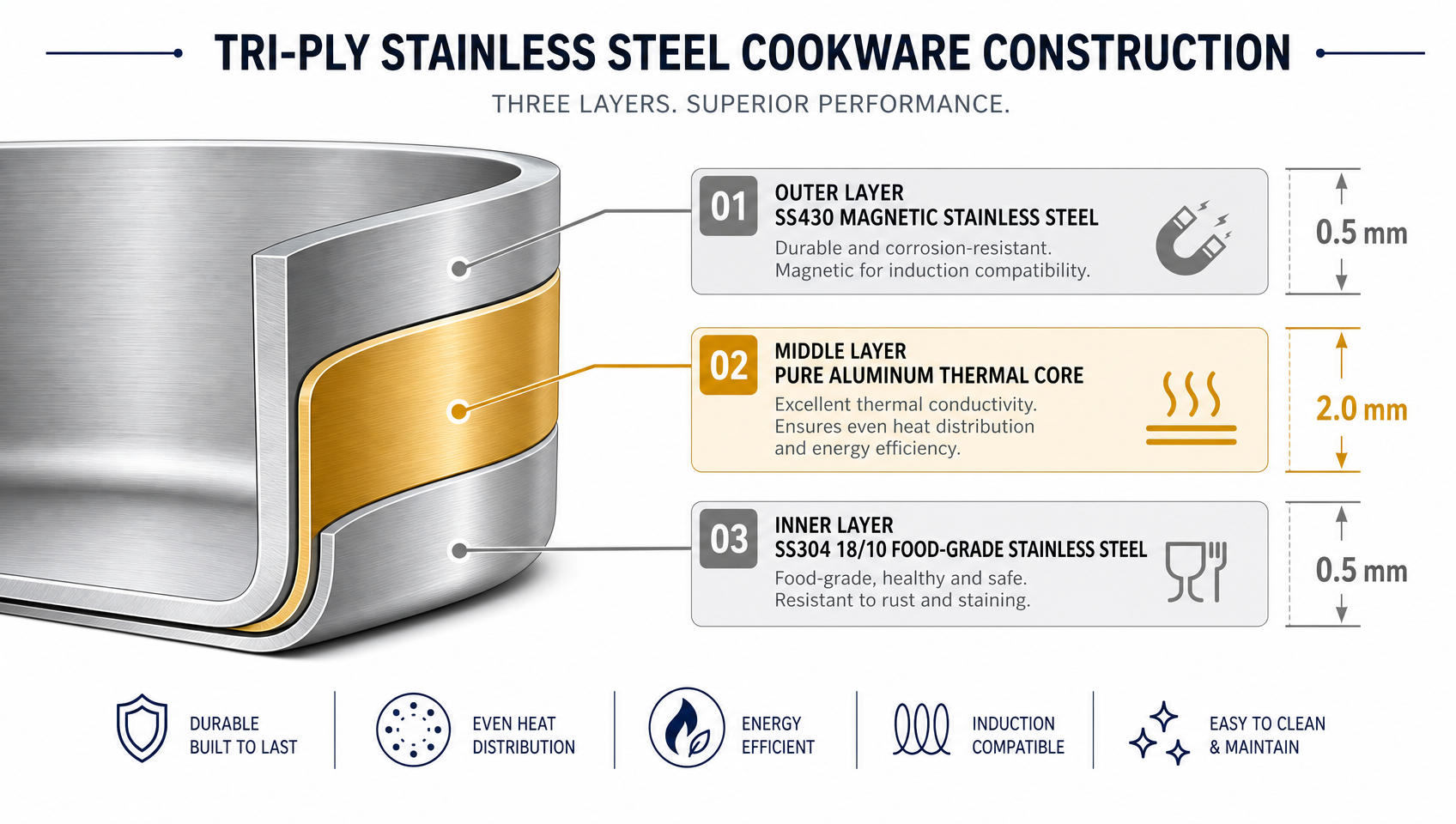
The industry standard for a wholesale-grade stainless steel crepe pan is true tri-ply (wall-to-wall cladding), not an impact-bonded disc base. The distinction matters because it determines how heat moves through the pan — and how many complaints you’ll receive after launch.
Layer 1 (Interior): SS304 — 18/10
The food-contact surface. 18% chromium, 10% nickel. The nickel content is what you’re paying for: it resists corrosion from acidic batters (lemon, wine-based crêpes), survives dishwasher cycles, and maintains a smooth, non-pitting surface over time.
If a supplier quotes a meaningfully lower price, run the magnet test on a sample: the interior of a genuine 304 pan will not attract a magnet. If it does, the factory substituted cheaper 200-series or 400-series steel. That’s the most common quality shortcut in the category.
Layer 2 (Core): Aluminum (Alu 1050 or 3003)
The thermal engine. Aluminum conducts heat about 5× faster than stainless steel. Without it, a stainless pan heats unevenly — you get a hot spot directly above the burner and cold edges, which is exactly the wrong condition for spreading thin crepe batter.
Optimal core thickness: 1.5 mm to 1.8 mm. Below 1.2 mm, the core lacks enough thermal mass to distribute heat evenly. Above 2.5 mm in a clad structure, the pan becomes unnecessarily heavy and harder to form — cost goes up without a proportional performance gain.
Layer 3 (Exterior): SS430 — 18/0
The induction-compatible layer. 430 ferritic stainless steel is magnetic, which is what allows induction cooktops to generate heat through electromagnetic induction. If the exterior is SS304 (non-magnetic), the pan will not work on induction.
Quick field check: A magnet must stick firmly to the outside of the pan. If it doesn’t, the induction claim is false — a real problem if you’re selling into European or North American markets where induction cooktops are increasingly standard.
Full-Body Tri-Ply vs. Impact-Bonded: Why Buyers Get Confused
Many factories describe their pans as “multi-layer” or “tri-ply” even when the construction is actually an impact-bonded disc base — a single stainless steel body with a thick aluminum disc attached to the bottom. The two are not equivalent:
| Feature | Impact Bonded (Disc Base) | Tri-Ply Clad (Full Body) |
|---|---|---|
| Heat coverage | Bottom only | Base to rim, full sidewall |
| Sidewall response | Stainless steel only (slow, uneven) | Aluminum core in wall (even) |
| Visual tell | Visible step or seam at bottom edge | Smooth, uniform body profile |
| Delamination risk | Disc can separate under thermal shock | Bonded sheet — no disc to detach |
| Price tier | Entry-level, mass retail | Mid-to-premium, specialty, HoReCa |
| Right choice for | Volume deals, price-first channels | Brand programs requiring performance claim |
For a crepe pan specifically, the sidewall matters. When you pour batter and tilt to spread, heat needs to move from the base up the wall evenly. An impact-bonded pan heats the base quickly and leaves the walls cold — you get a crepe that sets in the center before the edges have a chance to spread. A full-body tri-ply pan distributes heat to the entire cooking surface, including the shallow sidewall, which is why the batter spreads more consistently.
Sidewall Height and Surface Pattern: The Specs Most Buyers Overlook
Two specifications separate a real crepe pan from a shallow frying pan in stainless steel:
Sidewall height: 1.9 cm is the more aggressive crepe pan profile — extremely low, giving maximum spreading angle and easy flip access. 2.5 cm is a dual-purpose height that works for crepes but also functions as a shallow pizza pan or egg pan, giving you two catalog positions from one SKU.
Surface pattern: Smooth polished interior is the traditional crepe pan surface. Some factories now offer a honeycomb-etched interior, where a micro-pattern of raised dots reduces direct contact area between batter and steel. This improves release behavior without any coating and is a genuine functional difference — not a cosmetic feature. If you’re positioning a pan as “easy release stainless” to a consumer brand customer, the honeycomb surface is worth confirming.
Compliance Certifications for Import Channels
A stainless steel crepe pan going into EU or North American retail needs documented compliance. The main standards buyers should confirm with their factory:
LFGB (EU — Germany’s food contact standard, §30/31): Tests migration of metals into food simulants. Required for most German, Austrian, Swiss, and Scandinavian retail buyers. Often required as proxy for EU food contact compliance more broadly.
FDA 21 CFR (US): Covers materials used in food-contact articles. Stainless steel 304 and 430 generally comply without additional testing, but factory-issued documentation confirming compliance is best practice for any US retail program.
CA Prop 65: California’s chemical disclosure law. Relevant primarily for packaging, handle materials, and any surface treatments. A factory that holds BSCI or SEDEX audit status usually has this documentation ready.
BSCI / SEDEX audit: Factory social compliance audits. Not a product certification, but required by many EU retail chains and Amazon EU for factory qualification.
When requesting quotes, ask specifically: “Can you provide LFGB test report for the food-contact surface?” A factory with genuine test reports will supply them without hesitation. A factory that delays or offers vague reassurances is a signal to verify.
Sourcing Specs: What to Put in Your RFQ
The fastest way to get a comparable quote from multiple factories is a clear specification sheet. For a stainless steel crepe pan, these are the fields that matter:
| Parameter | Specification |
|---|---|
| Construction | True tri-ply, full-body wall-to-wall cladding |
| Interior (food contact) | SS304 (18/10) |
| Core | Aluminum 1050, 1.5–1.8 mm |
| Exterior | SS430 (18/0), induction compatible |
| Total wall thickness | 2.0–2.2 mm (standard) or 2.5 mm (premium) |
| Diameter options | 20, 22, 24, 26, 28, 30 cm |
| Sidewall height | 1.9 cm (crepe-specific) or 2.5 cm (dual-use) |
| Surface | Smooth polished or honeycomb-etched interior |
| Handle | Riveted stainless steel long handle with hanging hole |
| Certifications required | LFGB test report, FDA compliance statement |
| Customization | Bottom logo (laser or emboss), color box, barcode, sleeve |
| MOQ | 500 pcs (standard programs) |
| Lead time | ~60–70 days after deposit and artwork confirmation |
One note on pricing: at 500 pcs MOQ, stainless steel tri-ply crepe pans typically range from $7 to $13 per unit ex-works depending on diameter, surface finish, and packaging. Impact-bonded units start lower (around $3–$5), which is why the specification in your RFQ needs to explicitly state “true tri-ply, wall-to-wall cladding” — otherwise factories will quote the cheaper construction.
Quality Checks Before You Confirm Production

Once you receive samples, these three checks take five minutes and will catch the most common substitution issues:
1. The magnet test: Stick a magnet to the exterior (should attract firmly — SS430) and the interior (should not attract — SS304). If the interior attracts a magnet, the food-contact layer is not genuine 18/10 stainless.
2. The caliper check: Measure total wall thickness with a digital caliper at the sidewall, mid-body. Confirm it matches the spec you agreed. A 2.5 mm spec that measures 2.1 mm is a quality issue.
3. The visual rim check: Examine the rim edge. Sealed or folded rims (aluminum edge not exposed) are better for dishwasher programs and long-service use. Exposed cut-edge rims look “technical” but require careful deburring — check for any sharp or rough finish.
For premium private label programs, you can also request a salt spray test report (verifies long-term corrosion resistance) and arrange an ultrasonic flaw detection check on the bonded composite sheet before forming begins.
The Dual-SKU Opportunity: One Pan, Two Catalog Positions

This is something most wholesale articles miss entirely. A stainless steel crepe pan with 2.5 cm sidewall height and a flat base is functionally identical to a shallow pizza pan or a large egg pan. Same tool, different merchandising.
If you’re building a cookware catalog, the 2.5 cm body height variant can be marketed and packaged as:
- A crepe pan in the breakfast and brunch category
- A shallow pizza pan in the baking and pizza section
- A flat omelet pan for the egg category
One SKU, three positions. At a 500 pcs per variant MOQ, this is meaningful catalog efficiency — you’re committing one production run but generating coverage across multiple category placements.
The 1.9 cm variant is more specialized — it’s identifiably a crepe pan by its very flat profile — and is the better choice if your customer’s brand is specifically positioning around French-style crêpes or breakfast hospitality.
Frequently Asked Questions
What is the difference between a stainless steel crepe pan and a regular stainless frying pan?
The main difference is sidewall height and base geometry. A crepe pan has a very low sidewall (1.9–2.5 cm) and a wide, flat base designed for spreading thin batter with a wooden spreader. A standard frying pan has sidewalls of 4–5 cm. In terms of construction, both can be tri-ply stainless, but the crepe pan profile is specific to the spreading and flipping motion.
Can end consumers use a stainless steel crepe pan without sticking?
Yes, with proper technique. The key is preheat and butter/oil application before pouring batter. A tri-ply stainless pan with a honeycomb-etched interior makes this more forgiving than a smooth polished surface. Stainless crepes are a technique-dependent product — which is a sourcing decision about whether to include a how-to guide or video QR code in the packaging.
What certifications does a wholesale stainless steel crepe pan need for EU import?
At minimum: an LFGB test report covering the food-contact interior (SS304). For retail programs in Germany, Austria, and Scandinavia, LFGB is commonly required by buyers. For the broader EU market, a general food contact materials declaration under EU Regulation 1935/2004 is the baseline.
What is the typical MOQ for a private label stainless steel crepe pan?
For standard existing-mold OEM programs (logo + packaging customization on an existing model), MOQ is commonly 500 pcs. New mold or significant structural changes (custom handle shape, unique diameter outside the standard 20–30 cm range) typically require higher MOQs and tooling cost.
Why does “thin stainless” matter as a keyword for wholesale buyers?
Buyers searching “thin stainless crepe pan” are trying to understand how a stainless pan can work for crepes — a food that requires a very flat, low-profile cooking surface. The word “thin” in this context refers to the pan’s sidewall profile, not material quality. A properly specified tri-ply crepe pan at 2.0–2.2 mm total wall is mechanically thin-bodied (light and responsive) without being structurally weak.
Conclusion
Sourcing a stainless steel crepe pan for wholesale comes down to three decisions: construction type (tri-ply full-body, not impact-bonded), body geometry (sidewall height and surface pattern), and compliance documentation (LFGB for EU, FDA for US). The market has plenty of products labeled “tri-ply” that are not — the magnet test and caliper check are the fastest ways to separate genuine from substituted construction.
The strategic value for buyers: a stainless steel crepe pan in the 2.5 cm body height sits at the intersection of two growing retail trends — PFAS-free cookware and versatile single-tool cooking. One SKU can serve your crepe category, your shallow pizza category, and your egg pan category. That’s meaningful catalog efficiency at a manageable MOQ.
If you’re specifying for the first time, request a 2.0–2.2 mm true tri-ply sample at 26 cm (the most commercially versatile size), confirm the magnet test, and ask for the LFGB report before committing to bulk.





