


A stainless steel double boiler (also called a bain marie) uses a water-bath heating method to deliver gentle, controlled heat — the industry standard for sauces, chocolate, custards, and buffet food holding. For wholesale buyers and procurement managers, the key decisions come down to material grade (304 vs 316 stainless), capacity range (2 qt stovetop to 24-pan commercial units), certifications (NSF, CE, LFGB), and MOQ thresholds from manufacturers. This guide covers everything a B2B buyer needs: technical specs, grade selection, wholesale pricing benchmarks, and supplier vetting criteria — in one place.
Bain Marie vs Double Boiler: Are They the Same Product?
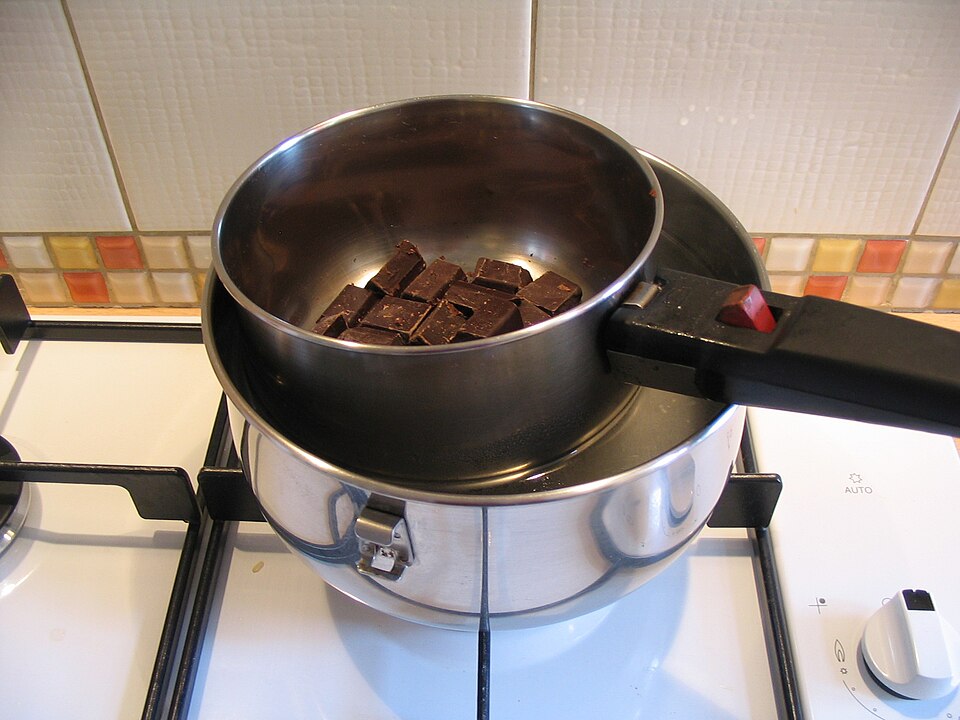
Yes — and no. The cooking method is identical; the product category differs.
A double boiler refers to a stovetop set: a lower pot holds simmering water, and an upper insert or pot sits above it, heating food indirectly. A bain marie, in commercial kitchen terminology, typically describes either a countertop or floor-standing electric unit that maintains a water bath at a set temperature across multiple GN (gastronorm) food pans.
In practice, wholesale buyers encounter both terms applied to the same stainless steel product. A 6-quart stainless insert sitting over a stockpot is called a double boiler at a restaurant supply house and a “bain marie pot” in the same manufacturer’s export catalog. Understanding the overlap prevents order errors.
The underlying physics are identical: water boils at 100°C (212°F), capping the maximum heat transferred to the food at approximately 90°C — gentle enough for hollandaise, ganache, and custard without scorching. This is why indirect water-bath heating remains the default for temperature-sensitive cooking in commercial kitchens worldwide.
When sourcing wholesale, clarify the format:
- Stovetop double boiler sets (insert + lower pot): standard in bakeries, small restaurants, chocolatiers
- Countertop electric bain maries (2–6 GN pans, 800–1,500W): cafés, buffets, catering prep
- Floor-standing bain maries (12–24 pans, dual temperature zones): hotels, hospital tray lines, school cafeterias
Why Stainless Steel — And Which Grade Actually Matters
Not all stainless steel performs the same under commercial conditions. When I evaluated spec sheets from multiple commercial kitchenware manufacturers, the grade question came up in every serious B2B conversation.
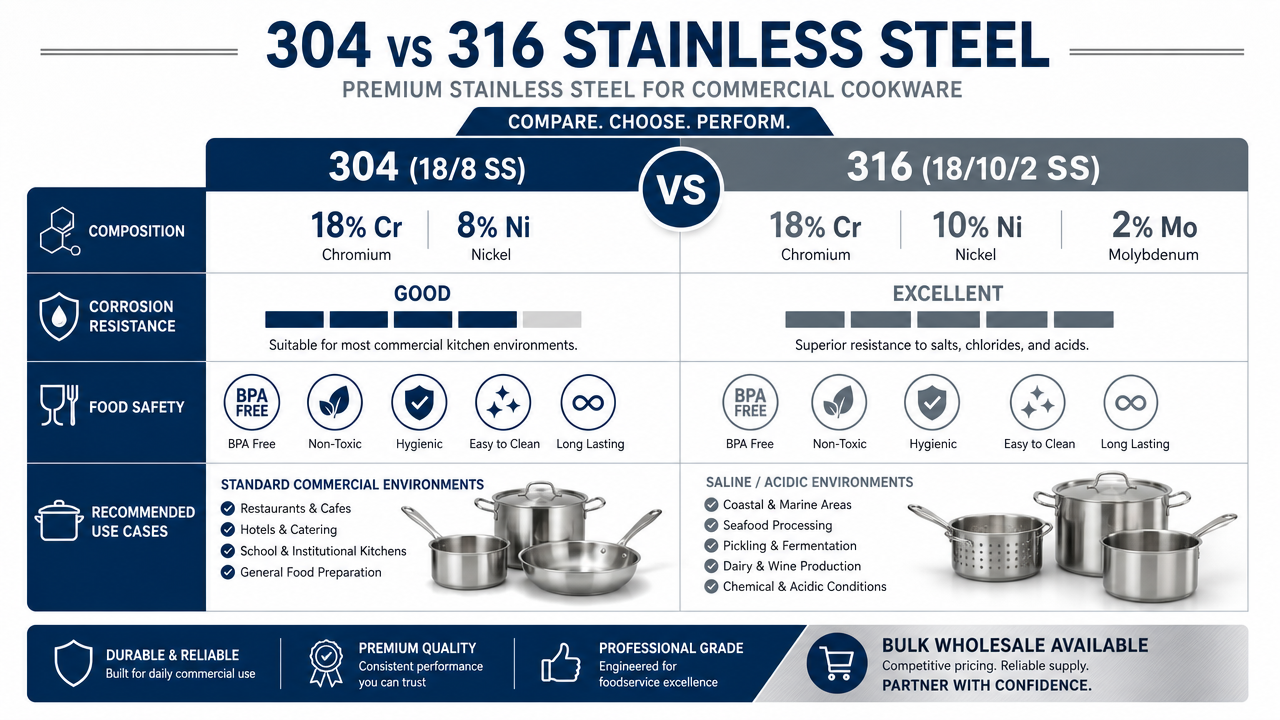
304 vs 316 vs 400-Series: A Practical Comparison
| Grade | Composition | Corrosion Resistance | Food Contact | Recommended Use |
|---|---|---|---|---|
| 304 (18/8) | 18% Cr, 8% Ni | High | Yes (FDA-compliant) | Standard commercial bain maries, most wholesale double boilers |
| 316 (18/10/2) | 18% Cr, 10% Ni, 2% Mo | Very High (molybdenum resists chlorides) | Yes | High-acid sauces, saline environments, coastal operations |
| 400-series | Cr only, no Ni | Low | Marginal | Not recommended for food contact in steam environments |
304 stainless steel is the correct choice for 95% of wholesale double boiler applications. It handles acidic sauces, withstands daily sanitization cycles, and meets FDA and NSF food-contact requirements. Commercial-grade 304 with proper weld quality will outlast cheaper alternatives by years in high-volume use.
316 is worth specifying if your buyers operate in coastal environments (salt air accelerates corrosion) or work frequently with high-salt brines and acidic marinades. The 2% molybdenum addition provides meaningful extra protection, but at a 20–30% price premium over 304 — something to factor into wholesale pricing structures.
The red flag to watch: suppliers listing “stainless steel” without a grade number. In our experience reviewing catalogs from multiple Chinese manufacturers, ungraded “stainless” in the sub-$5/unit range frequently turns out to be 400-series, which degrades under constant steam exposure and discolors within months of commercial use.
Wall Thickness
Commercial double boiler inserts range from 0.6mm to 1.3mm wall thickness. For stovetop double boilers, 0.8–1.0mm is the standard commercial specification. Thinner gauges (0.5mm or below) dent easily under kitchen handling and may warp over induction burners. Ask suppliers for the gauge spec in writing before placing wholesale orders.
Capacity Planning: What Size Do Your Buyers Actually Need?
Capacity is the most common sourcing error in double boiler wholesale orders. Buyers often default to the largest unit without matching it to real operational throughput.
Stovetop Double Boiler Sizes
| Capacity | Best Fit | Typical Users |
|---|---|---|
| 2–4 qt | Small batch sauces, chocolate work | Pastry shops, chocolatiers, small cafés |
| 6–8 qt | Mid-volume sauce production | Bistros, hotel room service, catering prep |
| 12–16 qt | High-volume holding and tempering | Restaurant commissaries, large catering operations |
| 20 qt | Bulk preparation | Institutional kitchens, food manufacturing |
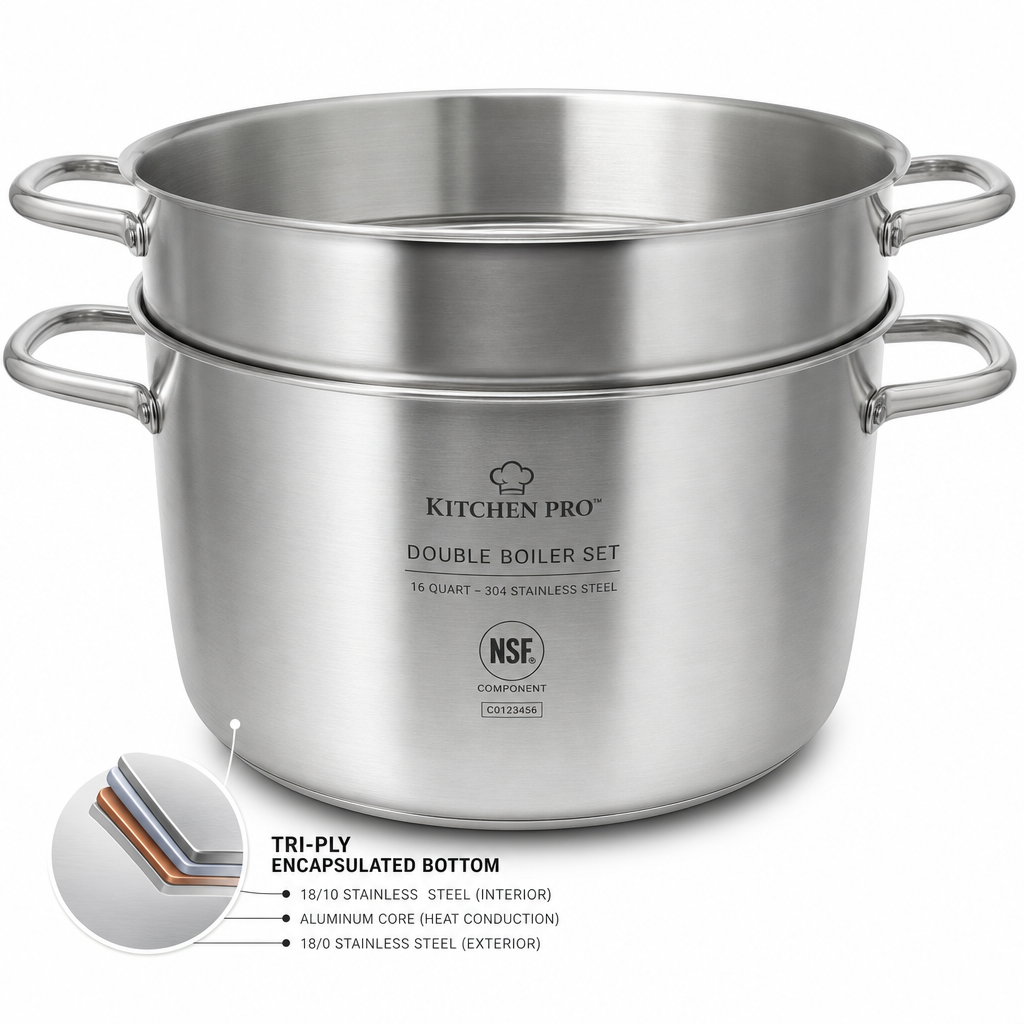
Winco’s SSDB-16 (16 qt, tri-ply bottom, NSF listed) and similar commercial-grade sets in the 12–20 qt range represent the sweet spot for most foodservice wholesale buyers in the US market, retailing at $88–$212 per unit depending on capacity.
Commercial Electric Bain Marie Capacity
- Countertop 2–4 pan units: footprint roughly 500–700mm wide; ideal for restaurants and cafés
- Countertop 6-pan units: 800–1,000mm wide; standard for hotel breakfast service
- Floor-standing 12+ pan units: 1,200–2,000mm; hospital, catering company, school cafeteria
For commercial electric units, always match GN pan format (1/1, 1/2, 1/3) to the buyer’s existing pan inventory. Mixing formats creates compatibility gaps that generate complaints after delivery.
Wholesale Sourcing: Certifications, MOQ, and Supplier Tiers
This is where most wholesale buyers lose time. The sourcing landscape for stainless steel double boilers breaks into three distinct tiers.
Certification Checklist for Wholesale Buyers
Before accepting a sample or placing a bulk order, verify the following:
| Certification | Market | What It Covers |
|---|---|---|
| NSF/ANSI 2 | USA / Canada | Food equipment safety and sanitation |
| CE | EU | Electrical safety (required for electric bain maries) |
| LFGB | Germany / EU | Food contact safety testing (stricter than standard EU) |
| FDA Compliance | USA | Food-grade material confirmation |
| HACCP compatibility | International | Smooth welds, no bacterial harborage points |
NSF listing is non-negotiable for selling into US foodservice. Winco, Vollrath, and Royal Industries all carry NSF-listed commercial double boilers. For imports, request the actual NSF certificate number — not a logo on packaging — and verify it at nsf.org.
MOQ and Supplier Tiers
Tier 1 — Chinese factory-direct (OEM/ODM):
- MOQ typically 50–500 units depending on customization level
- Price range: $8–$25 per unit (stovetop sets, 304 SS, standard specs)
- Lead time: 30–60 days
- Platforms: Alibaba, GlobalSources, Made-in-China
- Risk: Grade verification, weld quality, certification authenticity — all require due diligence
Tier 2 — US/EU distributors (wholesale):
- MOQ typically 6–24 units per SKU
- Price range: $45–$180 per unit (commercial grade, NSF-listed)
- Lead time: 3–10 business days
- Examples: KaTom, TigerChef, The Horecast Store, Carolina Restaurant Supply
- Risk: Lower margin, but certified product with domestic warranty support
Tier 3 — Brand-name commercial (Vollrath, Winco, Mauviel):
- MOQ: 1–6 units
- Price: $88–$510 per unit
- Lead time: 1–5 business days
- Risk: Highest cost, best certification and quality assurance
For importers looking at Tier 1 China sourcing, the critical due diligence steps are: (1) request a 304 material test certificate (SGS or Bureau Veritas third-party), (2) inspect weld seams for smooth polishing — rough welds fail food safety audits, and (3) verify NSF or LFGB certificate numbers before production begins.
Practical Buying Criteria: What Actually Fails in the Field
After reviewing commercial kitchen equipment failures and buyer feedback across procurement forums, three recurring failure modes show up in double boiler and bain marie purchases:
1. Bottom warping on induction: Thin-gauge (sub-0.8mm) lower pots warp on induction cooktops within months of commercial use. Specify tri-ply or impact-bonded bottoms for any induction-compatible stovetop double boiler.
2. Handle detachment: Spot-welded handles on cheaper units fail under repeated full-load lifting. Riveted or solid-cast handles are significantly more durable — worth specifying in your purchase order.
3. Lid fit degradation: On cheaper units, lids warp after repeated heat cycling, creating steam gaps. A properly fitted lid matters for temperature retention and HACCP compliance. Verify lid fit on the sample unit before bulk approval.
For electric bain maries, the most common field complaint is thermostat drift — units that claim ±2°C accuracy but drift 8–10°C over a service period. PID-controlled units maintain tighter tolerance than basic bi-metal thermostats; for high-volume foodservice buyers, specifying PID control is worth the cost premium.
Price Benchmarks: What to Pay at Wholesale Volume
Based on current market data from US distributors and export catalogs:
| Product Type | US Wholesale Range | China Factory Range |
|---|---|---|
| 6–8 qt stovetop double boiler set (304 SS, NSF) | $55–$95 / unit | $12–$20 / unit (MOQ 100+) |
| 12–16 qt commercial double boiler (NSF, tri-ply) | $88–$160 / unit | $18–$35 / unit (MOQ 50+) |
| 20 qt commercial double boiler (NSF) | $180–$212 / unit | $30–$50 / unit (MOQ 50+) |
| Countertop electric bain marie (4-pan, 304 SS, CE) | $200–$400 / unit | $60–$120 / unit (MOQ 20+) |
| Floor-standing electric bain marie (6-pan, 304 SS) | $450–$900 / unit | $150–$350 / unit (MOQ 10+) |
Factory prices are indicative FOB Ningbo/Shanghai. Add shipping, import duties, and certification costs when calculating landed cost.
The landed-cost calculation often surprises first-time importers: a $15/unit stovetop double boiler from China with $4 shipping, 8% import duty, and $2/unit certification amortization lands at approximately $23 — still below the $55 US wholesale floor, but not the 70% savings the FOB price implies.
Summary
For wholesale buyers, the stainless steel double boiler and commercial bain marie market is well-supplied but poorly labeled. The key decisions that determine long-term satisfaction are material grade (304 for nearly all applications), wall gauge (0.8–1.0mm minimum for commercial use), certification verification (NSF for the US, CE + LFGB for Europe), and honest capacity matching to the buyer’s operational scale.
The bain marie / double boiler terminology distinction matters less than the spec sheet — focus on what the product is built from and what it’s certified for, not what it’s called in the catalog.
FAQ
Is a bain marie the same as a double boiler?
Functionally yes — both use indirect water-bath heating to keep food below 100°C. The term “double boiler” typically refers to stovetop insert sets, while “bain marie” in commercial contexts often describes electric countertop or floor-standing units. Manufacturers use both terms interchangeably in export catalogs.
What stainless steel grade should I specify for wholesale double boilers?
304 (18/8) stainless is the correct specification for 95% of commercial applications. It is FDA-compliant, NSF-certifiable, and withstands acidic sauces and frequent sanitization. Specify 316 only for saline environments or chloride-heavy applications. Avoid ungraded “stainless” claims from any supplier.
What certifications do I need for selling double boilers into the US market?
NSF/ANSI 2 listing is the key certification for US foodservice. Verify the certificate number at nsf.org rather than relying on packaging logos. FDA food-contact material compliance is also required for food-contact surfaces.
What is a typical MOQ for stainless steel double boilers from a Chinese manufacturer?
MOQ varies by factory and customization level. Standard-spec stovetop double boiler sets typically start at 50–100 units for OEM orders. Electric bain maries often start at 20 units. Factory-direct pricing is most competitive above 200 units.
What capacity double boiler does a restaurant typically need?
A bistro or mid-size restaurant handling sauces and chocolate work generally needs 6–8 qt stovetop units. High-volume commissaries and catering operations work with 12–20 qt commercial sets or countertop electric bain maries holding 4–6 GN pans.
How do I verify that a supplier’s 304 stainless steel claim is accurate?
Request a third-party material test certificate from SGS, Bureau Veritas, or Intertek. A simple magnet test helps: 304 stainless is weakly magnetic at most; a strong magnet attraction suggests a lower-grade ferritic steel.





