


If you’ve searched for egg poacher suppliers on Alibaba, you’ve already noticed that every factory claims “304 food-grade stainless steel” and “PFOA-free non-stick cups.” Those claims are sometimes true, sometimes stretched, and occasionally just copied from a template. After reviewing dozens of factory listings and cross-referencing with commercial kitchen equipment specs, the differences that determine quality — and your return rate — come down to about six checkpoints most buyers skip.
This guide is written for wholesale buyers, not home cooks. The structure maps to the decisions you actually need to make: which grade to spec, what configuration moves in your market, what pricing tier to expect at your MOQ, and how to spot a supplier who’s selling 201 as 304.
What Is a Stainless Steel Egg Poacher Pan — and Why the Product Category Matters
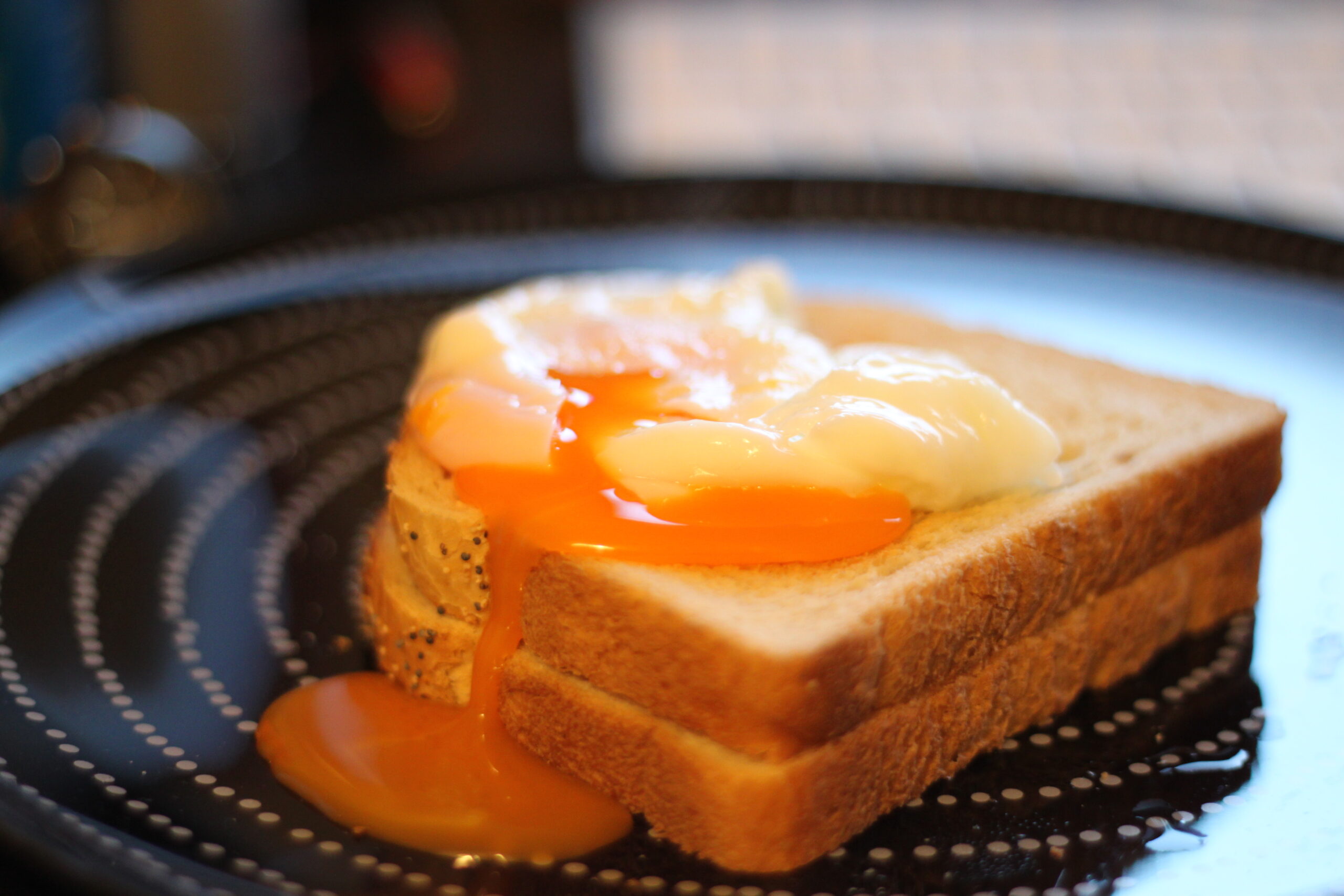
A stainless steel egg poacher is a stovetop cookware set consisting of a base pan (typically 18–24 cm in diameter) filled with shallow water, a fitted rack or tray, and individual cup inserts that hold the eggs above the simmering water. Steam cooks the eggs gently, producing the rounded, firm-white result that’s in demand at hotels, brunch restaurants, and among home cooks who want precision without the mess of free-poaching.
The category breaks into two distinct product types that wholesale buyers need to distinguish:
- Pan-and-cup sets: The base pan is included. These are complete retail units. Most common in 2-cup, 4-cup, and 6-cup configurations.
- Cup inserts only: Sold separately. Buyers who already have compatible pans purchase replacement cups or floating poacher rings. Smaller, lower-priced, often sold as multipack accessories.
Both types sell well on Amazon and in hospitality supply channels, but they have different MOQ structures, packaging requirements, and margin profiles. Pan-and-cup sets carry higher per-unit prices ($6–$18 retail) and justify more complex packaging. Cup inserts compete almost entirely on price.
Steel Grade Matters More Than Most Supplier Listings Admit
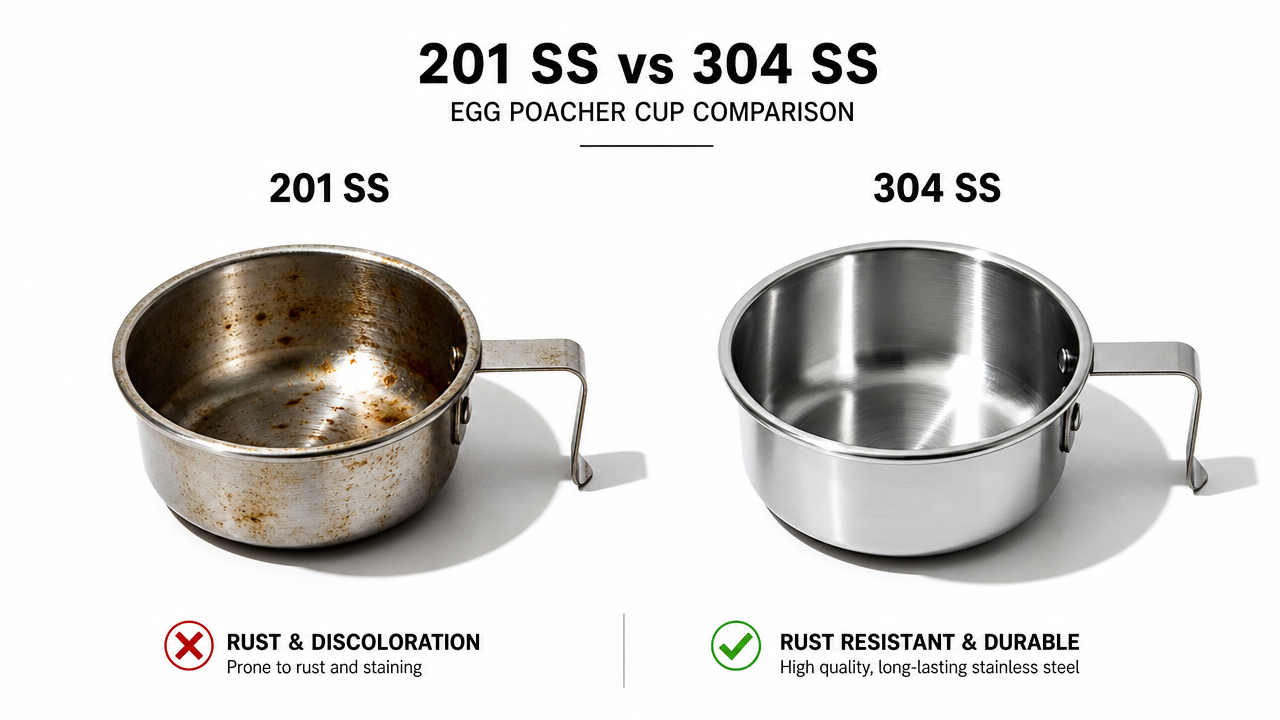
The single most important spec on a stainless steel egg poacher is the alloy grade — and it’s also the spec most frequently misrepresented.
The three grades you’ll encounter in factory quotations:
| Grade | Composition | Corrosion Resistance | Common Use | Risk Level for Buyers |
|---|---|---|---|---|
| 201 SS | 17% Cr, 4–5% Ni, 5–7.5% Mn | Low-moderate | Budget cookware, cutlery | High — can rust within 6–12 months in humid environments |
| 304 SS (18/8) | 18% Cr, 8% Ni | High | Standard food-safe cookware | Low — industry benchmark for kitchen products |
| 316 SS (18/10) | 16% Cr, 10% Ni, 2% Mo | Very high | Marine, medical, premium cookware | Very low — unnecessary for egg poachers unless premium tier |
304 (18/8) is the correct grade for egg poachers sold in the US, EU, and AU markets. It is widely recognized by the FDA as suitable for food contact applications and meets ASTM A240 material specifications for food-grade chromium-nickel stainless steel. It’s what reputable brands like Vollrath and ExcelSteel use in their commercial lines.
The problem: 201 stainless looks identical to 304 in photos, costs 15–25% less at the factory, and is frequently listed as “high-grade stainless steel” without specifying the alloy. Buyers discover the substitution only after receiving return complaints about rust spots appearing within the first year of use.
How to verify before ordering: Request a Mill Test Certificate (MTC) showing the chemical composition from your supplier. Any factory producing real 304 SS will have this document readily available. If they can’t produce it within 48 hours, treat it as 201 until proven otherwise.
For the pan body, 304 is the minimum acceptable spec. For cup inserts that may have nonstick coatings applied, the base material also needs to be 304 — coating adhesion is better on 304 than 201 due to the smoother, more stable surface.
Key Specifications to Review Before a Wholesale Order
Beyond the steel grade, six additional specs separate egg poachers that will generate good reviews from those that will generate returns.
1. Cup Capacity
The industry standard for a single egg poaching cup is approximately 75 ml (as confirmed by AVAcraft’s published specs). Cups smaller than 65 ml produce eggs that look compressed and don’t accommodate large eggs. Specify minimum 70 ml per cup in your purchase order.
2. Pan Gauge
Commercial-grade poachers use 22-gauge (approximately 0.8 mm) stainless steel for the base pan. Consumer-grade units sometimes use 24-gauge (0.6 mm), which warps more easily over induction burners. For any product going into a professional channel, specify 22-gauge or better.
3. Lid Type
Tempered glass lids with a steam vent are the market standard for retail units. Glass allows visual monitoring without lifting the lid (which releases steam and extends cooking time). Confirm the glass is tempered to at least 400°C — flimsy glass lids on cheap units are a leading cause of one-star reviews.
4. Induction Compatibility
Verify the base pan has a magnetic-grade stainless bottom (or a stainless/aluminum clad base with a magnetic layer). A simple magnet test confirms this. If the factory can’t confirm induction compatibility in writing, assume it isn’t.
5. Nonstick Cup Coating
Most egg poacher cups use a PTFE (Teflon-type) coating on the interior of the cup inserts. Specify PFOA-free and confirm with a supplier declaration. PFOA has been banned in the EU since 2020 and is effectively off the US market for cookware. Any supplier still using PFOA-containing coatings is a compliance risk. The coating thickness should be at least 0.025 mm for durability.
6. Handle Material and Attachment
Bakelite (phenolic resin) handles that stay cool to the touch are the standard. Avoid handles attached with a single screw — they loosen under thermal cycling. Riveted handles are significantly more durable. Check the number and type of rivets in the factory sample photos.
Cup Count Configurations: 2-Cup, 4-Cup, and 6-Cup Compared
The configuration you stock should match your sales channel and end-user profile. Here’s how the three main configurations perform in practice:
| Configuration | Retail Price Range (US) | Best Channel | Notes |
|---|---|---|---|
| 2-Cup | $18–$30 | Amazon, gifting | Compact, sells well as a solo-household item. Lower ASP but easy impulse buy. |
| 4-Cup | $28–$45 | Amazon, specialty retail, hospitality | Sweet spot for most wholesale buyers. Balances utility and price point. Highest search volume. |
| 6-Cup | $40–$65 | Foodservice, hotel supply, specialty retail | Slower retail velocity but strong B2B/hospitality demand. Larger SKU, higher per-unit profit. |
The 4-cup configuration is the volume leader on Amazon for this category, which makes it the safest first wholesale order if you’re testing market fit. The 6-cup pan, while slower to sell at retail, is the preferred format for hotel breakfast programs and restaurant brunch setups — commercial buyers often purchase in case quantities of 6–12 units.
If you’re selling to hospitality distributors, also consider stocking the cup inserts separately as a replacement part. Hotels replace cups far more often than they replace the base pan, making this a recurring revenue SKU that requires almost no shelf space.
Wholesale Pricing Tiers and MOQ Reality
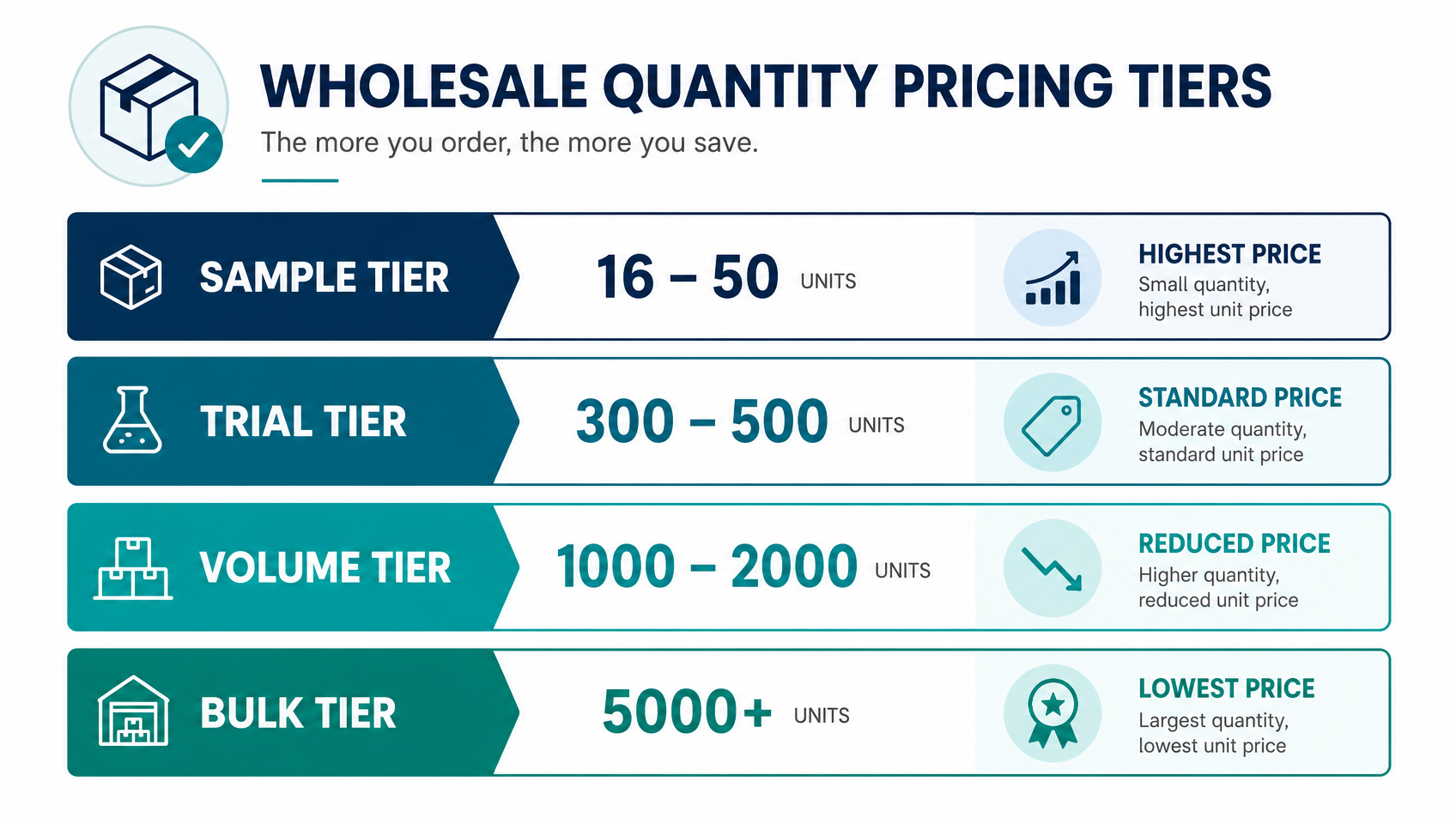
Factory pricing for stainless steel egg poachers (FOB China, 2025–2026 data from Alibaba and Made-in-China listings):
| MOQ | FOB Price Per Unit | Configuration | Notes |
|---|---|---|---|
| 16–50 pieces | $5.50–$7.20 | 2–4 cup, basic | Sample/trial pricing. Not viable for resale margin. |
| 300–500 pieces | $4.20–$5.80 | 2–4 cup, 304 SS | Standard trial order tier. Achievable for most new buyers. |
| 1,000–2,000 pieces | $3.60–$4.80 | 2–4 cup, 304 SS | Volume pricing kicks in. Viable margin for Amazon FBA at $25–35 retail. |
| 5,000+ pieces | $3.30–$4.20 | Any configuration | Full volume pricing. OEM tooling amortized at this tier. |
These are FOB (Free on Board) prices at the port of export. Add 12–18% for ocean freight, approximately 2% standard MFN import duty (HTS 7323.93) plus any applicable Section 301 tariffs on Chinese goods, and 5–8% for Amazon FBA fees to get a landed cost estimate. A 4-cup poacher at $4.50 FOB typically lands at $5.80–$6.50 per unit before FBA fees. Note that Section 301 tariff rates on kitchenware from China have varied significantly in 2025–2026 — confirm the current applicable rate with your customs broker before finalizing margin calculations.
A few things I’ve seen buyers miss in initial negotiations:
The gap between a $4.20 quote and a $5.80 quote from two factories on the same configuration often comes down to the steel grade (201 vs 304) and the coating spec (single-layer vs double-layer PTFE). Always ask what’s included, not just what the price is.
Lead times vary significantly: standard production runs at established factories take 30–45 days after sample approval. For first-time buyers without an approved sample, add 2–3 weeks for sample production and 1–2 weeks for revision. Budget 8–10 weeks from first contact to goods at port on your first order.
OEM and Private Label: What’s Realistic for Egg Poachers
Private labeling a stainless steel egg poacher is straightforward for logo application but more involved for custom design.
What factories can typically do with low tooling cost:
- Laser-engraved or pad-printed logo on the pan handle or lid rim
- Custom color Bakelite handles (often no tooling cost, just a color MOQ of 300–500 pieces)
- Custom retail box with your brand artwork (minimum 500 units is common)
- Custom hang tags and stickers
What requires new tooling (and higher MOQ):
- Custom cup shape or proprietary pouring handle design ($1,500–$4,000 for new mold tooling)
- Custom pan diameter or non-standard cup count
- Proprietary lid shape
For most Amazon sellers and private label brands at the 500–2,000 unit scale, the realistic OEM play is logo + custom packaging on an existing factory mold. This keeps tooling costs near zero while still creating brand differentiation on the shelf.
One thing worth knowing: factories that offer OEM services typically require a signed Non-Disclosure Agreement (NDA) and a larger first order (usually 1,000+ pieces) before agreeing to exclusive mold use. If you want exclusivity on a custom design, negotiate this in writing — verbal agreements don’t hold.
Red Flags When Vetting Egg Poacher Suppliers
After reviewing factory listings across multiple sourcing platforms, these are the patterns that signal a high-risk supplier:
1. “304 stainless” without a Mill Test Certificate
Any factory producing real 304 SS cookware will have MTC documentation. If they respond to your request with “we guarantee 304 quality” instead of an actual document, treat it as 201 until you receive a certified sample and lab test result.
2. “PFOA-free non-stick” without a supplier declaration
PFOA-free should come with a written declaration referencing the specific coating product or a third-party test report (e.g., SGS, Intertek, BV). “We use safe non-stick” is not a declaration.
3. Photos showing only one angle
Reputable factories show multiple product angles, inside-cup shots, and packaged goods photos. A listing with only one hero shot of the assembled pan usually means the factory is a reseller, not a manufacturer — which means your quoted price includes a middleman margin and you lose direct communication with production.
4. MOQ that’s too flexible
Legitimate manufacturers have cost-based MOQs. A factory quoting you “any quantity from 1 piece” on a stainless steel cookware item is either a trading company or is sourcing from another factory. Both reduce your margin and your quality control access.
5. No English product certifications
For products entering US, EU, or AU markets, look for CE, FDA, LFGB, or NSF certification documentation. Not every egg poacher needs all of these, but a factory that’s been exporting to developed markets will have at least one. No certifications at all is a yellow flag.
Commercial vs Consumer Grade: What Hotels and Restaurants Actually Need
Commercial egg poachers sold through foodservice distributors like Vollrath, Equippers, and WebstaurantStore are built to a different standard than retail consumer units — and wholesale buyers supplying hospitality channels need to understand these differences.
Pan construction: Commercial-grade pans use 18/8 stainless steel (equivalent to 304) at 22-gauge thickness minimum. The base should be heavy enough to maintain stable water temperature without hotspots. Thin-gauge consumer pans lose heat quickly when multiple cups are loaded, which produces inconsistent results in a commercial kitchen where speed matters.
NSF certification: NSF International certification (NSF/ANSI 2 for food equipment) is a meaningful signal for commercial buyers. It confirms the product has been tested for cleanability, material safety, and durability under repeated commercial use conditions. Most retail egg poachers don’t have NSF certification. If you’re sourcing for restaurant or hotel supply chains, ask specifically for NSF-certified units or source from established foodservice equipment suppliers.
Cup design: Commercial cups prioritize quick release over aesthetics. The cup interior should have minimal surface contact points so eggs release cleanly during service. Some commercial designs use a perforated cup with small drainage holes to drain residual water before plating — a detail worth requesting if your customer is running a high-volume breakfast program.
Handle durability: In a commercial setting, a pan might complete 40–80 poaching cycles per service. Handles need to withstand this thermal cycling without loosening. Riveted Bakelite handles with three-point attachment are the minimum spec for commercial use.
If you’re supplying hospitality distributors and they ask for “22-gauge 18/8 NSF-listed egg poachers,” that’s the language. Knowing it before the conversation makes you look like you know your product.
Frequently Asked Questions
What is the minimum order quantity (MOQ) for wholesale stainless steel egg poachers?
Most Chinese factories set MOQ at 300–500 pieces for standard configurations. At this quantity, FOB pricing typically falls between $4.20 and $5.80 per unit depending on the steel grade and configuration. Smaller trial orders (16–50 pieces) are available from some suppliers but at pricing that doesn’t support resale margins.
What stainless steel grade should I specify for egg poachers?
Specify 304 (18/8) as the minimum for any product entering US, EU, or AU markets. 304 stainless is recognized by the FDA as suitable for food contact applications and meets ASTM A240 material specifications for food-grade chromium-nickel stainless steel. Request a Mill Test Certificate from your supplier to verify the grade before committing to a full order.
Are the nonstick cups in stainless steel egg poachers safe?
The cup inserts in most stainless steel egg poachers use a PTFE (polytetrafluoroethylene) coating. PTFE itself is considered safe at normal cooking temperatures. What matters is confirming the coating is PFOA-free — PFOA is a processing chemical used in older coating formulations that’s now banned in the EU and effectively eliminated from US market cookware. Always request a written PFOA-free declaration from your supplier.
Can stainless steel egg poachers be used on induction cooktops?
Only if the base pan has a magnetic-grade stainless bottom layer. Not all stainless steel is magnetic — 304 and 316 grades are typically not magnetic on their own, which is why induction-compatible poachers require either a clad construction (stainless/aluminum/magnetic stainless sandwich) or a separate magnetic disc bonded to the base. Verify induction compatibility in writing with your supplier before listing the product as induction-compatible.
What’s a realistic timeline from first contact to receiving goods?
For a first order with a new factory: 2–3 weeks for sample production → 1–2 weeks for sample review and revision → 30–45 days production → 10–25 days ocean freight. Total: 8–12 weeks is a realistic planning number. Established buyers with approved samples and ongoing factory relationships can run 6–8 weeks.
What certifications should a wholesale egg poacher have for the US market?
At minimum, a PFOA-free coating declaration and documentation confirming 304 stainless steel grade. For Amazon listings, CPSC compliance (16 CFR 1500.14 for kitchenware) is relevant. For foodservice channels, NSF/ANSI 2 certification adds credibility. California Prop 65 compliance documentation is worth requesting for any product sold in California.
Summary
Sourcing stainless steel egg poachers wholesale comes down to three things you control before placing an order: verifying the steel grade, nailing the spec sheet, and filtering suppliers by documentation quality rather than price alone. The price difference between a 201 SS unit and a 304 SS unit at the factory is $0.60–$1.20 per piece — a gap that pays for itself many times over when you factor in avoided returns and negative reviews.
The 4-cup 304 SS configuration with a tempered glass lid is the volume sweet spot for most retail and Amazon channels. For hospitality supply, move up to 22-gauge construction and ask for NSF documentation. For OEM, keep tooling-free customization (logo + packaging) until you’ve validated the market and hit 1,000+ unit orders.
The factories willing to share MTC documentation, written PFOA declarations, and clear test reports upfront are the ones worth building a relationship with — regardless of whether their initial quote is the lowest in your comparison.





