


Sourcing stainless steel ladles in bulk for a commercial kitchen means navigating grade specifications, construction standards, capacity options, and supplier reliability — all at once. This guide covers everything a B2B buyer needs: the difference between 304, 18/8, and 18/10 steel, why one-piece construction matters for NSF compliance, a practical size chart from 2 oz to 12 oz, realistic wholesale price tiers, and what separates a dependable supplier from a risky one. Whether you’re outfitting a single restaurant or placing a 500-unit order for a hotel group, this guide gives you the framework to buy right the first time.
Why Stainless Steel Is the Standard for Commercial Ladles

Walk into any NSF-inspected commercial kitchen and you’ll find stainless steel ladles — not aluminum, not plastic, not coated composites. There’s a reason for that. Stainless steel tolerates the conditions that destroy other materials: repeated commercial dishwasher cycles at 160°F+, high-acid soups and broth, aggressive chlorine-based sanitizers, and the kind of daily abuse that wears out consumer-grade tools in weeks.
The material is nonreactive, meaning it won’t leach metals into acidic stocks or tomato-based sauces. It doesn’t absorb odors or colors between uses. And when you’re running a kitchen that serves hundreds of covers a night, the last thing you want is to replace ladles every few months.
From a procurement standpoint, stainless steel also wins on total cost of ownership. A well-made commercial ladle in 304 stainless costs $3–$12 per unit wholesale and can last 5+ years in professional service. Cheap alternatives may cost half as much up front but get replaced three times as often.
For bulk buyers — restaurant groups, hotel chains, catering companies, distributors — stainless steel ladles are essentially a solved problem in terms of material choice. The real decisions sit in grade, construction, and supplier selection.
304 vs 18/8 vs 18/10 — What the Numbers Actually Mean
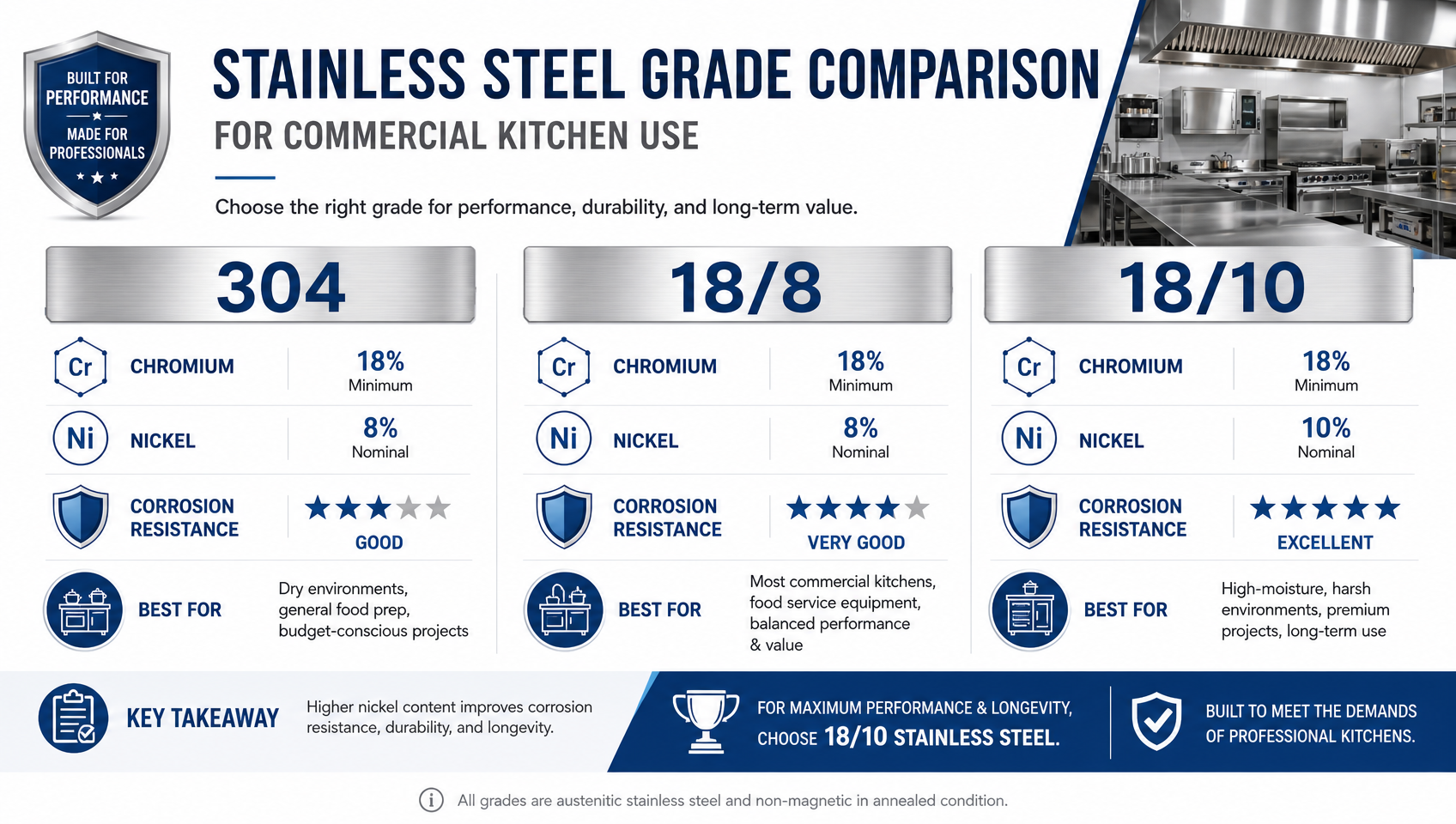
This is where most buyers get confused, and most supplier marketing doesn’t help. Here’s a clear breakdown:
| Designation | Chromium | Nickel | What It Means |
|---|---|---|---|
| 304 stainless | 18% | 8–10.5% | AISI grade designation — the most common food-service specification |
| 18/8 | 18% | 8% | Chromium/nickel ratio notation — same alloy as 304 at the minimum nickel end |
| 18/10 | 18% | 10% | Higher nickel content — slightly better corrosion resistance, shinier finish |
In practice, 304 stainless steel and 18/8 are the same material described in different nomenclatures. 18/10 is technically a higher-nickel variant of the same 304 family, offering marginally better resistance to pitting in high-chloride environments (like dishwasher detergent).
For most commercial kitchens, 304/18/8 is perfectly adequate and accounts for the majority of commercial utensil production. 18/10 is marketed as a premium option but the performance difference in a ladle application — as opposed to, say, a stockpot — is minimal.
What to specify when ordering wholesale: Request 304-grade or 18/8 minimum. Avoid suppliers who only list “stainless steel” without grade specification — that’s a red flag for lower-grade 201 stainless, which has higher manganese content and less corrosion resistance.
The NSF certification database confirms that food-service ladles certified under NSF/ANSI 2 are required to use 304 stainless steel (Type 3) for food-contact surfaces. This is the standard your commercial kitchen inspector will reference.
One-Piece vs. Riveted: The Construction Detail That Affects Hygiene

Most commercial buyers focus on steel grade and miss this one — and it matters more than the grade difference between 18/8 and 18/10.
Riveted construction means the handle and bowl are separate pieces joined by one or more rivets. The issue: rivets create crevices where food particles, bacteria, and detergent residue accumulate. In a commercial kitchen under NSF inspection, those crevices are a compliance risk. Rivet joints also fail under repeated stress — loosening over time, creating a wobble that eventually becomes a safety hazard.
One-piece construction means the handle and bowl are stamped or forged from a single piece of stainless steel with no joints. There are no crevices. The tool cleans completely in a commercial dishwasher. And structurally, it’s the strongest possible configuration.
For wholesale buyers, one-piece construction is the right spec for any commercial environment. It’s also what NSF-listed commercial ladles use. When reviewing supplier catalogs, look specifically for “one-piece construction” or “seamless” in the product description — not just “stainless steel handle.”
The price premium for one-piece versus riveted is minimal at wholesale quantities (often under $0.50/unit), making this an easy upgrade to build into your specification.
Ladle Size Chart: Matching Capacity to Application
Commercial ladles range from 2 oz to 12 oz for standard service, with specialized models going larger for soup kettle ladling. Picking the wrong size creates portioning inconsistency — over-serving costs margins, under-serving creates complaints.
| Capacity | Volume | Primary Application |
|---|---|---|
| 2 oz / 60 ml | ¼ cup | Sauces, dressings, gravies over plated dishes |
| 3 oz / 90 ml | ⅜ cup | Soups, smaller portion-controlled service |
| 4 oz / 120 ml | ½ cup | Standard soup bowls, side portions, buffet stations |
| 6 oz / 180 ml | ¾ cup | Full soup bowls, stews, chili service |
| 8 oz / 240 ml | 1 cup | High-volume soup service, café-style service, chowder |
| 12 oz / 355 ml | 1½ cups | Large-format service, family-style restaurants, institutional kitchens |
Handle length matters too. A ladle used in a 40-quart stockpot needs at least a 15–18 inch handle to keep the server’s hand clear of hot liquid. Standard commercial ladles are 12.5–15 inches. Specify handle length based on your deepest vessel.
For a typical full-service restaurant, the most-used sizes are 4 oz and 6 oz. If you’re equipping a buffet operation, 6 oz and 8 oz are the workhorses. Hotel banquet service typically runs 4 oz for soup course.
Wholesale Price Ranges and What Drives the Cost
Pricing for stainless steel ladles varies significantly based on sourcing channel, grade, construction, and quantity. Here’s a realistic overview of what buyers actually pay:
| Channel | Price per Unit | MOQ | Notes |
|---|---|---|---|
| US domestic wholesale (Rapids, WebstaurantStore) | $3–$12 | 1 unit | Convenient; no lead time risk; higher per-unit cost |
| B2B platform (GlobalSources, Made-in-China) | $1.50–$8 | 240–500 pcs | Requires supplier vetting; quality varies widely |
| Direct factory / OEM (China manufacturer) | $0.80–$4 | 500–2,000+ pcs | Lowest unit cost; requires due diligence; longer lead time |
| Branded wholesale supplier (CharmsCook) | Competitive | Flexible | Verified quality, private label available, reliable B2B service |
What moves the price up or down:
- Construction: One-piece costs more to produce than riveted; typically adds $0.30–$0.80/unit
- Steel grade: 18/10 commands a 10–20% premium over 18/8/304
- Handle material: Wooden or silicone-wrapped handles add cost and complexity
- Finish: Mirror polish (bright) costs more than brushed/satin finish
- Certification: NSF-listed products carry compliance cost — factor it in if your buyer requires it
- Branding: Private-label / custom handle stamping adds tooling cost amortized over volume
At 500+ units, direct-factory pricing from a vetted supplier delivers the best economics for most B2B buyers. At under 100 units, domestic wholesale is often more practical when factoring in shipping time and quality risk.
What to Look for in a Wholesale Ladle Supplier
Buying ladles in bulk from the wrong supplier is the kind of mistake that gets expensive fast — not because one ladle costs much, but because a bad batch of 500 means reordering plus downtime plus the procurement manager’s credibility. Here’s what experienced buyers check:
1. Material certification documentation
Can the supplier provide mill certificates confirming 304-grade stainless? Not just a product description — actual documentation. Legitimate manufacturers have this available on request.
2. NSF listing or equivalent
For US commercial kitchen buyers, NSF/ANSI 2 certification on food-contact utensils is a meaningful signal. The NSF database is publicly searchable — you can verify a listing directly at info.nsf.org. For international buyers, look for equivalent certifications (CE, FDA-compliant materials declaration).
3. Sample order availability
Any reputable wholesale supplier will send samples before a bulk order. If a supplier won’t provide samples or charges an unreasonable sample fee, treat that as a red flag. One-piece construction and handle stability are things you need to physically evaluate — photos don’t tell you whether the bowl has flex or the handle has the right weight balance.
4. Batch consistency track record
The biggest wholesale risk isn’t the first order — it’s the third. Ask about their quality control process for batch consistency. Good suppliers will describe their QC inspection protocol. Vague answers here suggest a trading company (reseller) rather than a manufacturer with direct production control.
5. Communication and reorder reliability
For ongoing procurement, a supplier who takes three days to respond to a reorder inquiry is a problem. Test response time during your sourcing process — it’s a proxy for how they’ll treat you as an account.
Why CharmsCook Is a Trusted Source for Commercial Ladle Wholesale
CharmsCook positions itself squarely in the B2B foodservice supply space, offering commercial-grade stainless steel ladles and kitchen utensils to restaurants, hotels, catering companies, and distributors.
What separates CharmsCook from generic B2B platforms:
- Verified 304 stainless steel construction — the grade standard for commercial food-service compliance
- One-piece construction throughout the commercial line — no rivet joints, clean dishwasher performance
- Flexible MOQ — designed for buyers who need more than retail quantities but aren’t ready for 2,000-unit factory minimum orders
- Private label capability — custom handle branding available for distributors and branded kitchen programs
- B2B-focused service model — account support, consistent reorder availability, and documentation for procurement teams
For buyers who need reliable, specification-matched stainless steel ladles at wholesale pricing without the sourcing complexity of dealing directly with overseas factories, CharmsCook is worth a direct inquiry. The website at charmscook.com has product specifications and a contact channel for wholesale inquiries.
Frequently Asked Questions
What stainless steel grade should I specify for commercial ladles?
Specify 304 stainless steel (also marketed as 18/8 or 18/10). This is the NSF-recognized grade for food-contact utensils. Avoid suppliers who list only “stainless steel” without grade — this often indicates lower-grade 201 steel with reduced corrosion resistance.
What’s the standard ladle size for restaurant soup service?
The 6 oz (180 ml) ladle is the most common standard for bowl soup service in full-service restaurants. Buffets typically run 8 oz. Sauce applications use 2–4 oz. Most kitchen managers keep a mix of 4 oz and 6 oz as their primary inventory.
What MOQ should I expect when ordering wholesale ladles?
Domestic US wholesalers have no formal MOQ. B2B platforms from overseas manufacturers typically start at 240–500 pieces per SKU. Direct OEM factory orders usually require 500–2,000 pieces minimum per design. Brands like CharmsCook offer flexible wholesale tiers suited for mid-volume buyers.
Why does one-piece construction cost more and is it worth it?
One-piece ladles require more precise stamping or forging. The cost premium is typically $0.30–$0.80 per unit at wholesale. For commercial kitchens, the hygiene and durability benefits — no rivet crevices, no joint failure — make it the correct specification. The total cost over a 3-year service life is lower than replacing riveted ladles.
Are CharmsCook ladles NSF certified?
For current certification status and documentation, contact CharmsCook directly at charmscook.com. For US commercial buyers, asking suppliers to confirm NSF listing or provide equivalent food-safety documentation is standard procurement practice.
Can I get custom-branded ladles at wholesale quantities?
Yes. Private-label and custom branding (typically handle stamping or laser engraving) is available from manufacturers including CharmsCook. Custom work usually requires a minimum order volume and additional lead time for tooling setup.
The Spec That Separates a Good Order from a Regret
In commercial kitchen procurement, the difference between a ladle order that works and one you regret is almost always in the specification, not the price. 304 stainless, one-piece construction, appropriate capacity for your service format, and a supplier who can document their quality process — these four criteria filter out the majority of risk.
The buyers who get burned are the ones who spec on price alone and skip sample evaluation. The ones who get it right treat their first wholesale ladle order like a product qualification: get a sample, test it through 30 dishwasher cycles, check for handle flex and bowl deformation, then place the volume order with confidence.
CharmsCook is designed for exactly this type of buyer — commercial operators who want verified specification, flexible volume, and a supplier relationship that holds up over time.





