


Sourcing stainless steel lunch boxes in bulk means navigating steel grade claims, MOQ tiers, certification requirements, and OEM options — all before placing a purchase order. This guide cuts through supplier marketing language to give importers, distributors, and brand owners the exact specs, certifications, and pricing benchmarks needed to source kids’ stainless steel lunch boxes with confidence.
Why Stainless Steel Lunch Boxes Dominate the Kids’ Container Market
The shift is clear in every major retail category. Parents are moving away from plastic lunch containers, and stainless steel is the primary beneficiary. The reason isn’t just aesthetics — it’s a combination of durability, chemical safety, and longevity that plastic cannot match.
For B2B buyers, this creates a specific opportunity. Kids’ stainless steel lunch boxes are one of the highest-reorder categories in school supply and eco-friendly houseware channels. Once a family commits to stainless, they typically stay in the category and buy additional containers.
What buyers consistently report from real use: stainless steel containers don’t absorb odors after a year of use, don’t stain from tomato-based sauces, and survive drops that would crack a plastic or glass container. These aren’t marketing claims — they reflect the material properties of 18/8 (304-grade) steel.
The wholesale market reflects this demand. Factory pricing for 304-grade stainless lunch boxes runs $2.76–$3.85 per unit at 1,000-piece MOQ from Chinese manufacturers (Made-in-China, 2026 listings). Retail price points of $20–$45 leave substantial margin for distributors and private-label brands.
Steel Grade Decoded: What 304, 316, and 18/8 Actually Mean
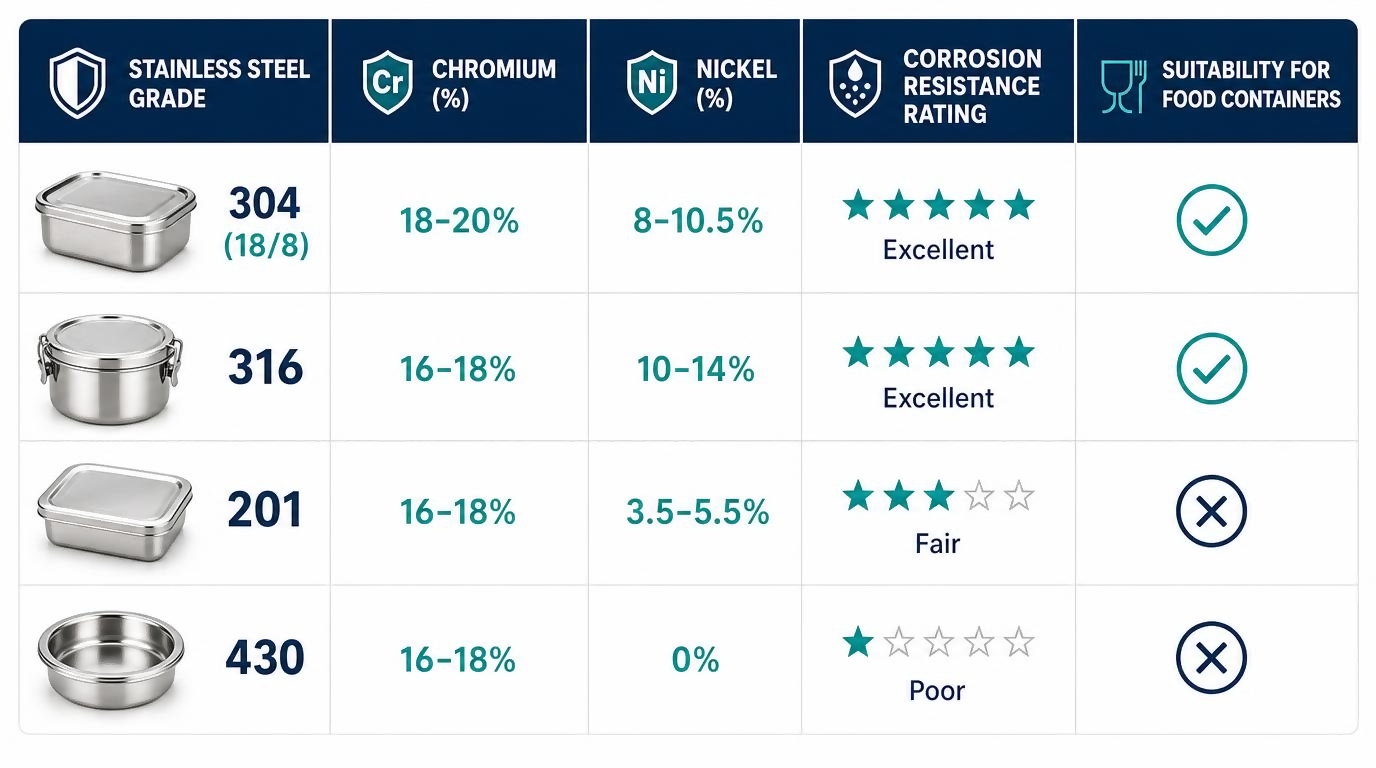
This is where most wholesale buyers get confused — and where most supplier product listings are deliberately vague. Understanding grade notation is the single most important due-diligence step before placing any bulk order.
18/8 stainless steel is the same as grade 304. The numbers refer to chromium (18%) and nickel (8%) content. Both notations appear on legitimate supplier listings, and both indicate the same alloy. If a supplier uses only “food-grade stainless steel” without specifying 18/8, 304, or 316, that’s a flag worth investigating.
Grade 304 (18/8): The industry standard for food contact applications. Corrosion-resistant, non-reactive with most foods, passes FDA and LFGB standards. The overwhelming majority of reputable wholesale stainless steel lunch boxes use 304. It handles acidic foods (citrus, vinegar dressings, tomato sauces) without leaching.
Grade 316: Contains molybdenum (2–3%), which adds chloride resistance. It’s the preferred grade in marine environments and pharmaceutical applications. For kids’ lunch boxes, the upgrade to 316 is rarely necessary unless the product will be washed repeatedly with chlorinated water in commercial dishwashers. Grade 316 costs approximately 20–30% more than 304 and is not the standard for this product category — any supplier charging a premium for 316 should provide mill certificates confirming the alloy composition.
Grade 201 / 430: Lower-cost alternatives that some factories substitute without disclosure. Grade 201 has less nickel and higher manganese content, which reduces corrosion resistance. Grade 430 is ferritic (no nickel), which means it’s magnetic — a quick magnet test in incoming quality inspection can screen for substitution. When placing a bulk order, specify 304 grade and request the material test certificate (MTC) or mill certificate before payment.
| Grade | Nickel % | Corrosion Resistance | Suitable for Kids’ Lunch Box | Cost vs 304 |
|---|---|---|---|---|
| 304 (18/8) | 8–10% | Excellent | Yes — industry standard | Baseline |
| 316 | 10–14% | Superior | Yes, overkill for most use | +20–30% |
| 201 | 3.5–5.5% | Good | Marginal — monitor acid foods | −15–20% |
| 430 | 0% | Moderate | Not recommended | −25% |
Food Safety Certifications: What to Demand From Any Supplier
“BPA-free” has become a baseline expectation, not a differentiating claim. For kids’ products specifically, buyers sourcing for U.S. and European markets need to understand what certifications actually cover.
FDA (U.S. Food and Drug Administration): The FDA doesn’t certify specific containers in the same way it approves drugs. What buyers should look for is whether the supplier can provide a compliance letter or test report referencing FDA 21 CFR 177.2600 (for rubber/silicone components) or confirming the steel composition meets FDA standards for food contact. Many Chinese manufacturers have had products tested by third-party labs (SGS, Bureau Veritas, Intertek) against FDA guidelines.
LFGB (Germany’s Food and Feed Code): More stringent than FDA for migration testing. If you’re selling into European markets, an LFGB-certified product is a stronger claim than FDA compliance alone. LFGB testing checks for heavy metals, volatile substances, and sensory impairment of food. Request the specific test report number, not just a logo on a catalog page.
California Prop 65: Required for any products sold into California. Relevant for stainless steel containers because the silicone seal and plastic lid components (if any) need to comply. Some suppliers will note “Prop 65 compliant” — always request the underlying test report.
BPA, BPS, BPF Free: Relevant for the lid and seal components, not the steel itself. Steel doesn’t contain BPA. When a supplier claims “BPA-free,” they’re referring to the plastic/silicone parts. Ask specifically which materials the lid and seal use (food-grade PP, silicone, or TPE are acceptable; PVC is not).
A practical sourcing checklist before finalizing any bulk order for kids’ lunch boxes:
- Material test certificate (MTC) confirming 304 grade steel
- SGS or equivalent third-party lab report for migration testing
- LFGB test report if selling to EU/UK markets
- Prop 65 compliance documentation if U.S. market includes California
- Silicone/PP material safety data sheet for lid and seal components
MOQ, Pricing, and What Factory-Direct Actually Looks Like
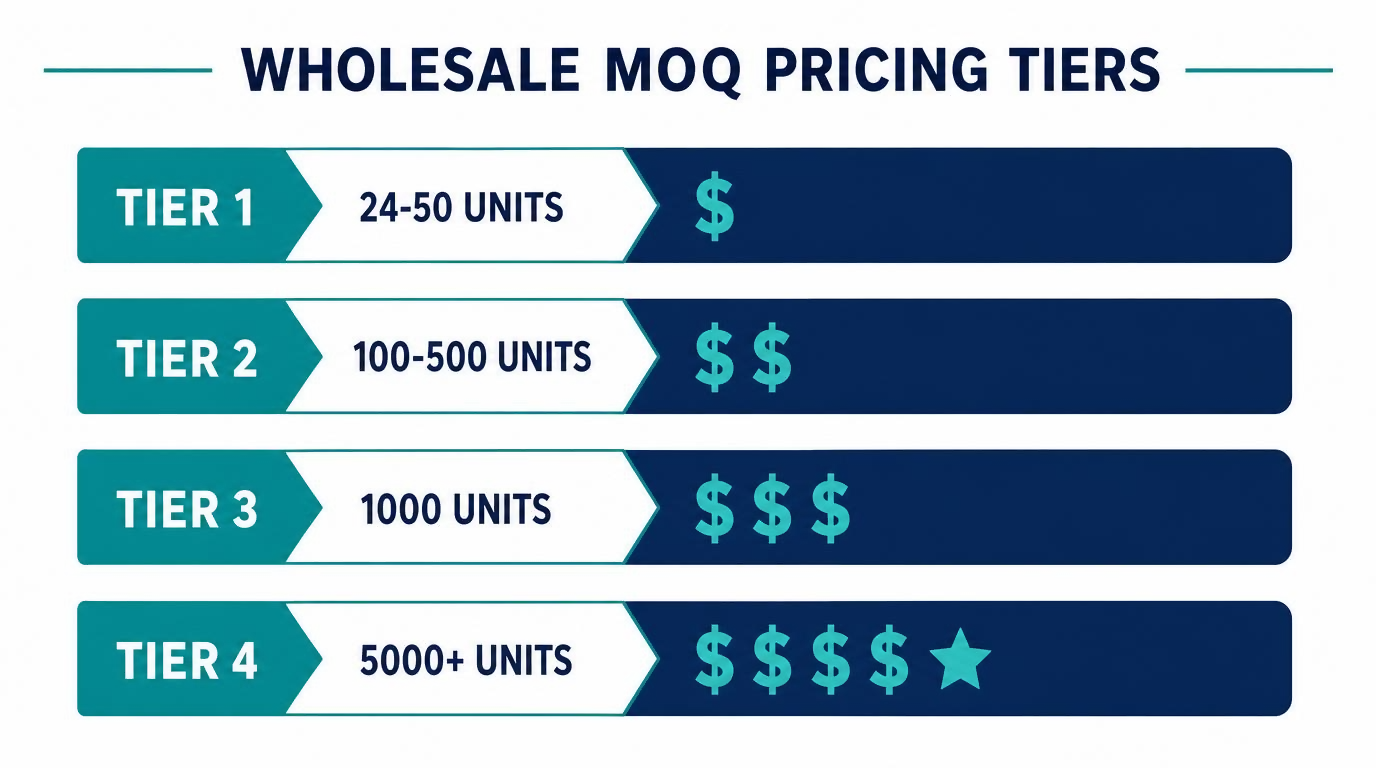
The MOQ landscape for stainless steel lunch boxes has fragmented significantly over the past few years. Here’s what the current market looks like based on factory listings and supplier data from 2026:
Standard MOQ tiers:
- 24–50 units: Available from smaller manufacturers offering OEM/custom options (e.g., Nicety Stainless, some Alibaba suppliers). These are typically higher per-unit cost ($4.50–$8.00) but low risk for first orders or new SKU testing.
- 100–500 units: Mid-tier for distributors adding their own branding. Per-unit cost drops to roughly $3.50–$5.00 depending on design complexity, number of compartments, and packaging spec.
- 1,000+ units: Factory-direct pricing. 304-grade stainless bento boxes in this range run $2.76–$3.85 per unit for standard configurations. Complex multi-tier tiffin-style boxes with insulation add 30–50% to this range.
- 5,000+ units: Custom tooling for new shapes/compartment layouts becomes viable. Factories will absorb mold costs (typically $800–$2,500) at this quantity with a signed PO.
Pricing factors that move the unit cost:
- Compartment count: 1-tier vs 2-tier vs 3-tier adds roughly $0.40–$0.80 per tier
- Insulation: Non-insulated is baseline; vacuum insulated doubles or triples unit cost
- Lid material: Pure stainless lid vs PP plastic lid (stainless is cleaner but heavier/more expensive)
- Silicone seal: A silicone gasket on compartment lids adds $0.20–$0.50 per unit but eliminates leakage complaints
- Surface treatment: Plain brushed vs powder-coated exterior vs printing; custom color or logo via laser engraving adds $0.15–$0.30 per unit
A note on “factory-direct” claims: Roughly half of Alibaba/Made-in-China listings labeled “factory” are trading companies with a factory relationship. The clearest way to verify: request a video call showing the production floor, ask to see the business license category (manufacturing vs trading), and check if they can modify existing molds or only ship standard SKUs. Genuine factories can accommodate minor spec changes; trading companies typically cannot.
Compartment Design and Leakproof Reality
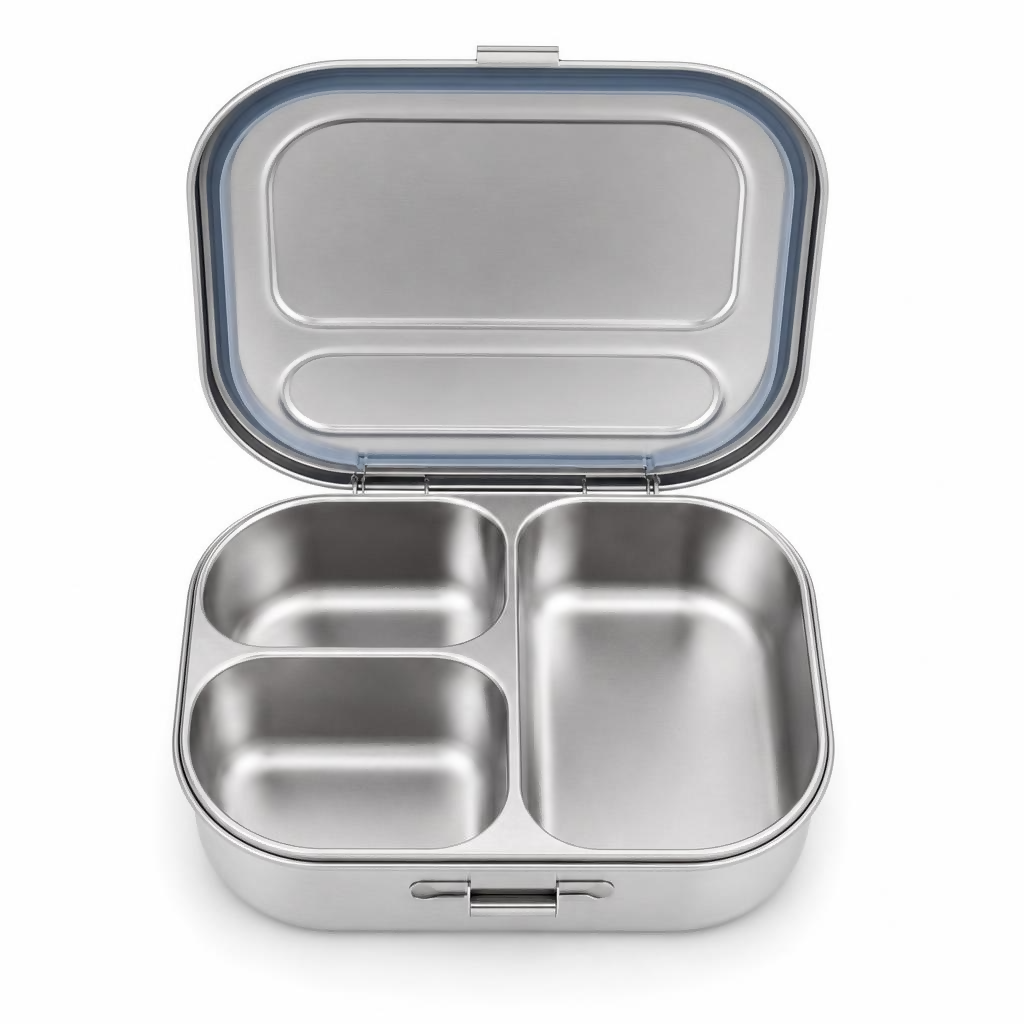
One of the most consistent buyer complaints in user reviews across Amazon and Reddit: inner compartments that leak between sections. A stainless bento box can be leakproof from the outside (no spillage from the box itself) while still allowing liquid from one compartment to migrate into adjacent sections.
This distinction matters for sourcing because it requires asking the right question to suppliers. There are two leakproof standards:
Box-level leakproof: The outer lid seals the entire container so nothing spills out. This is standard in virtually all 304-grade wholesale boxes. Achieved via silicone gasket on the main lid.
Compartment-level leakproof: Individual compartments have their own silicone seals, preventing cross-contamination between wet and dry foods (hummus and crackers, for example). This is a premium feature found in higher-end designs and commands a higher price point.
For kids’ lunch boxes specifically, compartment-level sealing is a meaningful differentiator — kids often mix wet foods (fruit, yogurt pouches) with dry snacks in the same box. When reviewing product samples, explicitly test cross-compartment leakage by adding colored water to one section and tilting.
Common compartment configurations seen in wholesale catalogs:
- 2-section: Large main + small snack (800ml total typical for kids 4–8)
- 3-section: Main + two snack compartments (900–1,100ml, ages 6–12)
- Bento tray style: 4–5 sections (PlanetBox style, 1,000–1,500ml, older kids)
- 2-tier tiffin: Stackable containers with individual lids (traditional Indian tiffin design, popular in Asian markets)
OEM and Private Label Options for Brand Buyers
Building a brand on stainless steel kids’ lunch boxes is viable at lower quantities than most buyers realize. The key variables are:
Logo options and their MOQ impact:
- Laser engraving: Permanent, premium look, typically no additional tooling cost, available from ~100 units on flat surfaces. Per-unit add: $0.15–$0.25.
- Silk screen printing: Color logos on the exterior. Works best on powder-coated surfaces. MOQ typically 200+ units. Fades with heavy dishwasher use over time.
- Debossed/embossed logo on lid: Requires mold modification. MOQ 1,000–2,000 units, tooling charge $600–$1,500. Most permanent and premium.
- Custom packaging (box/bag): Full custom retail packaging (printed box with your brand) typically requires 500+ unit runs and 2–3 week additional lead time.
Lead times to plan around:
- Standard in-stock OEM (your logo on existing design): 25–35 days from PO
- New color/surface treatment: 35–45 days
- Custom mold/new compartment layout: 60–90 days from tooling approval
Sampling: Any reputable factory will provide pre-production samples (PP samples) before mass production. Budget $50–$150 per sample in courier costs plus 2–3 weeks. Never approve a bulk order without a signed-off PP sample — this is the quality baseline for the entire run.
How to Vet a Stainless Steel Lunch Box Supplier
Beyond grade verification and certifications, here’s a practical vetting framework based on what separates reliable factories from problematic ones:
Green flags:
- Can provide MTC for the specific production batch, not a generic template
- Willing to accommodate third-party factory audits (BSCI, SEDEX, or customer-arranged)
- Shows production capacity documentation (not just warehouse inventory)
- Provides photographic evidence of QC inspection process (AQL sampling)
Red flags:
- Refuses to specify exact steel grade in the contract
- Cannot provide a test report from a recognizable third-party lab (SGS, BV, Intertek)
- Pricing is 30%+ below market average (often signals grade substitution)
- Lead times consistently shorter than 20 days for OEM orders (suggests inventory flip, not manufacturing)
Trade terms to understand:
- EXW (Ex Works): You handle all freight from the factory gate. Lowest price, highest logistics responsibility.
- FOB (Free on Board): Factory delivers to the port, you handle ocean freight forward. Standard for most B2B buyers.
- DDP (Delivered Duty Paid): Factory handles everything including customs and last-mile. Highest cost, lowest complexity. Common on Alibaba for small orders.
For first orders with a new supplier, FOB with a 30% deposit / 70% balance against Bill of Lading copy is a reasonable structure. Use a freight forwarder you already have a relationship with to manage the origin inspection.
Frequently Asked Questions
What is the minimum order quantity for stainless steel lunch boxes wholesale?
It varies significantly. Small factories and OEM-focused suppliers offer MOQs as low as 24 units. Standard factory-direct pricing kicks in at 500–1,000 units. For custom shapes or mold modifications, 1,000–2,000 units is the typical floor.
Is 304 stainless steel safe for kids’ food containers?
Yes. Grade 304 (also labeled 18/8) is the established food-contact standard used by brands like Klean Kanteen and PlanetBox. It contains 18% chromium and 8% nickel, forming a passive oxide layer that prevents corrosion and leaching. The key is verifying the steel is genuinely 304, not a lower grade labeled as such.
How do I verify the steel grade from a supplier?
Request the material test certificate (MTC) from the steel mill. This is a document showing the chemical composition of the batch. Third-party labs like SGS can also perform independent grade verification on your samples. A magnet test can screen out grade 430 (it’s strongly magnetic), but won’t distinguish 304 from 201.
Do stainless steel lunch boxes keep food warm?
Non-insulated stainless steel containers don’t provide meaningful heat retention. If temperature maintenance is a feature requirement, specify vacuum-insulated models. These are significantly more expensive ($6–$18 per unit at MOQ) but keep hot food warm for 4–6 hours.
What certifications should I require for U.S. and EU markets?
For U.S.: FDA compliance letter or SGS test report against FDA 21 CFR standards; Prop 65 compliance for California distribution. For EU/UK: LFGB test report (Germany’s food contact standard, widely accepted across EU). For both markets: third-party migration test confirming no heavy metal leaching above allowed limits.
The Right Questions Get You the Right Supplier
Sourcing stainless steel lunch boxes at scale isn’t complicated once you know what to verify. Grade 304, confirmed by a mill certificate. Silicone seals on both the outer lid and individual compartments if you need true leakproof performance. LFGB or FDA test reports from a recognized lab — not just a logo in a catalog PDF. Those three requirements filter out the majority of problematic suppliers before you ever place an order.
The market for kids’ stainless lunch boxes has years of runway left. Plastic-free and BPA-free messaging continue to resonate with parents, back-to-school channels are hungry for stainless alternatives, and the per-unit economics support healthy margins for distributors who source with discipline.
Start with 100-unit sample orders, validate the steel grade, test the compartment sealing under real conditions, and scale from there.





