


This guide covers everything wholesale buyers, restaurant equipment distributors, and OEM brands need to know about sourcing commercial-grade stainless steel pasta pots with insert systems. Topics include steel grades (304 vs 18/10), key size ranges (8–20 qt), wall thickness specs, NSF/ANSI 2 certification, aluminum vs. stainless base comparisons, and what to ask a supplier before placing a bulk order. If you’re equipping a commercial kitchen or building a wholesale catalog, this is where to start.
What Is a Pasta Insert Pot — and Why the Insert System Matters
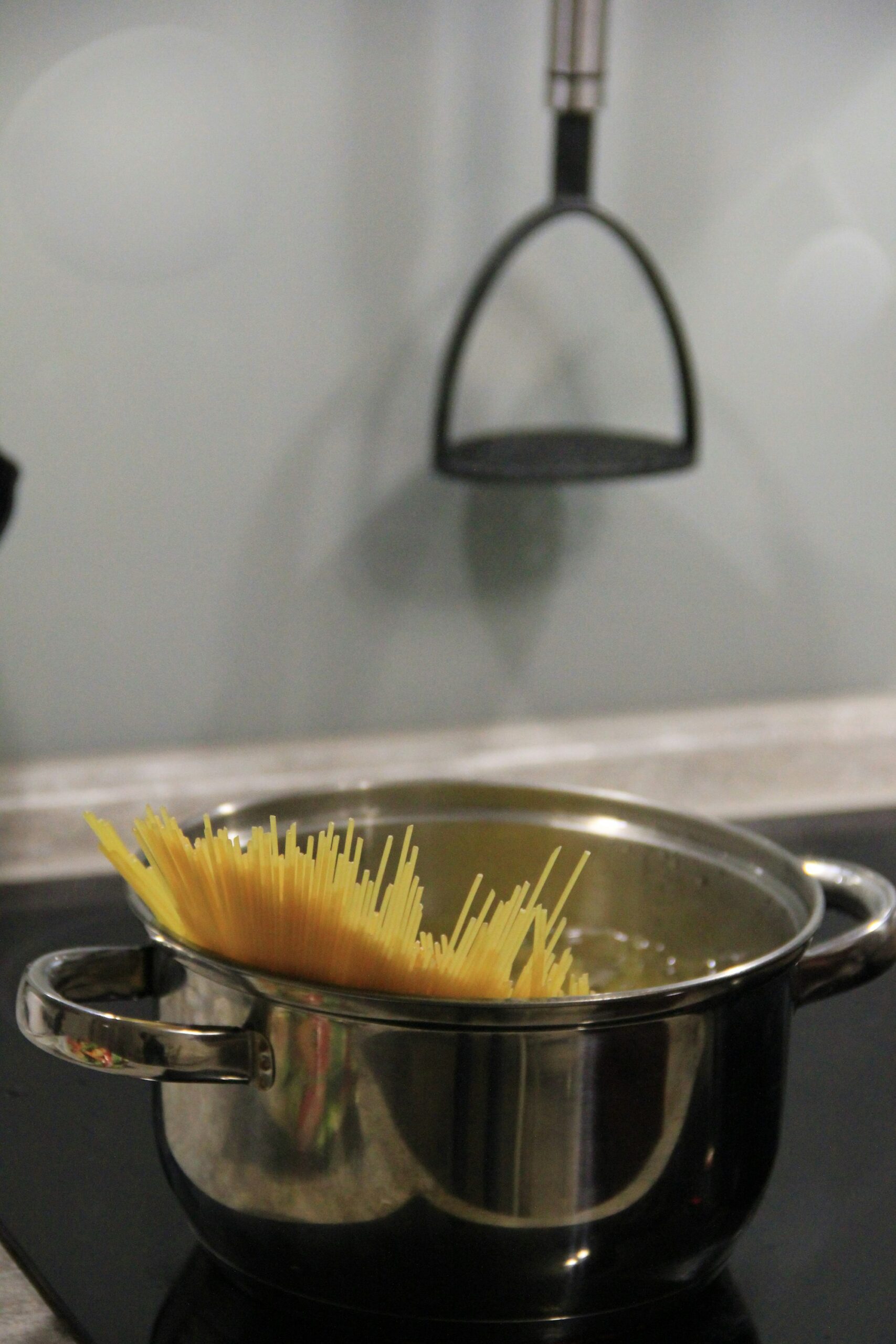
A pasta insert pot is a two-piece system: a large outer pot and a perforated stainless steel insert basket that sits inside it. You boil water in the outer pot, lower the pasta into the insert, cook it, then lift the entire insert to drain — no colander needed, no pouring a heavy pot of boiling water.
The insert system solves three real commercial kitchen problems:
- Speed: lifting an insert takes 3–5 seconds; pouring a 12-quart pot takes 30+ seconds and creates a burn risk
- Pasta water retention: the broth stays in the pot automatically, which restaurant cooks use for sauce finishing
- Batch cooking: multi-section insert systems (2, 4, or 6 holes) let one cook handle multiple pasta orders simultaneously
In commercial kitchens, this is not a convenience feature — it is a workflow requirement. A single pasta station at a mid-volume Italian restaurant may drain and refill that insert 40–80 times per service. The fit, handle durability, and material grade of the insert matter as much as the outer pot.
I’ve reviewed specifications from multiple commercial-grade pasta pot suppliers, and the most common sourcing mistake I see is buyers ordering the outer pot and insert from different vendors without verifying fit tolerances — then discovering the insert either rattles loose or won’t seat properly when full of pasta.
When sourcing wholesale: always order pot and insert as a matched set, or request clearance specs (inner pot diameter vs. insert outer diameter) in writing before placing a bulk order.
Stainless Steel Grades: 304, 18/8, and 18/10 Explained
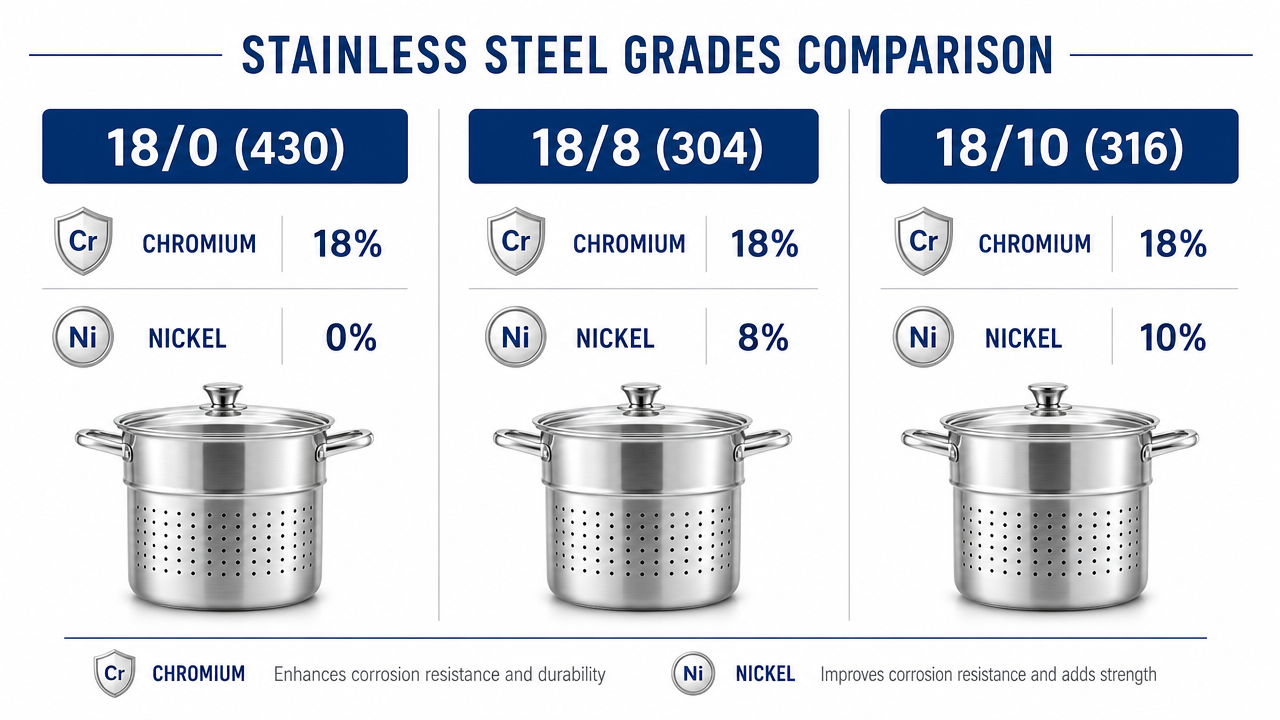
The short answer: for commercial pasta pots, 304 stainless steel (18/8) is the standard minimum. 18/10 offers marginally better corrosion resistance but costs more.
Here’s the breakdown that most product listings skip:
| Grade | Chromium | Nickel | Common Name | Corrosion Resistance | Commercial Use |
|---|---|---|---|---|---|
| 304 (18/8) | 18% | 8% | Standard food-grade SS | Good | Most commercial pasta pots |
| 316 (18/10) | 16–18% | 10–14% + Mo | Marine/premium grade | Excellent | High-end restaurant/hotel |
| 430 (18/0) | 17% | 0% | Magnetic SS | Fair | Budget / non-commercial |
What this means in practice:
304 stainless (also marked 18/8) contains 18% chromium and at least 8% nickel. A 2013 peer-reviewed study published in the Journal of Agricultural and Food Chemistry (Kamerud et al.) confirmed that 304 SS leaches trace nickel and chromium into acidic foods during extended cooking — but at levels well below FDA daily intake limits for healthy adults. For pasta (boiling water, short contact time), this is a non-issue.
18/10 (often used to describe 316 SS, though not always — verify with supplier) adds 2% molybdenum, which improves resistance to chloride corrosion. In a commercial dishwasher environment with high-chloride detergents, this matters over years of use. For buyers building a premium catalog or supplying hotel kitchens with long equipment lifecycles, 18/10 is worth the price premium.
The real risk I’ve seen in wholesale sourcing: some suppliers mark pots as “18/10” when they mean 18/8 (304), using the marketing designation loosely. Request a Mill Test Certificate (MTC) that specifies Cr and Ni percentages by weight. Any legitimate stainless steel pasta pot manufacturer will provide this without hesitation.
Commercial Sizes: What Restaurants Actually Order
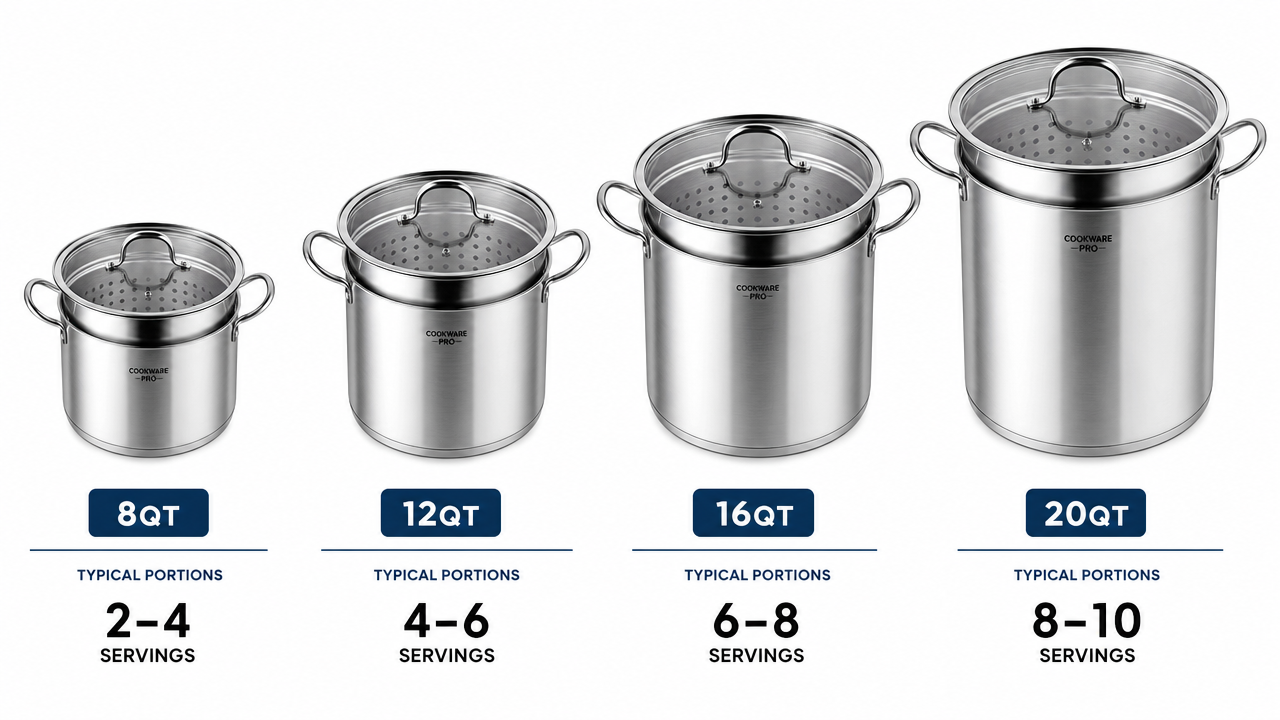
Commercial pasta pots typically range from 8 to 20 quarts. The 12-quart and 20-quart sizes see the highest wholesale volume.
| Size | Capacity | Portions per Batch | Best For |
|---|---|---|---|
| 8 qt | 7.6 L | 4–6 portions | Small restaurants, café kitchens |
| 12 qt | 11.4 L | 8–10 portions | Mid-volume Italian/pasta restaurants |
| 16 qt | 15.1 L | 12–16 portions | High-volume commercial kitchens |
| 20 qt | 18.9 L | 16–20 portions | Hotel banquets, catering operations |
The 20-quart set typically includes 4–6 individual insert sections (each 5 qt), allowing a single operator to cook multiple pasta types simultaneously. This is the configuration most commonly specified in commercial kitchen equipment packages.
Wall thickness is the spec that separates commercial-grade from consumer-grade (manufacturer-recommended specs, not a codified ASTM/NSF standard):
- Consumer grade: 0.6–0.8mm body wall
- Commercial grade: 1.5–2mm body wall, 2.5–3mm base
Thin-walled pots (under 1mm) warp on high-BTU commercial burners, lose base contact, and create hot spots that scorch pasta water and burn residue into the base — which then fails NSF inspection. When reviewing wholesale supplier catalogs, request the wall thickness specification in millimeters. If they can’t provide it, that tells you something.
Aluminum vs. Stainless Steel Outer Pot: The Commercial Trade-Off
Most commercial pasta cooker sets use an aluminum outer pot with stainless steel insert baskets — not an all-stainless system. This is a deliberate performance and cost choice.
| Feature | Aluminum Outer Pot | Stainless Steel Outer Pot |
|---|---|---|
| Thermal conductivity | ~205 W/m·K | ~16 W/m·K |
| Time to boil (20 qt) | Faster (~20% shorter) | Slower |
| Weight (20 qt) | Lighter | Heavier |
| Corrosion resistance | Lower | Higher |
| Price (wholesale) | Lower | Higher |
| NSF compliance | Yes (anodized/hard-coat) | Yes |
Stainless steel has a thermal conductivity of approximately 16 W/m·K — about 13 times lower than aluminum (205 W/m·K). In a high-volume restaurant where the pasta station boils water continuously through service, aluminum outer pots reach boiling temperature significantly faster. That’s why many commercial pasta cooker sets — including those sold through WebstaurantStore and Culinary Depot — use aluminum pots with stainless inserts.
Wholesale buyers should ask their end customers:
- If the kitchen prioritizes speed and cost → aluminum outer pot with SS insert
- If the kitchen prioritizes longevity, dishwasher durability, and premium appearance → all-stainless system
For hotel procurement and white-label brands targeting the premium segment, all-stainless 18/10 systems command a significant price premium and differentiate well in catalogs.
Certifications That Matter for Commercial Pasta Pots
For any pasta pot sold into US commercial foodservice, NSF/ANSI Standard 2 certification is the key compliance mark.
NSF/ANSI 2 (Food Equipment) verifies that a product:
- Is made from food-safe, non-toxic materials
- Has no crevices, seams, or surface finishes that harbor bacteria
- Can withstand commercial cleaning and sanitizing chemicals
The NSF maintains a public product database at info.nsf.org where buyers can verify certification by company name or model number. Thunder Group, for example, has NSF-certified stainless steel pasta cookers and perforated steamers listed under their company ID.
For EU/UK markets: look for CE marking and food contact compliance under EU Regulation 1935/2004. For stainless steel specifically, this means meeting EWG/CoE requirements on metal migration.
What to request from a wholesale supplier:
- NSF/ANSI 2 certificate (for US distribution)
- FDA food contact compliance letter (for materials used)
- Mill Test Certificate for stainless steel grade
- CE / EU food contact declaration (for European markets)
A supplier who hesitates on any of these documents is a supplier you should not be ordering from.
How to Evaluate a Wholesale Pasta Pot Supplier
After reviewing specifications from multiple commercial pasta pot manufacturers — including factory-direct suppliers on Alibaba and established restaurant equipment distributors — here are the questions that separate reliable wholesale partners from catalog vendors:
Specification questions:
- What is the wall thickness (body and base) in millimeters?
- What stainless steel grade is used — and can you provide the Mill Test Certificate?
- What is the insert clearance tolerance (outer pot inner diameter vs. insert outer diameter)?
- Are handles welded or riveted, and what is the rated load capacity?
Compliance questions:
- Is this product NSF/ANSI 2 certified? Can you provide the certificate?
- What is the FDA compliance status for materials?
Commercial terms:
- What is the MOQ for standard sizes? (Typical range: 50–200 units per SKU for factory-direct orders)
- Is OEM/ODM available — custom logo, custom handle design, custom packaging?
- What is sample lead time, and what is the cost (usually refunded on bulk order)?
- What is standard production lead time for a first order?
A reliable commercial pasta pot supplier will answer all of these without hesitation. If you receive vague answers or pushback on certification documentation, treat that as a qualification failure.
Real-World Performance: What Breaks First
Based on commercial kitchen sourcing experience and verified reviews from restaurant equipment buyers, the most common failure points in commercial pasta pots are:
- Handle attachment failure (most common): riveted handles that loosen under daily load at 20+ quarts. Look for welded handles rated for the full filled weight of the pot.
- Insert warping: thin-gauge inserts (under 1mm) warp after repeated thermal cycling. Commercial-grade inserts should be minimum 1.2–1.5mm.
- Base delamination (aluminum outer pots): if the base is a bonded tri-ply disc rather than a full-clad or solid base, the bond can fail under high-heat commercial use. Ask whether the base is impact-bonded or full-clad.
- Discoloration at weld points: indicates lower-grade SS or insufficient passivation after welding — a surface treatment that restores the chromium oxide layer. Well-made commercial pots are passivated post-weld.
Frequently Asked Questions
What is the difference between a pasta insert pot and a pasta cooker?
A pasta insert pot is a stovetop system — an outer pot and a perforated insert basket used on a regular burner. A pasta cooker (or pasta cooker machine) is a countertop commercial appliance with built-in heating elements, thermostatic controls, and multiple basket wells. For wholesale, the stovetop insert pot system is lower cost, more versatile, and the higher-volume category.
What stainless steel grade should I specify for commercial pasta pots?
Minimum: 304 (18/8) stainless steel with 1.5mm body wall and 2.5mm base. For premium or hotel-grade: 18/10 (316) SS. Always request a Mill Test Certificate to verify grade — don’t rely on marketing labels alone.
What size commercial pasta pot should a restaurant buy?
For most mid-volume Italian or pasta-focused restaurants, the 20-quart set with 4 insert sections is the standard. It handles 16–20 portions per batch and allows multiple pasta types to cook simultaneously. Smaller kitchens with lower pasta volume typically use 12-quart systems.
Is NSF certification required for commercial pasta pots?
In the US, NSF/ANSI 2 is not legally mandated everywhere, but most health departments and commercial kitchen inspectors require it for any cookware that contacts food in a commercial setting. Many restaurant equipment distributors will not stock non-NSF products. Always source NSF-certified pasta pots for US commercial distribution.
What is a typical MOQ for wholesale pasta pots from a factory-direct supplier?
Based on industry consensus (not independently verified), typical factory-direct MOQ ranges from 50–200 units per SKU for standard configurations, with lower MOQ available for mixed-size orders in some cases. OEM/custom orders typically require higher MOQ (200–500 units). Request a formal quote with MOQ and lead time in writing.
Can the insert basket from one brand fit another brand’s pot?
Not reliably. Insert fit is specific to each pot’s inner diameter. Always purchase pot and insert as a matched set, or verify exact clearance tolerances (typically 2–5mm clearance between insert outer diameter and pot inner diameter) before mixing components.
Summary
Sourcing stainless steel pasta pots for wholesale or commercial kitchen use comes down to four decisions: steel grade (304 vs. 18/10), size range (8–20 qt based on kitchen volume), base material (aluminum outer pot for speed vs. full stainless for durability), and certification (NSF/ANSI 2 for US commercial use). The insert system is not an accessory — it is the functional core of the product, and its wall thickness, fit tolerance, and handle strength determine whether the pot performs for 6 months or 6 years.
Before placing a bulk wholesale order, request the Mill Test Certificate, NSF certificate, and wall thickness specs in writing. Any supplier who provides these without hesitation is worth qualifying further.





