



Stainless steel saute pans are the backbone of commercial kitchen cookware. For wholesale and procurement buyers, the critical decisions come down to steel grade (Grade 304/18-8 is the commercial standard), construction (3-ply minimum for professional use), NSF/ANSI 2 certification status, and sourcing channel. This guide covers everything buyers need — from reading spec sheets and verifying material grades to comparing US distributors against Chinese OEM factories — with real pricing benchmarks and failure data from working commercial kitchens.
Why Commercial Kitchens Default to Stainless Steel
Stainless steel dominates commercial kitchen procurement for reasons that go beyond tradition. The material survives what aluminum and nonstick coatings cannot: the daily cycle of high-heat service, industrial dishwasher chemicals, and the physical abuse of a professional kitchen environment.
Three properties make it the default for high-volume operations:
Long service life under abuse. A well-built stainless saute pan in a commercial kitchen will outlast multiple nonstick pans on the same station. Kitchen managers at mid-scale restaurants consistently report replacing nonstick pans every 6–18 months, while 18-gauge stainless pans from the same purchase period are still in rotation 4–6 years later.
Chemical resistance to commercial detergents. Industrial dishwasher detergents are significantly more aggressive than consumer products. Grade 304 stainless (18/8 or 18/10) resists pitting and surface discoloration under repeated industrial cycles; 201-grade and 430-grade stainless do not hold up comparably over 500+ wash cycles.
Flavor neutrality. Stainless does not leach taste or odor into food — a meaningful factor for high-acid sauces, delicate proteins, and HACCP-sensitive operations where cross-contamination is a documentation concern.
The tradeoff is heat distribution. Bare stainless steel conducts heat poorly compared to aluminum or copper. This is exactly why construction quality — ply design and core material — matters more than the outer grade label alone when evaluating commercial stock.
Steel Grade Decoded: 18/8, 18/10, and What to Specify in Purchase Orders
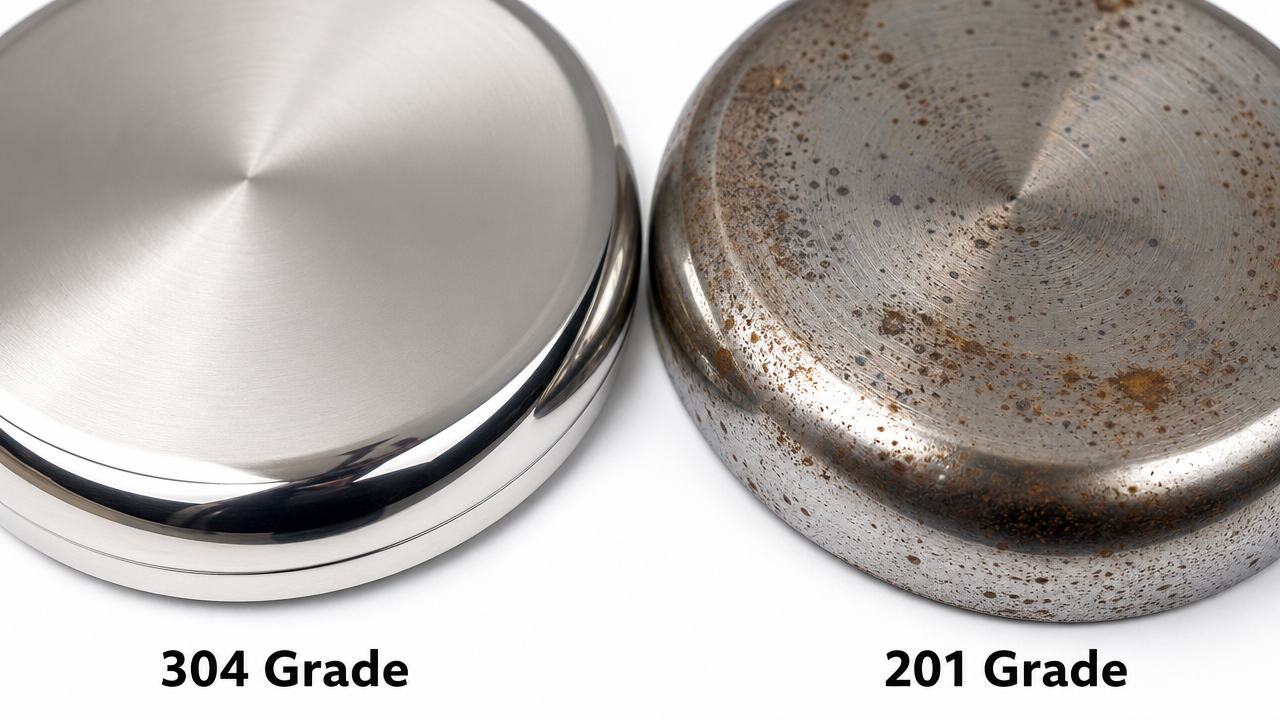
When sourcing stainless cookware in bulk, you will encounter three grade designations that suppliers often use interchangeably. They have real differences:
Grade 304 / 18/8: 18% chromium, ~8% nickel. The commercial kitchen standard. Strong corrosion resistance, FDA-compliant for direct food contact, and cost-effective to manufacture at scale. Vollrath’s commercial lines (Tribute, Optio, Intrigue) and Winco’s commercial offerings are built to 304/18-8 specification.
Grade 304 / 18/10: Same chromium content, ~10% nickel. Marginally better corrosion resistance in chloride-heavy or high-salinity environments. The practical performance gap between 18/8 and 18/10 in a standard commercial kitchen is negligible. 18/10 appears more often in premium consumer lines than in commercial procurement.
Grade 430 / 18/0: 18% chromium, 0% nickel. Magnetic — inherently induction-compatible without a separate magnetic base. Less corrosion-resistant over time, particularly under industrial dishwasher chemicals. Acceptable for lightly used operations; not recommended for high-volume commercial kitchens.
Grade 201 (the counterfeit risk): A lower-cost Chinese export-market steel that substitutes manganese for nickel. Often sold without grade disclosure or labeled as “304-equivalent.” It will discolor, pit, and show accelerated corrosion within 1–2 years in a commercial environment. This is the most common quality problem reported by buyers purchasing from unverified OEM suppliers.
Specification rule for bulk orders: Write “Grade 304 (18/8) minimum, ASTM A240 compliant” into your purchase agreement and require a mill certificate or SGS/Intertek test report from the factory. Every legitimate manufacturer supplies this documentation as a matter of routine; any factory that resists the request is a red flag.
Construction That Holds Up: Ply, Gauge, and Handle Type
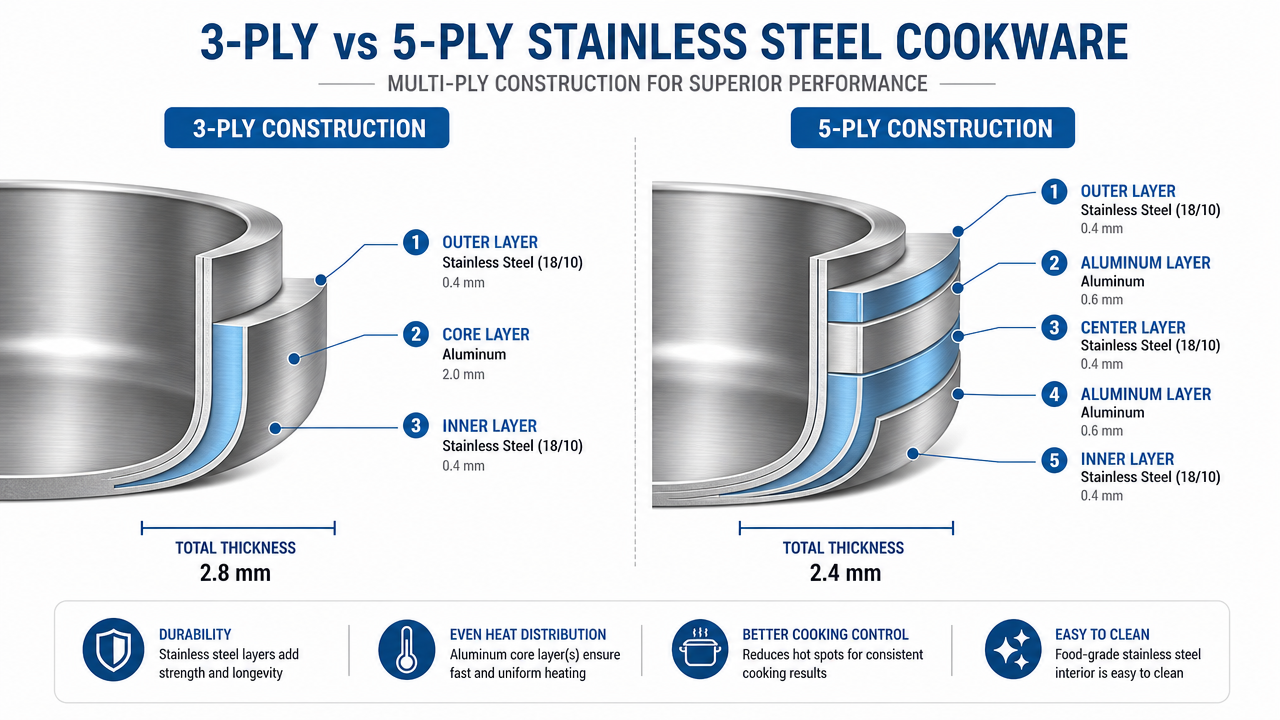
The steel grade tells you about corrosion resistance. The construction tells you about cooking performance and how long the pan stays flat and functional.
Ply and Core
| Construction | Core Material | Heat Distribution | Commercial Suitability |
|---|---|---|---|
| Single ply (monograde) | None | Poor | Economy / light use only |
| 3-ply | Aluminum core | Good | Standard commercial |
| 5-ply | Multi-layer aluminum + SS | Excellent | Premium commercial |
| Copper core (3–5 ply) | Copper core | Superior | High-end professional |
For most commercial applications — hotel banquet kitchens, restaurant groups, catering operations — 3-ply with an aluminum core is the right balance of performance and cost. The encapsulated aluminum core improves heat distribution significantly: aluminum’s thermal conductivity is approximately 205 W/m·K versus approximately 16 W/m·K for Grade 304 stainless, a roughly 12x difference that the core design bridges in practice.
5-ply construction is worth the premium for stations where even heat distribution directly affects plate consistency — saucing stations and fine-dining fish cookery, for example. For most bulk procurement, 3-ply is sufficient and meaningfully cheaper per unit.
Gauge (Wall Thickness)
- 18-gauge (~1.27mm): Standard commercial. Handles repeated thermal cycling without warping. Recommended for any high-volume operation.
- 20-gauge (~0.91mm): Lighter and cheaper. Acceptable for low-frequency use. Prone to warping over time when placed over high-output burners (>15,000 BTU).
- 22-gauge: Appropriate for hotel steam table pans. Too thin for direct-fire saute work.
Handle Construction
Riveted handles are the commercial standard and the specification you should require. Mechanical rivets are robust under the torque of a full, heavy pan being moved on a range and do not fatigue under thermal cycling. Vollrath’s Tribute and Optio lines and Winco’s commercial saute pans use riveted construction.
Welded handles can fatigue at the weld point over repeated high-heat cycles. The joint is the failure point. This is the most commonly cited reason kitchen managers replace commercial saute pans before expected end of life.
Silicone-wrapped or silicone-cast handles improve grip ergonomics and reduce heat transfer to the hand. Verify the silicone is rated for oven temperatures the pan will encounter — typically 400–450°F (204–232°C) for commercial silicone handle covers. Beyond that rating, the silicone will degrade and create a food safety and maintenance issue.
Commercial vs. Consumer Grade: What the Spec Sheet Reveals
Buyers new to commercial procurement frequently ask whether they can purchase consumer-brand stainless pans at scale. The specification comparison answers directly:
| Feature | Consumer Grade | Commercial Grade |
|---|---|---|
| Steel grade | 18/10 or 304 | 304 (18/8) minimum, documented |
| Wall gauge | 20–22 gauge | 18–20 gauge |
| Handle attachment | Often welded or hollow | Riveted |
| NSF Certification | Rare | Standard on major commercial brands |
| Oven-safe temp | 400–500°F (glass lid lower) | 500°F+ (metal handle); 400°F (silicone) |
| Dishwasher rating | “Dishwasher safe” (finish often degrades) | Rated for repeated industrial cycles |
| Warranty | 1–3 years limited | Lifetime on premium commercial lines (Vollrath Tribute) |
| Unit price (US distributor) | $30–80 | $40–150 (branded) |
| Unit price (OEM factory-direct) | N/A | $8–28 depending on size and ply |
The functional gap shows up most clearly in handle durability and long-term dishwasher resistance. Commercial pans typically cycle through an industrial dishwasher 2–3 times per day; consumer-grade handle adhesives, welds, and surface finishes show wear within months under that load.
Sizing Guide for Commercial Operations
Commercial stainless saute pans are spec’d by quart capacity. The standard commercial range and typical applications:
| Capacity | Common Application | Typical Diameter |
|---|---|---|
| 2–3 qt | Single-portion sauces, small proteins, egg cookery | 8–9″ |
| 4–5 qt | Medium batch sauces, fish fillets, vegetable sides | 10–11″ |
| 6–8 qt | Large batch sauteing, pasta finishing, braised items | 12–14″ |
| 10–12 qt | High-volume prep, catering batch cooking | 14–16″ |
For restaurant groups ordering in bulk, a practical per-station kit is one 3-qt and one 5-qt saute pan per active range burner. Catering operations often standardize on 6-qt or 8-qt pans for transport-volume efficiency and reduced per-unit SKU complexity.
Where to Source: Wholesale Suppliers and OEM Options
Sourcing channel determines cost, MOQ, lead time, and quality control responsibility.
Tier 1 — US Commercial Distributors
| Supplier | Key Lines | MOQ | Unit Price Range |
|---|---|---|---|
| Vollrath | Tribute (3-ply, lifetime warranty), Optio, Intrigue | 1 unit via distributor | $40-$150 |
| Winco | Stainless tri-ply commercial, economy SS | 1 unit | $20-$70 |
| WebstaurantStore | Multi-brand including Vigor house line | 1 unit | $15-$83 |
| Browne Foodservice | Heavy-duty stainless commercial | 1 unit | $30-$90 |
US distributors carry NSF-listed products, ship from domestic warehouses with 1-3 day lead times, and offer net-30 terms for qualified commercial accounts. For operations buying 10-50 units annually, this tier offers the best balance of quality assurance, lead time, and account support.
Tier 2 — Chinese OEM / Factory-Direct
Chinese manufacturers — concentrated in Guangdong, Zhejiang, and Fujian provinces — supply a large share of global commercial cookware volume. Factory-direct pricing is typically 40-70% below US distributor pricing at MOQ.
Realistic landed FOB pricing for verified 3-ply Grade 304 saute pans:
| Size | FOB Price per Unit | MOQ (unbranded) |
|---|---|---|
| 10 inch / 3-qt | $8-$14 | 200-500 pcs |
| 12 inch / 5-qt | $12-$20 | 200-500 pcs |
| 14 inch / 8-qt | $18-$28 | 200-500 pcs |
Custom logo or private-label packaging typically starts at 1,000 units per SKU. Some factories accept 20-100 unit sample orders at a 15-25% premium over MOQ pricing.
Due diligence checklist before placing a factory-direct order:
- Request SGS or Intertek test report confirming Grade 304 composition
- Verify NSF listing at nsf.org if the factory claims NSF certification
- Order a 20-unit sample batch before committing to a full PO
- Specify handle torque rating and dishwasher cycle rating in the purchase agreement
- Require third-party factory audit for orders exceeding $50,000
Tier 3 — B2B Marketplaces
Alibaba, Global Sources, and Made-in-China aggregate factory listings. Use them for supplier discovery and pricing benchmarks, then validate through direct sample orders before scaling. Do not place large initial orders based on platform ratings alone.
NSF Certification: The Non-Negotiable for US Commercial Use
NSF/ANSI 2 is the primary standard governing food equipment materials and construction in US commercial foodservice. For stainless saute pans, NSF/ANSI 2 certification confirms:
- All materials are food-safe and non-toxic
- Surface finishes are cleanable without harboring pathogens
- Construction has no crevices or joints that trap food debris
Many US state health departments and chain restaurant operators require NSF-certified cookware as a condition of vendor approval. For distribution into US institutional foodservice — hotel groups, hospital foodservice, school nutrition programs — NSF listing is a market access requirement, not a quality optional.
Vollrath and Winco commercial lines are NSF-listed. When evaluating Chinese OEM products for US resale, verify the listing independently at nsf.org/certified/commercial-foodservice. A factory claiming “NSF approved” in their product listing is not the same as an active, searchable NSF listing.
For EU export, the equivalent framework is EN 1.4301 material compliance (the European designation for Grade 304 stainless) plus EU Regulation 1935/2004, which is the general EU framework governing all food contact materials including metals.
What Kitchen Managers Notice After Two Years of Daily Use
Based on long-form feedback from r/KitchenConfidential and verified commercial buyer reviews across restaurant supply platforms, failure patterns are consistent and predictable.
What holds up: The 18/8 stainless exterior on properly spec’d 3-ply pans shows minimal surface degradation after two years of daily industrial dishwasher cycles. Handle rivets on Vollrath and Winco commercial units remain mechanically sound. Properly gauged 18-gauge pans maintain flatness across a typical commercial burner range.
What fails first:
- Welded handles on economy-tier pans. The weld joint fatigues from repeated thermal cycling and mechanical stress. This is the most-reported failure mode from kitchen managers who bought on unit price alone.
- Warping on under-gauged bodies. 20-gauge pans placed over high-output burners (over 15,000 BTU/h) develop a slight convex bow within 12-18 months, creating uneven contact on flat or induction cooktops.
- Surface pitting on 201-grade steel sold as 304. These pans begin pitting and discoloring within the first year under industrial dishwasher chemistry.
The total-cost calculation: Paying $15-20 more per unit for riveted handles and documented Grade 304 steel typically extends service life from 1-2 years to 4-6 years. Over any 4-year planning horizon, the verified-spec pan costs less per year of service.
FAQ
What steel grade should I specify for commercial saute pans?
Grade 304 (labeled 18/8 or 18/10) is the commercial standard. Always request a mill certificate or SGS/Intertek test report from OEM suppliers to confirm the grade. Grade 201 steel is sometimes substituted without disclosure and performs poorly in commercial environments.
Is NSF certification required for commercial kitchen cookware in the US?
Required by many state health codes and chain restaurant procurement contracts. For distribution into US institutional foodservice, treat NSF/ANSI 2 listing as a practical market access requirement. Verify listings directly at nsf.org.
What is a realistic MOQ for stainless steel saute pans from Chinese manufacturers?
Typically 200-500 units per SKU for unbranded product. Custom logo or packaging usually starts at 1,000 units. Sample batches of 20-100 units are available at a small premium over MOQ pricing.
What is the price difference between 3-ply and 5-ply for commercial bulk orders?
At OEM factory pricing, 5-ply construction adds approximately $5-12 per unit over 3-ply equivalents. For most commercial operations, 3-ply provides sufficient heat distribution at better cost-per-service-year performance.
Can consumer-brand stainless saute pans be used in a commercial setting?
They function but are not NSF-certified and not built for industrial dishwasher volume. Consumer pans typically show handle wear within 6-12 months of commercial use, making them more expensive per year of service than documented commercial-grade alternatives.
Summary
For wholesale and commercial buyers, stainless steel saute pans are a well-understood category with clear quality signals: Grade 304 steel with documentation, riveted handles, 18-gauge minimum construction, and NSF/ANSI 2 listing. The sourcing decision comes down to operational needs: US distributor channels (Vollrath, Winco, WebstaurantStore) deliver NSF-listed product with short lead times at $40-$150 per unit; factory-direct OEM sourcing delivers 40-70% cost reduction at $8-28 per unit with MOQ of 200-500 pieces and requires the buyer to own quality verification. Specify the grade, get the documentation, and test before you scale.





