

For procurement managers, caterers, and hospitality buyers sourcing stainless steel serving sets wholesale, the key decisions come down to material grade (18/0 vs 18/8 vs 18/10), set composition, MOQ flexibility, and compliance certifications. This guide covers how to evaluate suppliers, which grade fits which contract type, and what a complete buffet line actually needs — so you stop paying for specs you don’t need or getting burned by ones you assumed were included.
Why Grade Matters More in a Wholesale Contract Than at the Dining Table
When a home cook buys a set of serving spoons, 18/0 versus 18/10 is a minor aesthetic concern. When a hotel F&B manager is ordering 200 sets for a new banquet hall — and those sets will go through a commercial conveyor dishwasher twice a day — the grade difference shows up in your maintenance budget within 18 months.
The three grades you’ll see in supplier quotes:
| Grade | Chromium | Nickel | Corrosion Resistance | Best Fit |
|---|---|---|---|---|
| 18/0 | 18% | 0% | Good | Budget events, single-use rental stock, low-frequency use |
| 18/8 (304) | 18% | 8% | Very Good | Restaurants, mid-tier hotels, catering companies |
| 18/10 (304 grade) | 18% | 10% | Excellent | Luxury hospitality, high-volume daily use, long-term contracts |
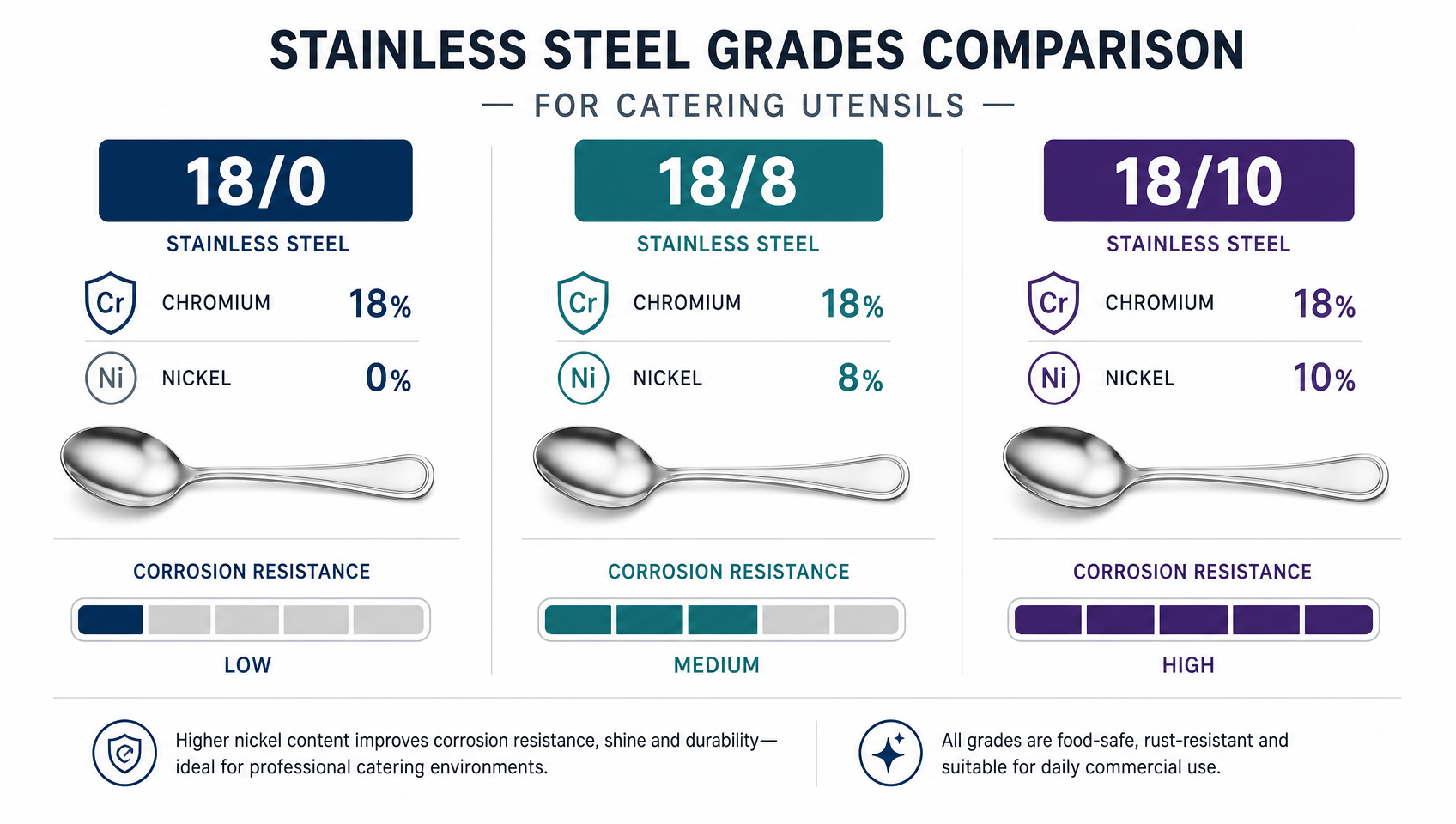
The nickel content is the deciding factor. 18/10 resists pitting from acidic foods (citrus, vinegar, tomato-based sauces) and survives high-alkaline commercial dishwasher detergents better than 18/0. In my experience evaluating supplier samples for high-volume buffet lines, 18/0 pieces from unverified factories showed surface oxidation at weld points after 60–90 commercial wash cycles. 18/10 pieces from the same wash regime looked identical to day one.
If your contract involves 100+ covers per service or a hotel-grade SLA for appearance, 18/10 is not a premium — it’s the minimum.
What a Complete Buffet Serving Set Actually Needs
Most supplier catalogs list piece counts (6-piece, 10-piece, 30-piece) without specifying what those pieces are. That matters because a 10-piece set of all spoons covers nothing a serving fork or tong would cover.
A functional buffet station requires at minimum:
- Solid serving spoon (liquids, rice, mashed items)
- Slotted serving spoon (drained vegetables, salads with liquid)
- Serving fork (proteins, bread, dense items)
- Tongs — utility (general) and scissor-type (breads, pastries)
- Soup ladle (6 oz for individual service, 8–12 oz for family-style)
- Pie/cake server (dessert station)
- Skimmer/perforated spoon (optional, but useful for pasta stations)
For event-size planning:
| Event Size | Buffet Stations | Recommended Pieces | Sets Needed |
|---|---|---|---|
| 50 guests | 3–4 stations | 8–10 pieces/station | 3–4 sets |
| 100 guests | 5–6 stations | 10–12 pieces/station | 5–6 sets |
| 200 guests | 8–10 stations | 10–12 pieces/station | 8–10 sets |
| Ongoing catering operation | Varies | Buffer stock ×1.5 | Based on peak |
One thing most buying guides skip: always order 20–30% overage for a catering operation. Pieces get lost during transport, bent tong springs fail, and piece-meal reorders from China take 4–6 weeks. Buffer stock is operational insurance.
Hollow Handle vs. Solid Handle: A Hidden Durability Risk
Nearly every wholesale catalog offers hollow-handle versions of serving spoons and ladles. They look identical to solid-handle pieces, weigh less (which reads as “premium feel” on spec sheets), and cost slightly more. For retail consumers, they’re fine.
For commercial catering, hollow-handle serving spoons are a liability.
The welded join between the hollow handle and the bowl traps moisture inside the handle during commercial dishwasher cycles. Over 6–12 months of daily use, this creates:
- Internal corrosion that is invisible until the handle separates
- A potential contamination point that fails food safety inspections
- Warranty disputes with suppliers who consider this “misuse”
When I evaluate factory samples for commercial kitchen specs, I always ask for cross-section photos of the handle joint weld and request solid-handle alternatives for any piece that will be dishwashed daily. Most China-based OEM suppliers can accommodate either option with the same mold; it’s a spec confirmation, not a custom request.
Ask your supplier explicitly: “Are these solid or hollow handle? What is the handle-to-bowl joint construction?”
Stainless Steel Grades and Certifications: What to Actually Request
Buyer-side due diligence on a wholesale serving set order involves more than getting a grade number on a quote sheet. The certifications that matter for different markets:
| Certification | Market | What It Covers |
|---|---|---|
| LFGB (§31) | EU / Germany | Migration limits for nickel and chromium into food |
| FDA 21 CFR | USA | Food contact material compliance |
| EU 1935/2004 | EU | General framework for food contact materials |
| SGS/Intertek test report | Global | Third-party material verification |
| NSF certification | USA foodservice | Sanitation design standard for foodservice equipment |
The most common gap in wholesale quotes: suppliers claim LFGB compliance but provide no test report number or lab name. A real LFGB test report from an accredited lab (SGS, Bureau Veritas, Intertek) includes the migration test values and report date. If a supplier can’t produce this, the claim is marketing language, not a verified specification.
For North American buyers, FDA 21 CFR compliance is the baseline. For EU/UK hotel buyers, LFGB + EU 1935/2004 is the standard. Request the actual test report, not just a certificate image — test reports include methodology and results; certificates don’t.
Sourcing: Manufacturer, Trading Company, or Distributor?
The wholesale supply chain for stainless steel catering utensils runs in three tiers, and price transparency varies significantly across them.
Tier 1 — Factory/Manufacturer (China, India, South Korea)
- Jieyang (Guangdong) and Yongkang (Zhejiang) are the two dominant manufacturing clusters in China
- MOQ typically 500–3,000 pieces per SKU for standard items; lower (100–500) for items in existing molds
- Lead time: 25–45 days for standard orders, 60–90 for custom molds
- Typical FOB pricing for 18/10 sets: $0.80–$3.50/piece depending on gauge and finish
Tier 2 — Trading Company (often on Alibaba)
- Sources from multiple factories, offers lower MOQ (50–200 pieces)
- Price markup: 15–35% over factory pricing
- Useful for: mixed SKU orders, smaller caterers testing a supplier
Tier 3 — Regional Distributor (WebstaurantStore, Katom, local restaurant supply)
- No MOQ, ships same-day or next-day
- Price markup: 100–300% over factory cost
- Useful for: emergency restocking, domestic buyers who can’t wait for ocean freight
The decision framework: If you need more than 500 pieces of a consistent SKU annually, going direct to a Jieyang or Yongkang manufacturer with OEM capability is almost always the right call. If your volume is under 200 pieces or you need delivery in under 3 weeks, a trading company or domestic distributor makes more sense operationally even at higher unit cost.
OEM and Custom Options: What China Factories Can Actually Do
For resellers, hospitality groups with house branding, or rental companies who want differentiating product, OEM customization on stainless steel serving sets is more accessible than most buyers assume.
Standard OEM options available from Jieyang/Yongkang factories:
- Custom laser-engraved logo on handle (setup cost: $50–$150, no per-piece adder)
- Custom handle shape/design (requires new mold: $800–$3,000 one-time tooling cost)
- Surface finish options: mirror polish, satin brush, matte, PVD black/gold coating
- Custom packaging: individual poly bag, gift box, carry case
- Private label branding on packaging
PVD-coated black or gold serving sets have become a strong-margin product for event rental companies and boutique caterers. The coating is scratch-resistant and dishwasher-safe to roughly 200–300 cycles before showing wear at contact points — not lifetime performance, but sufficient for event rental rotation where pieces cycle less frequently than restaurant dailies.
The Wholesale Checklist Before You Place an Order
Before confirming a wholesale order for stainless steel serving sets or catering utensils, verify these seven points:
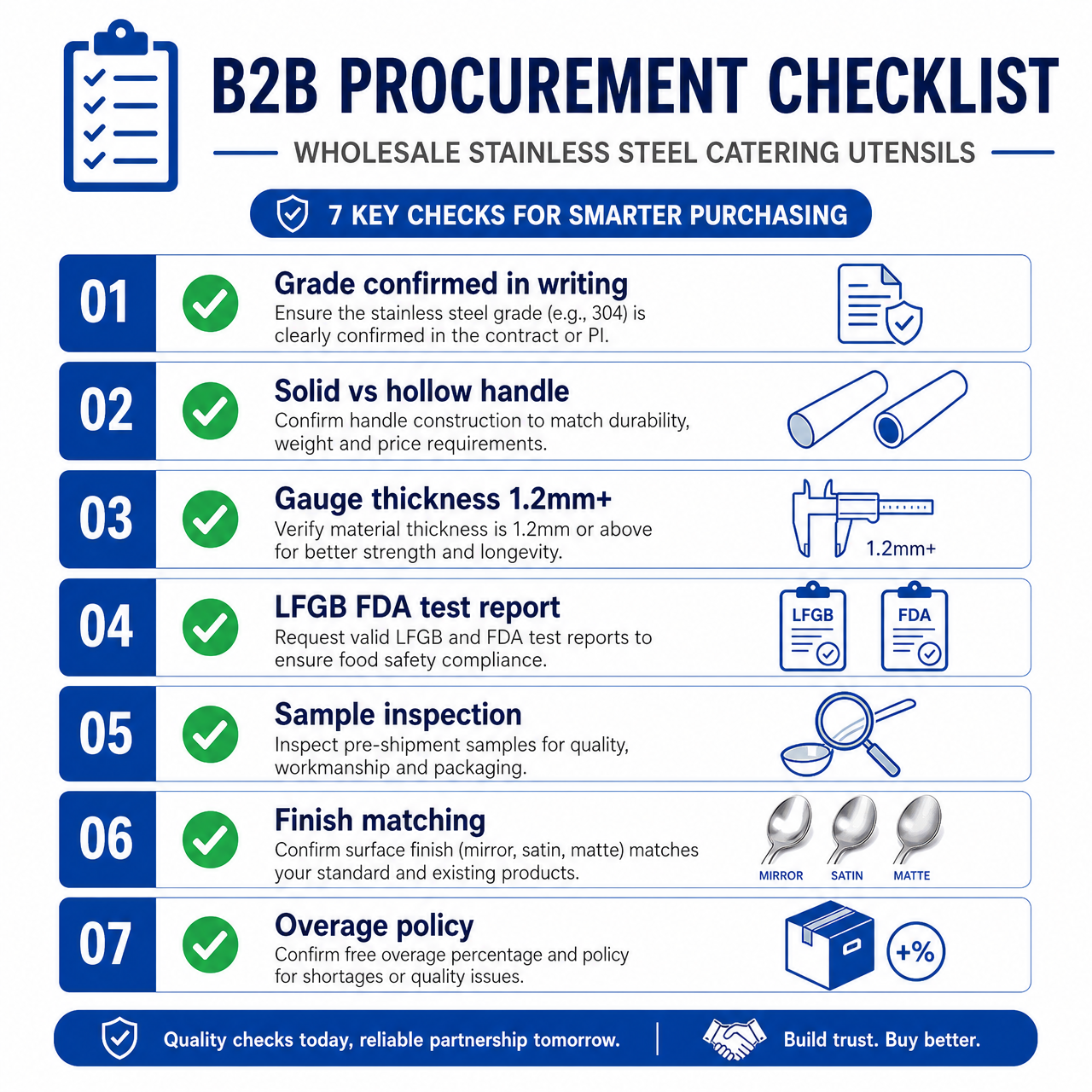
- Grade confirmed in writing — “18/10 stainless steel” on the commercial invoice and packing list, not just on the Alibaba listing
- Solid vs hollow handle — specified per SKU
- Gauge/thickness — 1.0mm is minimum for commercial serving spoons; 1.2–1.5mm is preferred
- Compliance documentation — LFGB/FDA test report with lab name and report number
- Sample inspection — 5–10 piece samples before production run; check weld joints and finish consistency
- Finish matching — mirror polish pieces from different factories often vary in chrome tone; batch consistency matters for sets
- Overage and replacement policy — confirm 2–3% production overage is standard, and whether supplier will ship replacement pieces for defects found post-delivery
The Bottom Line: Grade, Handle, and Paper Trail
Sourcing stainless steel serving sets wholesale is straightforward once you’re clear on three things: the grade that matches your use case (18/10 for commercial daily, 18/0 for low-frequency events), the handle construction (solid for anything going through a commercial dishwasher), and the documentation that protects your procurement from compliance risk.
The suppliers worth working with long-term are the ones who answer “solid or hollow handle?” without hesitation and can produce a test report PDF, not a certificate JPEG. Everything else — price, finish, set composition — is negotiable once those fundamentals are confirmed.
FAQ
What is the difference between 18/10 and 18/0 stainless steel for catering utensils? 18/10 contains 10% nickel versus 0% in 18/0. The nickel increases corrosion resistance, making 18/10 better suited for daily commercial dishwasher use, exposure to acidic foods, and high-alkaline cleaning chemicals. For occasional-use event catering, 18/0 is a functional budget option.
How many pieces do I need in a wholesale serving set order for a 100-person buffet? A 100-person buffet typically runs 5–6 stations. Each station needs 10–12 pieces (spoons, slotted spoons, tongs, ladles, forks). Plan for 60–80 core pieces, plus 20–30% buffer stock for attrition and transport losses. A 30-piece set from a single supplier covers about 3 stations.
What certifications should I request from a wholesale stainless steel serving set supplier? For EU buyers: LFGB §31 compliance report and EU 1935/2004 declaration. For US buyers: FDA 21 CFR food contact compliance. In both cases, request the actual lab test report (not just a certificate image) from an accredited third-party lab like SGS, Bureau Veritas, or Intertek.
What is a typical MOQ for stainless steel serving sets from a China manufacturer? Standard catalog items typically have a 500–2,000 piece MOQ at the factory level. Trading companies on Alibaba often accept 50–500 pieces at a price premium of 15–35%. For custom OEM items requiring new molds, most factories require 1,000–3,000 pieces to justify tooling costs.
Are hollow-handle stainless steel serving spoons safe for commercial kitchens? Technically food-safe when new, but hollow-handle construction traps moisture inside the handle during commercial dishwasher cycles. Over time this causes internal corrosion, handle-bowl joint failure, and potential contamination points. Solid-handle construction is the standard recommendation for daily commercial use.