


This guide is written for restaurant equipment distributors, foodservice importers, and commercial kitchen supply buyers sourcing stainless steel skimmers in bulk. It covers the functional difference between spider skimmers and flat perforated skimmers, how to evaluate material grades (304 vs. 316 stainless), how to match basket size to fryer volume, what wholesale pricing and MOQ norms look like in 2026, and what to look for in an OEM supplier. If you’re comparing suppliers or building a private-label kitchen tools line, this guide gives you the specs and sourcing framework to make a smarter purchase decision.
Spider Skimmer vs. Flat Skimmer: Which One Does Your Commercial Kitchen Actually Need?
The terms “skimmer” and “spider strainer” are often used interchangeably, but they serve different purposes in a commercial kitchen — and that distinction matters when you’re sourcing hundreds or thousands of units.
A flat or perforated skimmer has a solid or punched-hole disc head. It excels at skimming foam and fat from stocks, soups, and sauces. The flat profile glides across liquid surfaces without pushing down into the pot. Most Western-style kitchens use flat skimmers for stock preparation and sauce work.
A spider skimmer (also called a spider strainer or wire spider) has a wide shallow basket made of concentric or radial stainless steel wire mesh. This design drains liquid almost instantly — the open mesh means oil, water, and hot liquids fall away from the food the moment you lift the basket. It’s the go-to tool for Asian cuisine (pulling noodles and dumplings from boiling water), deep-fry operations (lifting baskets of fried chicken, tempura, or fries from oil), and blanching (retrieving vegetables from par-boil stations).
For commercial kitchens running high-volume deep fry or noodle stations, the spider skimmer is the functional choice. For soup/sauce preparation stations, flat perforated skimmers remain the standard. Many wholesale buyers source both types, since different stations have different needs.
From a sourcing perspective, spider skimmers are the higher-demand item in commercial kitchens — and the one with more variation in quality across suppliers. The wire mesh, weld points, and basket depth are where cheap manufacturing shows up first.
Stainless Steel Grades: 304 vs. 316 for Commercial Skimmers
The two grades you’ll encounter most often in commercial kitchen tools are AISI 304 and AISI 316 stainless steel.
AISI 304 is the industry standard for commercial kitchen utensils. Its composition — 18% chromium, 8% nickel — gives it strong corrosion resistance, good weldability, and a bright finish that holds up to commercial dishwasher cycles. The vast majority of wholesale skimmers on the market are made from 304 stainless. It handles hot oil, boiling water, acidic stocks, and detergent exposure without problem under normal commercial use.
AISI 316 adds 2–3% molybdenum to the 304 formula, which significantly improves resistance to chloride corrosion. In practice, that matters most in coastal food processing operations, seafood facilities, or kitchens using heavy chloride-based sanitizers. For standard restaurant and catering environments, 316 provides minimal real-world advantage over 304 at a notably higher per-unit cost.
One thing to watch for: some suppliers list products as “stainless steel” without specifying the grade. In my experience reviewing supplier samples, AISI 430 (ferritic, zero nickel content) is sometimes passed off as 304 at lower price points. A simple field test — try a magnet on the wire mesh. AISI 304 (austenitic, annealed) is non-magnetic or weakly magnetic; 430 will attract a magnet strongly across the full mesh surface. One caveat: cold-working or welding can induce minor magnetism in genuine 304, so a faint pull at weld points isn’t automatically a disqualifier. A strong pull uniformly across the mesh is the real red flag. If your supplier can’t provide material certification documents (mill test certificates), that’s a red flag.
For most wholesale buyers, 304 stainless is the right spec. Require documentation, not just verbal assurances.
Commercial Size Guide: Matching Basket Diameter and Handle Length to Your Kitchen
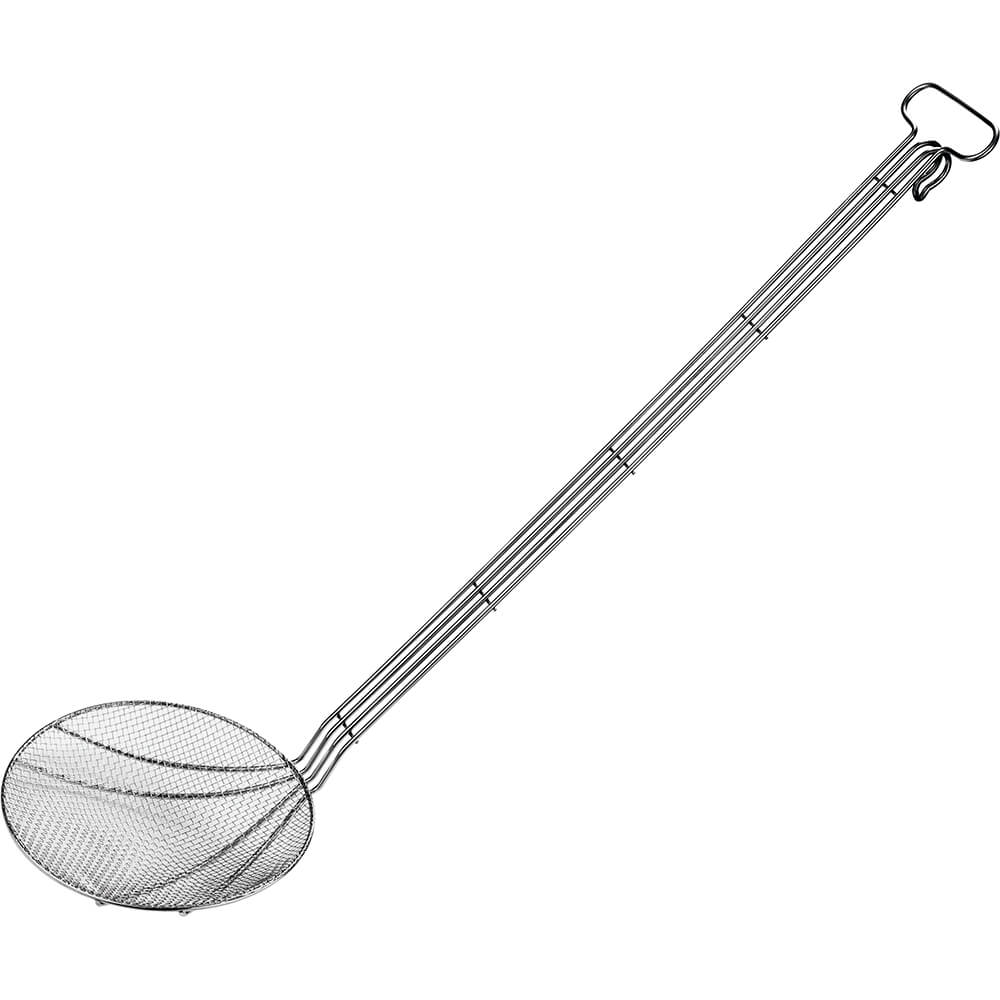
Size consistency matters when you’re buying in bulk. A spider skimmer that’s too small for your fryer basket wastes time. One with a handle that’s too short is a burn hazard. Here’s how commercial sizing works:
| Basket Diameter | Best Use | Recommended Handle Length |
|---|---|---|
| 5″–6″ | Single-portion fry stations, pasta/noodle stations, home-style commercial | 11″–16″ |
| 6″–8″ | Mid-volume fryers, blanching stations, wok ranges | 14″–20″ |
| 9″–11″ | High-volume deep fryers, large stockpots, Asian banquet kitchens | 20″–33″ |
The 11-inch basket with a 33″ extra-long handle is the commercial standard for large-volume fryer operations. It keeps hands clear of deep fryer oil and allows staff to work quickly across high heat.
Basket depth is often overlooked in wholesale specs. A deeper basket (1.5″–2″) holds more food per lift and reduces spillage when moving food to a drain tray. Shallow baskets (under 1″) drain faster but hold less — better suited for delicate items like tempura where you want minimal contact time.
Wire gauge affects how quickly the basket drains and how long it holds its shape under daily commercial use. Heavier gauge wire (thicker strands) resists deformation from repeated impacts in busy kitchens. Ask your supplier for wire diameter specs in millimeters (commercial-grade typically runs 0.8mm–1.2mm wire in the mesh).
Wholesale Pricing and MOQ: What to Expect in 2026
Pricing in the stainless steel skimmer market has held relatively stable. Based on current wholesale market data:
- Basic 304 SS spider skimmer (5″–6″ basket): $4–$6/unit at 500+ MOQ from factory-direct Chinese suppliers
- Mid-range commercial grade (7″–9″ basket, heavier wire): $6–$10/unit at 300–500 MOQ
- Professional commercial (11″ basket, long handle, NSF-compliant): $10–$18/unit, MOQ often 200–300 units
US-based wholesale distributors (WebstaurantStore, RestaurantSupply, Equippers) typically price commercial skimmers in the $15–$45 range per unit for retail and foodservice resale — with volume pricing available for bulk orders of 12+ dozen.
Key sourcing variables that affect price:
- Handle material (all-stainless one-piece vs. wood or plastic handle)
- Weld quality at basket-to-handle joint (welded vs. press-fitted)
- NSF certification (adds cost but opens doors to institutional buyers)
- Private label/OEM packaging (logo, branding, hang tags)
One-piece all-stainless construction costs more upfront but reduces warranty and replacement costs in commercial settings where tools take heavy daily use. The basket-to-handle weld point is the most common failure point on cheap units — worth specifying in your supplier contract.
OEM and Private Label: Questions to Ask Your Supplier Before Placing a Bulk Order
If you’re building a branded kitchen tools line, or restocking private-label inventory for a retail or foodservice client, here’s what to cover before committing to a manufacturer:
- Can you provide material test certificates for AISI 304? (Request mill certs, not just verbal confirmation)
- What is the wire diameter and mesh pattern specification? (Get this in writing, in millimeters)
- Is NSF certification available, or can you produce to NSF specs? (Required for many US institutional buyers)
- What is the basket-to-handle construction method? (Welded and polished is better than press-fitted)
- Can you do custom packaging or silk-screen branding on the handle?
- What is the quality inspection process before shipment? (AQL sampling level)
- What are your lead times for 500-unit and 1,000-unit orders?
Getting answers to these questions before your first order protects you from the most common wholesale sourcing problems: inconsistent material grade, structural failure under heavy commercial use, and certification gaps that block institutional sales.
Why CharmsCook Stainless Steel Skimmers Work for Wholesale Buyers
CharmsCook sources and supplies commercial-grade stainless steel cookware and kitchen tools designed for B2B buyers — restaurants, distributors, and private-label brands. Their spider skimmer line is built to AISI 304 spec with professional basket-to-handle welding and one-piece stainless construction throughout.
What makes CharmsCook a practical wholesale option:
- Material certification available on request — 304 stainless with mill test documentation
- Commercial sizing range — 5.4″ to 11″ baskets, matched to appropriate handle lengths
- NSF-compliant construction — suitable for institutional kitchen buyers
- OEM packaging support — custom branding available for private-label orders
- Flexible MOQ — realistic minimums for importers and regional distributors, not just mega-volume factory runs
For buyers who’ve been burned by material inconsistency from low-cost sources, CharmsCook’s approach focuses on supplier transparency over rock-bottom unit pricing. That trade-off makes sense when you’re selling into commercial kitchen accounts where tool failure has real operational consequences.
Visit charmscook.com to request wholesale pricing and sample arrangements.
Frequently Asked Questions
What is the difference between a spider skimmer and a flat skimmer?
A spider skimmer has an open wire-mesh basket that drains oil and water instantly — ideal for deep frying and blanching. A flat perforated skimmer has a solid disc with holes, better suited for skimming foam and fat off the surface of stocks and sauces.
What stainless steel grade is best for commercial skimmers?
AISI 304 (18% chromium, 8% nickel) is the commercial kitchen standard. It handles oil, acidic stocks, boiling water, and heavy dishwasher use without corrosion. AISI 316 adds chloride resistance but is only necessary in seafood processing or high-chloride sanitizer environments. Avoid unlabeled “stainless” that may be lower-grade 430.
What size spider skimmer do I need for a commercial fryer?
For high-volume fryer stations, a 9″–11″ basket with a 20″–33″ handle keeps hands safe and moves larger quantities per lift. Mid-volume stations typically use 6″–8″ baskets. Confirm basket depth (1.5″–2″ recommended for commercial use) and wire gauge (0.8mm–1.2mm mesh wire).
What is a typical MOQ for wholesale stainless steel skimmers?
Factory-direct MOQs from major manufacturing sources typically start at 300–500 units. US-based wholesale distributors often have lower entry points (12–36 units) at higher per-unit cost. For private-label OEM orders with custom branding, expect 300–500 units minimum.
How can I verify that my wholesale supplier is using real 304 stainless steel?
Request mill test certificates from your supplier before placing a bulk order. As a quick field check, AISI 304 (austenitic, annealed) is non-magnetic or weakly magnetic — a strong magnetic pull uniformly across the wire mesh indicates a ferritic grade like 430. Note that cold-worked or welded areas of genuine 304 can show minor magnetism, so a faint pull at weld points alone is not a disqualifier.
The Bottom Line on Commercial Skimmer Sourcing
Spider skimmers look simple, but the difference between a wholesale unit that survives two years of commercial kitchen use and one that fails in three months comes down to steel grade, wire gauge, weld quality, and basket construction. Consumer review content won’t tell you any of that. Sourcing from a B2B-focused supplier like CharmsCook — one that can provide material documentation and commercial-spec construction — is worth more in the long run than saving $1.50 per unit from an unverified source.
Get the specs in writing, request a sample order before committing to large volume, and treat the basket-to-handle weld as your quality indicator.





