


Sourcing stainless steel slotted spoons at wholesale requires more than finding the lowest price per piece. This guide covers everything B2B buyers need to know — from grade selection (18/8 vs. 18/10 vs. 201) and slotted vs. perforated design differences to real MOQ benchmarks, pricing ranges, and what commercial kitchens actually need from a supplier. Whether you’re stocking a restaurant chain or building a private-label line, this guide gives you a clear framework to buy smarter.
Slotted Spoon vs. Perforated Spoon: Not the Same Thing
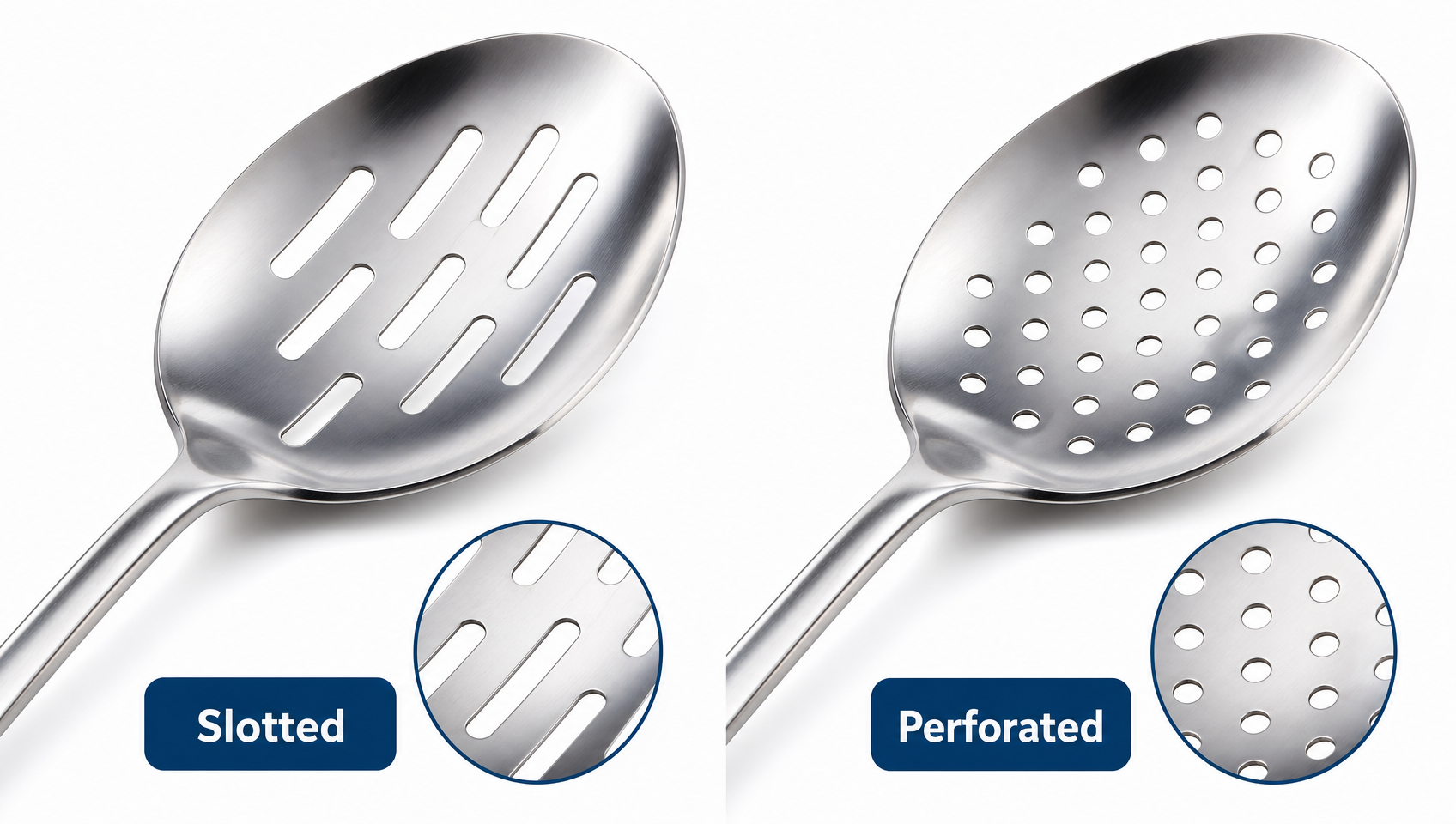
This distinction catches a lot of wholesale buyers off guard — and it matters when placing bulk orders.
A slotted spoon has elongated rectangular or oval openings cut into the bowl. Those long slots are designed for lifting larger, chunky solids — braised meats, boiled potatoes, poached eggs, pasta — while liquid drains quickly back into the pot. The wider openings mean faster drainage but also mean smaller items like peas or corn can slip through.
A perforated spoon uses many small circular holes across the bowl instead. This pattern creates more contact surface with food while still allowing liquid to pass through. Professional kitchens reach for perforated spoons when serving fine-cut vegetables, grains, or anything where you want control over small pieces.
In practice, both terms get used interchangeably on supplier platforms like Alibaba and Global Sources. When placing a wholesale order, always ask your supplier to confirm the hole pattern and send a physical sample. A photograph rarely shows you whether the holes are truly elongated slots or small perforations — and your end customer will notice.
At CharmsCook, we carry both configurations and can confirm the exact pattern before bulk production. That small spec clarification up front prevents returns and reorders down the line.
Stainless Steel Grades: What Actually Matters for Wholesale
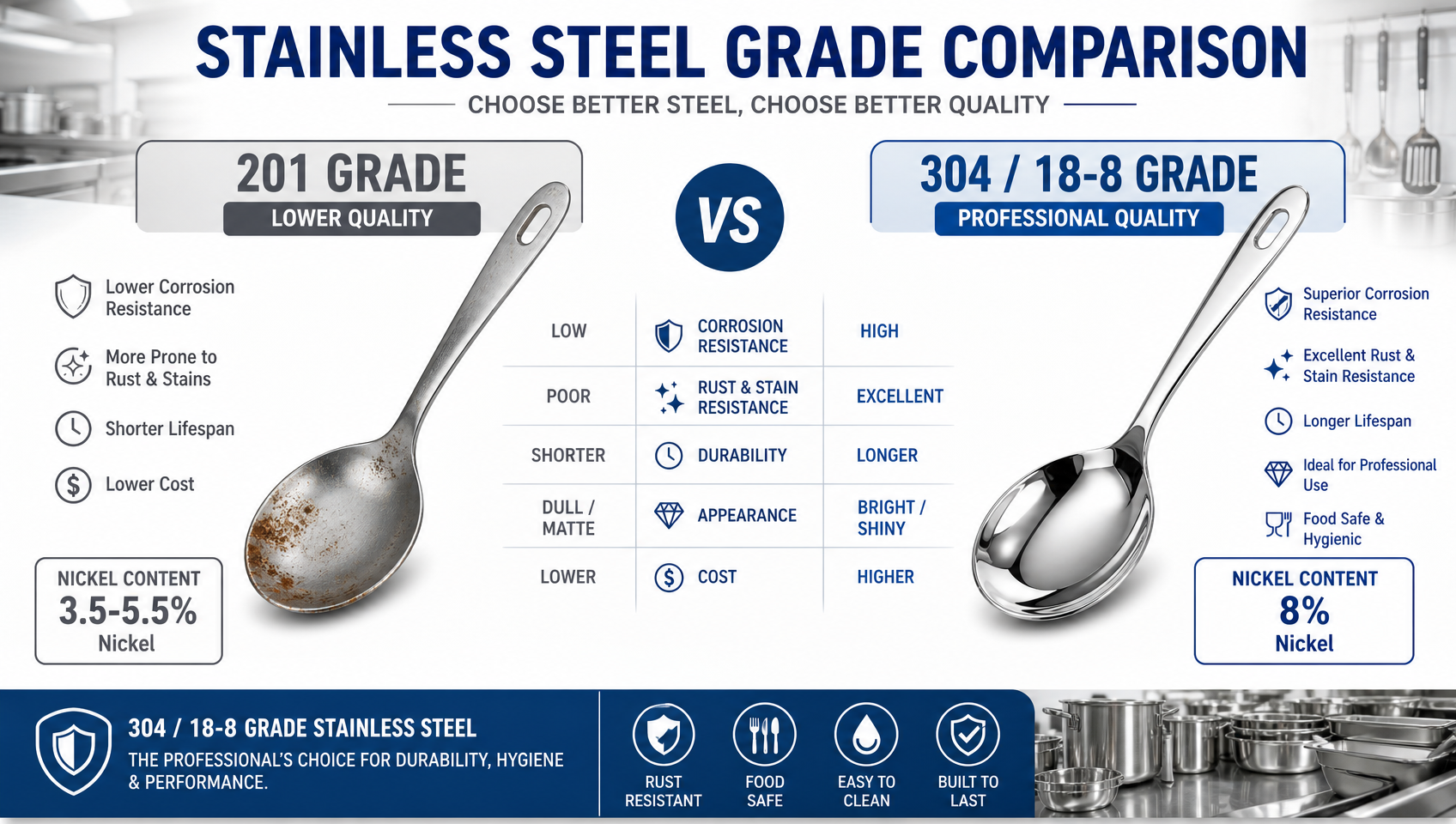
The grade you specify in your purchase order defines the product’s food safety, corrosion resistance, and long-term durability. Here’s what each grade means in practical terms:
| Grade | Chromium | Nickel | Common Name | Best For |
|---|---|---|---|---|
| 201 SS | 16–18% | 3.5–5.5% | Economy grade | Low-cost, non-food-contact items |
| 18/8 (304) | 18% | 8% | Food grade | Commercial kitchens, standard wholesale |
| 18/10 (304 variant) | 18% | 10% | Premium grade | High-end hospitality, premium flatware |
| 430 SS | 16–18% | 0% | Magnetic, no nickel | Induction-ready handles; lower corrosion resistance |
18/8 (304) is the commercial kitchen standard. It withstands repeated dishwasher cycles, contact with acidic foods like tomato sauce or citrus-based marinades, and the rough handling that comes with high-volume kitchen operations. Most reputable restaurant supply chains in the US and EU spec 304 as their baseline.
18/10 (a 304 variant with higher nickel) adds 2% more nickel, which marginally improves corrosion resistance and luster. Note: 18/10 is not 316 stainless steel — 316 is a different alloy that contains molybdenum and has true marine-grade corrosion resistance. For flatware and kitchen utensils, “18/10” refers to a premium variant of the austenitic 300-series with 10% nickel content. For most commercial slotted spoon applications — straining pasta, blanching vegetables, serving from steam tables — the real-world performance difference between 18/8 and 18/10 is minimal. The price difference is real though. If a buyer is sourcing for upscale hotel dining or a brand positioning around premium materials, 18/10 is worth specifying. For high-volume restaurant chains and cafeteria supply, 18/8 delivers the right balance.
201 grade is the one to watch out for. It looks identical to 304 in product photos and factory listings. The lower nickel content (3.5–5.5% vs. 8%) makes it less corrosion-resistant and less durable under frequent washing. Some China-based suppliers use 201 and list it vaguely as “stainless steel” without specifying the grade. Always request a material test report (XRF test or mill certificate) if you’re ordering at scale.
Wholesale Pricing Benchmarks: What to Expect
Based on current supplier data from Alibaba, Made-in-China, and Global Sources (as of 2026):
| Grade | Unit Price Range | MOQ |
|---|---|---|
| 201 SS slotted spoon | $0.35–$0.45/pc | 500–1,000 pcs |
| 304 (18/8) slotted spoon | $0.80–$1.50/pc | 500–1,000 pcs |
| 304 with custom logo/OEM | $1.20–$2.00/pc | 1,000–3,000 pcs |
| 18/10 (304 premium) slotted spoon | $1.50–$2.50/pc | 1,000 pcs |
Tip: Bulk pricing drops significantly at 2,000+ pieces. If you’re buying 304 grade at 500 pcs, expect to pay near the top of that range. At 5,000 pcs, some suppliers will go as low as $0.60–$0.70/pc for standard 304 without custom branding.
A low price on a 201 grade product might look attractive on paper — at $0.35/pc for 1,000 pieces, you’re spending $350 vs. $800 for 304. But factor in the customer complaints, returns, and brand damage when spoons rust or pit after six months in a commercial dishwasher environment. 304 is almost always the right call for wholesale buyers intending to supply professional kitchens.
Sizes and Specs: What Commercial Kitchens Actually Order
Standard commercial kitchen slotted spoons run 11 to 15 inches in total length. Here’s how kitchen segments tend to break down:
- 11–12 inch: Quick service and casual dining — compact, easy to handle at high speed
- 13–14 inch (most common): Full service restaurants, hotel kitchen lines, catering operations
- 15–21 inch: Large-batch cooking, steam table operations, institutional kitchens
Handle design matters more than buyers expect. Hollow handles feel lightweight and look clean, but in a busy kitchen they collect moisture and can harbor bacteria if the end cap seal fails. Solid welded handles cost slightly more to produce but are more durable and easier to maintain food safety certifications.
Look for a hanging hole at the end of the handle. Nearly every commercial kitchen has a utensil rail, and a spoon without a hanging hole is a storage inconvenience that chefs notice. It seems minor — buyers sometimes overlook it — but it comes up frequently in product feedback from kitchen staff.
For bowl thickness, 0.8mm–1.2mm gauge is standard for commercial use. Thinner bowls dent and deform under heavy use. If a supplier quotes prices significantly below market and you can’t get a sample, that’s often where the cost is cut.
What to Verify Before Placing a Bulk Order
From experience sourcing and testing kitchen utensils, these are the checks that prevent costly mistakes:
1. Request a physical sample first. A $15–$20 sample shipment saves hundreds or thousands in returned inventory. Check the weld quality where the bowl meets the handle — it should be smooth, fully sealed, and show no discoloration or porosity.
2. Confirm the steel grade with documentation. Ask for a mill certificate or XRF test report showing the actual composition. Reputable suppliers won’t hesitate; this is a normal B2B request.
3. Specify hole pattern explicitly. Don’t just say “slotted spoon” — specify elongated slots vs. circular perforations, and give approximate dimensions. A supplier producing 10,000 units to the wrong spec is a problem neither side wants.
4. Ask about surface finish. Mirror polish (bright finish) looks premium but shows scratches more easily in commercial use. Matte or satin finish is more practical for restaurants. Specify which you need.
5. Clarify packaging for resale. If you’re distributing to retailers, ask about individual polybag packing vs. bulk carton. MOQ for individual retail packaging is often higher than bulk.
At CharmsCook, we provide pre-shipment samples, grade documentation, and consistent hole pattern specs as standard — because those are the questions every serious wholesale buyer should be asking.
Common Commercial Kitchen Applications

Understanding end-user needs makes you a better supplier and helps you source the right product variant:
Pasta stations: High-volume pasta cooking needs slotted spoons that can handle repeated immersion in boiling water. 304 grade with a solid handle weld is the spec. Size: 13–15 inches.
Buffet and steam table service: Perforated spoons are preferred here — they drain continuously as food is held on the spoon during serving. Smaller holes keep portions controlled without losing small-cut vegetables. Handle should be long enough to rest on the tray rail.
Fry station support: While a spider skimmer handles deep fry work, a slotted spoon handles shallow-fry tasks — turning and lifting fritters, croquettes, or pan-fried items. Heat resistance to 250°C+ is non-negotiable; 304 steel handles this without issue.
Cold prep: Used for lifting chilled vegetables from ice baths after blanching, removing pickled items from brine, or plating cold salad components cleanly. Perforated pattern works well here.
Why the Right Wholesale Partner Changes the Equation
Most of the wholesale slotted spoon market on Alibaba is undifferentiated. Photos look the same, specs look similar, and price becomes the only decision factor. The risk is getting 201 grade in a 304 order, inconsistent hole patterns across production runs, or quality that drops sharply after the first sample batch.
The better approach is finding a supplier who can provide grade documentation, consistent production specs, and sample confirmation before bulk commitment. That applies whether you’re buying 500 units to test a new SKU or 10,000 units for a chain rollout.
CharmsCook works with buyers at both scales — from distributors sourcing their first private-label line to established foodservice suppliers expanding SKUs. The conversation usually starts with a material spec discussion, not a price negotiation, which tends to result in fewer surprises at delivery.
Frequently Asked Questions
What is the difference between a slotted spoon and a perforated spoon?
A slotted spoon has elongated rectangular openings best suited for large solid foods. A perforated spoon has small circular holes better suited for fine-cut items or when you need more contact surface with the food. Both allow liquid to drain; the choice depends on the food type and kitchen application.
What stainless steel grade should I specify for commercial kitchen wholesale?
18/8 (304) is the industry standard for commercial kitchens. It’s food-safe, corrosion-resistant, dishwasher-safe, and priced appropriately for bulk purchasing. 18/10 (a premium 304 variant with higher nickel) is worth specifying for high-end hospitality or premium flatware. Avoid 201 grade for food-contact wholesale orders.
What is a typical MOQ for wholesale slotted spoons?
Most China-based manufacturers set MOQ at 500–1,000 pieces per style for standard 304 grade without customization. Custom OEM orders (logo, packaging, custom size) typically start at 1,000–3,000 pieces. Some suppliers accommodate smaller test orders of 100–200 pieces at a premium price per unit.
How do I verify that a supplier is using genuine 304 stainless steel?
Request a mill certificate from the steel manufacturer, or ask the supplier to arrange an XRF (X-ray fluorescence) test on the finished product. This test directly measures chromium and nickel content and takes minutes to perform. Any reputable supplier accepts this request.
Can I get custom sizes or hole patterns for wholesale orders?
Yes, most manufacturers can accommodate custom bowl sizes, handle lengths, hole patterns, and surface finishes for orders of 1,000+ pieces. Lead time for custom tooling is typically 2–4 weeks before production begins.
What size slotted spoon is most commonly ordered for restaurant use?
13 inches is the most common length for full-service restaurant kitchens. Cafeteria and institutional kitchens often order 15+ inch spoons for steam table use. Quick-service and catering tend to favor the 11–12 inch range for portability.
One Grade, One Decision, Long-Term Value
The wholesale slotted spoon market rewards buyers who specify correctly the first time. The 201 vs. 304 decision isn’t just a material choice — it’s the difference between customer satisfaction and early returns. The slotted vs. perforated distinction isn’t just terminology — it determines whether your kitchen staff can do their jobs efficiently.
Get the spec right, confirm it with documentation, and source from a partner who treats those checks as standard practice, not an inconvenience. That’s the framework that holds across every bulk order, regardless of order size.
For B2B inquiries about stainless steel slotted spoons and perforated spoons, visit CharmsCook to start with a material and spec conversation.





