


Sourcing stainless steel spatulas wholesale means navigating grade confusion, opaque pricing tiers, and compliance requirements that vary by destination market. The three steel grades you’ll encounter are 201, 430, and 304 — and choosing the wrong one can mean product failures, returns, or customs holds. Factory EXW pricing from China runs $0.25–$1.50 per piece depending on grade and handle type; US wholesale distribution runs $2.00–$6.30. MOQs range from 100 pieces (OEM-ready factories) to 2,400 pieces (trading companies). Key certifications: FDA compliance for the US market, LFGB for Europe. This guide covers the full sourcing decision: grades, types, specs, pricing, certifications, and how to vet a sample shipment before committing to volume.
Spatula vs. Turner: Getting the Terminology Right
In commercial and wholesale contexts, “spatula” and “turner” describe the same tool — a flat-bladed kitchen utensil for flipping, lifting, and transferring food during cooking. The distinction matters when briefing suppliers: Chinese manufacturers almost universally list these products as “turners” or “food turners” in their catalogs, while US buyers often search for “spatulas.”
Call it a turner when talking to factory contacts. Call it a spatula when writing product listings for US retail buyers. On Alibaba and Made-in-China, search both terms — you’ll get different results and sometimes different pricing because the same product is tagged inconsistently.
A separate product family — the offset or spreading spatula used in baking — is unrelated. That’s a palette knife by another name. Make sure your supplier understands you want a cooking turner, not a baker’s offset.
Why Stainless Steel Still Dominates Commercial Kitchens

Stainless steel turners remain the default in professional kitchens because they outlast every alternative material in high-heat, high-frequency environments. Silicone turners score well in D2C markets and non-stick cookware households, but they deform under sustained griddle heat above 260°C (500°F) and aren’t the tool a line cook wants for steak or smash burgers. Nylon deteriorates. Wood warps with repeated washing.
For your wholesale buyers, the decision usually isn’t stainless versus something else — it’s which grade of stainless, what blade thickness, and which handle configuration. The durability argument is already won.
Commercial kitchens also prefer stainless because it’s dishwasher-safe without qualification. Stainless turners can run through a high-temp commercial dishwasher cycle indefinitely, which matters enormously for restaurant operations where tools turn over hundreds of times a week.
The Grade Decision That Most Buyers Get Wrong
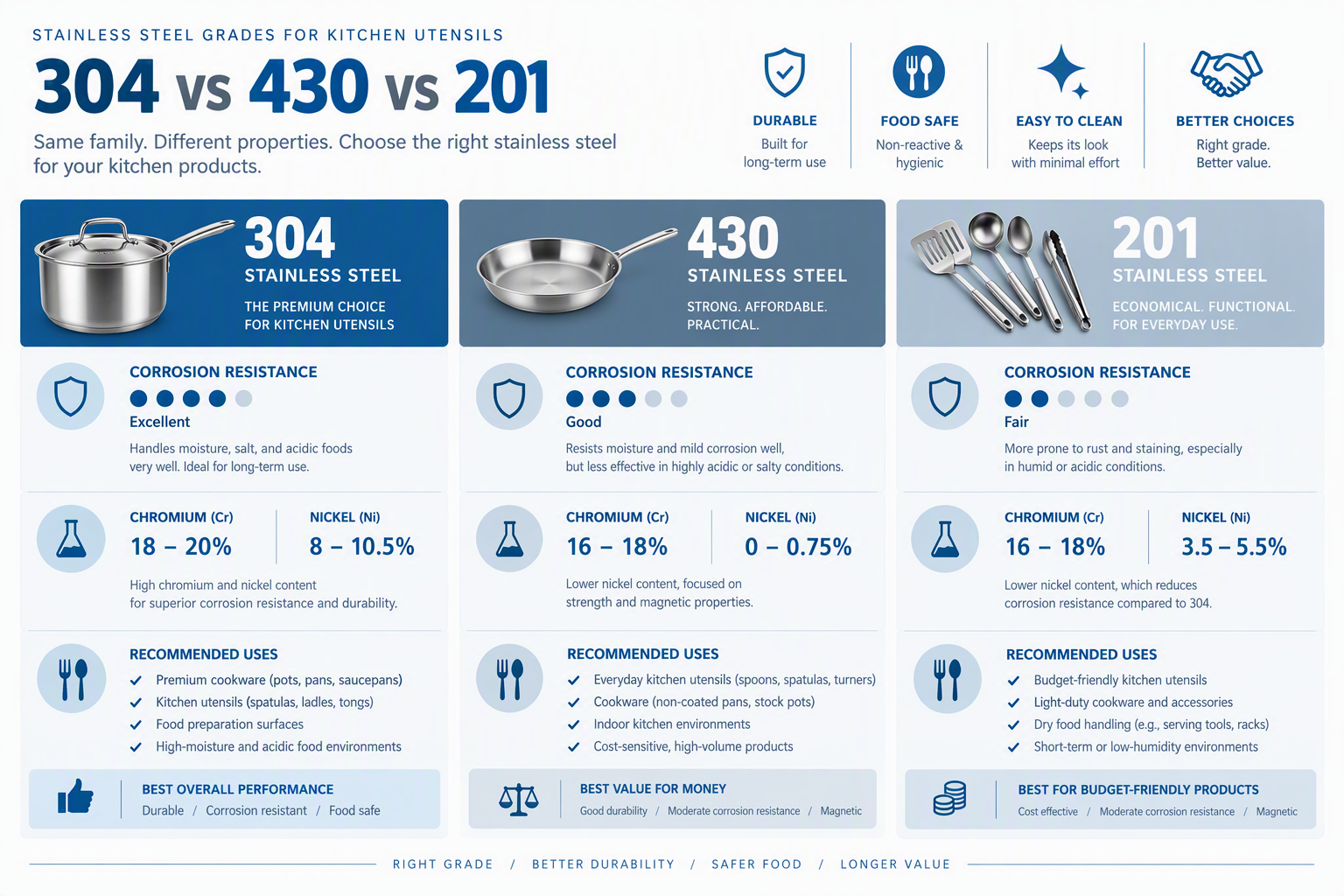
The single biggest quality risk in wholesale stainless spatulas is receiving 201-grade steel when you quoted and priced for 304. This happens because all three grades look identical, polish to the same finish, and are labeled as “stainless steel” by suppliers without distinction.
Here’s what each grade actually means:
| Grade | Composition | Corrosion Resistance | Nickel | Food Safe? | Best For |
|---|---|---|---|---|---|
| 304 (18/8) | 18% Cr, 8% Ni | Excellent | Yes | Yes — industry standard | Premium wholesale, EU/US retail |
| 430 (18/0) | 18% Cr, 0% Ni | Good | No | Yes — acceptable | Budget foodservice, magnetic-induction compatible |
| 201 | 16-18% Cr, 3.5-5.5% Ni, high Mn | Marginal | Low | Borderline | Low-cost markets, avoid for long-term use |
304 is the standard for good reason. Its 8% nickel content gives it genuine corrosion resistance in saline and acidic food environments — think tomato sauces, citrus marinades, saltwater brines. I’ve seen 201-grade spatulas develop rust pitting at the blade-handle weld within six months of commercial kitchen use. 304 doesn’t do that.
430 is a legitimate choice for price-sensitive buyers with one caveat: it contains no nickel, making it a practical option if your customer base includes people with nickel sensitivity, and it’s fully magnetic — useful for induction cooktop contexts. Corrosion resistance is slightly lower than 304 but acceptable for most foodservice applications.
201 is the grade to avoid and verify against. It’s cheaper because it substitutes manganese for nickel and uses lower chromium content. It will pass a visual inspection. The magnet test doesn’t reliably distinguish it from 304. If grade matters in your specification — and it should — demand a material test report (MTR) from the mill or request third-party SGS testing on your first bulk order.
Types of Stainless Steel Spatulas/Turners: Commercial Applications
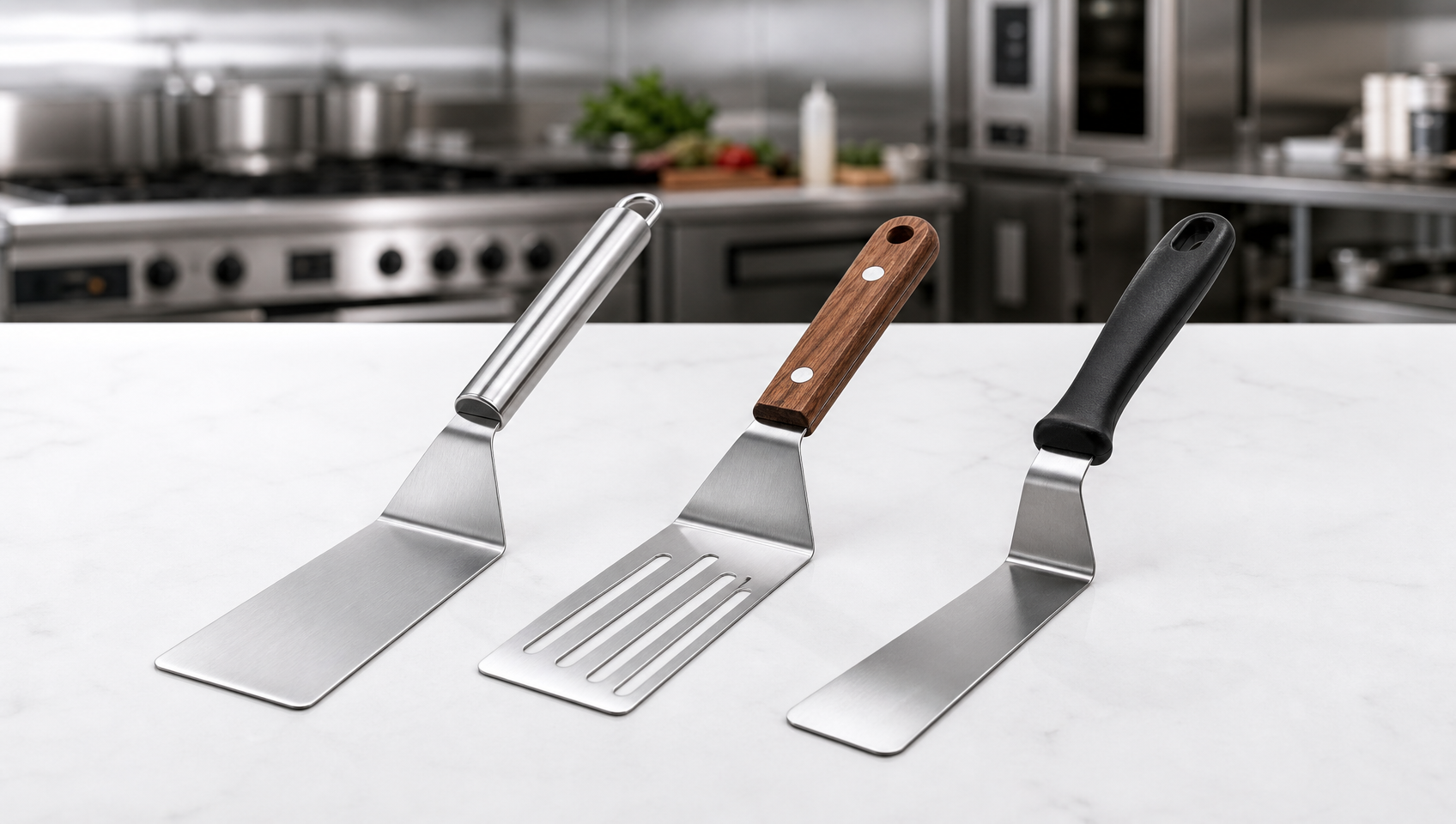
Different commercial applications need different blade formats. A smash burger operation and a hotel breakfast buffet have entirely different requirements.
| Type | Blade Design | Best Commercial Use | Typical Blade Size |
|---|---|---|---|
| Solid turner | Flat, no slots | Steak, burgers, delicate fish | 4″ × 3″ to 6″ × 4″ |
| Slotted turner | Slots for drainage | Bacon, eggs, fried fish, general frying | 5″ × 3″ to 6″ × 4″ |
| Fish spatula | Thin, flexible, angled blade | Whole fish, delicate proteins | 5″ × 3″, beveled edge |
| Offset turner | Bent neck, offset blade | Pancakes, crepes, griddle work | 4″ × 3″ |
| Wide griddle turner | Extra-wide blade | High-volume griddle stations | 6″ × 5″ or larger |
For most wholesale buyers building a general kitchen catalog, a 12″–14″ slotted turner in 304 stainless with a PP (polypropylene) handle covers the widest range of commercial use cases. It’s the item that shows up in every foodservice distributor’s catalog.
If you’re targeting BBQ or grilling markets, the solid turner with a longer handle (16″–18″ total length) moves well. If you’re targeting hotel banquet operations or breakfast stations, a solid wide turner in all-stainless construction (no separate handle material) is the safer choice — easier to sanitize, passes stricter food safety audits.
Specs to Lock Down Before Placing a Wholesale Order
Vague purchase orders are the root cause of most quality disputes in kitchen utensil sourcing. Before you commit to any volume, get these five parameters confirmed in writing:
- Steel grade with MTR — “304 stainless” written on a PO is not a guarantee. Request the mill test report number that your factory can provide. Legitimate manufacturers will have this on file for every steel coil they purchase.
- Blade thickness — Commercial kitchen spatulas typically run 1.0mm to 1.5mm blade thickness. Anything below 1.0mm flexes noticeably under load and won’t hold up in a busy fry line. Budget products often spec 0.8mm; premium commercial spec is 1.2–1.5mm.
- Overall length — Industry standard is 12″–14″ total. Specify whether the measurement includes the handle or is blade-only. Suppliers measure differently.
- Handle material and heat rating — PP handles have a heat deflection temperature of approximately 100–115°C (212–240°F) under load; beyond that they soften. Bakelite handles tolerate higher sustained heat. Wood handles look premium but add moisture-absorption risk in commercial washdown environments. Full-stainless handles are sanitation-optimal but heat-conduct to the hand.
- Weld quality at blade-handle joint — This is the single most common failure point. Ask your supplier for a 50-piece sample before any bulk order and deliberately stress-test three or four pieces. The joint should show no gap, no visible weld lines under a strong light, and no flex when you apply lateral force.
Wholesale Pricing Reality: What to Expect by Sourcing Channel
Pricing varies by nearly 10x depending on where you buy — from factory-direct EXW in China to US-based distributor stocked pricing. Understanding the tiers helps you negotiate and price your resale correctly.
| Sourcing Channel | Price Range (per piece) | MOQ | Lead Time |
|---|---|---|---|
| China factory direct (EXW, 304 SS, PP handle) | $0.25–$0.50 | 500–2,400 pcs | 25–35 days bulk |
| China factory direct (EXW, 304, wood handle, OEM) | $0.60–$1.50 | 200–500 pcs | 30–45 days |
| US distributor (no brand, bulk pack) | $2.07–$2.24 | 144 pcs (case) | In-stock or 3–5 days |
| US distributor (branded, commercial grade 18/8) | $3.90–$6.29 | 24 pcs (case) | In-stock |
The factory direct channel makes sense for buyers ordering 500+ pieces with enough lead time to absorb ocean freight. For buyers who need flexible replenishment or smaller quantities, US distributors like WebstaurantStore or DollarDays eliminate MOQ pressure at the cost of roughly 5–8x the per-unit price.
Landed cost from China adds roughly $0.15–$0.30 per piece in ocean freight and customs duty (US HTS 8215.99 general rate is 0%, so no import duty applies to most stainless kitchen tools under Chapter 82 — verify for your specific item). Air freight doubles the economics of the equation.
Certifications That Actually Protect You
Two certifications matter for most destination markets: FDA compliance for the US, and LFGB for Germany and the EU.
FDA compliance for stainless steel is different from FDA certification for silicone or plastic. Stainless steel kitchen tools don’t require pre-market FDA approval — they need to be manufactured from materials that comply with 21 CFR (Code of Federal Regulations) for food contact. Most 304 and 430 grade stainless automatically qualifies. When a supplier claims “FDA approved,” what they really mean is “FDA compliant materials.” That’s fine — just understand what the claim covers.
LFGB (Lebensmittel-, Bedarfsgegenstände- und Futtermittelgesetzbuch) is the German food safety law that sets migration limits stricter than FDA in some areas. If you’re selling to European retail or to any buyer who mentions German or EU compliance requirements, ask specifically for LFGB test reports from a third-party lab (SGS, Intertek, TÜV). A reputable Yangjiang factory will have these on file.
For Amazon or retail channel compliance, ask your supplier for: certificate of conformity (COC), material declaration (confirming grade), and any relevant third-party test report. The paperwork protects you if a retail buyer or marketplace ever runs a spot test.
OEM Customization: What’s Realistic at Small MOQ
Laser engraving a logo, adding a custom hang tag, or changing the handle color is achievable from 100–200 pieces at most Yangjiang-area factories. Custom handle injection molding (entirely new handle shape) typically requires 2,000–5,000 pieces to cover tooling costs of $500–$1,500.
Practical OEM options at small scale:
- Laser or electro-etched logo on blade: 100 MOQ, minimal tooling cost
- Custom color PP handle (from existing mold): 500 MOQ
- Custom polybag or retail packaging: 100 MOQ, low cost
- Custom length (from existing blank): 200–300 MOQ
Most buyers starting a private label kitchenware brand do well to start with stock-mold handles and custom packaging. It’s faster, cheaper, and lets you validate market response before investing in tooling.
Vetting Samples Before a Full Commitment
Order a sample before any bulk order, even from a supplier with good platform ratings. A 10–20 piece sample ($30–$80 including courier shipping) tells you more than any product photo or catalog.
When the samples arrive, check:
- Magnet test — A 304 piece will be slightly attracted to a magnet but weakly. Strong magnetic pull suggests 430; near-zero pull could indicate 201 or an austenitic alloy. This is a screen test, not a definitive grade ID. For certainty, use an XRF gun (most import testing services offer this for $50–$100).
- Weld at blade-handle joint — Hold the blade, grip the handle, apply lateral stress. Any creak, gap, or flex means the weld is insufficient for commercial use.
- Blade thickness — Use a digital caliper. Confirm it matches your spec.
- Handle heat test — Run it under very hot tap water for 30 seconds. A PP handle shouldn’t deform.
- Edge and finish — Run your fingertip along all edges. Rough edges on a stainless turner are a quality signal — properly finished commercial tools have deburred, smooth edges throughout.
If the sample fails any of these checks, don’t proceed to bulk. Good factories fix issues on the second sample run without charging you — if a supplier pushes back on a sample re-run for a quality issue, that’s a red flag about how they’ll handle bulk complaints.
FAQ
What is the difference between a spatula and a food turner?
In commercial and wholesale contexts, they’re the same tool — a flat-bladed utensil for flipping food. “Turner” is the more precise term used in commercial foodservice and by most manufacturers. “Spatula” is the common consumer term in the US. Chinese suppliers list these as “turners” in their product catalogs.
What HS code applies to a stainless steel spatula?
HS 8215.99 covers kitchen or tableware articles of base metal (spoons, ladles, skimmers, spatulas). The US HTS Chapter 82 general import duty rate for most stainless steel kitchen tools is 0%, though you should confirm your specific item classification with a customs broker, as some handle materials can shift classification.
What stainless steel grade should I specify for commercial kitchen wholesale?
304 (18/8) is the standard recommendation. It offers superior corrosion resistance in acidic and saline food environments and is the grade expected by professional kitchen buyers. 430 is acceptable for price-sensitive markets and induction-compatible contexts. Avoid 201 unless you can verify the end application is extremely low-risk and short-lifespan.
How much does a stainless steel spatula cost wholesale from China?
Factory EXW pricing runs approximately $0.25–$0.50 per piece for a basic 304 stainless turner with PP handle at 500–2,400 pieces. OEM configurations with wood handles or custom packaging run $0.60–$1.50. Landed cost in the US adds roughly $0.15–$0.30 per unit in freight and handling.
What certifications should I ask for when sourcing stainless steel spatulas?
For the US market, ask for a material declaration confirming 304/430 grade and an FDA-compliant materials statement. For EU or German retail buyers, request LFGB test reports from an accredited lab (SGS, Intertek, TÜV). For Amazon or major retail buyers, a certificate of conformity and third-party test report provide audit-ready documentation.
Summary
Stainless steel spatulas are a commodity product with genuine quality variation underneath. The decisions that matter most — steel grade, blade thickness, weld quality, and certifications — are invisible in a supplier photo and rarely stated upfront. Lock down your material spec in writing, request mill test reports on 304 claims, order samples before bulk, and understand which certification your destination market actually requires. Price the landed cost correctly by accounting for freight and handling, and you’ll be working with a product category that has durable, predictable demand across foodservice, retail, and e-commerce channels.





