


Stainless steel tableware is the default choice for commercial foodservice — but “stainless steel” covers three distinct grades (18/10, 18/8, 18/0) that perform very differently under daily restaurant and hotel conditions. This guide breaks down which grade matches which operation type, what wholesale prices to expect at different volume tiers, how to evaluate Chinese OEM suppliers without flying to a trade show, and why your dishwasher setting matters more than the grade stamp on the handle. Targeted at F&B procurement managers and hotel purchasing directors sourcing 500+ pieces per order.
18/10 vs 18/8 vs 18/0: Which Grade Actually Matters for Your Operation
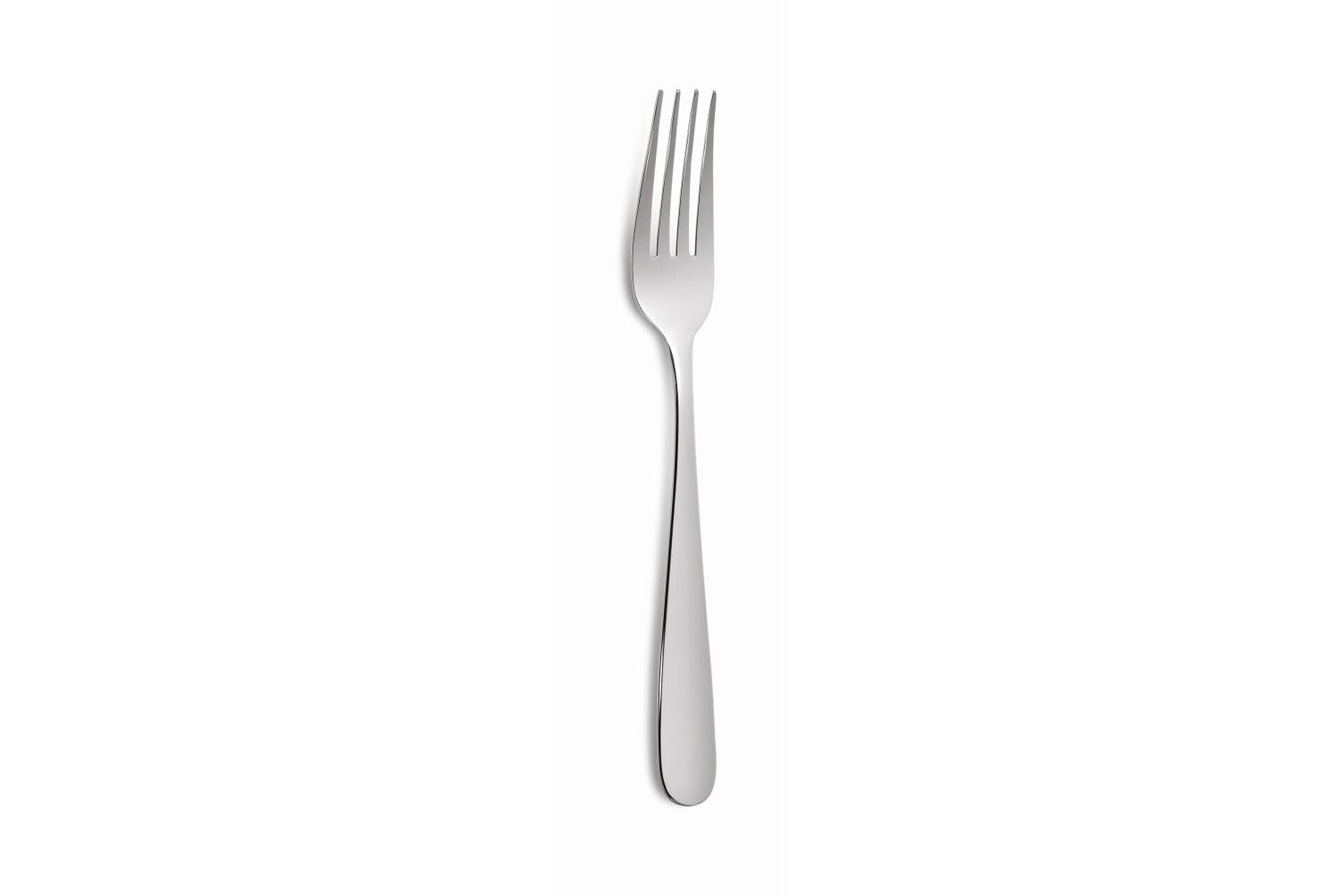
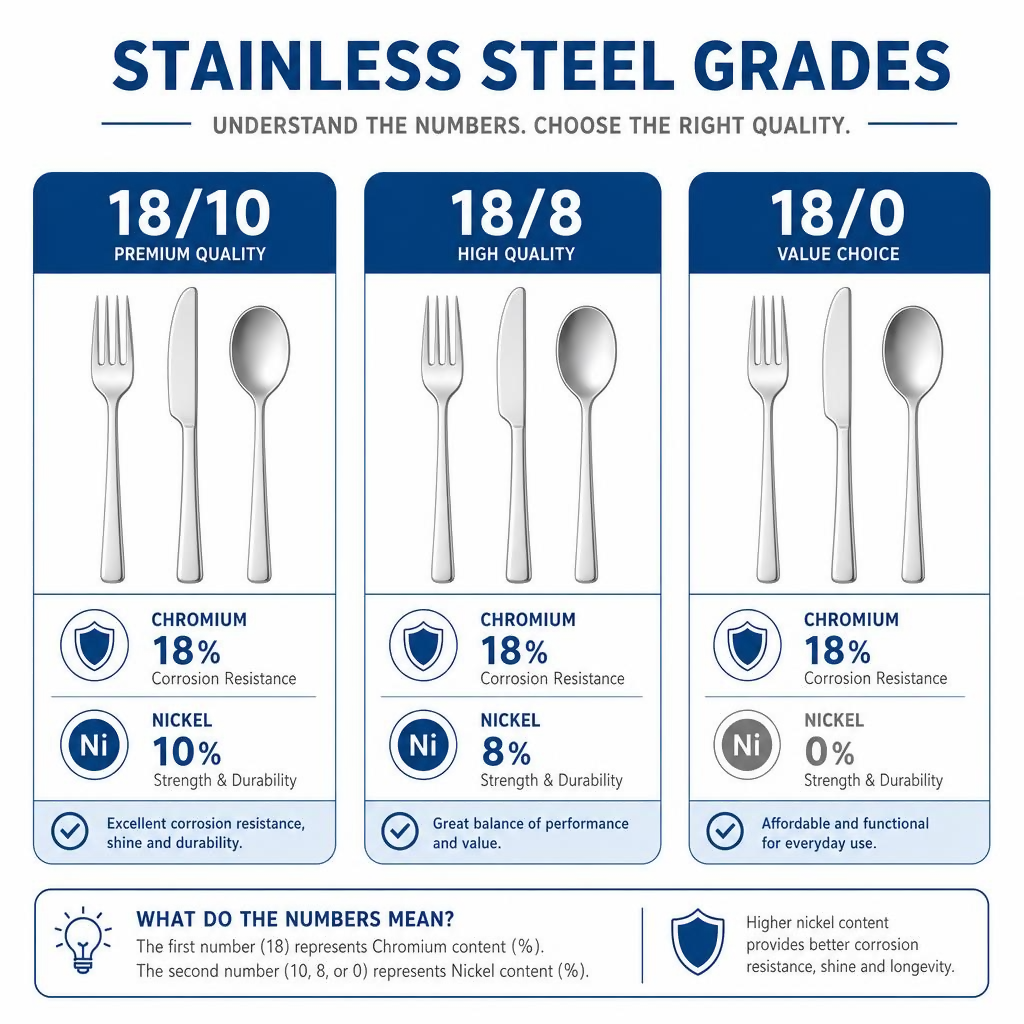
The grade number printed on stainless steel tableware tells you the chromium-to-nickel ratio. That ratio determines corrosion resistance, weight, and price — three things that affect every piece on your tables.
18/10 (304-grade): 18% chromium, 10% nickel. This is the standard for fine dining, upscale hotels, and any operation where tableware sits on tables for extended service. The 10% nickel content creates a dense, mirror-stable surface that resists pitting and maintains its finish after 500+ commercial dishwasher cycles. Weight per standard dinner fork: 60–75 grams. Wholesale cost at 500-piece MOQ: $1.20–$2.80 per piece depending on pattern complexity.
18/8 (also 304-grade, slightly different composition): In practice, 18/8 and 18/10 perform nearly identically in commercial foodservice. The nickel difference (8% vs 10%) is marginal under ISO 3506 testing. Many suppliers list 18/8 to hit a lower price point while delivering equivalent durability. At 1,000-piece MOQ, expect $0.90–$2.20 per piece.
18/0 (430-grade): 18% chromium, zero nickel. This grade is magnetic (useful for induction-adjacent applications) and costs 30–40% less than 18/10 at wholesale. The tradeoff: lower nickel content means faster surface oxidation when exposed to acidic foods, chlorine-heavy commercial detergents, or humidity. In a high-turnover fast casual operation where tableware cycles through 80+ washes per day, 18/0 shows visible spotting within 6–12 months. For hotels with formal dining, avoid 18/0 entirely. For cafeterias and casual dining, 18/0 is acceptable with proper detergent management.
| Grade | Chromium | Nickel | Dishwasher Cycles | Wholesale Price/Piece (500 MOQ) | Best For |
|---|---|---|---|---|---|
| 18/10 | 18% | 10% | 1,000+ | $1.20–$2.80 | Fine dining, 5-star hotels |
| 18/8 | 18% | 8% | 800–1,000+ | $0.90–$2.20 | Mid-scale restaurants, business hotels |
| 18/0 | 18% | 0% | 300–500 | $0.60–$1.40 | Cafeterias, fast casual, staff canteens |
What “Wholesale” Actually Means for Restaurant and Hotel Buyers
Wholesale tableware pricing varies significantly based on MOQ, customization, and whether you’re ordering stock patterns or OEM.
Tier 1 — Stock patterns, 100–500 pieces: This is where most independent restaurant owners operate. At this volume, you’re ordering from a distributor’s existing inventory. Expect to pay 40–60% above factory price. A standard 18/10 dinner fork costs $1.80–$3.50 per piece at this tier. No logo, no custom weight — just catalog items.
Tier 2 — 500–2,000 pieces: Most Chinese OEM manufacturers accept orders at this volume for stock patterns with optional logo engraving. Price per piece drops 25–35% compared to Tier 1. Lead time: 25–45 days. This is the sweet spot for hotel chains and multi-unit restaurant groups.
Tier 3 — 2,000+ pieces, custom patterns: Full OEM — custom handle design, specific weight spec, branded packaging. Factory pricing applies. At this volume, a 18/10 dinner fork can be produced for $0.85–$1.60 per piece (ex-factory, before shipping). Lead time: 45–70 days including sample approval.
Hidden costs buyers regularly miss:
- Sampling fees ($50–$200, sometimes refundable against order)
- Sea freight: $100–$150 per CBM (a standard 500-piece flatware set occupies roughly 0.08–0.12 CBM)
- Import duties vary by country — EU tariffs on Chinese stainless flatware currently run 3.7–6.5%
- Polishing defect rate: budget for 1–3% wastage on mirror-polished pieces
Mirror Polish vs Satin Finish: Match the Finish to Your Venue
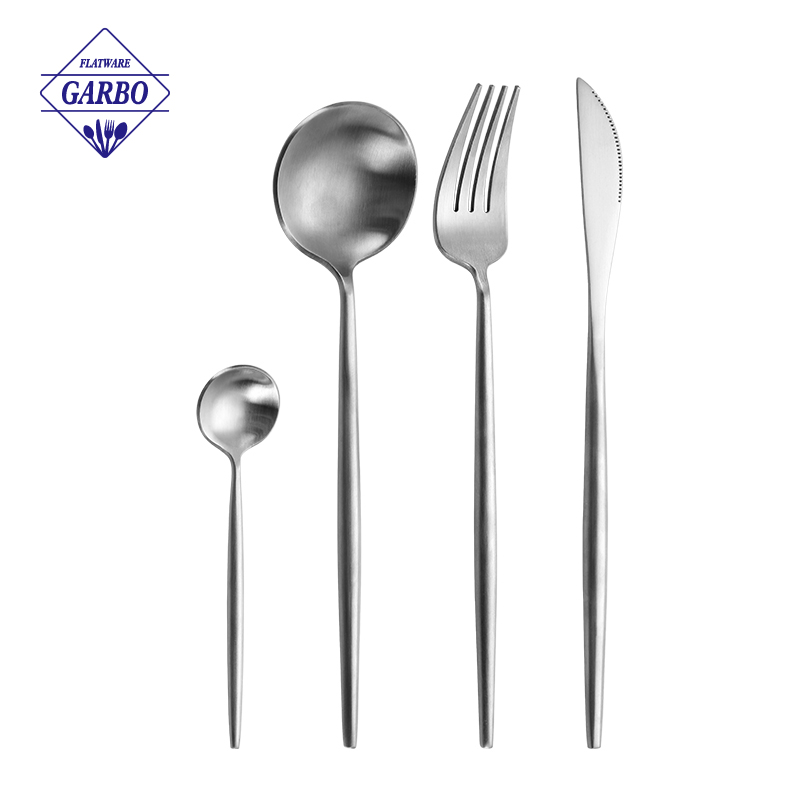
Surface finish affects maintenance labor, light behavior in the dining room, and how scratches show over time. This distinction gets skipped in most wholesale guides, but it changes the weekly labor cost for your front-of-house team.
Mirror polish (Grade 8 finish): High reflectivity, formal appearance. Shows fingerprints and smudges immediately. Requires hand-polishing with a soft cloth before table setting in fine dining environments. Popular in luxury hotels, Michelin-star restaurants, upscale banquet venues. Smudge marks under warm lighting become visible from across the room.
Satin finish (Grade 4/brushed finish): Matte, directional texture. Hides fingerprints and light scratches significantly better than mirror polish. Faster to polish and maintain. The standard choice for business hotels, mid-scale restaurants, and any operation prioritizing speed of service over formal presentation. Increasingly popular in modern/industrial restaurant aesthetics.
Electropolished finish: Applied after standard polishing — an electrochemical process that smooths surface micro-roughness. Enhances corrosion resistance by 15–20% over standard mirror finish (relevant for operations in coastal environments or with aggressive detergent chemistry). Adds $0.10–$0.30 per piece at wholesale.
| Venue Type | Recommended Finish | Maintenance Level |
|---|---|---|
| 5-star hotel, fine dining | Mirror polish | High |
| Business hotel, casual restaurant | Satin/brushed | Low-Medium |
| Buffet, cafeteria, outdoor dining | Satin or matte | Low |
| Coastal/tropical property | Electropolished | Medium |
Commercial Dishwasher Reality: What No One Tells Wholesale Buyers
The grade stamp on a piece of flatware is tested under lab conditions — single cycles, neutral pH water, controlled temperature. Your commercial dishwasher runs at 65–85°C with high-chlorine detergent 80–120 times per day.
Three factors that damage stainless steel tableware faster than the grade rating suggests:
1. Chlorine concentration in detergent. Chlorine-based commercial dishwasher detergents (standard for most foodservice operations) accelerate pitting corrosion on 18/0 and low-quality 18/8 pieces. If you’re running 18/10 but using aggressive chlorine programs, you’re shortening usable life unnecessarily. Request chlorine-reduced enzyme detergents — they’re now standard in German and Scandinavian hotel operations and extend flatware life by 30–40%.
2. Wet storage after washing. Leaving wet flatware in trays allows chlorine residue to concentrate as water evaporates. This is the most common cause of pitting and rust spots on otherwise high-quality stainless steel. A 15-minute air-dry protocol after the wash cycle eliminates most of this.
3. Mixed-metal contact. Silver-plated serving pieces, aluminum trays, and stainless cutlery stored in contact while wet creates galvanic corrosion. Keep metals separated in wash racks.
Practical benchmark: A properly maintained 18/10 flatware set in a hotel operation should last 7–12 years before replacement. An 18/0 set in the same conditions typically needs replacement in 3–5 years. The upfront price difference is usually recovered within 2–3 years through reduced replacement frequency.
How to Vet a Chinese OEM Tableware Supplier Without Visiting the Factory
China produces over 60% of the world’s stainless steel tableware, with Guangdong, Zhejiang, and Shandong as the major production hubs. The quality gap between factories is significant — two suppliers can both claim “18/10, mirror polish” and deliver very different products.
5-point supplier checklist before placing a wholesale order:
- Request a material certificate (mill certificate): A legitimate factory can provide the material test report from their steel supplier confirming chromium and nickel content. If a supplier hesitates or offers only an SGS “product certificate,” push for the mill certificate. Factories using sub-spec material won’t have one.
- Order samples of 3 pieces per SKU, not 1: One piece can be a showroom sample. Three pieces from a production run reveal consistency. Check edge finishing, handle attachment points, and surface polish uniformity across all three.
- Specify weight in grams, not just “heavy gauge”: Vague specs like “heavy duty” mean nothing contractually. Specify: dinner fork ≥62g, dinner knife ≥80g, soup spoon ≥65g. Include this in the purchase order.
- Request a production photo at 50% completion: Reputable OEM factories accept this request. If a supplier refuses or is evasive, that’s a risk signal.
- Check for food contact compliance documentation: For EU markets, ask for EU Regulation (EC) No 1935/2004 compliance. For US market, FDA 21 CFR compliance documentation. Neither is difficult to obtain from a legitimate factory — if they can’t provide it, find another supplier.
Ordering at Scale: MOQ Tiers, Lead Times, and Logistics
Realistic MOQ by supplier type:
| Supplier Type | Typical MOQ | Lead Time | Best For |
|---|---|---|---|
| Trading company (Alibaba) | 50–100 pieces | 15–25 days | Small orders, testing suppliers |
| Mid-size factory (direct) | 200–500 pieces | 25–40 days | Restaurant groups, small hotel chains |
| Large OEM manufacturer | 1,000–5,000 pieces | 45–70 days | Hotel chains, distributors |
Shipping from China: For tableware orders, sea freight is almost always the right choice for orders above 0.5 CBM (~200+ pieces of flatware). Air freight makes sense only for sample orders or urgent replacement stock. At $100–$150 per CBM for sea freight, a full 1,000-piece flatware set (approximately 0.2–0.3 CBM) costs $20–$45 to ship by sea.
Port-to-table timeline for a 1,000-piece hotel flatware order from a Guangdong factory:
- Sample approval: 7–10 days
- Production: 20–30 days
- Quality inspection: 3–5 days
- Sea freight (to US/EU): 18–28 days
- Customs clearance: 3–7 days
- Total: 51–80 days from order confirmation
Plan replacement stock orders 3 months ahead of need for hotel openings or seasonal refreshes.
FAQ: What Restaurant and Hotel Buyers Ask Most
What is the best stainless steel grade for restaurant tableware?
18/10 (304-grade) is the industry standard for full-service restaurants and hotels. It offers the best balance of corrosion resistance, durability after commercial dishwashing, and surface finish retention. 18/0 is acceptable for high-turnover casual operations where budget is the primary constraint.
How much does wholesale stainless steel tableware cost per piece?
At 500-piece MOQ, 18/10 flatware from a Chinese OEM manufacturer runs $0.90–$2.80 per piece depending on pattern complexity and finish. Electropolished or custom-engraved pieces are $0.20–$0.50 more per piece.
Is stainless steel tableware safe for food contact?
Yes. Stainless steel is FDA-compliant and approved under EU Regulation (EC) No 1935/2004 for food contact. Grade 304 (18/10 and 18/8) contains no leachable metals at concentrations that present health risks under normal foodservice conditions.
Why is my stainless steel flatware rusting after a few months?
Pitting and rust spots on stainless steel flatware are almost always caused by chlorine exposure (from dishwasher detergent), wet storage after washing, or contact with other metals in wash racks — not grade deficiency. Switch to enzyme-based detergents and implement a post-wash dry protocol to resolve the issue.
What is the minimum order for hotel tableware from a Chinese factory?
Most direct OEM factories accept orders from 200–500 pieces per SKU. Trading companies on Alibaba will often accommodate orders of 50–100 pieces but at higher per-piece pricing. For full hotel flatware sets (6–8 SKUs), expect a minimum total order of 1,200–3,000 pieces to get factory-direct pricing.
The Spec Sheet Your Next RFQ Needs
Most tableware procurement problems trace back to a vague purchase order. Before you contact a supplier, lock down these five specs in writing:
- Material grade: “18/10 stainless steel (AISI 304)” — not “stainless steel”
- Weight per piece: Specify minimum grams for each SKU
- Surface finish: “Mirror polish (Ra ≤ 0.1μm)” or “Satin finish (Grade 4)”
- Compliance requirement: FDA 21 CFR or EU 1935/2004 documentation required
- Acceptable defect rate: Typically ≤1.5% for mirror-polished pieces, ≤1% for satin
A supplier who resists any of these specs is telling you something important about how they operate.





