


The stainless steel tiffin box — known in India as the dabba — is a stackable, multi-compartment food carrier with a loyal global following, especially among Indian diaspora communities in the UK, Canada, Australia, and the UAE. For importers and retailers, India remains the primary manufacturing hub, offering everything from budget-grade 202 steel to export-ready 304 food-grade products. This guide covers steel grades, product types, certification requirements, and how to source in bulk without getting burned on quality.
What Is a Tiffin Box (Dabba) — and Why Importers Are Paying Attention Again
A tiffin box — or dabba — is a stacked, interlocking food container made from stainless steel. The design is distinctly South Asian: individual round or rectangular containers clip or lock into a vertical carrier, each tier holding a separate dish. The classic Bombay tiffin, for instance, stacks 2–5 tiers and arrives with a wire bail handle.
What’s driving renewed wholesale interest? Three converging trends:
- Indian diaspora populations in the UK, US, Canada, and Australia are actively seeking authentic kitchenware — and the tiffin box is a cultural staple, not a trend item.
- Zero-waste and plastic-free food storage movements have pushed stainless steel containers into mainstream eco-lifestyle retail.
- Food delivery and meal prep services are sourcing stainless steel containers as a premium alternative to single-use packaging.
The result is a product category that sells into multiple channels — ethnic grocery, zero-waste shops, Amazon, food service — from a single wholesale SKU.
Grade Matters: 304 vs 202 vs 201 Stainless Steel
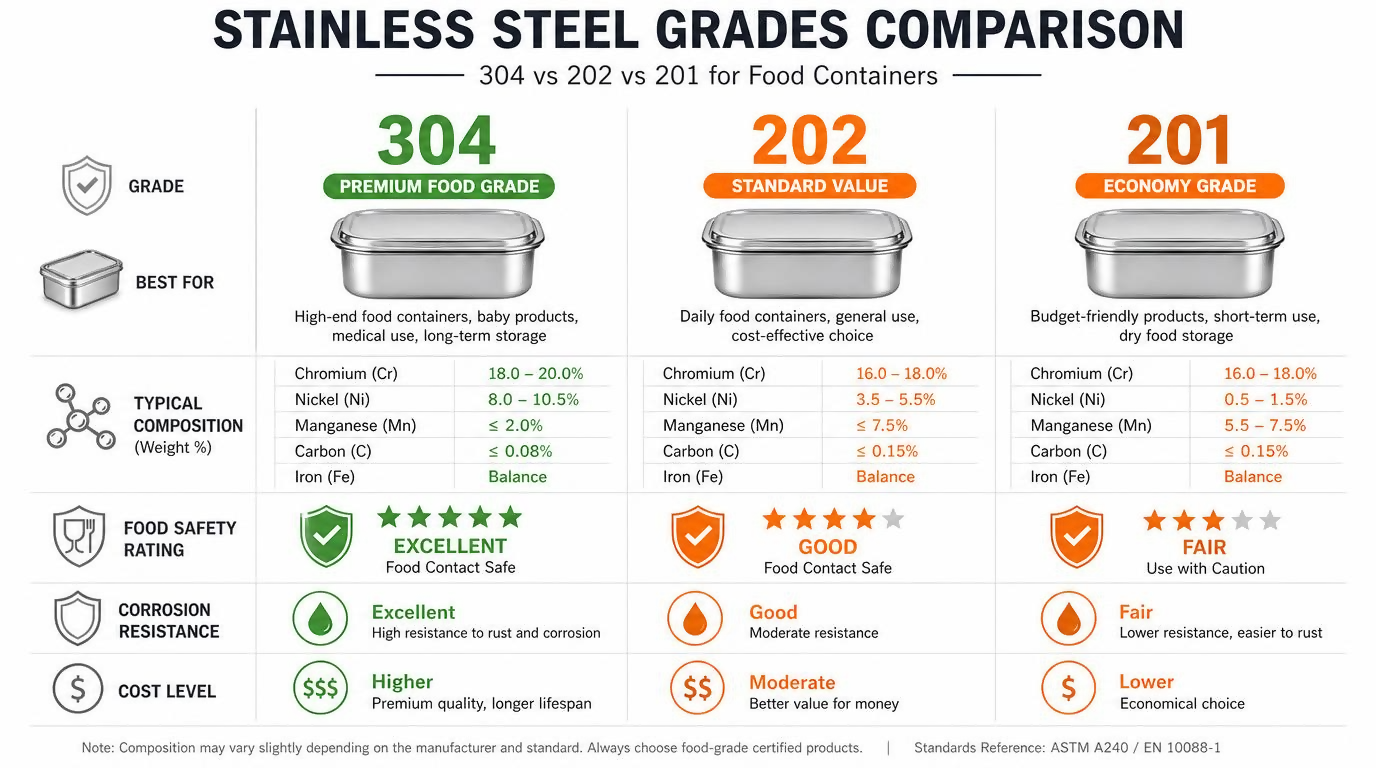
Not all “stainless steel tiffin boxes” are equal. Indian manufacturers produce tiffins in three main grades, and the grade determines food safety, rust resistance, and shelf life.
| Grade | Composition | Food Safe? | Rust Resistance | Relative Cost |
|---|---|---|---|---|
| 304 (18/8) | 18% Cr, 8% Ni | Yes — industry standard | Excellent | Baseline |
| 202 | 17–19% Cr, 4–6% Ni | Acceptable for dry/low-acid food | Good | ~15–25% cheaper |
| 201 | 16–18% Cr, 3.5–5.5% Ni | Marginal — avoid for acidic foods | Moderate | ~25–35% cheaper |
Grade 304 is the right call for most wholesale buyers. It meets FDA and EU LFGB food contact standards, handles acidic foods (curries, tamarind, citrus) without pitting, and is what reputable Indian exporters like Vinod Steel use in their export range.
Grade 202 is a cost-reduction play with tradeoffs. Some Indian manufacturers use it for the domestic market where price sensitivity is high. For export to markets with food contact regulations — UK, EU, US, Canada — you need to verify your supplier isn’t quietly substituting 202 for 304. Ask for mill test certificates (MTCs) that show the actual nickel content.
Grade 201 should be avoided for food applications. The lower nickel content makes it susceptible to corrosion from acidic food residues, which is a food safety and returns problem waiting to happen.
One thing I’d always verify at sampling stage: run a magnet test. Grade 304 is weakly magnetic or non-magnetic; grade 201/202 tends to be more strongly magnetic due to lower nickel. It’s not a definitive test, but it flags obvious substitutions before you order containers.
Types of Stainless Steel Tiffin Boxes for Wholesale
Indian manufacturers produce four main tiffin configurations. Mapping these to your sales channel before ordering saves costly mismatches.
1. Bombay / Round Tiffin (2–5 tier)
The classic design — cylindrical, stackable tiers with a bail handle. Available in 7″, 8″, 9″, 10″ diameters. The 3-tier 8″ is the bestselling wholesale configuration. Works across Indian grocery retail, Amazon, and gifting.
2. Rectangular Lunch Box with Clips
Modern design with locking side clips. Easier to fit in a bag, preferred for school and office markets in Western countries. Typically offered in 2–3 compartment versions.
3. Insulated Hot Tiffin
Stainless steel outer body with an insulated jacket — keeps food hot for 4–6 hours. Higher price point, higher margin. Common in 3–5 tier versions. Primarily an office and corporate gifting SKU.
4. Single Dabba / Storage Container
Single-compartment round or oval containers, often sold in sets of 3 or 5. Used as food storage or prep containers. Strong cross-sell to zero-waste kitchenware buyers.
For first-time wholesale buyers, the 3-tier 8″ Bombay tiffin in 304 grade with a wire handle carrier is the lowest-risk entry SKU. High recognition, proven demand across diaspora and eco-lifestyle channels, and enough margin to absorb freight.
What to Verify Before Placing a Bulk Order
Steel grade certification: Request mill test certificates for every batch. Confirm nickel content is consistent with stated grade.
Food contact compliance: For UK/EU markets, LFGB certification is required. For US imports, FDA food contact compliance documentation. For Indian domestic-branded products, BIS certification is the reference standard for stainless steel kitchenware.
Lid and clip quality: The most common failure point in tiffin boxes is not the steel — it’s the locking clips and gaskets. Request samples and stress-test the clips through 50+ open/close cycles. Check that the lids don’t warp under moderate pressure.
Finish consistency: Export-grade tiffins should have a mirror or brushed finish that’s uniform across the batch. Inconsistent finish often signals mixed-grade steel or quality control gaps.
MOQ and lead time: Most Indian tiffin manufacturers work with MOQs of 500–1,000 pieces per SKU for standard sizes. Custom sizes or private label typically require 2,000+ pieces. Standard lead time is 30–45 days from order confirmation; allow 60 days for custom work.
Where to Source Stainless Steel Tiffin Boxes from India
Manufacturing clusters: Delhi-NCR and Rajkot (Gujarat) are India’s two primary stainless steel kitchenware manufacturing hubs. Delhi suppliers tend to have stronger export documentation processes; Rajkot has a higher concentration of pure-volume manufacturers at lower price points.
Sourcing channels:
- IndiaMART / TradeIndia — largest B2B directories for Indian manufacturers. Filter by “Export License” and request MTCs upfront to qualify serious suppliers.
- Alibaba (India sellers) — many Indian tiffin suppliers list here. Compare Alibaba listings with the same supplier’s IndiaMART page to cross-check pricing.
- Trade fairs — India International Trade Fair (November, Delhi) and Ambiente (Frankfurt, February) both feature Indian kitchenware exhibitors. The Frankfurt show is worth attending if you’re buying for European retail.
- Direct factory approach — if your volume is above 5,000 pieces per order, direct factory sourcing from the Rajkot cluster typically yields 15–25% better pricing than trading company intermediaries.
Red flags to watch:
- Supplier can’t provide mill test certificates within 48 hours of request — likely a trader without direct manufacturing access.
- “Food grade stainless steel” with no grade number specified — ask explicitly for 304 confirmation.
- Price quotes that seem inconsistent with grade 304 raw material costs — a complete 3-tier Bombay tiffin with carrier in genuine 304 steel has real material cost; quotes that undercut similar-spec products by 40%+ are a red flag for grade substitution.
Frequently Asked Questions
What is the difference between a tiffin box and a dabba?
None — dabba is the Hindi/Marathi word for box or container, while “tiffin” is the British-era term for a light meal or its carrier. Both refer to the same stacked stainless steel food carrier in Indian use.
What stainless steel grade should I specify for a tiffin box wholesale order?
Specify grade 304 (18/8) in writing on your purchase order. It’s the food contact standard accepted in the UK, EU, US, and Australia. Request mill test certificates confirming the nickel content (minimum 8%).
What is the minimum order quantity for tiffin box wholesale from India?
Most manufacturers set a 500–1,000 piece MOQ per SKU for standard Bombay-style tiffins. Private label or non-standard sizes typically require 2,000+ pieces.
Are Indian stainless steel tiffin boxes BPA-free?
Yes — stainless steel contains no plastics or BPA. The relevant concern for metal containers is nickel migration, which grade 304 addresses through its controlled composition. Avoid low-grade 201 steel if you’re marketing to health-sensitive consumers.
What certifications should I request from an Indian tiffin supplier for EU/UK import?
LFGB (Germany food contact) is the most widely accepted EU certification. UK importers should request LFGB documentation plus ask about compliance with the UK’s Food Safety Act. Also request BIS certification documentation covering domestic Indian manufacturing standards for stainless steel kitchenware.
The Sourcing Decision That Separates Good Batches from Returns
The stainless steel tiffin box is one of the more forgiving wholesale products from India — low breakage, long shelf life, high cultural affinity in diaspora markets. But the grade issue is real, and it’s the single variable that separates a product that builds your brand from one that generates Amazon returns and refund requests.
Specify 304. Get the MTCs. Test the clips. The margin difference between 202 and 304 at wholesale is small — the customer service cost of corrosion complaints is not.





