


Sourcing stainless steel tongs at wholesale scale means more than comparing price-per-unit. Steel grade, spring mechanism quality, certification compliance, and MOQ structure all determine whether an order serves your customers or creates problems. This guide covers the specifics B2B buyers need: how to read material specs (304 vs 18/10 vs 316), which certifications are required in the US and EU, what realistic wholesale pricing looks like at different volumes, and how to evaluate suppliers before committing. Whether you’re supplying restaurant chains, catering companies, or building a private-label kitchenware program, the framework here helps you source with confidence. CharmsCook manufactures stainless steel kitchen tongs for wholesale buyers and OEM clients — this guide reflects the questions professional buyers ask most.
Why Stainless Steel Still Dominates Commercial Kitchen Tong Orders
Stainless steel has held the top position in professional kitchens for one reason: it performs reliably under conditions that eliminate the alternatives. Commercial kitchen tongs get dropped on concrete, run through industrial dishwashers dozens of times per week, and exposed to everything from acidic marinades to 400°F grill grates. Plastic and silicone work in narrow niches, but neither handles the full range of daily professional use.
The numbers back this up. Stainless steel tongs tolerate temperatures up to 500°F (260°C) without deforming, resist corrosion from repeated commercial dishwashing cycles, and don’t harbor bacteria in surface cracks the way porous materials can. In any health-regulated food service environment, that last point is what makes stainless the default.
From a wholesale distribution standpoint, durability creates a specific commercial dynamic: well-made stainless tongs last a restaurant two to three years under daily use. That’s a longer replacement cycle than plastic alternatives, which means your value proposition has to be quality and reliability, not just low unit cost. One bad batch — locking rings that loosen after 300 uses, tips that corrode despite being marketed as “rustproof” — and the buyer switches suppliers. The stakes in commercial kitchen supply are higher than in consumer retail.
Material Grades Decoded: 304, 18/8, 18/10, and When 316 Earns Its Premium
The most common point of confusion in wholesale tong sourcing is decoding what material grades actually mean — and whether a supplier’s claims are verifiable.
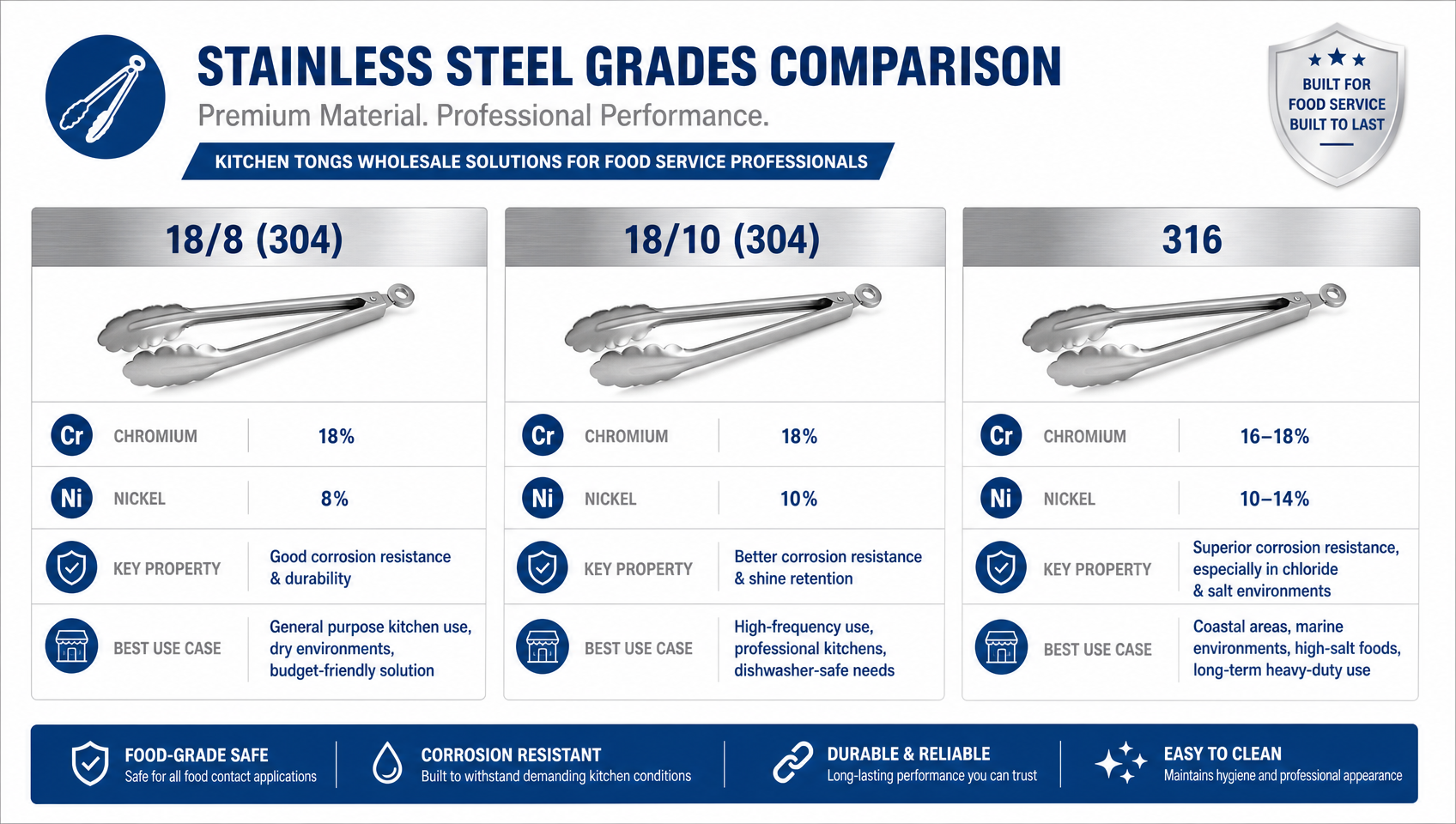
304 stainless steel is the industry standard for food-contact utensils. The ASTM A240 specification defines it as containing 18–20% chromium and 8–10.5% nickel. The chromium creates a passive oxide layer that resists corrosion; the nickel adds ductility and the characteristic bright finish.
18/8 and 18/10 are marketing designations, not separate alloys. Both describe 304-grade steel:
- 18/8: 18% chromium, 8% nickel — the lower end of the 304 nickel range
- 18/10: 18% chromium, 10% nickel — the higher end
In practice, 18/10 tongs offer marginally better corrosion resistance and a slightly more polished appearance. For food service wholesale, 18/10 is the specification you want your supplier to document.
316 stainless steel introduces 2–3% molybdenum, which dramatically improves resistance to chlorides — saltwater, bleach-based sanitizers, and high-salinity foods. For most commercial kitchens, 316 is overkill and adds unnecessary cost. Where it genuinely matters: seafood processing, oyster bar stations, and any operation using heavy chlorine sanitizers on a daily basis. If your buyers operate in those environments, 316 is worth the 15–25% price premium.
| Grade | Chromium | Nickel | Molybdenum | Best For |
|---|---|---|---|---|
| 18/8 (304) | 18% | 8% | None | General commercial kitchen use |
| 18/10 (304) | 18% | 10% | None | Premium food service, polished finish |
| 316 | 16–18% | 10–14% | 2–3% | Seafood, high-chlorine environments |
Critical sourcing note: When a supplier says “food grade stainless,” ask for the alloy designation and a material test certificate. “Food grade” without a specific grade number is an unverifiable claim.
The Main Types of Kitchen Tongs and Which Categories Move in Wholesale
Not every tong type sells equally well in wholesale channels. Understanding which types align with your buyer base determines what to stock and in what depth.
| Type | Primary Use | Common Lengths | Wholesale Volume |
|---|---|---|---|
| Locking / Utility Tongs | General kitchen, grilling, plating | 9″, 12″ | Highest — the core SKU for most wholesale programs |
| Serving / Buffet Tongs | Buffets, catering displays, salad bars | 9″, 12″ | High — consistent demand from catering and hotel buyers |
| BBQ / Grilling Tongs | Outdoor cooking, food stalls, grill stations | 16″, 18″ | Moderate — seasonal spike in spring/summer, steady for food service |
| Scissor Tongs | Noodle stations, Asian cuisine, bakeries | 8″, 10″ | Moderate — strong demand in specific regional markets |
| Silicone-Tip Tongs | Non-stick cookware protection | 9″, 12″ | Growing — driven by non-stick cookware adoption |
| Bread / Pastry Tongs | Bakery display cases, cafe service | 6″, 8″ | Low-moderate — niche but stable for bakery supply channels |
9″ and 12″ locking tongs represent the majority of commercial wholesale volume. Any supplier you work with should carry these in ready stock, not to order. If a factory can only offer 4–6 week lead times on standard locking tongs, that’s a supply chain risk for any buyer serving active restaurant clients.
Silicone-tip tongs deserve specific attention: the stainless steel body and the silicone tips require separate material documentation for certification purposes. This matters for US market sales where tip material compliance falls under FDA 21 CFR Part 177.
Specifications That Separate Quality Tongs From Budget Ones
Price is only one variable. These are the specs that determine whether commercial kitchen buyers come back for repeat orders:
Steel gauge (thickness): Commercial-grade tongs should use 1.0–1.2mm material. Below 0.8mm, the tong body flexes noticeably under load and deforms faster at high temperatures. Ask your supplier for a material datasheet — gauge should be listed, not estimated.
Joint / pivot design: Two designs dominate the market. A box joint (square-formed pivot where the two arms interlock) is more durable under repetitive stress — this is what professional-grade brands use. A coil spring pivot is lighter and more common in consumer-grade products. For commercial buyers who use tongs daily for years, the joint type matters more than most product descriptions suggest.
Locking ring mechanism: On locking tongs, the ring must slide smoothly and hold securely. Test it with 20–30 open/close cycles on any sample. Cheap locking mechanisms develop play in the ring groove after a few hundred uses — the ring stops locking reliably and the tong becomes a liability in a professional kitchen. This is the single most common complaint sourcing buyers pass along from their restaurant clients.
Tip design: Scalloped tips (with small teeth or scalloped edges) grip food without piercing it — preferred for serving and plating. Flat tips are better for flipping. Verify tip design matches the intended use case you’re selling into.
Surface finish: Mirror polish is the standard for food service environments — easy to inspect visually for cleanliness. Brushed finishes are acceptable but show wear faster. Never accept any coating, plating, or paint on food-contact surfaces.
Dishwasher tolerance: Commercial dishwashers operate with wash cycles at 150–165°F (66–74°C) and sanitizing rinse cycles reaching 165–180°F (74–82°C), with high-alkalinity detergents. Any tong marketed for commercial use should be tested and documented as dishwasher safe under those conditions.
Certifications That Open — and Close — Doors in Food Service Markets
This is the section most wholesale buyers skip until their distributor customer asks for documentation at the worst possible time.
NSF/ANSI 2 (United States): The primary food equipment certification for US commercial use. NSF/ANSI 2 verifies that materials, surface finish, construction, and design meet public health and sanitation standards. Products must have smooth, cleanable surfaces free of crevices that trap food debris. For any wholesale program targeting US restaurant chains, catering companies, or food service distributors, NSF certification is the standard requirement.
FDA 21 CFR Part 177 (United States): Covers food contact materials. Stainless steel (304/316) is inherently compliant. But if your tongs include silicone tips, rubber grip handles, or any polymer element, those materials need separate compliance documentation under this regulation. This is frequently missed in sourcing reviews.
LFGB (Germany/EU): The German standard for consumer goods testing, now widely used as the EU reference for kitchen utensils. More stringent than US standards in some migration testing categories. If you distribute into Germany or the EU, request LFGB test reports — not just the certification claim, the actual report file.
CE Marking: Required for regulated product categories sold in the EU. Kitchen utensils don’t universally require CE marking, but a supplier familiar with CE processes signals broader regulatory competence.
Practically: not every order needs all four. US-only distribution needs NSF and FDA documentation. EU distribution adds LFGB. Having the documentation available before your buyer asks for it builds the kind of trust that retains accounts.
Wholesale Pricing Tiers and MOQ — What the Market Actually Looks Like
Wholesale pricing for stainless steel kitchen tongs varies by grade, type, and order volume. Here’s a realistic picture of current market ranges:
| Order Volume | Unit Price (18/10, 9″–12″ locking tongs) |
|---|---|
| 100–300 pcs | $2.50–$4.00 |
| 500–1,000 pcs | $1.50–$2.50 |
| 2,000–5,000 pcs | $0.80–$1.50 |
| 10,000+ pcs (OEM) | $0.50–$0.90 |
These ranges reflect factory-level estimates for standard 304/18/10 stainless tongs from mid-size manufacturers. Silicone-tip models, custom handle colors, or branded packaging typically add $0.20–$0.50 per unit.
MOQ structure by program type:
- Stock items (no customization): Most factories accept 500–1,000 piece minimums. Some suppliers offer mixed-style orders — you can combine 9″ and 12″ locking tongs, or locking and serving tongs, to reach MOQ across the range rather than per SKU.
- OEM / custom branding: Logo laser engraving or custom packaging typically starts at 2,000–5,000 pieces. Custom silicone tip colors or handle materials can push OEM MOQ higher.
- Mixed container programs: For smaller distributors, working with a supplier that offers product family minimums (e.g., “any combination of our tong line up to container minimum”) provides better entry-level flexibility.
If a supplier’s quoted unit price is more than 50–60% below the table ranges above for comparable specs, there’s usually a reason — either the material grade is inferior, the certification documentation is absent, or there are hidden costs in the order structure.
Stainless Steel Kitchen Tongs Wholesale at CharmsCook
CharmsCook produces stainless steel kitchen utensils including tongs for wholesale buyers, distributor programs, and OEM clients. Their range covers standard locking tongs, serving tongs, BBQ grilling tongs, and silicone-tip variants across the common commercial lengths (9″, 12″, 16″).
For buyers who need material traceability — an increasing requirement from restaurant chains and institutional food service buyers — CharmsCook provides material documentation and certification records on request. This matters more now than it did five years ago: health department compliance requirements have pushed more buyers to ask for verifiable specs, not just product marketing claims.
The direct inquiry channel at charmscook.com handles wholesale pricing requests and OEM program discussions. What to bring to that conversation: your target volume, market (US/EU affects certification requirements), whether you need branded packaging, and your timeline. The more specific the inquiry, the faster the pricing turnaround.
A sample order before a full wholesale commitment is the standard approach. Request samples at multiple lengths and test the locking ring mechanism, joint quality, and finish consistency. Quality that holds up in the sample stage is the only reliable predictor of production batch quality.
Red Flags That Experienced Wholesale Buyers Know to Watch For
Most sourcing mistakes are visible in the evaluation phase if you know what to look for:
Vague material claims without documentation. “Stainless steel” or “food grade” without a specific alloy designation (304, 316) and a material test certificate is an unverifiable claim. Any manufacturer who produces to spec should be able to share an MTC (material test certificate) showing chemical composition. If they can’t or won’t, move on.
Certifications presented as images, not documents. A JPG of an NSF logo on a product brochure is not certification documentation. Ask for the actual NSF certificate with the certificate number, which you can verify independently at the NSF product database. Same applies to LFGB reports — request the test report file, not just a claim.
No sample program. Reputable suppliers offer samples before bulk orders. A manufacturer who refuses samples or charges a non-refundable sample fee that they won’t credit against a first order is a risk signal. Factories confident in their production quality want you to test before you commit.
Locking ring play on samples. Test every sample’s locking mechanism with 30–50 open/close cycles. If the ring develops visible play or stops holding position reliably within that range, it will fail faster in commercial use. This is the most consistent complaint from restaurant buyers about budget tong batches.
Lead times that don’t match stock claims. If a supplier’s catalog says “in stock” but their lead time quote is 6–8 weeks, those items aren’t actually in stock. For commercial buyers who need reliable replenishment, a supplier who can ship stock items within 7–14 days of order is fundamentally different from one operating on production lead times.
Frequently Asked Questions
What stainless steel grade is best for commercial kitchen tongs?
18/10 (304-grade stainless with 18% chromium and 10% nickel) is the standard for professional food service. It offers solid corrosion resistance, a polished finish, and proven durability under daily commercial use. 316-grade adds molybdenum for extra chloride resistance and is worth the premium only for seafood environments or operations using heavy chlorine sanitizers regularly.
What certifications should I require from a wholesale tong supplier?
For US food service distribution, NSF/ANSI 2 is the primary certification to request. Any polymer components (silicone tips, rubber handles) also need FDA 21 CFR Part 177 compliance documentation. For EU/German market distribution, request LFGB test reports. These are documents, not logos — ask for the actual certification or test report file.
What is the typical MOQ for stainless steel tongs wholesale?
For stock items without customization, most mid-size manufacturers accept 500–1,000 piece minimums, often with flexibility to mix styles within that MOQ. OEM or custom-branded orders typically start at 2,000–5,000 pieces. First-time buyers should look for suppliers who offer product family minimums rather than per-SKU requirements.
How do I verify that a supplier’s tongs are actually 304 stainless steel?
Request a material test certificate (MTC) showing the chemical composition of the production batch. For additional assurance, an XRF (X-ray fluorescence) spectrometer test independently confirms the alloy. This costs $50–$150 per sample through third-party testing labs and is worth doing on any first order with a new supplier at meaningful volume.
What tong lengths should I stock for a wholesale program?
9″ and 12″ locking tongs cover the majority of commercial kitchen use cases and should be your core stock. Adding 16″–18″ BBQ/grilling tongs serves food stall and outdoor catering buyers. Bread or pastry tongs in 6″–8″ are a useful add-on for bakery and cafe supply channels. For most wholesale programs, 9″ and 12″ locking account for 70–80% of volume.
Every Bad Wholesale Order Was a Skipped Evaluation Step
Stainless steel tongs are a simple product. Sourcing them well at wholesale scale means asking the right questions before a single dollar changes hands. Material grade documentation, certification compliance, spring mechanism durability, and realistic MOQ expectations aren’t bureaucratic details — they’re the difference between a program that builds customer loyalty and one that generates return shipments and lost accounts.
The evaluation process is straightforward once you know what to check: request documentation, test samples deliberately, verify certifications through primary sources, and compare pricing against market ranges. Suppliers who welcome that scrutiny are the ones building businesses on repeat orders, not one-time transactions.
For sourcing stainless steel kitchen tongs at wholesale — whether you’re building a distribution program, launching a private label line, or supplying commercial kitchens at scale — CharmsCook is a manufacturer worth adding to your evaluation list.





