

This guide covers everything B2B buyers need to source stainless steel serving and catering trays wholesale — from grade selection (201 vs 304 vs 316) and certification requirements to MOQ tiers, pricing benchmarks, GN sizing standards, and a supplier vetting checklist. Whether you’re outfitting a hotel buffet, airline catering operation, or restaurant chain, use this to negotiate better and avoid common sourcing mistakes.
The Grade Question Nobody Answers Directly
Every listing says “304 stainless steel.” Almost none of them explain what that actually means — or how to verify it.
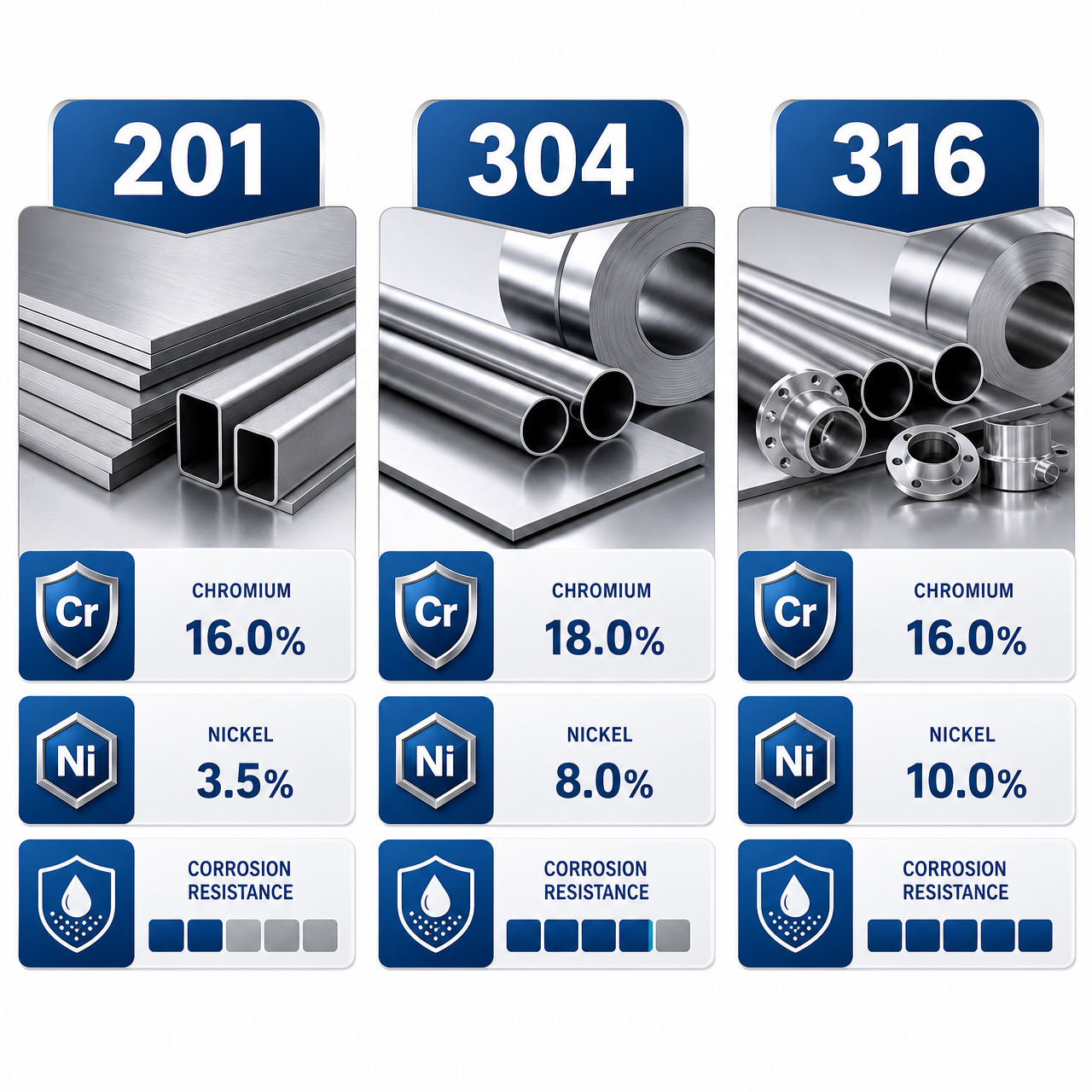
Stainless steel gets its corrosion resistance from chromium. When chromium content exceeds roughly 10.5%, it forms a passive oxide layer on the surface that blocks rust. The grade number tells you the specific alloy composition:
| Grade | Chromium | Nickel | Common Use | Food Safe? |
|---|---|---|---|---|
| 201 | 16–18% | 3.5–5.5% | Budget trays, decorative | Yes, but corrodes faster |
| 304 | 18–20% | 8–10.5% | Standard catering trays | Yes — industry standard |
| 316 | 16–18% | 10–14% | Coastal/marine, hospitals | Yes — best corrosion resistance |
The practical difference: A 304-grade tray used in a commercial dishwasher with industrial chlorine-based detergent will hold up for years. A 201-grade tray in the same environment typically shows rust spots within 6–18 months. The nickel content is the key variable — nickel stabilizes the austenite structure and increases resistance to chloride attack (exactly what dishwasher chemicals contain).
For most hotel, restaurant, and catering applications, 304 is the correct spec. For coastal operations, high-chloride environments, or hospital food service where stronger cleaning agents are used, 316 is worth the premium.
How to verify grade without an XRF gun: Ask suppliers for the material test report (MTR) or mill certificate. Legitimate factories will provide this. It shows the exact alloy composition from the steel mill. If a supplier refuses or provides a certificate that lists no chemical composition data, treat that as a red flag.
Gastronorm Sizing: The Standard Everyone Uses But Few Buyers Know
One of the biggest sourcing headaches in catering equipment is sizing confusion. Suppliers use different dimension names, and “1/1 size” from one factory might differ slightly from another.
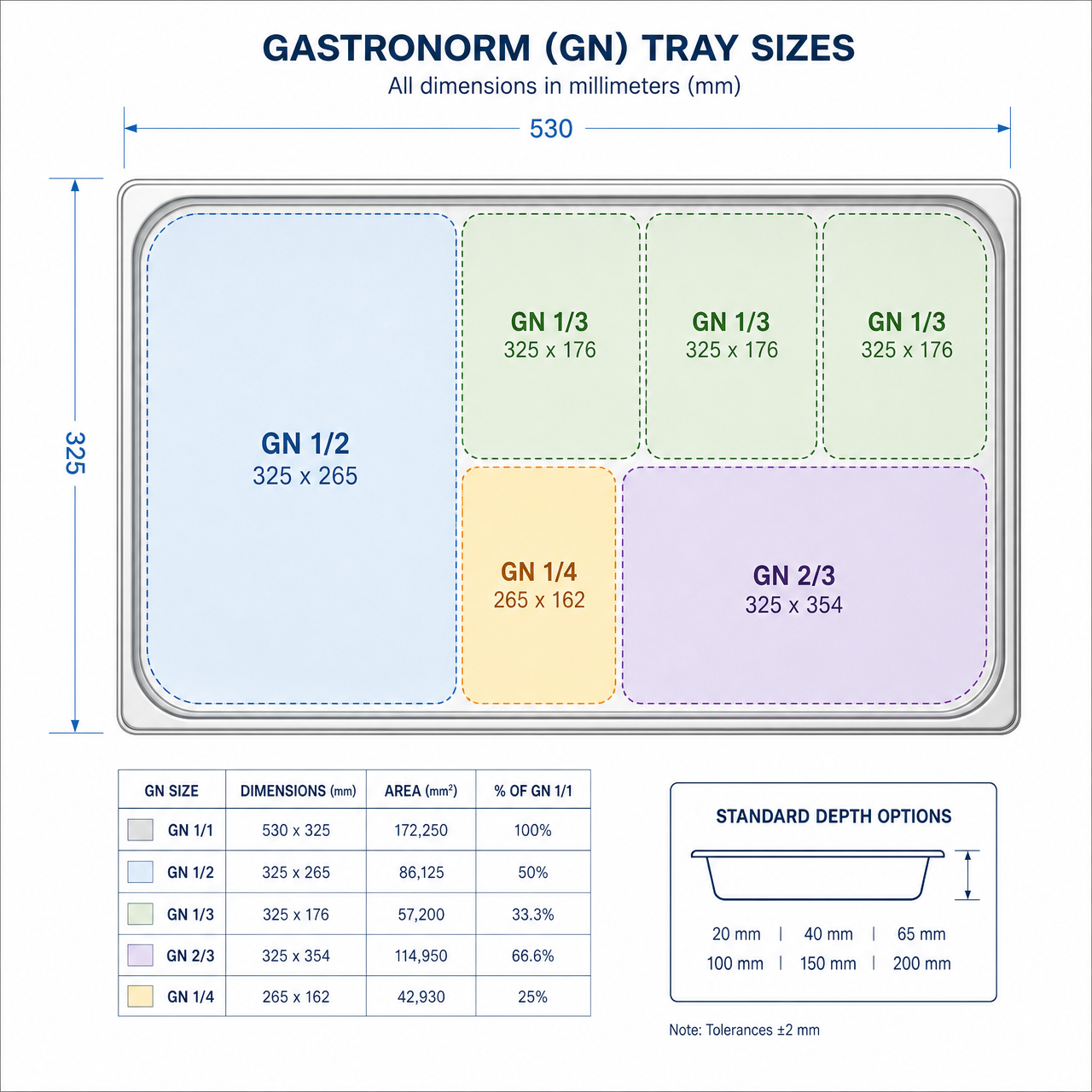
The international standard is Gastronorm (GN), defined by EN 631-1. Every serious catering supplier in Europe, Asia, and the Middle East sources to these dimensions:
| GN Size | External Dimensions (mm) | Typical Use |
|---|---|---|
| GN 1/1 | 530 × 325 mm | Full buffet trays, hotel chafers |
| GN 1/2 | 325 × 265 mm | Half-size serving trays |
| GN 1/3 | 325 × 176 mm | Sauce/condiment trays |
| GN 2/3 | 354 × 325 mm | Bread, pastry display |
| GN 1/4 | 265 × 162 mm | Small portion trays |
Depth options: 20mm (flat), 40mm, 65mm, 100mm, 150mm, 200mm.
When specifying your order, always use GN notation with the depth. “GN 1/1-65” means a full-size tray 65mm deep — universally understood by any qualified factory. This eliminates sizing ambiguity and ensures compatibility with existing bain-marie and chafing equipment.
For room service or carrying trays (non-GN applications), specify exact outer dimensions, rim height, and whether a raised edge or no-slip surface is required.
Certifications: What You Actually Need by Market
This is where most buyers waste time — trying to get every certification, or getting the wrong one.
Food contact certifications confirm that the material doesn’t leach harmful substances into food under normal use conditions. For stainless steel, the base material is inherently low-risk; certification mainly applies to surface treatments, coatings, and any non-metal components (handles, gaskets).
| Market | Required Certification | Notes |
|---|---|---|
| United States | FDA 21 CFR 182.70 / NSF/ANSI 2 | 182.70 covers GRAS metals; NSF 2 covers food equipment; most reputable factories already comply |
| European Union | EC 1935/2004 | General framework for food contact materials; no EU-harmonized metal-specific regulation |
| Germany | LFGB (BfR recommendation) | More rigorous than base EU — required for German retail/food service |
| China | GB 4806.9-2023 | Mandatory for domestic sale; increasingly required for Chinese hotel chains |
| Middle East / GCC | GSO 2231 | General GCC food contact framework |
Practical guidance: For export to the US, request the supplier’s FDA compliance declaration. For EU, ask for EC 1935/2004 conformity declaration. For Germany specifically, ask for LFGB test report. These are documents — not physical stamps on the product.
For bare 304 stainless steel trays with no coating or special treatment, FDA and EC compliance is straightforward and most established factories have these on file. Where certification gets complicated is with mirror-polished finishes (if a chemical polish is used) or powder-coated accessories.
MOQ and Pricing: Real Benchmarks for Negotiation

Most articles skip this entirely. Here’s what to expect when sourcing directly from Chinese manufacturers (FOB Guangzhou/Ningbo, 2025–2026 market):
| Grade | Product Type | MOQ | Price Range (USD/pc) |
|---|---|---|---|
| 201 SS | Basic serving tray, standard finish | 200–500 pcs | $1.20–$2.80 |
| 304 SS | GN 1/1 catering tray, satin finish | 100–300 pcs | $3.50–$7.00 |
| 304 SS | Hotel room service tray with handles | 100–200 pcs | $6.00–$12.00 |
| 316 SS | Heavy-duty serving tray | 100 pcs | $9.00–$18.00 |
| 304 SS | Custom logo/laser engraving | +50–200 pcs minimum | Add $0.50–$1.50/pc |
These are factory-direct FOB prices. Add freight, insurance, duties, and a domestic distributor margin (typically 30–50%) for landed cost estimates.
Negotiation leverage points:
- Committing to 500+ pcs on a first order significantly reduces unit price
- Requesting sea freight sample shipment (5–20 pcs) before bulk order — most factories accommodate this for established buyers
- Asking for the same mold/tooling to be amortized across multiple SKUs reduces setup costs
For sea freight cost reference: a 20ft container holds roughly 3,000–5,000 stainless steel trays depending on stacking and dimensions. Ocean freight from China to US West Coast runs approximately $2,500–$5,000 per 20ft FCL in 2025–2026 market conditions. Per-unit freight cost on a full container typically drops to $0.50–$1.50/pc, still making bulk orders significantly more cost-effective than air freight.
What a Real Supplier Vetting Process Looks Like

After working through multiple sourcing cycles, the evaluation criteria that actually matter narrow down to five checkpoints:
1. Mill certificate (MTR) availability. Request it on first contact. A factory that can’t produce a material test report from their steel supplier is either using uncertified materials or hiding grade substitution. This is non-negotiable.
2. Weld quality. For trays with welded handles or welded corner reinforcements, ask for close-up photos of weld seams. Clean, continuous welds that are properly ground and polished indicate quality control. Porous or rough welds fail in commercial dishwashers within months.
3. Passivation treatment. After manufacturing, stainless steel should be passivated — typically with citric acid or nitric acid bath — to restore the passive chromium oxide layer disrupted during cutting and welding. Ask if they passivate. Factories that do will say so readily. This single step dramatically extends tray lifespan.
4. Factory audit or third-party inspection. For first orders over 500 pcs, a pre-shipment inspection is worth every dollar. Budget inspection providers start around $200–$350, while established firms like SGS or Bureau Veritas typically run $350–$600+ per man-day. They check dimensions, surface finish, material compliance, and packaging.
5. Dishwasher durability test data. The best suppliers run their trays through commercial dishwasher cycles (typically 100+ cycles at 74–82°C sanitizing rinse temperature with commercial detergent) and can show results. If they don’t have this data, request a sample and run your own before committing to bulk.
Surface Finishes and Their Trade-offs


The finish affects both appearance and maintenance requirements:
- #4 Satin (brushed): Most common for commercial catering. Hides scratches well, easy to maintain. This is the default for hotel and restaurant trays.
- Mirror (#8 polished): High-end presentation trays, hotel room service. Scratches show more; requires more careful handling.
- Sandblasted/matte: Growing popularity in boutique hospitality. Hides fingerprints best. Slightly harder to clean.
- Embossed/textured: No-slip surface for carrying trays. Functional choice for cafeteria and airline catering.
For back-of-house and buffet use, #4 satin is almost always the right choice. Mirror finish is a front-of-house choice where visual presentation justifies the higher maintenance.
Why Cheap Trays Rust (And How to Avoid It)
The rust question comes up consistently in catering forums. It almost always traces to one of three causes:
Grade substitution. The tray was sold as 304 but manufactured with 201 or even lower-grade steel. 201 has significantly less nickel (3.5–5.5% vs 8–10.5% in 304), which reduces resistance to chloride attack from cleaning chemicals. Request MTR to eliminate this risk.
Poor passivation. Even genuine 304 steel, if cut and welded without proper passivation, will rust at the machined surfaces. The cutting and welding process disrupts the passive layer, and without re-passivation, those spots are vulnerable.
Cross-contamination with carbon steel. When stainless steel trays are stored against carbon steel shelving or transported with carbon steel equipment, iron particles transfer to the stainless surface and rust there. This creates rust spots that look like material failure but are actually surface contamination. Cleaning with oxalic acid removes them.
Understanding these causes makes it easy to evaluate supplier quality claims: ask specifically about passivation process and storage practices.
The Bottom Line on Bulk Stainless Tray Sourcing
The difference between a good wholesale sourcing outcome and a frustrating one almost always comes down to spec clarity. Buyers who specify “GN 1/1, 304 grade, #4 satin, passivated, with MTR” get consistent results. Buyers who say “send me your best stainless tray at the lowest price” get whatever margin the factory needs to protect.
Minimum viable spec for a wholesale order:
- GN size designation (or exact dimensions in mm)
- Grade: 304 minimum (316 if coastal/high-chloride environment)
- Surface finish: #4 satin for commercial use
- Request MTR / mill certificate
- Specify passivation treatment required
- Certifications: FDA or EC 1935/2004 depending on market
At 304 grade with proper sourcing, a commercial stainless tray should last 8–12 years in normal restaurant or hotel use before showing any meaningful wear. The upfront unit cost difference between 201 and 304 — roughly $1–3 per piece — is recovered in the first replacement cycle you avoid.
FAQ
What is the minimum order quantity for stainless steel trays wholesale? Most Chinese factories set MOQ at 100–500 pieces per SKU for standard sizes. For custom dimensions or engraving, MOQ is typically higher (200–500 pcs). Some distributors offer mixed-SKU minimums of 200–300 pcs total.
Is 201 stainless steel food safe? 201 stainless steel is food-safe in terms of material composition — it does not leach harmful substances under normal food contact conditions. The issue is corrosion resistance: 201 corrodes faster than 304 in commercial dishwasher environments, leading to surface rust that can contaminate food. For commercial kitchens, 304 is strongly preferred.
What certifications do I need for stainless steel trays exported to Europe? For EU food contact materials, EC 1935/2004 conformity declaration is required. For German retail or food service specifically, LFGB test certification is the standard buyers expect. A reputable supplier will have both on file.
How do I verify a supplier is using real 304 stainless steel? Request the mill certificate (MTR) showing the chemical composition from the steel mill. The report should show chromium content of 18–20% and nickel content of 8–10.5% for genuine 304. You can also commission XRF (X-ray fluorescence) testing on samples — SGS and Bureau Veritas both offer this service.
What is Gastronorm (GN) standard for catering trays? Gastronorm is the European standard (EN 631-1) for food service container sizes. GN 1/1 is the full size (530 × 325 mm), with fractions (1/2, 1/3, 1/4, 2/3) and depths (20–200mm) defining sub-sizes. Using GN notation in your purchase spec eliminates sizing ambiguity between suppliers.