


Sourcing stainless steel whisks wholesale requires more than finding the lowest price per unit. Commercial buyers need to evaluate wire gauge, stainless steel grade (18/8 vs 18/10), wire count, handle construction, and certification compliance before placing a bulk order. This guide covers every spec that matters when buying wire whisks for restaurant chains, hotel kitchens, or distribution — and explains how to find a factory-direct manufacturer like CharmsCook that can deliver on quality, MOQ flexibility, and custom branding.
The Hidden Cost of Getting Your Wire Whisk Wholesale Order Wrong
A wire whisk is not a high-stakes purchase. Until your kitchen crew starts complaining that wires snap off mid-service, handles rust after three weeks, or your 200-piece batch arrives with inconsistent balloon shapes that don’t perform the same way.
Wholesale whisk orders that go sideways usually share the same root cause: the buyer chose on price alone and didn’t spec the product. A $1.20 whisk from an unvetted source and a $1.80 whisk from a certified factory can look identical in a product photo. The difference shows up in the kitchen over the following six months.
The commercial kitchen standard for stainless steel whisks is stricter than retail. High-volume use — think 200 covers a night — demands wire whisks that maintain their spring tension, resist corrosion from acidic and alkaline ingredients, and survive commercial dishwasher cycles at 180°F. Sourcing right the first time is cheaper than replacing a flawed batch.
Types of Wire Whisks Used in Commercial Kitchens
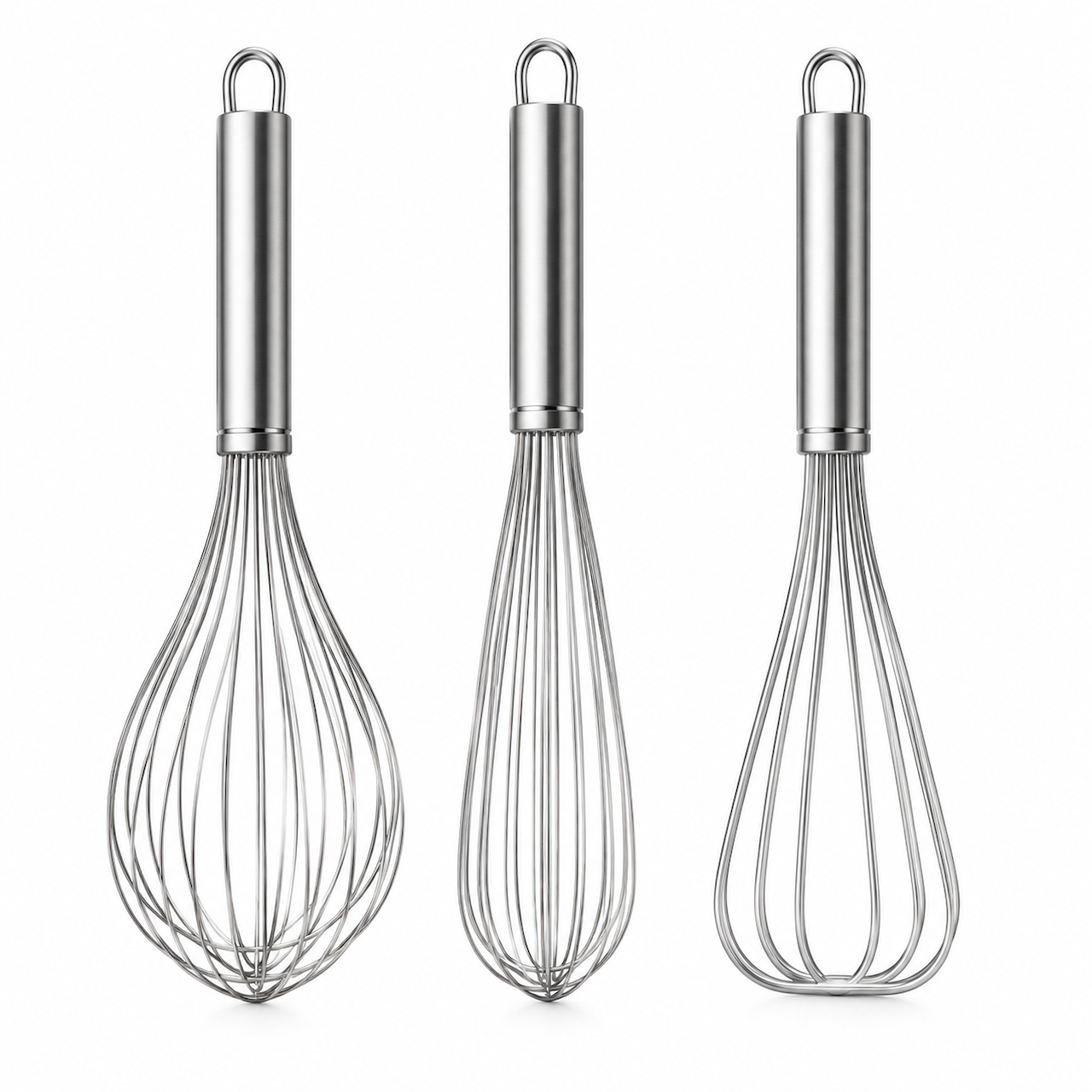
Most commercial kitchens run with two or three whisk types. Understanding which is which matters when you’re placing a purchase order across multiple SKUs.
Balloon Whisk (also called Piano Whisk)
The most common commercial kitchen whisk. Round, bulbous end with multiple looped wires — anywhere from 8 to 14 wires depending on size. Best for incorporating air into egg whites, cream, and light batters. The wider shape allows rapid aeration in a bowl. “Piano whisk” and “balloon whisk” describe the same design; the naming inconsistency trips up buyers on first orders.
French Whisk (also called French Whip)
Narrower and more elongated than a balloon whisk. Fewer wires, heavier gauge. Designed for heavy sauces, roux, and custards where you need control at the bottom of a saucepan rather than volume aeration. Common in saucier stations and hotel banquet production.
Flat Whisk (Sauce Whisk)
A flat, looped wire design that stays close to the pan surface. Used for deglazing, making gravy, and finishing sauces in wide pans. Less common in wholesale volume orders but increasingly popular in hotel banquet operations.
| Type | Wire Count | Wire Shape | Best For | Commercial Use Frequency |
|---|---|---|---|---|
| Balloon / Piano | 8–14 wires | Round bulb | Eggs, cream, batters | Very high |
| French Whip | 6–10 wires | Elongated oval | Sauces, roux, custards | High |
| Flat / Sauce | 4–6 wires | Flat loop | Pan sauces, gravies | Medium |
When placing a wholesale order for a restaurant group or hotel chain, a practical starting configuration is: 70% balloon whisks across multiple sizes (10″, 12″), 30% French whisks for sauce stations.
What “Commercial Grade” Actually Means — Specs That Matter
Walk into any commercial kitchen supply distributor and you’ll see “commercial grade” on every label. Here’s what to actually look for when evaluating a wire whisk wholesale listing.
Stainless Steel Grade: 18/8 vs 18/10
Both are food-grade austenitic stainless steels within the 304 family — the numbers describe chromium and nickel content, not different alloy grades. 18/8 contains 18% chromium and 8% nickel. 18/10 contains 18% chromium and 10% nickel. Neither is 316 stainless (which adds molybdenum for marine-grade corrosion resistance). The difference between 18/8 and 18/10 in a kitchen context is marginal.
For commercial kitchen whisks, 18/8 (304 grade) is the correct specification — it provides full food safety compliance, corrosion resistance adequate for kitchen chemicals and dishwashers, and lower cost at wholesale volumes. 18/10 is standard for flatware and fine dining cutlery; it’s not a meaningful upgrade for a wire whisk.
Require suppliers to provide material certifications (mill test reports) confirming 304-grade stainless. Any factory that cannot provide this on request is not a manufacturer — they’re a trading company reselling unmarked stock.
Wire Gauge
Wire gauge refers to the thickness of each individual wire loop. For commercial balloon whisks, 2.0–2.5 mm wire diameter is the commercial standard. Thinner wires (under 1.8 mm) flex too easily under heavy batter loads and fatigue faster. Thicker wires (above 2.8 mm) reduce aeration performance.
Wire Count
More wires mean faster aeration and a smoother result in thin liquids. Commercial balloon whisks at 12″ should have a minimum of 10–12 wires. A whisk with 8 wires at that size is a retail-grade tool. Ask your supplier for wire count by SKU before ordering.
Handle Construction
Three common handle types appear in wholesale catalogs:
- Sealed stainless handle — Single-piece or welded stainless tube, no seams. Best for NSF/commercial use; no crevice for bacteria.
- Silicone-grip stainless handle — Stainless core with silicone overmold. Popular in retail; adds grip but creates potential hygiene crevices unless sealed correctly.
- Hollow riveted handle — Common in budget-tier wholesale. The rivets can loosen under heavy use, and the hollow interior traps water.
For NSF-compliant commercial kitchens, sealed stainless handles are the correct spec.
Certifications to Require
| Certification | Market | What It Covers |
|---|---|---|
| FDA 21 CFR | USA | Food contact materials |
| LFGB §30/31 | EU/Germany | Migration testing for stainless |
| NSF/ANSI 2 | USA | Commercial foodservice equipment |
| REACH | EU | Chemical substance compliance |
Request test reports — not just certification logos — from any factory before placing a bulk order.
How to Source Wire Whisks Wholesale: Factory vs Distributor

The SERP for “wire whisk wholesale” is dominated by US restaurant supply distributors — WebstaurantStore, Katom, Central Restaurant, Rapids Wholesale. These are legitimate purchasing channels for small-volume operators, but they are not wholesale manufacturers. You’re buying their inventory at their margin.
Factory-direct sourcing starts at a different price point and unlocks options distributors can’t offer:
- Lower per-unit cost — 30–50% below distributor pricing at comparable MOQ
- Custom dimensions — specific handle lengths, wire counts, or balloon diameters for your specs
- Private label / OEM — your logo, your packaging, your brand
- Certificate customization — test reports issued to your entity for import compliance
Typical factory-direct MOQ for wire whisks: 500–1,000 pcs per SKU for standard items; 1,000–2,000 pcs for custom/OEM orders. Some manufacturers like CharmsCook offer flexible MOQ for buyers trialing multiple SKUs.
Lead time: 30–45 days for standard production; 45–60 days for custom OEM with packaging.
When evaluating a wholesale manufacturer, ask for:
- Factory audit reports or ISO 9001 certification
- Material test reports (stainless grade certificates)
- Third-party food-contact safety test reports (FDA/LFGB)
- Photos of production facility and QC process
- Sample order policy before full production commitment
Any factory willing to skip these steps is a risk you don’t need.
Wholesale Pricing Breakdown: What to Expect Per Unit
Retail pricing for wire whisks in the US runs $6.49–$28 per piece depending on size and brand. Wholesale case pricing (case of 24) from distributors typically lands at $2.50–$4.50 per piece.
Factory-direct pricing varies by size, specification, and volume:
| Size | Wire Count | Steel Grade | Factory-Direct Unit Cost (FOB) | MOQ |
|---|---|---|---|---|
| 8″ balloon | 10 wires | 18/8 | $0.85–$1.20 | 1,000 pcs |
| 10″ balloon | 12 wires | 18/8 | $1.10–$1.50 | 1,000 pcs |
| 12″ balloon | 12 wires | 18/8 | $1.40–$1.90 | 500 pcs |
| 14″ French whip | 10 wires | 18/8 | $1.60–$2.20 | 500 pcs |
| 12″ + silicone grip | 12 wires | 18/8 | $1.80–$2.50 | 500 pcs |
These figures reflect standard 304-grade stainless steel with sealed handles and no custom branding. OEM packaging and logo add $0.10–$0.30 per piece depending on print method and packaging spec.
The margin math for distributors and resellers is clear: at $1.50 FOB factory and $8–12 retail or distribution price, wire whisks carry healthy wholesale-to-retail margins that reward buyers who source direct.
CharmsCook: Factory-Direct Stainless Steel Whisk Wholesale
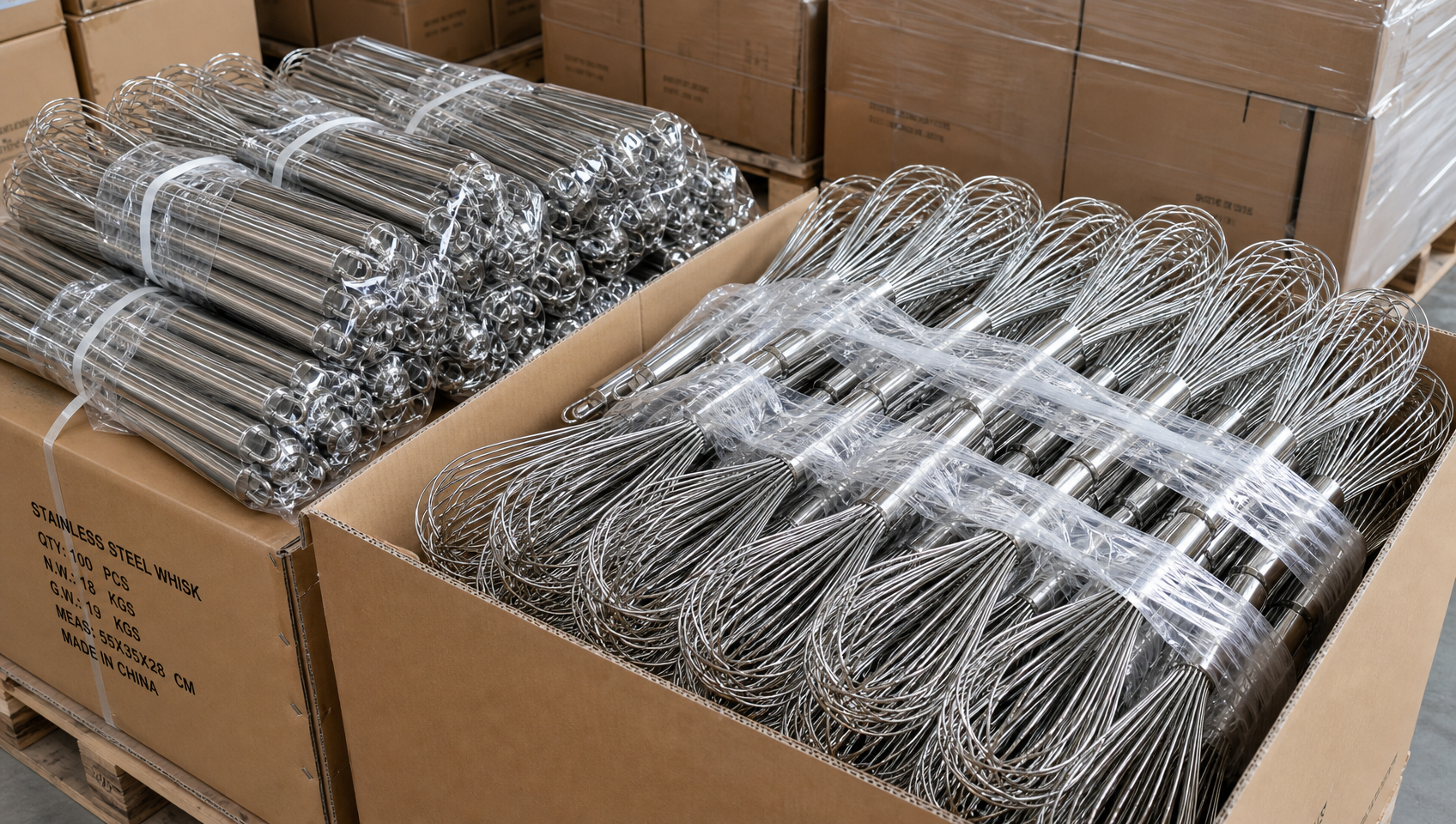
CharmsCook is a stainless steel kitchenware manufacturer specializing in wholesale supply for commercial kitchens, hotel groups, food service distributors, and international importers.
Their product range covers wire whisks, cookware sets, food storage solutions, steamers, saucepans, and pressure cookware — all manufactured in 18/8 stainless steel with food-grade compliance as the baseline, not an upgrade option.
Why buyers work with CharmsCook for whisk wholesale:
- OEM/ODM capability — custom dimensions, wire count, handle finish, and packaging for private label programs
- Material transparency — 304-grade stainless with mill test reports available
- Certifications — FDA, LFGB, and REACH test reports for US and EU market entry
- Multi-SKU orders — combine whisks with cookware, storage, and other kitchenware in a single factory order, reducing freight complexity
- Flexible MOQ — practical minimum order quantities for buyers building a product line
For commercial kitchen operators, hotel procurement teams, or kitchenware distributors looking for a reliable factory partner, CharmsCook is worth a direct inquiry — especially if you need branded product or are consolidating multiple kitchenware categories into one supplier relationship.
Frequently Asked Questions
What stainless steel grade should commercial wire whisks be?
18/8 stainless steel (304 grade) is the correct specification for commercial kitchen wire whisks. It provides full food-contact safety, corrosion resistance in dishwasher and kitchen chemical environments, and lower cost than 18/10 at wholesale volumes.
What is the difference between a balloon whisk and a French whisk?
A balloon whisk (also called a piano whisk) has a round, bulbous shape optimized for aeration — ideal for eggs, cream, and batters. A French whisk is narrower and longer with fewer, heavier-gauge wires, designed for working heavy sauces and roux at the bottom of a saucepan.
What wire gauge is standard for commercial whisks?
Commercial-grade balloon whisks use 2.0–2.5 mm wire diameter. Retail-grade whisks often use thinner wire (1.6–1.8 mm) that fatigues faster under high-volume use.
What MOQ should I expect when buying wire whisks factory-direct?
Standard MOQs from stainless steel kitchenware manufacturers run 500–1,000 pieces per SKU for catalog items. Custom OEM orders typically require 1,000–2,000 pieces minimum. Some manufacturers offer lower MOQs for multi-SKU buyers to facilitate product line trials.
Can I order wire whisks with my brand / private label?
Yes. OEM and ODM service is standard among stainless kitchenware manufacturers in China. This typically includes your logo on the handle, custom retail packaging, and test reports issued to your company name for import compliance. Add $0.10–$0.30 per piece to the base FOB cost.
What certifications should I require for US and EU food service markets?
For US: FDA 21 CFR (food contact materials) and NSF/ANSI 2 (commercial foodservice). For EU: LFGB §30/31 (migration testing) and REACH compliance. Request third-party test reports — not self-declarations.
Spec Right, Source Direct, and Stop Replacing What Should Last
Wire whisks are consumables in a commercial kitchen — until they’re not. When you spec correctly (18/8 stainless, 2.0–2.5 mm wire, sealed handle, proper wire count) and source from a verified manufacturer, a wholesale batch of wire whisks should survive years of daily commercial use without wire breakage, handle corrosion, or NSF compliance concerns.
The price gap between distributor pricing and factory-direct is wide enough to matter at volume. For restaurant groups, hotel chains, and distributors building a kitchenware catalog, going direct to a manufacturer like CharmsCook is where the real wholesale economics start.





